Securing Data Using Role Based Access Control for
Data Centric Approach
Shila Ravte 1, Prof. Priti Subramanium2
1M.E. Student, Dept. of Computer Science and Engineering, SSGBCOET, Bhusawal, Maharashtra, India 2 Assistant Professor, Computer Science and Engineering, SSGBCOET, Bhusawal, Maharashtra, India
Abstract: Currently all security arrangements are based on perimeter security. However, Use of cloud computing breaks the
organization borders. When organisational data stored on the Cloud, indirectly data reside outside the organizational boundaries. This may cause users to lost control over their data and raises security problems that slow down the efficiency of Cloud computing. Data-centric access control approach with role-based expressiveness in which security is concentrated on protecting user data regardless the Cloud service provider who is responsible to store and manage data. Identity-based and proxy re-encryption techniques are used to Secure the authorization model. Data is in encrypted form and authorization rules are cryptographically protected to stored user data against the service provider access or misused. The authorization model provides very high expressiveness for datas with role hierarchies and resource hierarchical support. The solution takes advantage of the logic formalism provided by Semantic Web technologies, which make possible advanced rule management like semantic conflict detection. Real-time implementation has been developed and a working prototypical deployment of the proposal has been integrated within Google services.
Keywords: RBAC, Data centric, Access Control , Identity-Based Proxy Re-encryption, Data-Centric Security
I. INTRODUCTION
Security is one of the main issue user consider while using Cloud Computing. Moving data to cloud usually user is dependent on Cloud service provider (CSP) for data protection. Whereas this management is based on legal or Service Level Agreements (SLA), in this situation CSP may potentially access the data or he can provide it to third parties. So user should trust the CSP to apply the access control protocol specified by the data owner for different users. The main problem arises in Inter-cloud scenarios where data exchange from one CSP to another CSP. Sometimes users may loss control on their data. Even the trust on the united CSPs is out of the control of the data owner. This situation leads to think about data security approaches again and to move to a data-centric approach so that we can ensure that data are self-protected whenever they reside. Encryption is the most commonly used method to provide security to data in the Cloud. Encrypting data avoids unauthorized accesses. However, it requires new issues related to access control management. A rule-based strategy would be suitable to provide expressiveness. But this big challenge for a data-centric approach as data has no computation capabilities by itself. It is not able to determine or compute any access control rule policy. This raises the problem of policy decision for a self-protected data package: who should examine the rules upon an access request? The first choice would be to have them calculated by the CSP, but it may bypass the rules. Another option would be to have rules determined by the data owner, but this entail that either data could not be shared or the owner should be online to make a decision for each access request. To overcome this issues, several proposals try to provide data-centric solutions based on Attribute-based Encryption (ABE). This is Attribute-based on Attribute-Attribute-based Access Control (ABAC), in which accesses are granted to users according to set of attributes. But there is no data-centric approach providing an RBAC approach for access control in which data is encrypted and self-protected. The proposal in this paper considers a first solution for a data-centric RBAC model, offering an alternative solution to the ABAC model. An RBAC approach would be closer to current access control strategies, resulting more natural to apply for access control effectiveness than ABE-based mechanisms. This paper presents a data-centric access control strategy to self-protect data that can work in utrusted CSPs and provides extended Role-Based Access Control. The proposed authorization solution provides a rule-based model by using the RBAC scheme, where roles are used to simplify the management of access to the resources. This approach can help to control and manage
II. LITERATURE REVIEW
data owner premises. However, in this strategy the CSP becomes a mere storage system and the data owner should be online to response access requests from users. Another strategy from [14] deals with this problem by using a plug approach in the CSP that allows data owners to prepare their own security modules. This permits to control the authorization model used within a CSP. However, it does not assure that how the authorization model should be secured, so the CSP could know information and access the data. Moreover, this strategy does not cover Inter-cloud scenarios, since the plug-in module should be delivered to different CSPs. Additionally, these strategies do not protect data with encryption methods. In the proposed data encryption is used to prevent the CSP to access the data or to release it bypassing the authorization strategies. However, applying data encryption entails additional challenges related to authorization expressiveness. Following a direct approach, one can include data in a package encrypted for the authorized users. This is done while sending a file or document to a specific receiver and assures that only the receiver with the appropriate key is able to decrypt it. From an authorization point of view, this can be seen as a simple rule where only the authorized user to access the data will be able to decrypt it (i.e. the one owning the key). However, no access control expressiveness is delivered by this approach. Only that simple rule can be emphasized and just one single rule can apply to each data package. Thus, multiple encrypted copies should be created in order to deploy the same data to different receivers. To cope with these issues, a centric approach that is able to cryptographically secure the data while providing access control capabilities. Number of data-centric approaches are developed, mostly based on Attribute-based Encryption (ABE) [5], have developed for data protection in the Cloud [4].
In ABE, encrypted cipher-text is labelled with a set of attributes defined by the data owner. Users also have a set of attributes with their private keys. They would be able to access data (i.e. decrypt it) or not depending on the match between cipher-text and key attributes. User required attribute to decrypt the data specified by an access structure, which is defined as a tree with AND, OR nodes. There are two main strategies for ABE depending on where the access structure resides: Key-Policy ABE (KP-ABE) [5] and Cipher-text-Policy ABE (CP-ABE) [3]. In Key Policy-ABE the access structure or policy is defined within the private keys of users. This allows encrypting data with attributes as labelled and then controlling the access to such data by delivering the appropriate keys to users. However, in this case the policy is defined by the key issuer not by encryptor of data, i.e. the data owner. So, the data owner should trust the key issue for this to properly generate an appropriate access policy. To overcome this issue, CP-ABE specifies including the access structure within the cipher-text, which is under control of the data owner. Then, the key issuer just affirm the attributes of users by including them in private keys.. Different proposals have been also developed to try to alleviate ABE expressiveness prescription. Authors in [15] propose a solution depend on CP-ABE allows sets of attributes called Cipher-text Policy Attribute Set Based Encryption (CP-ASBE). Attributes are arranged in a recursive set structure and access policies can be defined upon a single set or joining attributes from multiple sets. The definition of compound attributes and specification of policies that influence set of attributes. An strategy named Hierarchical Attribute-based Encryption is presented in [16]. It defines a hierarchical generation of keys to achieve subtle access control, scalability and delegation. However, this strategy implies that attributes should be managed by the same root domain authority. In [16], authors extend CP-ASBE with a hierarchical structure to users in order to improve scalability and flexibility. This approach provides a hierarchical solution for users within a domain, which is obtained by a hierarchical key structure. One more approach is Flexible and Efficient Access Control Scheme (FEACS) [2]. It is based on KP-ABE and provides an access control structure represented by a formula which include AND, OR and NOT, enabling more expressiveness for KP-ABE. ABE-based solutions developed for access control in Cloud computing are based on the Attribute-based Access Control (ABAC) model. ABAC and RBAC both models have their own advantages and disadvantages [7] [9]. Sometimes RBAC require the detailed specification of a large number of roles for authorization (role explosion problem in RBAC).
ABAC is also easier to set up without need to make an effort on role description as needed for RBAC. On another hand, ABAC may result in a huge number of rules since a system with n attributes would have up to 2n possible rule combinations (rule explosion
III.SYSTEM IMPLEMENTATION
A. System Architecture
Fig:1 System Architecture
Above figure shows Working of proposed system in which the application of these functions make use of the re-encryption scheme to lose the Multi-use feature, which is needed as described in this paper. That is, once a Re-encryption Key generated is used to re-encrypt, no further re-encryptions allowed to that encrypted object. However, for the purposes of authentication in this paper, this kind of re-encryption only required to be done to re-encrypt the protected object And this is executed in the last re-encryption, which is the one that results in the data being encrypted using the user public key. Thus, re-encryption of keys generated with by original function should be applied for encryptions with proper authorization path, without the affecting the user, which is the last re-encryption. With this strategy, the data owner uses the public key while defining rules in the authorization model. When user send a request, the data object is re-encrypted by public key of user. So that user can then decrypt the data by using the appropriate private key.
When data is going to stored on the cloud, Data owner automatically create a self-protected package This package contains: the encrypted data objects, the authorization rules and the corresponding re-encryption keys. Data objects are encrypted at the time of uploading them to the Cloud in order to prevent the CSP to access them. This step is executed by data owners by using the encrypt() function. Data must be encrypted using the identity of the object which is going to uploaded . A digital envelope approach can be used to secure data objects without applying direct encryption. This would extends crypto-graphic operations like re-encryptions for large number of data objects. This strategy consists in using a symmetric encryption algorithm (e.g. DES) to protect the data object at its own. The encryption of data is done by using a random symmetric key generated for the single encryption. Then, this key is encrypted using the encrypt() function. By using this procedure, big objects (e.g. large documents) are encrypted using symmetric cryptography, by using more efficient algorithms. Authorization rules are specified by the data owner and directly mapped into the authorization model. This is done by considering the corresponding elements in the binary relations.
B. Identity Based Proxy Re-encryption
could improve performance or security. It could be even a pure PRE scheme without combination with IBE, although that could imply the generation and management of extra key pairs. Moreover, some functionality provided by this solution might be lost, like compatibility with PKI, which is supported by IBPRE and avoids the usage of a PKG.
The following set of functions is provided by IBPRE. It constitutes the cryptographic primitives for the proposal:
Initializes the cryptographic scheme. It takes as input a security parameter to initialize the cryptographic scheme (e.g. parameters to generate an elliptic curve) and outputs both the Master Secret Key and a set of public parameters that is used as input for the rest of functions.
Generates Secret Keys. It takes as input the msk and an identity outputs the Secret Key corresponding to that identity. Encrypts data. It takes as input an identity and a plain text m; and outputs the encryption of m under the specified identity.
Generates Re-encryption Keys. It takes as input the source and target identities l as the Secret Key of the source identity and outputs the Re- encryption Key that enables to re-encrypt .
Re-encrypts data. It takes as input a cipher text under identity and a Re-encryption Key and outputs the re-encrypted cipher text under identity .
Decrypts data. It takes as input a cipher text and its corresponding Secret Key and outputs the plain text m .
C. RNS Algorithm
1) Key Generation Algorithm
Step 1: Start
Step 2: Generate two distinct prime number P1 & P2 Step 3: Let M = P1 * P2
Step 4: Let A1 = M / P1 Step 5: Let A2 = M / P2
Step 6: Solve the equation ((A1 * T) mod P1) == 1 and get the value of T Step 7: T1 = T
Step 8: Solve the equation ((A2 * T) mod P2) == 1 and get the value of T Step 9: T2 = T
Step 10: Form Encryption Key (P1,P2)
Step 11: Form Decryption Key (A1,A2,T1,T2,M) Step 12: Stop
2) Encryption Process
Step 1: Start
Step 2: Let F is the File Input and (P1,P2) is encryption key Step 3: Let N = Number of bytes in F
Step 4: Create a file EF to store encrypted data Step 5: Let I = 1
Step 6: Read the Ith byte (B) of F Step 7: Convert the B to ascii value V Step 8: Let R1 = V % P1
Step 9: Let R2 = V % P2 Step 10: Append (R1,R2) in EF Step 11: I = I + 1
Step 12: if I <= N Goto Step 6 Step 13: Close the File EF Step 14: Stop
3) Decryption Process:
Step 1: Start
Step 3: Let N = Number of Pair values in EF Step 4: Create a file F1 to store decrypted data Step 5: Let I = 1
Step 6: Read the Ith Pair value (R1,R2) from EF
Step 7: Let E = [(A1 * T1 * R1) + (A2 * T2 * R2)] mod M Step 8: Convert E to Byte Value E1
Step 10: Append E1 in F1 Step 11: I = I + 1
Step 12: if I <= N Goto Step 6 Step 13: Close the File F1 Step 14: Stop
D. DES Algorithm
The main parts of the algorithm are as follows:
1) Fractioning of the text into 64-bit (8 octet) blocks;
2) Initial permutation of blocks;
3) Breakdown of the blocks into two parts: left and right, named L and R;
4) Permutation and substitution steps repeated 16 times (called rounds);
[image:6.612.50.564.272.620.2]Re-joining of the left and right parts then inverse initial permutation
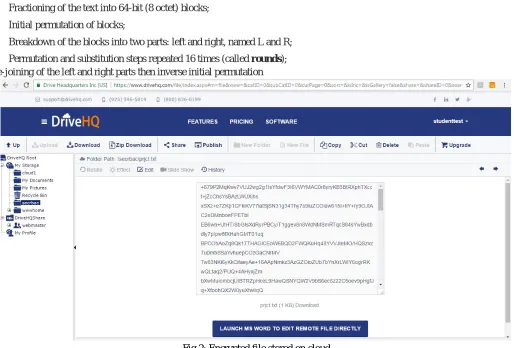
Fig 2: Encrypted file stored on cloud
IV.EXPERIMENTAL RESULTS
corresponding to MD5 algorithm
An analysis has been carried out based on this implementation to test the feasibility of the proposal in terms of performance. Tests have been done with an Intel i3 CPU at 2.53 GHz and 3 GB of RAM. A first set of tests consisted on measuring execution times for the cryptographic functions. These have been done by varying different parameters in order to observe how these affect the execution times. Concretely, the following variations have been done: (1) number of re-encryptions, (2) length of identities and (3) length of encrypted data. Then, another set of tests have been done to measure the time needed to evaluate the authorization model. In order to obtain statistics significant results, operations have been performed in sets of 100 executions, whose average is used as result value. Each execution performs the following steps. First, the setup() function is executed to initialize the cryptographic scheme. Then a piece of data m is encrypted under a randomly generated identity id1 with the encrypt() function to obtain a cipher-text. The corresponding Secret Key sk1 is generated with the keygen() function. These three last steps are repeated several times, resulting in a cipher-text under identity idn after n re-encryptions. Finally, the decrypt() function is used to decrypt and obtain the
plain data m. The length of the plain data m, the length of identities and the number of re-encryptions may vary depending on the test.
encrypt(), 48 ms for rkgen(), 6 ms for reencrypt() and 247 ms for decrypt() with 10 re-encryptions. Another set of tests has been also performed to measure the time needed by the AuthzService to take authorization decisions. The authorization model has been represented based on Semantic Web technologies . Times changing the length of encrypted data. Decision times are related to the number of authorization elements defined within the model, i.e. number of roles, users, grants, objects, etc. These elements are represented in what is called a Knowledge Base (KB), which is used by the reasoner implementing the Evaluator to evaluate the authorization query. The elements contained in the KB are called individuals and the set of individuals for a specific execution is referred to as population. In order to study the scalability of the proposal, 6 executions have been done using incremental populations. Access denied decisions would result in shorter times since the authorization chain does not need to be computed..Authorization decision times As can be observed, the query times are incremented as the population grows, while times for building the authorization chain and retrieving re-encryption keys remain con This is because the query need to analyze the ontology in order to check the conditions. The more individuals in the ontology, the more data should be analyzed by the reasoner during the query evaluation. However, computing the authorization chain from a given answer is independent of the ontology. So is the retrieval of re-encryption keys. Thus, times remain constant for these two, independently of the number of individuals. Finally, it should be noted that times for authorization decisions remain below 13 ms for populations of more than 6000 authorization elements, which is a reasonable decision time.
V. CONCLUSIONS
A data-centric authorization solution has been introduced to provide security to data stored on Cloud. Secure RBAC allow to manage authorization which follow rule-based approach and provides high -leveled role-based expressiveness including object and role hierarchies. Access control computations are delegated to the CSP, being this not only unable to data the access, but also not able to release it to unauthorized parties. Advanced cryptographic strategies have been applied to provide security to the authorization model. A re-encryption key complement each authorization rule as cryptographic token to provide security to data against CSP misbehavior. A concrete IBPRE technique has been used in order to provide a comprehensive and feasible option with Public Key Cryptography that enables the usage of standard PKI for key distribution and management. Future lines of research include the detailed study of novel cryptographic techniques that could enable the modification and deletion of data on the Cloud. This would allow to expand the privileges of the authorization model with more actions like delete and modify. One more interesting point is the obscure of the authorization model for privacy reasons. Although the usage of pseudonyms is introduces, but more advanced obfuscation techniques can be researched to achieve a higher level of security.
REFERENCES
[1] Cloud Security Alliance, “Security guidance for critical areas of focus in cloud computing v3.0,” CSA, Tech. Rep., 2003.
[2] Y. Zhang, J. Chen, R. Du, L. Deng, Y. Xiang, and Q. Zhou, “Feacs: A flexible and efficient access control scheme for cloud computing,” in Trust, Security and Privacy in Computing and Communications, 2014 IEEE 13th International Conference on, Sept 2014, pp. 310–319.
[3] B. Waters, “Cipher text-policy attribute-based encryption: An ex-pressive, efficient, and provably secure realization,” in Public Key Cryptography - PKC 2011, 2011, vol. 6571, pp. 53–70.
[4] B. B and V. P, “Extensive survey on usage of attribute based encryption in cloud,” Journal of Emerging Technologies in Web Intelligence, vol. 6, no. 3, 2014.
[5] V. Goyal, O. Pandey, A. Sahai, and B. Waters, “Attribute-based encryption for fine-grained access control of encrypted data,” in Proceedings of the 13th ACM Conference on Computer and Communi-cations Security, ser. CCS ’06, New York, NY, USA, 2006, pp. 89–98.
[6] Inter National Committee for Information Technology Standards, “INCITS 494-2012 - information technology - role based access control - policy enhanced,” INCITS, Standard, Jul. 2012.
[7] E. Coyne and T. R. Weil, “Abac and rbac: Scalable, flexible, and auditable access management,” IT Professional, vol. 15, no. 3, pp. 14–16, 2013. [8] Empower ID, “Best practices in enterprise authorization: The RBAC/ABAC hybrid approach,” Empower ID, White paper, 2013.