Reversible Architecture of Computer Arithmetic
Sayeeda Sultana
Department of Electrical and Computer Engineering
McGill University Montreal, Canada
Katarzyna Radecka
Department of Electrical and ComputerEngineering McGill University Montreal, Canada
ABSTRACT
Reversible logic plays an important role in emerging low power designs and quantum computing. This paper presents an efficient way to realize reversible arithmetic circuits especially targeting toward reversible arithmetic logic unit (RALU). In literature for reversible logic, not a significant advancement is found in integrating both logical and arithmetical functions, commonly known as arithmetic logic unit (ALU), a key feature of any computing system architecture. Here, this work presents a novel reversible arithmetic logic unit (ALU) performing basic functions similar to classical ALU such as addition, subtraction, AND, OR and XOR operations. Additional functions such as, NAND, NOR, XNOR and logical functions with single input inverted, overflow detection and comparison can also be performed with this design. The integration of these operations in single module using less number of control signals is not available in any of existing approaches. The design and analysis based on different parameters of reversible circuits – number of gates, garbage bits and quantum cost as well as simulation results are presented here. The proposed design offers efficient programmability and more flexibility than other methods.
General Terms
Arithmetic design and logic structures.
Keywords
Arithmetic logic unit, Reversible logic, Reversible controlled adder/subtractor, Quantum cost.
1.
INTRODUCTION
Recently, reversible circuit synthesis has started to emerge as an important topic, bringing alternative solutions to classical networks. The motivation behind reversible computation comes from its theoretical abilities to address burning issues of modern circuit designs such as power consumption and emerging new technologies. Namely, reversible circuits dissipate less energy, and are closely related to quantum circuits, which, in the near future, could become a competitor to current classical circuits. In 1961, Landauer showed that irreversible circuits regardless of the underlying technology always consume power, and consequently dissipate heat at the rate of at least kTln2 for each bit of information erase. In the above equation k is Boltzmann’s constant and T is the temperature [1]. Further, Bennett showed that, in principle, arbitrarily small or zero energy dissipation is only possible if no information is lost during computation [2]. This holds for reversible circuits as input and output data is processed without losing any of the original information. Further, as every quantum operation is inherently reversible, reversible circuits constitute a subclass of quantum circuits [3]. Thus, any development in this domain can be directly applied to future technologies. Finally, the use of reversible circuits is
already found in low power CMOS designs, adiabatic circuits [4, 5], cryptography [6], optical computing [7] and digital signal processing [8, 9] requiring that all the information encoded in the inputs be preserved in outputs.
A reversible function realizes a unique one-to-one mapping of inputs to outputs with equal number of bits. The irreversible nature of most of the original algorithms makes the synthesis of reversible circuits from irreversible specifications a challenging task. A large part of the existing algorithms, although optimized in garbage bits and gate counts, are restricted to small functions, while some approaches successfully address large functions but are costly in terms of gate count, additional lines and quantum cost [10-14]. A synthesis solution for large reversible circuits is presented in [15] by avoiding ancilla bits. A recent survey enlightened the key features, motivation and developments in the area of reversible logic synthesis [16].
In addition to the reversible realization of logical functions, a great deal of work has been done aiming to implement the basic reversible arithmetic units such as adders, subtractors and multipliers by finding a direct translation from classical truth table to reversible forms using basic standard reversible gates as well as dedicated newly proposed gates [17-24]. Apart from that we also see quantum/reversible circuits for arithmetic operations from addition to multiplication and modular exponentiation [25-28], playing an important role in quantum Shor’s algorithm.
Volume 93 – No 14, May 2014
ALU design is proposed in [33] which include many operations close to classical ALU design.
In this work, a new integrated module of a RALU is introduced, which encapsulates most of the operations in classical realization with less number of control lines. This module intends to perform the basic mathematical operations of addition, subtraction, as well as logic operations AND and OR. Further, an XOR function (not available in classical ALU), which is very useful in reversible circuits, is also included here. Finally, some negated logical functions such as NAND, NOR and XNOR including implication are realized in this design.
In this approach, the basic RALU operates on single-bit data, which is capable to realize various arithmetic functions, and can be cascaded into an n-bit design. Later the modifications are added to the RALU to detect overflow and to perform comparison (set-less-than) operation to detect whether a number is less than another number. Thus the proposed design includes more functions with less number of lines and acceptable quantum cost.
2.
BACKGROUND
Definition 1: An nxn reversible circuit realizes an n-input/n-output function where each input vector maps bijectively to an output vector. The reversible circuits allow no fan-outs and no feedback paths.
Hence, the iterative cascading preserving the rules listed in Def. 1 can be applied to building any reversible circuit using reversible gates. Reversible synthesis of irreversible specification aims on embedding an arbitrary (irreversible) function with I inputs and O outputs (generally IO) to a reversible implementation constructed solely from reversible gates. Often extra I/O signals must be added, where the extra A inputs are referred as ancilla bits, while the additional G outputs are garbage bits.
The cost of a reversible circuit is determined in terms of gate counts, number of garbage bits and overall quantum cost. In fact, the quantum cost plays an important role from the technological viewpoint.
Definition 2: A quantum cost of a reversible gate T is defined as a number of elementary quantum operations performed by NOT, CNOT and controlled V or V+ gates in order to realize this gate.
Many reversible gates have been proposed over the years such as basic NOT, CNOT, Toffoli [34], as well as Fredkin [35] and Peres [36]. Recently, some new reversible gates targeting specific implementations such as adder, subtractor, multiplier etc. have been introduced [17-24]. In this work basic reversible
gates such as CNOT, Peres and Fredkin gates are used for the construction of basic RALU design. A brief introduction of some standard reversible gates is presented below.
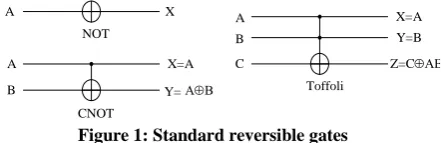
A CNOT gate shown in Fig.1 is a 2x2 gate with a single control input A, which inverts the second input B when its value is true. This gate is also known as a Feynman gate. A
multiple-control Toffoli gate has a single target line C that is inverted if all the control lines are set to 1, Fig.1. The quantum cost of 3x3 Toffoli gate is 5, Fig.2. A Toffoli gate implements a function Z= ABC with two control inputs A and B, which are copied at the outputs X and Y. That way, they can fan-out signals A and B to the rest of the circuit. Otherwise, if values of X and Y are not used at other places of the circuit, they are treated as garbage outputs.
A 3x3 Toffoli gate is universal since any reversible function can be realized by cascading this gate only. For example, AND, NOT, XOR can be obtained from Toffoli gate T (A,B,C):
AND
XOR
A multiple controlled 3x3 Fredkin gate [35], Fig.3, is a controlled swap gate with two target lines. This gate realizes the mapping of the inputs (A, B, C) to the outputs (X= A, Y= A’B+AC, Z= AB+A’C). Note, that the values of the target lines are interchanged if the control lines are set to 1. The quantum cost of this gate is 5 as assumed in [31].The Fredkin gate is an important part of many arithmetic circuit designs.
Another gate commonly used in reversible implementations, is the 3x3 Peres gate, Fig.4. This gate implements the mapping of
the inputs (A, B, C) to (X =A, Y= AB, Z= ABC). Its quantum cost is 4, which is lower than the two gates previously presented. The main advantage of a Peres gate is its capability to implement a half adder functions using only one instance of the gate when C=0 .
3.
REVERSIBLE
ARITHMETIC
AND
LOGICAL
OPERATION
BASICS
[image:2.595.365.532.89.157.2]An ALU is an integral module of multiple one- and two-input arithmetic and logic functions. Instead of constructing several single-function circuits this integrated module offers programmability with less gate cost. However, the incorporation of several functions into a single unit requires additional control lines and circuit resources. In this paper, the
Figure 3: Fredkin gate
F
A B C
X=A Y=A’B+AC Z=AB+A’C
A
B
C
V+
V V X=A
Y=A’B+AC
Z=AB+A’C
(a)
(b)
PG
AB C
X=A Y=A⊕B Z=AB⊕C
A
B
C V+
(a)
(b)
V V
X=A
Y=A⊕B
[image:2.595.326.531.424.502.2]Z=AB⊕C
Figure 4: Peres gate
V V V+
A
B
C
X=A
Y=B
[image:2.595.327.516.536.617.2]Z=A·B⊕C
Figure 2: Quantum Implementation of Toffoli gate
A
A B
A B C X
X=A
X=A Y=B NOT
CNOT
Y= Toffoli
Z=C
[image:2.595.62.283.614.685.2]implementation of a reversible version of a conventional irreversible ALU is presented. For the ALU design special attention should be made on including as many arithmetic and logic operations as possible in a simple design with maximum efficiency and minimum possible cost. Hence, the reversible ALU presented in this paper includes most operations available in conventional irreversible ALU. The stepwise development of the proposed RALU is described next.
3.1 The Logical Operations
In a classical design the most common logical functions included in basic ALU are AND and OR. In proposed RALU the reversible equivalent of these two functions are AND: (A, B, ‘0’ →A, B, 0⨁AB) implemented with single Toffoli gate and OR: (A, B, ‘0’ → A, B, 0⨁A⨁B⨁AB) implemented with one Toffoli gate and two CNOT gates. However, to ensure reversibility the AND and OR embeddings require some extra signals as garbage outputs. Another important logical operation, i.e., the bitwise exclusive-OR (XOR), which is elementary in reversible logic is also added. Extending ALU by this operation is obvious, and increases the flexibility and applicability of RALU. Moreover, suitable control signal facilitates performing NAND, NOR and XNOR operations too. For example, for the implemented function 0⨁A⨁B⨁Cnt,
when control Cnt is false then it performs bitwise XOR and
when Cnt is true then we get XNOR operation.
3.2 The Arithmetic Operations:
The two basic arithmetic operations included in any ALU are an addition and a subtraction of two binary numbers. The main problem in designing reversible adder or subtractor is that the function is not bijective, and hence like other designs in literature, it is important to find proper reversible embedding with the aid of extra signals. In proposed RALU, an adder and a subtractor are implemented in a single module with a control signal. The structure of the reversible controlled adder/subtractor (RCAS) module presented in next section is realized in reversible embedding, performing 2’s Complement computation, and execute addition or subtraction based on a control signal.
An adder/subtractor block is a combinational circuit, which adds or subtracts two binary numbers X and Y depending on the value of the input control signal. For addition, a general full adder block adds three bits X, Y, Z and generates two outputs: sum(S) and carry-out (Co) according to the logic equations S= XYZ and Co = XYZ(XY). A subtractor performs a subtraction on three bits X (minuend), Y (subtrahend) and Z (subtrahend), and results in a difference D and a borrow Bo
calculated according to the logic equations D= XYZ and Bo= X’YZ(XY)’ [24].
3.3 Reversible Controlled adder/subtractor
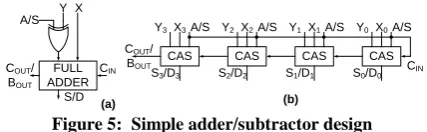
The concept of reversible controlled adder/subtractor presented here is based on the use of an adder circuit to perform subtraction instead of having a dedicated subtractor. Hence, the operation X-Y is implemented as X+Y’+1, i.e., 2’s Complement. The block diagram of a general irreversible controlled adder/subtractor is shown in Fig.5.
Note, that as a classical adder/subtractor module has 4 inputs (A/S, Cin, X and Y) and 2 outputs (S/D and Cout), its
input/output count is unequal, and hence the original form cannot be used directly as a reversible element. Therefore, to create a cascadable reversible CAS module, some garbage bits must be added to the original irreversible CAS structure. A second issue, addressed in the reversible CAS construction is the lack of support for fan-out signals in reversible designs. In
the classical adder/subtractor implementations, the same control signal A/S is fanned-out to all CAS blocks, Fig.5 (b). To overcome this shortcoming, one of the garbage bits, i.e., A/Sg, is used to provide a copy of a control signal from one
module to the next.
With the questions of fan-outs and I/O count compatibility resolved, the reversible controlled adder/subtractor (RCAS) block is constructed using reversible gates. The full adder is implemented by cascading two Peres gates (highlighted), which results in generating the target outputs S/D and Cout
where S/D = A/S⨁Y⨁X⨁Cin and Cout=
X(A/S⨁Y)⨁Cin(A/S⨁Y⨁X), in addition to garbage outputs
A/Sg, g1 and g2, Fig. 6 [37]. When A/S is set to 0, then CNOT
(first gate, Fig. 6) passes the true copy of Y while A/Sg acts as a
garbage output. When A/S is 1 then Y’ is available at the output of CNOT, and the full adder adds X, Y’ and Cin (which is set to
1 for subtraction). The garbage output A/Sg of a given RCAS
block is reused for a control signal fed to the consecutive RCAS block. The quantum cost of the RCAS module is 9 (8 for two Peres plus 1 for CNOT gate).
RCAS blocks can be cascaded to construct an n-bit adder/subtractor. In the proposed architecture, the A/Sg and Cout
outputs of a previous stage propagate to the input control signal A/S and the Cin of the next RCAS. For a 2’s Complement
subtraction X+Y’+1, an extra value 1 needs to be added to the least significant bit position (LSB) of the result. Hence, the original LSB block is modified by adding a CNOT gate between A/S and a constant ‘0’ ancilla bit. Note that when A/S is set to 0 for an addition, a value 0 is passed through the CNOT gate to the RCAS0 resulting in the addition of X0 and Y0
only. When A/S is set to 1 for the subtraction, a value 1 is added to X0+Y0’ as required by a 2’s Complement notation.
The addition of CNOT gate increases quantum cost by 1.
If a result of an n-bit addition/subtraction does not fall within the allowed range, then an arithmetic overflow occurs. Although, when adding unsigned numbers, the output carry-out Cout signal coming from the most significant RCAS block
serves as an overflow indicator, for the signed numbers the carry-out at the sign-bit position is not sufficient. In the case of signed numbers the overflow can occur, when adding two
FULL ADDER Y X A/S
CIN COUT/
BOUT S/D
CAS Y3 X3A/S
S3/D3
CAS Y2X2A/S
S2/D2
CAS Y1 X1A/S
S1/D1
CAS Y0X0A/S
S0/D0 COUT/
BOUT CIN
[image:3.595.322.536.76.142.2](a) (b)
Figure 5: Simple adder/subtractor design
A/Sg
g1=x
g2=A/S⊕Y⊕X
A/S⊕Y⊕X⊕Cin
X(A/S⊕Y)⊕CIN(X⊕A/S⊕Y)
A/S
X
Y
CIN
0
Peres gate Peres gate
[image:3.595.326.522.370.440.2](a)
Figure 6: Reversible Implementation of controlled adder/subtractor
0 X0
g g A/ S
0 RCASn-1
0
g g 0
g g A/ Sg
0 Ovf
0
g g 0
g g Cn
RCASn-2 RCAS2 RCAS1 RCAS0
Y0
X1
X2
Xn-2
Xn-1 Yn-2 Y2 Y1
Yn-1
S0/D
0
S1/D
1
S2/D
2
Sn-2
/D
n
-2
Sn-1
/D
n
[image:3.595.329.538.694.738.2]-1
Volume 93 – No 14, May 2014
numbers of the same sign with the carry out signal from the MSB position being 0, i.e., not indicating the overflow.
When considering the 2’s Complement addition (subtraction), the overflow occurs if the carry-in (borrow-in) to the most significant RCAS is the different than the carry-out (borrow-out) generated by that block, i.e., Ovf =Cn-1⨁Cn. To implement
the above check two additional CNOT gates at the outputs of the two most significant RCAS modules are added. The first CNOT gate placed at the Cout of RCASn-2 block provides a
copy of carry input Cn-1 to the RCASn-1. The second CNOT
performs XOR of Cn and Cn-1, where Cn is the carry output
from an nth bit RCAS. If Ovf is equal to 1, then the addition is incorrect, falling outside the assumed range. An n-bit signed numbers (2’s Complement) reversible adder/subtractor with overflow detector is given in Fig. 7.
The proposed reversible n-bit adder/subtractor requires 3n+1 gate (Peres and CNOT), 2n+1 garbage bits, and has the quantum cost of 9n+1. Table 1 summarizes the comparison of the proposed 16-bit design with binary adder/subtractors presented in [24]. These are three designs constructed from Fredkin, Peres and TR gates, and differ in the number of reversible gates, garbage outputs, ancilla inputs and quantum cost. As the Add/Sub- Design III implemented with Peres and CNOT gates clearly outperforms the Design I (Fredkin and CNOT), and the Design II (TR and CNOT gates) [24], the Design III is mainly considered for comparison with proposed designs (n-bit adder/subtractor with/without the overflow detector). The design presented in this work is better than adder/subtractor circuits [24] in terms of reversible gates, garbage outputs and the quantum cost. For example, for an n-bit Design III [24] the quantum cost is 10(n-1)+6 =10n-4 with (n-1) full adder/subtractor each contributing 10 to the quantum cost, and one LSB half adder/subtractor with quantum cost of 6. In contrast, the proposed n-bit design has a cost of 9n+1. Hence, the improvement in the quantum cost of this design is n-3 for n> 3. The gain grows with increasing size of the adder/subtractor.
4.
REVERSIBLE
ARITHMETIC
LOGIC
UNIT
In proposed reversible ALU design the arithmetic and logical operations are first performed in parallel, and then the desired result is selected by a multiplexer (MUX)- a circuit that chooses one out of several inputs depending on a control. The two steps of the design are defined as: function generation and function selection, Fig. 8.
4.1 Function Generator:
The first module of the proposed reversible ALU generates four arithmetic-logic functions in parallel as well as transmits
an input X unchanged. Another operand Y is controlled by a control signal AS, which determines the inverted operation or a subtraction. The implementation of this generator block is presented in Fig. 9. The control signal Cpn defines the
functionality of AND and OR when Cpn=0), otherwise NAND
[image:4.595.333.494.78.141.2]or NOR function is performed. Next if the control signal AS is ‘0’ then the device performs the following operations simultaneously: AND/NAND, OR/NOR, addition and XOR. On the other hand, if the control signal AS is ‘1’ then results for AND/NAND with single input inverted, OR/NOR with single input inverted, Subtraction and XNOR are generated, Table 2.
The RCAS in Fig. 6 is used for arithmetic operations.
However, in order to implement with fewer number of gates for extended functions AND, OR and XOR, two CNOT gates in between two Peres gates (AND and XOR) and one extra CNOT gate after the 2nd Peres gate are added, Fig. 9.The quantum cost of this function generator is 12.
4.2 Function Selector
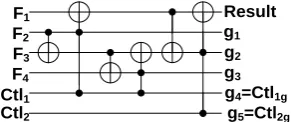
To select a desired function output a 4:1 reversible multiplexer shown in Fig. 10 is proposed in this work based on embedded reversible specification and is realized using Positive Davio expansion, which confirms minimum number
of lines i.e.
Result=(F1⨁Ctl1(F1⨁F2))⨁Ctl2(F1⨁Ctl1(F1⨁F2)⨁F3⨁Ctl1(
F3⨁F4)).The number of reversible gates for this MUX is 6,
while number of lines is 6. No ancilla bit is added. The quantum cost is 18.
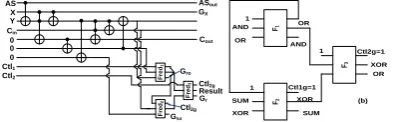
[image:4.595.341.507.306.470.2]Another implementation of a function generator is obtained by using Fredkin gates. A Fredkin gate itself is a reversible equivalent of 2:1 MUX. Hence, an alternative to 4:1 MUX proposed in the previous paragraph is to use three 2:1 MUXs
Table 2: RALU Operations with control inputs
Cpn AS Ctl2 Ctl1 Operation
0 0 0 0 AND 0 0 0 1 OR 0 0 1 0 ADD 0 0 1 1 XOR 1 0 0 0 NAND 1 0 0 1 NOR 0 1 0 0 XY’ 0 1 0 1 Y->X 1 1 0 0 X->Y 0 1 1 0 SUB 0 1 1 1 XNOR
AND (XY/XῩ) OR (XY/XῩ) ADD/Subtract
XOR/XNOR
AS Ctl1 Ctl2
Result X
Y
F
u
n
c
ti
o
n
G
e
n
e
ra
to
r
4
:1
M
U
[image:4.595.350.496.692.753.2]X
Figure 8: Reversible ALU two steps block diagram
AS ASout
X Y Cin 0 Cpn
0
g1=X
OR=0⊕X⊕(Y⊕AS)⊕X(Y⊕AS)⊕Cpn
Sum/Diff = X⊕(Y⊕AS)⊕Cin
Cout AND=(Y⊕AS)X⊕Cpn
XOR/XNOR=X⊕Y⊕AS
Figure 9: Reversible ALU function generator
F1 F2
Ctl1 Ctl2
Result g1 F3
F4
g2 g3 g4=Ctl1g
[image:4.595.89.237.705.762.2]g5=Ctl2g
Figure 10: Reversible ALU function selector (MUX) Table 1 Comparison of different adder/subtractor
Designs Reversible gates Garbage outputs ancilla Quantum cost
(Fredkin gates). The advantage of having a Fredkin gate multiplexer lies in a smaller quantum cost (15) as well as less logic depth. Further, a Fredkin gate generates the selected function as well as other functions available in the outputs. For example in Fig. 11, if the controls are set as Ctl1=’0’ and
Ctl2 =’1’ then Fredkin1 gate selects F1 in line 2 while F2 is
also available at line 3. Similarly Fredkin2 selects F3 in line 4
and F4 in line 5. The final Fredkin3 gate selects F3 as a
resulting output while F1 is also available as garbage output
Gr. Thus, though it selects only one function as a result in
target line, the rest of the functions can be obtained from its
garbage outputs.
4.3 1-bit Reversible Arithmetic Logic Unit
(RALU):
Two designs of reversible arithmetic logic unit for single bit are proposed in this section, one with 4:1 MUX and another using Fredkin selector. The design 1 of a 1-bit RALU is shown in Fig. 12. The circuit comprising 4:1 multiplexer requires two Peres gates, 3 Toffoli gates and 7 CNOT gates (total 12 reversible gates). The number of lines is 9 and
overall quantum cost is 30. On the other hand, the design 2 with Fredkin multiplexer, Fig. 13, requires two Peres gates, 4 CNOT gates and three Fredkin gates (9 gates in total) with overall quantum cost 27. In Fig. 13(b) all outputs as well as target function output (XOR) are available to monitor and the garbage outputs (AND, SUM and OR) for control inputs Ctl1g=1 and Ctl2g=1 are also shown.
Note, that all RALU blocks when placed in an n-bit reversible arithmetic logic unit in reversible embedding must comply with reversibility properties, Def. 1, while preserving the correctness of the execution of the arithmetic and logical operations.
4.4 n-bit RALU:
In the proposed circuit, cascading a number of the 1-bit RALU modules, it is possible to construct RALU of any size. The copy of all control signals (AS, Ctl2, Ctl1) available at the
module outputs are utilized for the next stage ALU operation. Thus RALU guarantees the generation of all required fan-out
signals for controlling the selection of functions through garbage signals and thus offers the minimal cost of the implementation.
A 4-bit reversible arithmetic logic unit with inputs X3X2X1X0
and Y3Y2Y1Y0 is presented in Fig. 14 (b). The basic block, i.e.,
the RALU module is shown in Fig. 14(a). Control signal AS transmits the true or inverted copy of input signal Y as well as defines the addition or subtraction operation. The other input X is transmitted unchanged at the output as garbage Gx. All
the functions outputs are available at each RALU module outputs as Gao, Gsx and Gr. The output Result presents the
desired function selected by the control signals. While cascading for the addition or subtraction operations, the carry out Cout of a previous stage is propagated to the next stage.
Thus four outputs are reused to provide next stage signals. This is a minimization of garbage outputs. Hence, a 4-bit reversible implementation of arithmetic logic unit requires 24 lines. Note that for subtraction operation the input carry in Cin
should be set to ‘1’.
4.5 Analysis and Comparisons of circuit
parameters for n-bit RALU:
By cascading RALU blocks the same way as in Fig. 14 any size of the arithmetic logic operation can be easily realized. The n-bit RALU with five basic arithmetic-logical operations requires elementary reversible logic gates (Peres, Toffoli, Feynman gates). Each RALU module with a 4:1 MUX requires 12 gates with quantum cost 30. Hence, for the n-bit realization the number of gates is 12n, and the quantum cost is 30n. On the other hand, with Fredkin multiplexer, the number of reversible gates for an n-bit design is 9n, and quantum cost is 27n. The number of garbage bits is also linear in the size of inputs (5n+4). Note, that the addition of the control and the combination of multiple functions do not necessarily require a large number of gates and ancilla.
Ctl1 F1 F2 F3 F4 Ctl1 C tl2 Ctl2 Result Gr Ctl1g
Ctl1'.F1+Ctlg'.F2
Ctl1'.F3+Ctl1.F4
Ctl1'.F1+Ctl1.F2
Ctl1.F3+Ctl1.F4
F re d1 F re d2 F re d3
F1/F2
[image:5.595.82.249.61.135.2]F3/F4
Figure 11: Reversible ALU function selector using Fredkin gates AS X Y Cin 0 0 0 ASout GX G1 G2out Cout Result G3
g4=Ctl1g
g5=Ctl2g
Ctl1
[image:5.595.320.541.79.210.2]Ctl2
Figure 12: Reversible ALU design I ( 4:1 MUX)
AS X0 Y0 Cin Ctl1 Ctl2 ASout GX3 Cout GC1 Result3 GC0 Gr0 Gsx0 Gao0
0 0 0
R A L U0 Gr1 Gsx1 Gao1
0 0 0
R A L U1 Gr2 Gsx2 Gao2
0 0 0
R A L U 2 Gr3 Gsx3 Gao3
0 0 0
R A L U3 GX0 Result0 GX1 Result1 GX2 Result2 AS X Y Cin Ctl1 Ctl2 ASout GX Cout GCtl2 Result GCtl1 Gr Gsx Gao
0 0 0
[image:5.595.70.257.278.354.2]R A L U (a) (b) X1 Y1 X2 Y2 X3 Y3
Figure 14: 4-bit RALU
ASout AS X Y Cin 0 0 0 F re d 1 F re d 2 F re d3 Ctl1 Ctl2 GX Cout Ctl2g Result Gr Ctl2g Gsx Gro 1 1 1 AND XOR OR SUM OR XOR F1 F2 F3 Ctl1g=1 Ctl2g=1 OR AND SUM XOR (b)
Figure 13: RALU design II ( using Fredkin selector)
Table 1 Comparison of 1-bit ALU
Circuit Operation # of lines # of gates QC Logic Unit, Gupta [12] AND, OR, NAND, NOR, XOR, const.
5 18 114
Mini ALU [30]
AND, OR, ADD,
no-op. 10 20 60
Proposed Design AND, OR, XOR,NAND, NOR, AND/OR with inverted input, ADD, SUB
[image:5.595.67.264.469.530.2] [image:5.595.319.540.595.720.2]Volume 93 – No 14, May 2014
A/S X Y Ccarry
0
Peres gate Peres gate Cnop
Csns Cres
F Csns Cnop
Cres X A/Sg
Result
Cout
[image:6.595.272.527.91.341.2]S/D g
Figure 15: Proposed RALU comparable to [32]
In literature, there are different realizations of logic or arithmetic units as benchmark circuits [30] implementing different operations. Table 3 compares various reversible circuit parameters of proposed design with existing realizations for a 1-bit RALU. Table 4 presents a summary of existing 32-bit reversible ALU or LU realizations with the proposed design. Note that the operations performed by each method are not the same; hence a solid comparison is not possible. The multiplication or division operations are not included as the complexity of the design increases and that’s why in CMOS design usually these operations are not integrated in ALU. Thus, the proposed implementation is very close to the classical ALU with acceptable cost. For a 32-bit realization, this design is better than Logic Unit, which does not even include arithmetic operations.
The V-shape design [32] is more economical and efficient for programmable reversible computing. From Table 4 it can be observed that the design contrast the proposed RALU in many operations. For example, the method in [32] calculates a modular addition and subtraction, so no carry output is considered, while the design presented in this work calculates complete result having a sum and carry output to indicate arithmetic overflow condition. Moreover, the proposed RALU includes more logic operations such as AND/NAND, OR/NOR. This requires an extra circuitry, which is absent in method [32]. To present a meaningful comparison a modification to original reversible ALU is performed to include the operations performed in [32], and the extra logic functions in this new design are discarded. In Fig. 15, the new design consisting of original reversible controlled adder/subtractor (RCAS: quantum cost 9, one CNOT and two Peres gates), one Toffoli, one CNOT and one Fredkin gate is presented. The functions with different control signals are presented in Table 5. The overall quantum cost is 20. Hence, the quantum cost for 32-bit design 640, which is less than the V-shaped design (QC= 694].
Recently two designs of reversible ALU were presented in [33] based on two newly proposed gates MRG and Peres-AND-OR (PAOG). These designs perform similar arithmetic and logical functions to ours. For example, a reversible ALU with MRG and HNG gates perform OR, NOR, XOR, XNOR, ADD, SUB operations, and a reversible ALU with PAOG and HNG gates perform AND, NAND, OR, NOR, ADD and SUB operation. Note that the first design excludes AND, NAND operation while the 2nd design excludes XOR/XNOR operations. However, our RALU integrates all the functions of these two designs. The total cost of an n-bit ALU in [33] is 26n-2. To make a fair comparison, the excess functions
(AND/NAND or XOR/XNOR) are not considered, and then the total quantum cost is calculated as 21n for a design with a Fredkin selector and 23n for a design with a multiplexer. For a 32-bit reversible ALU proposed design has a quantum cost of 672, while the design in [33] has quantum cost 830. Moreover, for a 1-bit ALU the design in [33] requires 10 lines whereas this new RALU needs 9 lines (actually 8 lines if one function is not considered for a proper comparison). Thus 2 lines are saved per bit of an RALU. Thus, proposed RALU is more economical than other methods.
4.6 RALU with overflow detector and
set-less-than function
When RALU performs an addition or a subtraction operation, one should consider the allowed range for the given number representation used. This means that it is important to check whether the result is within the acceptable range. For an unsigned number, the Cout output represents the overflow of
the operation. However, in case of signed numbers’ operations (2’s Complement Computation) a controlled adder/subtractor requires an extra circuit to monitor an overflow. Similar to the
RCAS design with the overflow detector, Fig. 8, the proposed RALU is modified at the most significant bit position. A copy
Table 4: Different 32-bit reversible ALU realizations
Circuit Operations Ancilla Gates used Lines Gates QC
Logic Unit [30] AND, OR, XOR yes CNOT, Generalized Toffoli 299 571 1223
no 203 385 6562
ALU SyReC [30] ADD, SUB, MULT, DIV yes CNOT, Generalized Toffoli 331 15950 1336477
no 235 15764 1851487
Simple ALU
SyRec [30] ADD, SUB, MULT, XOR
yes CNOT, Generalized
Toffoli
331 4413 27009
no 235 4227 152852
V-Shape [32] Modular arithmetic (ADD, SUB,
NSUB), XOR, no-op no
CNOT, Toffoli and
Fredkin 69 190 694
ALU [33] ADD, SUB, OR, NOR, AND/NAND (or XOR/XNOR) yes CNOT, Fredkin, HNG, MRG/POAG 196 254 830
Proposed design AND, NAND, OR, NOR, ADD, SUB,
XOR, XNOR, implication yes
CNOT, Peres, Fredkin,
Toffoli 164 288 864
Table 5: RALU (Fig. 15) operations with control inputs (X is unchanged)
Cres Csns Cnop AS Ccarry ALU Operation
1 0 0 0 0 Y +n X ADD
1 1 0 1 0 Y –nX SUB
1 0 0 1 1 X –nY NSUB
0 0 0 0 0 Y ⨁X XOR
0 0 1 0 0 Y NOP
0 0 1 1 0
0 0 0 1 0 ⨁
1 0 0 0 1 Y +n X +n1
[image:6.595.58.538.92.247.2]AS X0
Y0
Cin
Ctl1
Ctl2
ASout
GX3
Cout
GC1
Result3
GC0
Gr0
Gsx0
Gao0
0 0 0
R
A
L
U0
Gr1
Gsx1
Gao1
0 0 0
R
A
L
U1
Gr2
Gsx2
Gao2
0 0 0
R
A
L
U2
Gr3r
Gsx3
Gao3
0 0 0
R
A
L
U
3
GX0
Result0
GX1
Result1
GX2
Result2
Gr
X1
Y1
X2
Y2
X3
Y3
Cout2
0
0
Slt Ovflow
C
N
O
Tin
C
N
O
Tsign
C
N
O
Tov
f
C
N
O
[image:7.595.97.506.78.401.2]Tslt
Figure 16: Modified 4-bit RALU with overflow detection and set-less-than operation
of a carry-input of the RALU block is obtained using a CNOTin gate, and the carry-in is XOR-ed with carry output of
the block (CNOTovf) to detect overflow, Fig.16.
This overflow detector can be employed to add another operation to original RALU. The set-less-than is usually available in classical arithmetic logic unit, and is used to compare if a number X is less than the number Y (X<Y). As discussed earlier, during the subtraction of two signed numbers, i.e., X-Y, the sign of the result XOR-ed with the overflow signal indicates whether X is smaller than Y. The copy of a sign bit (most significant digit of a difference) is obtained with CNOTsign gate. The set-less-than output Slt is
generated by the CNOTslt gate, Fig. 16. The overall quantum
cost is increased only by 4 with the inclusion of two functions: the overflow detection and comparison.
5.
SIMULATION
RESULT
The reversible functionality of all designs is verified through simulations, i.e 1-bit RALU blocks (Fig. 17), 4-bit reversible arithmetic logic circuits (Fig.18) with Fredkin selector and finally RALU with overflow detector and set-less-than operation (Fig. 19). All of the above designs were implemented in VHDL and simulated using Quartus II 9.1 sp1 web edition [39]. The RCAS module is modeled in the behavioral manner, while the remaining designs are implemented using structural code with RCAS block as component.
Fig. 17 shows the simulations of a 1-bit RALU using a Fredkin multiplexer. Note that every input combination has an expected (unique) output pattern. For each control inputs combination, we simulate 4-input patterns of X and Y. The highlighted ‘Result’ represents correct function output values
for corresponding control signals. Moreover, the non-selected outputs are available at garbage outputs Gao, Gsx and Gr.
Fig. 18 presents the simulation results of a 4-bit RALU using Fredkin gates, with 24 inputs and 24 outputs. As before, the two random values are the inputs X and Y, the output ‘Result’. The time interval 0-20ns represents bit-wise AND (XY), 20-40ns bit-wise OR, 40-60ns Sum, 60-80ns XOR, 80-100ns AND with Y inverted (XY’), 100-120ns OR with Y inverted (X+Y’), 120-140ns Subtraction and finally 140-160ns XNOR operation. The garbage outputs Gx, ASout, Gc1 and Gc0 are
the copies of inputs X, AS, Ctl1 and Ctl0 respectively. The garbage outputs Gao, Gsx and Gr represent non-selected outputs (AND/OR for values of Ctl0), (Sum/XOR according to Ctl0) and AND/Sum or OR/XOR (based onCtl1), which is not
selected by ‘Result’.
The simulation results of RALU with the overflow detector and the set-less-than function are shown in Fig. 19. The node ‘Result’ shows the outputs according to the control signals for some random values of inputs set by the simulator.
Figure 17: Simulation result of 1-bit RALU using Fredkin MUX
Figure 18: Simulation result of RALU_Fredkin_4bit
[image:7.595.331.526.524.628.2]Volume 93 – No 14, May 2014
6.
CONCLUSION
Reversible logic is considered to be compatible with future computing technologies, which dissipate less energy. Finding an efficient reversible implementation of classical computer arithmetic especially the arithmetic logic unit is still a challenging issue. In this paper, the reversible architectures of computer arithmetic logic unit are presented which offer smaller overhead than designs proposed by other authors. Starting with the basic RCAS module, a complete and new RALU is constructed, which is similar to the basic classical ALU. Two different realizations are proposed and then analyzed their effectiveness. This integrated module is better than any existing reversible arithmetic logic unit incorporating more operations. The modular structure of the proposed n-bit RALU offers economical and acceptable values of reversible circuit parameters comparable to other benchmark circuits.
7.
REFERENCES
[1] R. Landauer, “Irreversibility and heat generation in the computational process”. IBM Journal of Research and Development, 1961. 5(3): pp. 183-191.
[2] C. H. Bennett, “Logical reversibility of computation”, IBM Journal of Research and Development, 1973. 17(6): pp. 525-532.
[3] M. A. Nielsen, I. L. Chuang, “Quantum Computation and Quantum Information”, Cambridge University Press, 2000.
[4] W. C. Athas and L.J. Svensson, “Reversible Logic Issues in Adiabatic CMOS”, Workshop on Physics and Computation, 1994, pp. 111-118.
[5] S. Burignat and A.D. Vos, “Test of a Majority-based Reversible (Quantum) 4-bits Ripple Carry Adder in Adiabatic Calculation”, 18th
International Conference on Mixed Design of Integrated Circuits and Systems, 2011, pp. 368-373.
[6] H. Thapliyal and M. Zwolinski, “Reversible Logic to Cryptographic Hardware: a New Paradigm”, CoRRabs/cs/0610089, 2006.
[7] H. Thapliyal and N. Ranganathan, “Mach-Zehnder interferometer based design of all optical reversible binary adder”, Design, Automation and Test in Europe, 2012.
[8] M. Skoneczny, Y van Rentergem and A. D. Vos, “Reversible Fourier Transform Chip”, 15th
International Conference on Mixed Design of Integrated Circuits and Systems, 2008.
[9] A. D. Vos, S. Burignat and M. K. Thomsen, “ Reversible Implementation of a discrete Integer Linear Transformation”, Journal of Multiple-Valued Logic and Soft Computing, vol. 18, no. 1, pp. 25-35, 2012.
[10] D. Maslov, G.W. Dueck and D. M. Miller, “Techniques for the Synthesis of Reversible Toffoli Networks”, ACM Trans. on Design Automation of Electronic System, Vol. 12, No.4, pp. 42:1-42:28, Sept.2007.
[11] D. Grobe, R.Wille, G. Dueck and R. Drechsler, “Exact Multiple Control Toffoli Network Synthesis with SAT Techniques”, IEEE Trans. On CAD, vol.28, no.5, pp. 703-715, 2009.
[12] P. Gupta, A. Agrawal and N.K. Jha, “An Algorithm for Synthesis of Reversible logic Circuits”, IEEE Trans. on CAD of Integrated Circuits and Sys.vol. 25, no.11, 2006.
[13] V. Shende, A. K. Prasad, I. L. Markov, and J. P. Hayes. “Synthesis of reversible logic circuits”, IEEE Trans. on CAD, 22(6):710–722, 2003.
[14] R. Wille, R. Drechsler,” BDD-based Synthesis of Reversible logic for Large Functions” Design Automation Conf., 2009.
[15] N. Alhagi, M. Hawash, M. A. Perkowski, “Synthesis of Reversible Circuits with No Ancilla Bits for Large Reversible Functions Specified with Bit Equations”, Proc. of the 40th IEEE International Symp. on Multiple-Valued Logic, pp. 39-45, 2010.
[16] M. Saeedi and I. L. Markov, “ Synthesis and Optimization of Reversible Circuits- A Survey”, ACM Computing Surveys 2012.
[17] L. Ni, Z. Guan and W. Zhu, “A General method of Constructing the Reversible Full Adder”, 3rd Intl. Symp. on Intelligent Inf. Technology and Security Informatics, pp. 109-113, 2010.
[18] H. Thapliyal and M.B Srinivas, “Novel Design and Reversible Logic Synthesis of Multiplexer Based Full Adder and Multipliers”, 48th Midwest Symp.on Circuits and Systems, vol. 2, pp. 1593-1596, 2006.
[19] H. Thapliyal, M.B Srinivas, “Novel Reversible TSG gate and its application for designing reversible carry look ahead adder and other adder architectures”, Proc. of 10th Asia-pacific computer system architecture Conference, 3740, 2005.
[20] M. Haghparast and K. Navi, “Design of a novel reversible multiplier circuit using HNG gate in nanotechnology”, Am. J. Applied Sci., vol.5, 2008, 282.
[21] M. Ehsanpour, P. Moallem, A. Vafaei, “Design of a Novel Reversible Multiplier Circuit Using Modified Full Adder”, 2010 Intl. Conf. on Computer Design and Applications, vol.3 .
[22] H. Thapliyal, M.B Srinivas and H.R. Arabnia, “Reversible Logic Synthesis of Half, Full and Parallel Subtractors”, Proc. of Intl. Conf. on embedded Sys. and App., June 2005, Las Vegas, pp. 165-181.
[23] H. Thapliyal and N. Ranganathan, “Design of Efficient Binary Subtractors Based on a New Reversible Gate”, Proc. of 2009 IEEE Computer Society Annual Symp. on VLSI, pp. 229-234.
[24] H. G. Rangaraju, U. Venugopal, K.N. Muralidhara and K. B. Raja, “ Low Power Reversible Parallel Binary Adder/Subtractor”, Intl. J. of VLSI design & Comm. Sys. (VLSICS), Vol. 1, no. 3, 2010, pp 23-34.
[25] V. Vedral, A. Barenco and A Ekert, “ Quantum Networks for Elementary Arithmetic Operations”, Phys. Rev. A, vol. 54, no. 1, pp. 147-153, 1996.
[26] S. A. Cuccaro, T. G. Draper, S. A. Kutin and D. P. Moulton, “ A new Quantum Ripple-Carry Addition Circuit,” quant-ph/0410184, 2004.
Information and Computation, vol. 10, no. 9&10, pp. 872-890, 2010.
[28] I. L. Markov and M. Saeedi, “Constant-Optimized Quantum Circuits for Modular Multiplication and Exponentiation”, Quantum Information and Computation, vol. 1. no. 5&6, pp. 872-890, 2012.
[29] M. K. Thomsen, H. B. Axelsen and R. Gluck, “ A Reversible Processor Architecture and its Reversible Logic Design”, Reversible Computation, Lecture Notes in Computer Science, vol. 7165, 2012, pp 30-42.
[30] Benchmark circuits. http://www.revlib.org
[31] R. Aradhaya, K. N. Muralidhara, B. Kumar, “ Design of Low Power Arithmetic Unit Based on Reversible Logic”, International Journal of VLSI and Signal Processing Applications, vol. 1, no. 1, pp. 30-38, 2011.
[32] M. K. Thomsen, R. Gluck, H. B. Axelsen, “Reversible arithmetic logic unit for quantum arithmetic”, J. Phys. A: Math. Theor., vol. 43, no. 38, 2010.
[33] M. Morrison and N. Ranganathan, “ Design of a Reversible ALU based on Novel Programmable Reversible Logic Gate Structures”, IEEE Computer Society Annual Symposium on VLSI, 2011, pp. 126-131.
[34] T. Toffoli, “ Reversible Computing”, Technical Memo, MIT/LCS/TM-151, Boston 1980.
[35] E. Fredkin, T. Toffoli, “Conservative Logic”, Int. J. Theor. Physics, vol. 21, no. 3-4, pp. 219-253, 1982.
[36] A. Peres, “ Reversible logic and quantum computers,” Phys. Rev. A, Gen. Phys., vol 32, no. 6, pp. 3266-3276, Dec. 1985.
[37] S. Sultana, K. Radecka, “ Reversible adder/subtractor with overflow detector”, Intl. Midwest Symp. on Circuits and Systems (MWSCAS 2011), pages 1- 4.
[38] V. Carl Hamacher, Safwat G. Zaky and Zvonko G. Vranesic, Computer Organization” New York : McGraw-Hill, ©1984, ISBN: 0072320869.
![Figure 15: Proposed RALU comparable to [32]](https://thumb-us.123doks.com/thumbv2/123dok_us/8046513.772813/6.595.58.538.92.247/figure-proposed-ralu-comparable-to.webp)