S T U D Y P R O T O C O L
Open Access
Remote ischemic preconditioning to reduce
contrast-induced nephropathy: study protocol
for a randomized controlled trial
Thomas B Sterenborg
1†, Theo P Menting
1†, Yvonne de Waal
2, Rogier Donders
3, Kimberley E Wever
1,
M Susan Lemson
5, Daan JA van der Vliet
1, Jack F Wetzels
2, Leo J SchultzeKool
4and Michiel C Warlé
1*Abstract
Background:Despite the increasing use of pre- and posthydration protocols and low-osmolar instead of high-osmolar iodine-containing contrast media, the incidence of contrast-induced nephropathy (CIN) is still significant. There is evidence that contrast media cause ischemia-reperfusion injury of the medulla. Remote ischemic preconditioning (RIPC) is a non-invasive, safe, and low-cost method to reduce ischemia-reperfusion injury. Methods:The RIPCIN study is a multicenter, single-blinded, randomized controlled trial in which 76 patients at risk of CIN will receive standard hydration combined with RIPC or hydration with sham preconditioning. RIPC will be applied by four cycles of 5 min ischemia and 5 min reperfusion of the forearm by inflating a blood pressure cuff at 50 mmHg above the actual systolic pressure. The primary outcome measure will be the change in serum creatinine from baseline to 48 to 72 h after contrast administration.
Discussion:A recent pilot study reported that RIPC reduced the incidence of CIN after coronary angioplasty. The unusual high incidence of CIN in this study is of concern and limits its generalizability. Therefore, we propose a randomized controlled trial to study whether RIPC reduces contrast-induced kidney injury in patients at risk for CIN according to the Dutch guidelines.
Trial registration:Current Controlled Trials ISRCTN76496973
Keywords:Contrast-induced nephropathy, Remote ischemic preconditioning, Acute kidney injury, Pre- and posthydration, Randomized controlled trial
Background
Iodine-containing contrast media are often used for diagnostic and therapeutic procedures and their use is the leading cause of hospital-acquired acute kidney injury [1]. Prospective studies demonstrate that contrast media are responsible for approximately 15% of acute kidney injury cases [2,3]. Despite the increasing use of pre- and posthydration protocols and low-osmolar instead of high-osmolar iodine-containing contrast media, the incidence of contrast-induced acute kidney injury is still sig-nificant [4,5]. This so called contrast-induced nephropathy
(CIN) is defined as an absolute rise of≥0.5 mg/dL and/or a relative increase of≥25% in serum creatinine compared to baseline within 48 to 72 h after contrast administration without an alternative cause of kidney injury [6]. CIN is strongly associated with morbidity and mortality [7,8]. In patients with CIN, 8% need dialysis treatment and between 22% and 34% die during the index hospitalization [3,9-11]. In accordance with international guidelines, all patients who receive iodine-containing contrast are screened for risk factors of CIN, including measures of renal function (estimated glomerular filtration rate, based upon the MDRD formula) [12-15]. High-risk patients receive pre-and posthydration by saline solution infusion for 4 to 12 h. Furthermore, 48 to 72 h after contrast administration, serum creatinine should be measured [16]. Despite the identification of high-risk patients and the use of hydration
* Correspondence:[email protected]
†Equal contributors
1Department of Surgery, Division of Vascular- and Transplant Surgery,
Radboud University Nijmegen Medical Centre, Geert Grooteplein-Zuid 10, Nijmegen, GA 6525, the Netherlands
Full list of author information is available at the end of the article
protocols, the incidence of CIN still varies between 2% and 13% [17-20]. The exact mechanism underlying CIN remains to be elucidated. There is evidence to suggest that contrast media have direct toxic effects on the tubular cells resulting in altered mitochondrial function and apoptosis [21]. Moreover, ischemia-reperfusion injury of the medulla has been shown to play an important role [22]. The outer part of the medulla has an area with a high oxygen demand and is located at a distance from the vasa recta which sup-plies the medulla of blood. Contrast-induced vasoconstric-tion of the vasa recta induces ischemia-reperfusion injury of the medulla which contributes significantly to the patho-physiology of CIN. Remote ischemic preconditioning (RIPC) is a short and harmless discontinuation of blood supply to particular organs or tissue, followed by reperfu-sion [23,24]. A preconditioning stimulus is applied before the onset of prolonged ischemia. In animal models it has been found to reduce ischemia-reperfusion injury of the kidney [25]. Although the precise mechanism of RIPC remains unknown, two major pathways may play a pivotal role: the humoral and neurogenic pathways. Both are thought to induce various kinase cascades and eventually prevent opening of the mitochondrial permeability transi-tion pore in the target organ, thereby reducing cell death [26]. A retrospective cohort study by Whittaker et al. indicated that multiple balloon inflations during coronary angioplasty (as a remote stimulus) might reduce CIN [27]. Furthermore, a recent pilot study by Er et al. showed that RIPC reduced CIN in high-risk patients undergoing elect-ive coronary angiography [28]. However, there was an unusually high incidence of CIN (40%) in the control group. The question arises whether protection by RIPC, as an adjunct to standard preventive measures (that is, hydra-tion and discontinuahydra-tion of nephrotoxic drugs), also holds for patients with a lower risk of CIN. As generalizability of the results by Er et al. is confined to a selected group of patients with an unusual high risk of CIN, we propose a randomized controlled trial to study whether RIPC reduces contrast-induced kidney injury in patients at risk of CIN according to the Dutch guideline [14].
Methods/Design
A multicenter, single-blinded, randomized controlled trial will be performed at the Radboud University Nijmegen Medical Centre and Slingeland Hospital Doetinchem. Inclusion will be performed by the physician researcher after written informed consent.
Study population
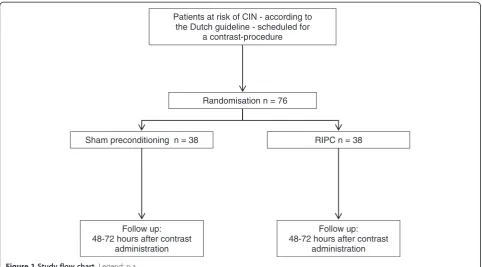
A total of 76 patients will be randomized. Sealed enve-lopes are used to randomly assign consecutive patients in a 1:1 ratio to receive either sham preconditioning or RIPC (Figure 1). The study population consists of patients at risk of CIN according to criteria adopted
from the Dutch guidelines: (1) eGFR <45 mL/min/1.73 m2; (2) eGFR <60 mL/min/1.73 m2; (3) eGFR <60 mL/min/ 1.73 m2and two additional risk factors (that is, peripheral vascular disease, heart failure, >75 years of age, anemia, dehydration, use of diuretics and/or NSAIDs). Patients undergoing contrast procedures for diagnostic and/or treatment purposes are eligible. As patients receiving less than 100 mL of iodinated contrast media may not have an increased risk of contrast-induced kidney injury, an ex-pected use of at least 100 mL was used as inclusion criterion [3,29].
Inclusion criteria
1) Patients undergoing an interventional or diagnostic radiological procedure in which they receive an expected >100 mL intravascular contrast including:
Thoracic and/or abdominal endovascular aortic repair
Endovascular aortic repair
Digital subtraction angiography
Percutaneous transluminal angioplasty
Percutaneous intentional extraluminal revascularization
Carotic artery stenting
Percutaneous coiling/embolization procedures
Computed tomography
2) Patients who comply with the risk criteria for CIN according to the Dutch guidelines [14]
Peripheral vascular disease, heart failure, >75 years, anemia (Ht < 0.39 men and <0.36 women,
dehydration, diuretics and/or NSAID use) 3) Written informed consent.
Exclusion criteria
Age <18 years
Hemodialysis or peritoneal dialysis
Simultaneous participation in another interventional study
Percutaneous coiling/embolization procedures of the kidney
Impossibility to perform RIPC, due to pathology of both arms (for example, dystrophy, recent trauma, chronic wounds)
Study protocol
administration. Nephrotoxic drugs (for example, metfor-min and diuretics) are discontinued at least 24 h before and after contrast administration [14]. Patients in the experimental group of the study will receive RIPC by four cycles of ischemia and reperfusion of the forearm by inflating a blood pressure cuff around the upper arm at 50 mmHg above the actual systolic pressure during 5 min followed by 5 min of reperfusion. In the control group, patients receive sham preconditioning by inflating the blood pressure cuff to 10 mmHg below the actual diastolic pressure during 5 min followed by 5 min of reperfusion (four cycles). The time between the last inflation cycle and the start of the intervention is planned within 45 min. In the interest of blinding, the investigator ensures that the inflation pressure is not visible for both the patient and the (interventional) radi-ologist. All patients receive Xenetrix 300 (0.6 to 0.85 Osmol/kg H2O), a low osmolar, non-ionic, and hydro-philic contrast medium [30,31]. Patients will complete a questionnaire to obtain all relevant baseline characteris-tics such as age, weight, previous contrast procedures, diabetes, vascular-related diseases, and (discontinuation of ) medication. Chart review will be performed to com-plement and double check this information. Blood and urine samples are taken at baseline and 4 to 6 h after contrast administration. A final blood sample is taken 48 to 72 h after contrast administration. According to the Dutch guidelines, monitoring of renal function in high-risk patients is recommended within 48 to 72 h after contrast administration. All samples will be number
coded before analysis to ensure blinding of the inde-pendent investigator performing the analyses.
Primary endpoint
The primary endpoint is change in serum creatinine form baseline to serum creatinine within 48 to 72 h after contrast administration.
Secondary endpoint
The secondary endpoints are the incidence of CIN (defined as an absolute rise of ≥0.5 mg/dL or a relative increase of ≥25% in serum creatinine over baseline within 48 to 72 h after contrast administration), rehospi-talization, hemodialysis, and mortality within 6 weeks after contrast administration.
Ethics, informed consent
An independent ethics committee, the Central Committee on Research involving Human Subjects, Arnhem-Nijmegen, approved the protocol. Oral and written informed consent from the patient will be obtained prior to inclusion.
Adverse events
Although RIPC by repeated insufflations of a blood pressure cuff around the upper arm is considered safe, serious adverse events possibly related to the application of RIPC will be reported to the ethical committee. Mild adverse events are: transient discomfort due to
Patients at risk of CIN - according to the Dutch guideline - scheduled for
a contrast-procedure
Randomisation n = 76
Sham preconditioning n = 38
Follow up: 48-72 hours after contrast
administration
RIPC n = 38
Follow up: 48-72 hours after contrast
[image:3.595.57.540.88.355.2]administration
compression and/or ischemia and the formation of ecchymosis (upper arm) or petechia (lower arm).
Power analysis
In this randomized study, the change of serum creatinine from baseline to 48 to 72 h after contrast administration will be compared between the experimental and control group. Using serum creatinine change as continuous response variable increases the power of the study. In a previous retrospective cohort study at our center includ-ing 2,169 patients at risk for contrast-induced nephropa-thy, serum creatinine values decreased from 120 μmol/L at baseline to 118 μmol/L at 48 to 72 h after contrast administration due to adequate hydration protocols [17]. This mean change in serum creatinine (-2 μmol/L) was normally distributed with a standard deviation of 23 μmol/L. Based on existing evidence we assume that RIPC with hydration may provide a further de-crease in mean serum creatinine from baseline to 48 to 72 h of approximately 14 μmol/L as compared to hydration only. This corresponds with approximately 60% of the effect that was found by Er et al. [28]. If the true difference in the experimental and control means is 14 μmol/L, we will need to study 34 experi-mental and 34 controls to be able to reject the null hypothesis with a power of 0.80 and an alpha of 0.05 calculated with a one-sided independent t-test. Based on existing animal [25] and human studies [32,33] investigating the influence of RIPC on renal ischemia-reperfusion injury, we assume that RIPC does not negatively affect renal function. Therefore, one-sided testing would be appropriate for this study. Expected lost to follow-up (for example, blood sampling not realized between 48 to 72 h) is approximately 5%. For this reason 38 patients will be included in both the experimental and control arm.
Statistical analysis
The analysis will be performed on the basis of intention-to-treat principles. Student’s t-test will be used to com-pare normally distributed variables, and Mann-Whitney U test will be used to compare not-normally distributed continuous data. Categorical variables will be compared with the chi-square test. If univariable analysis reveals a significant difference in baseline characteristics, then a multivariable linear regression analysis will be used to assess its impact on the primary outcome measure (that is, change in serum creatinine between baseline and 48 to 72 h after contrast administration). A subgroup ana-lysis will be performed to assess whether the impact of RIPC on the primary outcome measure is affected by the Mehran risk score. For this analysis patients will be divided into three equal groups (that is, tertiles) accord-ing to their Mehran risk score. Statistical analyses will be
performed with SPSS 20.0. A probability value of <0.05 is considered to indicate statistical significance and 95% confidence intervals will be calculated.
The RIPCIN study is registered at: http://www.con-trolled-trials.com/ISRCTN76496973.
Discussion
Trial status
The trial is ongoing. Currently 61 patients have been included.
Abbreviations
CIN:Contrast-induced nephropathy; MDRD: Mean glomerular filtration rate; RIPC: Remote ischemic preconditioning.
Competing interests
The authors of this manuscript have no competing interests to disclose.
Authors’contributions
TS contributed to data collection and analysis, manuscript writing, and final approval of the manuscript. TM and YW contributed to data collection, critical revision, and final approval of the manuscript. RD contributed to analysis, critical revision, and final approval of the manuscript. KW, SL and DV contributed to data collection, critical revision, and final approval of the manuscript. JW contributed to design, interpretation of the data, critical revision, and final approval of the manuscript. LS contributed to conception and design, critical revision, and final approval of the manuscript. MW contributed to conception and design, data collection, interpretation of the data, financial support, analysis, manuscript writing, and final approval of the manuscript. All authors read and approved the final manuscript.
Acknowledgements
This trial is partially funded by a research grant from COOK Medical Inc. (Bloomington, IN, USA).
Author details
1
Department of Surgery, Division of Vascular- and Transplant Surgery, Radboud University Nijmegen Medical Centre, Geert Grooteplein-Zuid 10, Nijmegen, GA 6525, the Netherlands.2Department of Nephrology, Nijmegen, the Netherlands.3Department of Epidemiology Biostatistics and HTA,
Nijmegen, the Netherlands.4Department of Radiology, Radboud University Nijmegen Medical Centre, Nijmegen, the Netherlands.5Department of
Surgery, Division of Vascular Surgery, Slingeland Hospital, Doetinchem, the Netherlands.
Received: 10 September 2013 Accepted: 1 April 2014 Published: 11 April 2014
References
1. Nash K, Hafeez A, Hou S:Hospital-acquired renal insufficiency.Am J Kidney Dis2002,39:930–936.
2. Hou SH, Bushinsky DA, Wish JB, Cohen JJ, Harrington JT:Hospital-acquired renal insufficiency: a prospective study.Am J Med1983,74:243–248. 3. McCullough PA, Wolyn R, Rocher LL, Levin RN, O’Neill WW:Acute renal
failure after coronary intervention: incidence, risk factors, and relationship to mortality.Am J Med1997,103:368–375.
4. McCullough PA:Contrast-induced acute kidney injury.J Am Coll Cardiol
2008,51:1419–1428.
5. Mitchell AM, Jones AE, Tumlin JA, Kline JA:Incidence of contrast-induced nephropathy after contrast-enhanced computed tomography in the outpatient setting.Clin J Am Soc Nephrol2010,5:4–9.
6. Morcos SK, Thomsen HS, Webb JA:Contrast-media-induced
nephrotoxicity: a consensus report. Contrast Media Safety Committee, European Society of Urogenital Radiology (ESUR).Eur Radiol1999, 9:1602–1613.
7. Solomon RJ, Mehran R, Natarajan MK, Doucet S, Katholi RE, Staniloae CS, Sharma SK, Labinaz M, Gelormini JL, Barrett BJ:Contrast-induced nephropathy and long-term adverse events: cause and effect?Clin J Am Soc Nephrol2009,4:1162–1169.
8. From AM, Bartholmai BJ, Williams AW, Cha SS, McDonald FS:Mortality associated with nephropathy after radiographic contrast exposure.
Mayo Clin Proc2008,83:1095–1100.
9. Rudnick MR, Goldfarb S, Wexler L, Ludbrook PA, Murphy MJ, Halpern EF, Hill JA, Winniford M, Cohen MB, VanFossen DB:Nephrotoxicity of ionic and nonionic contrast media in 1196 patients: a randomized trial. The Iohexol Cooperative Study.Kidney Int1995,47:254–261.
10. Levy EM, Viscoli CM, Horwitz RI:The effect of acute renal failure on mortality. A cohort analysis.JAMA1996,275:1489–1494.
11. Rihal CS, Textor SC, Grill DE, Berger PB, Ting HH, Best PJ, Singh M, Bell MR, Barsness GW, Mathew V, Garratt KN, Holmes DR Jr:Incidence and prognostic importance of acute renal failure after percutaneous coronary intervention.Circulation2002,105:2259–2264.
12. European Society of Urogenital Radiology:ESUR guidelines on contrast media.Vienna: ESUR; 2012.
13. American College of Radiologists:Practice guideline for the use of intravascular contrast media.Reston, VA: ACR; 2013.
14. CBO guideline:Precautions iodinated contrast-media.Dutch: CBO guideline; 2007. 15. McCullough PA, Adam A, Becker CR, Davidson C, Lameire N, Stacul F,
Tumlin J, Panel CINCW:Risk prediction of contrast-induced nephropathy.
Am J Cardiol2006,98:27K–36K.
16. Trivedi HS, Moore H, Nasr S, Aggarwal K, Agrawal A, Goel P, Hewett J:A randomized prospective trial to assess the role of saline hydration on the development of contrast nephrotoxicity.Nephron Clin Pract2003, 93:C29–C34.
17. Balemans CE, Reichert LJ, Van Schelven BI, van den Brand JA, Wetzels JF: Epidemiology of contrast material-induced nephropathy in the era of hydration.Radiology2012,263:706–713.
18. Kim SM, Cha RH, Lee JP, Kim DK, Oh KH, Joo KW, Lim CS, Kim S, Kim YS: Incidence and outcomes of contrast-induced nephropathy after computed tomography in patients with CKD: a quality improvement report.Am J Kidney Dis2010,55:1018–1025.
19. Brar SS, Shen AY, Jorgensen MB, Kotlewski A, Aharonian VJ, Desai N, Ree M, Shah AI, Burchette RJ:Sodium bicarbonate vs sodium chloride for the prevention of contrast medium-induced nephropathy in patients undergoing coronary angiography: a randomized trial.JAMA2008, 300:1038–1046.
20. Vasheghani-Farahani A, Sadigh G, Kassaian SE, Khatami SM, Fotouhi A, Razavi SA, Mansournia MA, Yamini-Sharif A, Amirzadegan A, Salarifar M, Sadeghian S, Davoodi G, Borumand MA, Esfehani FA, Darabian S:Sodium bicarbonate plus isotonic saline versus saline for prevention of contrast-induced nephropathy in patients undergoing coronary angiography: a randomized controlled trial.Am J Kidney Dis2009, 54:610–618.
21. Sendeski MM:Pathophysiology of renal tissue damage by iodinated contrast media.Clin Exp Pharmacol Physiol2011,38:292–299.
22. Evans RG, Ince C, Joles JA, Smith DW, May CN, O’Connor PM, Gardiner BS: Haemodynamic influences on kidney oxygenation: clinical implications of integrative physiology.Clin Exp Pharmacol Physiol2013,40:106–122. 23. Murry CE, Jennings RB, Reimer KA:Preconditioning with ischemia: a
delay of lethal cell injury in ischemic myocardium.Circulation1986, 74:1124–1136.
24. Przyklenk K, Bauer B, Ovize M, Kloner RA, Whittaker P:Regional ischemic ‘preconditioning’protects remote virgin myocardium from subsequent sustained coronary occlusion.Circulation1993,87:893–899.
25. Wever KE, Warle MC, Wagener FA, van der Hoorn JW, Masereeuw R, van der Vliet JA, Rongen GA:Remote ischaemic preconditioning by brief hind limb ischaemia protects against renal ischaemia-reperfusion injury: the role of adenosine.Nephrol Dial Transplant2011,26:3108–3117. 26. Kanoria S, Jalan R, Seifalian AM, Williams R, Davidson BR:Protocols and
mechanisms for remote ischemic preconditioning: a novel method for reducing ischemia reperfusion injury.Transplantation2007,84:445–458. 27. Whittaker P, Przyklenk K:Remote-conditioning ischemia provides a
potential approach to mitigate contrast medium-induced reduction in kidney function: a retrospective observational cohort study.
Cardiology2011,119:145–150.
28. Er F, Nia AM, Dopp H, Hellmich M, Dahlem KM, Caglayan E, Kubacki T, Benzing T, Erdmann E, Burst V, Gassanov N:Ischemic preconditioning for prevention of contrast medium-induced nephropathy: randomized pilot RenPro Trial (Renal Protection Trial).Circulation2012,126:296–303. 29. Manske CL, Sprafka JM, Strony JT, Wang Y:Contrast nephropathy in
azotemic diabetic patients undergoing coronary angiography.Am J Med
1990,89:615–620.
30. Vogl TJ, Honold E, Wolf M, Mohajeri H, Hammerstingl R:Safety of iobitridol in the general population and at-risk patients.Eur Radiol2006, 16:1288–1297.
comparison of the diagnostic efficacy of iobitridol 350 mgI/ml versus iomeprol 400 mgI/ml in a prospective, randomised, double-blind multi-centre trial.Eur Radiol2010,20:572–583.
32. Li L, Li G, Yu C, Li Y:The role of remote ischemic preconditioning on postoperative kidney injury in patients undergoing cardiac and vascular interventions: a meta-analysis.J Cardiothorac Surg2013,8:43.
33. D’Ascenzo F, Cavallero E, Moretti C, Omede P, Sciuto F, Rahman IA, Bonser RS, Yunseok J, Wagner R, Freiberger T, Kunst G, Marber MS, Thielmann M, Ji B, Amr YM, Modena MG, Zoccai GB, Sheiban I, Gaita F:Remote ischaemic preconditioning in coronary artery bypass surgery: a meta-analysis.
Heart2012,98:1267–1271.
34. Mehta Oza N, Raman SV:Letter by Mehta Oza and Raman regarding article,“Ischemic preconditioning for prevention of contrast medium-induced nephropathy: randomized pilot RenPro Trial (Renal Protection Trial)”.Circulation2013,127:e535.
35. Harjai KJ, Raizada A, Shenoy C, Sattur S, Orshaw P, Yaeger K, Boura J, Aboufares A, Sporn D, Stapleton D:A comparison of contemporary definitions of contrast nephropathy in patients undergoing percutaneous coronary intervention and a proposal for a novel nephropathy grading system.Am J Cardiol2008,101:812–819.
doi:10.1186/1745-6215-15-119
Cite this article as:Sterenborget al.:Remote ischemic preconditioning to reduce contrast-induced nephropathy: study protocol for a randomized controlled trial.Trials201415:119.
Submit your next manuscript to BioMed Central and take full advantage of:
• Convenient online submission
• Thorough peer review
• No space constraints or color figure charges
• Immediate publication on acceptance
• Inclusion in PubMed, CAS, Scopus and Google Scholar
• Research which is freely available for redistribution