ISSN: 1992-8645 www.jatit.org E-ISSN: 1817-3195
TAXONOMY FRAMEWORK OF ERP SUCCESS USAGE IN
SMEs IN MIDDLE EAST REGION
1MUHMMAD ISLAM NOFAL, 2ZAWIYAH M. YUSOF
1
Faculty of Information Science and Technology,
Universiti Kebangsaan Malaysia, 43600, Bangi, Selangor, Malaysia
2
Prof. Dr., Faculty of Information Science and Technology, Universiti Kebangsaan Malaysia, 43600, Bangi, Selangor, Malaysia
E-mail: [email protected], [email protected]
ABSTRACT
Enterprise Resource Planning (ERP) implementation is regarded as complex, cumbersome and costly, often exceeds the initial estimated resources. ERP is designed to model and automate basic processes across the organization over a centralized database sheet, or any type of tools that are used by organization. The success of ERP system usage does not require the demolishing of the traditional ERP system models, but instead re-platforming and hosting them. ERP application is often viewed as a strategic investment that can provide significant competitive advantage with positive return thus contributing to the company’s revenue and growth. Despite such strategic importance given to ERP, the implementation success to achieve the desired goal has been viewed disappointing. Small and medium sized enterprises (SMEs) encountered failures in the utilization of ERP. This paper presents the results of a study which identify the critical issues involved in the utilization of ERP in SMEs in Middle East countries. Over 50 previous works were critically reviewed to identify the main critical success factors (CSFs) for ERP usage in different industries with the aim to propose a taxonomic framework that can depict and identify the main CSFs that have impact on ERP usage success. The framework would help to improve the business outcome and help design new strategies for ERP projects in SMEs.
Keyword: Taxonomy framework; Critical success factors; Enterprise resource planning; Small and Medium Sized enterprises
1. INTRODUCTION
The use of computer technology is common to improve the performance, productivity, portability, and information flow throughout the organization. Due to rapid development in technology and to decrease the product lifecycle, every organization need to have a stable and well organized information system that can help improve the quality of service, decision making and achieve the target in the competitive market. To avail these facilities many organizations started to move towards Enterprise Resource Planning (ERP) which is identified as the essential platform upon which companies are building their competitive business process upgrades [1, 2]. In the past, the utilization of ERP systems has been attributed to large organizations due to the nature of their business and complexity [3]. The cost associated with implementation of ERP systems and difficulties found in achieving management expectations are the most significant reasons that hinder SMEs to
adopt the systems. Over the last decade the uses of ERP systems in SMEs is becoming common, as the technology is more established and prices come down. This is evident by the fact that a growing number of ERP vendors now focus primarily on SMEs, and also by noting that many of the large ERP vendors such as Oracle, SAP, IBM, and recently Microsoft, are actively expanding their business activities to the SME sector, as illustrated by the continuous ERP market growth within SMEs [4]. This growth is attributed to the fact that SMEs have realized the advantages of entirely integrating the information pertaining to all business processes into one system.
ISSN: 1992-8645 www.jatit.org E-ISSN: 1817-3195 suggests that the prospect of implementation of
integrated systems is a bleak picture of the future within SMEs. Although SMEs have advantages such as organizational simplicity, they usually face major problems in shortage of resource and funds [7]. In contrast, ERP use by SMEs in Middle East region has received less attention from researchers [8, 9]. This certainly represents a rich area for additional research works [9], since as discussed the above SMEs face a greater pressure in making adoption decisions, getting training, or collecting relevant information necessary to implement ERP due to their inherent resource constraints [10].
Several approaches and methodologies of ERP project implementation recognize a series of critical factors that must be carefully considered to ensure successful implementation of an ERP system project. According to Ahmad and Cuenca [7] the CSFs among the different stages would provide a better approach for measuring the usage. SMEs will be able to benefit from using ERP systems. In essence, there are predominant critical factors hypothesized to play a more overriding role in the utilization of ERP project and, they should be ongoing throughout all implementation levels. These factors are top management commitment, business case, change management, training, and communication. The predominant factors are the ones that will shape the overall project culture, and subsequently the organizational culture as ERP is far reaching in nature [11].
Benner and Tripsas [12] claim that the general relational affect among business systems from previous research may contribute to forming better perspectives on the method that should be conducted within different business contexts. Ultimately, this study has summarized and discussed the main CSFs that might have an impact on ERP usage success and its association to the overall performance of an organization. The study concludes by proposing a taxonomic framework to measure the success of ERP system usage, the proposed framework and its association is illustrated in the section 3.
2. DEFINITIONS OF CONCEPTS
2.1 Enterprise Resource Planning (ERP)
In the early 1990s, all the core business functionalities suggested by ISs were gradually combined into a single system, known as the ERP system, which had consistent definitions, user interfaces and one database [13]. ERP is a complex
software system that links together and automates the basic processes of a business [14]. ERP represents a better enterprise-wide technology infrastructure [15]. The ERP vendors also patterned their systems and incorporated business processes such as CRM, SCM, and legacy systems into ERP system according to several prominent companies. Therefore, the vendors were able to assert that their systems included “best practices”. Thus, an ERP system can be described as a combination of information systems that are composed of smaller modules, have an extensive range of business functions and are responsible for the processing of transactions in a real time setting [16].
The advanced ERP hierarchy by Goni et al.[17] offers a better explanation of the ERP where ERP should be looked at from five different levels or points of view: 1) an uncomplicated data management system or large storehouse of organizational information, 2) a set of modules all linked to a central database, 3) a manufacturing philosophy instead of a software program, 4) an instrument for the communication of business philosophy, and 5) a knowledge management system. It is necessary to understand these viewpoints if an ERP system is to be successfully implemented.
2.2 Critical success factors
CSFs can be defined as: ‘The limited number of areas in which results, if they are satisfactory, and could ensure successful competitive performance for the organization [18]. Hence, there is a strong connection between CSFs and the mission and strategic objectives of a business, whereby the latter are directed at the aims and the targets, while the former are directed at the most crucial areas, and target mainly what is to be achieved and how an organization is going to achieve it.
ISSN: 1992-8645 www.jatit.org E-ISSN: 1817-3195 different from those of a wholesaler in terms of the
industry, this does not mean that would not have some CSFs in common in terms of the environment.
Bharathi and Parikh [20] unified theory on CSFs for ERP adoption was established with five decision parts namely Planning; Acquisition; Implementation; Usage and Percolation; and Extension within which a set of 39 CSFs were identified. Using ideas from [18, 21] proposed the CSFs method to help CEOs specify their own needs for information about issues that were critical to the organization so that systems could be developed to meet those basics.
Different people have different ways of looking at success. Management should pay constant attention to a few major areas of activity in order to ensure that the organization will be able to compete successfully [22-24]. For instance, according to Umble, et al. [25], “An ERP system implementation is considered to be a success if it achieves a substantial proportion of its potential benefits”, particularly if it attains “the level of ROI identified in the project approval phase”.
3. WORKS RELATED CSF OF ERP
Since CSFs are constantly changing with time, it is expected that different researcher would come up with different CSFs [24]. From review of the literature on CSFs for the implementation of ERP systems, it can be concluded that the support of top management is vital at every phase of the implementation process [26, 27]. The most important CSF for the implementation phase is change management. Therefore, organizational CSFs are probably more important than technical CSFs [26, 27]. This verifies the claim by Markus and Tanis [28] that an ERP system implementation is not merely an IT project.
The question that remains unanswered is: what are the main critical factors for the successful implementation of an ERP system? [2, 7]. There is substantial literature covering ERP CSFs, but research regarding ERP CSFs is its infancy [29]. According to He [30], the more CSFs an organization has, the more chances it has of gaining a sustainable competitive advantage [22]. It should be noted that CSFs are more than just a set of requirements or specifications. From 1999 onwards, many IS researchers have frequently resorted to the
use of CSFs in their research into the implementation of ERP systems, particularly since ERP systems are unlike traditional systems in many ways, such as in terms of scale, scope, complexity, organizational changes, project costs, and the need for business process re-engineering [31, 32]. Ahmad and Cuenca [7] argue that the identification of CSFs is paramount for the implementation of ERP systems. The study confirmed that the most significant CSFs are project team skills, experienced project manager, resources, data analysis, cultural change, use of consultants, management support, cooperation, evaluation progress, and communication. Finney and Corbett [33] assert that there are 13 factors identified as critical for the ERP success. These are visioning and planning, top management commitment and support, communication plan, change management, balanced team, data conversion and integrity, project champion, managing cultural change, implementation strategy and timeframe, BPR and software configuration, consultant selection and relationship, team composition and competence, and training and job redesign.
ISSN: 1992-8645 www.jatit.org E-ISSN: 1817-3195
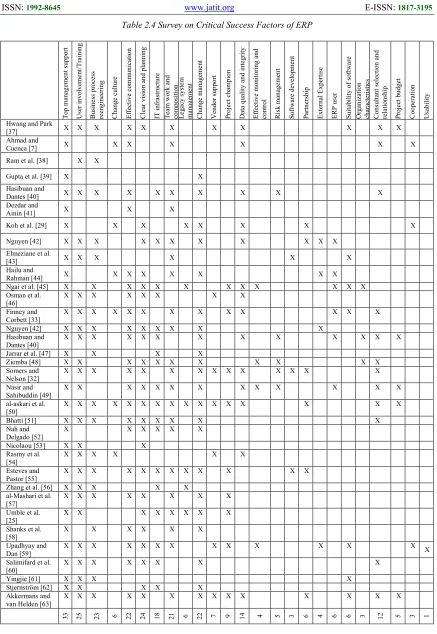
Table 2.4 Survey on Critical Success Factors of ERP
T o p m ana ge m en t su pp or t U se r invol ve m ent /T ra ini ng B us ine ss p roc es s re engi ne er ing C ha nge c ul tur e E ff ec ti ve c om m un ic at ion C le ar vi si on and p la nni ng IT i nf ra st ruc tur e T ea m w or k and com p os it ion L ega cy sys te m m ana ge m ent C ha nge m ana ge m ent V endor s u pp or t P ro je ct c ha m p ion D at a qua li ty and int egr it y E ff ec ti ve m oni tor in g and cont rol R is k m ana ge m ent S of tw a re de ve lo p m ent P ar tne rs h ip E xt er na l E x p er ti se E R P us er S ui ta b il it y of s of tw a re O rga ni za ti o n cha ra ct er is ti cs C ons ul ta nt s el ec ti on and re la ti ons hi p P ro je ct b ud ge t C oo p er at ion U sa b il it y
Hwang and Park
[37] X X X X X X X X X X X
Ahmad and
Cuenca [7] X X X X X X X
Ram et al. [38] X X
Gupta et al. [39] X X
Hasibuan and
Dantes [40] X X X X X X X X X X
Dezdar and
Ainin [41] X X X
Koh et al. [29] X X X X X X X X
Nguyen [42] X X X X X X X X X X X
Elmeziane et al.
[43] X X X X X X
Hailu and
Rahman [44] X X X X X X X X
Ngai et al. [45] X X X X X X X X X X X X
Osman et al. [46]
X X X X X X X X
Finney and Corbett [33]
X X X X X X X X X X X X X
Nguyen [42] X X X X X X X X X
Hasibuan and Dantes [40]
X X X X X X X X X X X X X
Jarrar et al. [47] X X X X
Ziemba [48] X X X X X X X X X X X
Somers and Nelson [32]
X X X X X X X X X X X X X X
Nasir and Sahibuddin [49]
X X X X X X X X X X X X X
al-askari et al. [50]
X X X X X X X X X X X X X X X X
Bhatti [51] X X X X X X X X X
Nah and Delgado [52]
X X X X X X
Nicolaou [53] X X X
Rasmy et al. [54]
X X X X X X
Esteves and Pastor [55]
X X X X X X X X X X X X
Zhang et al. [56] X X X X X
al-Mashari et al. [57]
X X X X X X X X
Umble et al. [25]
X X X X X X X X
Shanks et al. [58]
X X X X X X
Upadhyay and Dan [59]
X X X X X X X X X X X X X
X
Salimifard et al. [60]
X X X X X X X X
Yingjie [61] X X X X
Stjernström [62] X X X X X
Akkermans and van Helden [63]
X X X X X X X X X X X X X X
ISSN: 1992-8645 www.jatit.org E-ISSN: 1817-3195 The following factors are identified as crucial for
a successful ERP implementation: top management support, alignment, implementation team, role of consultants, data accuracy, change management programme, vendor support, product selection and its quality, present IT legacy system present, and business process reengineering. Upadhyay and Dan [59] made an attempt to identify those factors to ensure positive outcome of successful implementation of the enterprise planning systems on SMEs. The following issues are reflected importance for ensuring successful of implementation namely: clarity in goals and objectives behind implementation, adequacy of user training, competency in project implementation team, acceptance of changes brought about by implementation and adequate vendor support and participation of external consultants. According to al-Mashari et al. [6] success factors recognized as critical are found at various implementation phases levels like strategic, tactical and operational level. Factors found critical at the top management are such as support/commitment, benchmarking, change management, communication, business process reengineering, software configuration, alignment, consultation, software package selection, customization and role of project team. Upadhyay et al. [64] identified issues that would lead to the success of ERP implementation and discuss that: support from top management; goals and objectives; user knowledge; project champion; project team competency; improve work efficiency; scalability and scope and ERP are significant to the endeavour. On other hand, according to Hailu and Rahman [44], the CSFs for ERP implementation are clear and compelling vision, top management support, communication, change management, implementation team, cultural factors and external expertise. In the same way, Ngai et al. [45] and Annamalai and Ramayah [31] identified the critical factors influencing ERP implementation are performance measure, open and honest communication, and knowledge management. Ngai et al. [45] also carried out a comprehensive review, and many studies are based on their 18 categories of CSFs. Nguyen [42] was of the opinion that visioning and planning are closely related to the successful implementation of ERP systems.
This study does not emphasize on CSFs that appeared only once or twice in previous research such as scalability, project time, troubleshooting, and external expertise. Minor changes were made to some of the factors name in this review. For example, the term “executives” was replaced by
“top management”. Therefore, 26 CSFs have been classified in four categories i.e. organization, people, process, and technology as explained in section 4. The following comprehensive table shows the most frequently CSFs in previous study and, summary of CSFs that influence ERP implementation success based on several researches.
At this stage of the investigation, only the 10 most significant CSFs have been taken in consideration, selective the eleven significant factors, it is found that among the most influence, significant CSFs and the most frequent CSFs from literature review for ERP success. The CSFs identified in the ERP literature survey were classified in four categories, organizational, process, people, and technology dimensions. Figure 1 is explained the categories of CSFs that influence ERP usage success based on several researches
4. PROPOSED TAXONOMIC
FRAMEWORK OF ERP SUCCESS USAGE
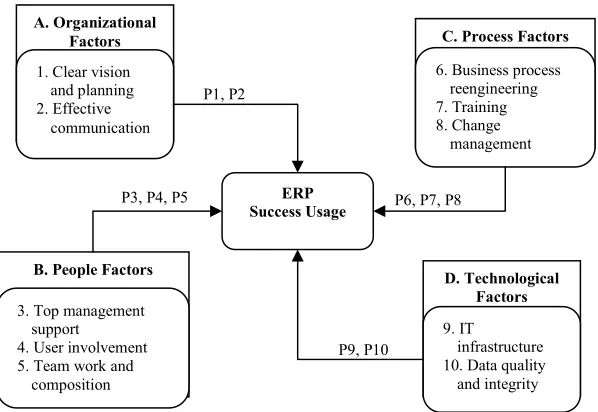
An understanding of the relevant theory(s) is fundamental in any research as it guides the researcher in producing a logical opinion of the relationship between several constructs when seeking to develop a model. This study intends to adapt and extend Wixom and Waston [65] statistical model of data warehouse success model. This study seeks to develop a taxonomic framework of ERP success usage which identified five interrelated variables for ERP success. These are organizational dimension, process dimension, technological dimension, people dimension, and ERP success usage (refer to figure 1).
ISSN: 1992-8645 www.jatit.org E-ISSN: 1817-3195 CSFs for the ERP usage projects. This study
extends Wixom and Watson [65] theory to categorize the ERP usage CSFs into four main factors of an ERP usage, i.e. organization, people, process, and technology which is in line with Hasibuan and Dantes [40]. This kind of classification gives a chance to stakeholders (chief executive officer, chief information officer, vendor, etc.) of ERP project to highlight the area in which problem may occur and evaluate ERP success usage from four collective points of view.
[image:6.612.164.463.229.435.2]In this study the top 10 factors critical for the ERP success are such as clear vision and planning, effective communication, top management support, user involvement, team work and composition, business process reengineering, training, change management, IT infrastructure, and data quality and integrity as shown in figure 1.
Figure 1: Taxonomic Framework of ERP Success Usage
This paper highlights that some of these factors are conjecture to play important role in the ERP usage. The presented factors should be clear, visible and understandable throughout the ERP usage process. Therefore these factors are termed as “predominant” and shown in figure 1.
A. Organizational Factors
1) Clear Vision and Planning
Planning and visioning is required during the ERP and BI process of adoption. It is crucial to obtain a clear business strategy and plan in order to lead to the project direction. Also, it is required to obtain a business model that is clear, informing the strategy the organization would use after the phases of implementation [45, 52]. Additionally, it has to be defined as the organization's most significant project and all decisions that are related to it have to be achieved before hand from the entire management team [67].
Proposition (P1): There is a positive relationship between level of clear vision and planning and ERP success usage
2) Effective Communications
Clear and effective communication at every different level within a company is required at the start and in the process of the application of ERP [68]. This communication is related to the formal development of teams for ERP projects and advertisements on progress and status of projects to other people in the company. Esteves and Pastor [55] have shown that communication that is effective is one of the important factors that leads to success, and impacts the overall acceptance of technology in an environment where ERP is applied.
Proposition (P2): There is a positive relationship between level of effective communications and ERP success usage
A. Organizational Factors
1. Clear vision and planning 2. Effective
communication
C. Process Factors
6. Business process reengineering 7. Training 8. Change
management
B. People Factors
3. Top management support
4. User involvement 5. Team work and
composition
D. Technological Factors
9. IT
infrastructure 10. Data quality and integrity
ERP Success Usage
P1, P2
P3, P4, P5 P6, P7, P8
ISSN: 1992-8645 www.jatit.org E-ISSN: 1817-3195 B. People Factors
3) Top Management Support
Top management support is the support by top managers or leaders, and also the engagement in and sustaining of actions that help others arrive at some set goal [69]. Schniederjans and Yadav [27] have referred to it through various facets, some of which are leadership involvement with the project, company support and leadership commitment. Top managers must have a leadership role that is driven by a sufficient commitment towards the organization.
Proposition (P3): There is a positive relationship between level of top Management support and ERP success usage
4) User Involvement
User involvement refers to the psychological state of the individual and is defined as the importance and personal relevance of a system to a user [51]. It is also defined as a user's participation in the usage process. The users will be involved in the stage of definition of the company’s ERP system needs and also in the implementation of this system.
Proposition (P4): There is a positive relationship between level of user involvement and ERP success usage
5) Teamwork and Composition
ERP projects commonly need a fixed mix of teams for implementation. Both business and technical capability have to exist in a team [70, 71]. Also, the people that make the decisions within the project team must be capable of taking fast and accurate decisions [58].
The literature on team composition and teamwork suggests that it is important for successful ERP usage. An ERP project involves all of the functional departments in an enterprise. It needs the cooperation of technical, business experts and external consultants as well as the involvement of end-users in different project phases [72, 73]. According to Bhatti [51] the ERP project team comprises of functional personnel and management, IT personnel and management, top management, ERP vendor, parent company employees, management consultants and the hardware member. The success of ERP projects is related to the knowledge, the skills, the abilities and
the experiences of the project team members but externals should be used as true consultants and not as long-term additions to internal staff [15]. External knowledge is often needed to facilitate successful implementation with the new technology [74].
Proposition (P5): There is a positive relationship between level of teamwork and composition and ERP success usage
C. Process Factors
6) Business Process Reengineering
Business process reengineering is recommended to be done in the process of ERP usage, in order to gain a competitive advantage for the company. It depends on the maturity level of organization, budget, and time available [40].
Proposition (P6): There is a positive relationship between level of business process reengineering and ERP success usage
7) Training
Training is a significant and crucial success factor. ERP usage needs knowledge to allow individuals to provide solutions to various issues within the model. If the employees do not have the knowledge of the way the model functions, the employees would consequently create their own processes with the use of those components of the model that they are capable of modifying. The user training may have up to 42.20% part in the determination of the overall success of an ERP usage. It is ultimately critical for the overall ERP adoption success. Since users have knowledge and comprehend the concepts of the newly implemented model sooner, the employees will obtain an overall positive attitude; their level of resistance to the new model will be greatly decreased; and training could be easily accepted. Additionally, the involvement of users is of help in the analysis of ERP configuration, in the data conversion process, and also in the testing of the model [33, 75, 76].
Proposition (P7): There is a positive relationship between level of training and ERP success usage
8) Change Management
ISSN: 1992-8645 www.jatit.org E-ISSN: 1817-3195 changes. Change management is a technique or
strategy to properly manage the transformation from the use of older models to the use of new models suitably. In the use of ERP, this aspect refers to the requirement for an organization and its corresponding employees to be ready for various kinds of changes. Particularly, an organization must formally create as early as possible a change management programme in order to handle the complicated problems in an organization, such as employee’s resistance, redundancies and confusion, and also errors that occur because of the newly implemented model [52].
Proposition (P8): There is a positive relationship between level of change management and ERP success usage
D. Technological Factors
9) Data Quality and Integrity
Accuracy of data is critically needed in order for an ERP model to correctly function [25]. An important need for the ERP system effectiveness is accurate data being readily available quickly [77].
Hence, corporate data may only be entirely combined and facilitated for more business worth as soon as the both the quality and integrity of the system are assured.
A great deal of hard work is input into obtaining the data correctly the first time, however, there is no sufficient time spent adjusting the data governance processes to make sure the quality of the data is sustained.
Proposition (P9): There is a positive relationship between level of data quality and integrity and ERP success usage
10) IT Infrastructure
IT infrastructure, or layout, is assumed to be a significant factor for the success of a business project [78]. The hardware must ensure for properly storing large volumes of data and its processes. Besides, the existing networks must be reliable, secure and fast. When those needs are satisfied, it would be of great benefit to the implementation phase and also the usage and maintenance phase [42].
Jarrar et al. [47] and al-Mashari, et al. [6] argues that sufficient IT infrastructure, networking and hardware are crucial for the success of an ERP
system. ERP facilitation comes with a complicated transformation from business processes and legacy information systems to a combined IT infrastructure and standard business process in the entire organization Bhatti [51]. The selection of hardware is decided by the organization’s choice of an ERP software system. The vendor of the ERP software validates which hardware (and hardware configurations) has to be implemented to run the ERP system. The IT Infrastructure factor has been assumed to be critical by both practitioners and academic researchers Bhatti [51].
Proposition (P10): There is a positive relationship between level of IT Infrastructure and ERP success usage
5. DISCCUSSION AND CONCLUSION
This paper makes a significant contribution to this area of research because the creation of a taxonomy can help to organize knowledge in relation to a topic. A taxonomy would help researchers by making their search easier as CSFs will be assigned to categories and the relationships between those categories will be defined.
Identifying CSFs leading to the success or the failure of ERP systems is of increasing importance [79]. From a practical point of view, understanding CSFs is a key for successful usage of a ERP system. Further research is being carried out to study in which stage each CSFs might have its critical role and their impact as overall. It is anticipated that the holistic view of the interrelationship of CSFs among the different stages of the implementation would provide a better approach of identifying CSFs for measuring the utilization of ERP. SMEs in Middle East region will be able to benefit from ERP usage systems. The ERP vendors are now trying to extend their market to companies in Middle East countries, SMEs. A believed that, those conducting research on SMEs might compile a different set of CSFs to those conducting research on large organization. Therefore, it would also be valuable to prepare a taxonomy based framework on CSFs relating to ERP projects in SMEs.
ISSN: 1992-8645 www.jatit.org E-ISSN: 1817-3195 interaction level among the CSFs. These CSFs
cannot be applied to ERP systems without giving careful consideration to the relevant contextual issues. Therefore, the individual evaluation of each CSF involved in the implementation process is crucial to reduce the number of difficulties encountered in the past and maximize the benefits from the utilization of ERP systems.
This paper add to the body of knowledge by identifying the CSFs that impact on ERP system usage. The new proposed model extends the current theory by identify and classify of various CSFs into (organizational, people, process, technological) factors. These classification would help researchers by making their search easier as CSFs will be assigned to categories and the relationships between those categories will be defined. The result of this work highlights those CSFs that need to be addressed, and it also points out those that are not so critical. Hence, it focuses attention on those important areas that might otherwise be neglected or taken for granted but are significant for the success usage.
This research also has practical contribution whereby SMEs would be better able to identify those CSFs that enhance the likelihood of success. Those CSFs should give attention to ensure receiving continuous management scrutiny. Also this finding could assist senior management by optimizing their scarce resources on those key areas that would improve the utilization process.
REFRENCES:
[1] D. Caruso, "The world class challenge: six critical issues midmarket manufacturers must address," AMR Research, Boston, MA, 2003. [2] M. I. Nofal and Z. M. Yusof, "Critical success
factors enhancing enterprise resource planning systems implementation in Jordanian SMEs,"
in Electrical Engineering and Informatics
(ICEEI), 2015 International Conference on, 2015, pp. 98-103.
[3] M. I. Nofal and Z. M. Yusof, "Integration of Business Intelligence and Enterprise Resource Planning within Organizations," Procedia Technology, vol. 11, pp. 658-665, 2013. [4] R. Seethamraju, "Adoption of Software as a
Service (SaaS) Enterprise Resource Planning (ERP) Systems in Small and Medium Sized Enterprises (SMEs)," Information Systems Frontiers, pp. 1-18, 2014.
[5] V. Farrokhi and L. Pokoradi, "The necessities for building a model to evaluate Business Intelligence projects-Literature Review," arXiv preprint arXiv:1205.1643, 2012. [6] M. al-Mashari, M. Zairi, and A. al-Mudimigh,
"ERP implementation: An integrative methodology," in I3E 01 Proceedings of the IFIP Conference on Towards The E-Society: E-Commerce, E-Business and E-Government, 2010.
[7] M. M. Ahmad and R. Pinedo Cuenca, "Critical success factors for ERP implementation in SMEs," Robotics and
Computer-Integrated Manufacturing, vol. 29,
pp. 104-111, 2013.
[8] D. L. Olson and J. Staley, "Case study of open-source enterprise resource planning implementation in a small business,"
Enterprise Information Systems, vol. 6, pp.
79-94, 2012.
[9] P. Poba-Nzaou, L. Raymond, and B. Fabi, "Adoption and risk of ERP systems in manufacturing SMEs: a positivist case study,"
Business Process Management Journal, vol.
14, pp. 530-550, 2008.
[10] S. Chong, "Business process management for SMEs: an exploratory study of implementation factors for the Australian wine industry," Journal of Information Systems and Small Business, vol. 1, pp. 41-58, 2014. [11] F. N. al-Aboud, "A Model Approach for the
Analysis of Dominant Factors in ERP Software Implementation," IJCSNS, vol. 11, p. 179, 2011.
[12] M. J. Benner and M. Tripsas, "The influence of prior industry affiliation on framing in nascent industries: the evolution of digital cameras," Strategic Management Journal, vol. 33, pp. 277-302, 2012.
[13] C. Annamalai and T. Ramayah, "Enterprise resource planning (ERP) benefits survey of Indian manufacturing firms: An empirical analysis of SAP versus Oracle package,"
Business Process Management Journal, vol.
17, pp. 495-509, 2011.
[14] T. Minahan, "Enterprise Resource Planning: Strategies not Included. Retrieved August 25, 2009," ed, 1998.
[15] M. al-Mashari, S. K. Ghani, and W. al-Rashid, "A study of the critical success factors of ERP implementation in developing countries,"
International Journal of Internet and
Enterprise Management, vol. 4, pp. 68-95,
ISSN: 1992-8645 www.jatit.org E-ISSN: 1817-3195 [16] P. Hawking and C. Sellitto, "Critical Success
Factors of Business Intelligence (BI) in an ERP Systems Environment," 2010.
[17] F. A. Goni, A. G. Chofreh, M. Mukhtar, S. Sahran, and S. A. Shukor, "Segments and Elements Influenced on ERP System Implementation," Australian Journal of Basic & Applied Sciences, vol. 6, 2012.
[18] J. F. Rockart, "Chief executives define their own data needs," harvard business review, vol. 57, pp. 81-93, 1979.
[19] J. K. Leidecker and A. V. Bruno, "Identifying and using critical success factors," Long range planning, vol. 17, pp. 23-32, 1984.
[20] V. Bharathi and S. Parikh, "A Comparative Study on the Conceptual and Contextual Perception about CSF for ERP Adoption in the SMEs," Researchers World Journal of
Arts, Science & Commerce, vol. 3, pp. 38-46,
2012.
[21] D. Ellsberg, "Risk, ambiguity, and the Savage axioms," The quarterly journal of economics, pp. 643-669, 1961.
[22] J. Ram, D. Corkindale, and M.-L. Wu, "ERP adoption and the value creation: Examining the contributions of antecedents," Journal of Engineering and Technology Management, vol. 33, pp. 113-133, 2014.
[23] C. V. Bullen and J. F. Rockhart, "A primer on critical success factors," Center for
Information Systems Research Working, p. 7,
1981.
[24] J. F. Rockart, "Chief executives define their own data needs," Harvard business review, vol. 57, pp. 81-93, 1978.
[25] E. J. Umble, R. R. Haft, and M. M. Umble, "Enterprise resource planning: Implementation procedures and critical success factors," European journal of
operational research, vol. 146, pp. 241-257,
2003.
[26] M. P. Méxas, O. L. G. Quelhas, and H. G. Costa, "Prioritization of enterprise resource planning systems criteria: Focusing on construction industry," International Journal
of Production Economics, vol. 139, pp.
340-350, 2012.
[27] D. Schniederjans and S. Yadav, "Successful ERP implementation: an integrative model,"
Business Process Management Journal, vol.
19, pp. 364-398, 2013.
[28] M. L. Markus and C. Tanis, "The enterprise systems experience-from adoption to success,"
Framing the domains of IT research:
Glimpsing the future through the past, vol.
173, pp. 207-173, 2000.
[29] S. L. Koh, A. Gunasekaran, and T. Goodman, "Drivers, barriers and critical success factors for ERPII implementation in supply chains: A critical analysis," The Journal of Strategic
Information Systems, vol. 20, pp. 385-402,
2011.
[30] X. J. He, "The ERP challenge in China: a resource‐based perspective," Information Systems Journal, vol. 14, pp. 153-167, 2004. [31] C. Annamalai and T. Ramayah, "Does the
organizational culture act as a moderator in Indian enterprise resource planning (ERP) projects?: An empirical study," Journal of Manufacturing Technology Management, vol. 24, pp. 555 - 587, 2013.
[32] T. M. Somers and K. Nelson, "The impact of critical success factors across the stages of
enterprise resource planning
implementations," in System Sciences, 2001. Proceedings of the 34th Annual Hawaii International Conference on, 2001, p. 10 pp. [33] S. Finney and M. Corbett, "ERP
implementation: a compilation and analysis of critical success factors," Business Process
Management Journal, vol. 13, pp. 329-347,
2007.
[34] M. I. M. Nofal and Z. M. Yusof, "Conceptual model of enterprise resource planning and business intelligence systems usage," International Journal of Business Information Systems, vol. 21, pp. 178-194, 2016.
[35] J. Dawson and J. Owens, "Critical success factors in the chartering phase: a case study of an ERP implementation," International Journal of Enterprise Information Systems (IJEIS), vol. 4, pp. 9-24, 2008.
[36] D. H. Brown and S. He, "Patterns of ERP adoption and implementation in China and some implications," Electronic Markets, vol. 17, pp. 132-141, 2007.
[37] H. J. Hwang and Y. J. Park, "Kazakhstan
Perspectives on ERP System
Implementation," development, vol. 8, 2014. [38] J. Ram, M.-L. Wu, and R. Tagg, "Competitive
advantage from ERP projects: Examining the role of key implementation drivers," International Journal of Project Management, vol. 32, pp. 663-675, 2014.
ISSN: 1992-8645 www.jatit.org E-ISSN: 1817-3195 Implementing and Evaluating ERP in Small
and Medium Scale Industries," International Journal, vol. 3, 2014.
[40] Z. A. Hasibuan and G. R. Dantes, "Priority of Key Success Factors (KSFS) on Enterprise Resource Planning (ERP) System Implementation Life Cycle," Journal of
Enterprise Resource Planning Studies, vol.
2012, pp. 1-15, 2012.
[41] S. Dezdar and S. Ainin, "Examining successful ERP projects in Middle-East and South-East Asia," American Journal of Scientific Research, vol. 56, pp. 13-56, 2012. [42] H. V. Nguyen, "Critical Success Factors for
ERP Adoption Process," 2011.
[43] K. Elmeziane, S. Chuanmin, and M. Elmeziane, "Critical success factors of enterprise resource planning implementation in China: Case study in Shanghai city, China,"
in E-Business and E-Government (ICEE),
2011 International Conference on, 2011, pp. 1-4.
[44] A. Hailu and S. S. Rahman, "Evaluation of Key Success Factors Influencing ERP Implementation Success," in Services (SERVICES), 2012 IEEE Eighth World Congress on, 2012, pp. 88-91.
[45] E. W. Ngai, C. C. Law, and F. K. Wat, "Examining the critical success factors in the adoption of enterprise resource planning,"
Computers in Industry, vol. 59, pp. 548-564,
2008.
[46] M. Osman, R. M. Yusuff, S. Tang, and S. M. Jafari, "ERP systems implementation in Malaysia: the importance of critical success factors," International Journal of Engineering and Technology, vol. 3, pp. 125-131, 2006. [47] Y. F. Jarrar, A. al-Mudimigh, and M. Zairi,
"ERP implementation critical success factors-the role and impact of business process management," in Management of Innovation
and Technology, 2000. ICMIT 2000.
Proceedings of the 2000 IEEE International Conference on, 2000, pp. 122-127.
[48] E. Ziemba, "Conceptual model of information technology support for prosumption," in Proceedings of the International Conference on Management, Leadership and Governance, 2013, pp. 355-363.
[49] M. H. N. Nasir and S. Sahibuddin, "Critical success factors for software projects: A comparative study," Scientific research and essays, vol. 6, pp. 2174-2186, 2011.
[50] O. al-askari, M. Ahmad, N. Dhafr, and R. Pinedo-Cuenca, "Critical successful factors (CSFs) for successful implementation of lean tools and ERP systems," 2013.
[51] T. Bhatti, "Critical success factors for the implementation of enterprise resource planning (ERP): empirical validation," in the second international conference on innovation in information technology, 2005, p. 110. [52] F.-H. Nah and S. Delgado, "Critical success
factors for enterprise resource planning implementation and upgrade," Journal of Computer Information Systems, vol. 46, p. 99, 2006.
[53] A. I. Nicolaou, "Firm performance effects in relation to the implementation and use of enterprise resource planning systems,"
Journal of Information Systems, vol. 18, pp.
79-105, 2004.
[54] M. Rasmy, A. Tharwat, and S. Ashraf, "Enterprise resource planning (ERP) implementation in the Egyptian organizational context," in Proceedings of the EMCIS International Conference, 2005.
[55] J. Esteves and J. Pastor, "Enterprise resource planning systems research: an annotated bibliography," Communications of the Association for Information Systems, vol. 7, p. 8, 2001.
[56] L. Zhang, M. K. Lee, Z. Zhang, and P. Banerjee, "Critical success factors of enterprise resource planning systems implementation success in China," in System Sciences, 2003. Proceedings of the 36th Annual Hawaii International Conference on, 2003, p. 10 pp.
[57] M. al-Mashari, A. al-Mudimigh, and M. Zairi, "Enterprise resource planning: A taxonomy of critical factors," European journal of
operational research, vol. 146, pp. 352-364,
2003.
[58] G. Shanks, A. Parr, B. Hu, B. Corbitt, T. Thanasankit, and P. Seddon, "Differences in critical success factors in ERP systems implementation in Australia and China: a cultural analysis," ECIS 2000 Proceedings, p. 53, 2000.
ISSN: 1992-8645 www.jatit.org E-ISSN: 1817-3195 [60] K. Salimifard, M. Ebrahimi, and M. A.
Abbaszadeh, "Notice of Retraction Investigating critical success factors in ERP implementation projects," in Advanced Management Science (ICAMS), 2010 IEEE International Conference on, 2010, pp. 82-86. [61] J. Yingjie, "Critical success factors in ERP
implementation in Finland," Sweden: The Swedish school of economics and business administration, 2005.
[62] L. Stjernström, "Chaos and complexity in ERP implementations-a literature review of Critical Success Factors within ERP implementation or adoption," in Scandinavian Academy of Management (NFF) Conference, 2003, pp. 1-7.
[63] H. Akkermans and K. van Helden, "Vicious and virtuous cycles in ERP implementation: a case study of interrelations between critical success factors," European journal of information systems, vol. 11, pp. 35-46, 2002. [64] P. Upadhyay, R. Basu, R. Adhikary, and P. K.
Dan, "A comparative study of issues affecting ERP implementation in large scale and small medium scale enterprises in India: A Pareto approach," International Journal of Computer Applications, vol. 8, pp. 23-28, 2010.
[65] B. H. Wixom and H. J. Watson, "An empirical investigation of the factors affecting data warehousing success," MIS quarterly, pp. 17-41, 2001.
[66] C. P. Holland, B. Light, and N. Gibson, "A Critical Success Factors Model for Enterprise Resource Planning Implementation," in ECIS, 1999, pp. 273-287.
[67] U. Remus, "Critical success factors for implementing enterprise portals: A comparison with ERP implementations,"
Business Process Management Journal, vol.
13, pp. 538-552, 2007.
[68] F. F. H. Nah, K. M. Zuckweiler, and J. L. S. Lau, "ERP implementation: chief information officers' perceptions of critical success factors," International Journal of Human-Computer Interaction, vol. 16, pp. 5-22, 2003. [69] J. Martin, Stories and scripts in organizational
settings: Graduate School of Business, Stanford University, 1980.
[70] D. Allen, T. Kern, and M. Havenhand, "ERP critical success factors: an exploration of the contextual factors in public sector institutions," in System Sciences, 2002. HICSS. Proceedings of the 35th Annual
Hawaii International Conference on, 2002, pp. 3062-3071.
[71] S. F. King and T. F. Burgess, "Beyond critical success factors: A dynamic model of enterprise system innovation," International
Journal of Information Management, vol. 26,
pp. 59-69, 2006.
[72] W. R. King, "Ensuring ERP implementation success," Information Systems Management, vol. 22, 2005.
[73] J. Magnusson, A. Nilsson, and F. Carlsson, "Forecasting ERP implementation success-Towards a grounded framework," ECIS 2004 Proceedings, p. 75, 2004.
[74] M. Sumner, "Critical success factors in enterprise wide information management systems projects," in Proceedings of the 1999 ACM SIGCPR conference on Computer personnel research, 1999, pp. 297-303. [75] J. Yingjie, "Critical success factors in ERP
implementation in Finland," The Swedish
School of Economics and Business
Administration, vol. 71, 2005.
[76] O. Françoise, M. Bourgault, and R. Pellerin, "ERP implementation through critical success factors' management," Business Process
Management Journal, vol. 15, pp. 371-394,
2009.
[77] Y. Van Everdingen, J. Van Hillegersberg, and E. Waarts, "Enterprise resource planning: ERP adoption by European midsize companies," Communications of the ACM, vol. 43, pp. 27-31, 2000.
[78] H. S. Woo, "Critical success factors for implementing ERP: the case of a Chinese electronics manufacturer," Journal of Manufacturing Technology Management, vol. 18, pp. 431-442, 2007.