R E S E A R C H
Open Access
Comparison of registered and published
intervention fidelity assessment in cluster
randomised trials of public health
interventions in low- and middle-income
countries: systematic review
Myriam Cielo Pérez
1,2, Nanor Minoyan
1,2, Valéry Ridde
3,4, Marie-Pierre Sylvestre
1,2and Mira Johri
1,5*Abstract
Background:
Cluster randomised trials (CRTs) are a key instrument to evaluate public health interventions. Fidelity
assessment examines study processes to gauge whether an intervention was delivered as initially planned. Evaluation
of implementation fidelity (IF) is required to establish whether the measured effects of a trial are due to the intervention
itself and may be particularly important for CRTs of complex interventions conducted in low- and middle-income
countries (LMICs). However, current CRT reporting guidelines offer no guidance on IF assessment. The objective of this
review was to study current practices concerning the assessment of IF in CRTs of public health interventions in LMICs.
Methods:
CRTs of public health interventions in LMICs that planned or reported IF assessment in either the trial protocol
or the main trial report were included. The MEDLINE/PubMed, CINAHL and EMBASE databases were queried from January
2012 to May 2016. To ensure availability of a study protocol, CRTs reporting a registration number in the abstract were
included. Relevant data were extracted from each study protocol and trial report by two researchers using a predefined
screening sheet. Risk of bias for individual studies was assessed.
Results:
We identified 90 CRTs of public health interventions in LMICs with a study protocol in a publicly available trial
registry published from January 2012 to May 2016. Among these 90 studies, 25 (28%) did not plan or report assessing IF;
the remaining 65 studies (72%) addressed at least one IF dimension. IF assessment was planned in 40% (36/90) of trial
protocols and reported in 71.1% (64/90) of trial reports. The proportion of overall agreement between the trial protocol
and trial report concerning occurrence of IF assessment was 66.7% (60/90). Most studies had low to moderate risk of bias.
Conclusions:
IF assessment is not currently a systematic practice in CRTs of public health interventions carried out in
LMICs. In the absence of IF assessment, it may be difficult to determine if CRT results are due to the intervention design,
to its implementation, or to unknown or external factors that may influence results. CRT reporting guidelines should
promote IF assessment.
Trial Registration:
Protocol published and available at:
https://doi.org/10.1186/s13643-016-0351-0
Keywords:
Cluster randomised trials, Intervention fidelity, Public health interventions, Process evaluation, Developing
countries, Systematic review
* Correspondence:[email protected]
1Centre de Recherche du Centre Hospitalier de l’Université de Montréal (CRCHUM), 900, rue Saint-Denis, Pavillon R, Tour Saint-Antoine Porte S03.414, Montréal, Québec H2X 0A9, Canada
5Département de gestion, d’évaluation, et de politique de santé, École de santé publique, Université de Montréal, 7101, avenue du Parc, 3e étage, Montréal, Québec H3N 1X9, Canada
Full list of author information is available at the end of the article
Background
Cluster randomised trials (CRTs) have become a key
instru-ment to evaluate public health interventions [
1
–
7
],
particu-larly in low- and middle-income countries (LMICs) [
3
,
8
].
Randomised controlled trials (RCTs) are widely considered
to provide the highest quality of evidence on the
effective-ness of health interventions [
9
–
12
], and CRTs are a form of
randomised trial in which clusters of individuals (such as
families, villages, hospital services or schools), rather than
independent individuals, are randomly allocated to
inter-vention or control groups [
2
]. Increasingly, public health
re-searchers recognise the importance of developing health
interventions that target populations rather than individuals
and can address the wide range of social and environmental
factors influencing health [
13
,
14
]. CRTs offer an
appropri-ate design to assess such public health interventions as well
as to measure the overall effect of an intervention at the
population level [
3
,
5
,
8
,
13
,
15
], heterogeneity of impact
among population subgroups and equity [
16
,
17
].
Intervention fidelity in CRTs of public health interventions
Recent methodologically oriented systematic reviews
have found evidence of improvements in the design and
analysis of CRTs, while also noting deficiencies in trial
implementation [
18
,
19
]. Previous systematic reviews
have emphasised the potential importance of process
evaluation to mitigate these methodological problems,
which can affect the internal and external validity of trial
results [
3
,
18
,
20
–
22
].
‘
Intervention fidelity
’
refers to the degree to which an
intervention is delivered as initially planned [
23
]. Fidelity
assessment is the practice of evaluating intervention
delity. Considered an aspect of process evaluation,
fi-delity assessment aims to understand and measure to
what extent the intervention is being implemented as
intended and identify specific reasons for the success
or failure of the intervention [
9
,
23
,
24
]. The benefits
of evaluating intervention fidelity include increased
confidence in scientific findings, increased power to
control for confounding factors and increased ability
to evaluate the performance of theory-based
interven-tions [
25
]. Fidelity assessment can improve internal
and external validity of CRTs [
18
] by providing
evi-dence that trial results are due to interventions
them-selves rather than to external factors and facilitating
generalisation of results to contexts that may differ
substantially from the original trial setting [
9
,
23
].
Fi-delity assessment may be particularly important for
public health interventions, as these interventions
tend to be complex and constituted by multiple
com-ponents [
10
,
26
] that act independently or
interdepen-dently [
27
], allowing greater potential for variation
during implementation [
23
].
Framework for the evaluation of implementation fidelity
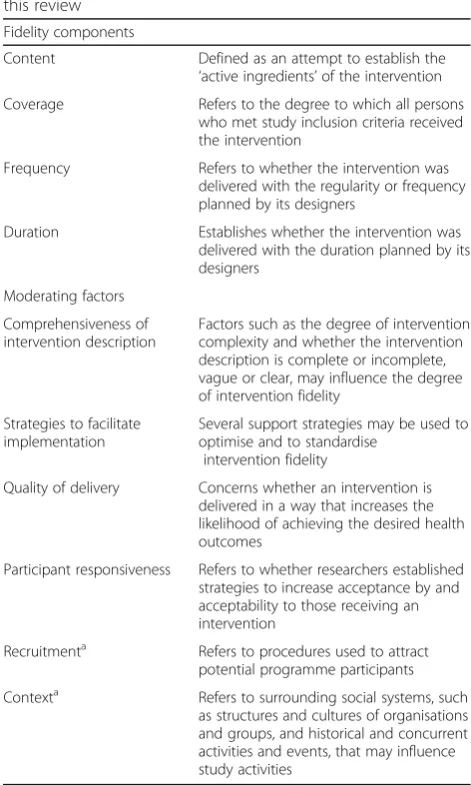
Table
1
outlines the conceptual framework used in this
review, based on the work of Carroll et al. [
23
] and
re-fined by Hasson [
28
]. We selected this framework to
guide the review because it provides a comprehensive
synthesis of previous work on intervention fidelity and
has been widely influential.
Fidelity assessment in CRT reporting guidelines
[image:2.595.303.539.322.715.2]The Consolidated Standards of Reporting Trials
(CON-SORT) group was created to provide guidance to
im-prove the quality and transparency of RCT reporting
[
29
], including CRTs [
2
,
30
]. The CONSORT statement
recognises that the trial protocol for a given study may
not have been followed fully by some trial participants
for a wide variety of reasons, including failure to receive
the entire intervention as planned [
29
]. Cases of protocol
Table 1
Conceptual framework for intervention fidelity used in
this review
Fidelity components
Content Defined as an attempt to establish the ‘active ingredients’of the intervention Coverage Refers to the degree to which all persons
who met study inclusion criteria received the intervention
Frequency Refers to whether the intervention was delivered with the regularity or frequency planned by its designers
Duration Establishes whether the intervention was delivered with the duration planned by its designers
Moderating factors
Comprehensiveness of intervention description
Factors such as the degree of intervention complexity and whether the intervention description is complete or incomplete, vague or clear, may influence the degree of intervention fidelity
Strategies to facilitate implementation
Several support strategies may be used to optimise and to standardise
intervention fidelity
Quality of delivery Concerns whether an intervention is delivered in a way that increases the likelihood of achieving the desired health outcomes
Participant responsiveness Refers to whether researchers established strategies to increase acceptance by and acceptability to those receiving an intervention
Recruitmenta Refers to procedures used to attract potential programme participants
Contexta Refers to surrounding social systems, such as structures and cultures of organisations and groups, and historical and concurrent activities and events, that may influence study activities
Adapted from Carroll et al. [23] a
non-adherence may influence interpretation and
credibil-ity of the results and thus the validcredibil-ity of the conclusions
[
18
,
25
,
31
,
32
]. To preserve the ability to make strong
in-ferences about intervention effects, CONSORT
recom-mends that all participants randomised be retained in the
analysis and analysed according to their original assigned
groups, an approach known as
‘
intention-to-treat
’
(ITT)
analysis.
Reasons for protocol non-adherence in individually
ran-domised RCTs may differ from those in CRTs. In a clinical
trial setting, non-adherence depends largely on the actions
of the trial participant and the treatment provider, which
may in turn be related to issues such as treatment side
ef-fects and safety. In CRTs of public health interventions,
protocol non-adherence may occur because complex
in-terventions that include multiple components are
deliv-ered with poor fidelity. However, both for individually
randomised parallel group trials [
29
] and CRTs [
2
,
30
],
current CONSORT guidelines offer no advice on methods
to assess protocol non-adherence.
Rationale for undertaking this review
As earlier methodologically oriented systematic reviews
have demonstrated, CRTs of complex public health
inter-ventions may be particularly at risk of experiencing
proto-col deviations and non-adherence, and these may
compromise the validity of their findings [
18
,
19
].
Al-though process evaluation techniques, such as evaluation
of intervention fidelity, can help to identify these problems
and mitigate their negative effects, current reporting
guidelines for CRTs offer no specific guidance on
inter-vention fidelity assessment. Wide divergence in current
practices is therefore likely. We undertook a
methodo-logically oriented systematic review of current practices
related to assessment of intervention fidelity within CRTs
of public health interventions in LMICs, so as to inform
best practices for CRTs. To our knowledge, no other
sys-tematic review addresses this question. Although CRTs
have been widely implemented to evaluate public health
interventions in both high-income countries and LMIC
contexts, interventions, approaches and outcomes may
differ substantially between settings. Given the limitations
of the resources, these challenges may be even more
im-portant in CRTs of public health interventions in LMICs.
We therefore limit our focus to LMICs.
Objective
We conducted a methodologically oriented systematic
review to address the following research questions:
1. What proportion of recent CRTs of public health
interventions in LMICs planned to assess
intervention fidelity (IF)?
2. What proportion of recent CRTs of public health
interventions in LMICs reported assessing IF?
3. Which fidelity components were examined and
which data collection methods were employed to
assess each component?
4. Is there evidence of divergent practices between
planned and reported studies?
Methods
We report results according to the Preferred Reporting
Items
for
Systematic
Reviews
and
Meta-Analyses
(PRISMA) guidelines [
33
]; the PRISMA checklist is
available in an online supplement (Additional file
1
). For
a detailed description of the methods, see the published
protocol [
34
] (doi:
https://doi.org/10.1186/s13643-016-03
51-0
). Some technical modifications were made while
implementing the review. We report the date for each
change in italics, along with the rationale.
Study eligibility
Study designs
We included all CRTs. For the purposes of this review, a
CRT is defined as a trial in which
“
intact social units or
clusters of individuals, rather than independent
individ-uals, are randomly allocated to intervention groups
”
[
30
]. CRTs may include trials employing parallel group,
stepped wedge, factorial, adaptive or pragmatic designs,
among others.
Participants
Study participants were humans living in LMICs
accord-ing to the World Bank country classifications [
35
].
Interventions
This review focuses on
‘
public health interventions
’
.
Fol-lowing Rychetnik et al. [
36
,
37
], we define a public health
intervention as a disease prevention or health promotion
intervention applied to many, most or all members in a
community, which aims to deliver a net benefit to the
community or population, as well as benefits to
individ-uals. Assessment of intervention fidelity may be especially
important for public health interventions, which are
in-herently
“
complex, programmatic, and context dependent
”
[
36
]. In order to operationalise this definition and guide
study inclusion decisions, we used the Minnesota
Depart-ment of Health
‘
Intervention Wheel
’
[
38
].
Comparators
Comparators were defined as per the original CRT.
Outcomes
such as a published article, an online appendix to the main
paper, or a grey literature report, in lieu of reporting
as-sessment of IF in the main trial report only. We
consid-ered studies as evaluating IF if they proposed or
implemented methods to assess at least one of the four
key fidelity components, namely (1) content, (2) coverage,
(3) frequency and (4) duration.
Report characteristics
Availability of the study protocol
To ensure availability of a study protocol, we included
CRTs reporting a registration number in the abstract for
any registry meeting WHO Trial Registration Data Set
criteria [
39
]. The Trial Registration Data Set was used in
this review to evaluate planned assessment of
interven-tion fidelity, either alone or in conjuncinterven-tion with a
pub-lished study protocol.
Exclusion criteria
We excluded studies that (1) were not cluster
rando-mised trials, (2) did not plan or report assessment of IF,
(3) were not public health interventions, (4) were
con-ducted in high-income countries [
35
], (5) were published
before 2012, (6) did not have a publicly available
proto-col or (7) for which only the protoproto-col but not the main
trial report has been published. Manuscripts were also
excluded if they were (8) pilot studies, (9) secondary
re-ports of a main study for which the relevant findings
were published prior to 2012, date of the last update to
the CONSORT Statement to improve reporting of CRTs,
(10) studies published in a language other than English,
Spanish or French, or (11) CRT trials published only in
the grey literature.
Information sources and search strategy
Literature search strategies were developed in
collabor-ation with an academic librarian. The search strategy
was limited to the period from January 2012 to May
2016 and, due to resource constraints, was not updated
towards the end of the review (
12-07-2017
). Search
strat-egies used MESH and text words related to cluster
ran-domised trials, developing countries and public health
interventions. The electronic database search was
devel-oped first for MEDLINE (ovid) and then adapted for
EMBASE (ovid), CINAHL (ovid), PubMed and EMB
Re-views (ovid). The full search strategy is available in an
online supplement (Additional file
2
). Searches were
fil-tered to articles concerning humans, written in English,
French or Spanish. We added relevant studies as
sug-gested by the review team. Identified records were
uploaded into EndNote software and duplicates were
eliminated.
Study screening and selection
Study screening and selection were performed manually
within EndNote. To ensure the availability of study
proto-cols, we limited the search to CRTs that have the word
“
regist*
”
in the abstract and used these results to begin the
process of screening and selection. We validated this
pro-cedure by examining a subset of excluded articles.
Screen-ing and selection were performed in two stages by two
independent reviewers (MCP and NM). In the first stage,
reviewers independently screened the titles and abstracts
of each identified reference against the inclusion criteria
to eliminate irrelevant publications. In the second stage,
each reviewer independently screened the full text of all
studies that appeared to meet the inclusion criteria, or for
which eligibility was uncertain. For each study, reviewers
identified additional articles of potential relevance by
reviewing references from the main trial report, consulting
the trial registry record and searching the PubMed
data-base for new publications by the lead trial author or using
trial identifiers. To aid in article screening and selection,
the team developed and tested a full text screening sheet.
Any disagreements between reviewers were resolved
through discussion and, as necessary, through arbitration
by a third author (MJ). A summary table describing
studies excluded with reasons is available in an online
supplement (Additional file
3
).
Data extraction and data items
According to our protocol, two review authors would
extract data independently. Given the volume and
com-plexity of materials to review, it was not practical for
both reviewers to abstract data independently. We
adopted the following procedure (
20-09-2016
): included
studies were randomly assigned to each of the two
re-viewers. Relevant data were extracted from each study
protocol and trial report by one reviewer (MCP or NM)
and cross-checked by the other reviewer (MCP or NM).
To ensure high quality data extraction and to reach
con-sensus, frequent meetings were held by the two
re-viewers (MCP and NM), including a third author (MJ)
when necessary.
Outcomes and prioritisation
Primary outcome
The primary outcome for this study was the proportion
of overall agreement between the protocol and trial
re-port concerning occurrence of IF assessment. This
cor-responds to research question 4. Data were summarised
in a two-by-two table comparing assessment of
interven-tion fidelity in the trial report to that in the protocol.
‘
N
’
represents the set of recently published CRTs of public
health interventions in LMICs that have registered the
study protocol in a publicly availably trial registry. For
each CRT in N, we determined whether IF was assessed
in the registered (or published) protocol or in the trial
report (or associated documents). Studies judged to have
assessed IF were coded as
“
1
”
; others were coded as
“
0
”
.
The proportion of overall agreement is defined as the
proportion of eligible CRTs for which the protocol and
the trial report agree in the practice of intervention
fidel-ity assessment (i.e. both positive or both negative). It
was computed as (a+d) /N.
Protocol
+ –
Trial Report + a b a + b
–c d c + d
a + c b + d N
Secondary outcomes
To address research questions 1, 2 and 3, we also
calculated:
The frequency and proportion of trial protocols
reporting assessment of intervention fidelity, out of N
The frequency and proportion of trial reports
reporting assessment of intervention fidelity, out of N
The proportion of positive agreement among those
that agree, computed as a/(a+d)
Frequency counts and percentages summarising
fidelity components examined and data collection
methods proposed or employed
Risk of bias in individual studies
We used the Cochrane Collaboration tool to assess the
risk of bias in individually randomised trials [
40
] and
included additional criteria relevant to assessing risk of
bias in CRTs [
40
–
42
], which are available in an online
supplement (Additional file
4
). We assessed each
criterion as low, high or uncertain risk, and provided a
sample text that illustrates the reasons for this
judgment. The initial evaluation was performed by the
primary reviewer (MCP or NM) and verified by the
other reviewer (MCP or NM). In case of doubt, a third
reviewer (MJ) was consulted. To investigate whether
study quality influences IF practices, we stratified the
sample to create categories of low risk studies (7 or
more of the 10 criteria were evaluated as low risk, n =
36 studies), versus uncertain or high-risk studies (6 or
fewer of the 10 criteria were evaluated as low risk, n =
29 studies). Cut-points were chosen empirically to create
groups of roughly equal size.
Data synthesis
A narrative synthesis was used to explore relationships
and findings within and between the included studies.
As our review focuses on methodological issues, we did
not assess potential publication bias.
Results
Study selection
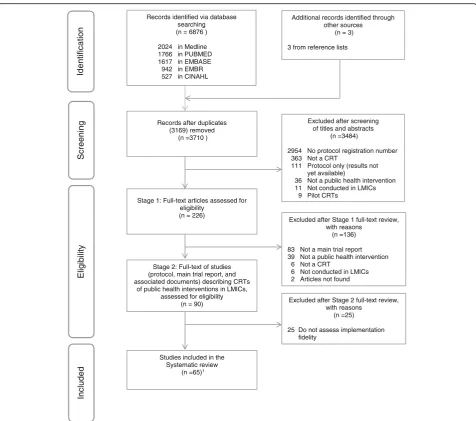
The electronic search identified 6876 publications, of
which 226 potentially relevant studies were assessed in
full text. Stage 1 of the full text review was used to
define the study denominator, as follows: of the 226
articles screened, 90 were CRTs of public health
interventions in LMICs with a study protocol in a
publicly available trial registry published from January
2012 to May 2016. In Stage 2 of the full text review, we
reviewed these 90 studies to identify those that in
addition considered IF in either the protocol, the trial
report or both. We excluded 25 studies (28%) that did
not plan or report assessing IF. The remaining 65
studies addressed at least one IF dimension [
43
–
107
].
Figure
1
shows the PRISMA flow chart.
Study characteristics
The 65 studies were published in English between
January 2012 and May 2016. The included studies are
very diverse in terms of sample size and target
population, ranging from 190 to more than 280,000
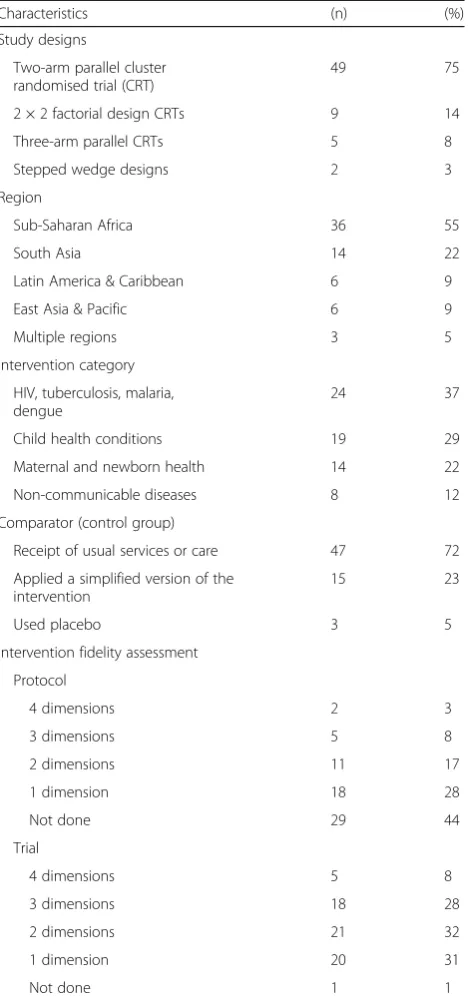
eligible participants per study. Table
2
presents general
characteristics of the studies included in the review.
Characteristics of the individual studies included are
summarised in an online supplement (Additional file
5
).
Interventions reviewed addressed diverse public health
aims; a detailed classification is available in an online
supplement (Additional file
6
).
Outcome
reports (Table
3
). The proportion of overall agreement
between the trial protocol and trial report concerning
occurrence of IF assessment was 66.7% (60/90). The
proportion of positive agreement among those that
agree was 58.3% (35/60). We were unable to compute
outcomes 4b, 4c and 4d as specified in the original
protocol [
34
].
Practices of intervention fidelity assessment in protocols
and trial reports
Of 65 studies assessing IF, 71% (46/65) described fidelity
assessment only in the main trial report, 20% (13/65) of
studies published a process evaluation, and 9% (6/65) of
studies detailed IF in a complementary document. We
found that fidelity components and moderating factors
were not systematically assessed in CRTs (Table
4
). In
addition, only 28% (18/65) of studies monitored events
taking place in control groups.
Methods employed to assess fidelity components and
moderating factors
Among the 65 the CRTs reviewed, a variety of procedures
were used to assess, maintain and monitor intervention
fidelity, including (1) training in intervention delivery, (2)
consultation of manuals and standardised guidelines, (3)
regular meetings between personnel involved in intervention
delivery and researchers to provide feedback, support and
monitoring during implementation, (4) logistical and
n
oit
a
cif
it
n
e
dI
Screenin
g
Eligibility
Included
Records identified via database searching (n = 6876 )
2024 in Medline 1766 in PUBMED 1617 in EMBASE
942 in EMBR 527 in CINAHL
Records after duplicates (3169) removed
(n =3710 )
Excluded after screening of titles and abstracts
(n =3484)
2954 No protocol registration number 363 Not a CRT
111 Protocol only (results not yet available)
36 Not a public health intervention 11 Not conducted in LMICs
9 Pilot CRTs
Excluded after Stage 1 full-text review, with reasons
(n =136)
83 Not a main trial report 39 Not a public health intervention
6 Not a CRT
6 Not conducted in LMICs
2 Articles not found Stage 1: Full-text articles assessed for
eligibility (n = 226)
Excluded after Stage 2 full-text review, with reasons
(n =25)
25 Do not assess implementation fidelity
Studies included in the Systematic review
(n =65)1
Stage 2: Full-text of studies (protocol, main trial report, and associated documents) describing CRTs
of public health interventions in LMICs, assessed for eligibility
(n = 90)
Additional records identified through other sources
(n = 3)
3 from reference lists
[image:6.595.60.537.85.506.2]management support for trial coordinators, (5) support
teams composed of local area and site managers, (6)
supervision and monitoring to ensure data quality, and (7)
field notes, self-reported evaluation or checklists to verify
im-plementation progress. Researchers often reported the
strat-egies used to promote intervention fidelity but failed to
describe methods used to assess IF [
108
].
Risk of bias within studies
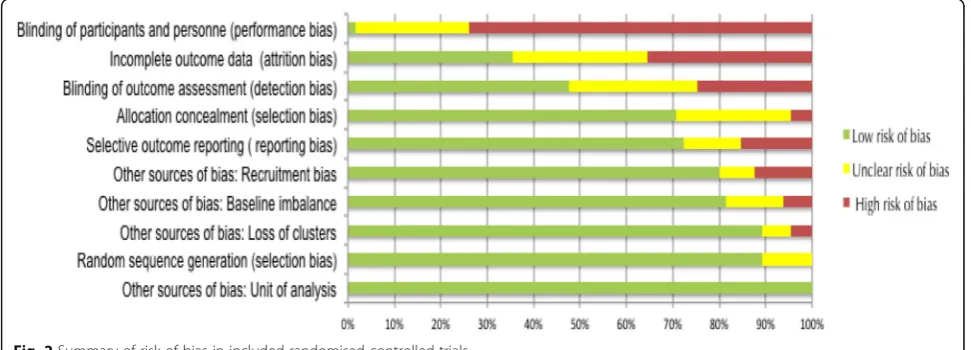
[image:7.595.58.293.99.598.2]All studies reported accounting for clustering in the
analysis. Due to the nature of the interventions, 74%
(48/65) of the studies presented a high risk of bias in the
category of
‘
blinding of participants and personnel
’
.
Only one study (1.5%) had low risk of bias for all
Table 2
General characteristics of included studies (n = 65)
Characteristics (n) (%)
Study designs
Two-arm parallel cluster randomised trial (CRT)
49 75
2 × 2 factorial design CRTs 9 14
Three-arm parallel CRTs 5 8
Stepped wedge designs 2 3
Region
Sub-Saharan Africa 36 55
South Asia 14 22
Latin America & Caribbean 6 9
East Asia & Pacific 6 9
Multiple regions 3 5
Intervention category
HIV, tuberculosis, malaria, dengue
24 37
Child health conditions 19 29
Maternal and newborn health 14 22
Non-communicable diseases 8 12
Comparator (control group)
Receipt of usual services or care 47 72
Applied a simplified version of the intervention
15 23
Used placebo 3 5
Intervention fidelity assessment
Protocol
4 dimensions 2 3
3 dimensions 5 8
2 dimensions 11 17
1 dimension 18 28
Not done 29 44
Trial
4 dimensions 5 8
3 dimensions 18 28
2 dimensions 21 32
1 dimension 20 31
[image:7.595.280.535.109.545.2]Not done 1 1
Table 3
Intervention fidelity assessment among cluster
randomised trials of public health interventions in low- and
middle-income countries (n = 90)
Trial Report Total
Positive Negative
Trial Protocol Positive 35 (a) 1 (c) 36 (a + c)
Negative 29 (b) 25 (d) 54 (b + d)
Total 64 (a + b) 26 (c + d) 90 N (a + b + c + d)
Table 4
Fidelity components and moderating factors identified
a(n = 65)
Trial Protocol
Fidelity components Studies Study ID
(n) (%)
Content 34 52.3 [43–76]
Coverage 13 20 [43, 44, 50, 53, 57, 62, 64, 69, 73–75, 77, 78]
Frequency 12 18.5 [43–45, 49, 50, 52, 57–59, 62, 70, 73]
Duration 4 6.2 [50, 63, 70, 73]
Trial Report
Fidelity components Studies Study ID
(n) (%)
Content 60 92.3 [43–60, 62–69, 71, 73–105]
Coverage 34 52.3 [43–48, 50, 52, 53, 57–59, 62–64, 66, 68, 71–75, 77, 80, 84, 85, 90, 93, 94, 97, 98, 101, 103, 105]
Frequency 33 50.8 [43–45, 48–50, 52, 57–59, 62, 63, 65, 68–70, 72–74, 78, 80–82, 84, 85, 90, 94, 99, 100, 101, 104–106]
Duration 9 13.8 [43, 47, 50, 52, 53, 68, 101, 106, 107]
Protocol & Trial
Moderating factors Studies Study ID
(n) (%)
Comprehensiveness of intervention description
20 30.8 [43, 48, 50, 52, 55, 59, 62, 63, 66–70, 73, 74, 79, 87, 90, 96, 106]
Strategies to facilitate implementation
60 92.3 [43–74, 76–85, 88–93, 95–102, 104– 107]
Quality of delivery 22 33.8 [43–45, 52, 53, 59, 62–64, 66, 67, 70, 71, 73, 80, 85, 89, 91, 96, 100, 102, 106]
Participant responsiveness
37 56.9 [46, 48, 49, 50–53, 55, 57, 58, 62, 64–66, 69, 72–75, 78–81, 84, 87–91, 94, 96, 97, 99, 102, 104, 106, 107]
Recruitment 5 7.7 [48, 52, 73, 80, 81]
Context 8 12.3 [45, 52, 65, 66, 69, 89, 94, 106]
a
[image:7.595.57.289.662.731.2]dimensions evaluated [
46
]. The risk of bias graph for
individual studies is available in an online supplement
(Additional file
7
). The overall risk of bias summary is
reported in Fig.
2
.
Subgroup analyses
To better understand heterogeneity of results concerning
IF assessment, we compared studies at low risk of bias
versus those at uncertain or high risk of bias (combined).
We found no clear differences in IF assessment between
subgroups. Results are available in an online supplement
(Additional file
8
).
Discussion
Fidelity assessment may contribute to making studies
more reliable, internally valid and externally generalisable
[
109
]. Our review shows that fidelity assessment is not
currently a systematic practice in CRTs of public health
interventions carried out in LMICs. In addition, the
amount of detail given and data collection methods used
for each component were variable between studies. In the
absence of fidelity assessment, it may be difficult to
determine if CRT results are due to the intervention
design, to its implementation, or to unknown or external
factors that may influence results.
Strengths and limitations of the study
The strengths of this review include publication of the
study protocol, adherence to the PRISMA guidelines,
the use of five bibliographic databases providing
comprehensive information on randomised trials [
110
],
and recognising that word limits for scientific journal
articles are highly constrained and that the current
CONSORT reporting guidelines for CRTs do not require
a description of elements related to IF, extending the
search for IF assessment to associated documents
beyond the main trial report.
Our study also has limitations. First, we included only
CRTs that have the word
“
regist*
”
in the abstract.
Therefore, we may not have identified all CRTs.
However, we reviewed 16 excluded studies to assess this
risk but none met our inclusion criteria. Thus, the effect
of this limitation is likely to be small. Second, according
to the original protocol [
34
], we were unable to compute
outcomes for research questions 4b (Are trial reports
with negative findings for the ITT analysis more likely to
report a per-protocol (PP) analysis?), 4c (What is the
overall agreement between ITT and PP analyses
con-cerning intervention effectiveness?), and 4d (Does the
magnitude of the intervention effect differ for PP as
compared to ITT analyses?) for two main reasons.
Firstly, it was not always possible to determine whether
articles had performed an ITT analysis to assess the
intervention effect. Although the CONSORT statement
requires that authors indicate whether analysis were
per-formed on an ITT basis, 16 (25%) studies did not
expli-citly declare the analysis as ITT or PP. These findings
confirm that ITT analysis is
“
often inadequately
de-scribed and inadequately applied
”
[
111
] in relation to
missing outcome data in RCTs [
111
,
112
]. Secondly,
many articles reported more than one primary outcome;
58% (38/65) of the studies had more than one primary
outcome, while 42% (27/65) of studies have results for
one primary outcome. Within studies, conclusions
re-garding the effectiveness of interventions sometimes
di-verged; 55% (36/65) of studies reported at least one
outcome effective.
Strengths and weaknesses in relation to other studies
This is the first published systematic review focussing on
methodological issues related to fidelity assessment in
CRTs. Previous reviews have shown that the information
required to ensure internal and external validity is often
poorly reported in CRTs [
18
,
113
]. This study complements
[image:8.595.56.542.547.722.2]previous reviews by documenting considerable variation in
the practice of fidelity assessment for CRTs of public health
interventions in LMICs and suggesting the potential need
for methodological improvement in this area.
Interpretation of findings
This review demonstrates that fidelity assessment is not
currently a systematic practice in CRTs. Public health
interventions are complex and may be affected by
multiple contextual factors affecting the internal and
external validity of the results. In CRTs, contextual
differences at the cluster level could favour local
adaptation of the intervention and differences in participants
’
exposure to intervention components [
114
,
115
]. This
variability can lead to the heterogeneity of fidelity, reducing
power to detect significant effects where they might be
present. Fidelity assessment could help to fill this knowledge
gap to aid researchers in attributing outcomes to the actual
intervention and identify contextual factors that influence
intervention in CRTs [
18
,
20
,
27
]. However, current
reporting guidelines for CRTs offer no specific guidance on
intervention fidelity assessment.
Failure to consider fidelity assessment in CRTs can be
explained by several factors. First, approaches to assess
intervention fidelity within randomised trials have not yet
been made accessible to practitioners. Carroll et al.
synthesise previous work [
23
,
25
,
28
,
109
,
116
], establishing
a conceptual framework to evaluate intervention fidelity
[
116
–
119
]. However, this framework does not provide
guidance on methods to assess specific fidelity dimensions
in practice. Second, fidelity assessment is not required at
present by the CONSORT guidelines for CRT reporting.
This does not encourage researchers to think about the
importance of assessing intervention fidelity, nor to report
their evaluations if conducted. Third, scientific journals
limit the number of words in the final report, which may
restrict authors
’
ability to report their evaluations.
Conclusions
Randomised trials are generally viewed as the gold
standard for establishing evidence of intervention
effectiveness. Public health interventions require
high-quality
evaluations
to
determine
whether
the
programmes work or not and to know how to improve
them [
120
,
121
]. Results of this methodologically
oriented systematic review demonstrate considerable
heterogeneity in the practice of fidelity assessment in
CRTs of public health interventions carried out in
LMICs. Failure to assess intervention fidelity may
weaken the internal and external validity of a study. We
offer two recommendations to enhance the quality of
future CRTs.
First, CRT reporting guidelines should promote
fidelity assessment as a means to facilitate valid causal
inference and replication of results. Guidelines, such as
those produced by the Cochrane network and by
CONSORT, play an important role in helping authors to
strengthen study methods and reporting and thereby in
improving the quality of health research [
2
,
29
,
30
,
40
,
122
,
123
]. The most recent Cochrane risk of bias
guidelines include, for the first time, consideration of the
potential biases arising from deviations from intended
interventions [
122
,
123
]. Based on the results of this
review, we make two suggestions to strengthen CRT
methods and reporting. CRT guidelines such as those
produced
by
CONSORT should
promote
fidelity
assessment and reporting to improve the transparency
of reports and to help draw firm conclusions about the
outcomes of interventions. By the same principle,
scientific journals should encourage researchers to
conduct and report IF assessment in CRTs.
Second, a practical tool is required to guide trialists
involved in the design and implementation of CRTs on
how to assess IF. The TIDieR checklist encourages
researchers to improve the reporting of interventions
and suggests, within its 12 items, that authors describe
how the fidelity of the intervention was assessed [
124
].
However, to our knowledge, neither the TIDieR checklist
nor any other resource offers researchers a practical
guide on how to approach interventionfidelity. This is a
fundamental gap that should be remedied.
Additional files
Additional file 1:PRISMA Checklist: Comparison of registered and published intervention fidelity assessment in cluster randomised trials of public health interventions in low- and middle-income countries: systematic review. (DOC 64 kb)
Additional file 2:Full search strategy for MEDLINE. (DOCX 32 kb)
Additional file 3:Articles excluded with reasons. (DOCX 38 kb)
Additional file 4:Tool for assessing risk of bias(a). (DOCX 42 kb)
Additional file 5:Characteristics of included studies. (DOCX 55 kb)
Additional file 6:Classification of Public Health Interventions*. (DOCX 322 kb)
Additional file 7:Risk of bias graph for individual studies. (DOCX 136 kb)
Additional file 8:Subgroup analyses. (DOCX 19 kb)
Abbreviations
CONSORT:Consolidated Standards of Reporting Trials; CRTs: cluster randomisation trials; IF: Intervention fidelity; ITT: intention-to-treat; LMICs: low- and middle-income countries; PP: per protocol; PRISMA: Preferred Reporting Items for Systematic Reviews and Meta-Analyses; RCTs: Randomised controlled trials; WHO: World Health Organization
Funding
Availability of data and materials
All data from this study, including literature searches and data extraction forms, are available from the corresponding author.
Authors’contributions
MJ and MCP conceived the study. MCP, NM and MJ performed the data abstraction and the data analysis. VR and MPS contributed to study design and interpretation of the results. MCP drafted the manuscript in
collaboration with MJ, and all authors contributed to the critical revision and final approval of the manuscript. All authors had full access to all of the data (including statistical reports and tables) in the study and can take
responsibility for the integrity of the data and the accuracy of the data analysis. All authors agree to be accountable for all aspects of the work in ensuring that questions related to the accuracy or integrity of any part of the work are appropriately investigated and resolved. MCP is guarantor.
Ethics approval and consent to participate
This research does not involve human subjects. It is exempted from research ethics board review as it relies exclusively on publicly available information for which there is no reasonable expectation of privacy.
Consent for publication Not applicable.
Competing interests
The authors declare that they no competing interests.
Publisher
’
s Note
Springer Nature remains neutral with regard to jurisdictional claims in published maps and institutional affiliations.
Author details
1Centre de Recherche du Centre Hospitalier de l’Université de Montréal (CRCHUM), 900, rue Saint-Denis, Pavillon R, Tour Saint-Antoine Porte S03.414, Montréal, Québec H2X 0A9, Canada.2Département de médicine sociale et préventive, École de santé publique (ESPUM), Université de Montréal, 7101, avenue du Parc, 3e étage, Montréal, Québec H3N 1X9, Canada.3Institut de Recherche en Santé Publique Université de Montréal (IRSPUM), Pavillon 7101 Avenue du Parc, P.O. Box 6128, Centre-ville Station, Montréal, Québec H3C 3J7, Canada.4Institut de Recherche Pour le Développement (IRD), Le Sextant 44, bd de Dunkerque, CS 90009 13572, Cedex 02 Marseille, France. 5Département de gestion, d’évaluation, et de politique de santé, École de santé publique, Université de Montréal, 7101, avenue du Parc, 3e étage, Montréal, Québec H3N 1X9, Canada.
Received: 17 January 2018 Accepted: 9 July 2018
References
1. Bland JM. Cluster randomised trials in the medical literature: two bibliometric surveys. BMC Med Res Methodol. 2004;4(1):21.
2. Campbell MK, Elbourne DR, Altman DG, CONSORT Group. CONSORT
statement: extension to cluster randomised trials. BMJ. 2004;328(7441): 702–8.
3. Isaakidis P, Ioannidis JP. Evaluation of cluster randomized controlled trials in sub-Saharan Africa. Am J Epidemiol. 2003;158(9):921–6.
4. Campbell MJ, Donner A, Klar N. Developments in cluster randomized trials and statistics in medicine. Stat Med. 2007;26(1):2–19.
5. Moberg J, Kramer M. A brief history of the cluster randomised trial design. J R Soc Med. 2015;108(5):192–8.
6. Campbell MK, Mollison J, Steen N, Grimshaw JM, Eccles M. Analysis of cluster randomized trials in primary care: a practical approach. Fam Pract. 2000;17:192–6.
7. Osrin D, Azad K, Fernandez A, et al. Ethical challenges in cluster randomized controlled trials: experiences from public health interventions in Africa and Asia. Bull World Health Org. 2009;87(10):772–9.
8. Handlos LN, Chakraborty H, Sen PK. Evaluation of cluster-randomized trials on maternal and child health research in developing countries. Trop Med Int Health. 2009;14(8):947–56.
9. Richards DA, Hallberg IR. Complex Interventions in Health: An Overview of Research Methods. London & New York: Routledge; 2015.
10. Campbell M, Fitzpatrick R, Haines A, et al. Framework for design and evaluation of complex interventions to improve health. BMJ. 2000;321(7262): 694–6.
11. Craig P, Cooper C, Gunnell D, et al. Using natural experiments to evaluate population health interventions: new Medical Research Council guidance. J Epidemiol Commun Health. 2012;66(12):1182–6.
12. Evidence-Based, Medicine Working, Group. Evidence-based medicine. A new
approach to teaching the practice of medicine. JAMA. 1992;268(17):2420. 13. Sanson-Fisher RW, D’Este CA, Carey ML, Noble N, Paul CL. Evaluation of
systems-oriented public health interventions: alternative research designs. Annu Rev Public Health. 2014;35:9–27.
14. Upshur RE. Principles for the justification of public health intervention. Can J Public Health. 2002;93(2):101–3.
15. Hayes RJ, Alexander ND, Bennett S, Cousens SN. Design and analysis issues in cluster-randomized trials of interventions against infectious diseases. Stat Methods Med Res. 2000;9(2):95–116.
16. Morris SS, Ranson MK, Sinha T, Mills AJ. Measuring improved targeting of health interventions to the poor in the context of a community-randomised trial in rural India. Contemp Clin Trials. 2007;28(4):382–90.
17. Ranson MK, Sinha T, Morris SS, Mills AJ. CRTs–cluster randomized trials or
“courting real troubles”: challenges of running a CRT in rural Gujarat, India. Can J Public Health. 2006;97(1):72.
18. Eldridge S, Ashby D, Bennett C, Wakelin M, Feder G. Internal and external validity of cluster randomised trials: systematic review of recent trials. BMJ. 2008;336(7649):876–80.
19. Bonell C, Oakley A, Hargreaves J, Strange V, Rees R. Assessment of generalisability in trials of health interventions: suggested framework and systematic review. Br Med J. 2006;333:346–9.
20. Oakley A, Strange V, Bonell C, Allen E, Stephenson J. Process evaluation in randomised controlled trials of complex interventions. BMJ. 2006;332(7583): 413–6.
21. Brierley G, Brabyn S, Torgerson D, Watson J. Bias in recruitment to cluster randomized trials: a review of recent publications. J Eval Clin Pract. 2012; 18(4):878–86.
22. Puffer S, Torgerson D, Watson J. Evidence for risk of bias in cluster randomised trials: review of recent trials published in three general medical journals. BMJ. 2003;327(7418):785–9.
23. Carroll C, Patterson M, Wood S, Booth A, Rick J, Balain S. A conceptual framework for implementation fidelity. Implement Sci. 2007;2:40.
24. Medical Research Council. Developing and Evaluating Complex
Interventions: New Guidance. London: Medical Research Council; 2008.
25. Borrelli B. The assessment, monitoring, and enhancement of treatment
fidelity in public health clinical trials. J Public Health Dent. 2011;71(s1): S52–63.
26. Hawe P. Lessons from complex interventions to improve health. Annu Rev
Public Health. 2015;36:307–23.
27. Moore GF, Audrey S, Barker M, et al. Process evaluation of complex interventions: Medical Research Council guidance. BMJ. 2015;350:h1258. 28. Hasson H. Systematic evaluation of implementation fidelity of complex
interventions in health and social care. Implement Sci. 2010;5:67. 29. Moher D, Hopewell S, Schulz KF, et al. CONSORT 2010 explanation and
elaboration: updated guidelines for reporting parallel group randomised trials. J Clin Epidemiol. 2010;63(8):e1–e37.
30. Campbell MK, Piaggio G, Elbourne DR, Altman DG, CONSORT Group. CONSORT
2010 Statement: extension to cluster randomised trials. BMJ. 2012;345:e5661. 31. Schneeweiss S. Sensitivity analysis and external adjustment for unmeasured
confounders in epidemiologic database studies of therapeutics. Pharmacoepidemiol Drug Saf. 2006;15(5):291–303.
32. Thabane L, Mbuagbaw L, Zhang S, Samaan Z, Marcucci M, Ye C, Debono
VB. A tutorial on sensitivity analyses in clinical trials: the what, why, when and how. BMC Med Res Methodol. 2013;13(1):92.
33. Moher D, Liberati A, Tetzlaff J, Altman DG, PRISMA group. Preferred reporting items for systematic reviews and meta-analyses: the PRISMA statement. PLoS Medicine. 2009;6(7):e1000097.
34. Perez MC, Minoyan N, Ridde V, Sylvestre MP, Johri M. Comparison of registered and published intervention fidelity assessment in cluster randomised trials of public health interventions in low- and middle-income countries: systematic review protocol. Syst Rev. 2016;5(1):177.
36. Rychetnik L, Frommer M, Hawe P, Shiell A. Criteria for evaluating evidence on public health interventions. J Epidemiol Community Health. 2002;56: 119–27.
37. Rychetnik L, Hawe P, Waters E, Barratt A, Frommer M. A glossary for evidence based public health. J Epidemiol Community Health. 2004;58(7): 538–45.
38. Keller LO, Strohschein S, Lia-Hoagberg B, Schaffer MA. Population-based public health interventions: practice-based and evidence-supported. Part I. Public Health Nurs. 2004;21(5):453–68.
39. World Health Organization. WHO International Clinical Trials Registry Platform (ICRP). New Standards for Registration of Human Medical Research. Trial Registration Data Set (version 1.2.1), 2016.http://www.who.int/ictrp/ network/trds/en/. Accessed 15 May 2016.
40. Higgins JP, Altman DG, Gøtzsche PC, et al. The Cochrane Collaboration’s tool for assessing risk of bias in randomised trials. BMJ. 2011;343:d5928. 41. Hayes R, Moulton L. Cluster randomised trials. Taylor & Francis; 2009.
42. Flynn TN. Design and Analysis of Cluster Randomization Trials in Health
Research. Donner A and Klar N. London: Arnold; 2000. pp.178, £35.00. ISBN: 0-340-69153-0. Int J Epidemiol. 2001;30(2)407–8.https://doi.org/10. 1093/ije/30.2.407-a.
43. Abramsky T, Devries K, Kiss L, et al. Findings from the SASA! Study: a cluster randomized controlled trial to assess the impact of a community mobilization intervention to prevent violence against women and reduce HIV risk in Kampala, Uganda. BMC Med. 2014;12:122.
44. Althabe F, Belizan JM, McClure EM, et al. A population-based, multifaceted strategy to implement antenatal corticosteroid treatment versus standard care for the reduction of neonatal mortality due to preterm birth in low-income and middle-low-income countries: the ACT cluster-randomised trial. Lancet. 2015;385(9968):629–39.
45. Awasthi S, Peto R, Read S, Richards SM, Pande V, Bundy D. Population deworming every 6 months with albendazole in 1 million pre-school children in North India: DEVTA, a cluster-randomised trial. Lancet. 2013; 381(9876):1478–86.
46. Boisson S, Stevenson M, Shapiro L, et al. Effect of household-based drinking water chlorination on diarrhoea among children under five in Orissa, India: a double-blind randomised placebo-controlled trial. PLoS Med. 2013;10(8): e1001497.
47. Boone P, Elbourne D, Fazzio I, et al. Effects of community health interventions on under-5 mortality in rural Guinea-Bissau (EPICS): a cluster-randomised controlled trial. Lancet Glob Health. 2016;4(5):e328–35. 48. Bousema T, Stresman G, Baidjoe AY, et al. The impact of hotspot-targeted
interventions on malaria transmission in rachuonyo south district in the western Kenyan highlands: a cluster-randomized controlled trial. PLoS Med. 2016;13(4):e1001993.
49. Chen-Hussey V, Carneiro I, Keomanila H, et al. Can topical insect repellents reduce malaria? A cluster-randomised controlled trial of the insect repellent N,N-diethyl-m-toluamide (DEET) in Lao PDR. PLoS One. 2013;8(8):e70664. 50. Clasen T, Boisson S, Routray P, et al. Effectiveness of a rural sanitation
programme on diarrhoea, soil-transmitted helminth infection, and child malnutrition in Odisha, India: a cluster-randomised trial. Lancet Glob Health. 2014;2(11):e645–53.
51. Coates TJ, Kulich M, Celentano DD, et al. Effect of community-based voluntary counselling and testing on HIV incidence and social and behavioural outcomes (NIMH Project Accept; HPTN 043): a cluster-randomised trial. Lancet Glob Health. 2014;2(5):e267–77.
52. Colbourn T, Nambiar B, Bondo A, et al. Effects of quality improvement in health facilities and community mobilization through women's groups on maternal, neonatal and perinatal mortality in three districts of Malawi: MaiKhanda, a cluster randomized controlled effectiveness trial. International Health. 2013;5(3):180–95.
53. Corbel V, Akogbeto M, Damien GB, et al. Combination of malaria vector control interventions in pyrethroid resistance area in Benin: a cluster randomised controlled trial. Lancet Infect Dis. 2012;12(8):617–26. 54. Deressa W, Yihdego YY, Kebede Z, Batisso E, Tekalegne A, Dagne GA. Effect
of combining mosquito repellent and insecticide treated net on malaria prevalence in Southern Ethiopia: a cluster-randomised trial. Parasit Vectors. 2014;7:132.
55. Devries KM, Knight L, Child JC, et al. The Good School Toolkit for reducing physical violence from school staff to primary school students: a cluster-randomised controlled trial in Uganda. Lancet Glob Health. 2015;3(7):e378–86.
56. Feikin DR, Bigogo G, Audi A, et al. Village-randomized clinical trial of home distribution of zinc for treatment of childhood diarrhea in rural Western kenya. PLoS One. 2014;9(5):e94436.
57. Go VF, Frangakis C, Minh NL, et al. Efficacy of a multi-level intervention to reduce injecting and sexual risk behaviors among HIV-infected people who inject drugs in Vietnam: a four-arm randomized controlled trial. PLoS One. 2015;10(5):e0125909.
58. Halliday KE, Okello G, Turner EL, et al. Impact of intermittent screening and treatment for malaria among school children in Kenya: a cluster randomised trial. PLoS Med. 2014;11(1):e1001594.
59. Hanson C, Manzi F, Mkumbo E, et al. Effectiveness of a home-based counselling strategy on neonatal care and survival: a cluster-randomised trial in six districts of rural southern Tanzania. PLoS Med. 2015;12(9): e1001881.
60. He FJ, Wu Y, Feng XX, et al. School based education programme to reduce salt intake in children and their families (School-EduSalt): cluster randomised controlled trial. BMJ. 2015;350:h770.
61. Huybregts L, Houngbe F, Salpeteur C, et al. The effect of adding ready-to-use supplementary food to a general food distribution on child nutritional status and morbidity: a cluster-randomized controlled trial. PLoS Med. 2012; 9(9):e1001313.
62. Kirkwood BR, Manu A, ten Asbroek AH, et al. Effect of the Newhints home-visits intervention on neonatal mortality rate and care practices in Ghana: a cluster randomised controlled trial. Lancet. 2013;381(9884):2184–92.
63. Lewycka S, Mwansambo C, Rosato M, et al. Effect of women's groups and
volunteer peer counselling on rates of mortality, morbidity, and health behaviours in mothers and children in rural Malawi (MaiMwana): a factorial, cluster-randomised controlled trial. Lancet. 2013;381(9879):1721–35. 64. More NS, Bapat U, Das S, et al. Community mobilization in Mumbai slums
to improve perinatal care and outcomes: a cluster randomized controlled trial. PLoS Med. 2012;9(7):e1001257.
65. Nikiema L, Huybregts L, Kolsteren P, et al. Treating moderate acute malnutrition in first-line health services: an effectiveness cluster-randomized trial in Burkina Faso. Am J Clin Nutr. 2014;100(1):241–9.
66. Onwujekwe O, Mangham-Jefferies L, Cundill B, et al. Effectiveness of provider and community interventions to improve treatment of uncomplicated malaria in Nigeria: a cluster randomized controlled trial. PLoS One. 2015;10(8):e0133832.
67. Pasha O, McClure EM, Wright LL, et al. A combined community- and facility-based approach to improve pregnancy outcomes in low-resource settings: a global network cluster randomized trial. BMC Med. 2013;11:215. 68. Pinder M, Jawara M, Jarju LB, et al. Efficacy of indoor residual spraying with
dichlorodiphenyltrichloroethane against malaria in Gambian communities with high usage of long-lasting insecticidal mosquito nets: a cluster-randomised controlled trial. Lancet. 2015;385(9976):1436–46.
69. Raj A, Ghule M, Ritter J, et al. Cluster randomized controlled trial evaluation of a gender equity and family planning intervention for married men and couples in rural India. PLoS One. 2016;11(5):e0153190.
70. Rotheram-Borus MJ, Richter LM, van Heerden A, et al. A cluster randomized controlled trial evaluating the efficacy of peer mentors to support South African women living with HIV and their infants. PLoS One. 2014;9(1): e84867.
71. Soofi S, Ahmed S, Fox MP, et al. Effectiveness of community case management of severe pneumonia with oral amoxicillin in children aged 2-59 months in Matiari district, rural Pakistan: a cluster-randomised controlled trial. Lancet. 2012;379(9817):729–37.
72. Tian M, Ajay VS, Dunzhu D, et al. A cluster-randomized, controlled trial of a simplified multifaceted management program for individuals at high cardiovascular risk (SimCard Trial) in rural Tibet, China, and Haryana, India. Circulation. 2015;132(9):815–24.
73. Tripathy P, Nair N, Sinha R, et al. Effect of participatory women's groups facilitated by Accredited Social Health Activists on birth outcomes in rural eastern India: a cluster-randomised controlled trial. Lancet Glob Health. 2016;4(2):e119–28.
74. Waiswa P, Pariyo G, Kallander K, et al. Effect of the Uganda Newborn Study on care-seeking and care practices: a cluster-randomised controlled trial. Glob Health Action. 2015;8:24584.
76. Yotebieng M, Labbok M, Soeters HM, et al. Ten Steps to Successful Breastfeeding programme to promote early initiation and exclusive breastfeeding in DR Congo: a cluster-randomised controlled trial. Lancet Glob Health. 2015;3(9):e546–55.
77. Suchdev PS, Ruth LJ, Woodruff BA, et al. Selling Sprinkles micronutrient powder reduces anemia, iron deficiency, and vitamin A deficiency in young children in western Kenya: a cluster-randomized controlled trial. Am J Clin Nutr. 2012;95(5):1223–30.
78. Andersson N, Nava-Aguilera E, Arostegui J, et al. Evidence based community mobilization for dengue prevention in Nicaragua and Mexico (Camino Verde, the Green Way): cluster randomized controlled trial. BMJ. 2015;351:h3267. 79. Andrade S, Lachat C, Ochoa-Aviles A, et al. A school-based intervention
improves physical fitness in Ecuadorian adolescents: a cluster-randomized controlled trial. Int J Behav Nutr Phys Act. 2014;11:153.
80. Ansah EK, Narh-Bana S, Affran-Bonful H, et al. The impact of providing rapid diagnostic malaria tests on fever management in the private retail sector in Ghana: a cluster randomized trial. BMJ. 2015;350:h1019.
81. Attanasio OP, Fernandez C, Fitzsimons EO, Grantham-McGregor SM, Meghir
C, Rubio-Codina M. Using the infrastructure of a conditional cash transfer program to deliver a scalable integrated early child development program in Colombia: cluster randomized controlled trial.[Erratum appears in BMJ. 2014;349:g6126]. BMJ. 2014;349:g5785.
82. Aung T, Montagu D, Su Su Khin H, Win Z, San AK, McFarland W. Impact of a social franchising program on uptake of oral rehydration solution plus zinc for childhood diarrhea in myanmar: a community-level randomized controlled trial. J Trop Pediatr. 2014;60(3):189–97.
83. Ayles H, Muyoyeta M, Du Toit E, et al. Effect of household and community interventions on the burden of tuberculosis in southern Africa: the ZAMSTAR community-randomised trial. Lancet. 2013;382(9899):1183–94. 84. Baker-Henningham H, Scott S, Jones K, Walker S. Reducing child conduct
problems and promoting social skills in a middle-income country: cluster randomised controlled trial. Br J Psychiatry. 2012;201:101–8.
85. Bhandari N, Mazumder S, Taneja S, Sommerfelt H, Strand TA. Effect of implementation of Integrated Management of Neonatal and Childhood Illness (IMNCI) programme on neonatal and infant mortality: cluster randomised controlled trial. BMJ. 2012;344:e1634.
86. Bird C, Ame S, Albonico M, Bickle Q. Do shoes reduce hookworm infection in school-aged children on Pemba Island, Zanzibar? A pragmatic trial. Trans R Soc Trop Med Hyg. 2014;108(5):297–304.
87. Burnhams NH, London L, Laubscher R, Nel E, Parry C. Results of a cluster randomised controlled trial to reduce risky use of alcohol, alcohol-related HIV risks and improve help-seeking behaviour among safety and security employees in the Western Cape, South Africa. Subst Abuse Treat Prev Policy. 2015;10:18.
88. Dave PV, Shah AN, Nimavat PB, et al. Direct observation of treatment provided by a family member as compared to non-family member among children with new tuberculosis: a pragmatic, non-inferiority, cluster-randomized trial in Gujarat, India. PLoS One. 2016;11(2):e0148488. 89. Durovni B, Saraceni V, Moulton LH, et al. Effect of improved tuberculosis
screening and isoniazid preventive therapy on incidence of tuberculosis and death in patients with HIV in clinics in Rio de Janeiro, Brazil: a stepped wedge, cluster-randomised trial. Lancet Infect Dis. 2013;13(10):852–8. 90. Fottrell E, Azad K, Kuddus A, et al. The effect of increased coverage of
participatory women's groups on neonatal mortality in Bangladesh: a cluster randomized trial. JAMA Pediatrics. 2013;167(9):816–25.
91. Fylkesnes K, Sandoy IF, Jurgensen M, Chipimo PJ, Mwangala S, Michelo C. Strong effects of home-based voluntary HIV counselling and testing on acceptance and equity: a cluster randomised trial in Zambia. Soc Sci Med. 2013;86:9–16. 92. Gong J, Chen X, Li S. Efficacy of a community-based physical activity
program KM2H2 for stroke and heart attack prevention among senior hypertensive patients: a cluster randomized controlled phase-II trial. PLoS One. 2015;10(10):e0139442.
93. Jack SJ, Ou K, Chea M, et al. Effect of micronutrient sprinkles on reducing anemia a cluster-randomized effectiveness trial. Arch Pediatr Adoles Med. 2012;166(9):842–50.
94. Lutge E, Lewin S, Volmink J. Economic support to improve tuberculosis treatment outcomes in South Africa: a qualitative process evaluation of a cluster randomized controlled trial. Trials. 2014;15:236.
95. Mengistie B, Berhane Y, Worku A. Household water chlorination reduces incidence of diarrhea among under-five children in rural Ethiopia: a cluster randomized controlled trial. PLoS One. 2013;8(10):e77887.
96. Olney DK, Pedehombga A, Ruel MT, Dillon A. A 2-year integrated agriculture and nutrition and health behavior change communication program targeted to women in Burkina Faso reduces anemia, wasting, and diarrhea in children 3-12.9 months of age at baseline: a cluster-randomized controlled trial. J Nutr. 2015;145(6):1317–24.
97. Ononge S, Campbell OM, Kaharuza F, Lewis JJ, Fielding K, Mirembe F. Effectiveness and safety of misoprostol distributed to antenatal women to prevent postpartum haemorrhage after child-births: a stepped-wedge cluster-randomized trial. BMC Pregnancy Childbirth. 2015;15:315. 98. Patil SR, Arnold BF, Salvatore AL, et al. The effect of India's total sanitation
campaign on defecation behaviors and child health in rural Madhya Pradesh: a cluster randomized controlled trial. PLoS Med. 2014;11(8): e1001709.
99. Sangoro O, Turner E, Simfukwe E, Miller JE, Moore SJ. A cluster-randomized controlled trial to assess the effectiveness of using 15% DEET topical repellent with long-lasting insecticidal nets (LLINs) compared to a placebo lotion on malaria transmission. Malar J. 2014;13:324.
100. Singla DR, Kumbakumba E, Aboud FE. Effects of a parenting intervention to address maternal psychological wellbeing and child development and growth in rural Uganda: a community-based, cluster randomised trial. Lancet Glob Health. 2015;3(8):e458–69.
101. Sorensen G, Pednekar M, Cordeira LS, et al. Effects of a worksite tobacco control intervention in India: the Mumbai worksite tobacco control study, a cluster-randomised trial. Tob Control. 2017;26(2):210–6.
102. Weiss SM, Zulu R, Jones DL, Redding CA, Cook R, Chitalu N. The Spear and Shield intervention to increase the availability and acceptability of voluntary medical male circumcision in Zambia: a cluster randomised controlled trial. Lancet HIV. 2015;2(5):e181–9.
103. West PA, Protopopoff N, Wright A, et al. Indoor residual spraying in combination with insecticide-treated nets compared to insecticide-treated nets alone for protection against malaria: a cluster randomised trial in Tanzania. PLoS Med. 2014;11(4):e1001630.
104. Young SD, Cumberland WG, Nianogo R, Menacho LA, Galea JT, Coates T. The HOPE social media intervention for global HIV prevention in Peru: a cluster randomised controlled trial. Lancet HIV. 2015;2(1):e27–32. 105. Yousafzai AK, Rasheed MA, Rizvi A, Armstrong R, Bhutta ZA. Effect of
integrated responsive stimulation and nutrition interventions in the Lady Health Worker programme in Pakistan on child development, growth, and health outcomes: a cluster-randomised factorial effectiveness trial. Lancet. 2014;384(9950):1282–93.
106. Fairall L, Bachmann MO, Lombard C, et al. Task shifting of antiretroviral treatment from doctors to primary-care nurses in South Africa (STRETCH): a pragmatic, parallel, cluster-randomised trial. Lancet. 2012;380(9845):889–98. 107. Gunawardena N, Kurotani K, Indrawansa S, Nonaka D, Mizoue T,
Samarasinghe D. School-based intervention to enable school children to act as change agents on weight, physical activity and diet of their mothers: a cluster randomized controlled trial. Int J Behav Nutr Phys Act. 2016;13:45. 108. Dusenbury L, Brannigan R, Falco M, Hansen WB. A review of research on
fidelity of implementation: implications for drug abuse prevention in school settings. Health Educ Res. 2003;18(2):237–56.
109. Bellg AJ, Borrelli B, Resnick B, et al. Enhancing treatment fidelity in health behavior change studies: best practices and recommendations from the NIH Behavior Change Consortium. Health Psychol. 2004;23(5):443–51. 110. Gasparyan AY, Ayvazyan L, Kitas GD. Multidisciplinary bibliographic
databases. J Korean Med Sci. 2013;28(9):1270–5.
111. Hollis S, Campbell F. What is meant by intention to treat analysis? Survey of published randomised controlled trials. BMJ. 1999;319(7211):670–4. 112. Alshurafa M, Briel M, Akl EA, et al. Inconsistent definitions for
intention-to-treat in relation to missing outcome data: systematic review of the methods literature. PLoS One. 2012;7(11):e49163.
113. Ivers NM, Taljaard M, Dixon S, et al. Impact of CONSORT extension for cluster randomised trials on quality of reporting and study methodology: review of random sample of 300 trials, 2000-8. BMJ. 2011;343:d5886. 114. Ibrahim S, Sidani S. Fidelity of intervention implementation: a review of
instruments. Health. 2015;2015:1687.
115. O'Donnell CL. Defining, conceptualizing, and measuring fidelity of implementation and its relationship to outcomes in K-12 curriculum intervention research. Rev Educ Res. 2008;78(1):33–84.
117. Schinckus L, Van den Broucke S, Housiaux M, Diabetes Literacy C. Assessment of implementation fidelity in diabetes self-management education programs: a systematic review. Patient Educ Couns. 2014; 96(1):13–21.
118. Hasson H, Blomberg S, Dunér A. Fidelity and moderating factors in complex interventions: a case study of a continuum of care program for frail elderly people in health and social care. Implementation Sci. 2012;7(23):1–11. 119. Morello RT, Barker AL, Ayton DR, et al. Implementation fidelity of a nurse-led
falls prevention program in acute hospitals during the 6-PACK trial. BMC Health Serv Res. 2017;17(1):383.
120. Duflo E, Glennerster R, Kremer M. Using randomization in development economics research: A toolkit. Handbook Develop Econ. 2007;4:3895–962. 121. Abhijit V. Banerjee and Esther Duflo, Poor Economics: A Radical Rethinking
of the Way to Fight Global Poverty. New York: Public Affairs; 2011. pp. 303. ISBN: 978-1-58648-798-0.
122. Eldridge S, Campbell M, Campbell M, et al. Revised Cochrane risk of bias tool for randomized trials (RoB 2.0): Additional considerations for cluster-randomized trials. In:Chandler J, McKenzie J, Boutron I, Welch V (editors). Cochrane Methods. Cochrane Database Syst Rev. 2016;10(Suppl 1).https://sites. google.com/site/riskofbiastool/welcome/rob-2-0-tool. Accessed 22 June 2018. 123. Higgins JPT, Sterne JAC, SavovićJ, Page MJ, Hróbjartsson A, Boutron I,
Reeves B, Eldridge S. A revised tool for assessing risk of bias in randomized trials In: Chandler J, McKenzie J, Boutron I, Welch V (editors). Cochrane Methods. Cochrane Database Syst Rev. 2016;10(Suppl 1).https://sites.google. com/site/riskofbiastool/welcome/rob-2-0-tool. Accessed 22 June 2018. 124. Hoffmann TC, Glasziou PP, Boutron I, Milne R, Perera R, Moher D, et al.