A Cross Layer based Channel Assignment Algorithm in
Multi Radio Multi Channel Wireless Mesh Networks
Anbu Ananth.C
Assistant Professor, Dept. of CSE FEAT, Annamalai University
Annamalai Nagar, India
Selvakumar.K, PhD.
Associate Professor, Dept. of CSEFEAT, Annamalai University Annamalai Nagar, India
ABSTRACT
A wireless mesh network consists of radio nodes which are organized in a mesh topology and a wireless mesh network is implemented using wireless technologies like 802.11, 802.15, 802.16, cellular technologies or combination of more than one type. The nodes in the network may have a single or multi radios, if the node poses multi radios the channels can be efficiently utilized and the average network throughput can be increased. The single radio mesh nodes face problems due to limited channel bandwidth hence by using multi radio nodes or routers with non overlapping channels can increase the overall capacity of the network. The main concern in this type of networks with multi radio nodes is Channel Allocation or Assignment (CA). The main focus of a channel assignment algorithm in multi radio network is to select channels with less interference and to distribute the load evenly among all the available channels. In this study a cross layer based channel selection algorithm is proposed which proposes a static channel assignment combined with a interference based channel re-assignment strategy.
General Terms
Wireless Mesh Network
Keywords
Channel Allocation
1. INTRODUCTION
The integration parallel development of different technologies, such as third- and fourth-generation (3G/4G) mobile cellular systems, IEEE 802.11 (WiFi) based wireless local area networks (WLANs), and emerging broadband wireless technologies such as IEEE 802.16 (WiMAX) will provide a high speed wireless communication system for the next generation. The Wireless mesh network is considered to be one of the important networks. It employs adhoc networking techniques to forward data packets to and from the internet through wireless mesh routers. Wireless mesh networks are in expensive way of interconnecting cities using existing technologies easily, effectively and wirelessly using existing technology. Mesh nodes are small radio transmitters that function in the same way as a wireless router. Nodes use the common WiFi standards known as 802.11a, b and g to communicate wirelessly with users, and, more importantly, with each other. As highlighted in [2], WMNs have emerged as a promising candidate for extending the coverage of WiFi islands and providing flexible high-bandwidth wireless backhaul for converged networks. The wireless backbone, consisting of wireless mesh routers equipped with one or more radio interfaces, highly affects the capacity of the mesh network [3].
Current state-of-the-art mesh networks, which use off-the-shelf 802.11-based network cards, are typically configured to operate on a single channel using a single radio. This configuration adversely affects the capacity of the mesh due to interference from adjacent nodes in the network, as identified in [3]. Various schemes have been proposed to address this capacity problem, such as modified medium access control (MAC) protocols adapted to WMNs [4], the use of channel switching on a single radio [5, 6], and directional antennas [3]. While directional antennas and modified MAC protocols make the practical deployment of such solutions infeasible on a wide scale, the main issue in using multiple channels with a single radio is that dynamic channel switching requires tight time synchronization between the nodes.
Equipping each node with multiple radios is emerging as a promising approach to improving the capacity of WMNs. First, the IEEE 802.11b/g and IEEE 802.11a standards provide 3 and 12 non overlapping (frequency) channels, respectively, which can be used simultaneously within a neighborhood (by assigning non-overlapping channels to radios). This then leads to efficient spectrum utilization and increases the actual bandwidth available to the network. Second, the availability of cheap off-the-shelf commodity hardware also makes multi radio solutions economically attractive. Finally, the spatio-temporal diversity of radios operating on different frequencies with different sensing-to-hearing ranges, bandwidth, and fading characteristics can be leveraged to improve the capacity of the network. Although multi radio mesh nodes have the potential to significantly improve the performance of mesh networks, efficient channel assignment is a key issue in guaranteeing network connectivity while still mitigating the adverse effects of interference from the limited number of channels available to the network.
2. RELATED WORKS
Channel assignment (CA) in a multi radio WMN environment consists of assigning channels to the radio interfaces in order to achieve efficient channel utilization and minimize interference. The problem of optimally assigning channels in an arbitrary mesh topology has been proven to be NP-hard based on its mapping to a graph coloring problem [7]. Therefore, channel assignment schemes predominantly employ heuristic techniques to assign channels to nodes in the network. The performance bottleneck associated with channel assignment in WMNs has been extensively studied in the literature.
scan the set of available channels and select the one with the lowest levels of contention (as the name suggests). Similarly, Leith and Clifford [9] propose a self managed distributed channel selection scheme, wherein each AP passively measures the received power from the packets transmitted by neighbor APs.
Along similar lines, Kauffmann et al. in [10] propose a distributed frequency selection algorithm, which is proved to minimize the global interference in the network. Simply put, minimizing the total interference can result in improved user throughput. Towards addressing this objective, each AP measures the total received power from all neighbor APs for every channel and selects the channel with the minimum total power. This is performed at each AP by measuring the RSSI of the received beacon frames from all the neighbor APs at every channel. The authors show that their proposed algorithm manages to converge to the global optimum of the optimization criterion, that is, the minimization of interference across the entire network. However, this algorithm does not consider the number of clients in the network; it assumes purely downlink saturated traffic and that all APs have affiliated clients.
Moreover, the work in [11], by Mishra et al., belongs to a set of studies that propose a distributed channel hopping mechanism. The mechanism in [11], MaxChop, provides higher levels of fairness among users. Channel hopping, however, requires tight synchronization between AP and clients, while it is difficult to implement efficiently with off-the-shelf hardware. Note that the channel switching and the subsequent restoration of traffic at the new channel may take from 700 to 1000 msec [12]; this is prohibitive in terms of incurred overhead. Lee et al. [13] take into account the expected traffic demand points in the network. Their channel allocation strategy seeks to assign frequencies in such a way that the signal strength at these demand points is maximized. As a further step, Rozner et al. in [14] also consider the current traffic demands at the WLAN. In particular, they show that, taking into consideration the current traffic demands at APs and clients, the quality of the channel assignment can be greatly improved.
Furthermore, centralized channel allocation algorithms have been proposed in [15, 16,17]. Mishra et al. [15] propose a frequency allocation scheme, wherein clients play a large role in the decision for the best channel. Their proposed approach opts to perform joint load balancing and frequency allocation. However, the approach is based on conflict graph coloring and cannot be directly implemented in a distributed setting. Leung and Kim [16] present a formulation of the channel assignment problem for 802.11 WLANs, which is then proven to be NP complete. Then, they design and analyze a heuristic algorithm that attempts to minimize the effective channel utilization for the bottleneck APs. The authors in [17] propose a novel framework to model the load of WLAN cells considering intercell interference. They also present a frequency planning algorithm which is designed on the basis of the aforementioned load model. Their algorithm provides fair service to its users, while preserving high network utilization. Efficient channel selection is essential in 802.11 mesh deployments too, for minimizing contention and interference among co-channel devices. However, the requirements of a channel allocation policy there are different from a channel allocation policy applied in WLANs. A critical requirement for the efficient routing of packets is the identification and use of interference-limited wireless links. Therefore, intermediate mesh hops along a route need to
operate in frequencies, where contention and interference are as low as possible, especially in highly dense mesh deployments.
Alicherry et al. [18] study the joint channel allocation and routing problem, assuming that traffic demands and network topology are known. They present an LP formulation of the problem, and they propose a centralized algorithm that maximizes the aggregate throughput. Raniwala and Chiueh propose in [19] a tree-based mesh architecture, called Hyacinth, where local channel usage and channel load information is exchanged, and the channel allocation is based on this information. They approach the joint problem of channel assignment and routing in wireless mesh networks. Ramachandran et al. [20] propose a measurement-based centralized approach to provide efficient channel allocation for radios. They perform channel-to-interface assignment based on channel reuse possibilities which in turn depend on interference.
3.
OVERVIEW
OF
CHANNEL
ASSIGNMENT
ALGORITHMS
FOR
WIRELESS MESH NETWORK
In this section we present a taxonomical classification of various CA schemes for mesh networks. Specifically, the proposed CA schemes can be divided into three main categories — fixed, dynamic, and hybrid — depending on the frequency with which the CA scheme is modified. In a fixed scheme the CA is almost constant, while in a dynamic scheme it is continuously updated to improve performance. A hybrid scheme applies a fixed scheme for some interfaces and a dynamic one for others. In the following we analyze these three categories and give examples of CA schemes from each category.
3.1 Fixed Channel Assignment Schemes
Fixed assignment schemes assign channels to interfaces either permanently or for long time intervals with respect to the interface switching time. Such schemes can be further subdivided into common channel assignment and varying channel assignment. Common Channel Assignment - This is the simplest scheme. In CCA [24] the radio interfaces of each node are all assigned the same set of channels. The main benefit is that the connectivity of the network is the same as that of a single channel approach, while the use of multiple channels increases network throughput. However, the gain may be limited in scenarios where the number of non-overlapping channels is much greater than the number of network interface cards (NICs) used per node. Thus, although this scheme presents a simple CA strategy, it fails to account for the various factors affecting channel assignment in a WMN.
3.1.1 Varying Channel Assignment
3.1.2 Centralized Channel Assignment
Based on Hyacinth, a multichannel wireless mesh network architecture, a centralized channel assignment algorithm for WMNs (C-HYA) is proposed in [23], where traffic is mainly directed toward gateway nodes (i.e. the traffic is directed to/from the Internet). Assuming the traffic load is known, this algorithm assigns channels, thus ensuring the network connectivity and bandwidth limitations of each link. It first estimates the total expected load on each virtual link based on the load imposed by each traffic flow. Then the channel assignment algorithm visits each virtual link in decreasing order of expected traffic loads and greedily assigns it a channel. The algorithm starts with an initial estimation of the expected traffic load and iterates over both channel assignment and routing until the bandwidth allocated to each virtual link matches its expected load. While this scheme presents a method for channel allocation that incorporates connectivity and traffic patterns, the assignment of channels on links may cause a ripple effect [23] whereby already assigned links have to be revisited, thus increasing the time complexity of the scheme.
3.1.3 A Topology Control Approach
In [25] the notion of a traffic independent channel assignment scheme is proposed to enable an efficient and flexible topology formation, ease of coordination, and to exploit the static nature of mesh routers to update the channel assignment on large timescales.
A polynomial time greedy heuristic called Connected Low Interference Channel Assignment (CLICA) is presented in [25] that computes the priority for each mesh node and assigns channels based on the connectivity graph and conflict graph. However, the algorithm can override the priority of a node to account for the lack of flexibility in terms of channel assignment and to ensure network connectivity. Thus, while this scheme overcomes link revisits, it does not incorporate the role of traffic patterns in channel assignment for WMNs.
3.2 Dynamic Channel Assignment Schemes
Dynamic assignment strategies allow any interface to be assigned any channel, and interfaces can frequently switch from one channel to another. Therefore, when nodes need to communicate with each other, a coordination mechanism has to ensure they are on a common channel. For example, such mechanisms may require all nodes to periodically visit a predetermined rendezvous channel [21] to negotiate channels for the next phase of transmission. In the Slotted Seeded Channel Hopping (SSCH) mechanism [22], each node switches channels synchronously in a pseudo- random sequence so that all neighbors meet periodically in the same channel. The benefit of dynamic assignment is the ability to switch an interface to any channel, thereby offering the potential to use many channels with few interfaces. However, the key challenges involve channel switching delays (typically on the order of milliseconds in commodity 802.11 wireless cards), and the need for coordination mechanisms for channel switching between nodes.
3.2.1
A Distributed Channel Assignment
Scheme
A set of dynamic and distributed channel assignment algorithms is proposed in [26, 27], which can react to traffic load changes in order to improve the aggregate throughput and achieve load balancing. Based on the Hyacinth
architecture, the algorithm (D-HYA) builds on a spanning tree network topology in such a way that each gateway node (the node directly connected to the wired network) is the root of a spanning tree, and every mesh node belongs to one of these trees. The channel assignment problem consists of:
• Neighbor-to-interface binding (i.e., it selects the interface to communicate with every neighbor), where the dependence among
the nodes is eliminated in order to prevent ripple effects in the network [23]
• Interface-to-channel binding (i.e., it selects the channel to assign to every interface), where the goal is to balance the load among the nodes and relieve interference finally, channels are dynamically assigned to the interfaces based on their traffic information. The tree-topology constraint of the scheme poses a potential hindrance in leveraging multipath routing in mesh networks.
3.3 Hybrid Channel Assignment Schemes
Hybrid channel assignment strategies combine both static and dynamic assignment properties by applying a fixed assignment for some interfaces and a dynamic assignment for other interfaces [24, 28, 20]. Hybrid strategies can be further classified based on whether the fixed interfaces use a common channel [20] or varying channel [24, 28] approach. The fixed interfaces can be assigned a dedicated control channel [26] or a data and control channel [20], while the other interfaces can be switched dynamically among channels. Hybrid assignment strategies are attractive because, as with fixed assignment, they allow for simple coordination algorithms, while still retaining the flexibility of dynamic channel assignment.
4. PROPOSED CHANNEL ASSIGNMENT
ALGORITHM
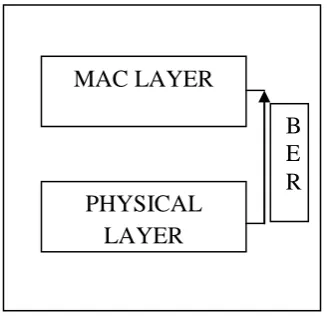
The proposed Channel Assignment algorithm uses a static channel assignment technique combined with a channel reassignment process based on the interference level in the Mesh Routers. Initially all the available channels are assigned statically to the set of available radio links in non overlapping manner. Then during the transmission the Bit Error Rate is measured at the Physical layer which marks the presence of channel Interference at the Mesh routers. In a wireless communication system the Bit error Rate may be affected by transmission noise, interference, signal distortion, attenuation and signal fading. In the proposed system model the signal strength is maintained high and the mesh nodes are positioned in the coverage area of Mesh routers so the problems like signal distortion and the fading are not considered. The BER marks the presence of channel interference in the system. The Physical layer sends up the estimated BER to the MAC layer and if it is higher than a threshold value the MAC layer estimates the interference level in all the channels and sorts the available channel list in the order of low interference. Then the channels are re-assigned depending on the interference level.
Fig 1: Information flow in Cross layer Design
5. INTERFERENCE ESTIMATION AND
MODELING
The goal of interference estimation is to measure the interference level in each mesh network environment. Accurate measurement, however, is challenging and requires that expensive hardware be used [7]. Instead, as an approximation, we rely on the number of interfering radios on each channel supported by each node as an estimation of interference. An interfering radio is defined as a simultaneously operating radio that is visible to node but external to the mesh. A visible radio is one whose packet(s) pass Frame Check Sequence (FCS) checks and are therefore correctly received. We assume that the node informs the router of radios internal to the mesh. The information could consist of an IP address range or an exhaustive list of all radio MAC addresses in the mesh. One caveat to the above estimation procedure is that carrier sensing radios, i.e., those radios that are within an estimating router’s carrier sensing range but outside its reception range, will not be accounted for in the estimation. This is because packets transmitted by such radios will fail FCS checks performed by the router. However, carrier-sensing radios may still interfere with the router. Our interference estimation technique does not consider such radios for two reasons. First, recent studies [12], [24] suggest that current IEEE 802.11 MAC implementations are overly conservative in their carrier sense mechanism and often overestimate the adverse impact of interfering radios. Therefore, even in the presence of multiple carrier-sensing radios, the performance degradation due to carrier-sensing neighbors may not be as severe as previously understood. Second, even if we were to incorporate carrier-sensing radios in our interference estimation solution, it is impossible to determine the presence of such radios using commodity hardware because of the inability of current firmware implementations to identify them1. Sanzgiri et al. propose to use specialized hardware to overcome the firmware limitations [22]. Such hardware are likely to be available in the future and can be leveraged when available. Measurement of only the number of interfering radios, however, is not sufficient because it does not indicate the amount of traffic generated by the interfering radios. For instance, two channels could have the same number of interfering radios but one channel may be heavily utilized by its interfering radios compared to the other. Therefore, in addition, each mesh router also estimates the channel bandwidth utilized by the interfering radios.
The interference estimation procedure is as follows: a mesh router configures one radio of each supported physical layer type to capture packets on each supported channel for a small duration. The router uses the captured packets to measure the number of interfering radios and per second channel utilization. The number of interfering radios is simply the number of unique MACs external to the mesh. The utilization on each channel due to the interfering radios is computed from the captured data frames by taking into account the packet sizes and the rates at which the packets were sent [13]. The overhead of the MAC layer is accounted for in our utilization calculation. We set the duration of the packet capture to three seconds in our implementation. The three second duration is large enough to allow for the averaging of the variations in per second measurements and is small enough to enable the interference estimation to complete quickly. Each mesh router then derives two separate channel rankings. The first ranking is according to increasing number of interfering radios. The second ranking is according to increasing channel utilization. The mesh router then merges the rankings by taking the average of the individual ranks. The resulting ranking is broadcast to all the nodes.
6.
CHANNEL
RE-ASSIGNMENT
STRATEGY
To adapt to the changing interference characteristics, the node periodically re-assigns channels. The periodicity depends ultimately on how frequently interference levels in the mesh network are expected to change. If a large number of interfering devices in the vicinity of the mesh network are expected to be short-lived, the invocation rate should be increased. On the other hand, if a majority of the interfering devices are likely to be long-lived, the invocation rate can be decreased. In our implementation, we have set the rate to ten minutes. We believe this rate results in a good tradeoff between interference adaptation and mesh radio reconfiguration. Nevertheless, we expect the network operator of a mesh network to choose a rate to best suit the target deployment.
7. SIMULATION & RESULTS
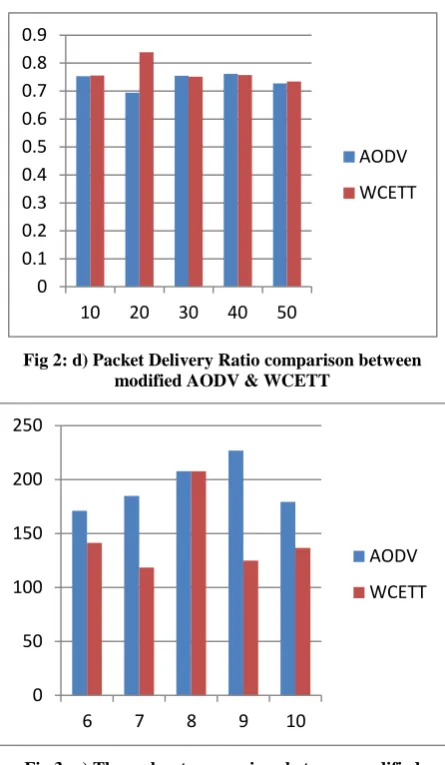
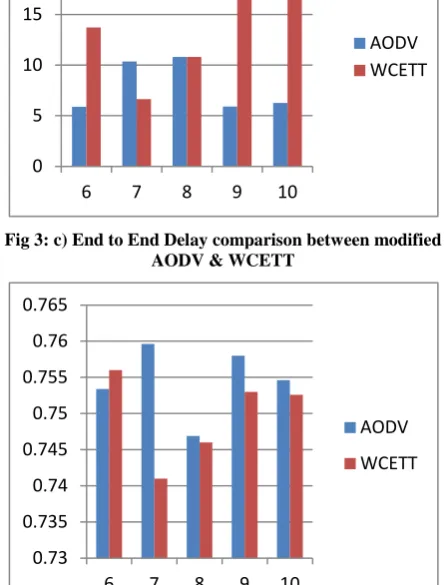
Since the network is envisaged to have a large number of nodes while in the implementation we have tested there are only a few nodes, there was a need to test the performance of the network by simulation. We decided to perform the simulation in ns-2 ver. 2.31. Although Network Simulator 2 (NS2) has been the dominant network simulation tool, it does not provide native support for multi-channel simulation. Modifications are carried out both on TCL and on C++ codes. In TCL level ns-mobilenode.tcl and ns-lib.tcl are modified to assemble the multi-channel components and to make TCL scripts to support multi-channel configuration. In C++ level MAC and Physical layer related files are modified to add the cross-layer based channel selection algorithm and to manage the multi-channel node lists. The proposed channel allocation algorithm is implemented both in AODV and WCETT routing protocols. Simulations are carried out using modified WCETT and AODV routing protocols by varying the number of channels and number of nodes non-concurrently. For each simulation the throughput, MAC overhead, End-to-End Packet delay and Packet Delivery ratio are calculated to measure the performance of the proposed channel allocation algorithm.
PHYSICAL
LAYER
MAC LAYER
Fig 2: a) Throughput comparison between modified AODV & WCETT
Fig. 2: b) MAC Overhead comparison between modified AODV & WCETT
Fig. 2: c) End to End Delay comparison between modified AODV & WCETT
Fig 2: d) Packet Delivery Ratio comparison between modified AODV & WCETT
Fig 3: a) Throughput comparison between modified AODV & WCETT
Fig 3: b) MAC Overhead comparison between modified AODV & WCETT
0 50 100 150 200 250
10 20 30 40 50
AODV
WCETT
0 5 10 15 20 25 30 35
10 20 30 40 50
AODV
WCETT
0 5 10 15 20 25
10 20 30 40 50
AODV
WCETT
0 0.1 0.2 0.3 0.4 0.5 0.6 0.7 0.8 0.9
10 20 30 40 50
AODV
WCETT
0 50 100 150 200 250
6 7 8 9 10
AODV
WCETT
0 0.2 0.4 0.6 0.8 1 1.2 1.4 1.6
6 7 8 9 10
AODV
[image:5.595.60.499.51.672.2] [image:5.595.317.540.66.449.2] [image:5.595.52.283.72.651.2]Fig 3: c) End to End Delay comparison between modified AODV & WCETT
Fig 3: d) Packet Delivery Ratio comparison between modified AODV & WCETT
7. CONCLUSION
A novel and simple channel assignment algorithm that utilizes multiple radio interfaces to improve the throughput and minimize the interference within the wireless mesh network and between the mesh network and co-located wireless mesh networks is proposed in this paper. This allows different nodes in the same network to communicate with each other without causing too much interference to their neighbors. This paper describes the interference by capturing packets at each supported physical layer and finding the number of interfering radios by identifying the unique MACs external to the mesh. The proposed Channel Assignment considers both the fixed channels (static) and the dynamic channel re-assignment to reduce interference of the network so that the network throughput increased greatly compared to hybrid and static channel assignment methods.
8. REFERENCES
[1] R. Bruno, M. Conti, and E. Gregori, “Mesh Networks: Commodity Multi-hop Ad Hoc Networks,” IEEE Commun. Mag., Mar. 2005, pp. 123–31.
[2] R. Karrer, A. Sabharwal and E. Knightly, “Enabling Large-scale Wireless Broadband: The Case for TAPs,” 2nd Wksp. Hot Topics in Wireless, Nov. 2003.
[3] I. Akyildiz, X. Wang, and W. Wang, “Wireless Mesh Networks: A Survey,” Comp. Networks, vol. 47, no. 47, 2005, pp. 445–87.
[4] X. Wang, W. Wang, and M. Nova, “A High Performance Single- Channel IEEE 802.11 MAC with Distributed TDMA,” Tech. rep., Kiyon, Inc. (submitted for patent application), Oct. 2004.
[5] J. So and N. Vaidya, “Multi-Channel MAC for Ad Hoc Networks: Handling Multi-Channel Hidden Terminals using a Single Transceiver,” Proc. ACM Mobihoc, 2004, pp. 222–33.
[6] P. Bahl, R. Chandra and J. Dunagan, “SSCH: Slotted Seeded Channel Hopping for Capacity Improvement in IEEE 802.11 Ad-Hoc Wireless Networks,” Proc. ACM Mobicom, 2004, pp. 216–30.
[7] A. Raniwala, K. Gopalan, and T. Chiueh, “Centralized Channel Assignment and Routing Algorithms for Multichannel Wireless Mesh Networks,” ACM Mobile Comp. and Commun. Rev., Apr. 2004, pp. 50–65.
[8] J. Geier, “Assigning 802.11b access point channels,” in Proceedings of the WiFI Planet Conference, 2002.
[9] D. J. Leith and P. Clifford, “A self-managed distributed channel selection algorithm for WLANs,” in Proceedings of the 4th International Symposium on Modeling and Optimization in Mobile, Ad Hoc and Wireless Networks (WiOPT ’06), pp. 1–9, Ireland, April 2006.
[10] B. Kauffmann, F. Baccelli, A. Chaintreau, V. Mhatre, K. Papagiannaki, and C. Diot, “Measurement-based self organization of interfering 802.11 wireless access networks,” in Proceedings of the 26th IEEE International Conference on Computer Communications (INFOCOM ’07), pp. 1451–1459, May 2007.
[11] A. Mishra, V. Shrivastava, D. Agrawal, S. Banerjee, and S. Ganguly, “Distributed channelmanagement in uncoordinated wireless environments,” in Proceedings of the 12th Annual International Conference onMobile Computing and Networking (MOBICOM ’06), pp. 170– 181, Los Angeles, Calif, USA, September 2006.
[12] B. Vedantham, S. Kakumanu, S. Lakshmanan, and R. Sivakumar, “Component based channel assignment in single radio, multi-channel ad hoc networks,” in Proceedings of the 12th Annual International Conference on Mobile Computing and Networking, (MOBICOM ’06), pp. 378–389, September 2006.
[13] Y. Lee, K. Kim, and Y. Choi, “Optimization of AP placement and channel assignment in wireless LANs,” in Proceedings of the 27th Annual IEEE International Conference on Local Computer Networks (LCN ’02), Tampa, Fla, USA, November 2002.
[14] E. Rozner, Y. Mehta, A. Akella, and L. Qiu, “Traffic-aware channel assignment in enterprise wireless LANs,” in Proceedings of the 15th IEEE International Conference on Network Protocols (ICNP ’07), pp. 133– 143, October 2007.
[15] A.Mishra, V. Brik, S. Banerjee, A. Srinivasan, andW. Arbaugh, “A client-driven approach for channel management in wireless LANs,” in Proceedings of the 25th IEEE International Conference on Computer Communications (INFOCOM ’06), April 2006.
0 5 10 15 20 25
6 7 8 9 10
AODV WCETT
0.73 0.735 0.74 0.745 0.75 0.755 0.76 0.765
6 7 8 9 10
AODV
[image:6.595.57.278.69.234.2] [image:6.595.55.279.127.420.2][16] K. K. Leung and B. J. Kim, “Frequency assignment for IEEE 802.11 wireless networks,” in Proceedings of the 58th IEEE Vehicular Technology Conference (VTC ’03), vol. 3, pp. 1422– 1426, October 2003.
[17] S. J. Han, Y. Bejerano, and M. Smith, “A novel frequency planning algorithm for mitigating unfairness in wireless LANs,” in Computer Networks, vol. 54, no. 15, pp. 2575–2590, October 2010.
[18] M. Alicherry, R. Bhatia, and L. Li, “Joint channel assignment and routing for throughput optimization in multiradio wireless mesh networks,” in Proceedings of the Annual International Conference onMobile Computing and Networking (MOBICOM ’05), pp. 58– 72, 2005.
[19] A. Raniwala and T. C. Chiueh, “Architecture and algorithms for an IEEE 802.11-based multi-channel wireless mesh network,” in Proceedings of the 24th Annual Joint Conference of the IEEE Computer and Communications Societies (INFOCOM ’05.), pp. 2223– 2234, March 2005.
[20] K. N. Ramachandran, E. M. Belding, K. C. Almeroth, and M. M. Buddhikot, “Interference-aware channel assignment in multi-radio wireless mesh networks,” in Proceedings of the 25th IEEE International Conference on Computer Communications (INFOCOM ’06), April 2006.
[21] J. So and N. Vaidya, “Multi-Channel MAC for Ad Hoc Networks: Handling Multi-Channel Hidden Terminals using a Single Transceiver,” Proc. ACM Mobihoc, 2004, pp. 222–33.
[22] P. Bahl, R. Chandra and J. Dunagan, “SSCH: Slotted Seeded Channel Hopping for Capacity Improvement in IEEE 802.11 Ad-Hoc Wireless Networks,” Proc. ACM Mobicom, 2004, pp. 216–30.
[23] A. Raniwala, K. Gopalan, and T. Chiueh, “Centralized Channel Assignment and Routing Algorithms for Multichannel Wireless Mesh Networks,” ACM Mobile Comp. and Commun. Rev., Apr. 2004, pp. 50–65.
[24] P. Kyasanur and N. Vaidya, “Routing and Interface Assignment in Multi-Channel Multi-Interface Wireless Networks,” Proc. IEEE Conf. Wireless Commun. and Net. Conf., 2005, pp. 2051–56.
[25] M. Marina and S. R. Das, “A Topology Control Approach for Utilizing Multiple Channels in Multi-Radio Wireless Mesh Networks,” Proc. Broadnets, Oct 2005, pp. 381–90.
[26] A. Raniwala and T. Chiueh, “Evaluation of a Wireless Enterprise Backbone Network Architecture,” Proc. 12th Hot-Interconnects, 2004.
[27] A. Raniwala, and T. Chiueh, “Architecture and Algorithms for an IEEE 802.11-Based Multi-Channel Wireless Mesh Network,” Proc. IEEE INFOCOM, Mar 2005, pp. 2223–34.