4313
DONG KEUN KIM
Professor, Division of Computer Science and Engineering Kongju National University, Republic of Korea
E-mail: [email protected]
ABSTRACT
In this paper, we propose a method for color region detection in color images and videos. It is based on Gaussian mixture model (GMM) which is calculated by the expectation-maximization (EM) algorithm. We assume that we know the number of Gaussian components in the reference image, but we do not know it in input images. The proposed our approach is composed of two steps. We first estimate GMM parameters using EM algorithm over a reference image including colors regions of interest (ROI). To construct 2-dimensional GMM in the reference, we consider two chrominance features, CbCr-channel from YCbCr color model. The second step is to detect and segment the color regions by using GMM parameters in input images. We decide the color regions by the posterior probability which is Gaussian distributions calculated by GMM in the reference image. Our method can only detect and segment the colors ROI including the Gaussian components from the input image. The experimental results show that it is very effective to detect the predefined multi-colored regions in images and videos.
Keywords: Gaussian mixture model (GMM), expectation maximization (EM), YCbCr color model, Color region detection, Segmentation
1. INTRODUCTION
Most of images and videos are captured and stored by various color formats. In computer vision applications such as image retrieval, video surveillance, object tracking, pattern recognition, robot vision system, color provides more information than gray scale. We are easily able to perceive objects or regions by color. Therefore, it is an important and useful feature that can be used for detecting and segmenting a region of interest from images and videos. In general, for color image segmentation and detection, we need to calculate color features based on color space models such as HSV, YCbCr, HLS and Lab, and then the distribution of the color features is calculated to localize color regions.
In this paper, we propose a method for color region detection in color images. It is based on Gaussian mixture model (GMM) which is calculated by the expectation-maximization (EM). We assume that we know the number of Gaussian components in the reference image, but we do not know it in input images. The proposed approach is composed of two steps. In the first step, we estimate GMM parameters using EM over a reference image including colors regions of interest. To construct 2-dimensional GMM in the reference image, we consider two chrominance features,
CbCr-channel from YCbCr color space model. The second step is to detect and segment the color regions in input images by using the GMM parameters extracted from the reference image. We classify the color regions as pixel-wise approach by the posterior probability which is Gaussian distributions calculated by the GMM parameters. Our method can only detect and segment the colors regions of interest including the Gaussian distribution components of colors from input images.
The remainder of the paper is organized as follows. Section 2 describes related work. Section 3 presents our color region detection method. Section 4 presents experimental results in an image and a video. Section 5 contains conclusions and future work.
2. RELATED WORK
4314 [8] uses in-range values in HLS color model for detection and segmentation of road and traffic signs. There are several skin color detection approaches by using statistical color modelling [9-14]. Color distribution can be estimated by histogram [15-19], covariance [20], K-means clustering [21-26], fuzzy C-means clustering [27-29], GMM [30-40]. Though there are many color segmentation techniques, they focus on segmentation an image into a given number of clusters or regions. We present a method by using GMM for color region detection in color images and videos.
In this paper, we provide colors of interest in a reference image, and estimate the distribution by considering two chrominance features, CbCr- channel from YCbCr color model using GMM, and then detect color regions of interest in an input image and video. It can be effectively detecting the predefined colors or the color regions of interest which are given by user in images and videos.
3. THE PROPOSED COLOR DETECTION
METHOD
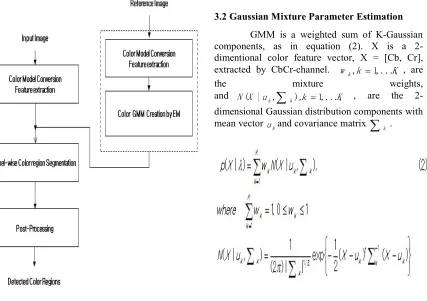
[image:2.612.99.526.432.733.2]Flow chart of our proposed color region detection is shown in Figure 1. It is based on GMM [31, 32, 33, 34, 35, 39, 40].
Figure 1: Flow chart of the proposed approach
We estimate GMM parameters using EM over a reference image including colors of interest which are provided by user. To calculate GMM parameters of a reference imager, we consider two chrominance features, CbCr-channel from YCbCr color model. To detect and segment color regions by using GMM in input images, we classify pixels in an input image into the color class which is based on the maximum likelihood based on GMM. The likelihood is calculated by using the estimated Gaussian distribution parameters.
3.1 Color and Features
RGB images captured from a camera are converted as YCbCr color model by using equation (1). We extract two color features, CbCr-channel to estimate color distributions in a reference image. Cb and Cr are the blue-difference and red-difference chrominance component. Y-channel which is luminance is not used for making robust against light intensity.
3.2 Gaussian Mixture Parameter Estimation
GMM is a weighted sum of K-Gaussian components, as in equation (2). X is a 2-dimentional color feature vector, X = [Cb, Cr], extracted by CbCr-channel. w k K
k
,..., 1
, , are
the mixture weights,
and N X u k K
k k
,..., 1 ), , |
(
, are the2-dimensional Gaussian distribution components with mean vector k
u and covariance matrix
4315 We can estimate the parameters of the
GMM, w u k K
k k k ,..., 1 ), , , (
by using EM
algorithm based on maximum likelihood (ML) estimation of equation (3).
The following algorithm is a summary for calculating GMM parameters by EM algorithm [32-34]. Input color feature vectors, i
x , i1,...,N are
2-dimentional color feature vectors (Cb, Cr) which are extracted from a reference image. Output is the parameters of GMM.
Algorithm: Calculation of GMM parameters by EM algorithm
Input: N
x
x ,...,
1 , 2-dimensional color feature
vectors from a reference image,
Output: K Gaussian parameters
Step 1: Initialize parameters,
and calculate the log-likelihood by equation (3).
Step2: Expectation step
For each feature vector x i N i ,..., 1 , , K i z ik ,..., 1 ), (
is calculated by equation (4).
Step3: Maximization step
Update Gaussian parameters,
K k u w k k k ,..., 1 ), , , (
Step4: Calculate the log-likelihood by equation (3). If it converges then stop, else go to Step 2.
3.3 Color Region Classification
The Gaussian distribution components ( | ,
),k k
u X
N k 1,...,K are estimated by using color features, CbCr-channel extracted from a reference image given by user. We consider that each Gaussian ( | ,
)k k
u X N represents the class k
C which is the color region. We classify each pixel in an image by using equation (8) which is based on the maximum likelihood. If the probability at each pixel is less than a threshold T, then we decide it as the color which is not in a given reference image. If the probability at each pixel is greater than a threshold, we decide it as the class with the maximum likelihood.
4. EXPERIMENTS AND RESULTS
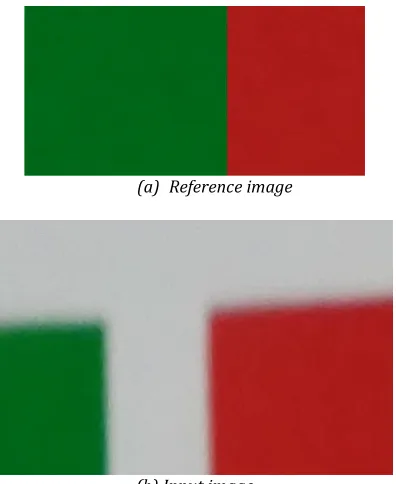
4316 The software is implemented by using Python and OpenCV. We use 3-Gaussian mixture components in GMM. Figure 2(a) is a reference image which has 2 colors (green and red) that we want to detect. Equation (9) shows the calculated GMM parameters.
Figure 2(b) is an input image which has 3 colors (green, red, and gray background) and is blurred a little in borders. Figure 2(c) and Figure 2(d) are the detected results using the probability threshold value in equation (8), T=0.1, T=0.01, T=0.0001 and T=0.000000001, respectively. It shows that the threshold value should be very small value for detecting colors at the boundary region. We use T=0.000000001 as the threshold value in the following experiments. In detection results of Figure 2(c)-2(f), if the class probability at each pixel is less than the threshold T, then it is displayed as the gray color, RGB=(100, 100, 100) and regions with the red and green color are displayed as the average color of the regions.
(a) Reference image
(b) Input image
(c ) Detection result (T=0.1)
(d)Detection result (T=0.01)
(e)Detection result (T=0.0001)
[image:4.612.313.522.71.640.2](f) Detection result (T=0.000000001) Figure 2: Red and Green Color Detection1
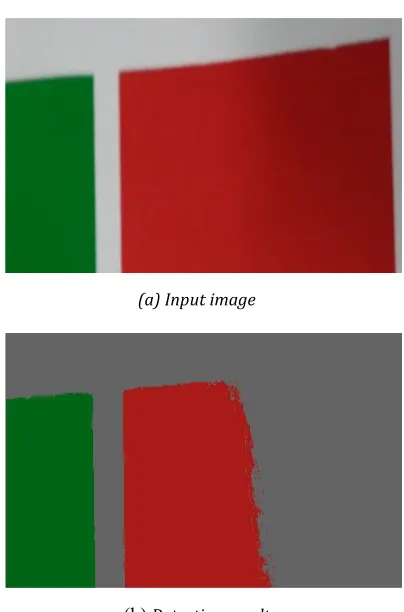
[image:4.612.91.266.172.278.2] [image:4.612.97.295.468.710.2]4317 color region in the reference image, the trouble can be solved.
(a) Input image
[image:5.612.319.524.86.223.2](b) Detection result Figure 3: Red and Green Color Detection2
Figure 4(a) is a reference image with a darker red color region. Equation (10) shows the calculated GMM parameters. By using Figure 4(a), we can detect the whole red color region as Figure 4(b).
(a) Reference image
(b) Detection Result Figure 4: Red and Green Color Detection3
Figure 5 shows input video frames at time t=10, 80, 200, 300, and 450. Figure 6 shows color detection results at the input frames in Figure 5 by using Figure 4(a) as a reference image. We can only detect the red and green color regions of interest in input video frames, but not detect the blue, skin colors and background colors.
(a) t=10
[image:5.612.96.298.119.425.2] [image:5.612.97.524.353.725.2]4318
(c) t = 200
(d) t = 300
(e) t = 450 Figure 5: Input frames in a video
(a) t = 10
(b) t = 80
(c) t = 200
(d) t = 300
[image:6.612.87.521.65.703.2](e) t = 450
4319
5. CONCLUSIONS AND FUTURE WORK
In this paper, we propose a simple color detection method which is based on Gaussian mixture model. We estimate GMM parameters in a reference image including colors of interest and classify pixels in an input image into the color regions of interest by the posterior probability of the Gaussian distributions. Because our work has pixel-wise classification step, it cannot be processed in real-time in a video without parallel programming by using GPUs. In future work, our proposed color detection technique is going to be applied into the other color models like HSV, YIQ, and LAB. It can be applied to n-dimensional feature vector for estimating n-dimensional GMM parameters, and also to estimate distributions in a reference image, K-means clustering can be used. It has the advantage of effectively detecting and segmenting the color regions of interest which are given by user in images and videos.
6. ACKNOWLEDGMENTS
This work was supported by the research grant of the Kongju National University in 2016.
REFRENCES:
[1] L. Lucchese and S.K. Mitra, “Color Image Segmentation: A State-of-theArt Survey,” In Proceedings of the International Conference on Image Processing, Vision, and Pattern Recognition (IPCV), vol. 67(A), 2001, pp.207– 221.
[2] Th. Gevers, Color in Image Search Engines, Survey on color for image retrieval from Multimedia Search, Springer Verlag, January, 2001.
[3] Th. Gevers, Color Feature Detection: An Overview, Color Image Processing: Methods and Applications, CRC Press, 2006.
[4] Verges-Llahi, Color Constancy and Image Segmentation Techniques for Applications to Mobile Robotics, PhD thesis, Universitat Politecnica de Catalunya, April 2005.
[5] ABEER ESA A M ALOMAIRI and GHAZALI SULONG, “AN OVERVIEW OF
CONTENT-BASED IMAGE
RETRIEVALTECHNIQUES”, JTAIT, vol.84, no.2, 2016, pp.215-223.
[6] Shermal Fernando, Color Detection & Object Tracking, Available at
http://opencv- srf.blogspot.kr/2010/09/object-detection-using-color-seperation.html
[7] Ahmad Kaifi, Track multiple objects based on their color using OpenCV, Available at http://akaifi.github.io/MultiObjectTrackingBase dOnColor/
[8] Hasan Fleyeh,“Color Detection and Segmentation for Road and Traffic Signs,” Proceedings of the 2004 IEEE Conference on Cybernetics and Intelligent Systems, 2004, pp.808-813.
[9] Chai, D., and Bouzerdoum A. “A Bayesian approach to skin color classification in ycbcr color space,” In Proceedings IEEE Region Ten Conference, vol. 2, 2000, pp.421–424.
[10] Jones, M.J., Rehg, J.M. “Statistical color models with application to skin detection,” International Journal of Computer Vision (IJCV), 46(1), 2002, pp.81–96.
[11] Elgammal, Ahmed, Crystal Muang, and Dunxu Hu. “Skin detection-a short tutorial,” Encyclopedia of Biometrics, 2009,pp.1-10.
[12] Vezhnevets, Vladimir, Vassili Sazonov, and Alla Andreeva. “A survey on pixel based skin color detection techniques,” Proc. Graphicon. vol.3, 2003.
[13] Brand, J., and Mason, J. “A comparative assessment of three approaches to pixel level human skin-detection,” In Proc. of the International Conference on Pattern Recognition, vol.1, 2000, pp.1056–1059. [14] Chai, D., and Bouzerdoum A. “A bayesian
approach to skin color classification in ycbcr color space,” In Proceedings IEEE Region Ten Conference (TENCON), vol.2, 2000, pp.421–
424.
[15] Michael and Zoran Duric, “Using Histogram to detect and Track Objects in Color Video,” 30th Applied Imagery Pattern Recognition Workshop, October 2001, pp.154-159.
[16] Shamik Sural et al, “Segmentation and Histogram Generation using the HSV Color Space for Image Retrival,” IEEE ICIP, vol.II, 2002, pp.589-592.
[17] G. Ramella and G. Sanniti di Baja, “Color Histogram-based Image Segmentation,” LNCS 6854, 2011, pp.76-83.
4320 [19] V. Rajinikantha, M. S. Couceiro, “RGB
Histogram based Color Image Segmentation Using Firefly Algorithm,” Procedia Computer Science 46, 2015, pp.1449-1457.
[20] DongKeun Kim, “Change Detection using Integral Images in Color Video,” Information Journal, vol.18, 2015, pp.229-235.
[21] Mu-Chun Su and Chien-Hsing Chou, “A Modified Version of the K-Means Algorithm with a Distance Based on Cluster Symmetry”, PAMI, vol.23, no.6, 2001.
[22] Mikolov, Toma, “Color Image Segmentation using K-means Classification on RGB Histogram,” Central European Seminar on Computer Graphics (CESCG), 2007.
[23] Shailendra S. R. and PremNarayan Arya, “Comparison of K-means and Modified K-mean algorithms for Large Data-set”, International Journal of Computing, Communications and Networking, vol. 1, no.3, 2012.
[24] Amritpal Kaur Dr.Yogeshwar Randhawa “Image Segmentation Using Modified K- Means Algorithm and JSEG Method,” International Journal Of Engineering And Computer Science ISSN:2319-7242 vol.3, 2014, pp.6760-6766.
[25] Basar, Sadia, et al. “Color Image Segmentation Using K-Means Classification on RGB Histogram ” , Proceedings of the 13th International Conference on Telecommunications and Informatics (TELE-INFO '14), 2014, pp.257-263.
[26] DongKeun Kim, “Color Detection using Color Feature Clustering,” Int’l Conf. IP, Comp. Vision, and Pattern Recognition (IPCV’17), 2017, pp.137-1138.
[27] Young Won Lim, Sang Uk Lee, “On the color image segmentation algorithm based on the thresholding and the fuzzy c-means techniques,” Pattern Recognition, vol.23, Issue 9, 1990, pp.935-952.
[28] Dae-Won Kim, et al, “A novel initialization scheme for the fuzzy c-means algorithm for color clustering,” Pattern Recognition Letters, vol.25, Issue 2, 2004, pp.227–237.
[29] S. N. Sulaiman and N. A. M. Isa, “Adaptive Fuzzy K-means Clustering Algorithm for Image Segmentation,” IJECS vol.3 Issue 6, June, 2014, pp.6760-6766.
[30] C Stauffer and E. Grimson, “Adaptive background mixture models for real-time tracking,” IEEE Computer Vision and Pattern Recognition Conference, vol.2, 1998, pp.246-252.
[31] T. Kurata et al, “The Hand Mouse: GMM hand-color classification and mean shift tracking,” IEEE ICCV Workshop on Recognition, Analysis, and Tracking of Faces and Gestures in Real-Time Systems, 2001.
[32] Haim Permuter et al, “A study of Gaussian mixture models of color and texture features for image classification and segmentation, Pattern Recognition 39, 2006, pp.695-706.
[33] Christopher M. Bishop, Pattern Recognition and Machine Learning, Springer, 2006.
[34] Zhi_Kai Huang and De-Hui Liu, “Segmentation of Color Image Using EM algorithm in HSV Color Space,” Proceeding of the 2007 International Conference on Information Acquisition, 2007, pp.316-319.
[35] Chuong B Do and Serafim Batzoglou, “What is the expectation maximization algorithm?,” Nature Biotechnology, vol.26, no.8, 2008, pp.897-899.
[36] K.Quast et al, “Real-Time Moving Object Detection in Video Sequences using Spatio-Temporal Adaptive Gaussian Mixture Models,” International Conference on Computer Vision Theory and Applications(VISAPP), 2010, pp. 13-418.
[37] K.Quast et al, “Real-Time Moving Object Detection in Video Sequences using Spatio-Temporal Adaptive Gaussian Mixture Models,” International Conference on Computer Vision Theory and Applications(VISAPP), 2010, pp.413-418.
[38] Sreejini K S, et al, “M-FISH Kayotyping – A New Approach based on Watershed Transform,
” International Journal of Computer Science, Engineering and Information Technology (IJCSEIT), vol.2, no.2, April 2012.
[39] DongKeun Kim, “Color Region Detection using Gaussian Mixture Model,” International Conference on Computing, Communication and Automation (ICCCA), 2016, pp.13-16.