Muhamad Saufi Che Rusuli 1, Rosmaini Tasmin 2
and Norazlin Hashim 3 1
Library, Universiti Tun Hussein Onn Malaysia
2
Faculty of Technology Management, Business and Entrepreneurship, UTHM
3
Centre for Diploma Studies, UTHM
Corresponding email: [email protected], [email protected], [email protected]
Abstract
The effectiveness of a knowledge sharing activities in organization has the potential of improving customer services, bringing new product to market and reducing cost of business operations. Recently, Information Technologies are often used in knowledge management in informing customers and employees of the latest innovation or development as well as sharing knowledge among the employees. In knowledge management, effective knowledge sharing is considered to be one of the most vital components of KM success. Knowledge sharing practice helps organization to improve performance and achieve their mission. However, many researchers and authors agree and disagree with each others about embedding knowledge sharing practice in workplace. Therefore, this paper discusses generally about knowledge sharing practices in organization to investigate whether knowledge sharing is practiced and embedded sufficiently in organization.
1. INTRODUCTION
Knowledge sharing is central to success of all knowledge management strategists. Effective knowledge sharing practices enable reuse and regeneration of knowledge at individual and organizational level. In recent years there had been considerable emphasis on the need to create a culture in organization that is proponent to knowledge sharing and implement strategies that are more knowledge friendly. Nowadays, organizations worldwide have been seriously undertaking initiatives to ensure knowledge management is successful by embedding knowledge sharing practices in their daily work process. In Malaysia context, several organizations have taken initiatives to embed knowledge sharing in their operational activities. They believe that through knowledge management platform they could share the experience and knowledge from individual to individual without boundaries.
2. DEFINITION OF KNOWLEDGE SHARING
Knowledge sharing defined as “the process of transferring knowledge from a person to another in organization [1]. It is a process to accumulate shared knowledge among members”. It also defined as a kind of social interaction among people [2]. Knowledge, unlike information and is locked in the human mind and part of human identity. Knowledge sharing is about “how people share and use what they know” [3]. In addition, knowledge sharing asserted as a social system that supports collaboration and integration which is normally facilitated by technology [4]. Other researchers agreed that knowledge sharing is to be associated with “appropriate mix” of technological channels for optimizing knowledge exchanges. Creating and exchanging knowledge are intangible activities that can neither be supervised nor imposed [5]. They happen only when people cooperate voluntarily. This exchange of knowledge can lead to the creation of new knowledge, which can be an important source of competitive advantage.
Referring to [2] stated that [6] argues sharing knowledge is often unnatural. He said that people will not share their knowledge as they think their knowledge is valuable and important.
Thus, knowledge sharing practice are motivated and executed mainly at the individual levels. Even in the absence of strong organizational norms of knowledge sharing, employees may tend to share knowledge according to their personal benefits and cost [7]. At the end, knowledge sharing practices can help organizations becomes more profitable and undefeated.
3. KNOWLEDGE SHARING PRACTICE AT WORK Nowadays, many CEOs and managers in organizations understand the importance of knowledge sharing among their employees and eager to introduce the knowledge management paradigm in their workplaces. Several studies have been conducted during five years to review knowledge management strategies and knowledge sharing practices in the local organizations [8]. Singapore, for example, provides an interesting case study in this regard. Singapore is conservative in adhering to Asian cultural traditions and at the same time open to innovation and creativity. It is a diverse and multiethnic society that is eager to stick to meritocracy and system efficiency in its pursuits of innovation and creativity which are crucial to the success of knowledge management activities.
In Malaysia, knowledge sharing practices are not widely implemented. Only several government body and private sectors especially which have link with worldwide company embedding knowledge sharing. Besides, the private companies which embedding knowledge sharing own their innovation and creativity to become more profitable and knowledgeable.
Knowledge sharing was taking place on informal basis through face-to-face communication and collaborative workgroups. His study reveals that knowledge is supported in this environmental by a culture that encourages sharing of knowledge, learning from failures, and developing people’s skills [9]. Organizational culture required favorable social environment such as trust, shared values, and goodwill to facilitate knowledge sharing. This signifies the importance of trust in knowledge culture and knowledge sharing [10].
Therefore, face-to-face context, people that have knowledge sharing attitudes were getting more evident rather than electronic medium. Employees were found to be more willing to share knowledge with increased rewards [11].
“Embedding knowledge into everyday work process is time consuming and expensive”
However, it’s impossible to measure whether someone is sharing their knowledge or not in organizations, but it is possible to measure if they comply with a process [12]. Therefore, employees are not susceptible to directive control in respect of intangible assets such as knowledge.
4. TACITVERSUS EXPLICIT
Today, managers are very concerned with implementing knowledge management practices in their organization. They face a number of challenges in implementing and developing knowledge practice methods. Both the growing literature on knowledge management and the advice offered by various knowledge management consultants, however, seem to advocate forms of knowledge management practice that often appear incomplete, inconsistent, and even contradictory. Knowledge is classified into two types namely as the “tacit knowledge” and the “explicit knowledge”.
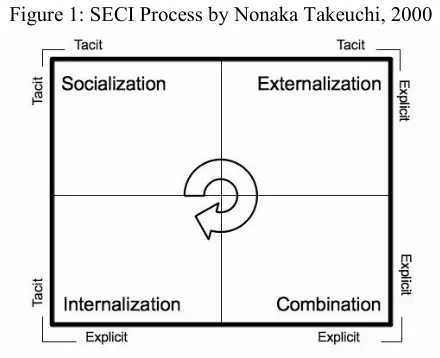
Basic conditions and elements should exist in the first place in organization for the Evolution of tacit knowledge. Tacit knowledge is what embedded in the human mind can be expressed through ability applications and it is transferred in form of learning by doing by watching [14]. The spiral model of knowledge from Nonaka shows that new knowledge always begins with the individual, (e.g. a good researcher has an insight that leads to a new patent or a shop-floor worker draws on years of experience to come up with a new process innovation.)
[image:3.612.74.294.478.657.2]In this case, an individual’s personal knowledge is transformed into organizational knowledge, which expands through the organization and is valuable to the company as a whole. Making personal knowledge available to others should be the central activity of the knowledge and innovation creating in company or organization. It takes place continuously and at all levels of the organization. Through these interactions an organization creates a knowledge process, called knowledge conversion [15]. These four modes of knowledge conversion form a spiral, the SECI process.
Figure 1: SECI Process by Nonaka Takeuchi, 2000
Explicit knowledge is the type of knowledge that can be easily documented and shaped. It can be created, written down, transferred and followed among the organizational units verbally or through computer programs, patents, diagrams and information technologies [16]. Explicit knowledge is easier to
capture and distribute because of its ability to be passed on in the form of tangible material. However, while it is easier to transfer, there are still obstacles with the transference of explicit knowledge. One major issue is that though explicit knowledge is available, it must be left up to the interpretation of the person who is using the material [17].
5. WHY DON’T PEOPLE SHARE
As mentioned earlier, knowledge sharing needs to communicate with face-to-face and collaboration with workgroup. One of the challenges of knowledge management is that of getting people to share their knowledge. In some organizations, sharing is caring and natural [18]. There are questions why don’t people share knowledge:
a) “Not invented here” syndrome
People have pride in not having to seek advice from others and in waiting to discover new ways for themselves.
b) Not realizing how useful particular knowledge isto others
An individual may have knowledge used in one situation but unaware that other people at other times and places might face similar situations.
c) Lack of trust
If people share some of their experience, will they used it out of context, mis-apply it and then blame each other or pass it off as their own without giving any acknowledgement or recognition to them as source.
d) Lack of time
Lack of time is also the major reason given by employees in many organizations. There is pressure on productivity on deadlines, and it’s general rule that the more knowledgeable they are, the more people waiting to collar for the next task.
e) Secret Information and knowledge
6. APRACTICE APPROACH TO KNOWLEDGE SHARING IN ORGANIZATION
Embedding knowledge sharing practice can be regarded as a public good because people who do not pay or contribute to the organization or community also can share knowledge. Multiple people also can access and shared knowledge at the same time [19].
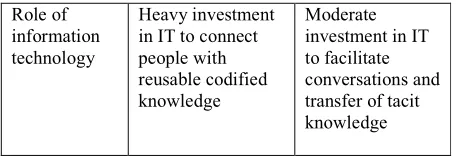
An alternative approach to managing knowledge sharing is the practice approach. This approach is more effective in gathering tacit knowledge through informal networks with moderate use of information technology. Table 1 show two approach of knowledge sharing [20].
Table 1: Process and Practice Approaches to Knowledge Sharing
Process Approach Practice
Approach Type of knowledge supported Explicit knowledge: codified in rules
Mostly tacit knowledge: unarticulated tools, and processes Means of transmission Formal controls, procedures, and standard operating procedures with heavy emphasis on information technologies to support knowledge creation, codification, and transfer of knowledge Informal social groups that engage in story telling and improvisation
Benefits Provides structure to harness generated ideas and knowledge
Achieves scale in knowledge reuse Provides an environment to generate and transfer high-value tacit knowledge Provides spark for fresh ideas and
responsiveness to changing environment.
Disadvantage Fails to tap into tacit knowledge.
May limit innovation and forces participants into fixed patterns of thinking.
Can result in inefficiency.
Abundance of ideas with no structure to implement them. Role of information technology Heavy investment in IT to connect people with reusable codified knowledge
Moderate investment in IT to facilitate conversations and transfer of tacit knowledge
(Source: Dennis Viehland, 2005)
7. ADVANTAGES OF KNOWLEDGE SHARING PRACTICE IN ORGANIZATION
There are some advantages of embedding knowledge sharing practices in organizations.
a) Sharing is Caring
Embedding knowledge sharing practice can be regarded as a public good because people who do not pay or contribute to the organization or community also can share knowledge. Multiple people also can access and shared knowledge at the same time.
b) Innovative and Creative
Knowledge sharing practices can make people in organization innovative and creative to created things. Meetings, discussion and forum are the best platform to share the knowledge and idea among groups. The people in the groups can easily exchange and share knowledge to make their tasks work. It is generally understood that knowledge sharing is an antecedent to many more knowledge management activities. Knowledge sharing through knowledge management effort has been empirically shown to positively and strongly influence higher innovation activities among manufacturing firms in Malaysia [21]. The predictive constructs of knowledge management enabling practices were able to explain 99% of its variance and innovation activities were 52% of its variance. Most importantly, the influence strength of KM on innovation was at a magnitude of 0.74. These facts show the significance and importance of knowledge sharing towards innovative activities.
c) Knowledge is Power
[image:4.612.314.542.46.124.2]“If HP knew what HP knows, we would be three times more profitable.”
Lew Platt, former CEO of HP
d) Attitude
One of advantages of embedding knowledge sharing practice in organization is attitude. Attitude has been shown to be a critical factor because one’s knowledge about how to solve organizational problems could influence one’s trade value [22]. In a case study at Petronas, the importance of the expertise sharing attitude with peers and people in workplaces. People also may consider sharing their knowledge in an organization if they believe this will be personally important and valuable for them [23].
e) Changing Culture
Culture change is never easy and takes time. But cultures can be changed. Takeuchi and Nonaka, in his KM milestone book, that “both IBM and Canon have successfully undergone a transformation and have proven themselves capable of changing as fast as the environment around them…” (pg. 25) [24]. In those firms environment, effective knowledge sharing deals with cultural change of the people, process transformation, and technological management systems. Nevertheless, involvement from people or individual in organization could be some of the best knowledge sharing cultures is where everybody believes their knowledge is respected, valued and used to inform decision. Knowledge sharing practice could make people and individual become valuable.
8. CONCLUSION
Finally, knowledge sharing practice in organization is very important and beneficial to be implemented. It helps organizations in many ways such as information updating, innovations, creations and others. Therefore, by understanding the concepts and advantages could facilitate knowledge sharing and help managers, information and knowledge professionals to support knowledge sharing practices. Due to this importance, it is expected that organizations to take advantage of the new transformation of information handling skills for their employees to turn into knowledge management capabilities.
REFERENCES
[1] Park, H. S. and Im, B. C. (2003). “A study on the Knowledge Sharing Behavior of Local Public Servants in Korea”. [Internet]
http://www.kapa21.or.kr/down/2003
[2] Bock, G. W. and Kim, Y. G. (2002). “Breaking the Myths of Rewards: An Exploratory Study of
Attitudes About Knowledge Sharing”. Information Resources Management Journal. 15(2), p.14-21. [3] Frappaolo, C. (2006). Knowledge Management.
Capstone Publishing Ltd. (A Wiley Company): West Sussex, England.
[4] Tasmin, R. and Woods, P. (2007). Relationship between corporate knowledge management and the firm’s innovation capability. International Journal of Services Technology and Management, 8(1), p. 62-79.
[5] Kimiz, D. (2005). Knowledge Management in Theory and Practice. Elsevier Butterworth-Heinemann: Oxford: UK.
[6] Davenport, T. H. (1997). Some Principles of Knowledge Management. (PhD Thesis). [7] Hanan M. Samieh and Khaled Wahba (2007).
Knowledge Sharing Behavior from Game Theory and Socio-Psychology Perspectives. 40th Annual Hawaii International Conference on System Sciences (HICSS'07), p.1-10.
[8] Chaudhry, A. S. (2005). Knowledge Sharing Practices in Asian Institutions: A Multi-Cultural Perspective From Singapore. World Library and Information Congress: 17th IFLA General Conference and Council. Aug. 14th – 18th.
[9] Chong, M. (2003). Knowledge Sharing Practices in Treasury Environment. Master’s Thesis. Nanyang Technological University, Singapore.
[10] Rastogi, P.N. (2000). Knowledge Management and Intellectual Capital – The New Virtuous Reality of Competitiveness. Human Systems Management. 19(1), p.39-49.
[11] Lim, Q; Tang, W; and Yang, H. (2004). Knowledge Sharing in the Workplace. Project Paper. Nanyang Business School, NTU, Singapore.
[12] Snowden, D. (2002). Knowledge Management Review. 5(5), p.13-17.
[13] Norris, D. M. et. al. (2003). A Revolution In Knowledge Sharing. EDUCAUSE Reviews. Sept./Oct., p.15-22.
[14] Lee, H. & Choi, B. (2003). Knowledge Management Enablers, Processes, and
Organizational Performance: AnIntegrative View and Empirical Examination. Journal of
Management Information Systems, p.20 (1):179-228.
[15] Nonaka, I., Toyama, R. and Konno, N. (2000). ‘SECI, Ba, and leadership: a unified model of dynamic knowledge creation’. Long Range Planning, 33, p. 5-34.
[17] Parise, S., R. Cross and T. Davenport, 2006. Strategies for preventing knowledge-loss crisis. MIT Sloan Manage. Rev., 47: 31-38.
[18] Skyrme, D. J. (2008). The 3Cs of Knowledge Sharing: Culture, Co-opetition and Commitment. (64). p.1-6.
[19] Kim, J., Lee, S. M. and Olson, D. L. (2006). Knowledge Sharing: Effects of Cooperative Type and Reciprocity Level. International Journal of Knowledge Management. 2(4), p.1-16.
[20] Viehland, D. (2005). ISExpertNet: Facilitating Knowledge Sharing in the Information Systems Academic Community. The Journal of Issues in Informing Science and Information Technology. (2), p.441-450.
[21] Tasmin, R. and Woods, P. (2008). Knowledge Management Practices and Innovation Activities Among Large Manufacturers in Peninsular Malaysia. PhD. Thesis. Multimedia University, Cyberjaya, Malaysia.
[22] Kuo, F. Y. and Young, M. L. (2008). Predicting Knowledge Sharing Practices Through Intention: A Test of Competing Models. Computer in Human Behavior. (24), p.2697-2722.
[23] Chowdury, N. (2004). People’s perception on various KM issues: Case Study with A Malaysian Oil Company. Gombak, Malaysia: IIUM.
[24] Takeuchi, H. & Nonaka, I. (2004). Hitotsubashi on Knowledge Management. Singapore: John Wiley & Sons.