© 2017, IRJET | Impact Factor value: 6.171 | ISO 9001:2008 Certified Journal | Page 1203
On the Performance Analysis of Blind Spectrum Sensing Methods for
Different Communication Channels
Cebrail ÇİFLİKLİ
1, Fatih Yavuz ILGIN
2*1Professor, Department of Electronics and Automation, Erciyes University Kayseri Vocational College, Melikgazi, Kayseri, Turkey
2*Instructor, Department of Electronics and Automation, Erzincan University Vocational College, Erzincan, Turkey
---***---Abstract -
Lately, with the increase of service standard in wireless communication systems, problem of spectrum shortage has appeared. In order to overcome this problem, it is necessary to use the existing frequency spectrum in the most efficient way. Cognitive radio systems are the emerging technologies to solve these problems. The first step in cognitive radio systems is the detection of the full / empty state of the current spectrum. Blind methods for this detection are highly preferred in terms of ease of implementation and computational cost. In this study, performance analyzes of Rayleigh, m, nakagami-n anakagami-nd nakagami-nakagami-q fadinakagami-ng communakagami-nicationakagami-n chanakagami-nnakagami-nels of blinakagami-nd spectrum detection methods are performed. A MIMO-OFDM based communication system was used in the study. Simulations were performed in MATLAB environment.Key Words: Detection theory, Spectrum sensing, Tracy-Widom distribution, Wireless communication channel.
1.INTRODUCTION
The frequency spectrum required for wireless communication systems is inherently limited and highly valuable. In many countries, the available spectrum is almost entirely allocated and the problem of spectrum shortage has arisen [1,2]. The main factor that causes spectrum scarcity is inefficient use of the spectrum due to static and inflexible assignment. In the current wireless networks, the fixed spectrum access (FSA) policy is followed to support many different applications and services in a way that does not interfere with each other. This principle divides the current radio spectrum into frequency bands dedicated to different services such as mobile, fixed services, satellite services, radio and television broadcasts. A certain bandwidth has been allocated for each service and has been allocated for a long time to license holders. Thus, while only licensed users can use the assigned band, they are not allowed to use the band by other users, even if the band is empty [3,4].
With the new generation of technologies, while there are frequency bands in certain spectrum bands, the rate of use in most of the spectrum is very low. For this reason, spectrum efficiency is low. Thus, the efficient use of the
frequency spectrum, which is a limited source, has become even more important. Along with the predicted increase in data amount per user and average data rate, especially between 2020 and 2040, the most fundamental problem that next generation wireless technologies will encounter is to find a free frequency band that can meet this projected demand [1,2,5,6]. Dynamic spectrum access techniques have been developed to provide this probing solution, facilitate access to the spectrum, exploit more users and achieve the maximum possible throughput. Cognitive radio (Cognitive Radio, BR), which allows these techniques, is emerging as one of the most promising and most prominent next generation wireless technologies, because it can increase productivity and increase the number of users and service demands with a solution to spectrum inadequacy [3,4] .
Cognitive radio is defined as an intelligent wireless communication system capable of dynamically changing transmitter parameters (such as frequency band, transmitting power, modulation type) in order to prevent interference and improve transmission speed, which is aware of the radio environment and depends on its interaction with the environment. The concept of cognitive radio was first proposed by Joseph Mitola and Gerald Q. Maguire in 1999, and as a result, the IEEE 802.22 standard has been developed targeting the use of cognitive radios in Wireless Regional Area Networks (WRAN)[[1-4].
© 2017, IRJET | Impact Factor value: 6.171 | ISO 9001:2008 Certified Journal | Page 1204
That is, they do not require prior knowledge of the signals. Each of these methods has certain requirements, advantages and disadvantages. Energy sensing is one of the most common spectrum sensing methods because it requires no knowledge of the primary user signal in addition to its low mathematical and hardware complexity [5,6]. However, it is a weakness of this method that the difficulty in determining the threshold value (the noise variance is not known correctly), the ability to distinguish interference from the primary user from the primary user while using the secondary user band, and the reduction in signal to noise ratio (SNR) values. Various feature detectors (such as cyclic stationary feature detection) have been proposed to improve the detection performance by using known features of the signals to be detected and to prevent the problem that the noise variance is not known correctly due to the loss of performance in case of noise uncertainty in the energy detection method [7]. Among the methods used in spectral censoring, the blind-eigenvalue based detection method [8-12] is predominant because it requires no information about noise variance and source signal. Due to multi-path damping and shadowing effects, the problem of performance drop in spectral estimation methods is significantly reduced by the use of multiple antennas in the cognitive radio receiver.
Different methods have been proposed for blind-eigenvalue detection in the literature. Detectors that process based on the maximum-minimum eigenvalue ratio (MME), the maximum eigenvalue-to trace (MET) ratio, and the maximum eigenvalue-eigenvalue sum ratio are the most commonly used for eigenvalue detection [11,12].
The aim of this study is to obtain performance analyzes of some blind-eigenvalue based detection methods in the literature with different fading communication channels.
In this work, it specifies the matrices of the bold lowercase
(x) letters, and the normal lowercase (x) letters indicate the vectors. (x '), the variable specifies the transpose.
2. BLIND EIGENVALUE BASED SENSING AND WIRELESS COMMUNICATION CHANNEL
The main purpose in spectrum sensing is to detect the presence of a primary user signal in only a specific region of the frequency spectrum. For multi-antenna systems, the following scenario can generally be used for spectrum detection. Where the secondary users may be randomly distributed. The prominent point is that they are within the coverage area of the primary user of the secondary user. The redundant number of antennas in the secondary users increases the detection performance. but increasing the number of antennas can be difficult in practice.
Fig-1: Proposed scenario for eigenvalue based spectrum sensing
Secondary users equipped with multiple antennas should determine that the spectrum is full / empty. When the spectrum is empty, they use the relevant spectrum to communicate among themselves. However, when the primary user becomes active, they must immediately release the relevant spectrum. Where h1, h2 hp represent the channel coefficient vector from the primary user to the secondary user [13]. Detection problem is mathematically defined as follows.
(1)
(2)
Where, x represents the matrix of the secondary user's signal through the multiple antennas, s is the gaussian and zero mean primary user signal, and n is the gaussian noise. Therefore, in case the primary user is inactive, the matrix x
only consists of noise. However, in the case of H1, the matrix x recognizes both the primary user mark and the noise signals mixture. Thus the eigenvalue distributions of the covariance matrix of the matrix x for the cases H1 and
H0 are as follows.
(3)
(4)
Where p shows the number of antennas in secondary users. There will be a difference in the probability distribution functions and variances of the eigenvalues according to the active / passive state of the primary user as seen in the equations. For the eigenvalue based detection, a decision is made between the states H1 and H0 using this difference. Equations 3 and 4 'represent the channel coefficient vector. There are some channel simulations for digital communication systems. The major ones are shown below.
Birincil verici TX
İkincil Kullanıcı RX
İkincil Kullanıcı RX h1
© 2017, IRJET | Impact Factor value: 6.171 | ISO 9001:2008 Certified Journal | Page 1205
2.1. Rayleigh fading channel
The Rayleigh distribution is often used to model multi-path damping (NLOS - Non line of sight) situations (such as mobile systems). Rayleigh fading is expressed by the following probability density function (PDF-Probability Density Function), with the channel amplitude fading [13]:
( ) (5)
Where, the mean-square value of the fading amplitude is given as . In this fading model, the signals are
independent of each other and reflect to the receiver.
2.2. Nakagami-n fading channel
Nakagami-n distribution is also known as the Rice distribution. It is used for modeling propagation paths consisting of a strong line of sight (LOS) component and a large number of randomly weak components (Figure 2). The fading amplitude of the channel is defined by the following PDF [13].
( ) ( ( ) ) ( √ ) (6)
Where n is the fading parameter that can take values in the range 0 to ∞, and I0 is the first type of zero-order modified Bessel function. The Nakagami-n distribution represents rayleigh fading in the case n= 0 and non-damping states in the case of n =∞.
Fig-2:LOS-Line of Sight and NLOS- Non Line of Sight Channel
2.3. Nakagami-q(hoyt) fading channel
The Nakagami-q distribution is observed in radio waves that are strongly bound to strong ionospheric fading. The PDF for the Hoyt distribution is defined as [13].
( )
(
( ) ) (
( )
) (7)
where q is a fading parameter that can take values in the range 0 to 1.
2.4. Nakagami-m fading channel
Nakagami-m fading distribution is commonly used by Nakagami to model fading channels. The Nakagami-m distribution has the center of the chi-square as follows [13].
(
) (8)
where m is the fading parameter and Γ (m) is the Gamma function and is defined as ∫ . As the
value of the fading parameter increases, the damping intensity decreases.
2.5. Threshold for MME
A decision between the H1 and H0 states in the narrow band spectrum detection methods depends on the test statistic (TS) and the threshold( ) value. This is mathematically defined as follows [12,15,16];
(9)
(10)
Where indicates false alarm probability and
indicates probability of detection. When calculating the threshold value, there is a limit value of 0.1, as determined by the 802.11 wireless communication working group, and this value should be considered. The threshold value should be set to , ie the probability of false detection. γ
is the threshold value.
(11)
Where denotes the largest eigenvalue of the
covariance matrix of x, and denotes the smallest eigenvalue.
© 2017, IRJET | Impact Factor value: 6.171 | ISO 9001:2008 Certified Journal | Page 1206
(12)
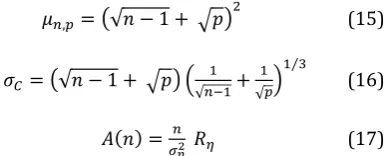
One side of the equation should be imitated to the Tracy-widom distribution of order 1. Where (√ √ ) should be written in place of . In this case, the following
equation is obtained. Where n is the number of samples, p
is the number of antennas in the secondary user.
(√ √ ) (13)
Where one side of the equation should be likened to tracy widom distribution of erder 1. Tracy-widom distribution of order 1 is described below [17].
→ (14)
Where some parameters defines are as follows.
(√ √ ) (15)
(√ √ ) (
√ √ ) ⁄
(16)
(17)
shows the signal samples received under the H0 hypothesis, that is, when there is only noise in the channel. In order to compare Equation 13 to tracy-widom distribution of order 1, the following additions have to be made.
((
) ( √ √ )) (18)
If survival function is used, the threshold value for MME is obtained as follows.
( ) (
(√ √ ) (√ √ ) )
( (√ √ )
⁄
⁄ )(19)
Where denotes the tracy-widom distribution of order
1. this distribution is the probability distribution of the largest eigenvalue of the random hermit matrix. The specific values for this distribution are given in Table 1.
Tablo -1: Numerical table for tracy widom distribution of order 1.
x -3.90 -2.78 -1.27 0.45 2.02
F1(x) 0.01 0.10 0.50 0.90 0.99
2.6.Threshold for MET
There is a test statistic in the MET method as the ratio of the largest eigenvalue of the covariance matrix to the sign of the received signal.
(20)
Where specifies trace of the received signal. In this method, the following equation is obtained if the equation is rearranged to obtain the threshold value.
(21)
Here equation 21 must be likened to the Tracy-widom distribution of order 1. Thus the threshold value for the MET method is defined as follows.
[ ( ) ⁄ ]
(22)
Where α and β denote the bevel and variance coefficients for the Tracy-widom distribution and are defined as follows [9].
(√ √ ) (23)
√ √ (
√ ) √ (24)
3. SIMULATION
[image:4.595.94.290.349.427.2]© 2017, IRJET | Impact Factor value: 6.171 | ISO 9001:2008 Certified Journal | Page 1207
The nakagami-n is used to model propagation paths consisting of a fading channel, a strong line of sight (LOS) component, and a large number of randomly weak components. This usually refers to the communication channels from the satellite to the base stations or vice versa. On the contrary, rayleigh damping can be shown as a communication network in the digital communication systems of today with mobile phones and base station or vice versa. Because there is no line of sight (LOS) component at rayleigh fading. In the simulations, the Rayleigh channel at the rate of -9 dB SNR for the MME method exhibited a perfectly accurate detection. If the noise level increases further, we see that the probability of detection is reduced.
Fig-3: Detection performances in different communication channels for the MME method n = 1000, p = 3.
As can be seen, the nakagami-n channel provides a detection performance in the middle of the other three channels. No additive white gaussian noise (AWGN) channel simulations are included in the simulations. The reason for this is that the AWGN channel models any faded channels. If the simulation results for the AWGN channel were in the graphs, it could have the best possible perceived performance. However, because the AWGN channel does not contain any fading, it is not the preferred choice for simulations in digital communication systems.
Performance analysis of the MET based detection method in different fading channels is given in Fig 4. Again, as shown here, the best sensing performance is presented under Rayleigh fading channel.
Fig-4: Detection performances in different communication channels for the MET method n = 1000, p = 3.
If Figure 3 is compared with Figure 4, it is seen that MME method perceives more successfully than MET. In addition, MME method is more advantageous than MET in terms of cost of calculation.
The performance of the blind spectrum detection methods according to the sample length is shown in Fig-4. As it is understood from the previous graphs that the most successful method is MET, only this method is given for the sample length. It is seen here that the probability of detection increases with the increasing number of samples in direct proportion. In cognitive radio systems, increasing the sample length for the relevant frequency to be used as an opportunist is also an unwanted condition. This is because the increase in the sample length means that the number of people who are in the process of perceiving the speculum is also increasing. For this to be accurate at least the length of the sample is an important point for cognitive radio systems.
Fig-4: Detection performances for different sample lengths for the MME method.
3. CONCLUSIONS
Since the spectrum is a scarce and ending source, using this source efficiently is an important point for the future of wireless communication systems. Over the last years, much work has been done to solve this problem under the topic of digital communication. Blind methods for spectrum sensing have been highly promising since they do not require any prior knowledge for the primary user and the noise signal. The success of spectrum sensing methods is greatly influenced by the dynamic characteristics of the communication environment. The channel modelling techniques and methods already used for digital communication are still among the over-worked topics. For this reason, the performance of the spectrum sensing methods using the greatest -minimum eigenvalue and the largest eigenvalue-ratio is investigated in this study. In simulations, MME and MET methods offered the best performance on rayleigh damped channel.
REFERENCES
[1] Sudharman K. J., .
-120 -10 -8 -6 -4 -2 0
0.5 1
SNR
P
roba
bi
li
ty of d
et
ec
ti
on(P
d
)
Nakagami-m
Nakagami-n
Rayleigh
Nakagami-q
-100 -8 -6 -4 -2 0 2
0.5 1
SNR
P
roba
bi
li
ty of d
e
te
c
ti
on(P
d
)
Nakagami-m Nakagami-n Rayleigh Nakagami-q
-200 -15 -10 -5 0
0.5 1
SNR
P
roba
bi
li
ty of d
et
ec
ti
on (P
d
)
© 2017, IRJET | Impact Factor value: 6.171 | ISO 9001:2008 Certified Journal | Page 1208
[2] J. Mitola, 4(1999), pp. 1318.
[3] T. Ratnarajah, R. Vaillancourt ; Alvo M.; ‘’Eigenvalues and condition num p x ’’ SIAM J. Matrix Anal.Appl., 26, 2(2005), pp. 441–456.
[4] M. Mishali, Y. Eldar , ‘’Blind Multiband Signal Reconstruction: Compressive Sensing for Analog Signals’’ , IEEE Trans. Sig. Proc., 57, 3(2009), pp. 993– 1009.
[5] I. Sobron ,P. Diniz , W. Martins , Velez M. ‘’Energy detection technique for adaptive spectrum sensing’’ , IEEE Trans. Commun. 63 (3) (2015) 617–627
[6] S. Chatterjee, A.Banerjee , Acharya T.; Maity S. P, ‘’Fuzzy c-means clustering in energy detection for cooperative spectrum sensing in cognitive radio system’’ in: Proceedings of Multiple Access Communications (MACOM) Sweden, 8715, (2014), pp. 84–95.
[7] Y. Mingchuan ,L. Yuan ,L. Xiaofeng ,T. Wenyan, ‘’Cyclostationary feature detection based spectrum sensing algorithm under complicated electromagnetic environment in cognitive radio networks ‘’, China Commun. 12 (9) (2015) 35–44.
[8] D. Bhargavi , C. Murthy , ‘’Performance comparison of energy, matched-filter and cyclostationarity-based spectrum sensing’’ Proceedings of IEEE Eleventh International Workshop on Signal Processing Advances in Wireless Communications (SPAWC) ,Morocco, 2010, pp. 1–5.
[9] Y. Zeng , Y.C. Liang , ‘’Covariance based signal detections for cognitive radio’’ Proc IEEE International Symposium on and New Frontiers in DynamicSpectrum Access Networks (DySPAN 2007) , Dublin, Ireland, April 2007, 2007, pp. 202–207.
[10] M. Jin , Q. Guo ,J. Xi , Y. Youming Li ,Y. Yu , Huang D. ‘’Spectrum Sensing Using Weighted Covariance Matrix in Rayleigh Fading Channels’’ T ı O V ı T ( 5) pp 5 37-5148.
[11] N. Pillay , H.J. Xu, ‘’Blind Eigenvalue-Based Spectrum Sensing for Cognitive Radio Networks’’. IET Comm. 6,11 (2011), pp.1388-1396.
[12] C. Çiflikli , F.Y .Ilgin; ‘’Covariance based spectrum sensing with studentized extreme eigenvalue’’ , Technical gazette (accepted papers in press) DOI: 10.17559/TV-20161217120341
[13] N. Kapucu ,’’ ş ç ş ı ö ü ü ş ı z ç matematiksel ifadelerin türetilmesi’’,Kayseri,2012
[14] S.Y.Xu , Y.L.Shang Y and H. M. Wang , ‘’Double thresholds based cooperative spectrum sensing against untrusted secondary users in cognitive radio networks’’, in Proc. 2009 IEEE Vehicular Technology Conference , vols. 1-5, pp. 519–523.
[15] C. Charan, R. Pandey, ‘’Eigenvalue Based Double Threshold Spectrum Sensing Under Noise Uncertainty for Cognitive Radio’’, Optik - International Journal for Light and Electron Optics . 127,15, (2016), pp 5968– 5975.
[16] L. Shi-Qi , H. Bin-Jie , W. Xian-Yi , ‘’Hierarchical Cooperative Spectrum Sensing Based on Double Thresholds Energy Detection’’ , IEEE Communications Letters,16, 7, (2012), pp.1096-1099.
[17] A T H “T largest eigenvalue in the gaussian ensembles," in Calogero-Moser-Sutherland Models, J. van Diejen and L. Vinet, eds., pp. 461-472. New York: Springer, 2000.
BIOGRAPHIES
Cebrail Ciflikli was born in K. Maras, Turkey, in 1961. He received the Ph.D. degree in electronics engineering from Erciyes University in 1990. In 2004, he joined Erciyes University Kayseri Vocational College as Professor where he is now Principal. Dr. Ciftlikli's current research interests include spread-spectrum communications, wireless ATM/LAN, signal processing, DS-CDMA system engineering, RF power amplifier linearization for wireless communication systems.
Fatih Yavuz Ilgin was born in Erzincan, Turkey, in 1982. He received the B.S. degree in Electronic And Computer Education from the Gazi University, Ankara, in 2007, the M.S. degree in electrical and electronics engineering from the Black Sea Technical University, Trabzon, Turkey, in 2013. In 2007 he joined the Erzincan University Vocational High School,
Electronic and Automation
Department, Erzincan University.
(Corresponding author