R E S E A R C H A R T I C L E
Open Access
Mixed methods developmental evaluation
of the CHOICE program: a
relationship-centred mealtime intervention for
long-term care
Sarah Wu
1, Jill M. Morrison
1, Hilary Dunn-Ridgeway
2, Vanessa Vucea
1, Sabrina Iuglio
1and Heather Keller
1,2*Abstract
Background:Mealtimes are important to quality of life for residents in long-term care (LTC). CHOICE (which stands for Connecting, Honouring dignity, Offering support, supporting Identity, Creating opportunities, and Enjoyment) is a multi-component intervention to improve relationship-centred care (RCC) and overall mealtime experience for residents. The objective of this developmental evaluation was to determine: a) if the dining experience (e.g. physical, social and RCC practices) could be modified with the CHOICE Program, and b) how program components needed to be adapted and/or if new components were required.
Methods:A mixed methods study conducted between April–November 2016 included two home areas (64 residents; 25 care staff/home management) within a single LTC home in Ontario. Mealtime Scan (MTS), which measures mealtime experience at the level of the dining room, was used to evaluate the effectiveness of CHOICE implementation at four time points. Change in physical, social, RCC dining environment ratings and overall quality of the mealtime experience over time was determined with linear mixed-effects analyses (i.e., repeated measures). Semi-structured interviews (n= 9) were conducted with home staff to identify what components of the intervention worked well and what improvements could be made.
Results:Physical and overall mealtime environment ratings showed improvement over time in both areas; one home area also improved social ratings (p< 0.05). Interviews revealed in-depth insights into the program and implementation process: i) Knowing the context and culture to meet staff and resident needs; ii) Getting everyone on board, including management; iii) Keeping communication lines open throughout the process; iv) Sharing responsibility and accountability for mealtime goals and challenges; v) Empowering and supporting staff’s creative mealtime initiatives.
Conclusions:This developmental evaluation demonstrated the potential value of CHOICE. Findings suggest a need to: extend the time to tailor program components; empower home staff in change management; and provide increased coaching.
Keywords:Dining, Complex intervention implementation, Evaluation, Program development, Implementation science, Mealtimes, Long-term care, Residential care, Relationship-centred care, Personal support workers
* Correspondence:[email protected]
1University of Waterloo, 200 University Avenue West, Waterloo, Ontario N2L 3G1, Canada
2Research Institute for Aging, 250 Laurelwood Drive, Waterloo, Ontario N2J 0E2, Canada
Background
Mealtimes have the potential to foster and support im-portant and meaningful social relationships over the life course [1, 2]. Consequently, food and mealtimes are considered key aspects of quality of life and satisfaction for residents living in long-term care (LTC) homes [3–5]. Specifically, mealtimes in LTC have the capacity to act as a starting point for creating and sustaining social relation-ships [6]. The concept of reciprocity is strongly associated with meals [1,7]; to extend this idea to LTC environments is to arrive at what many refer to as relationship-centred care (RCC), a social model that reflects the“importance of interactions amongst people as the foundation of any therapeutic or healing activity” [8]. The RCC model was purposefully selected for this intervention over the more commonly used philosophy of person-centred care, as it actively situates the resident within their social networks instead of viewing the resident as an unassociated, inde-pendent being [9]. Further, we may more effectively pos-ition the resident within the context of important and significant relationships (i.e., care staff, dietary aids, home management, etc.) during mealtimes in LTC through the adoption of an RCC model of care [9,10].
A recent study identifying the determinants of poor food intake among LTC residents found that the meal-time experience and the way care is provided at meals plays a critical role in supporting food intake [11]. Yet, only a handful of intervention studies have attempted to improve the mealtime experience in LTC by intentionally or unintentionally including a psychosocial component in their design [12, 13]. Interventions developed to improve social interaction among residents have focused on the built dining environment, such as smaller dining spaces [14] while others have created meaningful mealtime op-portunities for residents through involving them in meal preparation activities, such as making breakfast [15]. Ra-ther than emphasizing the social aspects of routine meals, care staff or volunteer training interventions focus on tasks to promote food intake [12, 13], and no program identified to date has explicitly promoted dignity, honour-ing of individual identity, or the supporthonour-ing of social con-nections between residents and staff at meals. Specifically, no training described in prior research has adopted an RCC model of care as a basis from which to enhance team member (i.e., care staff) capabilities or attempt to change behaviour to enhance reciprocal dining experiences for LTC residents.
Development of the CHOICE program
The concept of the CHOICE Program was developed over several years of research that identified the potential for dining in LTC to be more relationship-focused. Early research by this team identified the role meals played in the family home for persons living with dementia and
their family care partners [16]. As families moved into residential environments, the understanding that these meals did not live up to expectations was identified [17]. Observations in a variety of residential environments demonstrated the social engagement and potential for building of relationships for residents and staff [6] and fi-nally the concept of relational dining which encapsulates RCC and person-centred care practices was formed [18]. It was believed that the overall experience of a mealtime that captured physical, social and relationship-centred components could be measured and thus the Mealtime Scan (MTS) was developed and used in a large multi-site study [19]. The way that care was provided, and specific-ally more person- and relationship-centred was found to be associated with improved food intake [19]. This team then embarked on a journey to develop the CHOICE Pro-gram based on this acquired knowledge and experience with mealtimes in LTC settings.
Methods
Study aim
This study describes the developmental evaluation of the CHOICE Program for LTC staff delivered in a single pilot site. The aim of this study is to determine: a) if the mealtime experience (e.g. physical, social and RCC prac-tices) could be modified with the CHOICE Program, and b) how program components needed to be adapted and/ or if new components were required.
Research design
Developmental evaluation is used in the early stages of an intervention or program to understand what works and what does not, especially in multi-component pro-grams designed for complex environments [20]. A key pur-pose of such an evaluation is to learn and adapt the intervention as it is being delivered, and thus a‘bottom-up’ approach is needed [20]. This form of evaluation is espe-cially relevant for complex interventions that involve coord-ination of diverse staff and attempts to change their social interactions with others. As a result, components of CHOICE were revised or discarded and new components developed during the course of this evaluation. An explana-tory sequential mixed methods (QUANTITATIVE➔ quali-tative) pre-test post-test time series design was used to evaluate the CHOICE Program. This evaluation began with the collection of quantitative data using the observational tool, the Mealtime Scan for Long-Term Care (MTS), at four time points during a 24-week period. Quantitative results informed the subsequent qualitative data collec-tion using semi-structured interviews [21]. Findings were merged to address study objectives. Ethical clear-ance was obtained from the University of Waterloo Office of Research Ethics (#21413).
Intervention participants and setting
It was anticipated that learnings would be enhanced and strengthened if two home areas (sometimes referred to as "care units") Parker and Wellesley (pseudonyms) -in a s-ingle LTC were -included, as resident differences with respect to eating capacity would likely influence
types of team member activities undertaken to make im-provements. The LTC home was located in Southern Ontario, Canada, and is part of an Ontario chain of for-profit homes. The Schlegel-University of Waterloo Research Institute for Aging (RIA) facilitated the incuba-tion of this innovaincuba-tion in a research-friendly home so that the learnings from this work could contribute to the acceleration and eventual mobilization of the innovation to the broader LTC sector. The participating home has a total of 192 beds within 6 home areas and was also selected based on a self-identified need to refocus team member ef-forts on resident mealtimes. As well, this home had min-imal prior exposure to external mealtime-focused research initiatives. As the quantitative data collection procedure was based on dining room-level observations, written con-sent was not required as per the University of Waterloo Of-fice of Research Ethics from individual team members and residents, as only global aspects of the mealtime experience were being assessed. Informational posters and newsletters were provided to residents, families, and team members prior to the start of implementation to ensure that everyone who lived and worked in this home area was aware of the initiative and the use of observations to measure potential changes. Signs were posted advising the home areas when meal observations were to occur. Those care team mem-bers and home management who played critical roles in the implementation of the CHOICE Program were invited to participate in interviews in the qualitative phase; in-formed written consent was provided.
Implementation overview
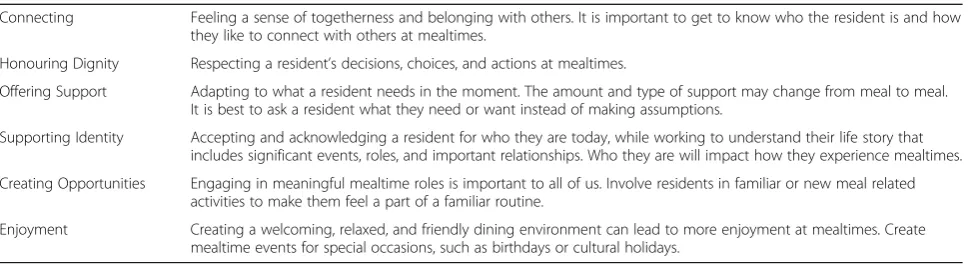
Prior to pilot implementation, the research team (i.e., Principal Investigator HK, HD Study Coordinator, and doctoral student, SW) met with the home’s administra-tors to discuss program components, implementation process, and potential barriers and facilitators of care team behaviour change during mealtimes (Table 2). A mutual agreement was reached on study timeline (i.e., 8-month involvement of care staff implementation process and evaluation), time commitments (i.e., time dedicated to staff huddles and coaching phone calls), support resources Table 1The Six Principles of CHOICE
Connecting Feeling a sense of togetherness and belonging with others. It is important to get to know who the resident is and how they like to connect with others at mealtimes.
Honouring Dignity Respecting a resident’s decisions, choices, and actions at mealtimes.
Offering Support Adapting to what a resident needs in the moment. The amount and type of support may change from meal to meal. It is best to ask a resident what they need or want instead of making assumptions.
Supporting Identity Accepting and acknowledging a resident for who they are today, while working to understand their life story that includes significant events, roles, and important relationships. Who they are will impact how they experience mealtimes.
Creating Opportunities Engaging in meaningful mealtime roles is important to all of us. Involve residents in familiar or new meal related activities to make them feel a part of a familiar routine.
(i.e., informational resources on care delivery, program print materials), and outcome goals (i.e., what was feasible for each home area to achieve in this program). The home’s administrators identified two Mealtime Cham-pions (MT ChamCham-pions) per home area to act as leaders to guide fellow team members through the implementation process. MT Champions play a critical role as point of contact for the interventionists as a way to give and re-ceive feedback during implementation. The MT Cham-pions were selected based on: a) their interest and dedication to care improvement, b) their positive social in-fluence among their colleagues and reciprocated respect they received, and c) full-time employment to ensure their knowledge of the home area. Each home area attempted to work on one CHOICE Principle at a time to raise awareness and identify areas for improvement. Flexibility in the program allowed home areas to spend as much time as needed on a principle. The Director of Food
Services (DFS), acted as both an internal resource and CHOICE advocate to hold the team members within each home area accountable to their goals each week. It became apparent immediately that the MT Champions and DFS needed further support post training to stimulate change among the care team. The research team took on this role collectively; the PI provided support on techniques and theory to make change; the study coordinator who was an employee of the RIA facilitated communications among home management, the dining team and the researchers, while the doctoral student visited the site, initially with the study coordinator, and took on the role of ‘CHOICE Coach’ on-site as the implementation progressed. The Coach visited the study site twice per month for 5 months, spending 1 day in each home area to attend team member huddles, support the completion of the huddle diary, observe mealtimes, gain feedback from team members and residents, and strategize and problem-solve with Table 2CHOICE Intervention Components and Functions
Intervention Components
Description Dosage Frequency over 8 months
Education Session and Training Modules
Overview of program components and best-practices to enhance mealtime experience for residents using relationship-centred approaches. Education session was developed into training module to ensure all staff received education sessions.
45 min./home area 1 per home area or as needed for new hires/refresher for current team members
Staff Huddles and Huddle Diary
Mealtime-focused huddles scheduled during shift changeover to promote CHOICE Principles, problem-solve, record progress in huddle diaries, and facilitate communication between care staff.
5–10 min./huddle 1 x week or as needed
Visual Reminders Posters provided weekly reminders of each CHOICE Principle for care staff and posted strategically around dining room and servery.
1 poster/week 2–3 posters per dining room or as needed
Reference Binder CHOICE reference binder provided resources staff would need to carry out program, including program overview, huddle schedule, huddle diary sheets, and reminder posters.
1 binder/home area As needed by care staff and leadership
MT Champion Meetings
Teleconference meetings held when CHOICE Coach not on site in order to discuss progress, identify areas for improvement, problem-solve, and identify ways to respond to MTS feedback. In-person meetings held when Coach on site.
10–20 min/home area 1 per week
Continuous Feedback Progress reports were generated based on MTS data collected by external auditors. Reports were reviewed by the MT Champions, DFS, project coordinator, with the research team prior to being shared with the care staff and other home administrators. Reports assisted in identifying areas that had improved and/or needed improvement
Comprehensive report based on MTS Data.
Baseline, 8 weeks, 16 weeks, 28 weeks for each home area (missing 5th meal audit because of outbreak)
CHOICE Coach CHOICE Coach worked closely with MT Champions and DFS to facilitate and support each component of CHOICE program and assist in tailoring components when needed. Coach provided feedback on barriers and facilitators of program components, implementation process, and important contextual factors, such as organizational climate.
In-person visit: 5–7 h per home area. MT Champion Meetings 10–20 min.
In-person visit 2 per month for 5 months for each home area. Teleconference 1 per week for 3 months.
the MT Champions. She also took this time to meet with the DFS to review progress reports generated by the research team using MTS results in order to strategize on ways to support team members in areas identified as needing improvement. Over the last 3 months of implementation, the Coach reduced in-person presence in order to promote capacity and independence among the MT Champions and team members; however, bi-weekly coaching teleconference meetings continued with the research team.
As the MT Champions and the DFS started to con-sider how to make improvements, it was recognized that they needed coaching on change management. The The-oretical Domains Framework was chosen as a basis for coaching on strategies to make change [22, 23]. In this framework, fourteen domains (i.e., knowledge, skill, beliefs about capabilities, intentions, goals, etc.) can be condensed into three core components in relation to be-haviour change: capability, opportunity, and motivation (e.g. COM-B; [24]). The COM-B model was selected specifically for this LTC intervention as it places em-phasis on the importance of context (i.e., opportunity) when looking to change behaviour, which is critical when designing feasible and acceptable interventions for health care environments. Without explicitly educating team members on this framework, coaching was pro-vided by the research team to support the adoption, up-take and execution of the program components. For example, celebrating success was an incentive to further motivate team members to complete a specific care activity.
The intervention evolved over the course of the pilot, as is typical of developmental evaluation [20]. It ultim-ately included 8 components that supported team mem-bers in their change efforts, as outlined in Table2. Team members and the research team worked to tailor these components over the course of the implementation process to meet specific needs of the individual home areas. For example, the in-person educational session on CHOICE Principles was translated into an online education module and made available on the home’s intranet training platform for those team members and administrators who were not present for the in-person sessions, as well as new team member hires.
Quantitative phase
Data collection
To understand impact of CHOICE on mealtime processes and interactions among residents and team members, several mealtime observations were conducted every two months using a standardized tool. Mealtime audits were completed with the Mealtime Scan [MTS] [25]. This ob-servational tool is a construct valid and reliable assess-ment that measures the psychosocial environassess-ment, as well
as physical aspects of a dining environment that impact the mealtime experience [25, 26]. Observations are con-ducted at the dining room level, and not at the individual resident level, to attain an overall impression and sum-mary of key aspects of the observed meal. As part of this developmental evaluation, a modified version of MTS was trialed to determine its responsiveness to the inter-vention. Modifications as recommended after extensive use [11, 25] included more detailed tracking of social in-teractions and improved scaling of items (i.e. dichotomous items changed to a 0–4 scale) that are intended to pro-mote responsiveness to change over time. The physical environment meter (e.g. temperature, sound, humidity, and illumination) was removed from the original tool, as the protocol to collect these data was potentially disrup-tive to mealtimes [25]. In addition to the physical, social and person/relationship-centred summative scales in-cluded on the original MTS, a summative scale was also created to capture the overall quality of the dining envir-onment; preliminary data demonstrated good inter-rater reliability of this summative scale (intraclass correlation coefficient = 0.76; unpublished). Maximum score for these four MTS summative scales was 8. Further details on the MTS are described in Keller et al., 2018 [25].
Two trained assessors arrived in their respective dining room several minutes before the scheduled meal start time, before residents entered, and contin-ued observation until the end of the meal when most residents had left the dining room. Data collection was originally planned to be carried out at baseline, 8 weeks, 16 weeks, 24 weeks, and 32 weeks, however, due to concerns about illness outbreak and other home events (i.e., special events, accreditation, etc.), data collection could not be carried out at Week 32. At each of the four time points, the MTS was com-pleted at 5 meals (1 breakfast, 2 lunches, 2 dinners) over a two-day period. Five meals had been previously used to assess the mealtime environment [25] in a large multi-site study and found to represent the meal context. The same assessor completed all assessments (n= 20) in the same assigned home area throughout the study to promote consistency.
eating). Higher values on the continuous score (max-imum = 28) indicate more impairment on ADLs [28].
Data analysis
To provide context, descriptive comparisons were made between home areas based on resident data and mealtime characteristics that were not expected to change with the intervention (e.g., number of residents, staff ) using chi-square or two-sample t-tests (or non-parametric equivalent, e.g., Wilcoxon signed rank test). Each of the four MTS summative scales and subscales (e.g. Mealtime Relational Care Checklist) were tested for normality and described (mean, standard deviation [SD]) by time point and dining room. Linear mixed models (Proc MIXED) with repeated measures over time within dining room were used to analyze each of the four MTS summative scales as out-comes. Dining room, time point (categorical with time 0 as referent), and the interaction between dining room and time point were included in the model as independent vari-ables tested as fixed effects. As both home areas received the CHOICE program, there was no control. The time effect demonstrated the potential for the MTS scales to change over time with implementation of the program, while time-home area interactions demonstrate differences by home area in this effect. Data were analyzed using SAS® Studio Statistical Software (SAS Institute Inc., Cary, North Carolina). Statistical significance was determined atp< 0.05 unless otherwise specified.
Qualitative phase
Data collection
Semi-structured interviews were used to explain quantitative results rather than confirm. Specifically, interviews identified what program components worked well (e.g. using data to stimulate change, educational activities), the implementation process (e.g. use of champions to lead effort), especially as it varied among home areas. Key informants were recruited based on their involvement with the implementation of the CHOICE Program (i.e., MT Champions, management, highly involved team members) at the completion of the study. Interview guides for team members and home man-agement were developed based on key findings from the progress reports generated for each home area (i.e., MTS data over time). In particular, the following areas were ad-dressed during the interviews:
Team members:their perceptions of the impact of the intervention on resident mealtime experience; their experiences adopting and carrying out
intervention components; their opinions on how the program could be improved and sustained; what mealtime changes were noticed
Home Management:their perceptions of the program components and how they were received
by team members; their experiences with the implementation process; how better to support team members to sustain the program; what mealtime changes were noticed.
In addition, brief qualitative comments were recorded by each of the auditors on each MTS audit form to account for and contextualize unusual events that may have impacted a particular meal’s score during MTS observations. These were reviewed and used to support the linkage between quantitative and qualitative findings. Interviews were conducted by the CHOICE Coach (SW) over one month following the end of the intervention in November 2016.
Data analysis
Data analyses were conducted concurrently with data collection conducted by SW until informational redun-dancy was reached [29]. Interviews were transcribed verba-tim and were then analyzed using a generalized inductive approach, whereby codes were applied to small segments of data and individual codes collapsed into larger categories that were interpreted into themes [30]. Emergent codes and the formation of categories and overarching themes were reviewed and discussed with co-authors HK, VV, and SI throughout analysis. The analytical process focused on the intervention implementation, the intervention components, and the changes that occurred during mealtimes on each home area. MTS text data was coded deductively and incorporated into the main interview themes in order to contextualize findings to the dining areas [31].
Results
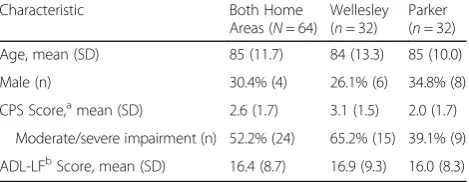
A total of 64 residents resided in the two home areas that participated in the study (Wellesley n= 32; Parker n= 32). Descriptive characteristics of residents are pre-sented in Table 3. The average age of residents from both home areas was 85 years, with the majority of resi-dents being female (70%). Data from the Minimum Data
Table 3Resident Characteristics of Two Home Areas (N= 64)
Characteristic Both Home
Areas (N= 64)
Wellesley (n= 32)
Parker (n= 32)
Age, mean (SD) 85 (11.7) 84 (13.3) 85 (10.0)
Male (n) 30.4% (4) 26.1% (6) 34.8% (8)
CPS Score,amean (SD) 2.6 (1.7) 3.1 (1.5) 2.0 (1.7)
Moderate/severe impairment (n) 52.2% (24) 65.2% (15) 39.1% (9)
ADL-LFbScore, mean (SD) 16.4 (8.7) 16.9 (9.3) 16.0 (8.3)
aCPSCognitive Performance Scale, scoring 0–6; scores≥
3 indicate moderate/ severe cognitive impairment
b
Set (MDS, [28]) collected during the baseline period indi-cates that 65% of residents living in Wellesley had a Cog-nitive Performance Scale (CPS) Score of 3 or greater, as compared to Parker where less than half of residents showed signs of significant cognitive impairment (CPS≥ 3); this difference was not statistically significant. Resi-dents in the two home areas did not differ on mean ADL-LF scores. However, the observations from the MTS indicated that Wellesley had a significantly greater number of residents who required assistance with tasks related to eating (mean = 4.8 ± 0.9 persons/ meal) than Parker (mean = 3.8 ± 1.2; p< 0.01).
A total of 16 team members (10 Personal Support Workers (PSW), 3 Dietary Aids (DA), 2 Registered Practical Nurse (RPN), 1 Recreational Therapist) and 5 members of home management (2 home area coordinators, 1 DFS, 1 Assistant DFS, 1 Director of Care, 1 quality indicators man-ager) received CHOICE training. Four PSWs, two from each home area, were selected as MT Champions by home management. However, half way through the implementa-tion process only one Champion remained on each unit due to staff scheduling changes.
Quantitative phase
Descriptive characteristics of two dining areas assessed by MTS
The two dining areas were statistically different in key physical characteristics over the course of the intervention (Table 4); Parker had more residents eating in the dining room than Wellesley (t=−5.86, p< 0.0001). The total number of team members in either dining room did not significantly differ. However, in terms of team members’ mealtime activities, a statistical significant difference was found between the number of team members passing food (Wilcoxon; z =−4.68,p< 0.0001) as well as the number of team members assisting residents with their meals (Wil-coxon; z = 4.06, p< 0.0001) with Wellesley having fewer food servers, but more team members assisting with eat-ing. There was no observed difference between the num-ber of family/volunteers present during meals, nor the number of residents eating outside the main dining area.
MTS changes over time by home area
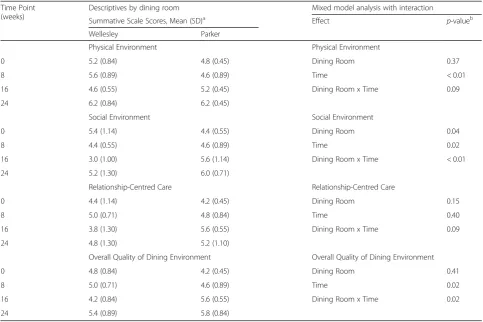
Five meals were observed at each of four time-points in each dining room, for a total of 20 mealtime observa-tions per home area. Linear mixed models were used to determine change in MTS summative scales (i.e., physical environment, social environment, and overall quality of mealtime environment) over time for both home areas. Table5presents the descriptive data for each of the sum-mative scales at each time point by home area. After adjusting for repeated measures across time within each dining room, the physical (p< 0.01), social (p= 0.02), and overall quality (p= 0.02) of the dining environment were significantly different, with improvements in Parker for all three scales, while Wellesley did not experience an im-provement in the social summative scale. Of the MTS subscales there were several differences between dining rooms, however, only the Mealtime Relational Care Checklist score showed a significant improvement over time (p< 0.01) (Additional file1: Table S1) [26].
Models of the social environment and overall quality scores demonstrated significant interactions between home area and time. Significant interactions indicate that changes in these MTS scores across the time points varied by dining room; the intervention’s effect was not consistent over time for the two home areas. Figures 1
and 2 display the difference in change from baseline of social environment score and the overall mealtime envir-onment rating between Wellesley and Parker. The social environment scores slightly decreased in Wellesley over the four observation points, whereas Parker’s social environment improved (Figure 1; Table 5). Overall quality of dining environment improved for Parker, how-ever, Wellesley had a more modest improvement main-tained for this scale from baseline (Figure2; Table5).
Qualitative phase
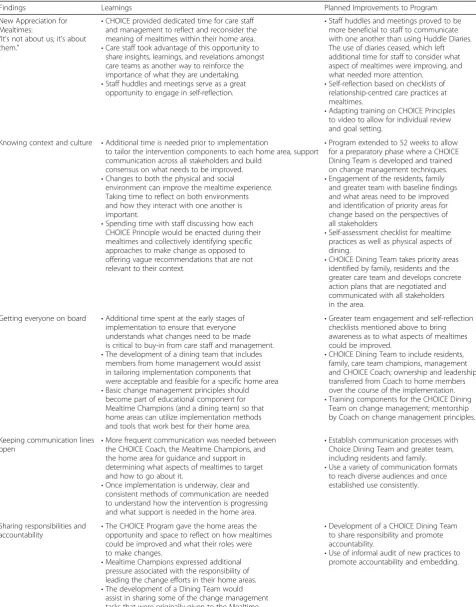
Nine interviews were conducted with four PSWs (two of whom were MT Champions), two DAs, two home manage-ment members (HM), and one registered nurse (RN). Six themes emerged from the analysis. In addition, we provide key learnings and/or materials developed in response to the
Table 4Descriptive Characteristics of Two Dining Areas Assessed by MTS Over All Observed Meals (n= 40)
Variable Both Home Areas Wellesley Parker
Residents in dining room, mean (SD) 24.3 (2.90) 22.4 (1.98) 26.3 (2.27)*
Any staff who entered dining room during meal observation, mean (SD) 6.7 (1.38) 7.2 (1.42) 6.3 (1.23)
Staff serving fooda, mean (SD) 2.1 (0.94) 1.4 (0.51) 2.8 (0.77)*
Staff assisting residents to eata, mean (SD) 2.6 (0.98) 3.2 (0.70) 2.0 (0.82)*
Family/Volunteers, mean (SD) 0.6 (0.89) 0.4 (0.59) 1.0 (1.05)
% of meals where at least 1 resident eating meal in adjacent area, % (freq.) 55.0 (22) 63.6 (14) 36.4 (8)
*Difference between home areas is statistically significant,p< 0.001
a
Table 5Descriptive and Linear Mixed Model Analysis of MTS Summative Global Scores At Each Time Point By Home Area
Time Point (weeks)
Descriptives by dining room Mixed model analysis with interaction
Summative Scale Scores, Mean (SD)a Effect p-valueb
Wellesley Parker
Physical Environment Physical Environment
0 5.2 (0.84) 4.8 (0.45) Dining Room 0.37
8 5.6 (0.89) 4.6 (0.89) Time < 0.01
16 4.6 (0.55) 5.2 (0.45) Dining Room x Time 0.09
24 6.2 (0.84) 6.2 (0.45)
Social Environment Social Environment
0 5.4 (1.14) 4.4 (0.55) Dining Room 0.04
8 4.4 (0.55) 4.6 (0.89) Time 0.02
16 3.0 (1.00) 5.6 (1.14) Dining Room x Time < 0.01
24 5.2 (1.30) 6.0 (0.71)
Relationship-Centred Care Relationship-Centred Care
0 4.4 (1.14) 4.2 (0.45) Dining Room 0.15
8 5.0 (0.71) 4.8 (0.84) Time 0.40
16 3.8 (1.30) 5.6 (0.55) Dining Room x Time 0.09
24 4.8 (1.30) 5.2 (1.10)
Overall Quality of Dining Environment Overall Quality of Dining Environment
0 4.8 (0.84) 4.2 (0.45) Dining Room 0.41
8 5.0 (0.71) 4.6 (0.89) Time 0.02
16 4.2 (0.84) 5.6 (0.55) Dining Room x Time 0.02
24 5.4 (0.89) 5.8 (0.84)
an
= 5 observations per time point per dining room
b
P-values from type 3 test of fixed effects
Fig. 1Change In Social Environment Summative Scale By Home Area Over Time
needs of each dining room identified during the implemen-tation process for each theme (Table6).
New appreciation for mealtimes:“It’s not about us, it’s about them”
After implementation of the CHOICE Program, all partic-ipants expressed a new appreciation and greater under-standing of the importance of the mealtime experience for residents in their home areas,“I’m going to be honest, we forget that we are in their dining room”(PSW 2). Leader-ship saw CHOICE as “a great opportunity for [them] to take a look at [the dining experience] more in-depth.”(MG 2), but as demonstrated in both qualitative and quantita-tive data, this was only a start to making change within each of the home areas. The program also served as a way to reflect on how team members’ behaviours impacted residents’ mealtimes, “I feel like it was a really big eye-opener about things we could change and how me and [the other team members] were acting in the dining room. These are human beings–they’re not robots. This is their home and we should be engaging with them”(PSW 3).
Knowing the context and culture
Dining rooms in Wellesley and Parker differed in terms of context and subculture, which meant that strategies to make change that worked well in one home area did not necessarily work well in the other. Gaining an un-derstanding and appreciation for these differences meant tailoring how the CHOICE Principles were enacted to meet the mealtime needs of team members and resi-dents. Characteristics of each home area (e.g., differences in the number of residents needing eating assistance) in-fluenced which improvements could be easily adopted, and why others were not as acceptable; context drove what was done to improve dining and how it was imple-mented. As one RN explained, “Wellesley is one of our heavier care units where we do struggle with team mem-bers a lot. I think that was a barrier in the research” (RN).As there were more residents who required eating assistance on Wellesley, less team members were avail-able to partake in mealtime processes such as serving food and socializing with residents.
Getting everyone on board
Interviews identified the importance of ensuring that care team members and management were aware of what would be involved in implementing the CHOICE Program from the outset. For example, team members felt that reassurance was needed in order to spend add-itional time socializing with residents without being pe-nalized, “You can’t sit down [at the dining table with residents], you’re going to get in trouble if the general manager walks on the floor and you’re sitting down” (PSW 1). Team members believed that CHOICE would
give them the opportunity to dedicate their time and ef-forts to meals, “I hear that a lot,‘we don’t have time to get to talk with them or help them more than we want to’. So, this was actually the time when you can do it.” (DA 2).However, dedicated time to the implementation process was identified by some leadership as difficult to achieve, “I would have loved to have been more involved in it, but I found myself at times… I get pulled in every direction” (HM 1). Restrictions in leadership’s ability to both dedicate time to the implementation process, as well as being aware of the additional time that team members require to execute CHOICE meal practices, may help to explain the lack of change in some aspects of the mealtime experience, such as a more relaxed dining envir-onment, “knowing that management is well aware that mealtime is going to take a bit longer”(PSW 3).
Keeping communication lines open
Communication between the research team, team mem-bers, and leadership was needed in order to problem-solve and overcome barriers throughout the implementation process. In-person contact was made by the CHOICE Coach, MT Champion, and leadership on a bi-weekly basis; however, mechanisms that supported more frequent communication were needed between the two home areas. In response, the research team began teleconfer-ences with MT Champions and leadership during those weeks where the CHOICE Coach was not on site. Select-ing MT Champions who possessed effective communica-tion skills and were respected by their co-workers was also vital to spreading the CHOICE Principles and compo-nents,“to be honest, you picked a really good communica-tor…Communication, I think, is the biggest thing”(DA1).
Sharing responsibilities and accountability
Table 6Learnings and Improvements to the CHOICE Program
Findings Learnings Planned Improvements to Program
New Appreciation for Mealtimes:
“It’s not about us; it’s about them.”
•CHOICE provided dedicated time for care staff and management to reflect and reconsider the meaning of mealtimes within their home area. •Care staff took advantage of this opportunity to
share insights, learnings, and revelations amongst care teams as another way to reinforce the importance of what they are undertaking. •Staff huddles and meetings serve as a great
opportunity to engage in self-reflection.
•Staff huddles and meetings proved to be more beneficial to staff to communicate with one another than using Huddle Diaries. The use of diaries ceased, which left additional time for staff to consider what aspect of mealtimes were improving, and what needed more attention.
•Self-reflection based on checklists of relationship-centred care practices at mealtimes.
•Adapting training on CHOICE Principles to video to allow for individual review and goal setting.
Knowing context and culture •Additional time is needed prior to implementation
to tailor the intervention components to each home area, support communication across all stakeholders and build
consensus on what needs to be improved. •Changes to both the physical and social
environment can improve the mealtime experience. Taking time to reflect on both environments and how they interact with one another is important.
•Spending time with staff discussing how each CHOICE Principle would be enacted during their mealtimes and collectively identifying specific approaches to make change as opposed to offering vague recommendations that are not relevant to their context.
•Program extended to 52 weeks to allow for a preparatory phase where a CHOICE Dining Team is developed and trained on change management techniques. •Engagement of the residents, family
and greater team with baseline findings and what areas need to be improved and identification of priority areas for change based on the perspectives of all stakeholders
•Self-assessment checklist for mealtime practices as well as physical aspects of dining.
•CHOICE Dining Team takes priority areas identified by family, residents and the greater care team and develops concrete action plans that are negotiated and communicated with all stakeholders in the area.
Getting everyone on board •Additional time spent at the early stages of implementation to ensure that everyone understands what changes need to be made is critical to buy-in from care staff and management. •The development of a dining team that includes
members from home management would assist in tailoring implementation components that were acceptable and feasible for a specific home area •Basic change management principles should
become part of educational component for Mealtime Champions (and a dining team) so that home areas can utilize implementation methods and tools that work best for their home area.
•Greater team engagement and self-reflection checklists mentioned above to bring awareness as to what aspects of mealtimes could be improved.
•CHOICE Dining Team to include residents, family, care team champions, management and CHOICE Coach; ownership and leadership transferred from Coach to home members over the course of the implementation. •Training components for the CHOICE Dining
Team on change management; mentorship by Coach on change management principles.
Keeping communication lines
open •
More frequent communication was needed between the CHOICE Coach, the Mealtime Champions, and the home area for guidance and support in determining what aspects of mealtimes to target and how to go about it.
•Once implementation is underway, clear and consistent methods of communication are needed to understand how the intervention is progressing and what support is needed in the home area.
•Establish communication processes with Choice Dining Team and greater team, including residents and family. •Use a variety of communication formats
to reach diverse audiences and once established use consistently.
Sharing responsibilities and
accountability •
The CHOICE Program gave the home areas the opportunity and space to reflect on how mealtimes could be improved and what their roles were to make changes.
•Mealtime Champions expressed additional pressure associated with the responsibility of leading the change efforts in their home areas. •The development of a Dining Team would
assist in sharing some of the change management tasks that were originally given to the Mealtime Champions.
•Development of a CHOICE Dining Team to share responsibility and promote accountability.
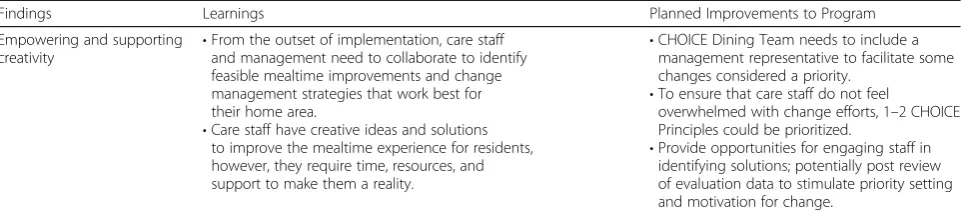
Empowering and supporting creativity
Leadership and team members were the experts in knowing how CHOICE Principles could be enacted, what would be feasible and acceptable within the subculture and context of their home area. Part way through implementa-tion and with the help of the CHOICE Coach they felt empowered to make the CHOICE Principles their own. Several team members took the initiative to implement cre-ative ways to enhance the mealtime experience for resi-dents, “Having the ideas and trying them, and then once you’ve tried them it gives you the motivation to think of other things”(PSW 4). For instance, team members took it upon themselves to bake bread in the living room so as to entice residents’appetites, which may have contributed to the significant improvement in the overall MTS physical environment score. Other team members held weekly Sup-per Clubs that involved a theme dinner with costumes, dec-orations, and music. These efforts were reflected in the MTS analysis where both the physical environment and overall mealtime ambiance scores improved over time. En-suring that all team members felt that they had the capacity and opportunity to implement CHOICE was identified by team members as an area for improvement, in particular, the need for more reflection and hands-on approaches be-yond education. In addition, targeting casual and part-time team members was identified as a priority to “get them more comfortable with serving in the dining room, so that it’s not always the same people, so that they all get those skills and they’re more well-rounded”(DA 1).
Discussion
Mealtimes are often the most anticipated daily event for residents living in LTC homes. However, opportunities for meaningful social engagement are oftentimes missed within these settings, where the communal dining room can result in the pleasurable aspects of a mealtime com-ing second to concerns surroundcom-ing efficiency and suffi-cient food intake [4, 32]. It is the authors’ contention that if mealtime experiences support relationships and positive social connections (a necessary aspect of quality of life), that improvements in nutritional intake will fol-low [11]. Team members and home management have an important role in assisting in defining and promoting
a culture of care that centers around relationships, as it is this culture that ultimately impacts how residents ex-perience their mealtimes [33].
This mixed methods developmental evaluation looked to determine whether the CHOICE Program was an intervention that was worthy of further development and testing. Despite each home identifying different areas for improvement, meta-inferences from both the quantitative and qualitative phases showed that the CHOICE Principles resonated with team members and were seen as a goal for dining. Those who were involved believed that the program was useful for addressing some of the challenges associated with mealtimes in their home areas [34]. Team members and management expressed a re-kindled appreciation for mealtimes and noted visible improvements in mealtime experiences in both home areas.
While the CHOICE Principles resonated with team members as a way to improve mealtimes, the feasibility of implementing and carrying out ways in which the principles could be enacted proved to be more challen-ging than initially anticipated. For example, as residents on Wellesley needed more one-on-one assistance with eating, there were fewer team members available to walk around the dining room to encourage conversation amongst residents and thus reach the goal of Connecting (refer to Table 1 for CHOICE Principles definitions). In this case, the motivation to perform certain aspects of the CHOICE Program on Wellesley was not the issue; it was a matter of addressing the feasibility of how that principle could be enacted within the context in order to create the opportunity for team members to engage in more socialization with residents. One strategy was in-clusion of a recreation therapist at meals to support the care team. Contextual differences between home areas, played an important role in shaping how the CHOICE Principles were interpreted and enacted during meals; this confirms that linear, structured approaches to care within the LTC setting [4, 35] is a barrier to improve-ments that are contextually driven. When looking to build upon this developmental evaluation, there is a need to be responsive to influencing factors at the man-agement and home levels that may hinder or promote
Table 6Learnings and Improvements to the CHOICE Program(Continued)
Findings Learnings Planned Improvements to Program
Empowering and supporting
creativity •
From the outset of implementation, care staff and management need to collaborate to identify feasible mealtime improvements and change management strategies that work best for their home area.
•Care staff have creative ideas and solutions to improve the mealtime experience for residents, however, they require time, resources, and support to make them a reality.
•CHOICE Dining Team needs to include a management representative to facilitate some changes considered a priority.
•To ensure that care staff do not feel
overwhelmed with change efforts, 1–2 CHOICE Principles could be prioritized.
the uptake of change initiatives early on in the imple-mentation process [36,37].
In addition, differences in improvements between the two home areas and feedback from interview participants reveal that more time with the Coach would have been beneficial to build capacity for both teamwork and change management techniques before change efforts were under-taken. No doubt, the large geographic distance (280 km) between the research team and the LTC resulted in less face-to-face time than what may have been needed with the home. This made it difficult to meet the needs of some team members and MT Champions during especially challenging times in the implementation process. Modi-fications to the CHOICE Program should acknowledge the face-time needed by the Coach [38] in order to em-power team members, specifically MT Champions [39], so that they feel confident in applying change manage-ment approaches when tailoring principles in their home areas [40, 41]. Table6 outlines key learnings and outcomes based on findings from this study, in addition to planned improvements for the future development of the CHOICE Program.
Working to make mealtimes more relationship-centred
Results from this developmental evaluation demonstrate the potential for the CHOICE Program to improve some aspects of the mealtime experience, namely physical and overall quality of the dining environment. It is important to note however, that these changes were not necessarily experienced in both home areas to the same extent. For example, although there was a significant time by dining room change noted in the social summative scale, there was a decrease in performance for one area (Wellesley = 5.4 to 5.2) over time. From baseline, one home area im-proved the overall quality of the environment signifi-cantly more than the other, demonstrating that comparisons across neighbourhoods can be challenging, as they are not equivalent with respect to their capacity for improvement. In areas where residents have signifi-cant dementia, social interactions are likely to never be high due to their limited verbal capacity. Relationship-centred care may also be challenging due to the higher demands for hands-on care. The physical and overall quality of the mealtime experience, which significantly improved in both areas included in this pilot, appear to be more readily changeable with the CHOICE program. These findings not only reinforce the need to account for contextual differences between envi-ronments, but also to temper expectations as to what can realistically be achieved within a short-period of time based on staffing and team member skills as well as the capacity of residents. Making improvements to an organization’s care culture and social environment has been noted to be a challenging task [42] that requires
additional time and effort when compared to making improvements to the physical dining environment [11]. Often such cultural changes require targeting roles and responsibilities with added quality supervision on the part of home leadership [36]. Thus, it is recommended that the feasible changes to the built environment be tar-geted in the initial stages of the implementation process, as altering the physical dining environment (i.e., clock on wall, decorations on table, music playing) provides visible improvements that change-making is underway.
Study limitations
Future evaluation of CHOICE should consider the use of a wait list control through a stepped-wedge design rather than a randomized control trial, as this pilot clearly demonstrated that the context of units greatly in-fluences uptake and discernible change. Methodological limitations of this study include the MTS potentially be-ing too insensitive, with too few observations, to capture the gradual improvements that team members and lead-ership referred to during interviews [25]. The issue of social desirability from interview participants may have led to responses, which may not have been entirely re-flective of their experiences implementing the program. As well, there is the potential for confirmation bias, as the interventionist was the interviewer. Other forms of quantitative assessment to capture improvements should include team members’ perspectives on mealtimes and dyads of the resident and family members. Furthermore, it should be noted that because of an illness outbreak at the LTC home, we were unable to capture the last point of data collection at 32 weeks, which may have indicated further improvements in the dining environment. Staff turnover was a barrier to continuity with initial study participants; most notably, a key individual from the home’s management team was unable to participate in the interview process due to extenuating circumstances, which would have undoubtedly revealed critical insights into the feasibility and acceptability of the program. The research team appreciates the importance of the inclusion of family and residents in a relationship-centred interven-tion, however, these perspectives were not attained in this evaluation. Future development of the CHOICE Program will extend qualitative data collection to family and resi-dents as well.
Conclusions
members and home management the opportunity to (re)-consider the importance of mealtimes for residents living in LTC homes. Tailoring program components and imple-mentation methods is absolutely critical for initial uptake and sustainability of change efforts. This involves includ-ing not only team members in the implementation of CHOICE, but also a vested interest and support from home management. Future directions for CHOICE development include a more collaborative approach to tailoring, implementation and evaluation, including the involvement of residents, family members, and volun-teers, as they have the capacity to enhance and support relationship-centred dining.
Additional file
Additional file 1:Table S1."Description and Linear Mixed Model Analysis of MTS Subscales At Each Time Point By Home Area”. This table provides the descriptive analysis of the six MTS subscales for each of the home areas over time. The table also provides results of the linear mixed model analysis of each of these MTS subscales for both home areas by dining room, time, and the interaction between dining room and time. (DOCX 23 kb)
Abbreviations
ADL-LF:Minimum Data Set Activities of Daily Living-Long Form; CPS: Cognitive Performance Scale; DA: Dietary Aid; DFS: Director of Food Service; HM: Home Management; LTC: Long-Term Care; MDS: Minimum Data Set; M-RCC: Mealtime Relational Care Checklist; MT Champions: Mealtime Champions; MTS: Mealtime Scan for Long-Term Care; PSW: Personal Support Worker; RCC: Relationship-Centred Care; RIA: Research Institute for Aging; RN: Registered Nurse; RPN: Registered Practical Nurse
Acknowledgements
The authors wish to acknowledge and thank the long-term care home, team members, and residents for contributions and involvement in this developmental evaluation study.
Funding
This work was supported by the Seed Catalyst Grant from the Network on Aging Research at the University of Waterloo. Research Institute on Aging provided project management and facilitation.
Availability of data and materials
The datasets generated and/or analyzed during the current study are available at request to the principal investigator, Prof. Heather Keller (email: [email protected]).
Author’s contributions
The Primary Investigator, SW, assisted in the development of the CHOICE Program and acted as the CHOICE Coach. SW conducted and analyzed participant interviews, integrated quantitative and qualitative datasets, and developed the initial draft of this manuscript. Principal investigator HK conceived and developed the CHOICE Program and created the validated measurement tool used throughout the study (MTS). HK made substantial intellectual contributions to the analysis and co-wrote the manuscript. Co-Investigator HD aided in the development of the CHOICE Program and was the main point of contact for the study site. Co-Investigator JMM made substantial intellectual contributions in the form of analysis and presentation of data and critically reviewed early and final drafts of the manuscript. VV and SI were site leads for the acquisition of data collection at the study site. All authors reviewed and provided final approval of this manuscript. All authors agree to be accountable for all aspects of the work.
Ethics approval and consent to participate
Study participants provided their written consent to participate. This protocol received clearance from the University of Waterloo ethics board (ORE #21413).
Consent for publication
Not applicable.
Competing interests
All authors declare they have no competing interests.
Publisher’s Note
Springer Nature remains neutral with regard to jurisdictional claims in published maps and institutional affiliations.
Received: 10 August 2018 Accepted: 24 October 2018
References
1. Devine CM. A life course perspective: understanding food choices in time, social location, and history. J Nutr Educ Behav. 2005;37(3):121–8. 2. Evans BC, Crogan NL, Shultz JA. The meaning of mealtimes: connection to
the social world of the nursing home. J Gerontol Nurs. 2005;31(2):11–7. 3. Cranley LA, Norton PG, Cummings GG, Barnard D, Batra-Garga N, Estabrooks
CA. Identifying resident care areas for a quality improvement intervention in long-term care: a collaborative approach. BMC Geriatr. 2012;12(1):59. 4. Lowndes R, Daly T, Armstrong P.“Leisurely dining”: exploring how work
organization, informal care, and dining spaces shape residents’experiences of eating in long-term residential care. Qual Health Res. 2018;28(1):126–44. 5. Watkins R, Goodwin VA, Abbott RA, Backhouse A, Moore D, Tarrant M.
Attitudes, perceptions and experiences of mealtimes among residents and staff in care homes for older adults: a systematic review of the qualitative literature. Geriatr Nurs. 2017;38(4):325–33.
6. Curle L, Keller H. Resident interactions at mealtime: an exploratory study. Eur J Ageing. 2010;7(3):189–200.
7. Kaplan H, Gurven M, Hill K, Hurtado AM. The natural history of human food sharing and cooperation: a review and a new multi-individual approach to the negotiation of norms. Moral sentiments and material interests: the foundations of cooperation in economic life 2005;6:75–113.
8. Tresolini CP, Force PF. Health professions education and relationship-centered care, vol. 8. San Francisco: Pew Health Professions Commission; 1994. 9. Nolan MR, Davies S, Brown J, Keady J, Nolan J. Beyond‘person-centred’care:
a new vision for gerontological nursing. J Clin Nurs. 2004;13:45–53. 10. Sheard D. Bringing relationships into the heart of dementia care. J of
Dementia Care. 2004;12(4):22–4.
11. Keller HH, Carrier N, Slaughter SE, Lengyel C, Steele CM, Duizer L, et al. Prevalence and determinants of poor food intake of residents living in long-term care. J Am Med Dir Assoc. 2017;18(11):941–7.
12. Abbott RA, Whear R, Thompson-Coon J, Ukoumunne OC, Rogers M, Bethel A, et al. Effectiveness of mealtime interventions on nutritional outcomes for the elderly living in residential care: a systematic review and meta-analysis. Ageing Res Rev. 2013;12(4):967–81.
13. Vucea V, Keller HH, Ducak K. Interventions for improving mealtime experiences in long-term care. J Nutr Gerontol Geriatr. 2014;33(4):249–324. 14. Chaudhury H, Hung L, Badger M. The role of physical environment in
supporting person-centered dining in long-term care: a review of the literature. Am J Alzheimers Dis Other Demen. 2013;28(5):491–500. 15. Perivolaris A, Leclerc CM, Wilkinson K, Buchanan S. An enhanced dining
program for persons with dementia. Alzheimer's care today. 2006;7(4):258–67. 16. Genoe R, Dupuis SL, Keller HH, Martin LS, Cassolato C, Edward HG.
Honouring identity through mealtimes in families living with dementia. J Aging Stud. 2010;24(3):181–93.
17. Henkusens C, Keller HH, Dupuis S, Schindel Martin L. Transitions to long-term care: how do families living with dementia experience mealtimes after relocating? J Appl Gerontol. 2014;33(5):541–63.
18. Ducak K, Sweatman G, Keller H. Dining culture change in long-term care homes: transitioning to resident-centered and relational meals. Ann Longterm Care. 2015;23(6):28–36.
cross-sectional study of food intake and its determinants in older adults living in long term care homes. BMC Geriatr. 2017;17(1):15.
20. Patton MQ. Developmental evaluation: applying complexity concepts to enhance innovation and use. New York: Guilford Press; 2010.
21. Creswell JW, Clark VL. Designing and conducting mixed methods research. California: Sage publications; 2017.
22. Cane J, O’Connor D, Michie S. Validation of the theoretical domains framework for use in behaviour change and implementation research. Implement Sci. 2012;7(1):37.
23. Michie S, Johnston M, Abraham C, Lawton R, Parker D, Walker A. Making psychological theory useful for implementing evidence based practice: a consensus approach. BMJ Qual Saf. 2005;14(1):26–33.
24. Michie S, Atkins L, West R. The behavior change wheel: a guide to designing interventions. Great Britain: Silverback Publishing; 2014. 25. Keller HH, Chaudhury H, Pfisterer KJ, Slaughter SE. Development and
inter-rater reliability of the mealtime scan for long-term care. Gerontologist. 2018; 58(3):e160-167.https://doi.org/10.1093/geront/gnw264.
26. Iuglio S, Keller H, Chaudhury H, Slaughter SE, Lengyel C, Morrison J, et al. Construct validity of the mealtime scan: a secondary data analysis of the making Most of mealtimes (M3) study. J Nutr Gerontol Geriatr. 2018;18:1–23. 27. Hirdes JP, Ljunggren G, Morris JN, Frijters DH, Soveri HF, Gray L, Björkgren
M, et al. Reliability of the interRAI suite of assessment instruments: a 12-country study of an integrated health information system. BMC Health Serv Res. 2008;8(1):277.
28. Morris JN, Fries BE, Morris SA. Scaling ADLs within the MDS. J Gerontol A Biol Sci Med Sci. 1999;54(11):M546–53.
29. Sandelowski M. Sample size in qualitative research. Res Nurs Health. 1995;18(2):179–83.
30. Thomas DR. A general inductive approach for analyzing qualitative evaluation data. Am J Eval. 2006;27(2):237–46.
31. Pope C, Ziedland S, Mays N. Qualitative research in health care: Analysing qualitative data. 320.
32. Milte R, Shulver W, Killington M, Bradley C, Miller M, Crotty M. Struggling to maintain individuality–describing the experience of food in nursing homes for people with dementia. Arch Gerontol Geriatr. 2017;72:52–8.
33. Harnett T, Jönson H. Shaping nursing home mealtimes. Ageing Soc. 2017;37(4):823–44.
34. Sidani S, Braden CJ. Design, evaluation, and translation of nursing interventions. United Kingdom: Wiley; 2011.
35. Keller H, Carrier N, Duizer L, Lengyel C, Slaughter S, Steele C. Making the Most of mealtimes (M3): grounding mealtime interventions with a conceptual model. J Am Med Dir Assoc. 2014;15(3):158–61.
36. Coleman CK, Medvene LJ. A person-centered care intervention for geriatric certified nursing assistants. Gerontologist. 2012;53(4):687–98.
37. Estabrooks CA, Squires JE, Hayduk L, Morgan D, Cummings GG, Ginsburg L, et al. The influence of organizational context on best practice use by care aides in residential long-term care settings. J Am Med Dir Assoc. 2015;16(6): 537–e1.
38. Cummings GG, Hewko SJ, Wang M, Wong CA, Laschinger HK, Estabrooks CA. Impact of managers’coaching conversations on staff knowledge use and performance in long-term care settings. Worldviews Evid-Based Nurs. 2018;15(1):62–71.
39. Woo K, Milworm G, Dowding D. Characteristics of quality improvement champions in nursing homes: a systematic review with implications for evidence-based practice. Worldviews Evid-Based Nurs. 2017;14(6):440–6. 40. McNally M, Martin-Misener R, McNeil K, Brillant M, Moorhouse P, Crowell S,
et al. Implementing oral care practices and policy into long-term care: the brushing up on mouth care project. J Am Med Dir Assoc. 2015;16(3):200–7. 41. Rahman AN, Simmons SF, Applebaum R, Lindabury K, Schnelle JF. The
coach is in: improving nutritional care in nursing homes. Gerontologist. 2011;52(4):571–80.