ISSN (Online): 2320-9364, ISSN (Print): 2320-9356
www.ijres.org Volume 6 Issue 8 Ver. I ǁ 2018 ǁ PP. 91-97
Effect Of Talc On The Physical, Microstructural And Mechanical
Properties Of Reaction Sintered Zirconia Toughened Mullite
Composites
H.Aydın
*, G.Tokataş
Department of Metallurgy and Material Engineering, Kütahya Dumlupınar University,43100 Kütahya, TURKEY
*
Corresponding authorH.Aydın;
ABSTRACT:
In this study the effect of talc Mg3Si4O12H2 additive on the physical, microstructural andmechanical properties of zirconia toughned mullite (ZTM) is discussed. The talc additive in ZTM not only stabilizes the tetragonal zirconia phase but also actsas a sintering aid for the formation of cross-linked mullite grains. Specimens such as pellets and rectangular bars were manufactered for ZTM with various amounts of talc additions (4 and 7 wt.%). The manufactered samples were sintered at 1450, 1500 and 15500C temperatures for 5 hrs. The physical properties of sintered samples such as bulk density, teorical density, percentage of linear shrinkage were examined. X-ray diffraction patterns confirm the constituent phasespresent in the samples were mullite and zirconia. The microstructure of all the composites is composed of irregularly shaped mullite grains, and round-shaped zirconia grains which are distributed homogenously.The samples were subjected to mechanical tests like modulus of elasticity, flexural strength. It was observed that the addition of talc was improved the elastic modulus, flexural strength of the ZTM.
KEYWORDS:
Zirconia toughned mullite composites, Talc, Properties, Reaction sintering.--- --- Date of Submission:03-10-2018 Date of acceptance: 15-10-2018
---
I.
INTRODUCTIONOver the past years a number of different studies have been conducted on zirconia toughned mullite (ZTM) composites selecting different synthesis methods and using different kinds of raw materials by various researchers due to their excellent thermomechanical properties [1-8].
ZTM is one of the basic ceramic matrix composites traditionally used for refractories and glass industry because of its high temperature mechanical properties as well as good wear and thermal shock resistance. Improving physical and mechanical properties with zirconia additives in the mullite matrix is a well accepted phenomena [9-10]. Many other additives are used to manufacture zirconia toughned mullite ceramics: these are mainly magnesia, calcia, titania, yttria, ceria, dysprosia, colemanite, ulexite etc [1,2, 7-11]. Various manufacturing methods for preparing mullite-zirconia composites havebeen reported [12] including: (a) sintering ofmixed mullite and ZrO2starting powders, (b) reactionsintering of silica,alumina and zirconia, and
(c)reaction sintering of alumina and zircon. In this study, unlike the literature kaolinite was added to the mixture of zircon and alumina.
Among these manufacturing methods, the reactionsintering is the most common one because ofits advantages to use cheap traditional rawmaterials and low manufacturing cost [13].
This study focuses on the reaction involving kaolinite and given in equation 1.1 is based
2ZrSiO4 + Al2O3.2SiO2.2H2O + 5 Al2O3 → 2 ZrO2 + 2[3Al2O3.2SiO2] 1.1
Due to the high purity of the precursors, complete decomposition of ZrSiO4 into ZrO2 and SiO2, owing
to its high purity, is assumed; similar to the disintegration of kaolinite which yields 1 mol of Al2O3 and 2 moles
of SiO2. Correspondingly, Al2O3 used in the reaction is also considered to be highly pure, in regards to
synthesize 2 moles of mullite.
Owing to the impurity content of the precursors (besides the molar ratio), the weight ratio ofAl2O3/SiO2
The goal of the present investigation is to characterize the reaction sintered zirconia toughened mullite composites, prepared from zircon, kaolinite and alumina in presence of talc additive.The effects of talc contentand sintering temperature on the phase evolution, microstructure and mechanical properties of the investigated bodies are throughly studied. Another goal of the study is to make a contribution to scientific literature concerning studies on sintering of mullite-zirconia composites at lower temperatures by taking advantage of talc (Mg3Si4O12H2).Apparently, if zircon’s dissociation occurs at lower temperature and reaction of
alumina with silica is fast, mullite-zirconia synthesis gets pulled to low temperature. There is a case study in which the MgO addition lowers the zircon decomposition temperature and hence the mullite- zirconia synthesis temperature [14].
II.
EXPERIMENTALStarting powders were zircon with D0.5 = 1.62 µm (ZrSiO4, Johnsen Matthey, Sereltas, Istanbul,
kaolinite with D0.5 = 10.20 µm (Al2Si2O5(OH)4, Kutahya Porselen, Kutahya), commercial calcined alumina
with D0.5 = 92 µm (Al2O3, BDH Limited Poole, Germany) and talc with D0.5 = 15.20 µm (Mg3Si4O12H2,
Kutahya Porselen, Kutahya).Three batches, M1-M3, were calculated according to Table 1.The starting powders were mixed in a ball mill for 6 h in zirconia pot using zirconia ball as grinding media in metyl alcohol medium at the speed of 300 rpm/min. Resulting mixtures were initially 24 h naturally dried followed by 24 h drying at 100 0C in drying oven. Dried mixtures obtained were crushed to break the lumps and passed through 500 µm sieve to get the desired powder mixtures. Afterwards, prepared mixtures were uniformly mixed with 5 wt.% PVA solutionas binder and shaped into bars (size 75 mm × 5 mm × 55 mm) for flexural strength and elastic modulus measurements and pellets (size d 10 mm) for density, phase and microstructure analyses by uniaxially pressing at 2 tons. The formed specimens were sintered at 1450-1550 0C for 5 hr. at a heating rate of 5 0C min.-1. Bulk density of specimens were determined by the Archimedes method. It was measured by calculating the linear shrinkage of the samples as a percentage of the original length of the sample, L0 (in mm), from the
equation:
Percentage of Linear Shrinkage= 1 −LD L0 100 Where LDis the length of the sintered sample(in mm).
Table 1: Investigated batches compositions. Compositions, wt.%
Zircon Alumina Kaolinite Talc
M1 30 45 25 -
M2 23.80 45 27.21 4
M3 40 43 10 7
Phases of sintered specimens were defined by X-ray diffraction (XRD, Rigaku, MiniFlex) at 10–450 and a scanning speed of 20 (2θ) per minute. The microstructure of the specimens and energy dispersive X-ray (EDX) analyses were carried out by means of scanning electron microscope (SEM, FEI Nova NanoSEM 650).
Fig.1:XRD paterns for additive-free mixture (M1) sintered at a temperature of 1450, 1500 and 1550°C.
Fig.3:XRD paterns for M3 sintered at a temperature of 1450, 1500 and 1550°C.
When kaolinite is calcined at elevated temperatures, dehydroxylation occurs which collapses the crystal structure to produce amorphous metakaolinite (Al2Si2O7).The thermal transformation of metakaolinite above
1000 °C first produces aluminasilicate phase which transforms into mullite. Above 1150 °C, amorphous silica (cristobalite, SiO2) is formed [17]. Similarly, zircon decomposes into zirconia and silica. Released silica again
reacts with alumina to form stoichiometric mullite [11].
Sintering of M2 and M3 at 1450-1550 °C resulted in an ocularly dissociation of zircon to zirconia and amorphous silica which reacted with alumina to form mullite. The zircon dissociation was enhanced considerably with the 4-7 wt.% talc additions. Besides, the increase of sintering temperature was more effective in the dissociation of zircon when the talc was added. XRD pattern of M3 at 1550 °C,zircon phase did not appear (Fig.3). Although MgO in talc addition was expected to stabilization zirconia in the tetragonal form [8, 15], most of the zirconia reflections indicated the monoclinic zirconia. Required amount of talc was not sufficient to provide the suitable amount for the stabilization.
It is well known that ZrO2 phase transformation is related to a presence of SiO2.At low temperature
such as 1400°C, ZrO2 andamorphous SiO2 is formed due to zircondissociation. ZrO2 particles is immersed inthe
amorphous SiO2 matrix, which stabilizesZrO2 as t-ZrO2 phase. At higher temperature,the amorphous SiO2 is
consumed toform mullite and losing the ability to stabilize ZrO2;thus, the ZrO2 in the samples obtained athigher
temperature mainly exist in m-ZrO2phase [20].
1.2.Densification behaviour
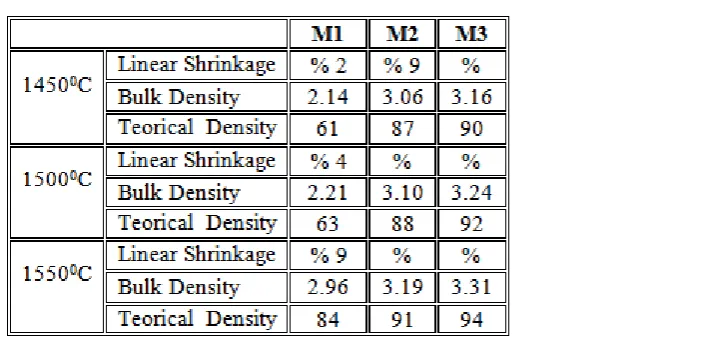
composites synthesized.It can be seen that densification rate of the samples containing talc additive is higher than that of the sample without additive. All specimens with talc additive have achieved optimum bulk and teorical density at 1550 °C, whereas specimens without additive haven’t attained the same level of densification at 1550 °C.
Table 2: Percentage of linear shrinkage, bulk density in g/cm3and teorical density values
1.3.Mechanical properties
Room temperature flexural strength (σ) and elastic modulus (E) of M1-M3 specimens are presented in Table 3 and Table 4, respectively. The values for the samples with talc additive were higher than those for the sample without the additive. Sample M1 (without additive) have shown flexural strength of 166 MPa and elastic modulus of 92 GPa at 1550 0C. With addition of talc, slight improvement in flexural strength and elastic modulus is provided. Specimens with 4 wt.% talc exhibited 171 MPa of flexural strength and elastic modulus of 112 GPa. The mechanical properties of samples were gradually enhanced when the amount of talc added was increased (7 wt. %).It is mentioned that uniform microstructure and dense structure can improve the mechanical properties of the composite in terms of flexural strength and elastic modulus [19].
Table 3: Flexural strength (σ) of M1-M3 sintered at 1450-1550 0C, 5 h. Temperature
(°C)
Strength (σ -MPa)
M1 M2 M3
1450 63±8.5 97±15.33 102±8.3
1500 108±13.36 148±15.47 156±10.25
1550 166±12.21 171±15.78 176±8.16
Table 4:Elastic modulus (E) of M1-M3 sintered at 1450-1550 0C, 5 h. Temperature (°C) Elastic Modulus (E-GPa)
M1 M2 M3
1450 34±8.25 57±12.86 62±10.45
1500 72±8.68 98±19.19 103±12.59
Fig.4:Flexural strength (σ) and Elasticmodulus (E) of M1-M3 sintered at 1450-1550 0C, 5 h.
Fig. 6: SEM photomicrograph and corresponding EDX spectra of the sample M3 sintered at 1550 °C: (1) mullite grain and (2) zirconia grain
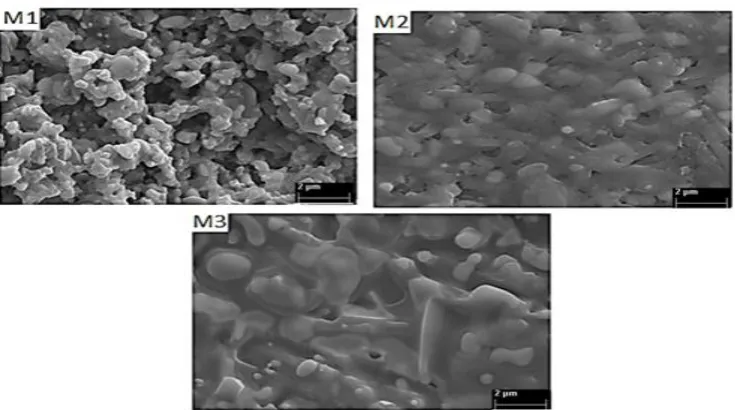
Fig. 5 shows the SE-SEM microstructure of a sintered surface of M1, M2 and M3 samples. As seen in Fig. 4, apparent grain growth of mullite and zirconia contributed decrease in porosity for specimens sintered at 1550 °C. In contrast, micrographs of M2 and M3 samples, which the zirconia grains demonstrated a large growth compared to M1, represent the effect of talc addition. Via reaction sintering process inter-particle pores could be eliminated by atomic diffusion which arised from capillary forces [17]. SEM photomicrograph and corresponding EDX spectra of the sample M3 sintered at 1550 °C has been shown in Fig. 6. As mentioned condition can be explained by our current research results, which shows that mullite-zirconia ceramics initiated effective densification at 1550 °C.
IV.
CONCLUSIONSMullite-zirconia composites from zircon, kaolinite, alumina can be synthesized by the reaction sintering process in the temperature range of 1450-1550 0C with talc as an additive.
It is well known, zircon usually dissociates at a temperature higher than1650°C [21].Thermal dissociation of zircon was found during the processing (1550 0C for 5 h) for M1 sample. The presence of mullite–zirconia grains promoted this decomposition process. Talc addition reduces the decomposition temperature of zircon thereby enables mullite-zirconia composite synthesis at much lower temperatures, compared to the batches without talc (M1).
XRD patterns confirm the reaction between kaolinite, alumina, zircon to form the mullite-zirconia composite at 1500°C after 5 h of soaking (Fig. 2 and Fig. 3). The zircon phase is not detected in the mixture of M3 sintered below 1500 °C, while the mixture of M1 zircon peaks appear at high sintering temperature (e.g. 1550 °C).Kaolinite converts into mullite and amorphous silica [19] on heating. Similarly, zircon flour decomposes into zirconia and silica after heat treatment and yields the source of zirconia. Released silica again reacts with calcined alumina to form stoichiometric mullite. XRD patterns of the samples sintered at 1550 °C have been illustrated in Fig. 3. In all samples sintered at 1550 °C, three major phases are identified: mullite, tetragonal zirconia (t-ZrO2) and monoclinic zirconia (m-ZrO2).The reason for the dominance of m-ZrO2 phase in XRD
analysis is either due to the large size of the t-ZrO2 particles and/or dissolving of impurities such as MgO, B2O3,
CaO and Al2O3 in mullite structure rather than thezirconia structure.
In presence of talc (Mg3Si4O12H2)additive, crystallinity of the specimens has been improved further
[22]. Talc exhibited a positive role on the formation of mullite and zirconia. The sintering temperature has a significant role on the formation of mullite in mullite- zirconia composite. According to XRD results of all the samples, evident increase in mullite formation was observed with the increase in sintering temperature from 1450 to 1550°C. Especially, at a sintering temperature of 1550°C for M2 and M3 samples, the zircon dissociation was almost complete, and therefore, with an increase in the sintering temperature from 1450 to 1550°C, the proportion of zirconia phase (t-ZrO2 and m-ZrO2) significantly increased.
As showed with the mineralogical analysis the microstructure of M2 and M3 samples shows a mullite-zirconia composite (two phase). The microstructure of all composites is composed of irregularly shapedmullite grains, and round-shaped zirconia grains which are distributed homogenously. Composites with 4 wt. % and 7 wt. % talc have shown flexural strength of 171 MPa and 176 MPa at room temperature, respectively. Similarly, composites with 4 wt. % and 7 wt. % talc performed an elastic modulus of 112 GPa and 117 GPa at room temperature, respectively.
REFERENCES [1]. H. Aydin, R. Goren, J Aust Ceram Soc. 283–286, 53 (2017)
[2]. P.M. Suoto, R.R. Menezes, R.H.G.A. Kiminami, Ceram. Int. 241–248, 37 (2011)
[3]. M.N. Ibarra Castro, J.M. Almanza Robles, D.A. Cortes Hernandez, J.C. Escobedo Bocardo, J. Torres, Ceram. Int. 921–924, 35 (2009)
[4]. S. Yugeswaran, V. Selvarajan, P. Dhanasekarana, L. Lusvarghi, Vacuum, 353–359, 83 (2008)
[5]. B.-Y. Ma, Y. Li, S.-G Cui, Y.-C Zhai, Transactions of Nonferrous Metals Society of China, 2331–2335, 20 (2010) [6]. N.M. Rendtorff, L.B. Garrido, E.F. Agiletti, Ceram. Int. 781–788, 36 (2010)
[7]. H. Aydın, R. Gören, Cogent Engineering, 1-10, 3: 1209809 (2016)
[8]. S. Prusty, D.K. Mishra , B.K. Mohapatra, S.K. Singh, Ceram. Int. 2363-2368,38 (2012) [9]. K. Das, G. Banerjee, Journal of the European Ceramic Soc. 153-157, 20 (2) (2000) [10]. L.B. Garrido, E.F. Aglietti, Materials Science Engineering A 250–257, 369 (2004)
[11]. P. Kumar, M. Nath, A. Ghosh and Tripathi, Himansu Sekhar , Transactions of Nonferrous Metals Society of China, 2397-2403, 26 (9) (2016)
[12]. H. Schneider, K. Okada, and J. A. Pask, (John wiley & Sons, Inc. New York, 1994), pp. 72-74 [13]. H. Belhouchet, V. Garnier,Verres, Céramiques & Composites, 16‐24,1 (2) (2011)
[14]. M.M.S. Wahsh, R.M. Khattab, M. Awaad, Materials and Design, 31-3641 (2012) [15]. I. M. Bakr, M.M.S. Wahsh, Mater. and Design, 99-105,35 (2012).
[16]. F. Sahnoune, H. Belhouchet, N. Saheb, M. Heraiz, M. Chegaar and P. Goeuriot, Adv. Appl. Ceram.,175–180, 110 (2011) [17]. E. Erasmus, Hem. Ind. 595–601,70 (5) (2016)
[18]. Emad M.M. Ewais, American Ceramic Society Bulletin, 9101-9110,86 (12) (2007)
[19]. Peng-fei Liu, Zhuan Lia, Peng Xiaoa, Heng Luo, Tian-hui Jiang Ceram. Int. 1394-1403,44 (2) (2018) [20]. S. Zhao, Y. Huang, C-A. Wang, X-X. Huang, J-K. Guo, Mater. Lett.,1716-1722,57 (2003)
[21]. Y. Kanno, T. Suzuki, Journal of the Soc. of Materials Sci. Japan 1372-1375,37 (423) (1988) [22]. D. Chandra, Int. J. Appl. Ceram. Technol., 771–782,12 [4] (2015)