An Efficient Algorithm for Video Restoration
Anagha Chandran N1 and Mr.Shehin A.U2
1S4-M.Tech (ECE-CE), Royal College of Engineering and Technology, Thrissur, Kerala, India. 2Department of ECE, Royal College of Engineering and Technology, Thrissur, Kerala, India.
Article Received: 29 January 2018 Article Accepted: 26 February 2018 Article Published: 30 April 2018
1. INTRODUCTION
During the wireless transmission of, the image/video is transmitted over the wireless channel block by block. Due
to severe fading, we may lose an entire block even several consecutive blocks of an image. In the worst case, a
whole line of image blocks might be lost. The previous image restoration algorithms have some disadvantages:
during the priority calculation, the credibility is not high. The accuracy is also not high when searching the best
matching patch. All of these will affect the final results of the image restoration. This paper improves the above
shortcomings and the restoration results of the algorithm are more accurate and reliable.
A. FLOWCHART OF PROPOSED SCHEME
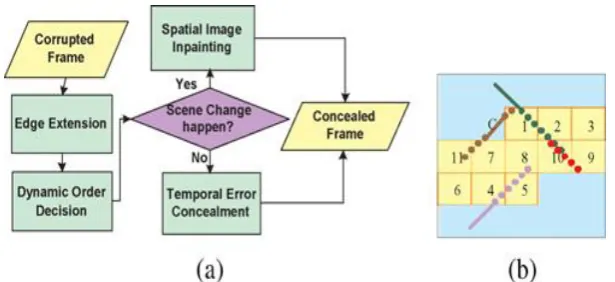
Fig. 1. (a) Flow chart of the current algorithm. The edge extension engine extends the existing edges from
uncorrupted MBs into corrupted MBs according to edge direction and strength. In order to retain the edge
continuity, a dynamic order decision engine is applied to decide the processing order for the corrupted MBs. Scene
change detection analyzes the correlation of the current frame and previous frame. If scene change is determined to
have occurred, the spatial image in painting algorithm is applied or temporal error concealment is applied to repair
the corrupted image. (b) Edge extension step. The extended points are extended from the detected edge following
its direction.
A B S T R A C T
The flowchart of the proposed algorithm is shown in Fig. 1(a). The structure of the corrupted region will be
calculated using fruitfly algorithm which extends the existing edges in uncorrupted MBs to corrupted MBs
according to isophote direction and variance. As the points shown in Fig. 1(b), the edge points are extended from
the detected edge in the same direction. The inpainting process is executed patch by patch. That is, the corrupted
patch is retrieved patch by patch.
Moreover, in order to retain the edge structure in each stage structure of missing block is calculated. As shown in
Fig. 1(b), the inpainting order for points on extended edges will be similar to that of the original inpainting
algorithm. After that, the system can start to perform spatial image inpainting or temporal error concealment as the
final stage, as shown in Fig.1(a).
B.FRUITFLYOPTIMISATIONALGORITHM
We introduce the Fruit Fly Optimization algorithm to search the best matching patch. The Fruit Fly Optimization
algorithm is a global optimization method based on the fruit fly ransacking behavior. According to the ransacking
process, we get the basic principles of the algorithm.
The first is smell inquiry process: using the smell to perceive the various gases in air and determine the food
position to close to it. The second is visual orientation process: in the visible range, determining the food position
accurate and flying to it.
The specific procedure for the algorithm is as follows:
Step 1 Determine the size of the fruit fly, the maximum number of iteration represented by max gen and other
parameters. Also, initialize the fruit fly position represented by ( Xaxis ,Yaxis);
Step 2 Give fruit fly the direction and distance to search the food by smell:
Step 3 Due to the specific position of the food is not known. So, determine the value of the taste concentration Si by
calculating the distance represented by Disti during the individual and origin. The calculation formula is as follows:
fruitfly represented by smelli:
smelli = function(Si)
Step 5 According to the smell concentration value, and find the individual with the lowest concentration:
[bestSmell,bestindex] = min(smelli)
Step 6 Retain the best smell concentration value and the Position (X,Y) , At this point, all fruit fly population fly to
there:
Step 7 Conduct the iterative optimization process. First, determine whether the best smell concentration is better
than the last best smell concentration, if it is better, carry out the Step 6, and if it is not better, repeat the steps from
2 to 5. Until the terminate condition is reached, stop the process.
We apply the fruit fly optimization algorithm to the best matching patch search process and the smell concentration
judgment function is as follows: d( Ψp,Ψq) When finding the patch with minimal smell concentration, it is the best
matching patch.
C. PROCESS OF FRUIT FLY OPTIMIZATION ALGORITHM
Step 1 Mark the areas to be restored in images with a special color;
Step 2 Initialize the boundary of the restored areas and record it as a 𝟃Ω
Step 3 Calculate priority of the restored patch which centers on the contour point, and by comparing, we select the
restored patch with the high priority;
Step 4 Use the Fruit Fly Optimization to Search the best matching patch in the known area, then we copy
corresponding pixel information in the best matching patch to the unknown area in the restored patch;
Step 5 Update the confidence value and continuing to search the next restored patch with the maximum priority;
Step 6 Repeat steps 3-5 until the damaged area is fully restored. At this point, the restoration process completed.
a. The redefinition of the priority
patch along the direction of the np. The patch is segmented evenly to be two patches I and 2. We calculate their
variances of the known pixels, which are F (1) and F ( 2 ). Next, we calculate the variance difference during patches
land 2, which is represented by F (p) . The variance difference can reflect the edge characteristics of the damaged
areas and it will influence the selection of the damaged patches. So we add it to the priority calculation.
However, as the filling and the selection of the template patch is inaccurate, C (p) will quickly drop to zero. At this
point, D(p) almost have no effect on priority calculation, which leads to wrong filling order and the bad restoration
results, so we add them so that they will have no impact on each other. So, we redefine the priority as follows
Where, F(p) = |F(1)- F(2)| and, C(p) represents confidence value, which is used to measure the known information
proportion in the target patch. D(p) represents data item, which decides that the restorations of the image are
conducted along the direction of the isophote. nprepresents the external normal line direction of an, a represents a
normalized factor, which values 255.
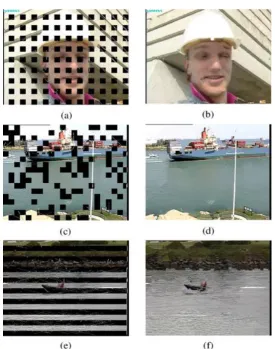
Fig. 4. Experimental results of the proposed inpainting algorithm with edge extension map. (a) Edge extension map
for Foreman. (b) Inpainting result for Foreman. (c) Edge extension map for Container. (d) Inpainting result for
Fig. 4(a), (c), (e) shows the results based on the proposed algorithm. Fig. 4(b), (d), (f) shows the respective
inpainting results.
2. CONCLUSION
In this paper, we improve the original algorithm. When calculating the priority of damaged patch, with the
conduction of the restoration, the confidence will decline rapidly. At this point, the data items have no effects on the
priority, so we change their geometric relationship to be addition, which avoid the effects they impact on each
other. Also, we consider that variance difference between patches can reflect the image edge structure. In order to
get a more accurate result, we introduce it into the priority calculation. When searching for the best matching patch,
because the fruit fly optimization algorithm has the benefits of easy realization, small calculation and strong global
optimization ability and so on, we use it to search for the best matching patch. By restoring the different damaged
images, we can see that not only the PSNR values are improved, but also we can get a better restoration result..
REFERENCES
[1] Harrison P.A nonhierarchical procedure for re synthesis of complex texture!! Proc. Int. Conf. Central Europe
Computer Graphics, Visualization, and Computer Vision, Plzen, 2001.
[2] Iddo D, Daniel C, Hezy Y. Fragment based image completion. ACM Transaction on Graphics, 22(3):303-312.
[3] Borikar S, Biswas K K, Pattanaik S. Fast Algorithm for Completion of Image with Natural Scenes.
http://graphics.cs.ucf.edulborikar!BorikarPaper.pdf, 2005
[4] Criminisi A. Perez p. Toyama K. Region filling and object removal by exemplar-based image inpainting. IEEE
Transactions on Image Processing, 2004, 13(9):1200-1212.
[5] Zhang Song, Zhou Xuya. An improved scheme for Criminisi's inpainting algorithm[C]. International Congress