The Data Sharing with Access Privilege to User
Revocation of Cloud Data
1
Pitta Kantarao,
2Dakineni Durga Prasad
1,2Dept. of Computer Science, BITS, Visakhapatnam, India
Abstract
Cloud computing empowers on request access to shared origination of assets, this is the most recent pattern in today’s IT industry. Among various administrations gave by cloud, cloud storage
benefit permits the data proprietors to store and share their data
through cloud and in this manner turn out to be free from the weight of storage administration. Cloud storage is rapidly turning into the technique for choice. Securing documents remotely rather than by locally brags a variety of inclinations for both home and expert
customers. Cloud storage signifies “the storage of data online in
the cloud”, in any case, the cloud storage is not totally trusted. Whether the data set up away on cloud are or not transforms into a huge worry of the customers additionally get to control turns into a troublesome occupation, especially when we share data on cloud servers. To handle this issue outsourcing Revocable
IBE plot for proficient key era and key redesigning procedure
is present. Additionally to enhance the effectiveness of cloud server as far as storage new secure data self-destructing system in cloud registering is utilized. On the off chance that the qualities
connected with the figure content fulfill the keys get to structure
and both the time moment is in the permitted time interim then
the figure content is decoded. After a client indicated end time the
data at cloud server will be safely self-destructed.
Keywords
Cloud Computing, Outsourced, IBE, Access control, Access key,
Cloud Storage, Integrity, Policy, Revocation
I. Introduction
Identity based encryption system permit any client to produce
an open key from a referred to character esteem, for example,
an ASCII string. There is trusted outsider, called the Private Key
Generator (PKG), who creates the comparing private keys. For encryption and decoding operations, PKG first distributes an ace open key, and after that create the relating expert private key (alluded as ace key). Utilizing this ace open key, any client can create an open key comparing to the identity by consolidating the ace open key with the character esteem. To get a relating private key, approved client can utilize character ID contacts PKG, which utilizes the ace private key to create private key for identity ID. Thus, client can encode messages with no earlier appropriation of keys between members. This is extremely helpful in situations where redistribution of keys is badly designed on
account of specialized limitations. In any case, for unscrambling
of message, the approved client must get a proper private key from
PKG. In this approach the issue is that PKG must be exceptionally
trusted, as it has capacity to create any clients private key and
unscrambling of message without approval. Since any client’s
private key can be produced utilizing outsider’s mystery, this system has inborn key confirmation. An alternate systems have
been proposed which evacuate this including endorsement
based encryption and secure key issuing cryptography. In PKI setting, revocation is finished by affixing legitimacy periods to
endorsements or utilizing mixes of methods. However, this require
administration of declarations which is definitely the weight that
IBE endeavors to mitigate. Boneh and Franklin proposed that their private keys can reestablished by client occasionally and
senders utilize recipients identity with current day and age. Be that as it may, this component would brings about an overhead at PKG. In another word, every one of the clients despite the fact
that their keys have been renounced or not, need to contact with private key generator( PKG) occasionally to demonstrate their characters and overhaul new private keys. It is required that PKG must be on the web and the safe channel must be kept up for every one of the exchanges, which will end up being a bottleneck
for IBE system as the quantity of clients develops. Numerous organizations vast and little utilize cloud registering today either
specifically or in a roundabout way rather than conventional on location choices. There are various reasons like Reduction of costs, Universal get to and numerous more in view of which cloud
registering is so broadly utilized among organizations today. In
this manner it require another working worldview for bringing
cloud administrations into IBE revocation to settle the issue of effectiveness and storage overhead. A credulous approach is hand
over the private key generators (PKG) ace key to the Cloud Service Providers (CSPs). The CSPs then just upgrade all private keys by utilizing the customary key overhaul procedure and exchange the private keys to unrevoked clients. Be that as it may, this approach
depends on an improbable presumption that CSPs are completely
trusted and are permitted to get to the ace key for IBE system. In any case, by and by people in general clouds are likely outside of
the same trusted space of clients and are interested about clients singular protection. Thus, a test is the means by which to plan a safe revocable IBE conspire so we can lessen the overhead calculation at PKG with an untrusted CSP is raised.
II. Related Work
Adel Binbusayyis* and Ning Zhang had proposed Decentralized
Attribute Based Encryption Schemes. Existing progresses in the direction of decentralized ABE can be ordered into two
classifications relying upon how the trait powers are organized:
multi-power ABE and various leveled ABE. In the setting of multi-power ABE, a few credit powers participate to deal with the characteristics in a system. Every characteristic power is given
a remarkable arrangement of qualities. A client may need to ask more than one power with a specific end goal to acquire his/her qualities. One of the security difficulties is the means by which to oppose the conspiracy assault of vindictive clients. The Chase work accomplishes intrigue resistance by presenting a Global Identifier (GID) given to every client mystery key. Every one of the clients mystery key parts from various powers will be attached to his GID. In any case, to make the figure content be free of the clients GID,
a focal power must be utilized to issue an exceptional mystery
key for the client utilizing his mystery key and alternate powers mystery keys. Lekwo and Waters proposed a multiauthority ABE
conspire that does not require either focal power or collaboration
the fact that every power needs to know all clients GID ahead of time. Likewise, they don’t consider how to decrease the workload
on a trait power when it needs to handle huge number of clients in expansive scale system. [6]Wan et. al. proposed a various
leveled property set-based encryption (HASBE) plot. Like our CP-DABE plot, their plan requires a client just to speak with his/her managing trait power, as opposed to with more than one
quality power as the case in. Be that as it may, the HASBE plot has
two downsides contrasted and our CP-DABE conspire. The first is that our CPDABE calculations are speedier than the HASBE
calculations as far as the computational cost. In the decoding calculation, for instance, in the HASBE conspire, the unscrambling
requires two matching operations for each leaf hub used to fulfill
the tree, one blending for each deciphering hub on the way from the leaf hub used to the root, and one exponentiation for every hub on the way from the leaf hub to the root. In any case, in
our CP-DABE plot, the unscrambling calculation requires just a single matching guide for every ascribe used to fulfill the get to
structure. The second downside is that the HASBE plan is just demonstrated secure in the bland security show, while our
CP-DABE plan is formally demonstrated against picked plaintext assaults under the decisional Bilinear Diffie-Hellman Exponent
supposition. [12]Qingwei Zhang, Mohammed Almulla proposed Revocation Schemes. Client revocation is the demonstration of
expelling benefits from a client so that the client can no longer
get to the data records. To deny a client, the data proprietor needs
to upgrade every one of the properties keys (i.e. trait open keys and characteristic ace keys) that have been utilized to infer the denied clients keys (i.e. client trait mystery keys). As a result of overhauling the characteristics keys, the data proprietor likewise needs to upgrade all other influenced clients keys (i.e. client quality mystery keys) and re-scramble every data that have been related
from with any of these denied traits. [13]Pervez, Z. et. al. proposed
making another get to arrangement with every data document, which contains all the approved clients IDs. To deny a client,
the data proprietor will just need to expel the renounced clients
ID from the get to strategy. This is a clear arrangement, however
not down to earth for extensive systems since the data proprietor
should know the every one of the clients IDs from the earlier.
To handle this issue, a lapse time based revocation procedure is proposed, which relates an ascribe called close time to every
client mystery key.
III. Problem Definition
A. Problem Definition
Cloud computing relies on sharing computing resources rather than having local servers or personal devices to handle applications and used as a metaphor for the internet so the phrase cloud computing means a type of internet based computing. To apply traditional supercomputing or high performance computing normally used
by military and research to perform such as financial portfolios to
deliver personalized information to provide storage or to power
large uses networks of large groups of servers.
Cloud computing provides clients with a virtual computing infrastructure on which they can store data and run applications, introducing new security challenges since cloud operators are expected to manipulate client data without necessarily being fully trusted.
Cloud computing provides cryptography even in order to realize
scalable flexible and fine grained access control of outsourced
data, we analyze encryption methods and priority hierarchical
structure of users.
Encryption is the conversion of data into a form called a cipher
text that cannot be easily understood by unknown persons and
decryption is the process of converting encrypted data return into its
original form. Use of encryption/decryption is art of communication cipher often incorrectly called a code can be employed to keep
the enemy from obtaining the contents of transmissions. In order to easily recover the contents of an encrypted signal the correct
decryption key is required alternatively a computer can be used in an attempt to break the cipher. Fact that encryption might
be accidently utilized on something that was not meant to be encrypted and the person who was meant to obtain the message may not be able to read the message sent to them, may not be strong enough and therefore others may be able to easily interpret information. Hierarchical structure of system users to achieve
scalable flexible and fine grained access control low initial capital
investment and maintenance.
B. Analysis for the Above Problem
Cloud server is either proportional to the number of system attributes or linear to the size of the user access structure tree achieved. Our construction also protects user access privilege information again cloud server.
Method for Hierarchical Attribute Solution:
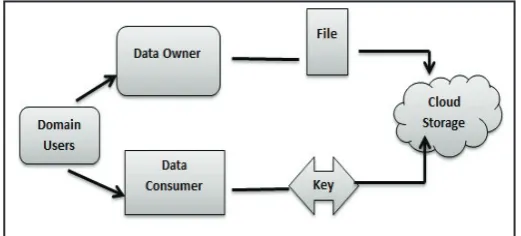
Fig. 1: Proposed Model
Data owner uploads the data in the cloud server for the security purpose, owner encrypts the file and store in the cloud and owner as rights to change the policy over data files by updating the
expiration time.
Data Consumer user can only access the data files with the encrypted key if the user has the privilege to access the file. For
all user level all the privilege is given by the domain authority and the data users are controlled by the domain authority.
Cloud service provider manages a cloud to provide data storage
service, data owners encrypt their data files and store them in the
cloud for sharing with data consumers. To access the shared data
files data consumer download encrypted data files.
Authority person is responsible for generating and distributing
system parameters and root master keys as well as authorizing the high level domain authorities. Domain authority is responsible for delegating keys to subordinate domain authorities at the next
level or users in its domain.
IV. Encryption Methods in Cloud Computing
To achieve security and quality of data, it is very important to provide encryption and signature based scheme.
A. Identity Based Encryption
Identity based encryption cryptography is a third party server uses
be used for encrypting and decrypting electronic data. Typical
public key cryptography greatly reduces the complexity of the
encryption process for users. Identity based encryption depends on the third party identity based encryption server that generates
private keys, information stores permanently is a secret master key
a large random number that is exclusive to the security domain.
The server uses this key to create a common set of public key
parameters that are given to each user, the persons who are installed the identity based encryption software setup. When an outsourcing sender creates an encrypted message the identity based software
on his system uses three parameters to generate the public key
for the message.
B. Linear Search Algorithm
A symmetric encryption algorithm is used to encrypt the plain text
for the cipher text of each keyword under symmetric encryption
scheme a pseudo random sequence is generated with a length
less that of the cipher text. At the same time check sequence is
generated based on the pseudo random sequence and the cipher text. The sum of the lengths of the pseudo random sequence and
the check sequence equals the length of the cipher text, the sum
of the lengths pseudo random sequence equals the length of the cipher text.
C. Identity Based Signature
Identity based signature scheme is deterministic if the signature
on a data by the same user is same, setup generates a private key
provides the security parameter as the input to this algorithm
generates the systems parameters and master private key. User extract his identity to private key generates as input and obtains the private key D and send to user through a secure channel. For
generating a signature on a message m the users provides his
identity private key D parameters and the message as input, the
algorithm generates a valid signature on message by the user.
D. Attribute Based Encryption
The attribute and policies associated with the message and the user decides which user can decrypt a cipher text; the authority
will create secret keys for the users based on attribute for each user. Users in the system have attributes receives a key from an
authority for its set of attributes. Cipher text contains a policy predicate over the attribute space.
E. Homomorphic Encryption
Homomorphic encryption is cryptography which promises to make
cloud computing perfectly secure a web user would send encrypted
data to a server in the cloud, without decrypting it and send back
a still encrypted result data. Sometimes however the server needs
to know something about the data its handling otherwise some computational tasks become prohibitively time consuming if not outright impossible. Suppose for instance the task we outsourced
to the cloud is to search a huge encrypted database for the handful of records that match an encrypted search tem. Homomorphic encryption ensures that the server has no idea what the search term or which records matches it. As a consequence however it has no choice record in the database. The user’s computer can decrypt that information to see which records matched and which did not match then assuming much of the computational burden
that was trying to offload to the cloud in the first.
V. Proposed System
In order to achieve efficient revocation, we introduce the idea of “partial private key update” into the proposed construction, which operates on two sides: (1) Utilized “hybrid private key” for each user in our system, which employs an AND gate connecting
two sub-components namely the identity component (IK) and the time component respectively (TK). IK is generated by PKG in
key-issuing but is updated by the newly introduced KU-CSP in key update; (2) In encryption, we take as input users identity as
well as the time period T to restrict decryption, more precisely, a user is allowed to perform successful decryption if and only if
the identity and time period embedded in his/her private key are identical to that associated with the ciphertext. Using such skill, we are able to revoke users decryption through updating the time component for private key by KU-CSP. Moreover, we remark that
it cannot trivially utilize an identical updated time component
for all users because revoked user is able to re-construct his/ her ability through colluding with unrevoked users. To eliminate such collusion, randomly generated an outsourcing key for each identity, which essentially decides a “matching relationship” for the two sub-components. KU-CSP maintain a list UL to record user‟s identity and its corresponding outsourcing key. In key-update, we can use OKID to update the time component TK[ID] T for identity ID . Suppose a user with identity ID is revoked at Ti . Even if he/she is able to obtain TK[ID`]Ti+1for identity ID` , the revoked user still cannot decrypt ciphertext encrypted under Ti+1.
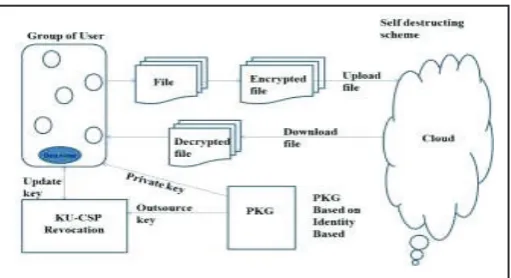
The following fig. 2 shows the proposed system architecture.
Fig. 2: Proposed System
A. System Overview
The user registers himself at server and then login with valid username and password in to system. After login, user request
for keys to KU-CSP [1]. The user / owner encrypt the files using the keys and uploaded these files at cloud server for specific
time interval and become free from the burden. When any user
leave the group ,the list of remaining user is send to KU-CSP, where the KU-CSP generate the new key or update the keys to maintain the security of the system and send the new keys to the key requested user. At cloud server if the specified time for the file is end then the file is destructed / delete from the server and it
is no longer available for users. This increases the storage space at cloud server.
In previous work the system stores the data at cloud server and the
user itself has delete the data stored at cloud if he no longer needed the data, it increases overhead of user and also uses more space at
cloud server, to overcome the drawback of previous system, the
system pro-poses data self-distractive scheme, In this user upload
2/2/2016-2/2/2017,).at cloud server data is valid for only one year i.e. from start date to end date specified by user after completion
of time period data is self-destructed from the cloud and it frees the space at cloud server.
B. Self-Destructing Scheme
A Self-Destructing Scheme called key-policy identity based encryption with time specified attributes scheme, which is based
on inspection that, in sensible cloud application situation, every
data item can be linked with a set of attributes and each attribute is linked with a specification of time interval, indicating that the encrypted data item can only be decrypted between on a specified date and it will not be recoverable that day. In which every users key
is associated with an access tree and each leaf node is associated
with a time instant the data owner encrypts his/her data to share
with users in the system. As the logical expressionof the access tree can signify any desired data set with any time interval, it can
attain fine-grained access control. If the time instant is not in the specified time interval, the ciphertext cannot be decrypted, i.e.,
this ciphertext will be self-destructed and no one can decrypt it
because of the expiration of the secure key. Therefore, secure data self-destruction with fine-grained access control is attained.
In order to decrypt the ciphertext effectively, the valid attributes should gratify the access tree where the time instant of each leaf
in the users key should belong to the in the matching attribute in
the ciphertext.
C. Algorithm
Setup ( ): PKG run the setup algorithm. It chooses a random
1.
generator g 2R G as well as a random integer x 2R Zq and
sets g1 = gx. Then, A random Element PKG picked by g2 2R G and two hash functions H1; H2: f0; 1g! GT. Finally, output the public key PK= (g; g1; g2; H1; H2) and the master key MK = x.
KeyGen (MK, ID, RL, TL, and PK): PKG firstly checks
2.
whether there quest identity ID exists in RL, for each user‟s private key request on identity ID, if so the key generation
algorithm is terminated. Next, PKG randomly selects X1 2R Zq and sets x2 = x x1. It randomly chooses, and computes.
Then, PKG reads the current time period Ti from TL.
Accordingly, it randomly selects Ti 2R Zq and computes,
where and finally, output SKID = (IK [ID]; TK [ID] Ti) and
OKId = x2.
Encrypt (M, ID, Ti+, and PK): Assume a user needs to encrypt
3.
a message M under identity ID and time Ti period. He/She chooses a random value s 2R Zq and computes, C0 = Me (g1; g2) s; C1 = gs; EID = (H1 (ID)) s and Finally, publish the ciphertext as CT = (C0; C1; EID; ETi).
Decrypt (CT; SKID; PK): Assume that the ciphertext CT
4.
is encrypted under ID and Ti, and the user has a private key SKID = (IK[ID]; TK[ID]Ti), where IK[ID] = (d0;
d1) and
TK[ID]Ti = (dTi0; dTi1).
Revoke(RL; TL; {IDi1; Idi2; ::::Idik}) : If users with
5.
identities in the set {IDi1; Idi2; ::::Idik} are to be revoked at time period Ti, PKG updates the revocation list as RL0 = RL{IDi1; Idi2; ::::Idik} as well as the time list. Through connecting the recently created time period Ti+1 onto original list TL. Finally send a copy for the updated revocation list as well as the new time period Ti+1 to KUCSP.
Key Update (RL; ID; Ti+1; OKID): Upon receiving a key
6.
update request on ID , KU-CSP firstly checks whether ID
exists in the revocation list RL , if so KU-CSP returns and key-update is terminated. Other-wise, KU-CSP gets the corresponding entry (ID; OKID = x2) in the user list UL. Then, it randomly selects Ti+1 2R Zq.
Data self-destruction after end: Previously the current time 7.
instant tx lags behind after the threshold value (expiration time) of the valid time interval tR; x, the user cannot obtain
the true private key SK. Therefore, the ciphertext CT is
not capable to be decrypted in polynomial time, ease the selfdestruction of the shared data after end.
D. Complexity Analysis Time Complexity of ECC is O (n).
E. Mathematical Model
System S is represented as S= {U, CS, KU-CSP} 1. User US = {R, L, Q, E, V}
Where,
R= Registration Process
L= Login Process
Q= Key Request Process
E= File Encryption Process V= Revocation Process
2. KU-CSP={PK,SK}
Key Generation PK={pk1, pk2, pk3 ...pkn} Where PK is the set of generate public keys.
SK= {sk1, sk2, sk3 ...skn}
Where SK is the set of generate private keys related to public key.
3. Cloud Server CS ={U, D}
Where,
U = Upload file D= {T, F}
Where,
D = Self-Destructive Process
T=Time Interval
F=Number of files
F. Dataset
The System uses multiple files with various sizes from 1 KB to 100 MB as dataset.
G. Experimental Setup
The system used Netbeans (version 8.0) tool for development and Java framework (version jdk 1.8) on Windows platform as a front
end. Any standard machine is capable of running the application.
The system doesn’t need any specific hardware to run.
VI. Conclusion
In this paper, concentrating on the basic issue of character repudiation, we bring outsourcing calculation into IBE and propose a revocable plan in which the repudiation operations are
assigned to CSP. With the guide of KU-CSP, the proposed plan is full-highlighted: (1) It accomplishes consistent productivity for both calculation at PKG and private key size at client; (2) User needs not to contact with PKG amid key update, as it were,
PKG is permitted to be disconnected from the net after sending
under a more grounded enemy model. We exhibit a propelled
development what’s more, demonstrate to it is secure under RDoC model, in which in any event one of the KU-CSPs is thought to be
completely forthright. In this manner, regardless of the possibility
that a repudiated client and both of the KU-CSPs conspire, it
can’t to offer.
References
[1] Boneh, Franklin mechanism, R. Schlegel, D. S. Wong, C.
Tang," Conditional proxy broadcast reencryption scheme supporting timed- release", In Proc. 9th Int. Conf. Inf.
Security Practice Experience, 2013, pp. 132– 146.
[2] Adel Binbusayyis, Ning Zhang, C. Tang,"A CCAsecure identity-based conditional proxy re-encryption without random oracles", In Proc. 15th Int. Conf. Inf. Security
Cryptol., 2012, pp. 231–146.
[3] A. B. Lewko, B. Waters,"Decentralizing attributebased encryption", In EUROCRYPT‘11. Springer, 2011, pp. 568–
588.
[4] J. Kenney,"Dedicated Short-Range communications (DSRC) standards in the united states", Proceedings of the IEEE, Vol. 99, No. 7, pp. 1162– 1182, Jul. 2011.
[5] L. Harn, J. Ren,"Generalized digital certificate for user authentication and key establishment for secure
communications", Wireless Communications, IEEE
Transactions on, Vol. 10, No. 7, pp. 2372–2379, Jul. 2011. [6] Wan et. al, Ciphertext-policy attribute-based encryption:
An expressive, efficient, and provably secure realization, in Public Key Cryptogra- phyPKC 2011. Springer, 2011, pp. 5370.
[7] PierangelaSamarati, Sabrina De Capitani di Vimercati, "Data Protection in Outsourcing Scenarios: Issues and directions”, E-Business and Telecommunications: 6th International Joint Conference, ICETE, 2011.
[8] C.-K. Chu, J. Weng, Chase, S. S. M. Chow, J. Zhou, R. H.
Deng,"Conditional proxy broadcast re-encryption", In Proc. 14th Aus- tralasian Conf. Inf. Security Privacy, 2009, pp. 327–342.
[9] Q. Tang,"Type-based proxy re-encryption and its
construction", In Proc. 9th Int. Conf. Cryptol. India: Progress Cryptol., 2008, pp. 130–144.
[10] L. Ibraimi, Q. Tang, P. Hartel, W. Jonker,"A typeand-iden-
tity-based proxy re-encryption scheme and its application in
healthcare", In Proc. 5th VLDB Conf. Secure Data Manage., 2008, pp. 185–198.
Pitta Kantarao is currently pursuing his
M.Tech(CST) in BITS, Visakhapatnam.
He received his B.Tech from
Kaushik College of Engineering, Visakhapatnam.
Dakineni Durga Prasad is working as an