http://www.sciencepublishinggroup.com/j/dmath doi: 10.11648/j.dmath.20180302.12
One-Dimensional Bin-Packing Problems with Branch and
Bound Algorithm
Niluka P. Rodrigo
*, Wasantha B. Daundasekera, Athula I. Perera
Department of Mathematics, Faculty of Science, University of Peradeniya, Peradeniya, Sri Lanka
Email address:
*
Corresponding author
To cite this article:
Niluka P. Rodrigo, Wasantha B. Daundasekera, Athula I. Perera. One-Dimensional Bin-Packing Problems with Branch and Bound Algorithm. International Journal of Discrete Mathematics. Vol. 3, No. 2, 2018, pp. 36-40. doi: 10.11648/j.dmath.20180302.12
Received: March 28, 2018; Accepted: May 14, 2018; Published: June 2, 2018
Abstract:
In this paper, our objective is to develop a mathematical formulation of solving the Bin Packing Problem (BPP) with different sizes of box. It has become one of the most important mathematical applications throughout the time. In our study, Modified Branch and Bound Algorithm (MBBA) is developed to generate all the feasible packing patterns of given boxes to required containers for One-Dimensional BPP. Further development of algorithms was made to ascertain the locations of each box within the containers by using Cartesian coordinate system. Developed algorithms are coded and programmed in the Python programming environment to generate feasible packing patterns.Keywords:
BPP, MBBA, Python Software Package, Cartesian Coordinate Points1. Introduction
Due to manufacturing uprising, at present most of the industries are focusing in the frame of globalization. In turn, industries have substantially augmented the capacity and magnitude of their global manufacture and allocation network around the world. Thus the globalized market results in rapid development of international trade and creates intensive competitions among the industries. In this research, our objective is to investigate a mathematical formulation of solving the One-Dimensional BPP which has been studied by many researchers in the recent past. Packing the produced goods in the optimum manner within a limited space has multiple paybacks to the production plant. This will eventually decrease the production of the plant. A Bin Packing Problem basically describes in three ways; One-Dimensional, Two-Dimensional and Three-Dimensional Bin Packing problems. The Bin Packing problem can be defined as a finite collection of items with varying specifications to be packed into one or more containers utilizing the maximum volume of the containers while satisfying the supply-demand. Each container can hold any subset of the collection of objects without exceeding its capacity. Bin packing is also called as container loading, box packing, cargo loading, knapsack, etc.
Heuristic Algorithm for minimum bin slack. In this research, each packing is determined in a search procedure that tests all possible subsets of items on the list which _t the bin capacity (C). The slack in packing A is expressed by S (A) =C and updating every time an item is added or removed from A [4]. Andrea Lodi et al (2002) have emphasized on exact algorithms and effective heuristics and meta heuristic approaches to the two-dimensional Bin Packing problem [5].
Christian Blum and Verena Schmid (2013) have dealt with two-dimensional Bin Packing problem under free guillotine cutting, a problem in which a set of oriented rectangular items are given which must be packed into minimum number of bins of equal size. An evolutionary algorithm has been discussed and the results of the proposed algorithm are compared with some of the best approaches from the literature [6]. There is intercommunication in between Cutting Stock Problem (CSP) and BPP. Many researchers have worked on the cutting stock problem as well and designed different algorithmic approaches to solve the problem. Among them, Saad (2001) modified Branch and Bound Algorithm to find feasible cutting patterns for one-dimensional cutting stock problem and formulated a mathematical model to minimize the total cut loss. Modified Branch and Bound Algorithm is illustrated using a case study [7]. Further Rodrigo et al (2012) developed an algorithm, based on Modified Branch and Bound algorithm [7] to determine the feasible cutting patterns for Two-Dimensional cutting stock problem with rectangular shape cutting items. The method was illustrated with the use of a case study, where the data were obtained from a floor tile company known as Mega Marble Company located in London. A computer programme was coded using Matlab inbuilt functions [8]. As an extension of the above study, Rodrigo et al (2012) redesigned the developed algorithm [8] to determine the locations of each cutting item using Cartesian Coordinate Geometry [9]. Rodrigo et al (2015) modified the Branch and Bound Algorithm to decide the feasible cutting patterns for One-Dimensional cutting stock problem and to determine the locations of each cutting item using Cartesian Coordinate Geometry. The algorithm has been coded using Matlab environment illustrated the algorithm using a case study. [10]. Thereafter, Rodrigo et al (2017) has made an approach to nest one-dimensional cutting items within rectangular shaped main sheet with known varying dimensions. Cartesian coordinate points of each item in each cutting sheet have been determined using a computer programme coded in Matlab software environment [11]. Besides, identification of cutting-packing location within the different sizes of container (or main sheet) is significantly crucial to outline items within the container depending on the selected cutting-packing pattern. To address this issue, further development of MBBA will be made to ascertain the locations of each cutting-packing item within the main sheet (or container) by using Cartesian coordinate system. Developed algorithm will be coded and programmed in the Python Software environment to generate feasible packing patterns for One-Dimensional BPP.
2 Materials and Method
2.1. One-Dimensional (1D) BPP
In most industries, the cost of the transportation consists of a high percent of total price. The BPP is one of the most famous operation research problems which are defined to improve the amount of packing boxes in to containers. This BPP can be described as follow; there is a container with the rectangular shape base with the width W and the length L. At the same time there are different size of boxes with the rectangular shape base with the width wi; i = 1, 2,..., n and the
length L. In this paper, MBBA applied to generate feasible packing patterns of n number of boxes to bunch into the container.
2.2. Mathematical Model (Gilmore and Gomary, 1961)
Any firm's main objective is to maximize the annual contribution margin accruing from its production and sales. By reducing costs, wastages and maximizing sales, productivity can be improved. Cost can occur in many ways and transportation cost takes a big challenge in industry. According to the selection, a mathematical model to minimize the packing cost is formulated as follows:
(
)
1
Minimize Total bin slack
Subject to for 1, 2,...,
0 and Integer for all , .
= = ≥ = ≥
∑
∑
n j j j ni j i j j
j
i j
z c x
a x N i m
x i j
Where
n = Number of boxes with different sizes,
m = Number of patterns,
ai j = The number of occurrences of the ith size box in the jth
pattern,
ck j = Bin slack of the kth bin in the jth pattern,
Nj = Number of boxes of the ithsize box,
xi k j = The number of boxes of ith size box can be packed in
the j th pattern.
2.3. Modified Branch and Bound Algorithm (MBBA)
Step 1: Arrange required widths (or lengths) of boxes, wj, j
= 1, 2,..., n in decreasing order, ie w1, w2,..., wn, where n =
number of boxes from each sizes.
Step 2: For i = 1, 2,..., m and j = 1 do Steps 3 to 5. Step 3: Set
11 1 ; = W a
w (1)
1 z 1 -; − = =
∑
i z j z i ji
W a w
a
w
where
Wkis the width of the container. Here, ai k j is the number of
quantity of the ith box in the jth pattern along the width of the container and [[y]] is the greatest integer less than or equal to
y.
Step 4: Set Pj = aij
where Pj is the number of quantities of the ith box in the jth
pattern within the base of the container.
Location of the ith item in the jth pattern and number of pieces from each item: If ai j> 0, then set
(
)
1 1
, ,0 ; , 0
= =
= −
=
∑
i∑
ii i z j z i k j i z j z
z z
i i j
x y a w a w a w
N a
where
Ni is the number of pieces can be nest from the ith box in
the jth pattern along the width-wise and (xi, yi), are the
coordinates of the each box of ith item in the jth pattern within the container.
Step 5: Bin slack along the width of the container:
1
;
=
= −
∑
m
j i j i
i
C W a w
Step 6: Set t = m-1. While t
≥
0, do Step 7.Step 7: While at j
≥
0 set j = j + 1 and do Step 8.Step 8: Generate a new pattern according to the following conditions:
For z = 1, 2,..., t– 1; Set az j = az j( )−1
For z = t
Set =( ( )−1-1)
z j z j
a a
For z = t + 1,..., m
calculate azjusing (1).
Go to Step 4. Step 9: Set t = t-1.
Step 10: STOP.
2.4. Case Study
Proposed MBBA to solve one-dimensional BPP is tested and analyzed to determine feasible and optimal packing patterns. Following examples will illustrate how to generate feasible packing patterns by minimizing the total bin slack.
Following data table represents two one-dimensional bin packing problem given in the paper [2] and proposed algorithm in this paper has been applied to solve those problems.
Table 1. Required widths of the boxes and containers.
Problem
No Width of the boxes
Width of the base of the container
1 1, 2, 3, 3, 4, 4, 5, 5, 6, 7 10
2 12, 13, 19, 21, 25, 25, 25, 100
28, 39, 40, 41, 47, 48, 54, 56, 67, 70, 70, 82, 85
3. Results and Discussion
Modified Branch and Bound Algorithm is applied to the above examples to generate feasible packing patterns as given below:
Problem No 1 in the Table 1:
Table 2. Required widths and demand of problem 1.
Width of the boxes Demand
1 1
2 1
3 2
4 2
5 2
6 1
7 1
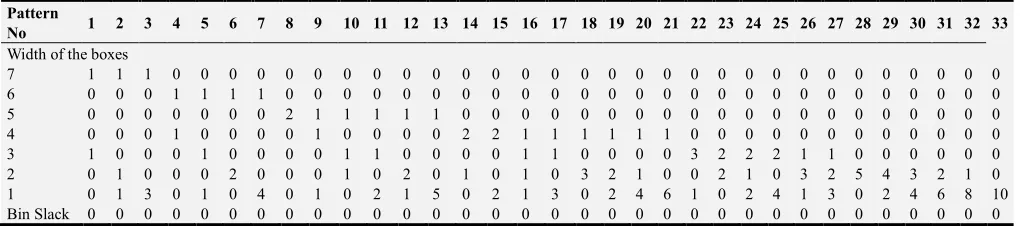
Following table represent the generated feasible packing patterns applying MBBA for problem 1 given in the table 3. Python programming language is used to code the MBBA.
Table 3. Generated Packing Patterns of problem 1.
Pattern
No 1 2 3 4 5 6 7 8 9 10 11 12 13 14 15 16 17 18 19 20 21 22 23 24 25 26 27 28 29 30 31 32 33
Width of the boxes
7 1 1 1 0 0 0 0 0 0 0 0 0 0 0 0 0 0 0 0 0 0 0 0 0 0 0 0 0 0 0 0 0 0
6 0 0 0 1 1 1 1 0 0 0 0 0 0 0 0 0 0 0 0 0 0 0 0 0 0 0 0 0 0 0 0 0 0
5 0 0 0 0 0 0 0 2 1 1 1 1 1 0 0 0 0 0 0 0 0 0 0 0 0 0 0 0 0 0 0 0 0
4 0 0 0 1 0 0 0 0 1 0 0 0 0 2 2 1 1 1 1 1 1 0 0 0 0 0 0 0 0 0 0 0 0
3 1 0 0 0 1 0 0 0 0 1 1 0 0 0 0 1 1 0 0 0 0 3 2 2 2 1 1 0 0 0 0 0 0
2 0 1 0 0 0 2 0 0 0 1 0 2 0 1 0 1 0 3 2 1 0 0 2 1 0 3 2 5 4 3 2 1 0
1 0 1 3 0 1 0 4 0 1 0 2 1 5 0 2 1 3 0 2 4 6 1 0 2 4 1 3 0 2 4 6 8 10
Bin Slack 0 0 0 0 0 0 0 0 0 0 0 0 0 0 0 0 0 0 0 0 0 0 0 0 0 0 0 0 0 0 0 0 0
The mathematical model is solved as an integer programming model using EXCEL to design generated
Table 4. Optimum solution for problem no 1.
Optimum Pattern No 1 5 8 14 Demand
Width of the boxes
7 1 0 0 0 1
6 0 1 0 0 1
5 0 0 2 0 2
4 0 0 0 2 2
3 1 1 0 0 2
2 0 0 0 1 1
1 0 1 0 0 1
No of Containers 1 1 1 1
Cartesian Coordinates obtained from the MBBA: Pattern no 1: (0, 0), (0, 7); (0, 7), (0, 10)
Pattern no 5: (0, 0), (0, 6); (0, 6), (0, 9); (0, 9), (0, 10) Pattern no 8: (0, 0), (0, 10)
Pattern no 14: (0, 0), (0, 8); (0, 8), (0, 10)
Similar procedure can be applied for the other problem as given below:
Problem No 2 in the Table 1:
There are 9 different packing patterns according to the MBBA and two containers should be required to satisfy the demand of boxes.
Table 5. Optimum solution for problem no 2.
Optimum Width of the boxes Bin No of
Pattern No 12 13 19 21 25 28 39 40 41 47 48 54 56 67 70 82 85 Slack Containers
1 0 1 0 0 0 0 0 0 0 0 0 0 0 0 0 0 1 2 1
4 1 0 0 0 0 0 0 0 0 0 0 0 0 0 0 1 0 6 1
5 0 0 0 0 0 1 0 0 0 0 0 0 0 0 1 0 0 2 1
6 0 0 0 0 1 0 0 0 0 0 0 0 0 0 1 0 0 5 1
13 0 0 0 0 1 0 0 0 0 0 0 0 0 1 0 0 0 8 1
20 0 0 0 0 0 0 0 0 1 0 0 0 1 0 0 0 0 3 1
33 0 0 1 0 1 0 0 0 0 0 0 1 0 0 0 0 0 2 1
45 0 0 0 0 0 0 0 0 0 1 1 0 0 0 0 0 0 5 1
57 0 0 0 1 0 0 1 1 0 0 0 0 0 0 0 0 0 0 1
Demand 1 1 1 1 3 1 1 1 1 1 1 1 1 1 2 1 1
Cartesian Coordinates points obtained from the MBBA: Pattern no 1: (0, 0), (0, 85); (0, 85), (0, 98)
Pattern no 4: (0, 0), (0, 82); (0, 82), (0, 94) Pattern no 5: (0, 0), (0, 70); (0, 70), (0, 98) Pattern no 6: (0, 0), (0, 70); (0, 70), (0, 95) Pattern no 13: (0, 0), (0, 67); (0, 67), (0, 92) Pattern no 20: (0, 0), (0, 56); (0, 56), (0, 97)
Pattern no 33: (0, 0), (0, 54); (0, 54), (0, 79); (0, 79), (0, 98)
Pattern no 45: (0, 0), (0, 48); (0, 48), (0, 95)
Pattern no 57: (0, 0), (0, 40); (0, 40), (0, 79); (0, 79), (0, 100)
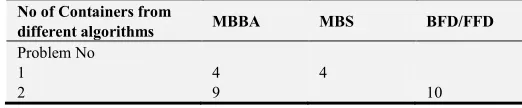
Effectiveness of the proposed MBBA has been compared with algorithms given in the paper [2].
Table 6. No of containers for problems given in the paper [2].
No of Containers from
different algorithms MBBA MBS BFD/FFD
Problem No
1 4 4
2 9 10
4. Conclusion
In this paper, a bin packing problem is formulated as a mathematical model based on theconcept of packing patterns. Five different problems are solved using proposed MBBA and results (minimum number of containers to satisfy the demand of each box) are compared with three different algorithms; Minimum Bin slack (MBS), First Fit Decreasing (FFD) and Best Fit Decreasing (BFD). According to the MBS algorithm [2], Minimum containers are found to satisfy the demand of each size of boxes. In our approach; MBBA gives
comparable solution with MBS but dissimilar with BFD/ FFD. However, looking the solution of the MBS and BFD/ FFD, it’s difficult to identify the places of each box should be allocated to into container satisfying the minimum number of containers for each problem. As a result, identification of packing location within the base of the container is significantly vital to trace boxes within the container depending on the selected packing pattern. Accordingly, MBBA can be addressing this issue; to ascertain the locations of each packing item within container by using Cartesian coordinate system. Developed algorithm (MBBA) is coded and programmed in the Python programming environment to generate feasible packing patterns and location of each box in the pattern.
References
[1] Jatinder N. D Gupta and Johnny C. “A new heuristic algorithm for the one-dimensional bin-packing problem”, Production planning and Control, ISSN 0953-7287(1999), Vol. 10, No. 6, 598-603.
[2] T. Dokeroglu, A. Cosar, “Optimization of one-dimensional Bin Packing Problem with island parallel grouping genetic algorithms” Computers & Industrial Engineering 75 (2014) 176–186.
[3] Mukhacheva E. A, G. N Belov, V. M. Kartack and Mukhacheva A. S. “Linear one-dimensional cutting-packing problems: Numerical experiments with the sequential value, Correction Method and a modified Branch and Bound method”.
[5] Andrea L, Silvano M and Daniele V. “Recent Advances on two-dimensional bin packing Problems”, Elsevier Science, Discrete Applied Mathematics. 123 (2002), 379-396.
[6] Christian B. and Verena S. “Solving the 2D bin packing problem by means of a Hybrid Evolutionary Algorithm”, Elsevier, International Conference on Computational Science, ICCS (2013), 899-908.
[7] Saad M. A. Suliman. “Pattern generating procedure for the cutting stock problem”, International Journal of Production Economics 74 (2001) 293-301.
[8] W. N. P. Rodrigo, W. B. Daundasekara and A. A. I. Perera. “Pattern Generationfor Two-Dimensional Cutting Stock Problem”, International Journal of Mathematics Trends and Technology, Vol. 3, Issue 2: 54-62.
[9] W. N. P. Rodrigo, W. B. Daundasekara and A. A. I. Perera. “Pattern Generation for Two-Dimensional Cutting Stock Problem with Location”, Indian Journal of Computer Science and Engineering (IJCSE), Vol. 3, No 2, April-May 2012, 354-368 (www.academia.edu/4463690/INDJCSE12-03-02-082).
[10] W. N. P. Rodrigo, W. B. Daundasekara and A. A. I. Perera. “Modified Method for One-Dimensional Cutting Stock Problem”, Software Engineering. Vol. 3, No. 3, 2015, pp. 12- 17. doi: 10.11648/j.se.20150303.11.
[11] Niluka Rodrigo, Sium Shashikala. “One-Dimensional Cutting Stock Problem with Cartesian Coordinate Points”,