IJSRSET1622397 | Received : 30 April 2016 | Accepted : 03 May 2016 | March-April 2016 [(2)2: 1201-1205]
© 2016 IJSRSET | Volume 2 | Issue 2 | Print ISSN : 2395-1990 | Online ISSN : 2394-4099 Themed Section: Engineering and Technology
1201
Comparative Study on Dynamic Behavior of Different Lateral Load Resisting
System
Jigar S Goyani, Hitesh K Dhameliya, Jasmin Gadhiya
Civil Engineering Department, CGPIT, Uka Tarsadia University, Bardoli, Gujarat, India
ABSTRACT
During April 2015 Nepal Earthquake, many elevated buildings in urban areas collapsed and suffered wide spread damages. After the earthquake observations shows many deficiencies in these structures including non-adoption of seismic engineering practices and lack of seismic resistant features. By adopting energy absorbing devices the seismic performance of building can be improved, which may be active or passive in nature. Active controls do not found much application due to its high cost and large instrumentation set up. Whereas, passive control systems for example, base isolation, dampers, bracing systems etc, are found to be easy to install and cost effective as compared to first one. Use of passive dampers is now a day becoming cost effective solution for improve seismic performance of existing as well as new buildings. This review paper is focussed on Energy dissipation system provided by fluid Viscous Dampers (FVD). In this paper, an attempt has been made for comparative study on dynamic behaviour of different lateral load resisting system. For that the analysis of models with bracing, with damper, and BF of different numbers of storey in bhuj time history has been done in ETABS software.
Keywords: Dynamic analysis, Passive dampers, Fluid viscous dampers, Energy dissipation, Lateral load resisting system, ETABS.
I.
INTRODUCTION
In the structure during seismic event large amount of energy is transmitted. For seismic design of building structures, the traditional method, which is by strengthening the stiffness, strength, and ductility of the structures, has been in common use for a long time. That design practice is to prevent collapse by permitting structural members to absorb and dissipate the transmitted earthquake energy by inelastic cyclic deformations. Therefore, the size of structural members and the use of material are expected to be increased, which leads to higher cost of the buildings as well as larger seismic responses due to larger stiffness of the structures. Thus, the efficiency of the traditional method is limited. To overcome these disadvantage associated with the traditional method, many vibration-control measures, namely as structural control, have been studied and remarkable advances in this respect have been made over recent years. Structural Control is a diverse field of study. These unconventional techniques enhance the energy dissipation capacity of the system.
Therefore, significant reduction of structural and non-structural damage could be achieved through a efficient use of passive energy dissipaters which reduces the inelastic demand on primary structural members [2].
In a structure to limit damaging deformations in structural components mainly use passive energy dissipation devices. The degree to which a certain device is able to accomplish this goal depends on the inherent properties of the basic structure, the properties of the device and its connecting elements, the characteristics of the ground motion [9]. Device that have most commonly been used for seismic protection of structures include viscous fluid dampers, viscoelastic solid dampers, friction dampers and metallic dampers. Semi-active dampers have also been used for seismic response control in other countries, notably Japan but not in India [7]
.
Structural control can be categorized into as follow
Passive energy dissipation,
Semi-active control systems,
Hybrid control.
II.
METHODS AND MATERIAL
Modelling & Analysis Of Building
Thus the modal analysis of framed Structure is of great technical importance for understanding the behavior of the framed Structure under applied dynamic loading. The study of response analysis methodology of a SMRF with bracing and SMRF with damper and bracing with different height and in different EQ load is essential to conclude effectiveness of passive dampers on building.
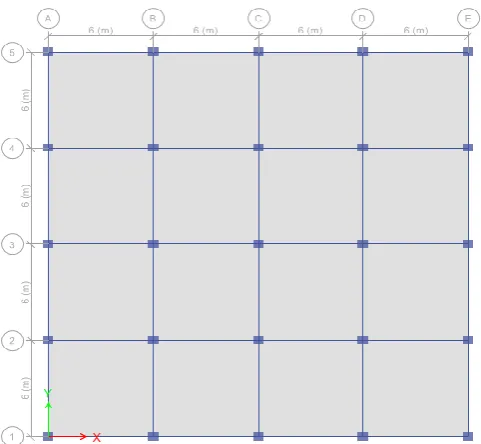
The study has done on 12 different models of an 22, 20, 17, 15 storey building are modelled. The building has four bays in X direction and four bays in Y direction with the plan dimension (24 m × 24 m) having storey height of 3.5 m each in all the floors. The building is kept symmetric in both mutually perpendicular directions in plan to avoid torsional effects. The orientation and size of column is kept same throughout the height of the structure. The unit weights of concrete are taken as 25.0 KN/m2. In seismic weight calculations, 50 % of the floor live loads are considered. Other input parameters are show in below table.
TABEL I : SOFTWARE INPUT
No. of storey 15,17,20,22
Storey height 3.5m
Live load 4 Kn/m2
Floor finish 1 Kn/ m2
Concrete grade M20
Steel Fe 415 HYSD
Beam size 300 X 450 mm
Column size 500 X 600 mm
Slab thickness 150 mm
Bracing size 210 X 210 mm
Damper
stiffness 25 X 104Kn/m
exponent 1
damping 5000 Kn s /m
Time history Bhuj , Gujrat
Figure 1: Plan layout of model for analysis in ETABS
Figure 2 : Elevation of Brace and Damper model
important parameters namely Earthquake time histories, no of story of building.
TABEL II
PROPERTIES OF BHUJ TIME HISTORY
Duration Of Eq (Sec) 133.53
PGA Value (Cm/Sec2) 103.82
Time For PGA (Sec) 46.94
Type Of Eq Long
Figure 3: Bhuj Acceleration Vs time
III.
RESULTS AND DISCUSSION
Figure 4 : Base shear Due to Bhuj EQ time history of 22 storey model
Figure 5: Base shear Due to Bhuj EQ time history of 20 storey model
Figure 6: Base shear Due to Bhuj EQ time history of 17 storey model
Figure 7: Base shear Due to Bhuj EQ time history of 15 storey model
The graph shows the comparison of Base shear value for BF, Brace and Damper model. Comparison shows the damper gives good results as compare to Brace. Damper
-6000 -4000 -2000 0 2000 4000 6000
1 24 47 70 93
11 6 13 9 16 2 18 5 B A SE S H EA R
Base Shear Vs Time for 22
Storey
BF Base FX kN
BRACE Base FX kN
DAMPER Base FX kN
-6000 -4000 -2000 0 2000 4000 6000
1 27 53 79
10 5 13 1 15 7 18 3 B A SE S H EA R
Base Shear Vs Time for 20
Storey
BF Base FX kN
BRACE Base FX kN
DAMPER Base FX kN
-6000 -4000 -2000 0 2000 4000 6000
1 27 53 79
10 5 13 1 15 7 18 3 B ASE SHE AR
Base Shear Vs Time for 17
Storey
BF Base FX kN
BRACE Base FX kN
DAMPER Base FX kN
-5000 0 5000 10000
1 30 59 88
11 7 14 6 17 5 B A SE S H EA R
Base Shear Vs Time for 15
Storey
BF Base FX kN
BRACE Base FX kN
model rapidly damp the Base shear as per time than BF and Brace. Brace have larger value of base shear than BF.
Graphs gives a particularly interesting reflection on the ability of FVD to reduce the base shear force. Note that it becomes very important in the cross braced case. It is due to the decrease of the fundamental period which makes greater acceleration but this forces decrease rapidly over time due to the stiffness of the system. Unlike to the unbraced model where the base shear force is not very important but remains constant throughout the duration of the signal. In the third model, forces are also low they disappear quickly and completely. This is due to the capacity of FVD to produce passive control system by balancing quickly the load forces to the resistance and damping forces.
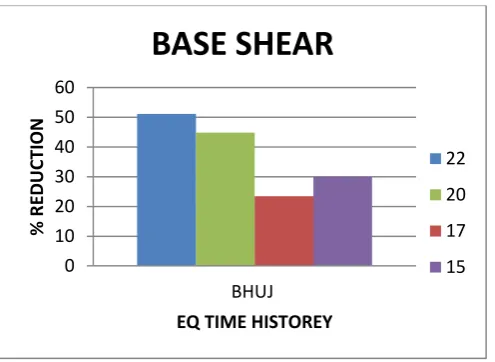
Figure 8 : Base shear reduction by damper as compare to BF
The reduction of base shear for damper model as compare to BF model for different time history is shown above. For the Bhuj time history reduction of base shear for the 22 storey and 20 storey model is higher around 45-50% than compare to 17,15 storey model.
The table show the date of fundamental time period of the model. For the BF time period for first mode 6.5 sec to 4.33 sec, 4.8 sec to 3 sec for bracing and for the damper model its reduce to 4.46-2.73 sec. Damper give the very good result for the Mode 2. Fundamental time period is almost nearly 0.25-0.20 sec for damped structure where 6.27-4.16 sec for BF and 4.71-2.94 sec for brace structure.
IV.
CONCLUSION
From, the above study it can be conclude that,
The performance of building structure in seismic loading is improved to great extent after application of damped system as compare to bare frame and braced structure.
Passive energy dissipaters usually relatively in expensive. It consumes no external energy, inherently stable and works even during a major earthquake.
As expected, the fundamental period of vibration for the braced structure decreases due to the increased stiffness. In the third case, the period decreases due to the added stiffness resulting from the use of dampers.
Damper give the very good result for the Mode 2. Fundamental time period is almost nearly 0.25-0.20 sec for damped structure where 6.27-4.16 sec for BF and 4.71-2.94 sec for brace structure. It shows that how damper is effective for absorb the energy.
The results of base shear showed a decrease values for reinforced cross brace and FVD models with a net benefit to the dissipative device model. This decrease is due to the additional stiffness provided by the reinforcing elements but it is also due to the increase of damping rate for the FVD model. It is also important to note that in the braced structure, the cross diagonals transmit a very important axial force the ones of the damped model.
V.
REFERENCES
[1] Abdelouahab Ras, Baghdad Boukhari, Nadir Boumechra, Karim Hamdaoui, "Dissipative Capacity Analysis of Steel Building Using Viscous bracing Device," in 2014 International
0 10 20 30 40 50 60
BHUJ
%
R
ED
UCTI
ON
EQ TIME HISTOREY
BASE SHEAR
22
20
17
15
TABEL III
Conference on Geological and Civil Engineering, IPCBEE vol.62 (2014), IACSIT Press V62. 4, Singapore.
[2] Asif Hameed, Asad-ullah Qazi, Ali Murtaza Rasool, "Seismic Performance of Low to Medium Rise Reinforced Concrete Buildings using Passive Energy Dissipation Devices", in Pak. J. Engg. & Appl. Sci., P 1-16, Vol.14, Jan., 2014, Pakistan. [3] Daisuke Asahina, John E. Bolander, Stefano
Berton, "Design optimization of passive devices in multi-degree of freedom structures" in 13th World Conference on Earthquake Engineering Vancouver, B.C., August 1-6, 2004, Paper No. 1600, Canada.
[4] G.S. Balakrishna, Jini Jacob, "Seismic analysis of building using two types of passive energy dissipation devices," in Journal of Mechanical and Civil Engineering, IOSR PP 13-19, ISSN: 2278-1684, p-ISSN: 2320-334X.
[5] Nitendra G Mahajan, D B Raijiwala, "Seismic response control of a building installed with passive dampers" in International Journal of Advanced Engineering Technology, Vol.2, Issue 3 July-September, 2011, ISSN 0976-3945.
[6] Prashanthi C Sudula, Dr. B. Shivakumara Swamy, "Comparative Study on Seismic Behavior of Multistoreyed Frames With Different Passive Dampers for Different Zones" in International Journal of Engineering Research & Technology, Vol. 3, Issue 7, July - 2014, ISSN: 2278-0181. [7] Soong, T. T., and Spencer, Jr. B. F..
"Supplemental energy dissipation: State-of-the-art and state-of-the-practice", Engineering Structure, 24 (3), 2002, 243–259.
[8] V. Sadeghi Balkanlou, M. Reza Bagerzadeh Karimi, B. Bagheri Azar, Alaeddin Behravesh, "Evaluating Effects of Viscous Dampers on optimizing Seismic Behavior of Structures" in International Journal of Current Engineering and Technology, Vol.3, No.4 October 2013, ISSN 2277 – 4106.
[9] Yuvraj Bisht, Saraswati Setia, "Seismic Behaviour Of A Soft Storey Building With & Without Viscous Dampers" in International Journal of Engineering Research and Applications, AET- 29th March 2014, ISSN: 2248-9622.in International Journal of Emerging Technology and Advanced Engineering, June 2012
[10] R. P. Ramkumar, Dr. S. Arumugam, “A Novel Iris Recognition Algorithm” in Third International Conference on Computing, Communication and Networking Technologies, IEEE 2012
[11] Argles, D, A. Pease, R. Walters, "An Improved Approach to Secure Authentication and Signing," Advanced Information Networking and Applications Workshops, AINAW '07, 2007. [12] J. Daugman. How iris recognition works.
Proceedings of 2002 International Conference on Image Processing, Vol. 1, 2002.