The Value of Semantic Parse Labeling for
Knowledge Base Question Answering
Wen-tau Yih Matthew Richardson Christopher Meek Ming-Wei Chang Jina Suh
Microsoft Research Redmond, WA 98052, USA
{scottyih,mattri,meek,minchang,jinsuh}@microsoft.com
Abstract
We demonstrate the value of collecting se-mantic parse labels for knowledge base question answering. In particular, (1) unlike previous studies on small-scale datasets, we show that learning from la-beled semantic parses significantly im-proves overall performance, resulting in absolute 5 point gain compared to learn-ing from answers, (2) we show that with an appropriate user interface, one can obtain semantic parses with high accuracy and at a cost comparable or lower than obtaining just answers, and (3) we have created and shared the largest semantic-parse labeled dataset to date in order to advance research in question answering.
1 Introduction
Semantic parsing is the mapping of text to a mean-ing representation. Early work on learnmean-ing to build semantic parsers made use of datasets of questions and their associated semantic parses (Zelle and Mooney, 1996; Zettlemoyer and Collins, 2005; Wong and Mooney, 2007). Recent work on semantic parsing for knowledge base question-answering (KBQA) has called into question the value of collecting such semantic parse labels, with most recent KBQA semantic parsing systems being trained using only question-answer pairs in-stead of question-parse pairs. In fact, there is ev-idence that using only question-answer pairs can yield improved performance as compared with ap-proaches based on semantic parse labels (Liang et al., 2013). It is also widely believed that collect-ing semantic parse labels can be a “difficult, time consuming task” (Clarke et al., 2010) even for do-main experts. Furthermore, recent focus has been more on the final task-specific performance of a
system (i.e., did it get the right answer for a ques-tion) as opposed to agreement on intermediate rep-resentations (Berant et al., 2013; Kwiatkowski et al., 2013), which allows for KBQA datasets to be built with only the answers to each question.
In this work, we re-examine the value of se-mantic parse labeling and demonstrate that seman-tic parse labels can provide substantial value for knowledge base question-answering. We focus on the task of question-answering on Freebase, using the WEBQUESTIONSdataset (Berant et al., 2013). Our first contribution is the construction of the largest semantic parse dataset for KB question-answering to date. In order to evaluate the costs and benefits of gathering semantic parse labels, we created the WEBQUESTIONSSP dataset1, which contains semantic parses for the questions from WEBQUESTIONSthat are answerable using Free-base. In particular, we provide SPARQL queries for 4,737 questions. The remaining 18.5% of the original WEBQUESTIONSquestions are labeled as “not answerable”. This is due to a number of factors including the use of a more stringent as-sessment of “answerable”, namely that the ques-tion be answerable via SPARQL rather than by returning or extracting information from textual descriptions. Compared to the previous seman-tic parse dataset on Freebase, Free917 (Cai and Yates, 2013), our WEBQUESTIONSSP is not only substantially larger, but also provides the semantic parses in SPARQL with standard Freebase entity identifiers, which are directly executable on Free-base.
Our second contribution is a demonstration that semantic parses can be collected at low cost. We employ a staged labeling paradigm that enables ef-ficient labeling of semantic parses and improves the accuracy, consistency and efficiency of
ob-1Available athttp://aka.ms/WebQSP.
taining answers. In fact, in a simple comparison with using a web browser to extract answers from freebase.com, we show that we can collect se-mantic parse labels at a comparable or even faster rate than simply collecting answers.
Our third contribution is an empirical demon-stration that we can leverage the semantic parse labels to increase the accuracy of a state-of-the-art question-answering system. We use a system that currently achieves state-of-the-art performance on KBQA and show that augmenting its training with semantic parse labels leads to an absolute 5-point increase in average F1.
Our work demonstrates that semantic parse bels can provide additional value over answer la-bels while, with the right labeling tools, being comparable in cost to collect. Besides accuracy gains, semantic parses also have further benefits in yielding answers that are more accurate and con-sistent, as well as being updatable if the knowl-edge base changes (for example, as facts are added or revised).
2 Collecting Semantic Parses
In order to verify the benefits of having labeled semantic parses, we completely re-annotated the WEBQUESTIONS dataset (Berant et al., 2013) such that it contains both semantic parses and the derived answers. We chose to annotate the ques-tions with the full semantic parses in SPARQL, based on the schema and data of the latest and last version of Freebase (2015-08-09).
Labeling interface Writing SPARQL queries
for natural language questions using a text editor is obviously not an efficient way to provide semantic parses even for experts. Therefore, we designed a staged, dialog-like user interface (UI) to improve the labeling efficiency. Our UI breaks the po-tentially complicated structured-labeling task into separate, but inter-dependent sub-tasks. Given a question, the UI first presents entities detected in the questions using an entity linking system (Yang and Chang, 2015), and asks the user to pick an en-tity in the question as thetopic entity that could lead to the answers. The user can also suggest a new entity if none of the candidates returned by the entity linking system is correct. Once the en-tity is selected, the system then requests the user to pick the Freebase predicate that represents the relationship between the answers and this topic entity. Finally, additional filters can be added to
further constrain the answers. One key advantage of our UI design is that the annotator only needs to focus on one particular sub-task during each stage. All of the choices made by the labeler are used to automatically construct a coherent semantic parse. Note that the user can easily go back and forth to each of these three stages and change the previous choices, before pressing the final submit button.
Take the question “who voiced meg on fam-ily guy?” for example. The labeler will be pre-sented with two entity choices: Meg Griffin andFamily Guy, where the former links “meg” to the character’s entity and the latter links to the TV show. Depending on the entity selected, legiti-mate Freebase predicates of the selected entity will be shown, along with the objects (either proper-ties or entiproper-ties). Suppose the labeler choosesMeg Griffinas the topic entity. He should then pick actoras the main relationship, meaning the an-swer should be the persons who have played this role. To accurately describe the question, the la-beler should add additional filters like the TV se-ries isFamily Guyand the performance type is voicein the final stage2.
The design of our UI is inspired by recent work on semantic parsing that has been applied to the WEBQUESTIONS dataset (Bast and Haussmann, 2015; Reddy et al., 2014; Berant and Liang, 2014; Yih et al., 2015), as these approaches use a sim-pler and yet more restricted semantic representa-tion than first-order logic expressions. Following the notion of query graph in (Yih et al., 2015), the semantic parse isanchoredto one of the enti-ties in the question as thetopic entityand the core component is to represent the relation between the entity and the answer, referred as the inferential chain. Constraints, such as properties of the an-swer or additional conditions the relation needs to hold, are captured as well. Figure 1 shows an example of these annotated semantic parse com-ponents and the corresponding SPARQL query. While it is clear that our UI does not cover compli-cated, highly compositional questions, most ques-tions in WEBQUESTIONScan be covered3.
Labeling process In order to ensure the data
quality, we recruit five annotators who are famil-iar with design of Freebase. Our goal is to provide
Family Guy
in-tv-program actor
Meg Griffin y0 x
who voiced meg on family guy?
Topic Entity: Meg Griffin (m.035szd)
Inf. Chain: in-tv-program – actor
Constraints: (1) y0 – series – Family Guy (m.019nnl)
(2) y0 – performance-type – Voice (m.02nsjvf)
Voice
PREFIX ns: <http://rdf.freebase.com/ns/> SELECT ?x
WHERE {
ns:m.035szd ns:tv.tv_character.appeared_in_tv_program ?y0 . ?y0 ns:tv.regular_tv_appearance.actor ?x ;
ns:tv.regular_tv_appearance.series ns:m.019nnl ; ns:tv.regular_tv_appearance.special_performance_type
ns:m.02nsjvf . }
(a)
(b)
(c)
[image:3.595.76.292.70.276.2](d)
Figure 1: Example semantic parse of the ques-tion (a) “who voiced meg on family guy?” The three components in (b) record the labels collected through our dialog-like user interface, and can be mapped deterministically to either the correspond-ing query graph (c) or the SPARQL query (d).
correct semantic parses for each of the legitimate and unambiguous questions in WEBQUESTIONS. Our labeling instructions (included in the supple-mentary material) follow several key principles. For instance, the annotators should focus on giv-ing the correct semantic parse of a question, based on the assumption that it will result in correct an-swers if the KB iscompleteandcorrect.
Among all the 5,810 questions in WEB -QUESTIONS, there are 1,073 questions that the an-notators cannot provide the complete parses to find the answers, due to issues with the questions or Freebase. For example, some questions are am-biguous and without clear intent (e.g., “where did romans go?”). Others are questions that Freebase is not the appropriate information source (e.g., “where to watch tv online for free in canada?”). 3 Using Semantic Parses
In order to compare two training paradigms, learn-ing fromquestion-answer pairsand learning from semantic parses, we adopt the Staged Query Graph Generation (STAGG) algorithm (Yih et al., 2015), which achieves the highest published an-swer prediction accuracy on the WEBQUESTIONS dataset. STAGG formulates the output semantic parse in a query graph representation that mimics
the design of a graph knowledge base. It searches over potential query graphs for a question, iter-atively growing the query graph by sequentially adding a main topic entity, then adding an in-ferential chain and finally adding a set of con-straints. During the search process, each candi-date query graph is judged by a scoring function on how likely the graph is a correct parse, based on features indicating how each individual com-ponent matches the original question, as well as some properties of the whole query graph. Exam-ple features include the score output by the entity linking system, the match score of the inferential chain to the relation described in the question from a deep neural network model, number of nodes in the candidate query graph, and the number of matching words in constraints. For additional de-tails see (Yih et al., 2015).
When question-answer pairs are available, we create a set of query graphs connecting entities in the question to the answers in the training set, as in (Yih et al., 2015). We score the quality of a query graph by using the F1score between the an-swer derived from the query graph and the anan-swer in the training set. These scores are then used in a learning-to-rank approach to predict high-quality query graphs.
In the case that semantic parses are available, we change the score that we use for evaluating the quality of a query graph. In particular, we assign the query graph score to be zero when-ever the query graph is not a subgraph consis-tent with the semantic parse label and to be the F1 score described above otherwise. The hope is that by leveraging the semantic parse, we can sig-nificantly reduce the number of incorrect query graphs used during training. For instance, the predicate music.artist.track was incor-rectly predicted as the inferential chain for the question “what are the songs that justin bieber write?”, where a correct parse should use the re-lationmusic.composer.compositions.
4 The Value of Semantic Parses
In this section, we explore the costs of collect-ing semantic parse labels and the benefits of uscollect-ing them.
4.1 Benefits of Semantic Parses
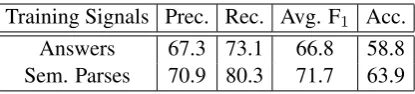
Training Signals Prec. Rec. Avg. F1 Acc. Answers 67.3 73.1 66.8 58.8 Sem. Parses 70.9 80.3 71.7 63.9 Table 1: The results of two different model train-ing setttrain-ings: answers only vs. semantic parses.
of just question-answer pairs can answer questions more accurately, using the knowledge base. Be-low, we describe our basic experimental setting and report the main results.
Experimental setting We followed the same
training/testing splits as in the original WEB -QUESTIONSdataset, but only used questions with complete parses and answers for training and eval-uation in our experiments. In the end, 3,098 tions are used for model training and 1,639 ques-tions are used for evaluation4. Because there can be multiple answers to a question, precision, re-call and F1are computed for each individual ques-tion. The average F1 score is reported as the main evaluation metric. In addition, we also report the true accuracy – a question is considered answered correctly only when the predicted answers exactly match one of the answer sets.
Results Table 1 shows the results of two differ-ent models: learning from question-answer pairs vs. learning from semantic parses. With the la-beled parses, the average F1 score is 4.9-point higher (71.7% vs. 66.8%). The stricter metric, complete answer set accuracy, also reflects the same trend, where the accuracy of training with labeled parses is 5.1% higher than using only the answers (63.9% vs. 58.8%).
While it is expected that training using the anno-tated parses could result in a better model, it is still interesting to see the performance gap, especially when the evaluation is on the correctness of the an-swers rather than the parses. We examined the out-put answers to the questions where the two models differ. Although the setting of using answers only often guesses the correct relations connecting the topic entity and answers, it can be confused by re-lated, but incorrect relations as well. Similar phe-nomena also occur on constraints, which suggests that subtle differences in the meaning are difficult
4The average F
1 score of the original STAGG’s output
to these 1,639 questions is 60.3%, evaluated using WEB -QUESTIONS. Note that the number is not directly comparable to what we report in Table 1 because many of the labeled an-swers in WEBQUESTIONSare either incorrect or incomplete.
Labeling Methods Ans. Ans. Sem. Parses Annotator MTurkers Experts Experts Avg. time/Question Unknown 82 sec 21 sec Labeling Correctness 66% 92% 94% Table 2:Comparing labeling methods on 50 sampled ques-tions.
to catch if the semantic parses are automatically generated using only the answers.
4.2 Costs of Semantic Parses
Our labeling process is very different from that of the original WEBQUESTIONS dataset, where the question is paired with answers found on the Freebase Website by Amazon MTurk workers. To compare these two annotation methods, we sam-pled 50 questions and had one expert label them using two schemes: finding answers using the Freebase Website and labeling the semantic parses using our UI. The time needed, as well as the cor-rectness of the answers are summarized in Table 2. Interestingly, in this study we found that it ac-tually took less time to label these questions with semantic parses using our UI, than to label with only answers. There could be several possible ex-planations. First, as many questions in this dataset are actually “simple” and do not need complicated compositional structured semantic parses, our UI can help make the labeling process very efficient. By ranking the possible linked entities and likely relations, the annotators are able to pick the cor-rect component labels fairly easily. In contrast, simple questions may have many legitimate an-swers. Enumerating all of the correct answers can take significantly longer than authoring a semantic parse that computes them.
When we compare the annotation quality be-tween labeling semantic parses and answers, we find that the correctness5of the answers are about the same (92% vs 94%). In the original WEB -QUESTIONSdataset, only 66% of the answers are completely correct. This is largely due to the low accuracy (42.9%) of the 14 questions contain-ing multiple answers. This indicates that to en-sure data quality, more verification is needed when leveraging crowdsourcing.
5 Discussion
Unlike the work of (Liang et al., 2013; Clarke et al., 2010), we demonstrate that semantic parses
[image:4.595.310.525.62.105.2]can improve over state-of-the-art knowledge base question answering systems. There are a number of potential differences that are likely to contribute to this finding. Unlike previous work, we compare training with answers and training with semantic parses while making only minimal changes in a state-of-the-art training algorithm. This enables a more direct evaluation of the potential benefits of using semantic parses. Second, and perhaps the more significant difference, is that our evalu-ation is based on Freebase which is significantly larger than the knowledge bases used in the pre-vious work. We suspect that the gains provided by semantic parse labels are due a significant re-duction in the number of paths between candidate entities and answers when we limit to semantically valid paths. However, in domains where the num-ber of potential paths between candidate entities and answers is small, the value of collecting se-mantic parse labels might also be small.
Semantic parsing labels provide additional ben-efits. For example, collecting semantic parse la-bels relative to a knowledge base can ensure that the answers are more faithful to the knowledge base and better captures which questions are an-swerable by the knowledge base. Moreover, by creating semantic parses using a labeling system based on the target knowledge base, the correct-ness and completecorrect-ness of answers can be im-proved. This is especially true for question that have large answer sets. Finally, semantic labels are more robust to changes in knowledge base facts because answers can be computed via exe-cution of the semantic representation for the ques-tion. For instance, the answer to “Who does Chris Hemsworth have a baby with?” might change if the knowledge base is updated with new facts about children but the semantic parse would not need to change.
Notice that besides being used for the full semantic parsing task, our WEBQUESTIONSSP dataset is a good test bed for several important se-mantic tasks as well. For instance, the topic en-tity annotations are beneficial to training and test-ing entity linktest-ing systems. The core inferential chains alone are quality annotations for relation extraction and matching. Specific types of con-straints are useful too. For example, the temporal semantic labels are valuable for identifying tem-poral expressions and their time spans. Because our dataset specifically focuses on questions, it
complements existing datasets in these individual tasks, as they tend to target at normal corpora of regular sentences.
While our labeling interface design was aimed at supporting labeling experts, it would be valu-able to envalu-able crowdsourcing workers to provide semantic parse labels. One promising approach is to use a more dialog-driven interface using natu-ral language (similar to (He et al., 2015)). Such UI design is also crucial for extending our work to handling more complicated questions. For in-stance, allowing users to traverse longer paths in a sequential manner will increase the expressiveness of the output parses, both in the core relation and constraints. Displaying a small knowledge graph centered at the selected entities and relations may help users explore alternative relations more effec-tively as well.
Acknowledgments
We thank Andrei Aron for the initial design of the labeling interface.
References
Hannah Bast and Elmar Haussmann. 2015. More ac-curate question answering on Freebase. In Proceed-ings of the 24th ACM International on Conference on Information and Knowledge Management, pages 1431–1440. ACM.
Jonathan Berant and Percy Liang. 2014. Seman-tic parsing via paraphrasing. InProceedings of the 52nd Annual Meeting of the Association for Compu-tational Linguistics (Volume 1: Long Papers), pages 1415–1425, Baltimore, Maryland, June. Association for Computational Linguistics.
Jonathan Berant, Andrew Chou, Roy Frostig, and Percy Liang. 2013. Semantic parsing on Freebase from question-answer pairs. In Proceedings of the 2013 Conference on Empirical Methods in Natural Lan-guage Processing, pages 1533–1544, Seattle, Wash-ington, USA, October. Association for Computa-tional Linguistics.
Qingqing Cai and Alexander Yates. 2013. Large-scale semantic parsing via schema matching and lex-icon extension. InProceedings of the 51st Annual Meeting of the Association for Computational Lin-guistics (Volume 1: Long Papers), pages 423–433, Sofia, Bulgaria, August. Association for Computa-tional Linguistics.
the world’s response. InProceedings of the Four-teenth Conference on Computational Natural Lan-guage Learning, pages 18–27. Association for Com-putational Linguistics.
Luheng He, Mike Lewis, and Luke Zettlemoyer. 2015. Question-answer driven semantic role labeling: Us-ing natural language to annotate natural language. In Proceedings of the 2015 Conference on Empiri-cal Methods in Natural Language Processing, pages 643–653, Lisbon, Portugal, September. Association for Computational Linguistics.
Tom Kwiatkowski, Eunsol Choi, Yoav Artzi, and Luke Zettlemoyer. 2013. Scaling semantic parsers with on-the-fly ontology matching. In Proceedings of the 2013 Conference on Empirical Methods in Natu-ral Language Processing, pages 1545–1556, Seattle, Washington, USA, October. Association for Compu-tational Linguistics.
Percy Liang, Michael I Jordan, and Dan Klein. 2013. Learning dependency-based compositional seman-tics. Computational Linguistics, 39(2):389–446. Siva Reddy, Mirella Lapata, and Mark Steedman.
2014. Large-scale semantic parsing without question-answer pairs. Transactions of the Associ-ation for ComputAssoci-ational Linguistics, 2:377–392. Yuk Wah Wong and Raymond J Mooney. 2007.
Learning synchronous grammars for semantic pars-ing with lambda calculus. InAnnual Meeting of the Association for Computational Linguistics (ACL). Yi Yang and Ming-Wei Chang. 2015. S-MART: Novel
tree-based structured learning algorithms applied to tweet entity linking. InProceedings of the 53rd An-nual Meeting of the Association for Computational Linguistics and the 7th International Joint Confer-ence on Natural Language Processing (Volume 1: Long Papers), pages 504–513, Beijing, China, July. Association for Computational Linguistics.
Wen-tau Yih, Ming-Wei Chang, Xiaodong He, and Jianfeng Gao. 2015. Semantic parsing via staged query graph generation: Question answering with knowledge base. InProceedings of the 53rd Annual Meeting of the Association for Computational Lin-guistics and the 7th International Joint Conference on Natural Language Processing (Volume 1: Long Papers), pages 1321–1331, Beijing, China, July. As-sociation for Computational Linguistics.
John Zelle and Raymond Mooney. 1996. Learning to parse database queries using inductive logic pro-gramming. InProceedings of the National Confer-ence on Artificial IntelligConfer-ence, pages 1050–1055. Luke S Zettlemoyer and Michael Collins. 2005.