Proceedings of the 57th Annual Meeting of the Association for Computational Linguistics, pages 3485–3492 3485
An Imitation Learning Approach to Unsupervised Parsing
Bowen Li† Lili Mou‡ Frank Keller†
†Institute for Language, Cognition and Computation
School of Informatics, University of Edinburgh, UK
‡University of Waterloo, Canada
[email protected], [email protected] [email protected]
Abstract
Recently, there has been an increasing inter-est in unsupervised parsers that optimize se-mantically oriented objectives, typically us-ing reinforcement learnus-ing. Unfortunately, the learned trees often do not match actual syn-tax trees well. Shen et al. (2018) propose a structured attention mechanism for language modeling (PRPN), which induces better syn-tactic structures but relies on ad hoc heuristics. Also, their model lacks interpretability as it is not grounded in parsing actions. In our work, we propose an imitation learning approach to unsupervised parsing, where we transfer the syntactic knowledge induced by the PRPN to a Tree-LSTM model with discrete parsing ac-tions. Its policy is then refined by Gumbel-Softmax training towards a semantically ori-ented objective. We evaluate our approach on the All Natural Language Inference dataset and show that it achieves a new state of the art in terms of parsingF-score, outperforming our base models, including the PRPN.1
1 Introduction
From a linguistic perspective, a natural language sentence can be thought of as a set of nested con-stituents in the form of a tree structure (Partee et al., 2012). When a parser is trained on la-beled treebanks, the predicted constituency trees are useful for various natural language processing (NLP) tasks, including relation extraction (Verga et al.,2016), text simplification (Narayan and Gar-dent,2014), and machine translation (Aharoni and Goldberg,2017). However, expensive expert an-notations are usually required to create treebanks.
Unsupervised parsing(also known asgrammar induction or latent tree learning) aims to learn syntactic structures without access to a treebank
1Our code can be found at
https://github.com/libowen2121/ Imitation-Learning-for-Unsup-Parsing
during training, with potential uses in low resource or out-of-domain scenarios. In early approaches, unsupervised parsers were trained by optimizing the marginal likelihood of sentences (Klein and Manning, 2014). More recent deep learning ap-proaches (Yogatama et al., 2017;Maillard et al.,
2017;Choi et al., 2018) obtain latent tree struc-tures by reinforcement learning (RL). Typically, this involves a secondary task, e.g., a language modeling objective or a semantic task. How-ever,Williams et al.(2018a) have pointed out that these methods do not yield linguistically plausible structures, and have low self-agreement when ran-domly initialized multiple times.
Recently, Shen et al. (2018) proposed the parsing-reading-predict network (PRPN), which performs language modeling with structured at-tention. The model uses heuristics to induce tree structures from attention scores, and in a repli-cation was found to be the first latent tree model to produce syntactically plausible structures (Htut et al., 2018). Structured attention in the PRPN is formalized as differentiable continuous vari-ables, making the model easy to train. But a ma-jor drawback is that the PRPN does not model tree-building operations directly. These operations need to be stipulated externally, in an ad hoc infer-ence procedure which is not part of the model and cannot be trained (see Section3).
2017) trained with a semantic objective, viz., nat-ural language inference (NLI).
We evaluate our approach on the All Natu-ral Language Inference dataset and show that it achieves a new state of the art in terms of parsing
F-score, outperforming our base models, includ-ing the PRPN. Our work also shows that semantic objectives can improve unsupervised parsing, con-trary to earlier claims (Williams et al.,2018a;Htut et al.,2018).
2 Related Work
Recursive neural networks are a type of neural net-work which incorporates syntactic structures for sentence-level understanding tasks. Typically, re-cursive neural network models assume that an an-notated treebank or a pretrained syntactic parser is available (Socher et al.,2013;Tai et al.,2015;Kim et al.,2019a), but recent work pays more attention to learning syntactic structures in an unsupervised manner.Yogatama et al.(2017) propose to use re-inforcement learning, and Maillard et al. (2017) introduce the Tree-LSTM to jointly learn sentence embeddings and syntax trees, later combined with a Straight-Through Gumbel-Softmax estimator by
Choi et al.(2018). In addition to sentence classifi-cation tasks, recent research has focused on unsu-pervised structure learning for language modeling (Shen et al.,2018,2019;Drozdov et al.,2019;Kim et al.,2019b). In our work, we explore the possi-bility for combining the merits of both sentence classification and language modeling.
Unsupervised parsing is also related to dif-ferentiation through discrete variables, where re-searchers have proposed to use reinforcement learning with sampling (Williams, 1992), neural attention for marginalization (Deng et al., 2018), and proximal gradient methods (Jang et al.,2017;
Peng et al., 2018). Our work follows the frame-work ofMou et al.(2017), who couple neural and symbolic systems for table querying by pretrain-ing an reinforcement learnpretrain-ing executor with neu-ral attention. We extend this idea to syntactic pars-ing and show the relationship between parspars-ing and downstream tasks. Such a framework couples di-verse models at the intermediate output level (la-tent trees in our case); its flexibility allows us to make use of heterogeneous models, such as the PRPN and the Tree-LSTM.
The knowledge transfer between the PRPN and the Tree-LSTM applies a simple imitation learning
procedure, where an agent learns from a teacher (a human or a well-trained model) based on demon-strations (i.e., predictions of the teacher). Typi-cal approaches to imitation learning include be-havior cloning (step-by-step supervised learning) and inverse reinforcement learning (Hussein et al.,
2017). If the environment/simulator is available, the agent can refine its policy after learning from demonstrations (Gao et al.,2018). Our work also adopts a two-step strategy: learning from demon-strations and refining policy. Policy refinement is needed in our approach because the teacher is im-perfect, and experiments show the benefit of pol-icy refinement in our case.
3 Our Approach
Parsing-reading-predict network (PRPN). The first ingredient of our approach is the PRPN, which is trained using a language modeling objective, i.e., it predicts the next word in the text, based on previous words.
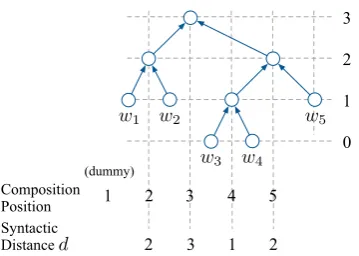
The PRPN introduces the concept of syntactic distancedt, defined as the height of the common
ancestor ofwt−1 andwtin the tree (tis the
posi-tion index in a sentencew1, ..., wN). Since gold
standard dt is not available, the PRPN learns the
estimateddbt end-to-end in an unsupervised
man-ner. The PRPN computes the differences between
b
dtat the current step and all previous stepsdbj for
2≤j < t. The differences are normalized to[0,1]
and used to compute attention scores right to left. These scores are applied to reweight another set of inner-sentence attention scores, which are then used in a recurrent neural network to predict the next word. The PRPN is explained in more detail in AppendixA.
Based on the real-valued syntactic distances in the PRPN, an external procedure is used to infer tree structures. The main text ofShen et al.(2018) suggests using the following intuitive scheme: find the largest distancedbi and split the sentence into
two constituents (· · · , wi−1) and(wi,· · ·). This
process is then repeated recursively on the two new constituents.
The trees inferred by this scheme, however, yield poor parsing F-scores, and the results re-ported byShen et al.(2018) are actually obtained by a different scheme (evidenced in their supple-mentary material and code repository): find the largest syntactic distancedbi and obtain two
constituent contains two or more words, then it is further split into (wi)and(wi+1,· · ·), regardless
of the syntactic distancedbi+1. This scheme
intro-duces a bias for right-branching trees, which pre-sumably is the reason why it yields good parsing
F-scores for English.
The reliance on this trick illustrates the point we make in the Introduction: syntactic distance has the advantage of being a continuous value, which can be computed as an attention score in a differ-entiable model. However, this comes at a price: the PRPN does not model trees or tree-building operations directly. These operations need to be stipulated externally in an ad hoc inference proce-dure. This procedure is not part of the model and cannot be trained, but yet is crucial for good per-formance.
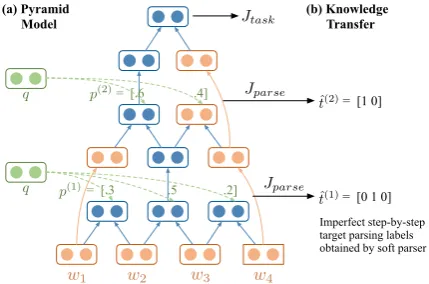
Discrete syntactic parser. To address this prob-lem, we combine the PRPN with a parser which explicitly models tree-building operations. Specif-ically, we use the pyramid-shaped, tree-based long short-term memory (Tree-LSTM, Figure1a,Choi et al., 2018), where reinforcement learning (RL) in this model can be relaxed by Gumbel-Softmax. Concretely, letw1,w2,· · · ,wN be the
embed-dings of the words in a sentence. The model tries every possible combination of two consecu-tive words by the Tree-LSTM, but then uses soft-max (inN−1ways) to predict which composition is appropriate at this step.
Let h(1)1 ,· · · ,h(1)N−1 be the candidate Tree-LSTM composition at the bottom layer. With q
being a trainable query vector, the model com-putes a distributionp:
p(1)i = softmax{q>h(1)i } (1)
Assuming the model selects an appropriate com-position at the current step, we copy all other words intactly, shown as orange arrows in Fig-ure1a. This process is applied recursively, form-ing the structure in the figure.
The Tree-LSTM model is learned by straight-through Gumbel-Softmax (detailed in Ap-pendix B), which resembles RL as it samples actions from its predicted probabilities, exploring different regions of the latent space other than a maximum a posteriori tree. Training involves doubly stochastic gradient descent (Lei et al.,
2016): the first stochasticity comes from sam-pling input from the data distribution, and the second one from sampling actions for each input.
(a) Pyramid
Model (b) Knowledge Transfer
= [.6 .4]
p(2)
p(1)= [.3 .5 .2]
q
q
Jparse
Jtask
ˆ t(2)= [1 0]
= [0 1 0] ˆ
t(1)
Jparse
Imperfect step-by-step target parsing labels obtained by soft parser
[image:3.595.309.524.64.206.2]w1 w2 w3 w4
Figure 1: Overview of our approach. (a) The Tree-LSTM model of Choi et al. (2018). (b) The model is first trained with step-by-step supervision, and then Gumbel-Softmax is applied to refine the policy.
Therefore, ST-Gumbel is difficult to train (similar to RL), and may be stuck in poor local optima, resulting in low self-agreement for multiple random initializations (Williams et al.,2018a).
Imitation learning. Our aim is to combine the PRPN and its continuous notion of syntactic dis-tance with a parser that has discrete tree-building operations. The mapping from the sequence of Tree-LSTM composition operations to a tree structure is not injective. Given a parse tree, we may have multiple different composition se-quences, e.g., left-to-right or right-to-left. This ambiguity could confuse the Tree-LSTM during training. We solve this problem by using the PRPN’s notion of syntactic distance.
Given a parse tree predicted by the PRPN, if more than one composition is applicable, we al-ways group the candidates with the lowest syn-tactic distance. In this way, we can unambigu-ously determine the composition order from the trees inferred by the PRPN. Then, we train the Tree-LSTM model in astep-by-step(SbS) super-vised fashion. Let tb(j) be a one-hot vector for thejth step of Tree-LSTM composition, where the hat denotes imperfect target labels induced by the PRPN’s prediction. The parsing loss is defined as:
Jparse=−
X
j
X
ibt
(j)
i logp
(j)
i (2)
wherep(j)is the probability predicted by the Tree-LSTM model. The subscriptiindexes theith po-sition among in 1,· · ·, Nj −1, where Nj is the
and the parsing loss, i.e.,J =Jtask+λJparse.
Af-ter step-by-step training, we performpolicy refine-mentby optimizingJtaskwith ST-Gumbel, so that
the Tree-LSTM can improve its policy based on a semantically oriented task.
It should be emphasized that how the Tree-LSTM model builds the tree structure differs be-tween step-by-step training and ST-Gumbel train-ing. For SbS training, we assume an imperfect parsing tree is in place; hence the Tree-LSTM model exploits existing partial structures to predict the next composition position. For ST-Gumbel, the tree structure is sampled from its predicted probability, enabling our model to explore the space of trees beyond the given imperfect tree.
4 Experiments
We train our model on the AllNLI dataset and evaluate on the MultiNLI development set, follow-ing experimental settfollow-ings inHtut et al.(2018) (for detailed settings, please see AppendixC).
Table 1 shows the parsing F-scores against the Stanford Parser. The ST-Gumbel Tree-LSTM model and the PRPN were run five times with dif-ferent initializations, each known as a trajectory. For imitation learning, given a PRPN trajectory, we perform SbS training once and then policy re-finement for five runs. Left-/right-branching and balanced trees are also included as baselines.
Parsing results with punctuation. It is a com-mon setting to keep all punctuation for evaluation on the AllNLI dataset (Htut et al.,2018). In such a setting, we find that the Tree-LSTM, trained by ST-Gumbel from random initialization, does not outperform balanced trees, whereas the PRPN out-performs it by around 30 points. Our PRPN repli-cation results are consistent withHtut et al.(2018). Our first stage in imitation learning (SbS train-ing) is able to successfully transfer the PRPN’s knowledge to the Tree-LSTM, achieving an F -score of 52.0, which is clearly higher than the 21.9 achieved by the Tree-LSTM trained with ST-Gumbel alone, and even slightly higher than the PRPN itself. The second stage, policy refinement, achieves a further improvement in unsupervised parsing, outperforming the PRPN by 2.1 points.
We also evaluate the self-agreement by comput-ing the meanF-score across 25 runs for policy re-finement and five runs for other models. We find that our imitation learning achieves improved
self-agreement in addition to improved parsing perfor-mance.
Parsing results without punctuation. We are interested in investigating whether punctuation make a difference on unsupervised parsing. In the setting without punctuation, our imitation learning approach with policy refinement outperforms the PRPN by a larger margin (7.3F-score points) than in the setting with punctuation. But surprisingly, strictly right-branching trees are a very strong baseline in this setting, achieving the best pars-ing performance overall. The PRPN cannot out-perform the right-branching baseline, even though it uses a right-branching bias in its tree inference procedure.
By way of explanation, we assume that the syn-tactic trees we compare against (given by the Stan-ford parser) become more right-branching if punc-tuation is removed. A simple example is the period at the end of the sentence: this is always attached to a high-level constituent in the correct tree (of-ten to Root), while right-branching attaches it to the most deeply embedded constituent. So this pe-riod is always incorrectly predicted by the right-branching baseline, if punctuation is left in.
To further elucidate this issue, we also com-pute the agreement of various models with a right-branching baseline. In the setting without punctu-ation, the PRPN sets an initial policy that agrees fairly well with branching, and this right-branching bias is reinforced by imitation learn-ing and policy refinement. However, in the set-ting with punctuation, the agreement with right-branching changes in the opposite way. We con-jecture that right-branching is a reason why our imitation learning achieves a larger improvement without punctuation. Right-branching provides a relatively flat local optimum so that imitation learning can do further exploring with a low risk of moving out of it.
w/o Punctuation w/ Punctuation
Model MeanF Self-agreement RB-agreement MeanF Self-agreement RB-agreement
Left-Branching 20.7 - - 18.9 -
-Right-Branching 58.5 - - 18.5 -
-Balanced-Tree 39.5 - - 22.0 -
-ST-Gumbel 36.4 57.0 33.8 21.9 56.8 38.1
PRPN 46.0 48.9 51.2 51.6 65.0 27.4
Imitation (SbS only) 45.9 49.5 62.2 52.0 70.8 20.6
Imitation (SbS + refine) 53.3† 58.2 64.9 53.7† 67.4 21.1
Table 1: Parsing performance with and without punctuation. MeanF indicates mean parsingF-score against the Stanford Parser (early stopping byF-score). Self-/RB-agreement indicates self-agreement and agreement with the right-branching baseline across multiple runs. †indicates a statistical difference from the corresponding PRPN baseline withp <0.01, paired one-tailed bootstrap test.2
Type # Occur ST-Gumbel PRPN Imitation (SbS + refine)
NP 69k 22.6 53.2 49.5
VP 58k 4.9 49.4 57.0
S 42k 44.3 63.9 66.0
PP 29k 13.9 55.4 52.4
SBAR 12k 6.9 38.9 41.4
ADJP 4k 10.6 44.2 46.5
Table 2: Parsing accuracy for six phrase types which occur more than 2k times in the MultiNLI development set with keeping punctuation.
methods could be employed to combine them.
Discussion. Our results show the usefulness of a downstream task for unsupervised parsing. Specifically, policy refinement with a semantically oriented objective improves parsing performance by twoF-score points, outperforming the previous state-of-the-art PRPN model. This provides evi-dence against previous studies which have claimed that an external, non-syntactic task such as NLI does not improve parsing performance (Williams et al., 2018a; Htut et al., 2018). At the same time, our results are compatible with findings of
Shi et al. (2018) that a range of different tree structures yield similar classification accuracy in NLI: we find that the mean NLI accuracy of the ST-Gumbel-only model and our imitation learning model with policy refinement is 69.9% and 69.2%, respectively, on the MultiNLI development set. NLI performance seems to be largely unaffected by the syntactic properties of the induced trees.
An interesting question is why ST-Gumbel im-proves unsupervised parsing when trained with an NLI objective. It has been argued that NLI as currently formulated is not a difficult task (Poliak et al., 2018); this is presumably why models can
2F-score is not normally distributed. It is therefore
ap-propriate to use the non-parametric bootstrap test.
perform well across a range of different tree struc-tures, only some of which are syntactically plau-sible. However, this does not imply that the Tree-LSTM will learn nothing when trained with NLI. We can think of its error surface being very rugged with many local optima; the syntactically correct tree corresponds to one of them. If the model is initialized in a meaningful catchment basin, NLI training is more likely to recover that tree. The intuition also explains why the Tree-LSTM alone achieves low parsing performance and low self-agreement. On a very rugged high-dimensional error surface, the chance of getting into a partic-ular local optimum (corresponding to a syntacti-cally correct tree) is low, especially in RL and ST-Gumbel, which are doubly stochastic.
We show examples of generated trees in Ap-pendixD.
5 Conclusion
We proposed a novel imitation learning approach to unsupervised parsing. We start from the differ-entiable PRPN model and transfer its knowledge to a Tree-LSTM by step-by-step imitation learn-ing. The Tree-LSTM’s policy is then refined to-wards a semantic objective. We achieve a new state-of-the-art result of unsupervised parsing on the NLI dataset. In future work, we would like to combine more potential parsers—including chart-style parsing and shift-reduce parsing—and trans-fer knowledge from one to another in a co-training setting.
Acknowledgments
References
Roee Aharoni and Yoav Goldberg. 2017. Towards string-to-tree neural machine translation. In ACL, pages 132–140.
Samuel R. Bowman, Gabor Angeli, Christopher Potts, and Christopher D. Manning. 2015. A large anno-tated corpus for learning natural language inference. InEMNLP, pages 632–642.
Jihun Choi, Kang Min Yoo, and Sang-goo Lee. 2018.
Learning to compose task-specific tree structures. In
AAAI, pages 5094–5101.
Yuntian Deng, Yoon Kim, Justin Chiu, Demi Guo, and Alexander Rush. 2018. Latent alignment and varia-tional attention. InNIPS, pages 9712–9724.
Andrew Drozdov, Pat Verga, Mohit Yadav, Mohit Iyyer, and Andrew McCallum. 2019. Unsupervised latent tree induction with deep inside-outside recur-sive autoencoders. InNAACL-HLT.
Yang Gao, Ji Lin, Fisher Yu, Sergey Levine, Trevor Darrell, et al. 2018. Reinforcement learning from imperfect demonstrations. arXiv preprint arXiv:1802.05313.
Phu Mon Htut, Kyunghyun Cho, and Samuel Bow-man. 2018. Grammar induction with neural lan-guage models: An unusual replication. InEMNLP, pages 4998–5003.
Ahmed Hussein, Mohamed Medhat Gaber, Eyad Elyan, and Chrisina Jayne. 2017. Imitation learn-ing: A survey of learning methods. ACM Comput. Surveys, 50(2):21:1–21:35.
Eric Jang, Shixiang Gu, and Ben Poole. 2017. Cat-egorical reparameterization with Gumbel-softmax. InICLR.
Taeuk Kim, Jihun Choi, Daniel Edmiston, Sanghwan Bae, and Sang-goo Lee. 2019a. Dynamic composi-tionality in recursive neural networks with structure-aware tag representations. InAAAI.
Yoon Kim, Alexander M Rush, Lei Yu, Adhiguna Kun-coro, Chris Dyer, and G´abor Melis. 2019b. Un-supervised recurrent neural network grammars. In
NAACL-HLT.
Dan Klein and Christopher Manning. 2014. Corpus-based induction of syntactic structure: Models of de-pendency and constituency. InACL, pages 479–486.
Tao Lei, Regina Barzilay, and Tommi Jaakkola. 2016.
Rationalizing neural predictions. InEMNLP, pages 107–117.
Jean Maillard, Stephen Clark, and Dani Yogatama. 2017. Jointly learning sentence embeddings and syntax with unsupervised Tree-LSTMs. arXiv preprint arXiv:1705.09189.
Lili Mou, Zhengdong Lu, Hang Li, and Zhi Jin. 2017.
Coupling distributed and symbolic execution for nat-ural language queries. InICML, pages 2518–2526.
Shashi Narayan and Claire Gardent. 2014.Hybrid sim-plification using deep semantics and machine trans-lation. InACL, pages 435–445.
Barbara BH Partee, Alice G ter Meulen, and Robert Wall. 2012. Mathematical Methods in Linguistics, volume 30. Springer Science & Business Media.
Hao Peng, Sam Thomson, and Noah A. Smith. 2018.
Backpropagating through structured argmax using a SPIGOT. InACL, pages 1863–1873.
Adam Poliak, Jason Naradowsky, Aparajita Haldar, Rachel Rudinger, and Benjamin Van Durme. 2018.
Hypothesis only baselines in natural language infer-ence. InProc. 7th Joint Conf. Lexical and Compu-tational Semantics, pages 180–191.
Yikang Shen, Zhouhan Lin, Chin-Wei Huang, and Aaron Courville. 2018. Neural language modeling by jointly learning syntax and lexicon. InICLR.
Yikang Shen, Shawn Tan, Alessandro Sordoni, and Aaron Courville. 2019. Ordered neurons: Integrat-ing tree structures into recurrent neural networks. In
ICLR.
Haoyue Shi, Hao Zhou, Jiaze Chen, and Lei Li. 2018. On tree-based neural sentence modeling. In
EMNLP, pages 4631–4641.
Richard Socher, Alex Perelygin, Jean Wu, Jason Chuang, Christopher D. Manning, Andrew Ng, and Christopher Potts. 2013. Recursive deep models for semantic compositionality over a sentiment tree-bank. InEMNLP, pages 1631–1642.
Kai Sheng Tai, Richard Socher, and Christopher D. Manning. 2015. Improved semantic representations from tree-structured long short-term memory net-works. InACL-IJCNLP, pages 1556–1566.
Patrick Verga, David Belanger, Emma Strubell, Ben-jamin Roth, and Andrew McCallum. 2016. Multi-lingual relation extraction using compositional uni-versal schema. InNAACL-HLT, pages 886–896.
Adina Williams, Andrew Drozdov, and Samuel R. Bowman. 2018a. Do latent tree learning models identify meaningful structure in sentences? TACL, 6:253–267.
Adina Williams, Nikita Nangia, and Samuel R Bow-man. 2018b. A broad-coverage challenge corpus for sentence understanding through inference. In
NAACL-HLT, pages 1112–1122.
Dani Yogatama, Phil Blunsom, Chris Dyer, Edward Grefenstette, and Wang Ling. 2017. Learning to compose words into sentences with reinforcement learning. InICLR.
A Details of the PRPN
We now describe in more detail the parsing-reading-predict network (PRPN), proposed by
Shen et al.(2018). The PRPN introduces a con-cept called the syntactic distance, illustrated in Figure2. The syntactic distance dt is defined as
the height of the common ancestor ofwt−1andwt
in a tree.
The PRPN uses a two-layer multilayer percep-tron (MLP) to estimate dt. The input is the
em-beddings of the current word and its left context
wt−L,wt−L+1,· · ·,wt. The output is given by:
b
dt= MLP(wt−L,wt−L+1,· · · ,wt) (3)
In fact, absolute distance values are not required, it is sufficient to preserve their order. In other words,
ifdi < dj, then it is desired thatdbi < dbj.
How-3
2
1
0 Height
w1 w2
w3 w4
w5
3 2
1 4 5
2 3 1 2
Syntactic Distance Composition Position
(dummy)
[image:7.595.74.254.390.518.2]d
Figure 2: A parse tree with syntactic distance values.
sti= gt
i
Pt 1
i=1git
e
sti
…
w1 w2 wt
Predict next word
Gated-weighted attention
wt+1= ?
s1 s2 st
Figure 3: The prediction of the next word in the PRPN language model.
ever, even the order ofdtis not available at training
time, anddbtis learned end-to-end in an
unsuper-vised manner.
The PRPN computes the difference between the distance dt at the current step and all previous
steps dj for 2 ≤ j < t. The difference is
nor-malized to the range[0,1]:
αtj = hardtanh(τ(dbt−dbj)) + 1
2 (4)
whereτ is the temperature.
Finally, a soft gate is computed right-to-left in a multiplicatively cumulative fashion:
gti =
t−1 Y
j=i+1
αtj (5)
for1≤i≤t−1. The gatesgt
iare used to reweight
another inner-sentence attentionest
i, which is
com-puted as:
e
sti= softmax{h>i (W[ht−1;wt])} (6)
The reweighed inner-sentence attentionsithen
be-comes:
st i =
gt i
Pt−1
i=1git
e st
i (7)
and is used to compute the convex combination of attention candidate vectors, which are incorpo-rated in a recurrent neural network to predict the next word, shown in Figure3.
B Details of Gumbel-Softmax
Gumbel-Softmax can be thought of as a relaxed version of reinforcement learning. It is used in the training of the Tree-LSTM model (Choi et al.,
2018), as well as policy refinement in our imitation learning. In particular, we use the straight-through Gumbel-Softmax (ST-Gumbel,Jang et al.,2017).
In the forward propagation of ST-Gumbel train-ing, the model samples an action—in the Tree-LSTM model, the position of composition—from the distributionpby the Gumbel trick. The sam-pled action can be represented as a one-hot vector
a, whose elements take the form:
ai=
(
1, ifi= argmaxj{log(pj) +gj}
0, otherwise (8)
wheregiis called theGumbel noise, given by:
gi =−log(−log(ui)) (9)
ui ∼Uniform(0,1) (10)
[image:7.595.96.265.570.727.2]This is a powerful and evocative museum . This is a powerful and evocative museum .
He seemed a trifle .
Chapter 1 : His real name was Leonard Franklin Slye . Chapter 1 : His real name was Leonard Franklin Slye .
[image:8.595.94.498.63.225.2]embarrassed He seemed a trifle embarrassed .
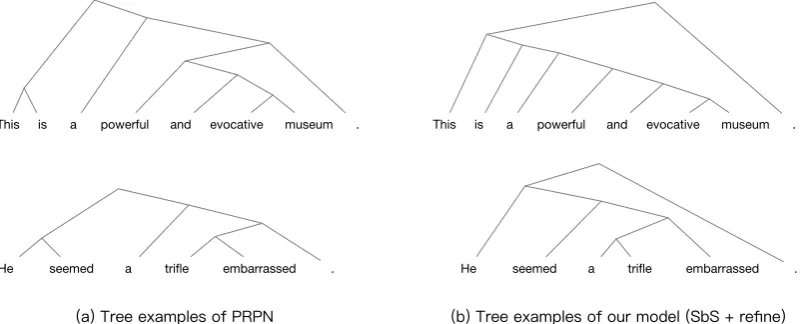
Figure 4: Parse tree examples produced by the PRPN and our model (SbS + refine).
During backpropagation, ST-Gumbel substi-tutes the selected one-hot action a given by argmax in Equation (8) with a softmax operation.
e
pi =
exp{(log(pi) +gi)/γ}
P
jexp{(log(pj) +gj)/γ}
(11)
whereγ is a temperature parameter that can also be learned by backpropagation.
The Tree-LSTM model is trained using the loss in a downstream task (for example, cross-entropy loss for classification problems). Compared with reinforcement learning, the ST-Gumbel trick al-lows more information to be propagated back to the bottom of the Tree-LSTM in addition to the selected actions, although it does not follow exact gradient computation. For prediction (testing), the model selects the most probable composition ac-cording to its predicted probabilities.
C Experimental Setup
We conduct experiments on the AllNLI dataset, the concatenation of the Stanford Natural Lan-guage Inference Corpus (Bowman et al., 2015) and the Multi-Genre NLI Corpus (MultiNLI;
Williams et al. 2018b). As the MultiNLI test set is not publicly available, we follow previous work (Williams et al.,2018a;Htut et al.,2018) and use the development set for testing. For early stop-ping, we remove 10k random sentence pairs from the AllNLI training set to form a validation set. Thus, our AllNLI dataset contains 931k, 10k, and 10k sample pairs for training, validation, and test, respectively.
We build the PRPN model and the Tree-LSTM parser following the hyperparameters in previous work (Shen et al.,2018;Choi et al., 2018).3 For
the SbS training stage, we setλto be 0.03. For the policy refinement stage, the initial temperature is manually set to 0.5. The PRPN is trained by a lan-guage modeling loss on the AllNLI training sen-tences, whereas the Tree-LSTM model is trained by a cross-entropy loss for AllNLI classification.
We adopt the standard metric and compute the unlabeledF-score of the constituents predicted by our parsing model against those given by the Stan-ford PCFG Parser (version 3.5.2). Although the Stanford parser itself may make parsing errors, it achieves generally high performance and is a rea-sonable approximation of correct parse trees.
D Parse Tree Examples
In Figure 4, we present a few examples of parse trees generated by the PRPN and by our model (SbS + refine).
As can be seen, our model is able to handle the period correctly in these examples. Although this could be specified by hand-written rules (Drozdov et al.,2019), it is in fact learned by our approach in an unsupervised manner, since punctuation marks are treated as tokens just like other words, and our training signal gives no clue regarding how punc-tuation marks should be processed.
Moreover, our model is able to parse the verb phrases more accurately than the PRPN, including
is a powerful and evocative museumandseemed a trifle embarrassed. This is also evidenced by quantitative results in Table2.
3The code bases of the PRPN and the Gumbel
Tree-LSTM are available at https://github.com/
yikangshen/PRPN and https://github.com/