10
Describing a Knowledge Base
Qingyun Wang1, Xiaoman Pan1, Lifu Huang1, Boliang Zhang1, Zhiying Jiang1, Heng Ji1, Kevin Knight2
1Rensselaer Polytechnic Institute
2 DiDi Labs and University of Southern California
Abstract
We aim to automatically generate nat-ural language descriptions about an in-put structured knowledge base (KB). We build our generation framework based on a pointer network which can copy facts from the input KB, and add two attention mechanisms: (i) slot-aware attention to capture the association between a slot type and its corresponding slot value; and (ii) a newtable position self-attentionto cap-ture the inter-dependencies among related slots. For evaluation, besides standard metrics including BLEU, METEOR, and ROUGE, we propose aKB reconstruction based metric by extracting a KB from the generation output and comparing it with the input KB. We also create a new data set which includes 106,216 pairs of struc-tured KBs and their corresponding natu-ral language descriptions for two distinct entity types. Experiments show that our approach significantly outperforms state-of-the-art methods. The reconstructed KB achieves 68.8% - 72.6% F-score.1
1 Introduction
Show and tell, showing an audience something and telling them about it, is a common classroom activity for early elementary school kids. As a similar practice for knowledge propagation, we of-ten need to describe and/or explain the informa-tion in a structured knowledge base (KB) in natu-ral language, in order to make the knowledge ele-ments and their connections easier to comprehend.
1We make all data sets and programs of
vari-ous models publicly available for research purposes athttps://github.com/EagleW/Describing_a_ Knowledge_Base.
For example, (Cawsey et al.,1997) presents a nat-ural language generation system to convert struc-tured medical records to natural language text de-scriptions, which enables more effective commu-nication between health care providers and their patients and among health care providers them-selves.
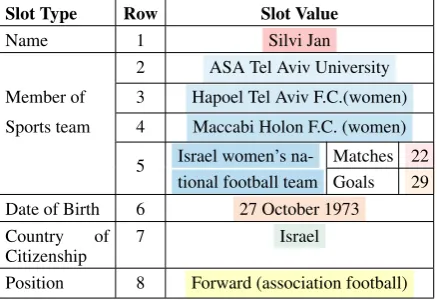
Moreover, 51% of entity attributes in the cur-rent English Wikipedia Infoboxes are not de-scribed in English articles in the Wikipedia dump of April 1, 2018. The availability of vast amounts of Linked Open Data (LOD) and Wikipedia de-rived resources such as DBPedia, WikiData and YAGO encourages pursuing a new direction of knowledge-driven (Whitehead et al., 2018; Lu et al., 2018) or semantically oriented ( Bouayad-Agha et al., 2013) Natural Language Generation (NLG). We aim to fill in this knowledge gap by developing a system that can take a KB (consisted of a set of slot types and their values) about an entity as input (see example in Table1), and auto-matically generate a natural language description (Table2).
Slot Type Row Slot Value
Name 1 Silvi Jan
2 ASA Tel Aviv University
Member of 3 Hapoel Tel Aviv F.C.(women)
Sports team 4 Maccabi Holon F.C. (women)
5 Israel women’s na- Matches 22 tional football team Goals 29 Date of Birth 6 27 October 1973
Country of Citizenship
7 Israel
[image:1.595.308.527.547.697.2]Position 8 Forward (association football)
Table 1: Input: Structured Knowledge Base
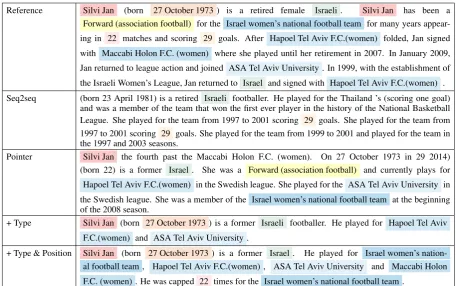
tem-Reference Silvi Jan (born 27 October 1973 ) is a retired female Israeli . Silvi Jan has been a Forward (association football) for the Israel women’s national football team for many years
appear-ing in 22 matches and scorappear-ing 29 goals. After Hapoel Tel Aviv F.C.(women) folded, Jan signed
with Maccabi Holon F.C. (women) where she played until her retirement in 2007. In January 2009,
Jan returned to league action and joined ASA Tel Aviv University . In 1999, with the establishment of
the Israeli Women’s League, Jan returned to Israel and signed with Hapoel Tel Aviv F.C.(women) .
Seq2seq (born 23 April 1981) is a retired Israeli footballer. He played for the Thailand ’s (scoring one goal) and was a member of the team that won the first ever player in the history of the National Basketball League. She played for the team from 1997 to 2001 scoring 29 goals. She played for the team from 1997 to 2001 scoring 29 goals. She played for the team from 1999 to 2001 and played for the team in the 1997 and 2003 seasons.
Pointer Silvi Jan the fourth past the Maccabi Holon F.C. (women). On 27 October 1973 in 29 2014) (born 22) is a former Israel . She was a Forward (association football) and currently plays for
Hapoel Tel Aviv F.C.(women) in the Swedish league. She played for the ASA Tel Aviv University in
the Swedish league. She was a member of the Israel women’s national football team at the beginning of the 2008 season.
+ Type Silvi Jan (born 27 October 1973 ) is a former Israeli footballer. He played for Hapoel Tel Aviv
F.C.(women) and ASA Tel Aviv University .
+ Type & Position Silvi Jan (born 27 October 1973 ) is a former Israel . He played for Israel women’s nation-al footbnation-all team , Hapoel Tel Aviv F.C.(women) , ASA Tel Aviv University and Maccabi Holon
[image:2.595.70.527.60.346.2]F.C. (women) . He was capped 22 times for the Israel women’s national football team .
Table 2: Human and System Generated Descriptions about the KB in Table1
plates and styles which human use to describe the same slot type. For example, to describe a foot-ball player’s membership with a team, we can use various phrases includingmember of, traded to, drafted by, played for, face of, loaned to and signed for. Instead of manually crafting patterns for each slot type, we leverage the existing pairs of structured slots from Wikipedia infoboxes and Wikidata (Vrandeˇci´c and Krötzsch,2014) and the corresponding sentences describing these slots in Wikipedia articles as our training data, to learn a deep neural network based generator.
Pointer network to copy over facts. The pre-vious work (Liu et al., 2018) considers the slot type and slot value as two sequences and applies a sequence to sequence (seq2seq) framework (Cho et al.,2014) for generation. However, the task of describing structured knowledge is fundamentally different from creative writing, because we need to cover the knowledge elements contained in the input KB, and the goal of generation is mainly to clearly describe the semantic connections among these knowledge elements in an accurate and co-herent way. The seq2seq model fails to capture such connections and tends to generate wrong in-formation (e.g.,Thailandin Table2). To address this challenge, we choose a pointer network (See et al.,2017) to copy slot values directly from the
input KB.
Slot type attention. However, the copying mechanism in the pointer network is not able to capture the alignment between a slot type and its slot value, and thus it often assigns facts to wrong slots. For example, 22 in Table 2 should be the number of matches instead of birth date. It also tends to repeat the same slot value based on lan-guage model, e.g., “Uroplatus ebenaui is a of gecko endemic toMadagascar. The Uroplatus is a member of the species of the genus Madagas-car.”. We propose aSlot-aware Attention mech-anism to compute slot type attention and slot value attention simultaneously and capture their corre-lation. Attention mechanism in deep neural net-works (Denil et al.,2012) is inspired from human visual attention, which refers to human’s capabil-ity to focus on a certain region of an image with high resolution while perceiving the surrounding image in low resolution. It allows the neural net-work to have access to the hidden state of the en-coder, and thus learn what to attend to. For exam-ple, for aDate of Birth slot type, words such as bornmay receive higher attention thanfemale. As we can see in Table2(+Type), the output with slot type attention contains more precise slots.
may join multiple teams, with each team associ-ated with a certain number of points, goals, scores and games participated. We design a new table po-sition based self-attention to capture correlations among interdependent slots and put them in the same sentence. For example, our model success-fully associates the number of matches22with the Israel women’s national football teamas shown in Table2.
The major contributions of this paper are:
• For the first time, we propose a new table po-sition attention which proves to be effective at capturing inter-dependencies among facts. This new approach achieves 2.5%-7.8% F-score gain at KB reconstruction.
• We propose aKB reconstruction based met-ricto evaluate how many facts are correctly expressed in the generation output.
• We create a large dataset of KBs paired with natural language descriptions for 106,216 en-tities, which can serve as a new benchmark.
2 Model
We formulate the input structured KB
to the model as a list of triples: L =
[(s1, v1,(r1,rˆ1)), ...,(sn, vn,(rn,rˆn))], where
si denotes a slot type (e.g., Country of
Citizen-ship), vi denotes the corresponding slot value (e.g., Israel), and (ri,rˆi) denotes the position of the triple in the input list and consists of the forward position ri and the backward position
ˆ
ri = n−ri + 1. The outcome of the model is a paragraph Y = [y1, y2, ..., ym]. The training instances for the generator are provided in the form of:T = [(L1, Y1), ...,(Lk, Yk)].
2.1 Sequence-to-Sequence with Slot-aware Attention
Following previous studies on describing struc-tured knowledge (Lebret et al., 2016; Sha et al.,
2018;Liu et al., 2018), we apply a sequence-to-sequence based approach, and incorporate a slot-aware attention to generate the descriptions.
Encoder Given a structured KB input: L = [(s1, v1,(r1,rˆ1)), ...,(sn, vn,(rn,rˆn))], where si,
vi,ri,rˆi are randomly embedded as vectorssi,vi,
ri,ˆri2respectively, we concatenate the vector
rep-2We use bold mathematical symbols to denote vector
rep-resentations for the whole paper.
resentations of these fields asli = [si,vi,r1,rˆ1], and obtainL= [l1,l2, ...,ln].
We attempted to apply the average ofLas the representation for the input KB. However, such flat representation vectors fail to capture the struc-tured contextual information in the entire KB. Therefore, we apply a bi-directional Gated Re-current Unit (GRU) encoder (Cho et al., 2014) on L to produce the encoder hidden states H = [h1,h2, ...,hn], wherehiis a hidden state forli.
Decoder with Slot-aware Attention The de-coder is a forward GRU network with an initial hidden statehn, which is the encoder hidden state of the last token. In order to capture the associ-ation between a slot type and its slot value, we design a Slot-aware Attention. At each step t, we compute the attention distribution over the se-quence of input triples. For each triplei, we assign it an attention weight:
eti=v>tanhWhh˜ t
+Wssi+Wvvi+Wccti+be
αt=Softmax et
where h˜t is the decoder hidden state at step t.
si and vi denote the embedding representations of slot type si and slot value vi respectively.
cti = Pt−1
k=0αki is a coverage vector, which is the sum of attention distributions over all previous de-coder time steps and can be used to reduce repeti-tion (See et al.,2017).
The source attention distributionαtcan be con-sidered as the contribution of each source triple to the generation of the target word. Next we useαt to compute two context vectorsL∗s andL∗v as the representation of the slot types and values respec-tively:
L∗s =Xn i=1α
t isi
L∗v =Xn i=1α
t ivi
(1)
At step t, the vocabulary distributionPvocab is computed with the context vectorsL∗s,L∗vand the decoder hidden state˜ht, using an affine-Softmax layer:
Pvocab=Softmax
V[˜ht;L∗s;L∗v] +bvocab
The loss function is computed as:
Loss=P
t
n
−logPvocab(yt) +λPimin αti, cti
o
Bidirectional GRU
<SOS> Zsolt
Laczkó ( born
<Name> <Country of Citizenship> <Date of Birthday> <Position> <Sports team> <Member of Sports team> <Member of Sports team> <Member of Sports team> <Matches> <Goals>
(1,8) (7,2) (6,3) (8,1) (2,7) (3,6) (4,5) (5,4) (5,4) (5,4)
Silvi Jan Israel 27 October 1973 Forward (associate football) ASA T
el A
viv University
Hapoel T
el A
viv F
.C. (women)
Maccabi Holon F
.C. (women)
Israel women's national football team 22 29 Slot Type
Slot Value Input
Table Position
Slot-aware Attention
Table Position Attention
Attention Distribution
Vocabulary
Distribution Final
Distribution pgen
1pgen
Figure 1: KB-to-Language Generation Model Overview
2.2 Table Position Self-attention
Although the sequence-to-sequence attention model takes into account the information of input triples, it still encodes the structured knowledge as sequential facts while ignoring the correlations between facts. In our task, multiple inter-dependent slots should be described within one sentence. For example, in Table1, the sport team Israel women’s national football team should be described together with22matches and29goals. Previous studies (Lin et al.,2017;Vaswani et al.,
2017) applied self-attention on sentence level to capture the correlation between continuous tokens. Inspired by these approaches, we design a new table position based self-attention and incorporate it into the slot-aware attention.
In our task, since most triples are organized in temporal order, we use the row index r and the reverse row index rˆ to denote the po-sition information of each triple in the input
KB. Given a structured KB as input: L =
[(s1, v1,(r1,rˆ1)), ...,(sn, vn,(rn,ˆrn))], we obtain
a sequence of row index embeddings R =
[r01,r02, ...,r0n] with random initialization, where
r0i = [ri; ˆri]. We model the inter-dependencies among slots as a latent structure, where for each positioniwe assume it has a latent in-link and an out-link to denote where it is linked to or from. This assumption is similar to the structure atten-tion applied inLiu and Lapata(2018), which as-sumes each word within a sentence can be a parent node or a child node in a latent tree structure. For each pair of slotsiandj, we compute the attention scorefij as follows:
gin = tanh
Winr 0
i
gout= tanh
Woutr 0
j
fij =Softmax
gin>Wggout
fij can be viewed as the contribution from a context triple j to triple i. For each slot si and valuevi, we obtain a context vector by collecting information from other slot types and their values:
s∗i =Xn
k=1fiksk
v∗i =Xn
k=1fikvk
We further encode position-aware representa-tion of each slot type and value, and update their context vectorsL∗t andL∗vin Equation1as:
L∗s =Xn i=1α
t is
∗ i
L∗v =Xn i=1α
t iv∗i
2.3 Structure Generator
Traditional sequence-to-sequence models predict a target sequence by only selecting words from a vocabulary with a fixed size. However, in our task, we regard the slot value as a single information unit. Therefore, there is a certain amount of out-of-vocabulary (OOV) words during the test phase. Inspired by the pointer-generator (Gu et al.,2016;
See et al., 2017), which is designed to automat-ically locate particular source words and directly copy them into the target sequence, we design a structure-aware generator as follows.
We first obtain a source attention distribution of all unique input slot values. Since one partic-ular slot value may occur in the structure input for many times, we aggregate the attention weights for each unique slot valuevjfromαtand obtain its ag-gregated source attention distributionPsourcej by
Psourcej = X m|vm=vj
αtm
The gates in neural networks act on the sig-nals they receive, and block or pass on informa-tion based on its strength. In order to combine two types of attention distributionPsourceandPvocab, we compute a structure-aware gatepgen∈[0,1]as a soft switch between generating a word from the fixed vocabulary and copying a slot value from the structured input:
pgen=σ
W>
s L∗s+Wv>L∗v+Wh>h˜ t
+W>
yyt−1+bgen
whereyt−1 is the embedding of the previous gen-erated token at timet−1, andσis a Sigmoid func-tion.
The final probability of a tokeny at timetcan be computed bypgen,Pvocab andPsource:
P(yt) =pgenPvocab+ (1−pgen)Psource
The loss function, combining with the coverage loss (See et al.,2017), is presented as:
Loss=P
t
n
−logP(yt) +λP
imin αti, cti
o
where P(yt) is the prediction probability of the ground truth tokeny.λis a hyperparameter.
3 Experiments
3.1 Data
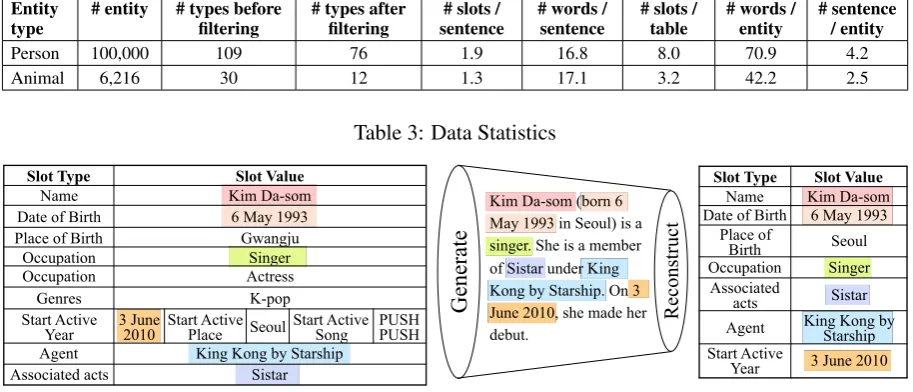
Using person and animal entities as case studies, we create a new dataset based on Wikipedia dump (2018/04/01) and Wikidata (2018/04/12) as fol-lows: (1). Extract Wikipedia pages and Wiki-data tables about person and animal entities, and align them according to their unique KB IDs. (2). For each Wikidata table, filter out the slot types of which frequency is less than 3. For each Wikipedia article, use its anchor links (clickable texts in hyperlinks) to locate all the entities and determine their KB IDs. (3). For each Wiki-data table, search each value (including Number, Date) and entity contained in the table in the cor-responding Wikipedia article according to its KB ID, and remove the values and entities which can-not be found in the corresponding Wikipedia arti-cle. (4). For each Wikipedia article, remove the sentences which contain no values, and remove sentences which only contain entities that do not exist in the Wikidata table. The remaining sen-tences will be taken as ground-truth reference de-scriptions. (5). Index the row numbers for each slot type according to their orders in the Wikidata table. The ground-truth structured KB is then cre-ated. (6). Build a fixed vocabulary for the whole corpus of ground-truth descriptions and label the words with frequency<5as OOV.
We further randomly shuffle and split the dataset into training (80%), development (10%) and test (10%) subsets for person and animal enti-ties respectively. Table3shows the detailed statis-tics. Compared with the Wikibio dataset used in previous studies (Lebret et al., 2016; Sha et al.,
Entity type
# entity # types before filtering
# types after filtering
# slots / sentence
# words / sentence
# slots / table
# words / entity
# sentence / entity
Person 100,000 109 76 1.9 16.8 8.0 70.9 4.2
[image:6.595.71.528.65.261.2]Animal 6,216 30 12 1.3 17.1 3.2 42.2 2.5
Table 3: Data Statistics
Slot Type Slot Value
Name Kim Da-som
Date of Birth 6 May 1993
Place of Birth Gwangju
Occupation Singer
Occupation Actress
Genres K-pop
Start Active
Year 3 June 2010 Start Active Place Seoul Start Active Song PUSH PUSH
Agent King Kong by Starship
Associated acts Sistar
G
ene
ra
te
Re
cons
truc
t
Kim Da-som (born 6 May 1993 in Seoul) is a singer. She is a member of Sistar under King Kong by Starship. On 3 June 2010, she made her debut.
Slot Type Slot Value
Name Kim Da-som
Date of Birth 6 May 1993 Place of
Birth Seoul
Occupation Singer
Associated
acts Sistar
Agent King Kong by Starship Start Active
Year 3 June 2010
Figure 2: KB Reconstruction based Evaluation (Scores for the example: Overall Slot Filling P=67=85.7%, R=116=54.5%, F1=66.7%; Inter-dependent Slot Filling P=57=71.4%, R=59=55.6%, F1=62.5%)
It makes the generation task more challenging, practical and interesting.
3.2 Evaluation Metrics
We apply the standard BLEU (Papineni et al.,
2002), METEOR (Denkowski and Lavie, 2014), and ROUGE (Lin, 2004) metrics to evaluate the generation performance, because they can mea-sure the content overlap between system output and ground-truth and also check whether the sys-tem output is written in sufficiently good English. In addition, we can also consider natural lan-guage as the most expressive way for knowledge transmission via a noisy channel. If we are able to reconstruct the input KB from the generated de-scription, our generator achieves a 100% success rate at knowledge propagation. We propose aKB reconstruction based metric as follows: for each entity, construct a KB from the generated para-graph, and compute precision, recall and F-score by comparing it with the input KB from two as-pects: (1). Overall Slot Filling: If a pair of slot type and its slot value exists in both of the recon-structed KB and the input KB, it’s considered as a correct slot. (2). Inter-dependent Slot Filling: If a row that consists one or multiple slot types and their slot values exist in both of the reconstructed KB and the input KB, it’s considered as a correct row.
If the same slot/row is correctly described mul-tiple times in the system generation output, it’s only counted as correct once, i.e., redundant de-scriptions will be penalized. This metric is further
illustrated in Figure 2. It’s similar to the relation extraction based generation evaluation metric pro-posed by (Wiseman et al., 2017) and entity/event extraction based metric proposed by (Whitehead et al.,2018;Lu et al.,2018). They compared auto-matic Information Extraction results from the ref-erence description and the system generation out-put. However, the performance of state-of-the-art open-domain slot filling (Wu and Weld,2010;
Fader et al.,2011;Min et al.,2012;Xu et al.,2013;
Angeli et al.,2015;Bhutani et al.,2016;Yu et al.,
2017) is still far from satisfactory to serve as an automatic extraction tool for evaluating generation results. Therefore for the pilot study in this pa-per we manually reconstruct KBs from the gen-eration output for evaluation. Notably none of the above automatic metrics is sufficient to capture ad-equacy, grammaticality and fluency of the gener-ated descriptions. However extrinsic metrics such as system purpose and user task are expensive, while cheaper metrics such as human rating do not correlate with extrinsic metrics (Gkatzia and Ma-hamood,2015). Moreover the task we address in this paper requires essential domain knowledge for a human user to assess the generated descriptions.
3.3 Baseline Models
sequence with attention model to generate a de-scription. (2). Pointer-generator (See et al.,
2017) which introduces a soft switch to choose between generating a word from the fixed vocabu-lary and copying a word from the input sequence. Here, we concatenate all slot values as the input sequence, e.g., {Silvi Jan, ASA Tel Aviv Univer-sity, Hapoel Tel Aviv F.C. ...} for Table 1. (3).
Pointer-generator + slot type attention which incorporates the slot type attention (Section 2.1) into the pointer-generator. We use the sequence of (slot type, slot value) pairs as input, e.g.,{(Name, Silvi Jan), (Sports team, ASA Tel Aviv University), (Sports team, Hapoel Tel Aviv F.C.)...}for Table1.
3.4 Hyperparameters
Table4shows the hyperparameters of our model.
Parameter Value
Vocabulary size (|s|+|v|) 46,776 Value\type embedding size 256 Position embedding size 5
Slot embedding size 522
Decoder hidden size 256
Coverage lossλ 1.5
Optimization Adam (Hu et al.,2009)
Learning rate 0.001
Table 4: Hyperparameters
3.5 Results and Analysis
Table5shows the performance of various models with standard metrics. We can see that our atten-tion mechanisms achieve consistent improvement. We conduct paired t-test between our proposed model and all the other baselines on 10 randomly sampled subsets. The differences are statistically significant withp≤0.016for all settings.
As shown in Table 6 and Table7, the KBs re-constructed from models with these two attention mechanisms achieve much higher quality.
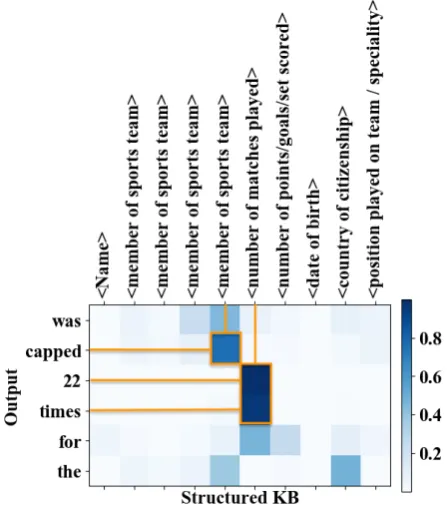
Figure 3 and Figure 4 visualize the attentions applied to the walk-through example in Table1.
Impact of Slot-aware Attention. The same string can be filled into various slots of multiple types. For example, dates, ages, the number of matches and goals can all be presented as num-bers. The pointer network often mistakenly mixes them up. For example, it produces “24 Septem-ber 1979 was born 3 OctoSeptem-ber 1903 in 17 on 33 October 1906”, where 33 should be the number
Figure 3: Slot Type Attention Visualization (Con-text words strongly associated with certain slot types receive high weights, e.g., capped to de-scribe member of sports team, and times to de-scribethe number of matches played. )
of matches and17should be the number of goals. In contrast our model with slot type attention cor-rectly generates “he made 33 appearances and scored17 goals”. In addition, as mentioned ear-lier, the pointer network often produces redundant slot values because it loses control of slot types, e.g., “He was born in the city ofAssociation foot-ball. In the late 1990s he was appointed manager of theAssociation footballteam of the team.”.
Impact of Table Position Attention. The ta-ble position attention successfully captures inter-dependent slots, such as a membership with a sports team and its corresponding number of matches and games: “Bill Sampy ... who played for Sheffield United F.C. 41times.”; “Giancarlo Antognoni ... he was also a member of theItaly national football team at the 1982 FIFA World Cup.”.
[image:7.595.309.533.67.320.2]Model Person Animal
BLEU METEOR ROUGE BLEU METEOR ROUGE
Seq2seq 11.3 16.9 28.8 5.8 11.5 20.5
Pointer 17.2 21.1 37.4 6.6 13.7 37.8
+Type 23.1 22.2 39.5 17.2 17.3 42.8
[image:8.595.67.529.61.138.2]+Type & Position 23.2 23.4 42.0 14.8 17.2 45.0
Table 5: Generation Performance based on Standard Metrics %)
1 2 3 4 5 5 5 6 7 8
[image:8.595.78.525.173.331.2]1 2 3 4 5 5 5 6 7 8
Table Position 1
2 3 4 5 5 5 6 7 8
1 2 3 4 5 5 5 6 7 8
Table Position <member of sports team> : ASA Tel Aviv University :
<member of sports team> : Hapoel Tel Aviv F.C. (women) : <member of sports team> : Maccabi Holon F.C. (women) : <member of sports team> : Israel women's national football team : <number of matches played> : 22 : <number of points/goals/set scored> : 29 : <date of birth> : 27 October 1973 : <country of citizenship> : Israel : <position played on team/speciality> : Forward (association football) : <name> : Silvi Jan : 1
2 3 4 5 5 5 6 7 8
1 2 3 4 5 5 5 6 7 8
Table Position <member of sports team> : ASA Tel Aviv University :
<member of sports team> : Hapoel Tel Aviv F.C. (women) : <member of sports team> : Maccabi Holon F.C. (women) : <member of sports team> : Israel women's national football team : <number of matches played> : 22 : <number of points/goals/set scored> : 29 : <date of birth> : 27 October 1973 : <country of citizenship> : Israel : <position played on team/speciality> : Forward (association football) : <name> : Silvi Jan :
Figure 4: Table Position Self Attention Visualization (the highlighted inter-dependent slots appear in the same row and the same sentences, and thus they receive the same high weight.)
Model Person Animal
P R F1 P R F1
Seq2seq 74.6 29.3 42.0 82.5 27.8 41.6 Pointer 72.6 56.4 62.8 58.5 37.5 45.7 +Type 75.9 58.8 66.3 65.9 63.8 64.8 +Type & Position 76.3 62.7 68.8 73.4 71.8 72.6
Table 6: Overall Slot Filling Precision (P), Recall (R), F-score (F1) (%)
Model Person Animal
P R F1 P R F1
Seq2seq 74.7 30.0 43.4 82.5 27.9 41.7 Pointer 73.0 56.4 63.6 57.7 37.2 45.2 +Type 75.8 58.9 66.3 66.3 64.2 65.2 +Type & Position 77.2 63.5 69.7 72.6 71.0 71.8
Table 7: Inter-dependent Slot Filling Precision (P), Recall (R), F-score (F1) (%)
because we don’t have enough training data for some rare slot types.
Contextual words generated by the LM intro-duces some incorrect facts, especially temporal expressions. For example, the generator does not have the commonsense knowledge that foot-ball players could not play before they were born: “Aleksei Gasilin ( born 1 March 1996 ) is a Russian Association football Forward (associa-tion football). He made his professional debut in
the Russian Second Division in 1992 for Russia national under-19 football team. ”. Similarly, a football player would probably not be still active when he was already 72 years old: “Basil Rigg ( born12 August 1926) is a former Australian rules football Rigg played for the Perth Football Club in the Western Australia cricket team from1998to 1998.”.
Our approach sometimes fails to detect person gender so as to generate incorrect pronouns. For animal entities, human writers are able to elab-orate more details. For example, human writes the specific endemic places forBrown treecreeper: “The bird endemic to eastern Australia has a broad distribution occupying areas from Cape York Queensland throughout New South Wales and Victoria to Port Augusta and the Flinders Ranges South Australia.” while our system is only able to cover the generic location informa-tion “It is endemic toAustralia.” from the input KB.
4 Related work
Our task is similar to the WebNLG challenge gen-erating text from DBPedia data (Gardent et al.,
induce templates and then fill appropriate content into slots (Kukich,1983;Cawsey et al.,1997; An-geli et al., 2010; Duma and Klein, 2013; Kon-stas and Lapata, 2013a; Flanigan et al., 2016a). These methods can generate high-quality descrip-tions but heavily rely on information redundancy to create templates. The second category is to directly generate a sequence of words using lan-guage model (Belz, 2008; Chen and Mooney,
2008; Liang et al., 2009; Angeli et al., 2010;
Konstas and Lapata,2012a,b,2013a,b;Mahapatra et al., 2016) or deep neural networks (Sutskever et al.,2011;Wen et al.,2015;Kiddon et al.,2016;
Mei et al.,2016;Gardent et al., 2017b;Wiseman et al.,2017;Wang et al.,2018;Song et al.,2018). Several studies (Lebret et al., 2016; Chisholm et al.,2017;Kaffee et al.,2018a,b;Liu et al.,2018;
Sha et al., 2018) generate a person’s biography from an input structure, which are closely related to our task. However, instead of modeling the in-put structure as a sequence of facts and generat-ing one sentence only, we introduce a table posi-tion self-attenposi-tion, inspired from structure atten-tion (Lin et al., 2017;Kim et al., 2017;Vaswani et al., 2017;Shen et al.,2018a,b), to capture the dependencies among facts and generate a para-graph to describe all facts.
In contrast to some recent work on converting structured Abstract Meaning Representation ( Ba-narescu et al.,2013) into natural language ( Pour-damghani et al.,2016;Flanigan et al.,2016b), our task requires us to capture inter-dependent relation links in a knowledge base and use them to generate multiple sentences in most cases. Our work is also related to attention mechanisms for sequence-to-sequence generation (Bahdanau et al.,2015;Mei et al.,2016;Ma et al.,2017). Different from pre-vious studies, our task requires the slot type and slot value to appear in the generated sentences in pairs. Thus we design a slot-aware attention to ob-tain two context vectors for both slot type and slot value simultaneously. To deal with OOV words, we use a structure generator, which is similar to the pointer-generator networks (Vinyals et al.,
2015;Luong et al., 2015; Gulcehre et al., 2016;
See et al.,2017) and copy mechanism (Gu et al.,
2016).
5 Conclusions and Future Work
We develop an effective generator to produce a natural language description about an input
knowl-edge base. Our experiments show that two at-tention mechanisms focusing on slot type and ta-ble position advance state-of-the-art on this task, and provide a KB reconstruction F-score up to 73%. We propose a new KB reconstruction based evaluation metric which can be used for other knowledge-driven NLG tasks such as news im-age/video captioning. In the future, we aim to address the remaining challenges as summarized in Section 3.5, and tackle the setting where mul-tiple facts of the same slot type are not presented in temporal order in the input KB. We also plan to extend the framework to cross-lingual cross-media generation, namely to produce a foreign language description or an image/video about the KB.
Acknowledgments
This work was supported by the U.S. DARPA AIDA Program No. FA8750-18-2-0014 and U.S.
ARL NS-CTA No. W911NF-09-2-0053. The
views and conclusions contained in this document are those of the authors and should not be inter-preted as representing the official policies, either expressed or implied, of the U.S. Government. The U.S. Government is authorized to reproduce and distribute reprints for Government purposes notwithstanding any copyright notation here on.
References
Gabor Angeli, Percy Liang, and Dan Klein. 2010. A simple domain-independent probabilistic approach to generation. InProceedings of the 2010 Confer-ence on Empirical Methods in Natural Language Processing.
Gabor Angeli, Melvin Jose Johnson Premkumar, and Christopher D Manning. 2015. Leveraging linguis-tic structure for open domain information extraction. In Proceedings of the 53rd Annual Meeting of the Association for Computational Linguistics and the 7th International Joint Conference on Natural Lan-guage Processing.
Dzmitry Bahdanau, Kyunghyun Cho, and Yoshua Ben-gio. 2015. Neural machine translation by jointly learning to align and translate. InInternational Con-ference on Learning Representations.
Anja Belz. 2008. Automatic generation of weather forecast texts using comprehensive probabilistic generation-space models. Natural Language Engi-neering, 14(4):431–455.
Nikita Bhutani, HV Jagadish, and Dragomir Radev. 2016. Nested propositions in open information ex-traction. InProceedings of the 2016 Conference on Empirical Methods in Natural Language Process-ing.
Nadjet Bouayad-Agha, Gerard Casamayor, and Leo Wanner. 2013. Natural language generation in the context of the semantic web. Semantic Web Journal.
Alison J Cawsey, Bonnie L Webber, and Ray B Jones. 1997. Natural language generation in health care. Journal of the American Medical Informatics Asso-ciation, 4.
David L Chen and Raymond J Mooney. 2008. Learn-ing to sportscast: a test of grounded language ac-quisition. InProceedings of the 25th international conference on Machine learning.
Andrew Chisholm, Will Radford, and Ben Hachey. 2017. Learning to generate one-sentence biogra-phies from wikidata. In Proceedings of the 15th Conference of the European Chapter of the Associa-tion for ComputaAssocia-tional Linguistics.
Kyunghyun Cho, Bart Van Merriënboer, Caglar Gul-cehre, Dzmitry Bahdanau, Fethi Bougares, Holger Schwenk, and Yoshua Bengio. 2014. Learning phrase representations using rnn encoder-decoder for statistical machine translation. InProceedings of the 2014 Conference on Empirical Methods in Nat-ural Language Processing.
Misha Denil, Loris Bazzani, Hugo Larochelle, and Nando de Freitas. 2012. Learning where to attend with deep architectures for image tracking. Neural Computation, 24(8):2151–2184.
Michael Denkowski and Alon Lavie. 2014. Meteor universal: Language specific translation evaluation for any target language. InProceedings of the Ninth Workshop on Statistical Machine Translation.
Daniel Duma and Ewan Klein. 2013. Generating nat-ural language from linked data: Unsupervised tem-plate extraction. InProceedings of the 10th Interna-tional Conference on ComputaInterna-tional Semantics.
Anthony Fader, Stephen Soderland, and Oren Etzioni. 2011. Identifying relations for open information ex-traction. InProceedings of the 2011 Conference on Empirical Methods in Natural Language Process-ing.
Jeffrey Flanigan, Chris Dyer, Noah A Smith, and Jaime Carbonell. 2016a. Generation from abstract mean-ing representation usmean-ing tree transducers. In Pro-ceedings of the 2016 Conference of the North Amer-ican Chapter of the Association for Computational Linguistics: Human Language Technologies.
Jeffrey Flanigan, Chris Dyer, Noah A. Smith, and Jaime Carbonell. 2016b. Generation from abstract meaning representation using tree transducers. In Proc. the 15th Annual Conference of the North American Chapter of the Association for Computa-tional Linguistics: Human Language Technologies (NAACL-HLT2016).
Claire Gardent, Anastasia Shimorina, Shashi Narayan, and Laura Perez-Beltrachini. 2017a. Creating train-ing corpora for micro-planners. InProceedings of the 55th Annual Meeting of the Association for Com-putational Linguistics (Volume 1: Long Papers), Vancouver, Canada. Association for Computational Linguistics.
Claire Gardent, Anastasia Shimorina, Shashi Narayan, and Laura Perez-Beltrachini. 2017b. Creating train-ing corpora for nlg micro-planners. InProceedings of the 55th Annual Meeting of the Association for Computational Linguistics.
Dimitra Gkatzia and Saad Mahamood. 2015. A snap-shot of nlg evaluation practices 2005 - 2014. In Pro-ceedings of the 15th European Workshop on Natural Language Generation (ENLG).
Jiatao Gu, Zhengdong Lu, Hang Li, and Victor O.K. Li. 2016. Incorporating copying mechanism in sequence-to-sequence learning. In Proceedings of the 54th Annual Meeting of the Association for Com-putational Linguistics.
Caglar Gulcehre, Sungjin Ahn, Ramesh Nallapati, Bowen Zhou, and Yoshua Bengio. 2016. Pointing the unknown words. InProceedings of the 54th An-nual Meeting of the Association for Computational Linguistics.
Chonghai Hu, Weike Pan, and James T. Kwok. 2009. Accelerated gradient methods for stochastic opti-mization and online learning. InAdvances in Neural Information Processing Systems 22, pages 781–789.
Lucie-Aimée Kaffee, Hady Elsahar, Pavlos Vou-giouklis, Christophe Gravier, Frédérique Laforest, Jonathon Hare, and Elena Simperl. 2018a. Learn-ing to generate wikipedia summaries for under-served languages from wikidata. arXiv preprint arXiv:1803.07116.
Lucie-Aimée Kaffee, Hady Elsahar, Pavlos Vou-giouklis, Christophe Gravier, Frédérique Laforest, Jonathon Hare, and Elena Simperl. 2018b. Mind the (language) gap: Generation of multilingual wikipedia summaries from wikidata for articleplace-holders. In Proceedings of the 15th European Se-mantic Web Conference.
Yoon Kim, Carl Denton, Luong Hoang, and Alexan-der M Rush. 2017. Structured attention networks. InInternational Conference on Learning Represen-tations.
Ioannis Konstas and Mirella Lapata. 2012a. Concept-to-text generation via discriminative reranking. In Proceedings of the 50th Annual Meeting of the As-sociation for Computational Linguistics.
Ioannis Konstas and Mirella Lapata. 2012b. Unsuper-vised concept-to-text generation with hypergraphs. InProceedings of the 2012 Conference of the North American Chapter of the Association for Computa-tional Linguistics: Human Language Technologies.
Ioannis Konstas and Mirella Lapata. 2013a. A global model for concept-to-text generation.Journal of Ar-tificial Intelligence Research, 48:305–346.
Ioannis Konstas and Mirella Lapata. 2013b. Inducing document plans for concept-to-text generation. In Proceedings of the 2013 Conference on Empirical Methods in Natural Language Processing.
Karen Kukich. 1983. Design of a knowledge-based re-port generator. In Proceedings of the 21st annual meeting on Association for Computational Linguis-tics.
Rémi Lebret, David Grangier, and Michael Auli. 2016. Neural text generation from structured data with ap-plication to the biography domain. InProceedings of the 2016 Conference on Empirical Methods in Natural Language Processing.
Percy Liang, Michael I Jordan, and Dan Klein. 2009. Learning semantic correspondences with less super-vision. In Proceedings of the Joint Conference of the 47th Annual Meeting of the ACL and the 4th In-ternational Joint Conference on Natural Language Processing of the AFNLP.
Chin-Yew Lin. 2004. Rouge: A package for automatic evaluation of summaries. In Proceedings of Text Summarization Branches Out.
Zhouhan Lin, Minwei Feng, Cicero Nogueira dos San-tos, Mo Yu, Bing Xiang, Bowen Zhou, and Yoshua Bengio. 2017. A structured self-attentive sentence embedding. InInternational Conference on Learn-ing Representations.
Tianyu Liu, Kexiang Wang, Lei Sha, Baobao Chang, and Zhifang Sui. 2018. Table-to-text generation by structure-aware seq2seq learning. InProceedings of the 32nd AAAI Conference on Artificial Intelligence.
Yang Liu and Mirella Lapata. 2018. Learning struc-tured text representations. Transactions of the Asso-ciation for Computational Linguistics, 6:63–75.
Di Lu, Spencer Whitehead, Lifu Huang, Heng Ji, and Shih-Fu Chang. 2018. Entity-aware image cap-tion generacap-tion. In Proc. 2018 Conference on Em-pirical Methods in Natural Language Processing (EMNLP2018).
Thang Luong, Ilya Sutskever, Quoc Le, Oriol Vinyals, and Wojciech Zaremba. 2015. Addressing the rare word problem in neural machine translation. In Pro-ceedings of the 53rd Annual Meeting of the Associ-ation for ComputAssoci-ational Linguistics and the 7th In-ternational Joint Conference on Natural Language Processing.
Shuming Ma, Xu Sun, Jingjing Xu, Houfeng Wang, Wenjie Li, and Qi Su. 2017. Improving semantic relevance for sequence-to-sequence learning of chi-nese social media text summarization. In Proceed-ings of the 55th Annual Meeting of the Association for Computational Linguistics.
Joy Mahapatra, Sudip Kumar Naskar, and Sivaji Bandyopadhyay. 2016. Statistical natural language generation from tabular non-textual data. In Pro-ceedings of the 9th International Natural Language Generation conference.
Hongyuan Mei, Mohit Bansal, and Matthew R. Walter. 2016. What to talk about and how? selective gener-ation using lstms with coarse-to-fine alignment. In Proceedings of the 2016 Conference of the North American Chapter of the Association for Computa-tional Linguistics: Human Language Technologies.
Bonan Min, Shuming Shi, Ralph Grishman, and Chin-Yew Lin. 2012. Ensemble semantics for large-scale unsupervised relation extraction. In Proceedings Joint Conference on Empirical Methods in Natural Language Processing and Computational Natural Language Learning.
Kishore Papineni, Salim Roukos, Todd Ward, and Wei-Jing Zhu. 2002. Bleu: a method for automatic eval-uation of machine translation. InProceedings of the 40th Annual Meeting of the Association for Compu-tational Linguistics.
Nima Pourdamghani, Kevin Knight, and Ulf Her-mjakob. 2016. Generating english from abstract meaning representations. In Proc. The Interna-tional Natural Language Generation conference (INLG2016).
Abigail See, Peter J. Liu, and Christopher D. Manning. 2017. Get to the point: Summarization with pointer-generator networks. InProceedings of the 55th An-nual Meeting of the Association for Computational Linguistics.
Lei Sha, Lili Mou, Tianyu Liu, Pascal Poupart, Sujian Li, Baobao Chang, and Zhifang Sui. 2018. Order-planning neural text generation from structured data. InProceedings of the 32nd AAAI Conference on Ar-tificial Intelligence.
Tao Shen, Tianyi Zhou, Guodong Long, Jing Jiang, and Chengqi Zhang. 2018b. Bi-directional block self-attention for fast and memory-efficient sequence modeling. InInternational Conference on Learning Representations.
Linfeng Song, Yue Zhang, Zhiguo Wang, and
Daniel Gildea. 2018. A graph-to-sequence
model for amr-to-text generation. arXiv preprint arXiv:1805.02473.
Ilya Sutskever, James Martens, and Geoffrey E Hin-ton. 2011. Generating text with recurrent neural networks. InProceedings of the 28th International Conference on Machine Learning.
Ashish Vaswani, Noam Shazeer, Niki Parmar, Jakob Uszkoreit, Llion Jones, Aidan N Gomez, Łukasz Kaiser, and Illia Polosukhin. 2017. Attention is all you need. InAdvances in Neural Information Pro-cessing Systems 22.
Oriol Vinyals, Meire Fortunato, and Navdeep Jaitly. 2015. Pointer networks. In C. Cortes, N. D. Lawrence, D. D. Lee, M. Sugiyama, and R. Garnett, editors,Advances in Neural Information Processing Systems 28, pages 2692–2700.
Denny Vrandeˇci´c and Markus Krötzsch. 2014. Wiki-data: a free collaborative knowledgebase. Commu-nications of the ACM, 57(10):78–85.
Qingyun Wang, Zhihao Zhou, Lifu Huang, Spencer Whitehead, Boliang Zhang, Heng Ji, and Kevin Knight. 2018. Paper abstract writing through edit-ing mechanism. InProceedings of the 56th Annual Meeting of the Association for Computational Lin-guistics.
Tsung-Hsien Wen, Milica Gaši´c, Nikola Mrkši´c, Pei-Hao Su, David Vandyke, and Steve Young. 2015. Semantically conditioned lstm-based natural lan-guage generation for spoken dialogue systems. In Proceedings of the 2015 Conference on Empirical Methods in Natural Language Processing.
Spencer Whitehead, Heng Ji, Mohit Bansal, Shih-Fu Chang, and Clare Voss. 2018. Incorporating back-ground knowledge into video description genera-tion. InProc. 2018 Conference on Empirical Meth-ods in Natural Language Processing (EMNLP2018).
Sam Wiseman, Stuart Shieber, and Alexander Rush. 2017. Challenges in data-to-document generation. In Proceedings of the 2017 Conference on Empiri-cal Methods in Natural Language Processing.
Fei Wu and Daniel S. Weld. 2010. Open information extraction using wikipedia. In Proceedings of the 48th Annual Meeting of the Association for Compu-tational Linguistics.
Ying Xu, Mi-Young Kim, Kevin Quinn, Randy Goebel, and Denilson Barbosa. 2013. Open information ex-traction with tree kernels. In Proceedings of the 2013 Conference of the North American Chapter of
the Association for Computational Linguistics: Hu-man Language Technologies.