Abstract— A tricky way some courageous investors make
money is precisely to buy or sell money itself! The exchange of foreign currency ("forex" market) is the purchase, or trade, of a particular currency from an individual or institution and the simultaneous sale of another currency at the equivalent value or current exchange rate. This exchange rate or price fluctuation is based on demand, political, social and economic events surrounding each country currency, this is a stochastic phenomenon, hence hard to predict, of course there is a strong potential for loss.
Currencies are always traded in pairs. When someone says they are “buying the EUR/USD”, they are buying Euros and selling Dollars. One challenge is to predict the rise and fall of the value so that one can make the decision to buy or sell a position. Another challenge is to select the best currency pair in term of return on investment. The innovative approach developed in this paper attempts to solve these challenges.
Index Terms—Markov Chain, Forex Market, Trading
Strategy, Expected Payoff, Two Players Game, Gambler Ruin.
I. INTRODUCTION
HIS paper presents a generalized approach to determine the optimal strategy when trading several pairs of currency in forex stock market. The model developed herein is based on stochastic mathematics, namely Markov Chains, briefly reviewed in section II herein, ([1], Chap 7 through 10 and [6], Chap 4). Then we use advance matrix calculus, ([1], Chap 1 to 3), ([2], Chap 1), ([3], Appendix A), ([4]) and ([5]), and combine the concepts of “gambler’s ruin problem”, “two-person zero-sum game”, rise and fall of stock market” and “mixed strategy” into a generalized approach. We then use our generalized formulae to determine the optimal currency to trade on. In the meantime we demonstrate that the trader is a loser by default.
In section III, we present our “generalized optimal strategy” technique that uses an n x n matrix to represent several pairs of currency. The concept was developed by the author and therefore has no direct reference.
The last section illustrates the technique using data from a financial experiment conducted by the author in trading forex.
II. THEORETICAL FOUNDATIONS
A. Markov Chains and Games
In a Markov chain, let pii denotes the probability of remaining in state Ei. If pii=1, then Eii is called an absorbing state. A Markov chain is said to be absorbing Markov
Manuscript revised Jan 23, 2015. D.N.Ovono is an oil & gas engineer and researcher at One Science Solution Inc., phone: 1-832-706-4036, e-mail:[email protected] and
chain if and only if it contains at least one absorbing state and it is possible to go from any non-absorbing state to an absorbing state in one or more trials.
Gambler’s Ruin Problem:
For an absorbing Markov chain that has a transition matrix P of the form
P=[
𝐼𝑟 | 0
− | −
𝑆 | 𝑄
]
Where S is of dimension s x r and Q is of dimension s x s. Let the matrix 𝑇 = [𝐼𝑠− 𝑄]−1. T is called the fundamental matrix of the Markov chain. The entries of T give the expected number of times the process is in each absorbing state provided the process began in a non-absorbing state.
The expected number of trials before absorption for each non-absorbing state is found by adding the entries in the corresponding row of the fundamental matrix T.
Probability of being absorbed: The (i,j)th entry in the matrix product T.S gives the probability that, starting in non-absorbing state i, we reach the absorbing state j. More details can be found in reference [6], pp.230-234.
The Rise and Fall of Stock Prices:
Let I (increase), D (decrease) and N (no change) be the three states of a stock price, the transition matrix P is a 3 x 3 matrix, where rows 1(I), 2(D) and 3(N) are initial states I, D and N and columns 1, 2 and 3 are final states I, D and N. In the long run, if t=[t1 t2 t3] is the fixed probability vector derived from P, the entries t1, t2 and t3 indicate respectively that a stock will have increased its price 100t1% of the time, decrease it price 100t2% of the time and remained the same 100t3% of the time.
To know how long a stock will spend, for instance, on state I and N before arriving in state D, one could assume D is an absorbing state by replacing the current probability p22 (or pDD) with 1 and make all other entries in the D row (or row 2) 0. The matrix thereof could be subdivided into identity (I), zero (O), absorbing (S) and non-absorbing (Q) matrices. The (i,j)th entry of 𝑇 = [𝐼𝑠− 𝑄]−1 gives the average time spent in state j having started in state i before reaching the absorbing state D.
The average amount of time between visits to state i (called
mean recurrence average) is given by the reciprocal of the ith component of the fixed vector t.
B. Two Person Games
A two-person game is any conflict or competition between two people. If whatever is lost (or gained) by player I is gained (or lost) by player II, the game is said to be a zero-sum game. Such a game can be represented by an m x n matrix A=[aij] called a game matrix or payoff matrix, where each entry is termed payoff and in which player I chooses any of the m rows and player II chooses any of the
Generalized Optimal Strategy of n Currencies
Dieudonne Ndong Ovono
n columns. A strategy for a given matrix is the decision for player I to select rows and player II to select columns. A game defined by a matrix is said to be strictly determined
if and only if there is an entry of the matrix that is the smallest element in its row and is also the largest element in its column. This entry is then called the saddle point
and is the value of the game. If the value is positive, the game favors player I, if the value is negative, the game favors player II and if the value is zero, the game is fair. The row containing the saddle point is the best strategy of player I and the column containing the saddle point is the best strategy of player II, such strictly determined games are called game of pure strategy.
C. Mixed Strategies
The expected payoff E of player I in a two-person zero-sum game, defined by the matrix A, in which the row vector P and column vector Q define the respective strategy probabilities of player I and player II is
𝐸 = 𝑃𝐴𝑄
D. Optimal Strategy in “Two-Person, Zero-Sum Games”
with 2X2 Matrices
Using the model of “Rise and Fall of Stock market prices” presented earlier, we obtain:
E(1)=P.A.Q= [𝑝1 𝑝2] [
𝑎11 𝑎1𝑛
𝑎𝑛1 𝑎𝑛𝑛] [
1 0] E(2)=P.A.Q= [𝑝1 𝑝2] [
𝑎11 𝑎1𝑛
𝑎𝑛1 𝑎𝑛𝑛] [
0 1] E(1)= E(2) and 𝑝1+ 𝑝2= 1 leading to the following theorem:
The optimal strategy for player I is P=[p1 p2] where
𝑝1=
𝑎22−𝑎21
𝑎11+𝑎22−𝑎12−𝑎21, 𝑝2=
𝑎11−𝑎12
𝑎11+𝑎22−𝑎12−𝑎21, a11+ a22− a12− a21≠ 0
The optimal strategy for player II is 𝑄 = [𝑞𝑞1 2] where 𝑞1=
𝑎22−𝑎12
𝑎11+𝑎22−𝑎12−𝑎21, 𝑝2=
𝑎11−𝑎21 𝑎11+𝑎22−𝑎12−𝑎21, a11+ a22− a12− a21≠ 0
The expected payoff E corresponding to the optimal strategy is
𝐸 = 𝑃𝐴𝑄 = 𝑎11𝑎22− 𝑎12𝑎21 𝑎11+ 𝑎22− 𝑎12− 𝑎21
III. GENERALIZED “OPTIMAL STRATEGY IN TWO PERSON ZERO-SUM GAME” TO AN N X N MATRIX
A.
Definitions and NotationsThe “Game or Payoff” Matrix,A:
Let A be a n x n matrix representing the Markov Chain “game matrix” or “payoff matrix” in the “two-person zero-Sum games”. A is represented as followed:
𝐴 = [
𝑎11 ⋯ 𝑎1𝑛
⋮ ⋱ ⋮
𝑎𝑛1 ⋯ 𝑎𝑛𝑛
]
Trader, Player-I Probability Vector, P:
P: the best currency pair investment or the “optimal strategy” for the trader, 1 x n probability distribution vector to trade n pairs of currencies. The trader plays rows and is represented by “player-I” in the “two-person zero-sum game” model.
𝑃 = [𝑝1 𝑝2… 𝑝𝑛−1 𝑝𝑛]𝑇 Forex Market, Player-II Probability Vector, Q:
Q: n x 1 probability distribution of the Forex market conditions (up or down) for each pair of currency. The Forex market plays columns and is represented by “player-II” in the “two-person zero-sum game” model.
Q=[ 𝑞1
⋮ 𝑞𝑛−1
𝑞𝑛
],
Expected Payoff:
The Expected Payoff is defined by:
E=P.A.Q
B.
Trader Best Strategy, Optimal CurrencyMatrix Calculus:
Let U, V be column vectors and A be an n x n matrix. Let 𝑞𝑦 be the yth entry of V, it can then be shown that (refer to [4] for details on matrix calculus):
𝜕𝑈𝑇𝐴𝑉
𝜕𝑉 = 𝑈
𝑇𝐴
Hence, for
𝑉 = [𝑞1… 𝑞𝑦… 𝑞𝑛] 𝑇
We obtain
𝜕𝑈𝑇𝐴𝑉
𝜕𝑞𝑦
= 𝑈𝑇𝐴 𝜕𝑉
𝜕𝑞1
= 𝑈𝑇𝐴
[ 0 ⋮ 1 ⋮ 0]
Optimal P, Function of A entries:
Assuming player-I chooses rows 1, 2, …, n-1 with probabilities p1, p2, …, pn-1, then player-I chooses row n with probability 𝑝𝑛= 1 − ∑𝑛−11 𝑝𝑖, so that ∑𝑛𝑖=1𝑝𝑖=
1 with 𝑝𝑖≥ 0, leading to
𝑃 = [𝑝1 𝑝2… 𝑝𝑛−1 (1 − ∑ 𝑝𝑖 𝑛−1 1
)]𝑇
It follows that the optimal payoff 𝐸𝑦 with regard to the yth row, when player-II choses that row again player-I is
𝐸𝑦 = [𝑝2… 𝑝𝑛−1 (1 − ∑ 𝑝𝑖 𝑛−1 1
)] [
𝑎11 ⋯ 𝑎1𝑛
⋮ ⋱ ⋮
𝑎𝑛1 ⋯ 𝑎𝑛𝑛
]
[ 0
⋮ yth entry = 1
⋮
0 ]
𝐸𝑦 =[𝑝1 𝑝2… 𝑝𝑛−1 (1 − ∑𝑛−11 𝑝𝑖)] [
𝑎11 ⋯ 𝑎1𝑛
⋮ ⋱ ⋮
𝑎𝑛1 ⋯ 𝑎𝑛𝑛
]
[ 0
⋮ 1 ⋮ 0]
𝐸𝑦 = 𝑝2… 𝑝𝑛−1 (1 − ∑𝑛−11 𝑝𝑖)] [
a1y
⋮ any
]
𝐸𝑦 =∑𝑛−1i=1 𝑝𝑖 aiy+(1 − ∑𝑛−11 𝑝𝑖) any It follows that, for 𝑦 + 1 ≤ 𝑛
𝐸𝑦+1 =∑𝑛−1i=1 𝑝𝑖 ai(y+1)+(1 − ∑𝑛−11 𝑝𝑖) an(y+1) Using calculus of variation, (refer to ([2] Chap.2) for details on extremals), the optimal payoff is obtained for
𝐸1=𝐸2=…=𝐸𝑦=𝐸𝑦+1=…=𝐸𝑛 Where 𝐸𝑖=
𝜕𝐸
𝜕𝑞𝑖 is the derivative with regard to the 𝑞𝑖
situated at the ith =yth entry of Q.
Leading to n-1 equalities and equations of the form:
𝐸𝑦=𝐸𝑦+1=…=𝐸𝑛 for y=1, …, n-1
𝐸𝑦= 𝐸𝑦+1⇔ ∑𝑛−1i=1 𝑝𝑖 aiy+(1 −
∑𝑛−11 𝑝𝑖) any=∑i=1𝑛−1𝑝𝑖 ai(y+1)+(1 − ∑𝑛−11 𝑝𝑖) an(y+1)
⇔ ∑𝑛−1i=1 𝑝𝑖 (aiy− ai(y+1)− any+ an(y+1)) = an(y+1)- any This leads to a system of n-1 equations with n-1 unknown p1 p2, … , pn-1. Such a system can be represented by
M.P1…(n-1)=X
Where M is n-1 x n-1 matrix of the system of equations, X is n-1 x 1 column vector and P1…(n-1) is the 1 x n-1 column vector containing the first n-1 probabilities of the player-I:
Summary Results for P:
M=[𝑚𝑖𝑘], 𝑚𝑖𝑘= (aik− ai(k+1)− ank+ an(k+1)) X={𝑥𝑖}, 𝑥𝑖= an(i+1)- ani
P1…(n-1)= {𝑝𝑖} = [𝑝1 𝑝2… 𝑝𝑛−1]T
⇒P1…(n-1)=M-1.X and p
n=𝟏 − ∑𝒌=𝒏−𝟏𝒌=𝟏 𝒑𝒌, for i=1, 2, … , n-1
C.
Forex Market Optimal Up and DownA reasoning similar to the previous section leads to the following:
Optimal Q, Function of A entries:
∑𝑛𝑗=1𝑞𝑗= 1, 𝑝𝑗≤ 1 ⇒ 𝑞𝑛= 1 − ∑𝑛−11 𝑞𝑗⇒
Q=[ 𝑞1
⋮ 𝑞𝑛−1
(1 − ∑𝑛−11 𝑞𝑗)
]
If player-I chooses a given row x of A, all entries of P are equal to 0 except the xth entry which is 1. The expected payoff is:
𝐸𝑥=P.A.Q=
[ 0 … 1 … 0] [
𝑎11 ⋯ 𝑎1𝑛
⋮ ⋱ ⋮
𝑎𝑛1 ⋯ 𝑎𝑛𝑛
] [ 𝑞1
⋮ 𝑞𝑛−1
(1 − ∑𝑛−11 𝑞𝑗)
]
𝐸𝑥 = [𝑞1 𝑎𝑥1+ 𝑞2𝑎𝑥2… 𝑞𝑛−1 𝑎𝑥(𝑛−1)+ (1 −
∑𝑛−11 𝑞j) 𝑎𝑥𝑛]
= ∑𝑛−1j=1 𝑞𝑗 axj+(1 − ∑𝑛−11 𝑝𝑗) axn
𝐸𝑥=𝐸𝑥+1, for x=1, … , n-1
𝐸𝑥=𝐸𝑥+1⇔ ∑𝑛−1j=1 𝑞𝑗 axj+(1 −
∑𝑛−11 𝑞𝑗) axn=∑j=1𝑛−1𝑞𝑗 a(x+1)j+(1 − ∑𝑛−11 𝑞𝑗) a(x+1)n
⇔ ∑𝑛−1j=1 𝑞𝑗 (axj− a(x+1)j− axn+ a(x+1)n) = a(x+1)n- axn We obtain a system of n-1 equations of n-1 unknowns
𝑞1, 𝑞2, … 𝑞𝑛−1, which can be represented by N.Q1…(n-1)=Y
Where N is n-1 x n-1 matrix of the system of equations, Y is n-1 x 1 column vector and Q1…(n-1) is the 1 x n-1 vector containing the first n-1 probabilities of the player-II:
Summary Results for Q:
N=[𝑛𝑘𝑗], 𝑛𝑘𝑗= (akj− a(k+1)j− akn+ a(k+1)n) Y=[𝑦𝑗], 𝑦𝑗= a(j+1)n- ajn
Q1…(n-1)= {𝑞𝑗} = [𝑞1 𝑞2… 𝑞𝑛−1]T
⇒Q1…(n-1)=N-1.Y and q
n=𝟏 − ∑ 𝒒𝒍
𝒋=𝒏−𝟏 𝒋=𝟏 , for k=1, 2, … , n-1
The Optimal Expected Payoff,E:
Formula, Assembling E:
Following the previous sections, E is entirely defined by the
entries of A.
𝐸 = 𝑃. 𝐴. 𝑄 = [𝑝1 𝑝2… 𝑝𝑛−1 𝑝𝑛][
𝑎11 ⋯ 𝑎1𝑛
⋮ ⋱ ⋮
𝑎𝑛1 ⋯ 𝑎𝑛𝑛
] [ 𝑞1
⋮ 𝑞𝑛−1
𝑞𝑛
]
1-
Assembling
P
:
M=[𝑚𝑖𝑘], 𝑚𝑖𝑘= (aik− ai(k+1)− ank+ an(k+1)), i=1, 2, … , n-1
X=[𝑥𝑘], 𝑥𝑘 = an(k+1)- ank
⇒ [𝑝1 𝑝2… 𝑝𝑛−1]T =M-1.X, for the first (n-1)thentries and the nth entry is given by p
n=1 − ∑𝑖=𝑛−1𝑖=1 𝑝𝑖
⇒ 𝑃 = [𝑝1 𝑝2… 𝑝𝑛−1 𝑝𝑛]T =[𝑀−1𝑋 𝑝𝑛]T
2-
Assembling
Q
:
N=[𝑛𝑘𝑗], 𝑛𝑘𝑗= (akj− a(k+1)j− akn+ a(k+1)n), j=1, 2, … , n-1
Y=[𝑦𝑘], 𝑦𝑘 = a(k+1)n- akn
⇒ [𝑞1 𝑞2… 𝑞𝑛−1]T=N-1.Y, for the first (n-1)th entries and the nth entry is given by q
n=1 − ∑𝑗=𝑛−1𝑗=1 𝑞𝑗
⇒ 𝑄 = [𝑞1 𝑞2… 𝑞𝑛−1 𝑞𝑛]T =[𝑁−1𝑋 𝑞𝑛]T For k=1, 2, … , n-1
3-
Calculating
E
:
To evaluate E, first one has to calculate 𝑀−1 and 𝑋, then evaluate (𝑀−1𝑋) which gives the (n-1) first 𝒑
𝒊 and then, deduce 𝑝𝑛 by pn=𝟏 − ∑𝒊=𝒏−𝟏𝒊=𝟏 𝒑𝒊. Similarly, evaluate 𝑁−1𝑌, and the (n-1) first 𝒒𝒊, then deduce qn=𝟏 − ∑ 𝒒𝒋
𝒋=𝒏−𝟏
𝒋=𝟏 .
𝑬 = 𝑷. 𝑨. 𝑸 = [(𝑴−𝟏𝑿) 𝒑
Or
𝑬 = [(𝑴−𝟏𝑿) (𝟏 − ∑ 𝒑
𝒊 𝒊=𝒏−𝟏 𝒊=𝟏
) ]
𝑻
. 𝑨. [(𝑵−𝟏𝒀) (𝟏 − ∑ 𝒒 𝒋 𝒋=𝒏−𝟏 𝒋=𝟏
) ]
Alternative Assembling Method forE:
1-
Assembling
M and N, X and Y
:
The representation can be rearranged as followed:M={𝒎𝒊𝒌}, 𝒎𝒊𝒌 = 𝐚𝐧(𝐤+𝟏)− 𝐚𝐧𝐤− (𝐚𝐢(𝐤+𝟏)− 𝐚𝐢𝐤), i=1, 2, … , n-1, k=1, 2, … , n-1
X={𝒙𝒌}, 𝒙𝒌= 𝐚𝐧(𝐤+𝟏)- 𝐚𝐧𝐤, k=1, 2, … , n-1
N={𝒏𝒌𝒋}, 𝒏𝒌𝒋 = 𝐚(𝐤+𝟏)𝐧− 𝐚𝐤𝐧− (𝐚(𝐤+𝟏)𝐣− 𝐚𝐤𝐣), j=1, 2, … , n-1, k=1, 2, … , n-1
Y={𝒚𝒌}, 𝒚𝒌= 𝐚(𝐤+𝟏)𝐧- 𝐚𝐤𝐧, k=1, 2, … , n-1
2-
Assembling
P
:
Clearly, the entries of the matrix M are obtained from the sub-matrix 𝐀(𝐧−𝟏)𝐱 (𝒏−𝟏) by replacing the 𝒊𝒕𝒉 row, i≤n-1, by
{𝒎𝒊,[𝟏…(𝒏−𝟏)]} = ({𝐚𝐧,[𝟐…𝐧]} − {𝐚𝐧,[𝟏…(𝐧−𝟏)]}) − ({𝐚𝐢,[𝟐…𝐧]}
− {𝐚𝒊,[𝟏…(𝒏−𝟏)]}) Or by replacing the 𝒋𝒕𝒉 column, j≤n-1, by
{𝒎[𝟏…(𝒏−𝟏)],𝒋} = (𝐚𝐧,(𝐣+𝟏)− 𝐚𝐧,𝐣){𝟏}𝒏−𝟏− ({𝐚[𝟏…(𝒏−𝟏)],𝒋+𝟏}
− {𝐚[𝟏…(𝒏−𝟏)],𝒋}) Meanwhile, the entries of X are:
𝐗 = {𝐚𝐧,[𝟐…𝐧]} − {𝐚𝐧,[𝟏…(𝐧−𝟏)]} Where:
{𝒎𝒊,[𝟏…(𝒏−𝟏)]} is the ith row of 𝐌, with entries from column 1 to n-1
{𝒎[𝟏…(𝒏−𝟏)],𝒋} is the jth column of 𝐌, with entries from row 1 to n-1
{𝐚[𝟏…(𝒏−𝟏)],𝒋}is the jthcolumn of 𝐀, with entries from row 1 to n-1
{𝐚[𝟏…(𝒏−𝟏)],𝒋+𝟏}is the (j+1)th column of 𝐀, with entries from row 1 to n-1
{𝐚𝒏,[𝟐…𝒏]}is the nth row of 𝐀, with entries from column 2 to n
{𝐚𝒏,[𝟏…(𝒏−𝟏)]}is the nth row of 𝐀, with entries from column 1 to n-1
Etc…
3-
Assembling
Q
:
Conversely, the entries of the matrix N are obtained from the sub-matrix 𝐀(𝐧−𝟏)𝐱 (𝒏−𝟏) by replacing the 𝒋𝒕𝒉 column,
j≤n-1, by
{𝒏[𝟏…(𝒏−𝟏)],𝒋} = ({𝐚[𝟐…𝐧],𝐧} − {𝐚[𝟏…(𝐧−𝟏)],𝐧}) − ({𝐚[𝟐…𝒏],𝒋}
− {𝐚[𝟏…(𝒏−𝟏)],𝒋}) Or by replacing the 𝒊𝒕𝒉 row 𝐀, i≤n-1, by
{𝒏𝒊,[𝟏…(𝒏−𝟏)]} = ({𝐚(𝒊+𝟏),𝐧} − {𝐚𝒊,𝐧}){𝟏}𝒏−𝟏
− ({𝐚(𝒊+𝟏),[𝟏…(𝐧−𝟏)]} − {𝐚𝒊,[𝟏…(𝐧−𝟏)]}) Meanwhile, the entries of Y are:
𝐘 = ({𝐚[𝟐…𝐧],𝐧} − {𝐚[𝟏…(𝐧−𝟏)],𝐧})
Where:
{𝒏 [𝟏…(𝒏−𝟏)],𝒋} is the jth column of 𝑁, with entries from row 1 to n-1
{𝒏𝒊,[𝟏…(𝒏−𝟏)]} is the ith row of 𝑁, with entries from column 1 to n-1
{𝐚[𝟏…(𝒏−𝟏)],𝒋}is the jth column of 𝐀, with entries from row 1 to n-1
{𝐚[𝟐…𝒏],𝒋}is the jth column of 𝐀, with entries from row 2 to n.
{𝐚𝒊+𝟏,[𝟏…(𝒏−𝟏)]}is the (i+1)th row of 𝐀, with entries from column 1 to n-1
{𝐚[𝟐…𝒏],𝒏}is the nth column of 𝐀, with entries from row 2 to n
{𝐚[𝟏…(𝒏−𝟏)],𝒏}is the nth column of 𝐀, with entries from row 1 to n-1
Etc…
IV. APPLICATION EXAMPLE WITH ACTUAL DATA
Problem Formulation
1.Statistical Approach: Using actual data (Table 1), what are average Euro/USD rate, standard deviation, median and mode? Draw the histogram and frequency polygon.
2.Probability: Using actual trading data over a two months period in 2009, a total of $265 was gained when $1080 was lost, leading to the odds for winning of $265/$1080. What is the probability of winning, losing?
3.
T
rader’s Ruin: Assuming the trader starts with a balance of $500 and will lose or win $2 par trade, using the above win/lose probability figures, what is the probability the initial $500 balance decreases to $494 or increases to $506? If the balance reaches $6, what is the probability of getting broke (Hint: use the Gambler’s Ruin Problem model)? 4.Optimal Currency Pair: The trader can exchange several pairs of currencies; meanwhile the forex market will go up and down for each pair. Assuming the trader will win or lose at least the “spread” of each pair as summarized in the below 6x6 matrix for three currency pairs, what is the optimal pair of currencies to trade, amount EUR/USD, GBP/USD and JPY/USD ? (1- Propose a generalization of the 2 x 2 matrix to the “optimal strategy for a 2-person zero-sum game with an n x n matrix”. 2- Apply to the case of a 6 x 6 matrix below, each pair having two possibilities of “sell” or “buy” versus its “up and down”.TABLE 2–SPREAD OF TRADE OR NUMBER OF PIP(PERCENTAGE IN POINT BETWEEN SELL AND BUY)
TABLE 1-TRADING DATA
Foreign Exchange Market (forex)
Up Down Up Down Up Down
Euro Sell -4 2 0 0 0 0
Euro Buy 2 -4 0 0 0 0
Trader GBP Sell 0 0 -6 3 0 0
GBP Buy 0 0 3 -6 0 0
JPY Sell 0 0 0 0 -10 5
5.Predicting the Rise and Fall: To decide rather or not we “buy” (the exchange rate will rise) or “sell” (the exchange rate will fall) and at what time we would likely close the position. Using actual data below (Table 2), calculate the average amount of time elapsed between visits to each state (increase, decrease, neutral). (Hint: use the “mean recurrence time” and the Rise and Fall of Stock model).Note: data points are shown in reverse order, they start at {1.4026,1.4014, -12.00} up to {1.4425, 1.4419, 6.00}, read from bottom up, for each set of three columns.
TABLE 3-RE-ORDERED DATA
TABLE 4-RE-ORDERED DATA (FOLLOWED)
Solution
Statistical Analysis
[image:5.595.349.507.51.215.2]Using Excel and the functions average(), median(), mode() and graphic capabilities, we obtain:
Fig. 1 - Graph and Results from Statistical Analysis
Probability from Odds
If the odds for winning are a/b, the probability for winning is p=a/(a+b)=$265/($265+$1080)=0.197 and the probability of losing is 0.803.
Trader’s Ruin
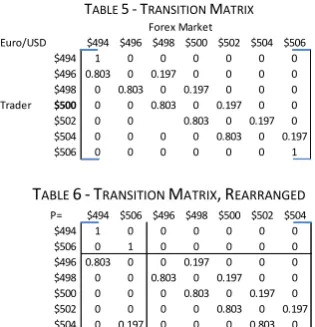
The transition matrix is rearranged as showed on the following tables.
TABLE 5-TRANSITION MATRIX
TABLE 6-TRANSITION MATRIX,REARRANGED
Using Excel, the fundamental matrix of the Markov chain is given by T=[I-Q]-1:
TABLE 7-FUNDAMENTAL MATRIX AND NUMBER OF TRADE BEFORE ABSORPTION
and the probability of being absorbed (broken) is given by the probability matrix T.S:
Starting at $500, the probability of moving to $494 is 0.985; the probability of moving to $506 is 0.015.
Starting at $6, the probability of getting broken is 0.985. in conclusion, the probability of losing is very high, meaning that trading forex is a very risky business that requires a lot of experience.
Optimal Currency Trade
The transition matrix of spread is given in Table 2:
[image:5.595.46.292.196.475.2]mkl and nkl are calculated using the Excel INDEX() function. [yk] and [xk] are calculated combining Excel MMULT() and INVERSE() functions. The results are given by:
Fig. 2 – Calculations of Entries of Matrices M and N
Forex Market
Euro/USD $494 $496 $498 $500 $502 $504 $506 $494 1 0 0 0 0 0 0 $496 0.803 0 0.197 0 0 0 0 $498 0 0.803 0 0.197 0 0 0 Trader $500 0 0 0.803 0 0.197 0 0 $502 0 0 0.803 0 0.197 0 $504 0 0 0 0 0.803 0 0.197 $506 0 0 0 0 0 0 1
T.S: Probability of being Absorbed
$0 $12 $2 0.999 0.001
$4 0.997 0.003
$6 0.985 0.015
$8 0.940 0.060
$10 0.755 0.245
P= $494 $506 $496 $498 $500 $502 $504 $494 1 0 0 0 0 0 0 $506 0 1 0 0 0 0 0 $496 0.803 0 0 0.197 0 0 0 $498 0 0 0.803 0 0.197 0 0 $500 0 0 0 0.803 0 0.197 0 $502 0 0 0 0 0.803 0 0.197 $504 0 0.197 0 0 0 0.803 0
T=[I-Q]-1, fundamental matrix Expected number of trade $2 $4 $6 $8 $10 before absorption $2 1.2450.3050.0740.0170.003 1.644
$4 1.2411.5460.3750.0880.017 3.267 $6 1.2271.5281.6020.3750.074 4.807 $8 1.1711.4581.5281.5460.305 6.007 $10 0.94 1.1711.2271.2411.245 5.824
T.S: Probability of being Absorbed
$494 $506 $496 0.9990.001
$498 0.9970.003
$500 0.9850.015 $502 0.9400.060
$504 0.7550.245
[image:5.595.48.296.532.651.2] [image:5.595.307.550.629.746.2]The expected payoff is 𝑬 =
[0.241935 0.241935 0.16129 0.16129 0.096774 0.096774]*
[
−4 2
2 −4
0 0 0 0
0 0 0 0 0 0
0 0
−6 3
3 −6
0 0 0 0 0 0
0 0
0 0 0 0
−10 5
5 −10][
0.241935 0.241935 0.16129 0.16129 0.096774 0.096774]
𝑬 = −𝟎. 𝟒𝟖𝟑𝟖, unfavorable to the trader.
The optimal strategy for the trader is the rows 1 and 2 with highest probabilities of 0.24 as shown in the probability distribution vector P. However, the expected value is negative indicating that even the trader plays rows 1 and 2 (Euro/USD sell and buy), he/she will still lose.
Predicting the Rise and Fall
Data reporting the past history of currency trading in 2009 were rearranged in three columns. Additional columns “I to I”, “I to D”, etc were added to return 1 or 0. For instance, in the column H “I to I”, row 128 (cell H128), the exchange rate that was increasing from 1.3952 to 1.3960, closed higher at 1.3965, “I to I”=1, all the other “X” to “Y” are zero. We used the IF() and AND() functions as shown to complete all the “X” to “Y” columns and calculate the probability of “X to Y” and statistically fits the transition matrix to the model:
[image:6.595.57.259.51.127.2]Note: For clarity purposes, only partial data are displayed to show an example (H128) of the formulae used.
Fig. 3 – Counting Rise and Fall with Excel. The probability X to Y (I to I, I to D, etc) is the probability that a rate that was in state X moves to state Y. For instance 0.397 is the probability that a rate that was increasing continues to increase (I to I).
[image:6.595.303.550.255.460.2]By considering N as the absorb state, the results are:
Fig. 4 - Results
V. CONCLUSION
The generalized approach outlined herein could serve as “a posteriori” (after the fact) estimate that is used to analyze the trade, up to a given point of time, and then allows the trader to reconsider or adjust the current strategy or selection of optimal pair of currency, in term of expected payoff. The tool can then be used as “a priori” (before the fact) indicator for the next currency pairs to trade. This model is a technical analysis tool for selecting the optimal pair when trading multiple currency pairs. It predicts the best pair to focus on and the expected return in term of payoff. Finally, the formulas found in section III, used for a given set of currency, confirms an intuitive result which is that trading forex is intrinsically “unfavorable” to the trader.
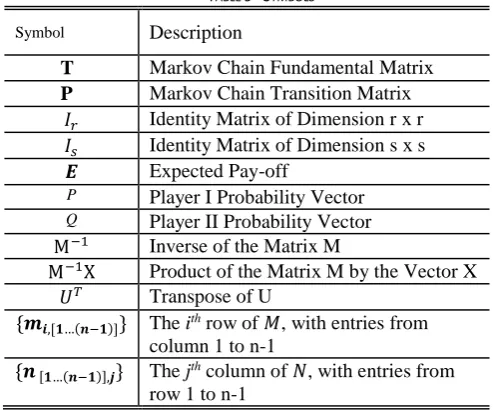
TABLE 9-SYMBOLS
Symbol Description
T Markov Chain Fundamental Matrix
P Markov Chain Transition Matrix
𝐼𝑟 Identity Matrix of Dimension r x r
𝐼𝑠 Identity Matrix of Dimension s x s
𝑬 Expected Pay-off
P Player I Probability Vector Q Player II Probability Vector
M−1 Inverse of the Matrix M
M−1X Product of the Matrix M by the Vector X
𝑈𝑇 Transpose of U
{𝒎𝒊,[𝟏…(𝒏−𝟏)]} The ith row of 𝑀, with entries from column 1 to n-1
{𝒏 [𝟏…(𝒏−𝟏)],𝒋} The jth column of 𝑁, with entries from row 1 to n-1
ACKNOWLEDGEMENT
This paper is submitted as a continuation of my works started during my PhD in Applied Mathematics related to finite element implementation. Therefore, I would like to take this opportunity to express my gratitude to those that have been very supportive and of great help, many of my great colleagues, friends, former teachers, parents and close family, my mother Clementine Avome Ndong and my uncle, Paul Ovono Ndong for their moral encouragements throughout my life and studies.
REFERENCES
[1] Michael Sullivan, “Finite Mathematics, An Applied Approach”, Kindle Edition, 2010.
[2] Francis B. Hildebrand, “Methods of Applied Mathematics”, Prentice Hall, The Dover edition, 1992.
[3] Bruce E. Hansen, “Econometrics”, University of Wisconsin, 2013 [4] Randal J. Barnes, “Matrix Differentiation”, University of Minnesota,
USA.
[5] Charles M. Grinstead, Swarthmore College, J. Laurie Snell, Dartmouth College, “Introduction to Probability”.
[6] Sheldon M. Ross, “Introduction to Probability Models”, 10th Edition,
Elsevier.
Results Interpretation: Probability
14,32 days start in I, average time spent in I, before unchanged T.S 16,64 days start in I, average time spent in D, before unchanged 13,36 days start in D, average time spent in I, before unchanged 1,00 17,56 days start in D, average time spent in D, before unchanged 1,00
Probability Fixed Probability Vector
T.S P P.P P.P.P P.P.P.P 0,397
0,571 0,032 0,452 0,517 0,031 0,448 0,521 0,031 0,448 0,521 0,031 1,00 0,459 0,508 0,033 0,448 0,521 0,031 0,448 0,521 0,031 0,448 0,521 0,031 1,00 1,000 - - 0,397 0,571 0,032 0,448 0,521 0,031 0,448 0,521 0,031 Fixed Probability Vector
I D N Check Euro/USD increases 44,81%of the time t= 0,448 0,521 0,031 1,000 Euro/USD decreases52,06%of the time 1/ti= 2,232 1,921 31,954 Euro/USD neutrals 3,13%of the time
1/ti: Mean Recurrence Time Conclusion: mostly decreases, so sell!
[image:6.595.47.293.387.516.2]