3795
Cross-Lingual Transfer Learning for Multilingual Task Oriented Dialog
Sebastian Schuster∗ Stanford Linguistics
Sonal Gupta
Facebook Conversational AI
Rushin Shah
Facebook Conversational AI
Mike Lewis Facebook AI Research
Abstract
One of the first steps in the utterance interpre-tation pipeline of many task-oriented conver-sational AI systems is to identify user intents and the corresponding slots. Since data col-lection for machine learning models for this task is time-consuming, it is desirable to make use of existing data in a high-resource guage to train models in low-resource lan-guages. However, development of such mod-els has largely been hindered by the lack of multilingual training data. In this paper, we present a new data set of 57k annotated ut-terances in English (43k), Spanish (8.6k) and Thai (5k) across the domains weather, alarm, and reminder. We use this data set to evalu-ate three different cross-lingual transfer meth-ods: (1) translating the training data, (2) us-ing cross-lus-ingual pre-trained embeddus-ings, and (3) a novel method of using a multilingual ma-chine translation encoder as contextual word representations. We find that given several hundred training examples in the the target language, the latter two methods outperform translating the training data. Further, in very low-resource settings, multilingual contextual word representations give better results than using cross-lingual static embeddings. We also compare the cross-lingual methods to us-ing monolus-ingual resources in the form of con-textual ELMo representations and find that given just small amounts of target language data, this method outperforms all cross-lingual methods, which highlights the need for more sophisticated cross-lingual methods.
1 Introduction
One of the first steps in many conversational AI systems that are used to parse utterances in per-sonal assistants is the identification of what the user intends to do (theintent) as well as the argu-ments of the intent (theslots) (Mesnil et al.,2013;
∗
Work carried out during an internship at Facebook.
Liu and Lane,2016). For example, for a request
such asSet an alarm for tomorrow at 7am, a first step in fulfilling such a request is to identify that the user’s intent is to set an alarm and that the re-quired time argument of the request is expressed by the phrasetomorrow at 7am.
Given these properties of the task, the problem can be stated as a joint sentence classification (for intent classification) and sequence labeling (for slot detection) task and therefore naturally lends itself to using a biLSTM-CRF sequence labeling model (Lample et al., 2016;Vu,2016) where the biLSTM layer is also used as the input for a pro-jection layer for intent detection.
These models are very powerful and given enough training data, they achieve very high ac-curacy on the intent classification as well as the slot detection task. However, given the require-ment of large amounts of labeled training data, de-veloping a conversational AI system for many new languages is a very resource-intensive task and clearly not feasible to be done for the more than 6,500 languages that are currently spoken around the world.
For this reason, one would like to make use of methods that enable transfer learning from a high-resource language to a low-high-resource language. However, the development of sophisticated cross-lingual transfer methods for intent detection and slot filling has so far been hindered by the lack of multilingual data sets that have been annotated according to the same guidelines.1 In this work, we therefore present a novel data set containing a large number of English utterances (the high-resource data) as well as a smaller set of utterances in Spanish and in Thai (the low-resource data), which were annotated according to the same anno-tation scheme. This data allows the systematic
in-1Upadhyay et al.(2018) collected such a dataset but to the
Number of utterances
Intent types Slot types
Domain English Spanish Thai
Alarm 9,282/1,309/2,621 1,184/691/1,011 777/439/597 6 2
Reminder 6,900/943/1,960 1,207/647/1,005 578/336/442 3 6
Weather 14,339/1,929/4,040 1,226/645/1,027 801/460/653 3 5
[image:2.595.109.492.62.135.2]Total 30,521/4,181/8,621 3,617/1,983/3,043 2,156/1,235/1,692 12 11
Table 1: Summary statistics of the data set. The three values for the number of utterances correspond to the number of utterances in the training, development, and test splits. Note that the slot typedatetimeis shared across all three domains and therefore the total number of slot types is only 11.
vestigation of cross-lingual transfer learning meth-ods from high-resource languages to low-resource languages.
We use this data set to explore different strate-gies to make use of training data from a high-resource language to improve intent and slot de-tection models for other languages. We investi-gate two previously proposed strategies for cross-lingual transfer, namely using cross-cross-lingual pre-trained embeddings (XLU embeddings; seeRuder
et al.,2017for a review) as well as automatically
translating the English training data to the target language. Further, we present a novel technique that uses a bidirectional neural machine transla-tion encoder as cross-lingual contextual word rep-resentations. We compare the cross-lingual trans-fer methods to models that are only trained on the target language data.
Across the two languages and the various trans-fer methods, we find that joint training on the high-resource and the low-high-resource target language im-proves results on the target language. We further find that the optimal choice of transfer method de-pends on the size of the available training data in the target language: In the zero-shot case where no target language data is available, translating the training data gives the best results. However, if a small amount of training data is available, we find that jointly training on the high-resource and low-resource data works better than training on trans-lated data.
We release the data at https://fb.me/ multilingual_task_oriented_data.
2 Data
We originally collected a data set of around 43,000 English utterances across the domains ALARM,
REMINDER, and WEATHER. Data collection
pro-ceeded in three steps. First, native English speak-ers were asked to produce utterances for each in-tent, e.g., provide examples of how they would ask
for the weather. In a second step, two annotators would label the intent and the spans correspond-ing to slots for each utterance. As a third step, if annotators disagreed on the annotation of an utter-ance, a third annotator who corresponded with the authors of the guidelines adjudicated between the two annotations.
For the Spanish and Thai data, native speak-ers of the target language translated a sample of the English utterances. These translated utterances were then also annotated by two annotators. For Spanish, if annotators disagreed, a third annota-tor who was bilingual in Spanish and English ad-judicated these disagreements in communication with the guideline authors. Unfortunately, for Thai, we did not have a bilingual speaker available and hence we decided to discard all utterances for which the annotators disagreed. We hope to rec-tify this for future data collection efforts.
We believe this data presents a great opportu-nity to investigate cross-lingual semantic models and to the best of our knowledge, this is the first parallel data set for a word tagging task that has been annotated according to the same guidelines across multiple languages.
Table 1 contains several summary statistics of the data set. Note that the percentage of training examples as compared to development and test ex-amples is much higher for the English data than for the Thai and Spanish data. We decided for a more even split for the latter two languages so that we had a sufficiently large data set for model selec-tion and evaluaselec-tion.
3 NLU models
ba-Set an alarm for tomorrow at 7 am Embedding
biLSTM CRF
Predicted slots ∅ TIME TIME TIME TIME
Self-attention
Intent: ALARM/SET_ALARM
[image:3.595.72.290.62.161.2]∅ ∅ ∅
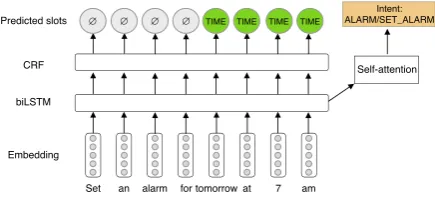
Figure 1: Slot and intent model architecture. Word em-beddings are passed through a biLSTM layer which is shared across the slot detection and intent prediction tasks.
sic architecture of the joint intent-slot prediction model. It first embeds the utterance using an em-bedding matrix and then passes the word vectors to a biLSTM layer. For intent classification, we use a self-attention layer (Lin et al.,2017) over the hidden states of the biLSTM as input to a softmax projection layer; for slot detection, we pass for each word the concatenation of the forward and backward hidden states through a softmax layer, and then pass the resulting label probability vec-tors through a CRF layer for final predictions.
In our experiments, we vary how the tokens are embedded:
• Zero embeddings: We train the parameters of a 0-initialized embedding matrix that con-tains each word that appears in the training data.
• XLU embeddings: We embed the tokens through lookup in a pre-trained cross-lingual embedding matrix and concatenate these em-beddings with tuned zero emem-beddings. Here, we follow Dozat et al. (2017) in having a fixed pre-trained embedding matrix com-bined with tuneable zero-embeddings.
• Encoder embeddings: We embed tokens by passing the entire utterance through a pre-trained biLSTM sentence encoder and us-ing the hidden states of the top layer as in-put. We keep the parameters of the pre-trained encoder fixed and concatenate them with tuneable zero-embeddings. (See Sec-tion4for a detailed description of the differ-ent encoders.)
4 Encoder models
As mentioned in the previous section, some of our models use a pre-trained biLSTM encoder to generate contextual word embeddings. In all our experiments, we use a bidirectional LSTM en-coder with two layers. Overall, we compare three strategies for training these encoders. The moti-vation for choosing these strategies is to investi-gate whether there is a benefit of using multilin-gual embeddings.
• CoVe: Following McCann et al. (2017), we train a neural machine translation model to translate from the low-resource language (Spanish or Thai) to English.
• Multilingual CoVe: We train a neural ma-chine translation model to translate from the low-resource language to English and from English to the low-resource language. We encode the translation direction using target language-specific start tokens in the decoder
(Yu et al.,2018a). In this model, the encoder
does not have access to the target language and therefore we expect it to learn to encode phrases with similar meanings into similar vector spaces across languages.
Spanish Epoch es→en en→es es→es en→en CoVe (unidirectional) 81 8.50 - - -Mult. CoVe 98 8.27 6.90 - -Mult. CoVe + autoencoder 282 9.15 7.29 1.15 1.14
[image:4.595.152.447.63.161.2]Thai Epoch th→en en→th th→th en→en CoVe (unidirectional) 12 13.06 - - -Mult. CoVe 35 12.73 17.00 - -Mult. CoVe + autoencoder 92 11.76 16.31 1.12 1.13
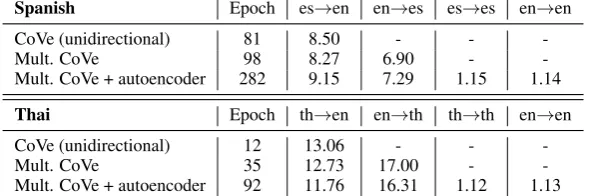
Table 2: Perplexities on validation set for different encoder models for the Spanish-English and Thai-English language pairs. A hyphen means that an encoder was not trained for the corresponding language pair.
For Spanish, for which pre-trained ELMo (
Pe-ters et al., 2018) embeddings are available, we
also evaluate the use of the ELMo embeddings
by Che et al. (2018); Fares et al. (2017). Note
that the ELMo encoder and the CoVe encoder are trained to encode only the low-resource language and therefore neither of them are multilingual en-coders.
Implementation details We train all models us-ing a wrapper around the fairseq (Gehring et al.,
2016, 2017) sequence-to-sequence models. We use 300d randomly initialized word vectors as in-put to the first embedding layer. Each direction in each hidden layer has 512 dimensions which re-sults in a total encoder output dimension of 1024. For the machine translation models, we further use dot-product attention (Luong et al., 2015) and to improve efficiency, we limit the output space of the softmax to 30 translation candidates as deter-mined by word alignments as well as the 2,000 most frequent words (L’Hostis et al.,2016).
Data For the Spanish models, we use two copies2 of Europarl v7 (Koehn, 2005), every eighth sentences of the Paracrawl data,3 and the newstest2008-2011 data. For model selection, we use the newstest2012-2013 data. For the Thai models, we use 10 copies of the IWSTL training data (Cettolo et al.,2012) as well as the OpenSub-titles data (Lison et al.,2018) for training, and the IWSTL development and test data for model se-lection. We use the 20,000 most common words in the training data as the vocabulary. For the mul-tilingual models, we take the union of the vocabu-lary from both languages. We tokenize the data
us-2We upsample the Europarl (for Spanish) and IWSLT (for
Thai) data since these data sets are presumably of higher quality than the largerly automatically mined Paracrawl and OpenSubtitles data.
3https://paracrawl.eu, the version that was used in the
WMT 2018 task
ing an in-house rule-based (for English and Span-ish) and dictionary-based (for Thai) tokenizer. We further lowercase all data and remove all dupli-cates within a data set. We discard all sentences whose length exceeds 100 tokens.
Training details We train the models using stochastic gradient descent with an initial learn-ing rate of 0.5. We decrease the learnlearn-ing rate by 1% after an epoch whenever perplexity on the val-idation data is higher than for the epoch with the lowest perplexity. We train all models for up to 100 epochs, except for the Spanish bidirectional MT model with an autoencoder which we trained for 300 epochs since it took considerably longer to converge. For multilingual models, we choose the model that has the lowest average perplexity on both translation tasks.
Table2shows the perplexities for the different models. In general, the translation perplexities are very similar independent of whether we train a unidirectional MT system or a bidirectional MT system, except for the Spanish bidirectional MT model with an autoencoder which even after 300 epochs still yields higher perplexities on the vali-dation data than the other translation models.4
5 Cross-lingual learning
In our first set of experiments, we explore the fol-lowing baselines and strategies for training models in Spanish and Thai given a large amount of En-glish training data and a small amount of Spanish and Thai training data.
• Target only: Using only the low-resource target language data.
4
English Embedding type Exact match Domain acc. Intent acc. Slot F1
Target only - 90.91 - 99.11 94.81
Spanish Embedding type Exact match Domain acc. Intent acc. Slot F1 Target only - 72.94 99.43 97.26 80.95 Target only XLU embeddings 72.90 99.47 96.90 80.99 Target only CoVe 73.93 99.52 97.43 81.51 Target only Mult. CoVe 74.13 99.55 97.61 81.64 Target only Mult. CoVe + auto 73.05 99.51 97.13 81.22 Target only ELMo 74.81 99.53 96.64 82.96 Translate train - 72.49 99.65 98.47 80.60 Cross-lingual XLU embeddings 75.39 99.52 97.68 83.00 Cross-lingual CoVe 75.17 99.55 97.81 82.55 Cross-lingual Mult. CoVe 75.20 99.56 97.82 82.49 Cross-lingual Mult. CoVe + auto 74.68 99.59 97.90 82.13 Cross-lingual ELMo 75.96 99.47 97.51 83.38
[image:5.595.124.471.65.373.2]Thai Embedding type Exact match Domain acc. Intent acc. Slot F1 Target only - 79.80 99.31 95.13 87.26 Target only CoVe 84.84 99.36 96.60 90.63 Target only Mult. CoVe 84.66 99.37 96.75 90.20 Target only Mult. CoVe + auto 84.79 99.41 96.59 90.51 Translate train - 73.37 99.37 97.41 80.38 Cross-lingual CoVe 84.49 99.29 96.87 90.60 Cross-lingual Mult. CoVe 85.76 99.39 96.98 91.22 Cross-lingual Mult. CoVe + auto 86.12 99.33 96.87 91.51
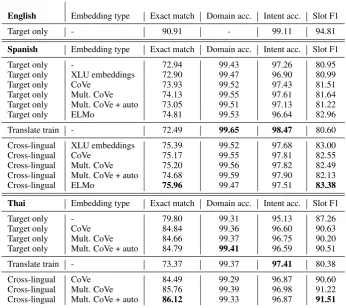
Table 3: Results using the full training data averaged over 5 training runs. Thetranslate trainmodels are trained on the union of translated English and target language data; thecross-lingualmodels are trained on English and target language data.
• Target only with encoder embeddings: Us-ing only the low-resource language trainUs-ing data and using pre-trained encoder embed-dings.
• Translate train: Combining the target train-ing data with the English data that has been automatically translated to the target lan-guage. The slot annotations are projected via the attention weights (Yarowsky et al.,2001). We translate the data using the Facebook neu-ral machine translation system.
• Cross-lingual with XLU embeddings: Joint training on the English and target lan-guage data with pre-trained MUSE (
Con-neau et al.,2017) cross-lingual embeddings.
Since MUSE embeddings are not available for Thai, we only evaluate this method for Spanish.
• Cross-lingual with encoder embeddings: Joint training on the English and target lan-guage data using pre-trained encoder embed-dings.
Implementation details We implement all clas-sification and sequence labeling models within the PyText framework (Aly et al., 2018). We train models for 20 epochs and select the model that performs best on the development set. We use the Adam optimizer (Kingma and Ba, 2015) with a learning rate of 0.01. We use dropout of 0.3 in the BiLSTM and we set the size of the self-attention layer to 128 dimensions.
Evaluation We evaluate our models according to four metrics: Domain accuracy, which mea-sures the accuracy of the domain classification task; intent accuracy, which measures the accuracy of identifying the correct intent; slot F1, which is the geometric mean of the slot precision and slot recall; and the exact match metric, which indicates the number of utterances for which the domain, in-tent, and all slots were correctly identified. Exact match is thus the strictest metric of all. We micro-average all metrics across domains.
Spanish Embedding type Exact match Domain acc. Intent acc. Slot F1 Translate train - 54.95 88.70 85.39 72.87
Cross-lingual - 0.63 37.74 36.17 5.50 Cross-lingual XLU embeddings 4.01 38.24 36.94 17.50 Cross-lingual CoVe 1.37 39.42 37.13 5.35 Cross-lingual mult. CoVe 10.56 59.29 53.34 22.50 Cross-lingual mult. CoVe + auto 9.28 59.25 53.89 19.25 Cross-lingual ELMo 0.18 35.98 35.36 2.53
Thai Embedding type Exact match Domain acc. Intent acc. Slot F1 Translate train - 45.59 98.11 95.85 55.43
[image:6.595.126.470.61.234.2]Cross-lingual - 0.20 39.36 39.11 3.44 Cross-lingual CoVe 5.82 66.75 54.24 8.84 Cross-lingual mult. CoVe 15.37 73.84 66.35 32.52 Cross-lingual mult. CoVe + auto 20.84 81.95 70.70 35.62
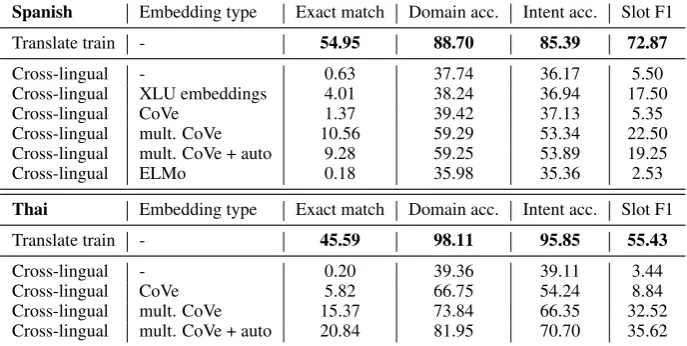
Table 4: Zero-shot results averaged over 5 training runs. All models were trained only on the English data. In the case of thetranslate trainmodels, the English data was automatically translated into the target language.
slightly different results for the two languages, there are several consistent patterns. For Spanish, we observe that adding contextual word represen-tations to the target onlymodel, consistently im-proves results. Not surprisingly since the ELMo embeddings were trained on a large monolingual corpus, the model that uses these embeddings out-performs all othertarget onlymodels.
If we turn to the cross-lingual models for Span-ish, the results indicate that the translation method works well for domain and intent classification but less so for slot detection, presumably due to noisy projection of the slot annotations. For slot detec-tion, we get the best results using the ELMo em-beddings which outperform the XLU emem-beddings as well as the bidirectional MT encoder in terms of exact match and slot F1. Similarly as in the
tar-get onlysetting, the model with multilingual CoVe embeddings combined with the autoencoder per-forms worse than the other CoVe encoders. Over-all, however, the choice of embeddings seems to have only a relatively small impact on the perfor-mance of the cross-lingual models. Importantly, however, we see improvements across all metrics as compared to training only on the target lan-guage data.
We observe similar results for Thai. The trans-lation approach again yields the worst results for slot detection and we again see a consistent im-provement from cross-lingual training as com-pared to training only on Thai data. And we again only observe small differences depending on the type of embeddings in the cross-lingual training scenario, but in this case, the models with the
multilingual CoVe encoders outperform the model with the monolingual encoder.
Table3also shows the results for English. Not surprisingly, since we have an order of magnitude more data for English, the model trained and tested on English data still performs better than any of the evaluated methods for the other two languages. However, the gap between the numbers for En-glish and the numbers for the other two languages does get considerably smaller for the cross-lingual models. Prima facie, the results also indicate that the models perform better for Thai than for Span-ish. However, this is potentially an artifact of the data. As we mentioned above, we had to discard some of the Thai utterances for which the annota-tions disagreed with the annotaannota-tions of their En-glish translations and it is possible that we dis-carded a disproportionate number of more com-plex utterances which in return made parsing the Thai utterances easier.
In summary, the results from both languages suggest that pre-trained word representations as well as cross-lingual training improve results over training only on target language data without any pre-trained embeddings. The choice of embed-dings, however, seems to matter less, and the over-all performance seems to depend only very little on whether we use dynamic or static word repre-sentations or whether we use monolingual or bilin-gual word representations.
re-sults. This potentially indicates that the benefit of cross-lingual training comes from sharing the biLSTM layer or the CRF layer and that embed-ding the tokens of the high-resource and the low-resource language in a similar space is not as im-portant. At the same time, considering that we are getting relatively good results for both languages if we only train on the target language data, the po-tential of cross-lingual training might be limited in this case. To investigate whether the embed-ding type matters in more extreme low-resource scenarios, we also performed a series of zero-shot and low-resource experiments, which we describe in the next section.
6 Zero-shot learning and learning curves
As mentioned in the previous section, from the re-sults on the full data, it is not entirely clear whether there is an advantage of using cross-lingual em-beddings. We therefore conducted additional ex-periments with even smaller training sets in the target language: the case where we no annotated data in the target language exists (zero-shot) and the case where a very limited amount of training data in the target language exists. If there is no advantage of using cross-lingual embeddings over using monolingual embeddings, we expect to see similar results for all models independent of the training data size. On the other hand, if the mul-tilingual CoVe encoder actually embeds phrases with similar meanings in the two languages in a similar vector space, we would expect the model with multilingual CoVe embeddings to perform much better in the zero-shot and very low-resource scenarios than any of the models with monolin-gual embeddings. Further, we can also investi-gate whether there is an advantage of translating the training data over other methods in extremely low-resource scenarios.
Experiments We used the same models with the same parameters as in the previous section. In the zero-shot case, we only use English data for train-ing and model selection. For the learntrain-ing curve experiments, we sample 10, 50, 100, or 200 ut-terances from each domain for the target language for training and model selection and upsample the target language data so that it roughly matches the size of the English data. For the zero-shot results, we present the average numbers across 5 runs. For the learning curve experiments, since we introduced another random factor by randomly
sampling the training and model selection data, we repeat this process 10 times and report the average as well as the minimum and maximum values of the exact match metric for these experiments.
Results and discussion Table4shows the zero-shot results. These results indicate that using the multilingual CoVe embeddings works better than not using any encoder embeddings or using monolingual CoVe embeddings. This is true for the sentence-level domain and intent classification tasks as well as for slot detection. The Spanish results also suggest that in the zero-shot case, the multilingual encoder embeddings lead to better re-sults than the XLU embeddings. However, also the models that use cross-lingual embeddings per-form very poorly and contrary to the case where we have some training data in the target language, in the zero-shot scenario, the translation method works considerably better than any other of the transfer methods.
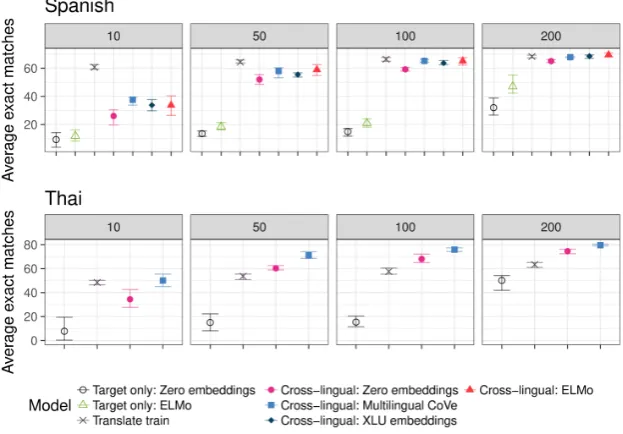
The results for different training set sizes are shown in Figure2. These results generally confirm the patterns that we observed in the experiments with all available training data: cross-lingual train-ing improves the results over traintrain-ing only on the target language (to a much bigger extent when there is much less target language training data available) and using pre-trained word represen-tations leads to further improvements. We fur-ther observe that cross-lingual learning seems to lead to much more stable training which can be seen in the much smaller ranges of results as com-pared to the models trained only on the target lan-guage. Also in the extremely low-resource scenar-ios, the choice of embeddings seems to have very little effect. Lastly, as these plots show, the trans-lation approach works better when there is very little training data available but the performance quickly plateaus and once there are are several hundred target language training examples avail-able, joint training on multiple languages leads to better results.
Figure 2: Results for different training set sizes. The top and the bottom of the error bars correspond to the highest and lowest value of the exact match metric among the 10 runs.
This is in line with the results by de Lhoneux
et al. (2018) who found for cross-lingual
train-ing of dependency parsers, shartrain-ing the MLP layer for parser decisions improved results for all lan-guage pairs that they considered, whereas shar-ing of lower-level parameters only led to improve-ments for a limited set of language pairs.
7 Related work
Cross-lingual sequence labeling The task of cross-lingual and multilingual sequence labeling has gained a lot of attention recently. Yang
et al. (2017) used shared character embeddings
for cross-lingual transfer, and Lin et al. (2018) used shared character and sentence embeddings that were trained in a multitask setting for part-of-speech tagging and named entity recognition.
Upadhyay et al.(2018) used cross-lingual
embed-dings for training multilingual slot-filling systems.
Xie et al. (2018) used a similar model for NER
but they first “translated” the high-resource train-ing data by replactrain-ing each token with the token in the target language that was closest in vector space, and they further used character embeddings and a self-attention mechanism. Yu et al.(2018b) investigated using character-based language mod-els for NER in several languages but did not do any cross-lingual learning.Plank and Agi´c(2018) used cross-lingual embeddings, projected annota-tions, and dictionaries for zero-shot cross-lingual part-of-speech tagging.
Cross-lingual sentence representations Re-cently, there was also a lot of work of using cross-lingual sequence encoders for sentence classifica-tions using either multilingual MT encoders sim-ilar to ours (e.g.,Eriguchi et al.,2018;Yu et al.,
2018a; Singla et al., 2018) or training encoders
and then aligning their vector spaces after pre-training (Conneau et al., 2018; Schuster et al.,
2019). Even more recently,Lample and Conneau
(2019) and Mulcaire et al. (2019) showed that it is also possible to directly train contextual word representations jointly on multiple languages.
Cross-lingual transfer for other tasks Apart from tasks such as slot filling and NER, cross-lingual transfer learning has also been investigated a lot for syntactic tasks, and in particular for part-of-speech tagging and dependency parsing. Early work trained part-of-speech taggers for individual languages and then trained delexicalized depen-dency parsers (e.g.,Zeman and Resnik,2008;
Mc-Donald et al.,2011). Further, a lot of syntactic and
semantic parsing models recently successfully in-corporated parameter sharing for training parsers in closely related languges (Duong et al., 2015;
Ammar et al.,2016;Susanto and Lu,2017;Smith
et al.,2018;de Lhoneux et al.,2018). In the
do-main of dialog managers,Mrkˇsi´c et al.(2017) and
Chen et al. (2018) presented methods for
8 Conclusion and future work
In this paper, we presented a new multilingual in-tent and slot filling data set for task oriented dia-log of around 57,000 utterances and evaluated the performance of different methods for cross-lingual transfer learning, including a novel method us-ing cross-lus-ingual contextual word representations. For both investigated languages, we consistently found that cross-lingual learning improves results as compared to only training on limited amounts of target language data, and our results suggest that the choice of multilingual or monolingual em-beddings has only a small impact on the overall performance.
Despite the range of models that we consid-ered in this paper, we only scratched at the sur-face of possible cross-lingual (embedding) mod-els, and hence there are many future directions of this work. First, except for the Spanish ELMo embeddings, we did not use any character em-beddings in any of our experiments or models. This presumably makes sense for the English-Thai transfer learning case since these two languages use different writing systems but given the results
by Lin et al. (2018) and Yang et al. (2017), we
would expect additional improvements by sharing character embeddings for languages with similar writing systems.
Second, one could try to include a specific learning objective to embed translations into a similar vector space as used by Yu et al.(2018a)
and Conneau et al. (2018) for multilingual
sen-tence representations.
As yet another extension, one could combine the approaches of multilingual CoVe embeddings and monolingual ELMo (or BERT,Devlin et al.,
2018) embeddings and jointly train an encoder with a language model and an MT objective, which would potentially combine the benefit of training a model on large monolingual corpora while at the same time aligning the vector spaces of the two languages. A similar approach worked well for cross-lingual NLI inference on the XNLI data set (Conneau et al.,2018) as well as for un-supervised machine translation (Lample and Con-neau,2019).
We hope that our data set will facilitate research in these directions and ultimately lead to improved natural language understanding models for low-resource languages.
Acknowledgements
We thank the three anonymous reviewers for their thoughtful comments. We also thank Luke Zettlemoyer and Christopher Manning for valu-able feedback throughout this project, and Maria Sumner and Neghesti Tinsew for their help with collecting the annotations and improving their consistency.
References
Ahmed Aly, Kushal Lakhotia, Shicong Zhao, Mri-nal Mohit, Barlas Oguz, Abhinav Arora, SoMri-nal Gupta, Christopher Dewan, Stef Nelson-Lindall, and Rushin Shah. 2018. PyText: A seamless path from NLP research to production. ArXiv preprint.
Waleed Ammar, George Mulcaire, Miguel Ballesteros, Chris Dyer, and Noah A. Smith. 2016. Many lan-guages, one parser. Transactions of the Association for Computational Linguistics, 4:431–444.
Mauro Cettolo, Christian Girardi, and Marcello Fed-erico. 2012. Wit3: Web inventory of transcribed and translated talks. In Proceedings of the 16th
Con-ference of the European Association for Machine Translation (EAMT), Trento, Italy.
Wanxiang Che, Yijia Liu, Yuxuan Wang, Bo Zheng, and Ting Liu. 2018. Towards better UD parsing: Deep contextualized word embeddings, ensemble, and treebank concatenation. InProceedings of the CoNLL 2018 Shared Task: Multilingual Parsing from Raw Text to Universal Dependencies.
Wenhu Chen, Jianshu Chen, Yu Su, Xin Wang, Dong Yu, Xifeng Yan, and William Yang Wang. 2018. XL-NBT: A cross-lingual neural belief tracking framework. InProceedings of the 2018 Conference on Empirical Methods in Natural Language Pro-cessing (EMNLP 2018), pages 414–424.
Alexis Conneau, Guillaume Lample, Marc’Aurelio Ranzato, Ludovic Denoyer, and Herv´e J´egou. 2017. Word translation without parallel data. In Proceed-ings of ICLR 2018.
Alexis Conneau, Guillaume Lample, Ruty Rinott, Hol-ger Schwenk, Ves Stoyanov, Adina Williams, and Samuel R. Bowman. 2018. XNLI: Evaluating cross-lingual sentence representations. InProceedings of the 2018 Conference on Empirical Methods in Nat-ural Language Processing (EMNLP 2018), pages 2475–2485.
Jacob Devlin, Ming-Wei Chang, Kenton Lee, and Kristina Toutanova. 2018. BERT: Pre-training of deep bidirectional transformers for language under-standing. ArXiv preprint.
parser at the CoNLL 2017 shared task. In Proceed-ings of the CoNLL 2017 Shared Task: Multilingual Parsing from Raw Text to Universal Dependencies.
Long Duong, Trevor Cohn, Steven Bird, and Paul Cook. 2015. Low resource dependency parsing: Cross-lingual parameter sharing in a neural network parser. In Proceedings of the 53rd Annual Meet-ing of the Association for Computational LMeet-inguistics and the 7th International Joint Conference on Nat-ural Language Processing (ACL 2015), pages 845– 850.
Akiko Eriguchi, Melvin Johnson, Orhan Firat, Hideto Kazawa, and Wolfgang Macherey. 2018. Zero-shot cross-lingual classification using multilingual neural machine translation. ArXiv preprint.
Murhaf Fares, Andrey Kutuzov, Stephan Oepen, and Erik Velldal. 2017. Word vectors, reuse, and replica-bility: Towards a community repository of large-text resources. InProceedings of the 21st Nordic Con-ference on Computational Linguistics, pages 271– 276.
Jonas Gehring, Michael Auli, David Grangier, and Yann N Dauphin. 2016. A Convolutional Encoder Model for Neural Machine Translation. ArXiv preprint.
Jonas Gehring, Michael Auli, David Grangier, Denis Yarats, and Yann N Dauphin. 2017. Convolutional Sequence to Sequence Learning. ArXiv preprint.
Diederik P. Kingma and Jimmy Lei Ba. 2015. Adam: A method for stochastic optimization. In Proceed-ings of ICLR 2015.
Philipp Koehn. 2005. Europarl: A parallel corpus for statistical machine translation. InMT summit.
Guillaume Lample, Miguel Ballesteros, Sandeep Sub-ramanian, Kazuya Kawakami, and Chris Dyer. 2016. Neural architectures for named entity recognition. InProceedings of the 2016 Conference of the North American Chapter of the Association for Computa-tional Linguistics: Human Language Technologies (NAACL 2016), pages 260–270.
Guillaume Lample and Alexis Conneau. 2019. Cross-lingual language model pretraining. ArXiv preprint.
Miryam de Lhoneux, Johannes Bjerva, Isabelle Augen-stein, and Anders Søgaard. 2018.Parameter sharing between dependency parsers for related languages. InProceedings of the 2018 Conference on Empirical Methods in Natural Language Processing (EMNLP 2018), pages 4992–4997.
Gurvan L’Hostis, David Grangier, and Michael Auli. 2016.Vocabulary selection strategies for neural ma-chine translation. ArXiv preprint.
Ying Lin, Shengqi Yang, Veselin Stoyanov, and Heng Ji. 2018. A multi-lingual multi-task architecture for low-resource sequence labeling. InProceedings of
the 56th Annual Meeting of the Association for Com-putational Linguistics (ACL 2018), pages 799–809.
Zhouhan Lin, Minwei Feng, Cicero Nogueira dos San-tos, Mo Yu, Bing Xiang, Bowen Zhou, and Yoshua Bengio. 2017. A structured self-attentive sentence embedding. InProceedings of ICLR 2017.
Pierre Lison, J¨org Tiedemann, and Milen Kouylekov. 2018. OpenSubtitles2018: Statistical rescoring of sentence alignments in large, noisy parallel cor-pora. InProceedings of the 11th edition of the Lan-guage Resources and Evaluation Conference (LREC 2018), pages 1364–1369.
Bing Liu and Ian Lane. 2016. Attention-based recur-rent neural network models for joint intent detection and slot filling. InProceedings of Interspeech 2016.
Minh-Thang Luong, Hieu Pham, and Christopher D. Manning. 2015. Effective approaches to attention-based neural machine translation. InProceedings of the 2015 Conference on Empirical Methods in Nat-ural Language Processing (EMNLP 2015), pages 1412–1421.
Bryan McCann, James Bradbury, and Richard Socher. 2017. Learned in translation: Contextualized word vectors. In Proceedings of the 31st Conference on Neural Information Processing Systems (NIPS 2017).
Ryan McDonald, Slav Petrov, and Keith Hall. 2011. Multi-source transfer of delexicalized dependency parsers. InProceedings of the 2011 Conference on Empirical Methods in Natural Language Processing (EMNLP 2011), pages 62–72.
Gr´egoire Mesnil, Xiaodong He, Li Deng, and Yoshua Bengio. 2013. Investigation of recurrent-neural-network architectures and learning methods for spo-ken language understanding. InProceedings of In-terspeech 2013.
Nikola Mrkˇsi´c, Ivan Vuli´c, Diarmuid ´O S´eaghdha, Ira Leviant, Roi Reichart, Milica Gaˇsi´c, Anna Korho-nen, and Steve Young. 2017. Semantic special-ization of distributional word vector spaces using monolingual and cross-lingual constraints. Transac-tions of the Association for Computational Linguis-tics, 5:309–324.
Phoebe Mulcaire, Jungo Kasai, and Noah A. Smith. 2019. Polyglot contextual representations improve crosslingual transfer. In Proceedings of the 2019 Conference of the North American Chapter of the Association for Computational Linguistics: Human Language Technologies (NAACL 2019).
Barbara Plank and ˇZeljko Agi´c. 2018. Distant super-vision from disparate sources for low-resource part-of-speech tagging. InProceedings of the 2018 Con-ference on Empirical Methods in Natural Language Processing, pages 614–620.
Sebastian Ruder, Ivan Vuli´c, and Anders Søgaard. 2017. A survey of cross-lingual word embedding models. ArXiv preprint.
Tal Schuster, Ori Ram, Regina Barzilay, and Amir Globerson. 2019. Cross-lingual alignment of con-textual word embeddings, with applications to zero-shot dependency parsing. In Proceedings of the 2019 Conference of the North American Chapter of the Association for Computational Linguistics: Hu-man Language Technologies (NAACL 2019).
Karan Singla, Dogan Can, and Shrikanth Narayanan. 2018. A multi-task approach to learning multilin-gual representations. InProceedings of the 56th An-nual Meeting of the Association for Computational Linguistics (ACL 2018), pages 214–220.
Aaron Smith, Bernd Bohnet, and Miryam de Lhoneux. 2018. 82 treebanks, 34 models: Universal Depen-dency parsing with multi-treebank models. In Pro-ceedings of the CoNLL 2018 Shared Task: Multilin-gual Parsing from Raw Text to Universal Dependen-cies.
Raymond Hendy Susanto and Wei Lu. 2017. Neural architectures for multilingual semantic parsing. In
Proceedings of the 55th Annual Meeting ofthe Asso-ciation for Computational Linguistics (ACL 2017), pages 38–44.
Shyam Upadhyay, Manaal Faruqui, Gokhan T¨ur, Dilek Hakkani-T¨ur, and Larry Heck. 2018.(Almost) zero-shot cross-lingual spoken language understanding. InProceedings of the IEEE ICASSP 2018.
Ngoc Thang Vu. 2016. Sequential convolutional neural networks for slot filling in spoken language under-standing. InProceedings of Interspeech 2016, pages 3250–3254.
Jiateng Xie, Zhilin Yang, Graham Neubig, Noah A. Smith, and Jaime Carbonell. 2018. Neural cross-lingual named entity recognition with minimal re-sources. InProceedings of the 2018 Conference on Empirical Methods in Natural Language Processing (EMNLP 2018), pages 369–379.
Zhilin Yang, Ruslan Salakhutdinov, and William W. Cohen. 2017. Transfer learning for sequence tag-ging with hierarchical recurrent networks. In Pro-ceedings of ICLR 2017.
David Yarowsky, Grace Ngai, and Richard Wicen-towski. 2001. Inducing multilingual text analysis tools via robust projection across aligned corpora. InProceedings of the First International Conference on Human Language Technology Research.
Katherin Yu, Haoran Li, and Barlas Oguz. 2018a. Multilingual seq2seq training with similarity loss for cross-lingual document classification. In Pro-ceedings of The Third Workshop on Representation Learning for NLP, pages 175–179.
Xiaodong Yu, Stephen Mayhew, Mark Sammons, and Dan Roth. 2018b. On the strength of character lan-guage models for multilingual named entity recog-nition. InProceedings of the 2018 Conference on Empirical Methods in Natural Language Processing (EMNLP 2018), pages 3073–3077.