A Joint Sequential and Relational Model
for Frame-Semantic Parsing
Bishan Yang
Machine Learning Department Carnegie Mellon University
Tom Mitchell
Machine Learning Department Carnegie Mellon University
Abstract
We introduce a new method for frame-semantic parsing that significantly im-proves the prior state of the art. Our model leverages the advantages of a deep bidi-rectional LSTM network which predicts semantic role labels word by word and a relational network which predicts seman-tic roles for individual text expressions in relation to a predicate. The two net-works are integrated into a single model via knowledge distillation, and a unified graphical model is employed to jointly decode frames and semantic roles during inference. Experiments on the standard FrameNet data show that our model sig-nificantly outperforms existing neural and non-neural approaches, achieving a 5.7 F1 gain over the current state of the art, for full frame structure extraction.
1 Introduction
One way to represent meaning is through organi-zation of semantic structures. Consider the follow-ing sentences “John sells Marry a car.” and “Mary buys a car from John.”. While having different syntactic structures, they express the same type of event that involves a buyer, a seller, and goods. Such meaning can be represented using seman-tic frames – structured representations that char-acterize events, scenarios, and the participants. Researchers have developed FrameNet (Baker et al., 1998; Fillmore et al., 2003), a large lexi-cal database of English that comes with sentences annotated with semantic frames. It has been con-sidered a valuable resource for Natural Language Processing and useful for studying tasks such as
information extraction, machine translation, and question answering (Surdeanu et al., 2003; Shen and Lapata,2007;Liu and Gildea,2010).
Here we consider the task of automatic extrac-tion of semantic frames as defined in FrameNet. This include target identification – identifying frame-evoking predicates, frame identification – identifying which frame each predicate evokes, and semantic role labeling (SRL) – identifying phrasal arguments of each evoked frame and la-beling them with the frame’s semantic roles. Con-sider the sentence “We decided to treat the pa-tient with combination chemotherapy.”. Here “de-cided” evokes the DECIDING frame and “treat” evokes the CUREframe. Each frame takes a set of arguments that fill the semantic roles of the frame, as illustrated below:
[WeCOGNIZER] decided [to treat the patient with combination chemotherapyDECISION].
[WeHEALER] decided to treat [the
patientPATIENT] [with combination
chemotherapyTREATMENT].
We address frame identification and semantic role labeling in this work.1 Frame identification can be addressed as a word sense disambiguation problem, while semantic role labeling can be for-mulated as a structured prediction problem. We train different neural network models for these two problems, and interpret their outputs as factors in a graphical model for performing joint inference over the distribution of frames and semantic roles. Specifically, our frame identification model is a simple multi-layer neural network that learns
ap-1We do not consider target identification due to the lack
of consistent labeled data (Das et al.,2014).
propriate feature representations for frame disam-biguation. Our SRL model is an integrated model of an LSTM-based network that learns to pre-dict semantic roles on a word-by-word basis and a multi-layer network that learns to directly pdict semantic roles for individual text spans in re-lation to a given predicate. The sequential neu-ral network is powerful for modeling sentence-level information while the relational neural net-work is good at capturing span-level dependen-cies between predicate and arguments. To lever-age the power of these two networks, we transfer the knowledge in the sequential model, encoded as its predictive distributions. Specifically, we do this by training a single relational model with an ob-jective that measures both its prediction accuracy with respect to the true semantic role labels, and its match to the probability distributions provided by the sequential model.
We evaluate our models for frame identification, SRL, and full structure extraction on the FrameNet 1.5 data. Our full model achieves 76.6 F1, a 5.7 absolute gain over the prior state of the art. We also evaluate our SRL model on CoNLL 2005. It demonstrates strong performance that is close to the best published results. Error analysis further confirms the benefits of integrating sequential and relational models and performing joint inference over frames and semantic roles.
2 Related Work
Research on automatic semantic structure extrac-tion has been widely studied since the pioneer-ing work of Gildea and Jurafsky (2002). This work focuses on extracting semantic frames de-fined in FrameNet (Baker et al.,1998), which in-cludes predicting frame types and frame-specific semantic roles. Our model can be easily adapted to predict PropBank-style semantic roles (Palmer et al.,2005), where role labels are generic instead of frame-specific.
The core problem in semantic frame extraction is semantic role labeling (SRL). Earlier SRL sys-tems employ linear classifiers which rely heav-ily on hand-engineered feature templates to repre-sent argument structures (Johansson and Nugues, 2007;Das et al.,2010;Das, 2014). Recent work has exploited neural networks to learn better fea-ture representations. Roth and Woodsend (2014) improves the feature-based system by adding word embeddings as features. Roth and Lapata (2016)
further includes dependency path embeddings as features.FitzGerald et al.(2015) embeds the stan-dard SRL features into a low-dimensional vector space using a feed-forward neural network and demonstrates state-of-the-art results on FrameNet. Different neural network architectures have also been explored for SRL. Collobert et al. (2011) first applies a convolutional neural network to extract features from a window of words. Zhou and Xu (2015) employs a deep bi-directional LSTM (DB-LSTM) network and achieves state-of-the-art results on PropBank-style SRL. Re-cently, Swayamdipta et al. (2016) employs stack LSTMs (Dyer et al., 2015) for joint syntactic-semantic dependency parsing.He et al.(2017) re-cently proposed further improvements to the DB-LSTM architecture which significantly improve the state of the art results on PropBank SRL.
In order to enforce structural consistency, most existing work applies different types of structural constraints during inference. The inference prob-lem are typically solved via Integer Linear Pro-gramming (ILP) (Punyakanok et al.,2008). T¨ack-str¨om et al. (2015) improves the inference effi-ciency with a dynamic programming algorithm that encodes tractable global constraints. Re-cently, Belanger et al.(2017) models SRL using end-to-end structured prediction energy networks and demonstrates benefits of accounting for com-plex structural dependencies during training. In this work, we explicitly encode structural con-straints as factors in a graphical model, and adopt the Alternating Directions Dual Decomposition (AD3) algorithm (Martins et al.,2011) for efficient inference.
3 Overview
We aim to extract frame-semantic structures from text. Each semantic frame contains a frame-evoking predicate, its frame type, the arguments of the predicate, and their semantic roles.
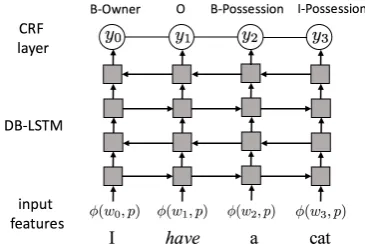
Figure 1: DB-LSTM network (four layers) with a CRF prediction layer. The network learns to pre-dict a sequence of argument role labels given a sentence (e.g., “I have a cat”) and a predicate (e.g., “have”).
For example, the COMMERCE BUY frame con-tains core roles such as BUYER and GOODS, and non-core roles such as MONEY and MEANS. In PropBank, a semantic frame is corresponding to a verb senses. Each verb sense is associated with a set of semantic roles. For example, the verb sense buy.01 is associated with roles A0 (i.e., agent), A1 (i.e., patient), A2 (i.e., instrument), etc. The semantic roles in PropBank use generic labels. There are about 30 different role labels in total (vs∼103role labels in FrameNet). Among them 7 are core role labels (A0-A5 and AA) and the rest are non-core (modifier) roles (e.g., the loca-tive role LOC and the temporal role TMP).
In the rest of the paper, we first describe our models for SRL (§4), including a sequential neu-ral model, a relational neuneu-ral model, and the in-tegration of the two. Then, we present our frame identification model (§5), followed by a joint in-ference algorithm for full frame-semantic struc-ture extraction that enforces structural constraints among predicates and arguments (§6).
4 Semantic Role Labeling
Given a predicate and its frame, we seek to iden-tify arguments of the predicate and their semantic roles in relation to the predicate’s frame. Denote a predicate as p, its frame as f, and a sentence asx. We want to output a set of argument spans A ={a1, ..., ak}, where eachai is labeled with a semantic role that takes values from a set of role labelsRf with respect to the framef.
4.1 Sequential Neural Model
The SRL task can be formulated as a sequence labeling problem, where the semantic role labels are encoded using the “IOB” tagging scheme, as in (Collobert et al., 2011; Zhou and Xu, 2015), where “I” indicates the inside of a chunk, “B” indi-cates the beginning of a chunk, and “O” indiindi-cates being outside of a chunk.
We employ DB-LSTM, a deep bidirectional Long Short-Term Memory neural network with a Condidtional Random Field (CRF) layer intro-duced byZhou and Xu(2015) for PropBank-style SRL. The architecture is illustrated in Figure1. In this work, we adapt it to perform both FrameNet-style and PropBank-FrameNet-style SRL.
At each time stept, the DB-LSTM network is provided with a set of input featuresφ(wt, p), in-cluding the current wordwt, the predicate wordp, and a position mark that denotes whether the cur-rent word is in the neighborhood of the predicate (within a window of 5 words)2. Each word fea-ture is associated with a parameter vector which is initialized using the pre-trained paraphrastic word embeddings (Wieting et al.,2015). The input rep-resentation at time stept is the concatenation of the above features. As proposed in (Zhou and Xu, 2015), we stack 8 layers of the LSTM unit to pro-duce the hidden representation for each time step. Then, we employ a CRF layer on top to estimate the sequence-level label distributions.
During training, we minimize the negative con-ditional log-likelihood of N training examples. Each example consists of a sentencex, a predicate p, and a label sequencey = {y1, ..., yn}, where n is the length of the sentence. The conditional probability is given by:
Pseq(y|p, f;θ) = 1
Zf exp
Xn
t=1
Ct,yt+
n
X
t=0
Tyt,yt+1
(1)
where Zf is a normalization constant depending on the framef, as we only normalize over role la-bel sequences that are compatible with the frame. For PropBank-style SRL, we simply drop the de-pendency onfand compute normalization over all possible role label sequences. Ct,yt is the score
output by DB-LSTM for assigning thet-th word
2We did not use the predicate context features as inZhou
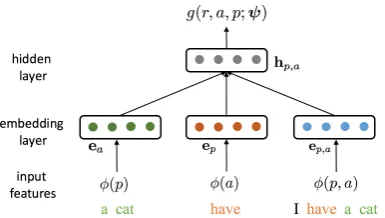
Figure 2: A relational network architecture. The network learns to predict a relation between a predicatepand an argumentagiven the predicate-argument pair and the sentence that contains it.
with labelytandTyt,yt+1is the score of
transition-ing from labelyttoyt+1.θdenotes the model pa-rameters, including the DB-LSTM parameters and the transition matrixT.
4.2 Relational Neural Model
An alternative way to formulate the SRL problem is to enumerate all possible argument spans for a given predicate and employ multi-class classifica-tion on every argument span. We describe how to obtain candidate argument spans in Section§7.2.
Denote a set of candidate argument spans asA˜. For each argument span a ∈ A˜, we seek to esti-mate the conditional probability given by:
Prel(r|a, p, f;ψ) =
exp(g(r, a, p;ψ)) P
r0∈Rf∪∅exp(g(r0, a, p;ψ))
(2)
whereg(r, a, p;ψ)is a potential function for scor-ing the assignment of semantic roler to an argu-ment spanawith respect to predicatep,ψdenotes the model parameters,Rf is a set of valid seman-tic roles with respect to framefand∅is an empty class that indicates invalid semantic roles.
We estimate g using a neural network as de-picted in Figure 2. The inputs to the network are discrete features: φ(a)denotes argument-specific features, which include words within the argument span, the dependents of the argument’s head, and their dependency labels; φ(p) denotes predicate-specific features, which include the predicate word, its dependents, and their dependency labels; φ(p, a) denotes predicate-argument relation fea-tures, which include the words between p and a and the lexicalized shortest dependency path.
We then map these features into a low dimen-sional space. Specifically, we compute an
embed-ding of the argument features: ea = [¯vaw; ¯vad; ¯val], wherev¯a
w ∈ Rk is the average of argument word embeddings, v¯a
d ∈ Rk is the average embedding of the argument’s dependents, and v¯a
l ∈ Rk is the average embedding of the corresponding de-pendency labels. Similarly, the embedding of the predicate features is: ep = [¯vpw; ¯vdp; ¯vpl], which is the concatenation of the average embeddings for the predicate words, the predicate’s depen-dents, and their dependency labels. For the rela-tional features, we haveep,a= [¯vpaw;vpath], where
¯
vpaw ∈Rkis the average embedding for words be-tweenp anda, and vpath ∈ Rk is a dependency path embedding, which is the final hidden state of an LSTM network that operates over the depen-dency path betweenpanda, with the input at each time step being the concatenation of a dependency label embedding and a word embedding.
The feature embeddings are then integrated through a non-linear hidden layer:
hp,a=ReLu(Wp,a·[ea;ep;ep,a]) (3) whereWp,ais anm×8kmatrix and ReLu(x) =
max(0, x). Finally, we compute the potential function: g(r, a, p;ψ) = wT
rhp,a, where wr ∈
Rmis a weight vector to be learned.
During training, we minimize the negative con-ditional log-likelihood of the training examples, with the conditional probability for each example given by Eq.2.
4.3 An Integrated Model
Our integrated model is essentially a relational neural model that is learned using the knowledge distilled from the sequential model.
Note that the sequential model estimates prob-abilities for semantic role label sequences over words instead of over text spans. These learned probabilities carry important information about how the sequential model learns to generalize. We identify them as the learned knowledge of the se-quential model. To make use of such knowledge in the relational model, we first transform the se-quence distributions into span-based distributions. Specifically, we derive the marginal distribution for any given span a = (ws, ..., wt), 1 ≤ s ≤ t < n, and a non-empty semantic role labelras:
Pseq(r|a) =
inside, and the outside of the filler of role r re-spectively. The probability for an empty role is:
Pseq(r=∅|a) = 1− X
r∈Rf
Pseq(r|a) (5)
After obtaining the span-based role distributions, we incorporate them into the training objective of a relational modelP˜relby adding a regularization term that minimizes the KL divergence:
L=−log ˜Prel(r|a) +βKL(Pseq||P˜rel) (6)
which is equivalent to minimizing
−log ˜Prel(r|a)+β
X
r
Pseq(r|a) log ˜Prel(r |a)
where β is a weight parameter. We refer toP˜rel as the integrated model. At inference time, it com-putes the predictive distributions of semantic roles in the same way as a vanilla relational model.
5 Frame Identification
Our semantic role labeling model is conditioned on a predicate and its frame. We now describe how to estimate the probabilities of a framef given a predicatep.
DenoteF as a set of semantic frames, we learn to estimate the probability:
Pf(f |p) = exp u(f, p;λ)
P
f0∈Fexp u(f0, p;λ) (7)
The potential functionu(f, p;λ)is computed us-ing a multi-layer neural network, whose architec-ture is similar to Figure2. The input features are φ(p) as defined in §4.2. The embedding layer computes ep as described above, and the hidden layer computes:
hp =ReLu(Wp·ep)
where Wp is an m ×3k matrix. The potential function is then estimated asu(f, p;λ) =wT
fhp, wherewf ∈Rmis a weight vector to be learned. Training is done by minimizing the negative con-ditional log-likelihood of the training examples where the conditional probability for each exam-ple is given by Eq.7.
6 Joint Inference
Finally, we want to jointly assign frames and roles to all predicates and their arguments.
Given a set of predicates P = {p1, ..., pN} and a set of candidate argument spans A˜ = {a1, ..., aM}, we optimize the following objective:
arg max s. t.(f,r)∈Q
N
X
j=1
Pf(fj |pj) M
X
i=1
˜
Prel(ri |ai, pj, fj)
(8) where f is a vector of frame assignments, ris a vector of role assignments, andQis a constrained set of frame and role assignments.
We employ the standard structural constraints for SRL, including avoiding non-overlapping ar-gument spans and repeated core roles for each frame. In addition, we introduce two constraints: one encodes the compatibility between frame types and semantic roles, for example, INSTRU -MENTis not a valid role for the frame COMMER -CIAL TRANSACTION, and the other encodes type consistencies of semantic role fillers of different frames, e.g., the same named entity cannot play both a PERSONrole and a VEHICLErole. We con-sider six common entity types (that are mutually exclusive): PERSON, LOCATION, WEAPON, VE -HICLE, VALUE, and TIME.3
We solve the inference problem (8) using the AD3 algorithm (Martins et al., 2011), which al-lows for more efficient constrained optimization than generic Integer Linear Programming solvers.
7 Experiment
7.1 Datasets
We evaluate our approach on semantic frame ex-traction using the FrameNet 1.5 release4. We use the same train/development/test split of the fully-annotated text documents as in previous work. We also include the partially-annotated exemplar sen-tences (i.e., each exemplar has only one annotated frame.) in FrameNet as training data.5 We use the standard evaluation script that measures frame
3We simply check if the role name contains any of the
en-tity type names like “person”, “location”. We plan to incorpo-rate an automatic semantic typing model into our framework in future work.
4http://framenet.icsi.berkeley.edu 5Existing work also makes use of the exemplars, but
structure extraction precision, recall and F16. For PropBank-style SRL, we use the CoNLL2005 data set (Carreras and M`arquez, 2005) with the official scripts7 for evaluation. It contains section 2-21 of WallStreet Journal (WSJ) data as training set, section 24 as development set and section 23 of WSJ concatenated with 3 sections from Brown corpus as the test set.
For data pre-processing, we parse all the sentences with the part-of-speech tagger and the dependency parser provided in the Stanford CoreNLP toolkit (Manning et al.,2014).
7.2 Argument candidate extraction
Existing work relied on either constituency syn-tax (Xue and Palmer, 2004) or dependency syn-tax (T¨ackstr¨om et al., 2015) to derive heuris-tic rules for extracting candidate arguments. In-stead, we extract candidate arguments using a pre-trained sequential SRL model (described in§4.1). Specifically, we extract the argument spans from the K-best semantic role label sequences output by the sequential model. We choose K from
{5,10,20,50}. IncreasingK will increase the re-call of unlabeled arguments but lower the preci-sion. We tune K based on the argument extrac-tion performance of our relaextrac-tional model (in§4.2) using the development data. In all our experi-ments, we set K = 10, which gives an unla-beled argument recall/precision of 89.6%/24.8% on FrameNet and 92.4%/29.4% on CoNLL2005.
7.3 Implementation details
All of our models are implemented using Theano on a single GPU. We set the embedding dimen-sion k to 300 and the hidden dimension m to
100. We initialize the word embeddings using the pre-trained word embeddings from (Wieting et al., 2015) while randomly initializing the embeddings for out-of-vocabulary words and the embeddings for the dependency labels within (−0.01,0.01). All these embeddings are updated during the train-ing process. We apply dropout to the embeddtrain-ing layer with rate 0.5, and train using Adam with de-fault settings (Kingma and Ba,2014). The weight parameterβin Eq.6is set to1in our experiments. All the models are trained for 50 epochs with early stopping based on development results.
6http://www.cs.cmu.edu/˜ark/SEMAFOR/ eval/
7http://www.lsi.upc.edu/˜srlconll/ srl-eval.pl
Model All Ambiguous
[image:6.595.318.513.63.130.2]LOG-LINEARWORDS 87.3 70.5 LOG-LINEAREMBEDDING 86.7 70.3 WSABIEEMBEDDING 88.4 73.1 Ours(Frame Only) 88.2 75.7
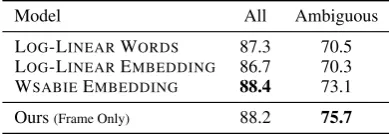
Table 1: Accuracy results on frame identification, including results onallpredicates andambiguous predicates in the FrameNet lexicon.
For all our experimental results, we perform sta-tistical significance tests using the paired bootstrap test (Efron and Tibshirani,1994) with 1000 boot-strap samples of the evaluated examples, and use∗
to indicate statistical significance (p <0.05) of the differences between our best model and our sec-ond best model.
7.4 FrameNet Results
Frame Identification. We first evaluate our frame identification model in§5. For baselines, we con-sider the prior state-of-the-art approach WSABIE EMBEDDING(Hermann et al.,2014), which learns feature representations based on word embeddings and dependency path embeddings using the WSA -BIE algorithm (Weston et al., 2011). We also in-clude two strong baselines implemented in Her-mann et al. (2014): LOG-LINEAR WORDS and LOG-LINEAREMBEDDINGS, which are both log-linear models, one with standard linguistic fea-tures and one with embedding feafea-tures. Table 1 shows the results.8 We can see that our model in general gives competitive performance and it out-performs all the baselines on predicting frames for ambiguous predicates (i.e., seen with more than one possible frames in the FrameNet lexicon).
Semantic Role Labeling. Next, we evaluate our SRL models with gold-standard frames, so that we can focus on the performance for argument identification. Our SRL models include the se-quential model described in§4.1(denoted asSeq); the relational model described in§4.2(denoted as Rel); and the integrated model described in§4.3 (denoted asSeq+Rel).
Table2shows the results for argument span
ex-8We consider the FULLLEXICONevaluation setting and
Model Prec. Rec. F1
SEMAFOR 65.6 53.8 59.1
SEMAFOR (best) 66.0 60.4 63.1 Ours(Seq) 63.4 66.4 64.9
Ours(Rel) 71.8 57.7 64.0
[image:7.595.316.512.60.216.2]Ours(Seq+Rel) 70.2 60.2 65.5∗
Table 2: Argument only evaluation results on the FrameNet test set in comparison to the results inKshirsagar et al.(2015).
Model Prec. Rec. F1
SEMAFOR 78.4 73.1 75.7 Framat 80.3 71.7 75.8 Framat+context 80.4 73.0 76.5
Ours(Seq) 78.5 79.9 79.2
Ours(Rel) 84.8 75.5 80.0
Ours(Seq+Rel) 84.2 77.1 80.5∗
Table 3: Full structure extraction results on the FrameNet test set (with gold frames) in compar-ison to the results inRoth and Lapata(2015).
traction. Our baselines include SEMAFOR (Das et al.,2014)9, a widely used frame-semantic parser for English, and SEMAFOR (BEST), an im-proved SEMAFOR system that is trained with heterogeneous resources (Kshirsagar et al.,2015). We can see that all of our models outperform these two systems in terms of F1, especially, our sequen-tial model provides the best recall, our relation model provides the best precision, and our inte-grated model gives the best F1 score.
Table 3 shows results for full structure extrac-tion (i.e., the accuracies of the frame-argument structure as a whole). We compare to the results reported inRoth and Lapata(2015). Framatis an open-source semantic role labeling tool provided by mate-tools (Bj¨orkelund et al.,2010), and Fra-mat+contextis an extension ofFramatthat uses
ad-ditional context features. All of our models sig-nificantly outperform the baselines in F1. In par-ticular, our integrated model achieves the best F1 score of 80.5%.
Full Semantic Structure Extraction. We now evaluate our models on full semantic frame ex-traction. Previous work implements the task in a two-stage pipeline: first apply a frame identifica-tion model to assign a frame to each predicate, and then apply a SRL model to assign a frame-specific
9http://www.cs.cmu.edu/˜ark/SEMAFOR/
Model Prec. Rec. F1
SEMAFOR 69.2 65.1 67.1
Framat 71.1 63.7 67.2
Framat+context 71.1 64.8 67.8
Hermann 74.3 66.0 69.9
T¨ackstr¨om(Struct.) 75.4 65.8 70.3
FitzGerald(Struct.) 74.8 65.5 69.9
FitzGerald(Struct., PoE) 74.6 66.3 70.2
FitzGerald(Local, PoE, Joint) 75.0 67.3 70.9
Ours(Seq) 69.6 70.9 70.2
Ours(Rel) 77.1 68.7 72.7
Ours(Seq+Rel) 77.3 71.2 74.1
Ours(JointAll) 78.8 74.5 76.6∗
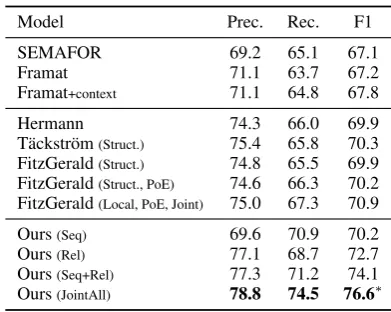
Table 4: Full structure extraction results on the FrameNet test set in comparison to the previously published results.
role label or∅to each candidate argument span. We compare with previous work using four model variants: three are pipeline models that combine our frame identification model with each of our SRL models and JointAll is the joint model that simultaneously predicts frames and roles as de-scribed in§6.
Table 4 compares our models with previously published results. The first block shows results fromRoth and Lapata(2015) and the second block shows results from FitzGerald et al.(2015). All these previous methods implements a pipeline of frame identification and semantic role labeling. The first block uses SEMAFOR for frame iden-tification and the second block uses the WSABIE model fromHermann et al.(2014). For the seman-tic role labeling step,Hermannis a standard log-linear classification model used inHermann et al. (2014);T¨ackstr¨om(Struct.)is a graphical model with
global factors (T¨ackstr¨om et al., 2015); FitzGer-ald (Struct.) is an improved version of the
graphi-cal model with non-linear potential functions in-stead of linear ones; FitzGerald (Struct., PoE) further
employs an ensemble with the product-of-experts (PoE) (Hinton,2002); andFitzGerald(Local, PoE, Joint)
[image:7.595.97.266.63.140.2]Method Dev WSJ Brown Surdeanu(Ensemble) - 80.6 70.1
Toutanova(Ensemble) 78.6 80.3 68.8
Punyakanok(Ensemble) 77.4 79.4 67.8
Zhou(DB-LSTM) 79.6 82.8 69.4
T¨ackstr¨om(Struct.) 78.6 79.9 71.3
FitzGerald(Struct.) 78.3 79.4 71.2
FitzGerald(Struct., PoE) 78.9 80.3 72.2
Ours(Seq) 78.5 80.5 70.8
Ours(Rel) 79.2 81.4 71.3
[image:8.595.88.275.63.190.2]Ours(Seq+Rel) 80.3 81.9 72.0∗
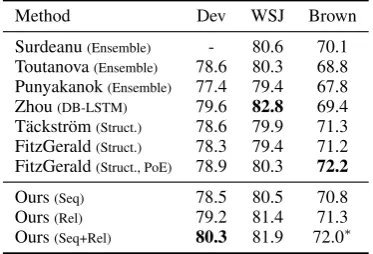
Table 5: Semantic role labeling results on CoNLL 2005.
joint inference of both frames and semantic roles, our model performs even better, achieving a 5.7 absolute F1 gain over the prior state of the art.
7.5 CoNLL Results
Table 5shows the results of our SRL models on the CoNLL 2005 data. Our baselines include the best feature-based systems ofSurdeanu et al. (2007), Toutanova et al.(2008), andPunyakanok et al.(2008), the recurrent neural network model (DB-LSTM) (Zhou and Xu, 2015), the graphi-cal model with global factors (T¨ackstr¨om et al., 2015) and the improved versions that use neural network factors (FitzGerald et al., 2015). Note that our sequential model in this setting is essen-tially the same as the DB-LSTM model (Zhou and Xu,2015) since all the frame-specific constraints are removed, except that we use simpler input fea-tures.10 We observe a similar performance trend among our models. However, the performance gain introduced by our integrated model is rel-atively small compared to our FrameNet results. Note that the argument structures in CoNLL 2005 is much simpler and less diverse than the ones in FrameNet. This may lead to less complemen-tary information captured by the sequential model and the relational model. Overall, our integrated model achieves comparable performance to the previously published results.
7.6 Analysis
We perform further analysis of our results on FrameNet to better understand our models.
We first look at how well our models perform on sentences of different lengths. In general,
10Our reimplementation using the same feature set asZhou
[image:8.595.314.522.87.190.2]and Xu (2015) did not achieve the same performance, see§4.1for details.
Figure 3: Full structure F1 on the FrameNet test set by the sentence length.
Figure 4: Examples of semantic frames output by different models.
longer sentences tend to have more predicates and are more likely to contain complex long-range predicate-argument dependencies. We divide the FrameNet test set into 7 bins based on sentence lengths, each with length increased by 10, and the last bin contains sentences of length> 60. Fig-ure3shows the F1 scores for full structure extrac-tion for each bin. For all our models, performance tends to degrade as sentence length increases. In-terestingly, our relational model consistently out-performs our sequential model at different sen-tence lengths, which demonstrates its robustness of handling relations of different ranges. The com-bination of the two models leads to consistent per-formance gains, and our final joint model performs the best across different sentence lengths.
[image:8.595.309.527.245.381.2]shows that performing sequential predictions over individual words has limitations. Although our relational models are good at reducing precision errors, they can be affected by frame identifica-tion errors if they are used in a pipeline. This is demonstrated by the second sentence in Figure4, where only the JointAll model correctly predicts that the word “train” triggers a “Vehicle” frame. All the pipeline approaches mistakenly predict the “Education teaching” frame in the first stage. In the second stage, the sequential model further ex-tracts wrong semantic roles “Student” and “Insti-tution”. While the relational model and the inte-grated model extract no semantic roles, the frame prediction mistake remains.
8 Conclusion
We presented a new method for frame-semantic parsing that achieves the new state of the art results on standard FrameNet data. Our model integrates a sequential neural network into the learning of a relational neural network for more accurate span-based semantic role labeling. During inference, it jointly predicts frames and semantic roles us-ing a graphical model with neural network factors. Empirical results demonstrate that our approach significantly outperforms existing neural and non-neural approaches on FrameNet data. Our model can also be adapted to perform PropBank-style SRL and it demonstrates comparable performance with the state of the art on CoNLL 2005 data.
Acknowledgments
This research was supported in part by DARPA under contract number FA8750-13-2-0005, and by NSF grants IIS-1065251 and IIS-1247489. We also gratefully acknowledge the support of the Mi-crosoft Azure for Research program and the AWS Cloud Credits for Research program. In addition, we would like to thank anonymous reviewers for their helpful comments.
References
Collin F Baker, Charles J Fillmore, and John B Lowe. 1998. The berkeley framenet project. In Proceed-ings of the 36th Annual Meeting of the Associa-tion for ComputaAssocia-tional Linguistics and 17th Inter-national Conference on Computational Linguistics-Volume 1. pages 86–90.
David Belanger, Bishan Yang, and Andrew McCallum.
2017. End-to-end learning for structured prediction energy networks. InICML.
Anders Bj¨orkelund, Bernd Bohnet, Love Hafdell, and Pierre Nugues. 2010. A high-performance syntac-tic and semansyntac-tic dependency parser. InProceedings of the 23rd International Conference on Computa-tional Linguistics: Demonstrations. Association for Computational Linguistics, pages 33–36.
Xavier Carreras and Llu´ıs M`arquez. 2005. Introduc-tion to the conll-2005 shared task: Semantic role la-beling. InCoNLL.
Ronan Collobert, Jason Weston, L´eon Bottou, Michael Karlen, Koray Kavukcuoglu, and Pavel Kuksa. 2011. Natural language processing (almost) from scratch. Journal of Machine Learning Research 12(Aug):2493–2537.
Dipanjan Das. 2014. Statistical models for frame-semantic parsing. InProceedings of Frame Seman-tics in NLP: A Workshop in Honor of Chuck Fill-more. volume 1929, pages 26–29.
Dipanjan Das, Desai Chen, Andr´e FT Martins, Nathan Schneider, and Noah A Smith. 2014. Frame-semantic parsing. Computational linguistics 40(1):9–56.
Dipanjan Das, Nathan Schneider, Desai Chen, and Noah A Smith. 2010. Probabilistic frame-semantic parsing. In Human language technologies: The 2010 annual conference of the North American chapter of the association for computational lin-guistics. Association for Computational Linguistics, pages 948–956.
Chris Dyer, Miguel Ballesteros, Wang Ling, Austin Matthews, and Noah A Smith. 2015. Transition-based dependency parsing with stack long short-term memory. InACL.
Bradley Efron and Robert J Tibshirani. 1994. An intro-duction to the bootstrap. CRC press.
Charles J Fillmore, Christopher R Johnson, and Miriam RL Petruck. 2003. Background to framenet. International journal of lexicography 16(3):235– 250.
Nicholas FitzGerald, Oscar T¨ackstr¨om, Kuzman Ganchev, and Dipanjan Das. 2015. Semantic role labeling with neural network factors. In EMNLP. pages 960–970.
Daniel Gildea and Daniel Jurafsky. 2002. Automatic labeling of semantic roles. Computational linguis-tics28(3):245–288.
Karl Moritz Hermann, Dipanjan Das, Jason Weston, and Kuzman Ganchev. 2014. Semantic frame iden-tification with distributed word representations. In ACL.
Geoffrey E Hinton. 2002. Training products of experts by minimizing contrastive divergence. Neural com-putation14(8):1771–1800.
Richard Johansson and Pierre Nugues. 2007. Lth: se-mantic structure extraction using nonprojective de-pendency trees. In Proceedings of the 4th interna-tional workshop on semantic evaluations. Associa-tion for ComputaAssocia-tional Linguistics, pages 227–230. Diederik Kingma and Jimmy Ba. 2014. Adam: A
method for stochastic optimization. InICLR. Meghana Kshirsagar, Sam Thomson, Nathan
Schnei-der, Jaime Carbonell, Noah A Smith, and Chris Dyer. 2015. Frame-semantic role labeling with het-erogeneous annotations. InACL.
Ding Liu and Daniel Gildea. 2010. Semantic role features for machine translation. In Proceedings of the 23rd International Conference on Compu-tational Linguistics. Association for Computational Linguistics, pages 716–724.
Christopher D Manning, Mihai Surdeanu, John Bauer, Jenny Rose Finkel, Steven Bethard, and David Mc-Closky. 2014. The stanford corenlp natural lan-guage processing toolkit. In ACL (System Demon-strations). pages 55–60.
Andr´e FT Martins, Mario AT Figeuiredo, Pedro MQ Aguiar, Noah A Smith, and Eric P Xing. 2011. An augmented lagrangian approach to constrained map inference. InICML.
Martha Palmer, Daniel Gildea, and Paul Kingsbury. 2005. The proposition bank: An annotated corpus of semantic roles. Computational linguistics31(1):71– 106.
Vasin Punyakanok, Dan Roth, and Wen-tau Yih. 2008. The importance of syntactic parsing and inference in semantic role labeling. Computational Linguistics 34(2):257–287.
Michael Roth and Mirella Lapata. 2015. Context-aware frame-semantic role labeling. Transactions of the Association for Computational Linguistics 3:449–460.
Michael Roth and Mirella Lapata. 2016. Neural se-mantic role labeling with dependency path embed-dings. InACL.
Michael Roth and Kristian Woodsend. 2014. Composi-tion of word representaComposi-tions improves semantic role labelling. InEMNLP. Citeseer, pages 407–413. Dan Shen and Mirella Lapata. 2007. Using semantic
roles to improve question answering. In EMNLP-CoNLL. pages 12–21.
Mihai Surdeanu, Sanda Harabagiu, John Williams, and Paul Aarseth. 2003. Using predicate-argument structures for information extraction. In Proceed-ings of the 41st Annual Meeting on Association for Computational Linguistics-Volume 1. Associa-tion for ComputaAssocia-tional Linguistics, pages 8–15. Mihai Surdeanu, Llu´ıs M`arquez, Xavier Carreras, and
Pere R Comas. 2007. Combination strategies for semantic role labeling. Journal of Artificial Intel-ligence Research29:105–151.
Swabha Swayamdipta, Miguel Ballesteros, Chris Dyer, and Noah A Smith. 2016. Greedy, joint syntactic-semantic parsing with stack lstms. InCoNLL. Oscar T¨ackstr¨om, Kuzman Ganchev, and Dipanjan
Das. 2015. Efficient inference and structured learn-ing for semantic role labellearn-ing. Transactions of the Association for Computational Linguistics3:29–41. Kristina Toutanova, Aria Haghighi, and Christopher D Manning. 2008. A global joint model for semantic role labeling. Computational Linguistics34(2):161– 191.
Jason Weston, Samy Bengio, and Nicolas Usunier. 2011. Wsabie: Scaling up to large vocabulary image annotation. InIJCAI. volume 11, pages 2764–2770. John Wieting, Mohit Bansal, Kevin Gimpel, and Karen Livescu. 2015. Towards universal paraphrastic sen-tence embeddings. InICLR.
Nianwen Xue and Martha Palmer. 2004. Calibrat-ing features for semantic role labelCalibrat-ing. InEMNLP. pages 88–94.