ISSN Online: 1947-3826 ISSN Print: 1949-2421
Performance Improvement of Multi-User
Multiple-Input Multiple-Output Protocol for
WLAN
Maha Bakalla, Mznah Al-Rodhaan, Yuan Tian
Department of Computer Science, College of Computer and Information Sciences King Saud University, Riyadh, KSA
Abstract
The increase in the number of devices with a massive revolution in mobile technology leads to increase the capacity of the wireless communications net- works. Multi-user Multiple-Input Multiple-Output is an advanced procedure of Multiple-Input Multiple-Output, which improves the performance of Wireless Local Area Networks. Moreover, Multi-user Multiple-Input Mul-tiple-Output leads the Wireless Local Area Networks toward covering more areas. Due to the growth of the number of clients and requirements, research-ers try to improve the performance of the Medium Access Control protocol of Multi-user Multiple-Input Multiple-Output technology to serve the user bet-ter, by supporting different data sizes, and reducing the waiting time to be able to transmit data quickly. In this paper, we propose a Clustering Mul-ti-user Multiple-Input Multiple-Output protocol, which is an improved Me-dium Access Control protocol for Multi-user Multiple-Input Multiple-Out- put based on MIMOMate clustering technique and Padovan Backoff Algo-rithm. Utilizing MIMOMMate focuses on the signal power which only serves the user in that cluster, minimizes the energy consumption and increases the capacity. The implementation of Clustering Multi-user Multiple-Input Mul-tiple-Output performs on the Network Simulator (NS2.34) platform. The re-sults show that Clustering Multi-user Multiple-Input Multiple-Output proto-col improves the throughput by 89.8%, and reduces the latency of wireless communication by 43.9% in scenarios with contention. As a result, the overall performances of the network are improved.
Keywords
Clustering Multi-User Multiple-Input Multiple-Output, Multi-user Multiple-Input Multiple-Output, MIMOMate, Padovan Backoff Algorithm, Wireless Local Arewa Network
How to cite this paper: Bakalla, M., Al-Rodhaan, M. and Tian, Y. (2017) Per-formance Improvement of Multi-User Mul-tiple-Input Multiple-Output Protocol for WLAN. Communications and Network, 9, 124-141.
https://doi.org/10.4236/cn.2017.92008
Received: February 20, 2017 Accepted: May 24, 2017 Published: May 27, 2017 Copyright © 2017 by authors and Scientific Research Publishing Inc. This work is licensed under the Creative Commons Attribution International License (CC BY 4.0).
1. Introduction
Wireless Local Area Network (WLAN) becomes an important technique in our life in recent years. However, the applications that used this technology require a lot of bandwidth. Telecommunications manufacturing plays an important role in wireless communication, which leads to the widespread acceptance of cell phones and wireless computer networking. Moreover, the number of users who used the network increases dramatically. Therefore, the capacity of current wireless communications networks has also increased. As a result, services re-quire high data rate, great capacity, high quality, growth throughput and spectral efficiency. Therefore, various technologies are proposed to improve the wireless networks to meet the demands of users [1].
wire-less communication.
The remainder of this paper is organized as follows: Section 2 discusses the background of the main concepts of the paper. Section 3 presents the literature review related to the MU-MIMO MAC protocols. The design of CMU-MIMO protocol that improves the IEEE 802.11n protocol is explained in Section 4. In Section 5, the experiment results are discussed. Finally, the conclusion and fu-ture work are presented in Section 6.
2. Background
Multiple-Input Multiple-Output (MIMO) communication has experienced a conversion from a theoretical concept to a real-world technique in last few years for improving the performance of wireless networks. Studying MAC mechanism for MU-MIMO in WLAN is the main point in this paper. Therefore, this section gives the foundation that helps to understand the basic principles.
2.1. IEEE 802.11 Wireless Network
A combination of the physical layer and MAC are the main principles of IEEE 802.11 WLAN. The MAC layer is the lower sublayer of the Open Systems Inter-connection model; it allows many stations to share a single wireless channel. Meanwhile, the IEEE 802.11 MAC technique only allows one communication at the same time. Due to this limitation, there is no benefit of using MU-MIMO, therefore, MU-MIMO has tried to adapt their MAC protocol and their methods to control the simultaneous transmission between stations [3].
2.2. Overview of MIMO
MIMO is an improved smart antenna that used in wireless communication. MIMO is a complex technology, although it is widely used for wireless commu-nication as it offers high data rate and throughput without additional bandwidth or spectral frequency. There are two operational modes in MIMO systems: the single-user and multi-user MIMO technologies, respectively.
In the single-user MIMO system, there are only one receiver and one sender, each of them has multiple antennas, which is a point-to-point communication. In each round, only one station can use the channel to send and receive multiple data so, it does not support sending data to multiple receivers at the same time. Whereas MU-MIMO is a point-to-multi-point network communication, in this technique, there are many receivers sending/receiving data to AP, and each of them has many antennas [3].
2.3. Quality of Services Concept
of services. One of these performance matrices is throughput, which measures the success amount of transmitted data.
In Distributed Coordination Function scenario, each station has its Conten-tion Window (CW) that starts from zero and increases exponentially with each unsuccessful transmitting by using BEB. Also, Distributed Coordination Func-tion delegates staFunc-tions to keep listening to the network channel. If it is idle for Distributed coordination function Inter Fame Space (DIFS), every station starts reducing a backoff timer that is selected from its CW. The station has fewer backoff successes to access the channel and sends its data. The collision happens if many stations select the same random backoff, In this case, the senders in-crease their CW and then try to access the channel again [3].
3. Literature Review
Recently, MIMO and its versions are a popular technology in wireless commu-nications and there are extensive studies go through it. This chapter provides a comprehensive literature review on the availability of multi-user medium access control and backoff algorithms in WLAN, which has a strong influence on the development of new MAC protocol.
3.1. MIMO in Wireless Area Network
An asynchronous MIMO Multiple Packet Reception method is proposed in [4]. The MAC algorithm in this method operates to expand the reception duration on the receiving side of the standard IEEE request-to-send and clear-to-send (RTS/CTS) scheme to enable for obtaining a larger number of received request- to-send frames. The Network Simulator (NS-2) is used to compare the proposed MAC protocol with the IEEE 802.11 standard. The simulation results show that IEEE 802.11 achieves better outcomes for greater values of backoff. In contrast, Multiple Packet Reception-aware MAC achieves good results in a small value of the minimum CW size, because most collision transforms to double successful transmissions for the Multiple Packet Reception-aware MAC. As a result, win-dow sizes are kept at their smallest values.
A whole distributed random access protocol for designing and implementing of 802.11n+ for MIMO wireless networks is presented in [5]. The objective of this design is to enable as many simultaneous transmissions as possible by the MIMO transmitter with a large number of antennas. In this design, the stations with extra antennas than the contention winner continue to sense and contend for the channel. Analysis scenarios are shown where the sender and receiver have the same or a different number of antennas. The result compares the new design against the existing 802.11n design in the term of throughput and shows that the throughput increases when the number of antennas increased.
3.2. MU-MIMO MAC Protocol
precoder by maximizing the signal-to-leakage-and-noise ratio for all clients si-multaneously. They compared their method with the zero-forcing precoding technique that forces a constraint on the relation between the numbers of transmitting and receiving antennas. The proposed method outperforms the ze-ro-forcing precoding even when the dimension requirement for zeze-ro-forcing solutions is satisfied.
Analyzed and compared two schemes which are single-user MIMO and MU- MIMO with random station distribution scenarios in [7]. In single-user MIMO scheme, there are many symbols transmitted from one station, while in MU- MIMO scheme from many stations as in Multi-Packet Reception in uplink WLAN. Moreover, analyzing and comparing the maximum throughput achieve- ment of both the single user and MU-MIMO schemes in uplink WLANs mode. The result shows that the MU-MIMO scheme is a good elect for enhancing the effectiveness of the network because it produces high throughput performance for few data load sizes and a huge amount of stations competing, however, the single-user MIMO scheme shows that is uselessness for small-sized packets.
3.3. MAC Protocol in MU-MIMO Uplink
A new cluster-based carrier sense multiple access with the collision avoidance scheme is introduced in [8]. This scheme is simple and could be utilized to a dis-tinct infrastructure or ad hoc network. In this protocol, stations and AP are al-located different clusters and stations within the same cluster can send concur-rently. Each cluster shares a single backoff, by this the cluster is seen as one node in the wireless network. The contention is done between stations in a different cluster. The result of this proposed method shows that it decreases the collision chance in a network and provides throughput enhancement compared to the other system based on 802.11.
To maximize the gain of MU-MIMO and provides fairness for clients, a new user matching MAC protocol is present in [2] which is MIMOMate, a lead-er-contention-based MU-MIMO MAC protocol. In this protocol, the clients are groups in MIMO-Mates, each MIMO-Mate can send at the same time with only one contending process. The contention is done between the leaders of each group by using a traditional CSMA/CA. The MAC overhead is reduced because it needs a single contention for concurrent transmission. The implementation results and the theoretical analysis proved that this matching protocol could achieve greater throughput compared to the conventional contention scheme using two antenna AP scenarios.
3.4. Backoff Algorithms
re-sources utilization and beats the standard BEB scheme in diverse scenarios. In addition, it realizes greater throughput compared to BEB, particularly in a dense network.
After analyzing the behavior of BEB, an Improved Binary Exponential Backoff algorithm is proposed in [10] to enhance the fairness of medium access which is missing in BEB. This improvement is made by modifying the way of growing or shrinking the CW based on a number of frames that transmit successfully. The simulation results show that the Improved Binary Exponential Backoff enhances the fairness and throughput capacity compared to BEB in both the static and dynamic environments.
A new Enhanced Binary Exponential Backoff algorithm is introduced in [11], to enhance the fairness of channel access in the network. The improvement in Enhanced Binary Exponential Backoff is made by offering some association be-tween Backoff Time Threshold and CW size. To reduce collisions, if there are several users consuming the channel, it needs a small value of Backoff Time Threshold comparative to present CW size, and via verse. The simulation is performed by using NS-2.34, and the results show that Enhanced Binary Expo-nential Backoff is better than BEB and Improved Binary ExpoExpo-nential Backoff al-gorithms [10] regarding fairness and throughput.
4. Clustering MU-MIMO Protocol
The MAC layer provides channel access control mechanisms to allow several clients to incorporate a shared medium and communicate within a multiple access network. As a result, there are many issues come up with this concept, such as packet collision, delay, and fairness between users. Therefore, the need for designing MAC protocol to deal with these issues has been an active area of research. In this section, the main idea and the detailed design of CMU-MIMO MAC protocol are presented. CMU-MIMO protocol applies Padovan backoff protocol. In addition, it improves MU-MIMO protocol by using the MIMOMate clustering technique.
4.1. Padovan Backoff Algorithm
Wireless networks indicate using radio frequency signals to exchange informa-tion and communicainforma-tion among wireless devices. IEEE 802.11 protocol is a famous and extensively used as core MAC protocol in WLAN. With advancing years, the numbers of users that use the wireless network are increasing. As a result, when users try to enter the shared wireless channel simultaneously, it leads to increase the collision problem that will reduce the network performance in the distributed MAC protocol under Distributed Coordination Function mode. To avert such collisions or at least decrease it, the well-known algorithm is used which is BEB [12].
a result, it leads to increase the delay, lack fairness, low throughput and reduce the overall network performance, especially in the dense network. In this net-work there are a lot of users that want to occupy the shared channel. Sequential, collisions have a high probability to happen in such type of network. According-ly, increasing the CW exponentially is not the best solution to deal with the packet loss problem. Since the time selected from the CW might be greater than the required waiting time to guarantee collision-free channel access [9].
In this paper, we use PBA, to overcome the above problems that faced BEB algorithm. PBA will allow a significant decreasing of the number of collisions and guarantee better controlling of the CW size based on the Padovan sequence number. The main goal of using PBA is to enhance the effectiveness of our IEEE 802.11 MAC protocol and reduce delay when working in Distributed Coordina-tion FuncCoordina-tion mode and dense network.
4.2. CMU-MIMO Protocol
Nowadays, the numbers of clients use the wireless network to communicate concurrently are increasing. Consequently, the needing to explore a new tech-nology to deal with them is increasing. MU-MIMO techtech-nology is an exciting development standard that evolved to enable multiuser sending and to receive at the same time. To achieve the benefits of having MU-MIMO technology, we have to consider a good matching clustering mechanism to allow them to use this technology without any wastes of resources. In MU-MIMO, the perfor-mance of the user bases on who is sending simultaneously. The existing MAC protocol of MU-MIMO enables all clients to use traditional MAC protocol and competes for the channel, by doing this, the medium time will be wasted and failed to deliver the earning of MU-MIMO.
Making clustering in uplink MU-MIMO is much more challenging than downlink mode because there is no coordination point. The best clustering
me-chanism that used with uplink MU-MIMO MAC protocol is proposed in [2],
namely the MIMOMate matching mechanism. In MIMOMate, the chain or cluster of clients will be generated to enable them concurrent transmissions. This matching is based on grouping clients whose mediums are more orthogonal to each other to eliminate any interference and maximize the throughput. This MAC protocol that based on MIMOMate allows only at the first stream all clients to compete for the channel. After that, the residual clients connect the simultaneous transmission of its leader in the MIMO-Mate relation. As a result, the less contention environment will reduce the overhead. The proposed
MU-MIMO MAC protocol based on MIMOMate [2] suffers from some
re-duce delay. Figure 1 summarizes the main steps and the following four sub sec-tions present detailed explanasec-tions of these steps.
4.2.1. The Proposed CMU-MIMO Protocol
To achieve the goal of our improvement, firstly, we assume a dense network. Secondly, the number of members in one cluster is identical to the number of antennas in the AP. Thirdly, each antenna (angle) has one member in each cluster and only the leader of the cluster will compete each time. Fourthly, each station has data to send and the transmission time of all stations relatively close to each other. Lastly, the nodes were clustered using the MIMOMate technique.
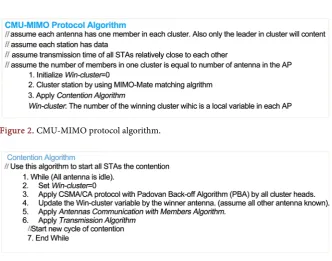
[image:8.595.218.529.274.718.2]We propose the following CMU-MIMO algorithms as shown in Figure 2. The global variable for the antennas and local variable in each AP that we need to
identify is the Win_cluster. It is used to store the number of the winning cluster in the contention process. After that, the variable used by all antennas tell the members of this cluster that they have to send in this time. The first step of the algorithm is to initialize the global variable as 0, and then apply the MIMOMate matching algorithm to generate clusters. After that, calling the Contention Algo-rithm that allows the contention between leaders for the first stream to access the channel, which will be described in the following sub section.
4.2.2. Contention Algorithm
[image:9.595.207.540.451.712.2]The main goal of this algorithm is to start the contention between all leaders when all antennas are idle after each cycle (one cycle means one cluster occupies the channel and has finish off sending). The steps of this algorithm are shown in Figure 3. First, set the variable Win-cluster to zero when new contention starts. Then apply CSMA/CA protocol that integrates PBA by all cluster heads, the an-tenna of the winner will update the value of Win-cluster. After that, all other an-tennas will know that the value of this variable is changed, and stored the num-ber of new winner cluster. Then all another antenna will communicate with their stations by calling Antennas Communication with the Members Algori- thm. Finally, the cluster will start the transmission by calling the Transmission Algo-rithm. These algorithms are explained in the following two sub sections.
4.2.3. Antennas Communication with Members Algorithm
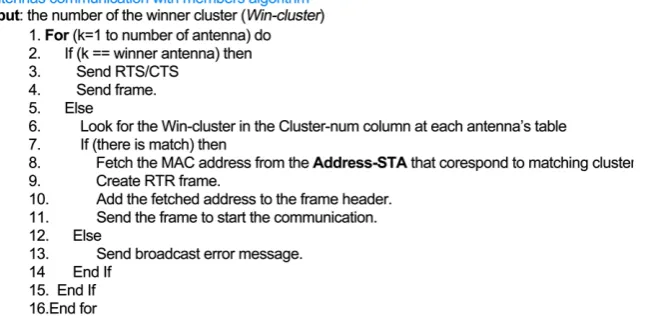
The main goal of this algorithm is to communicate each antenna with the mem- bers of the winning cluster. The steps of this algorithm are shown in Figure 4, the input of this algorithm is the number of the winner cluster. According to the number of antennas in the AP, this algorithm loops to check all antennas.
Figure 2. CMU-MIMO protocol algorithm.
Figure 3. Contention algorithm that allow leaders to make contention when all antennas
If this antenna is the winner antenna, the algorithm will allow the antenna’s station to start sending its data by using the mechanism of handshaking (RTS/ CTS). Otherwise, the antenna will check first if the number of the winner cluster matches its table to fetch the MAC address. After that, add it to the request- to-receive (RTR) frame header, and then broadcast this frame to all its stations. Therefore, all members of the winner cluster will know that they have to send their data in this cycle. In contrast, if there is no matching then it broadcast an error message.
4.2.4. Transmission Algorithm
This algorithm allows the member of the winner cluster to start its transmission concurrently as shown in Figure 5. At the beginning, the algorithm will first check if this antenna is not the winner antenna, and then check if the member (station) has data to send or not. If yes, then it starts sending RTS/CTS control message, at last, the station will send the data frames.
5. Experimental Result and Analysis
[image:10.595.219.544.373.533.2]In this section, we present the implementation of CMU-MIMO protocol and test its performance. After that we discuss the improvement in performance of
Figure 4. Antennas Communication with Members algorithm.
Figure 5. Transmission algorithm which allows the member of the winner cluster to start
[image:10.595.216.538.577.704.2]CMU-MIMO protocol. We compared the performance of IEEE 802.11n protocol and the CMU-MIMO protocol in terms of throughput and average delay. For better analysis, we have tested our method on different network sizes. The fol-lowing are the specifications of hardware and software, then the simulation set-ting we have used to conduct all experimental runs. After that, we present the implementation of PBA and its result. Finally, the implementation of CMU- MIMO protocol and its result will describe.
5.1. System Specification
Determining the specification of a system is one of the factors that eases the un-derstanding of results. In this section, we will specify the hardware and software requirement that we used to implement in this paper.
The hardware that used is a computer with 993.4 MB, two processors Intel(R) Core(TM)2 CPU and 4300 @ 1.80GHz processor speed. While the software is an Ubuntu operating system with 9.10 (karmic) release, Kernel Linux 2.6.31-14- generic and GNOME 2.28.1. Moreover, we use NS-2.34 network simulator soft- ware. The programming languages that we used in our implementation are C++ and OTCL.
5.2. Simulation Setting
To show the performance of implementing CMU-MIMO protocol, we specify the simulation setting parameters in our experiment as shown in Table 1. Also, we conduct the number of different scenarios that vary between 5 and 11 nodes (maximum size allowed based on memory available). After that, we show the behavior of CMU-MIMO protocol by measuring the throughput and average delay.
5.3. Implementation of PBA and Result
PBA is a new scheme that used as a way to reduce the collision that may happen in the IEEE 802.11n WLAN network. In this paper, we modify the 802.11n MAC protocol by replacing BEB with PBA and test its effectiveness on the perfor- mance of the network. Also, we compare this algorithm with the BEB as a ben- chmark. The implementation is carried on the system specification that men- tioned above.
How the CW size update is the most affected parameter on the performance of network protocols. The PBA increases the CW of node up to the maximum value CW max after unsuccessful transmission, and resets it to the minimum value CW min after successful transmission according to the following Equa- tion[9]:
(
)
min * Wold, max if collision new
max if success
P C CW
CW
CW =
(1)
Where P represents the Padovan number that calculated by this Equation:
( )
0( )
1( )
2 1The recurrence relation is given by this Equation:
( )
(
2)
(
3 ,)
3P n =P n− +P n− n≤ (3)
How the CW increases comparing to the BEB CW is shown in Figure 6. After applying BEB with PBA algorithms on different scenarios with different sizes of network, and taking the average of running these algorithms ten times, we conclude that as the network becomes dense, the throughput increases and the average delay decreases compared to the BEB.
Figure 7 shows the result obtained by plotting network size versus throughput that measured in kilo byte per second (Kb/s). As we can see that with the in-creasing of the number average throughput by 1.6% in PBA compared to BEB. This proves that the PBA has better and clear performance in large network size than a small one.
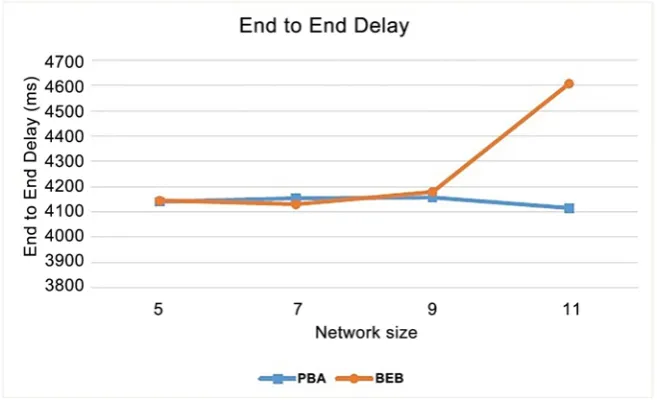
[image:12.595.206.540.334.717.2]The next graph is obtained by plotting network size on the x-axis and average delay on the y-axis that measured in milisecond (ms). As shown in Figure 8, the PBA has close and similar average delay to the BEB in small network size.
Table 1. Simulation setting parameter.
Parameters Value Parameters Value Access control CSMA/CA Number of node 5-11 nodes
Antenna type Direction Antenna Packet size 1500 bytes Application protocol FTP Routing protocol AODV
Bandwidth 2Mbits/s RTS Threshold 3000 bytes CW max 1023 DIFS 10us CW min 31 Simulation time 15ms MAC protocol IEEE 802.11n Slot time 20us Number of interfaces 2 Transport protocol TCP
Figure 7. Throughput vs. Network size in CMU-MIMO protocol.
Figure 8. The end to end delay vs. network size in CMU-MIMO protocol.
However, when the number of nodes increases, PBA reduces the average delay compared to the BEB by 2.9%. This result expected because the PBA increase its CW slowly and reduce the unnecessary time that nodes must wait to access the channel. From these results, we decide to use PBA instead of BEB in our pro- posed algorithm.
Finally, we have to mention that in both PBA and BEB the throughput and average delay are inversely proportional to the network size. This means that if the network is dense the number of contending nodes within the same trans- mission range increase that leads to lower throughput and average delay.
[image:13.595.207.536.303.503.2]which contains the main functions of handshaking mechanism. After that we compare CMU-MIMO protocol with the IEEE 802.11n protocol as a benchmark. In the experiments we executed the CMU-MIMO protocol and IEEE 802.11n protocol on four network sizes; firstly, with network size that allowed making a cluster in CMU-MIMO protocol which is five nodes. This is because we assume the number of nodes in each cluster is equal to the number of antennas that found in the AP (which is n0 in our experiment). Then increased to 7 nodes, nine nodes and lastly for 11 nodes (maximum size allowed based on memory available).
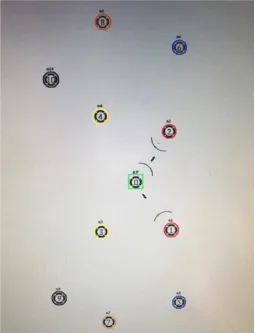
[image:14.595.246.502.356.690.2]Moreover, we ran these two protocols in two cases, the first one is when there is no contention between leaders, while the other one is when there is a conten-tion between leaders that locate and covered by the same antenna. After that, we ran both of these protocols ten times for each network size then we take the av-erage of them in each case. The results obtained from the CMU-MIMO protocol are used to calculate the throughput and the average delay of each network size when we fixed the Transmission Control Protocol (TCP) connection between nodes. Figure 9 shows the scenario with 11 nodes and the channel is occupied by the members of first cluster n1, n2 and communicated with the AP (n0).
Figure 9. A sample of output scenario with 11 nodes, where n0 is the
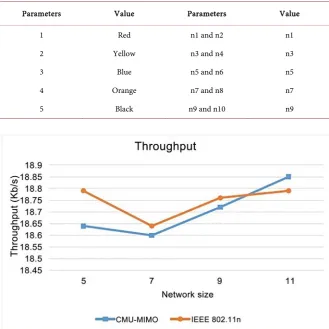
In this scenario, we have five clusters, in each one there are two nodes and n0 setting as AP. The description of this scenario is shown in Table 2. The next subsections discuss the results obtained from case 1 and case 2 AP.
5.4.1. Scenario with No Contention
As shown in Figure 10, we obtained the first case by plotting network size and throughput, which is measured in kilo byte per second (Kb/s), on x and y-axis respectively. Each line represents the result of applying CMU-MIMO protocol and the IEEE 802.11n corresponding with different network sizes used in our experiments. As we can see that with the increasing of the number of nodes, there is a considerable increase in the throughput in CMU-MIMO protocol by 0.99%, while in the IEEE 802.11n, we can see that there is inconsistency in the value of through put.
[image:15.595.207.537.382.711.2]The next graph is obtained by plotting network size on the x-axis and average delay that, measured in millisecond (ms), on the y-axis. As shown in Figure 11, each line represents the result of applying CMU-MIMO protocol and the IEEE 802.11n corresponding with different network sizes used in our experiments. The graph shows clearly that CMU-MIMO minimizes the average delay by 0.06% in dense network.
Table 2. Scenario description.
Parameters Value Parameters Value 1 Red n1 and n2 n1 2 Yellow n3 and n4 n3 3 Blue n5 and n6 n5 4 Orange n7 and n8 n7 5 Black n9 and n10 n9
5.4.2. Scenario with Contention
In the second case, as shown in Figure 12, we obtained by plotting network size and throughput, that measured in kilo byte per second (Kb/s), on x and y-axis respectively. Each line represents the result of applying CMU-MIMO protocol and the IEEE 802.11n corresponding with different network sizes used in our experiments. As we can see clearly that CMU-MIMO protocol has better per-formance by 89.8% than IEEE 802.11n in term of throughput when there is a contention between nodes to access the medium. Therefore, we can conclude that the CMU-MIMO protocol solves the contention problem that IEEE 802.11n suffers from it, and lets all the nodes to have full and very high contention that leads to enter in a waiting time until the time is ended and each one waits for the other to start sending.
[image:16.595.209.539.293.486.2] [image:16.595.209.539.522.712.2]In Figure 13, we have plotted network size versus average delay that measured in millisecond (ms), where problem size is on the x-axis and average delay is on
Figure 11. Average Delay in the first case where there is no contention between.
Figure 13. Average Delay in the second case where there is a contention between nodes.
the y-axis. As shown in this figure, each line represents the result of using a dif-ferent number of nodes. It shows that CMU-MIMO protocol helps to decrease the average delay significant by 43.9%.
From the results shown above, we can conclude that the CMU-MIMO proto-col improves the performance of overall network by increasing the throughput and decreases the average delay.
6. Conclusions and Future Work
Recently, there is a noticeable increase in the number of wireless communication users. At the same time, the technologies that meet the requirements are im-proved. MU-MIMO is an advanced method of MIMO that can serve many users simultaneously, thus, the MU-MIMO improves the overall network communica-tion. In this paper, we proposed a CMU-MIMO protocol, which is an improved MAC protocol for MU-MIMO based on MIMOMate mechanism and PBA. Based on our results, we concluded that CMU-MIMO protocol decreases the average delay by 43.9% and increases the throughput of wireless communication by 89.8%. Therefore, a considerable improvement in performance of IEEE 802.11n is observed.
In future work, we will test CMU-MIMO in large network size by increasing the number of stations. Moreover, we will relax the assumptions in CMU- MIMO protocol by increasing the numbers of members in one cluster, consi-dering the case if the number of members is less than the number of antennas, utilizing all the antennas of AP in case of there are some stations in the winner cluster does not have data to send and if the transmission times between stations are different. Finally, measuring other metrics such as fairness to provide the quality of services will be considered.
Acknowledgements
King Saud University for funding this work through research group no. RGP- 264.
References
[1] Marzetta, T.L. (2015) Massive MIMO: An Introduction. Bell Labs Technical Jour-nal, 20, 11-22. https://doi.org/10.15325/BLTJ.2015.2407793
[2] Kuo, T.-W., Lee, K.-C., Lin, K.C.-J. and Tsai, M.-J. (2014) Leader-Contention-Based User Matching for 802.11 Multiuser MIMO Networks. IEEE Transactions on Wire-less Communication, 13, 4389-4400. https://doi.org/10.1109/TWC.2014.2320908 [3] Liao, R., Bellalta, B., Oliver, M. and Niu, Z. (2016) MU-MIMO MAC Protocols for
Wireless Local Area Networks: A Survey. IEEE Communications Surveys & Tuto-rials, 18, 162-183. https://doi.org/10.1109/COMST.2014.2377373
[4] Barghi, S., Jafarkhani, H. and Yousefi’zadeh, H. (2011) MIMO-Assisted MPR-Aware MAC Design for Asynchronous WLANs. IEEE/ACM Transactions on Networking, 19, 1652-1665. https://doi.org/10.1109/TNET.2011.2130538
[5] Lin, K.C.-J., Gollakota, S. and Katabi, D. (2011) Random Access Heterogeneous MIMO Networks. Proceedings of the ACM SIGCOMM 2011 Conference, Toronto, 15-19 August 2011, 146-157. https://doi.org/10.1145/2018436.2018454
[6] Sadek, M., Tarighat, A. and Sayed, A.H. (2007) A Leakage-Based Precoding Scheme for Downlink Multi-User MIMO Channels. IEEE Transactions on Wireless Com-munications, 6, 1711-1721. https://doi.org/10.1109/TWC.2007.360373
[7] Jin, H., Jung, B.C. and Sung, D.K. (2011) A Tradeoff between Single-User and Mul-ti-User MIMO Schemes in Multi-Rate Uplink WLANs. IEEE Transactions on Wire- less Communications, 10, 3332-3342.
https://doi.org/10.1109/TWC.2011.080311.101980
[8] Ettefagh, A., Kuhn, M., Eli, C. and Wittneben, A. (2011) Performance Analysis of Distributed Cluster-Based MAC Protocol for Multiuser MIMO Wireless Networks.
EURASIP Journal on Wireless Communications and Networking, 2011, 34. https://doi.org/10.1186/1687-1499-2011-34
[9] Moad, D., Djahel, S. and Nait-Abdesselam, F. (2014) Padovan Sequence Based Backoff Algorithm for Improved Wireless Medium Access in MANETs. Global In-formation Infrastructure and Networking Symposium (GIIS),Montreal, 15-19 Sep-tember 2014, 1-6. https://doi.org/10.1109/giis.2014.6934267
[10] Wang, K. and Sun, C. (2009) An Improved Backoff Algorithm of Ad Hoc Networks.
International Conference on Computational Intelligence and Software Engineering
(CiSE 2009), Wuhan, 11-13 December 2009, 1-4. https://doi.org/10.1109/cise.2009.5362984
[11] Al-Hubaishi, M., Abdullah, T., Alsaqour, R. and Berqia, A. (2012) E-BEB Algorithm to Improve Quality of Service on Wireless Ad-Hoc Networks. Research Journal of Applied Sciences, Engineering and Technology, 4, 807-812.
[12] Li, T., Tang, T. and Chang, C. (2009) A New Backoff Algorithm for the IEEE 802.11 Distributed Coordination Function. 6th International Conference on Fuzzy Systems and Knowledge Discovery, Tianjin, 14-16 August 2009, 455-459.
Submit or recommend next manuscript to SCIRP and we will provide best service for you:
Accepting pre-submission inquiries through Email, Facebook, LinkedIn, Twitter, etc. A wide selection of journals (inclusive of 9 subjects, more than 200 journals)
Providing 24-hour high-quality service User-friendly online submission system Fair and swift peer-review system
Efficient typesetting and proofreading procedure
Display of the result of downloads and visits, as well as the number of cited articles Maximum dissemination of your research work