ENHANCEMENT OF DISSOLUTION RATE OF LERCANIDINE BY
SOLID DISPERSION TECHNIQUE
Chinchawade Ashlesha B1* and Gadhave Manoj V2
1
Student, Department of Quality Assurance Techniques, VJSM‟S Vishal Institute of Pharmaceutical Education and Research, Ale, Pune, Maharashtra, 412411.
2
Professor, Department of Pharmaceutics, VJSM‟S Vishal Institute of Pharmaceutical Education and Research, Ale, Pune, Maharashtra, 412411.
ABSTRACT
Solubility is an important physicochemical factor affecting absorption of drug and its therapeutic effectiveness. Consequences of poor aqueous solubility would lead to failure in formulation development. The poor solubility of drug substances in water and their low dissolution rate in aqueous G.I.T fluid often leads to insufficient bioavailability. In the present investigation, an attempt were made to improve the solubility and dissolution rate of a poorly soluble drug, Lercanidipine by solid dispersion (Spray drying) method using polyvinyl pyrrolidone K‐30, β‐cyclodextrin as carrier. Solid dispersion of Lercanidipine was prepared by spray drying method. In vitro release profiles of all Solid dispersions were comparatively evaluated and also studied against pure Lercanidipine. Faster dissolution was exhibited by F6, Solid dispersion containing 1:3 ratio of drug: PVP K30 by Spray drying method. The prepared Solid dispersions were subjected for percent practical yield, drug content, infra red (IR) spectroscopic studies and differential scanning calorimetry (DSC). FT‐IR spectra revealed no chemical incompatibility between drug and β‐cyclodextrin. Drug ‐ polymer interaction were investigated using differential scanning calorimetry (DSC).
KEYWORDS: Lercanidipine, Solid dispersion, PVP K‐30, β‐cyclodextrin.
INTRODUCTION
Poorly water‐soluble drugs present many difficulties in the development of pharmaceutical dosage forms due to their limited water solubility, slow dissolution rate and low
Volume 4, Issue 2, 1192-1199. Research Article ISSN 2277– 7105
Article Received on 26 Nov 2014,
Revised on 21 Dec 2014, Accepted on 15 Jan 2015
*Correspondence for
Author
Chinchawade
Ashlesha B.
bioavailability. Solid dispersions have been widely reported as an effective method for enhancing the dissolution rate and bioavailability of poorly water soluble drugs.[1] The dissolution rate is directly proportional to solubility of drug.[2] The term „solid dispersion‟ refers to the dispersion of one or more active ingredients in an inert carrier or matrix in the solid state prepared by the fusion, solvent evaporation and melt solvent methods.[3] The release mechanism of drug from a variety of solid dispersions depends on the physical properties of carriers as well as drug substances and preparation methods.[2] Lercanidipine was used as a model drug, which is an anti‐hypertensive agent with topical and systemic action that can be incorporated into several pharmaceutical forms.[4] Lercanidipine HCl is a calcium channel blocker of the dihydropyridine class. Effective in the treatment of hypertension, chronic stable angina pectoris and Prinzmetal's variant angina. Oral bioavailability is approx 10-20% only due to extensive hepatic first pass metabolism into inactive metabolites .Indicated as 10-20 mg once a day .The main objective of this work was to investigate the possibility of improving the solubility and dissolution rate of Lercanidipine by preparing Solid dispersion with various water soluble polymers such as polyvinyl pyrrolidone K‐30, and ß‐cyclodextrin. The prepared Solid dispersions were evaluated for % practical yield, drug content, in‐ vitro dissolution rate studies and interactions between the drug and polymer using IR spectral studies and differential scanning calorimetry.
MATERIALS AND METHODS
Materials
Lercanidipine HCl was recieved from Torrent pharmaceutical limited, Gandhinagar, India. Polivinylpyrolidone K30, β cyclodextrin, KBr were supplied by Yarrow Chem.Products, Mumbai, India. All other materials used were of pharmaceutical or analytical grade.
Preparation of solid dispersion by spray dryer
Spray dried solid dispersion were prepared by dissolving ratios of drug (Lercanidipine HCl), polymer ( PVP K 30 and β cyclodextrin) in sufficient amount of methanol to obtain clear solution and spray-dried to obtain amorphous Lercanidipine or solid dispersion of Lercanidipine HCl with polymers. The solutions were prepared 10% W/V. The solutions were added slowly under stirring to obtained uniform solid dispersion. Spray Drying was carried out in spray dryer using following parameter.Feed rate: 1 ml/min,Inlet temp : 450C , Outlet temp: 400C, Aspirator: 40% , Pump: 15-17%, O2 content: 2.8% (should be < 5% )All
a dessicator until further study. Physical mixture of Lercanidipine HCl with polymers in the ratio (1:1, 1:2, and 1:3 resp.) was prepared by mixing them gently.[5]
Table 1: Spray drying technique composition
Ratio Drug
(gm)
Polymer (PVP K30) gm
Polymer (β cyclodextrin)
Solvent (W/V) ml
(10%) % Yield
1:1 3 - 3 50 56
1:2 3 - 6 100 65
1:3 3 - 9 150 72
1:1 3 3 - 50 70
1:2 3 6 - 100 85
1:3 3 9 - 150 92
Lercanidipine HCl with PVP K 30 and β cyclodextrin
Evaluation of Lercanidipine solid dispersions
Percent practical yield[7]
Percentage practical yield were calculated to know about percent yield or efficiency of any method, thus it helps in selection of appropriate method of production. Solid dispersions were collected and weighed to determine practical yield (PY) from the following equation.
PY (%) = [Practical Mass (Solid dispersion) / Theoretical Mass (Drug + Carrier)] × 100
Drug content[8]
The Physical mixture and solid dispersion equivalent to 25 mg of model drug were taken and dissolved separately in 25 ml of methanol. The solutions were filtered and were further diluted such that the absorbance falls within the range of standard curve. The absorbances of solutions were determined at 240 nm by UV‐visible spectrophotometer. The actual drug content was calculated using the following equation as follows:
% Drug content = Actual Lercanidipine content in weight quantity of solid dispersion/ Theoretical amount of Lercanidipine solid dispersion x 100.
InVitro dissolution study[9]
UV‐visible spectrophotometer. The samples withdrawn were replaced by fresh buffer solution. Each preparation was tested in triplicate and then mean values were calculated.
Infrared spectroscopy (IR)[10]
FT‐IR spectra of pure Lercanidipine, PVP K30, with its solid dispersions were obtained by Perkin‐Elmer FT‐IR spectrophotometer using potassium bromide (KBr) pellets. KBr pellets were prepared by gently mixing the sample with KBr (1:100). The sample was scanned from 4,000 to 400 cm‐1.
Differential scanning calorimetry (DSC)[11]
Thermal analysis of Lercanidipine, PVP K30 and the solid dispersion were carried out using differential scanning calorimetry method. Samples were examined using a Shimadzu TGA‐ 50 DSC instrument. Samples equivalent to approximately 8 mg Lercanidipine were placed in aluminum pans and heated from 40 to 250°C with a heating rate of 10°C/min.
RESULTS AND DISCUSSION
Solid dispersions of Lercanidipine were prepared by different methods using carriers like PVP K‐30, and ß‐cyclodextrin. In the present work, total 6 formulations were prepared and their complete composition is shown in Table‐1. All the Solid dispersions prepared were found to be fine and free flowing powders.
Percent practical yield
The results of percent practical yield studies are shown in Figure 1. The % Practical yield of the prepared solid dispersions was found to be in the range of 55 ‐ 92 % . The maximum yield was found 92 % in F6 formulation.
Drug content
The actual drug content of all the 6 formulations are shown in Figure 2. The drug content of the prepared Solid dispersions were in the range of 86.64 ‐ 96.11% indicating the application of the present methods for the preparation of Solid dispersions with high content uniformity. The maximum % drug content was found 96.11% in F6 formulation.
In vitro dissolution study
formulations. Cumulative percent drug released after 80 minutes were 56.44, 62.23, 74.50, 88.17, 93.31 and 98.48, for F1 to F6 formulations respectively, while it was 40.61% in 80 minutes for pure drug Lercanidipine. In vitro release study revealed that there was a marked increase in the dissolution rate of Lercanidipine from all solid dispersions when compared to pure Lercanidipine. From the in‐vitro drug release profile, it can be seen that formulation F6 containing ß cyclodextrin (1:1 ratio of drug: ß‐cyclodextrin) shows higher dissolution rate compared with other formulations. The increase in dissolution rate was in the order of PVP K30 > β cyclodextrin.
Infrared spectroscopy (IR)
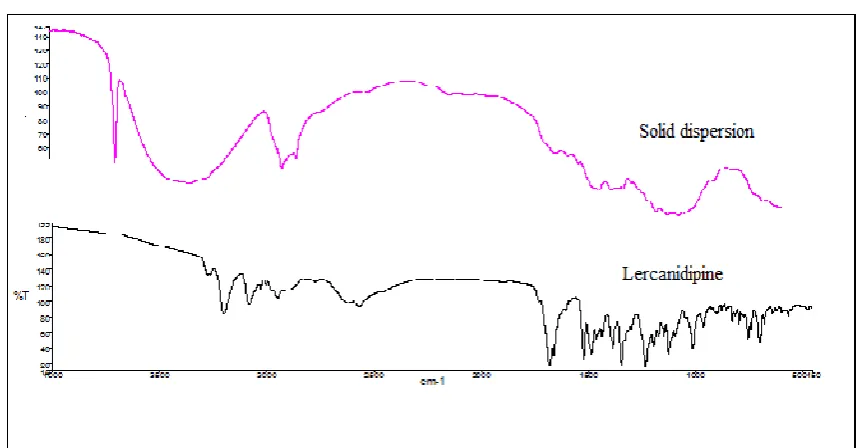
[image:5.595.79.511.404.628.2]IR spectroscopic studies were conducted to determine possible drug: carrier interactions. IR spectra of pure drug Lercanidipine, PVP K30, and Lercanidipine with its Solid dispersion were obtained which shows all the characteristic peaks of Lercanidipine and carrier was present in the Solid dispersion, thus indicating no significant evidence of chemical interaction between drug and carrier, which confirms the stability of drug with its solid dispersion. The result of IR study shown in Figure1.
Fig. 1: IR Specta of Pure Lercanidipine and Solid dispersion.
Differential scanning calorimetry
boiling, and sublimation points usually are shifted to a different temperature or disappear within the temperature range in which the PVP K30 lattice is decomposed. The DSC shows sharp endothermic fusion peak at 196.27˚C, which is corresponding to the melting point of Lercanidipine. (Figure 2).
Figure 2: A) DSC thermogram of lercanidipine.
B) DSC thermogram of Solid dispersion Peak Value -5.62 mW
Peak 196.89 °C LERCANIDINE, 07.04.2014 11:36:54
LERCANIDINE, 2.0000 mg
mW2
°C
40 60 80 100 120 140 160 180 200 220 240 260 280
S
AISSMS College of Pharmacy: METTLER
LERCANIDINE, 07.04.2014 11:36:54 LERCANIDINE, 2.0000 mg
mW2
°C
40 60 80 100 120 140 160 180 200 220 240 260 280
SW 9.01
[image:6.595.102.492.163.444.2]CONCLUSION
The objective of the present study was to improve the solubility and dissolution behaviour of the poorly soluble drug, Lercanidipine by solid dispersion technique using PVP K‐30 and β‐cyclodextrin as carrier. The spray drying method of preparing solid dispersions was found to be satisfactory as it produced good product with high drug content. Out of the 6 formulations prepared formulation F6 showed marked increase in the solubility as well as the dissolution when compared to pure drug. The IR study showed no signs of interactions of the drug with the carrier. Thus it can be concluded that the solubility of the poorly soluble drug, Lercanidipine can be improved markedly by using solid dispersion technique and the carrier PVP K30 has increased the dissolution of the drug without any interaction.
REFERENCES
1. Chiou WL and Riegelman S. Pharmaceutical applications of solid dispersion system. J. Pharm. Sci, 1971; 60: 1281‐1302.
2. Batra V, Shirolkar VS, Mahaparale PR, Kasture PV and Deshpande AD. Solubility and dissolution enhancement of Glipizide by solid dispersion technique. Indian J. Pharma Edu Res, 2008; 42(4): 373‐378
3. Bhanja SB, Ellaiah P, Roy HK, Samal BK, Tiwari S And Murthy KVR “Formulation And Evaluation Of Perindopril Sublingual Tablets” International Journal Of Research In Pharmaceutical And Biomedical Sciences, 2011; 2(3): 1193-1198.
4. Inara Staub, Elfrides ES Schapoval, Ana M Bergold. Microbiological assay of Ketoconazole in shampoo Int.J.pharm, 2005; 292: 195‐199
5. Shashikanth G. Solubility enhancement of Nimesulide and Ibuprofen by solid dispersion technique. Ind.J.Pharm. sci, 2002; 64(6): 529‐534.
6. Van den Mooter G, Wuyts M, Blaton N, Busson R, Grobet P, Augustijns P, Kinget R. Physical stabilization of amorphous Ketoconazole in solid dispersion with polyvinyl pyrrollidone K‐25. Eur.J.Pharm. Sci, 2001; 12: 261‐269.
7. Sachin R Patil, Rani Kumar, Patil MB, Mahesh S Paschapur and Malleswara Rao VSN. Enhancement of Dissolution rate of aceclofenac by solid dispersion technique. Int. J. PharmaTech Res, 2009; 1(4): 1198‐1204.
9. Norbert Rasenack and Bernd W Miiller. Dissolution Rate Enhancement by in Situ Micronization of poorly Watersoluble Drugs. Pharmaceutical Research, 2002; 19(12): 1894‐ 1900.
10. Malleswara Rao VSN, Shyam T, Appa Rao B and Srinivasa Rao Y. Formulation and characterization of meloxicam solid dispersions. The Indian Pharmacist, 2008; 67‐70. 11.Guanhao Ye, Siling Wang, Paul Wan Sia Heng, Ling Chen, Chao Wang. Development
and optimization of solid dispersion containing pellets of itraconazole prepared by high shear pelletization. Int.J.Pharm, 2007; 337: 80‐87.
12.Acharjya Sasmita Kumari, “Spectrophotometric Determination of Lercanidipine Hydrochloride in Pharmaceutical Formulations” International Journal of PharmTech Research CODEN (USA), 2010; 2(2): 1431-1436.
13.Young Sik Chung, “ Complex formulation comprising lercanidipine hydrochloride and valsartan and method for the preparation thereof”, WO2012077968 A3.
14.Wattanaporn abrhamovitz, “Lercanidipine modified release compositions” US 2006165789A.
15.Per holm, Tomas Noling, “Pharmaceutical compositions comprising lercanidipine”, US20070105912 A1.