Secure Handover Scheme for Traffic Optimization
based on OLSR Protocol
S. Indhu1, R. Mohanapriya2
1PG Scholar, 1Assistant Professor, Electronics and Communication Engineering, Paavai Engineering College, Namakkal.
Abstract: Mobile communication industry is growing rapidly with the increasing demand of users in the field of communication. For better communication, there are various networks such as Wi-Fi, which allows the user to stay on always connected and also provide seamless connectivity to the internet. But Wi-Fi has some limitations as its range is limited. Then WiMAX based on IEEE standards and LTE standardized by 3GPP, are two competing technologies, very technically similar which provides the speed of Wi-Fi. Thus by combining these three networks, a new wireless solution is created, which provide seamless roaming and better connectivity for mobile users. By using NS-3 tool, Handoff latency, packet loss, throughput and SNR for mobile users are analyzed. In this we use OLSR protocol, to access the performance of the inter system handover between Wi-Fi, WiMAX and LTE networks. The proposed scheme reduces traffic and increases the quality of communication.
Keywords: Wi-Fi network, WiMAX network, LTE network, OLSR protocol.
I. INTRODUCTION
In the present time, key to provide mobile users with required QoS will be seamless handoff between homogenous or heterogeneous wireless access networks. Also the continuation of user application should not be compromised. Generally handover bring up the process of transferring an active call or data session from one cell in a cellular network to another. There are many reasons to perform handover between three cellular networks, and the most important reason is to deliver uninterrupted service to a user [12, 13]. There are some rules to initialize the handoff and it can be divided into two types:
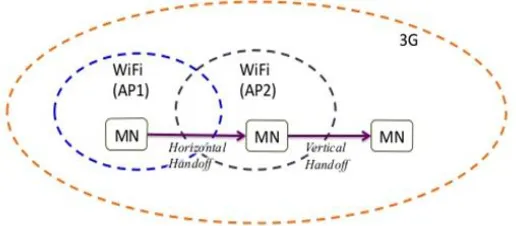
1) Horizontal handoff – In this process the handoff occurs between the two cells having the same access technology or among the
homogenous base stations. In this process there is no connection break between the two cells [11, 14].
2) Vertical handoff – In this process the handoff occur between the two cells having different technologies or when a node moves
between various wireless access networks. In this case the access technologies as well as IP address change because as the node move from one network to another the technology also changes. But change of network interface and IP address are main concern of this process. In the Figure 1.1, a vertical handover occur among AP2 and 3G [12,15].
[image:1.612.177.435.531.644.2]In this paper, three major wireless access technologies-Wi-Fi wireless network, WiMAX mobile communication system and LTE are selected as our research subject. Section 2 describes the method used. Section 3 describes the result and analysis. Section 4 deals with conclusion.
Figure 1.1 Vertical and Horizontal Handover
A. Wi-Fi (Wireless Fidelity)
limited range and the actual distance depend upon the several factors. Generally the range can be 150-300 feet and 1000 feet for outdoor[1].
Technically Wi-Fi setup can contain Access point and clients. Since Wi-Fi communicate in the air so there are chances that collision may occur. But like most of the radio packet it trey to avoid collision rather than collision detection[2].
B. WiMAX
The IEEE 802.16 standard which famously known as WiMAX approved in June 2004. This is comparatively new and also provides better speed and coverage area than Wi-Fi. With the use of WiMAX we can easily achieve the speed up to 70 mbps and the coverage area of 48 kilometer. WiMAX has the capability to provide higher data rates, better coverage area, efficient bandwidth and minimum interference. As it provides long distance communication with better speed it is considered as an alternative to DSL and cable [3].
WiMAX technology is more secure as it uses 3DES and AES encryption technology and also less susceptible to interference. Technically WiMAX uses the similar approach which is used in cell phones. In this approach two channels are used known as uplink and downlink to transfer the data from base station to user and from user to base station respectively.
C. LTE
Long Term Evolution (LTE) is a 4G wireless broadband technology developed by the Third Generation Partnership Project (3GPP), an industry trade group. 3GPP engineers named the technology "Long Term Evolution" because it represents the next step (4G) in a progression from GSM, a 2G standard, to UMTS, the 3G technologies based upon GSM. LTE bring significantly increased peak data rates, with the potential for 100 Mbps downstream and 30 Mbps upstream, reduced latency, scalable bandwidth capacity, and backwards compatibility with existing GSM and UMTS technology. Future developments to could produce peak throughput on the order of 300 Mbps.
1) Handover Procedure: Handover is the process of maintaining a mobile user’s active connection as it moves within the network. When a user moves from one cell to other, maintaining good quality of signal is a very important aspect which includes deciding the correct handover time, the correct handover decision, packet losses, latency, signaling traffic overhead, security and increased system loads [4]. Frequent handovers can put a large burden on the base station and can also lead to an inefficient utilization of network resources. This unnecessary handover is called pingpong effect where a mobile device is handed over from one cell to other cell several times within a period of few milliseconds [5]. Therefore, handover decision criterion should always lead to minimization of these unnecessary handovers.
2) Handover Process: Handover is the process of changing the channel associated with the current connection while a call is in progress. It is often initiated either by crossing a cell boundary or by deterioration in quality of the signal in the current channel. The complete handover procedure is divided into following three phases [6]:
3) Handover Initiation: It deals with collecting all the information, related to network and the mobile device, required to identify the need for handover. For a network, information such as bandwidth available, QoS provided by network, bit error rate, current traffic load, Received Signal Strength (RSS) is collected. For the mobile device, its velocity, battery life and access mode is required.
4) Handover Decision: Based on the various parameters chosen for handover, one best network is selected out of various possibilities. Decision may be taken based on a single parameter like RSS or a combination of two or more parameters from RSS, velocity, available bandwidth, access mode and battery life etc. The decision can be taken by network, the mobile or the network in assistance with mobile.
5) Handover execution: In this phase the connectivity to the target cell is established. The radio link to the old cell is deleted and a radio link to the new cell is set up.
Reasons of Handover: Telecommunication reasons for conducting handoff can vary. Here we have mentioned some of these cases.
a) When the cellular phone is moving away from the area covered by the serving BS, the device eventually goes outside the
range of the serving BS. So in order to avoid call termination, the call needs to be transferred to an area covered by another BS [7].
c) When the capacity for connecting new calls of a cell in a BS becomes full or more traffic is pending, capacity must be made available for users who can only be connected on that cell. Therefore, the existing calls or the new calls from a phone that is located in an area that is overlapped by both cells can be transferred from the first cell to the second cell [7] [8].
d) In non-CDMA networks several phones use different cells but the same channel. As a channel is being used by several phones,
disturbing co-channel interference comes from another phone. Therefore, in order to avoid interference, the call is transferred to a different channel in the same cell or to a different channel in another cell [7].
e) In vertical handoff, a faster network is occasionally available. So the phone changes its network to the cheaper one [8].
II. PROPOSED METHOD
A. Overview of OLSR
We propose a proactive routing protocol for mobile ad hoc networks, which we call as Optimized Link State Routing (OLSR). The protocol inherits the stability of the link state algorithm. Due to its proactive nature, it has an advantage of having the routes immediately available when needed. In a pure link state protocol, all the links with neighbour nodes are declared and are flooded in the entire network. OLSR protocol is an optimization of a pure link state protocol for mobile ad hoc network. First, it reduces the size of control packets: instead of all links, it declares only a subset of links with its neighbours who are its multipoint relay selectors (see Section 2.2). Secondly, it minimizes flooding of this control traffic by using only the selected nodes, called multipoint relays, to diffuses its messages in the network. Only the multipoint relays of a node retransmit its broadcast messages. This technique significantly reduces the number of retransmissions in a flooding or broadcast procedure [9, 10].
Apart from normal periodic control messages, the protocol does not generate extra control traffic in response to link failures and additions. The protocol keeps the routes for all the destinations in the network, hence it is beneficial for the traffic patterns where a large subset of nodes are communicating with each other, and the [source, destination] pairs are also changing with time. The protocol is particularly suitable for large and dense networks, as the optimization done using the multipoint relays works well in this context. More dense and large a network is, more optimization is achieved as compared to the normal link state algorithm.
The protocol is designed to work in a completely distributed manner and thus does not depend upon any central entity. The protocol does not require a reliable transmission for its control messages: each node sends its control messages periodically, and can therefore sustain a loss of some packets from time to time, which happens very often in radio networks due to collisions or other transmission problems. The protocol also does not need an in-order delivery of its messages: each control message contains a sequence number of most recent information, therefore the re-ordering at the receiving end can not make the old information interpreted as the recent one.
OLSR protocol performs hop by hop routing, i.e. each node uses its most recent information to route a packet. Therefore, when a node is movement, its packets can be successfully delivered to it, if its speed is such that its movement could be followed in its neighbourhood, at least. The protocol thus support a nodal mobility that can be traced through its local control messages, which depends upon the frequency of these messages.
B. Multipoint Relays
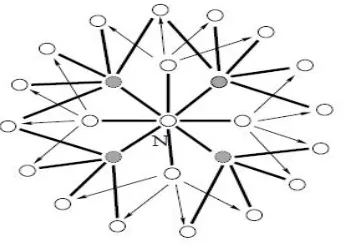
The idea of multipoint relays [11] is to minimize the flooding of broadcast packets in the network by reducing duplicate retransmissions in the same region. Each node in the network selects a set of nodes in its neighborhood, which retransmits its packets. This set of selected neighbour nodes is called the multipoint relays (MPRs) of that node. The neighbors of any node N which are not in its MPR set, read and process the packet but do not retransmit the broadcast packet received from node N. For this purpose, each node maintains a set of its neighbors which are called the MPR Selectors of the node. Every broadcast message coming from these MPR Selectors of a node is assumed to be retransmitted by that node. This set can change over time, which is indicated by the selector nodes in their HELLO messages.
Figure 2.1 Multipoint relays
OLSR protocol relies on the selection of multipoint relays, and calculates its routes to all known destinations through these nodes, i.e. MPR nodes are selected as intermediate nodes in the path. To implement this scheme, each node in the network periodically broadcast the information about its one-hop neighbors which have selected it as a multipoint relay. Upon receipt of this MPR Selector’s information, each node calculates and updates its routes to each known destination. Therefore, the route is a sequence of hops through the multipoint relays from source to destination.
Multipoint relays are selected among the one hop neighbors with a bi-directional link. Therefore, selecting the route through multipoint relays automatically avoids the problems associated with data packets transfer on uni-directional links. Such problems may consist of getting an acknowledgment for data packets at each hop which cannot be received if there is a uni-directional link in the selected route.
[image:4.612.133.480.367.551.2]III. RESULT AND ANALYSIS
Figure 3.1 Three wireless network connected together
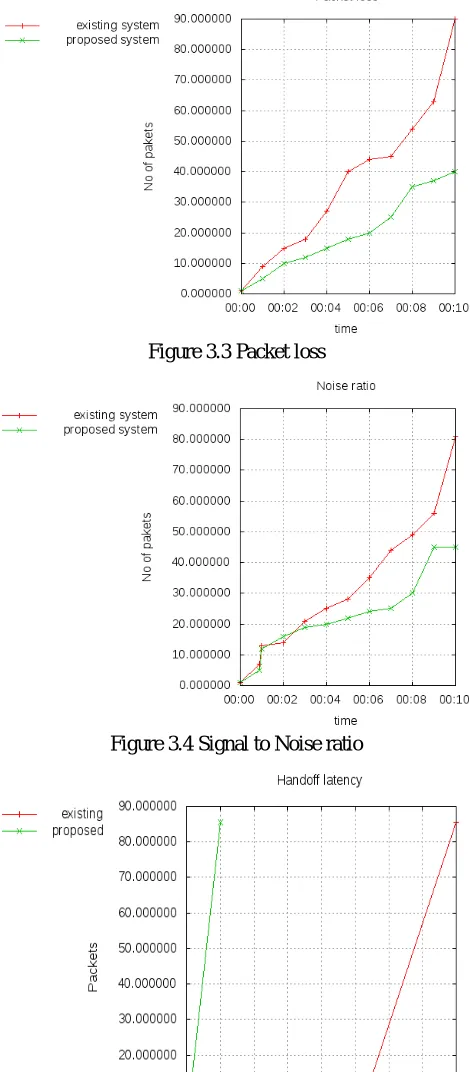
Figure 3.3 Packet loss
Figure 3.4 Signal to Noise ratio
Figure 3.5 Handoff latency
IV. CONCLUSION
REFERENCE
[1] Malak,” Battery Based Vertical Handover between WiMAX and WLAN Technologies” 978-1-4244- 5118-011©2011 IEEE.
[2] Miss.Minal J.Patil, Prof.S.S.Patil, “Simulation Based Analysis of Vertical Handover Between Wi-Fi and WiMAX Networks using NS2”, International Journal of Engineering Trends and Technology (IJETT) –Volume 11 Numbers 9-May2014
[3] Gurpartap Singh*, Garima Saini,” Development of Vertical Handover (VHO) Protocol Based on MIH (IEEE 802.21 standard) In UMTS-WIMAX Heterogeneous Network” International Journal of Scientific Research Engineering & Technology (IJSRET) Volume 1 Issue2 pp 027-034 May 2012. [4] A. Singhrova, N. Prakash,” Vertical handoff decision algorithm for improved quality of service in heterogeneous wireless networks”, IET Communications,
vol. 62, pp. 211- 223,2012.
[5] G. P. Pollini,”Trends in Handover Design.” IEEE Commun. Mag., vol. 34:pp. 82-90, 1996.
[6] K.Sethom, Ben Reguiga, F. Mhiri, R.Bouallegue,” Handoff Management in Green FEMTOCELL Network”, International Journal of Computer Applications, vol. 27,pp. 1-7,2011.
[7] Pooja, B., Bijender M., “Analysis of Handover in Wimax for Ubiquitous connectivity”, International Journal of Computational Engineering Research, ISSN: 2250–3005, Vol. 2, July-August 2012.
[8] Makelainen, A., “Analysis of Handoff Performance in Mobile WiMAX,” pp.12-68, 2007.
[9] A. Qayyum, L. Viennot, and A. Laouiti. Multipoint relaying: An efficient technique for flooding in mobile wireless networks. Technical Report RR-3898, INRIA, February 2000.
[10] Amir Qayyum. Analysis and Evaluation of Channel Access Schemes and Routing Protocol in Wireless LANs. PhD thesis, Universite de Paris-sud, Orsay, France, 2000.
[11] ETSI STC-RES10 Committee. Radio Equipment and Systems: High Performance Radio Local Area Network (HIPERLAN) Type 1, Functional specifications, June 1996. ETS 300-652.