Volume 2, Issue 8, August 2013
Page 137
Abstract
The trend of scientific transformations, technological leaps, and the dimensions of their effects on society remind the necessity of considering ethical criteria and social commitments in designing appropriate models of innovation management.
Innovation Management, scientific, and technological changes require a true understanding of the idea formation process to its commercializing with respect to the values of society and observation of ethical standards.
In this regard, forces and institutions involved in innovation process are faced with issues such as intellectual property rights, confidential information, and appropriate resources management. These issues always possess ethical aspects.
Development of portfolio codes of ethics and new standards is an important element in transformational innovation which provides the necessary condition for the trend of free thinking and value making preserving intellectual property rights.In this paper, first the procedures of innovation process and the role of ethical codes in it are introduced and then, portfolio codes of ethics in each innovation stage from pre-idea stage to investment options basket are presented.
Keywords: Codes of ethics, Portfolio, Open Innovation, Mass collaboration
1.Introduction
In present century, the knowledge forces are the bases of economic, cultural, social, and political growth of various societies; and development of knowledge-based industries has gained especial importance. This subject because of shift paradigm development from closed innovation toward open innovation occurs in the world.
Based on theories of scientists in field of open innovation, By coining the Open Innovation model, Chesbrough has brought to the surface why former leading multinationals like Philips, Xerox and IBM did not manage to obtain full credits from their massive R&D expenditures, and why relatively new-born enterprises like Intel managed to grow rapidly in the past decades. And because the intellectual property (IP) that arises from this internal innovation was closely guarded, rivals could barely exploit these ideas for their own profit [1]. Technological innovation management requires technical readiness on the part of materials, human and financial resources. However, without a specific and definite culture, the technical aspect of technological innovation will not be created in a satisfactory manner [2]. In this respect, knowledge forces and institutions involved in the whole process of innovation are faced with issues like intellectual property rights, confidential information, and appropriate resource management. These issues have always had ethical aspects. There is a great demand in this area for ethical behavior toward the involved sectors and observation of ethical codes in all sectors is one of the infrastructural requirements for moving toward a knowledge society [3]. Innovation ethics covers the complicated relationship among ethics, traditions, religious features, economy, and management.
Determination of Portfolio Codes of Ethics in
Innovation Management
Maryam Goodarzi1, Mashallah Torabi 2*(D.D.S.), Jayran Zebardast3, Reza Safdari4, Daryadokht Masroor Roodsari5, Tahmineh Akbarzadeh6, AzarMehri7, Jamshid Hadjati8, Tahereh Mousavi
Shabestari9
1Expert of Industrial Engineering, Tehran University of Medical Sciences, Tehran, Iran
2*(Corresponding author) President Counselor and Secretary of Innovation Initiative , Tehran University of Medical Sciences, Tehran,Iran
3Researcher nurse, Deputy of research, Imam Khomeini Hospital, Tehran University of Medical Science, Tehran, Iran.
4Associated Professor, Department of Health Information Management, Faculty of Allied Health sciences, Tehran University of Medical Sciences, Tehran,Iran
5Senior lecturer, Faculty of nursing & midwifery ,Tehran University of Medical Sciences, Tehran,Iran
6Assistant professor, Department of medical chemistry, faculty of pharmacy, Tehran University of Medical Sciences, Tehran,Iran
7Lecturer, Faculty of Rehabilitation, Tehran University of Medical Sciences, Tehran,Iran
8Professor, Department of Immunology, Faculty of Medicine, Tehran University of Medical Sciences, Tehran,Iran
Volume 2, Issue 8, August 2013
Page 138
Application of ethics in business focuses on the relationship between ethics and marketing, agency and personnel, company and customers, and other interested parties. Commercialization in innovation process makes a relationship between ethics in specialized areas and commercial ethics thereby emergence of a new combination of ethics in growing institutions and advanced technologies which requires a holistic approach within the framework of the portfolio codes of ethics. Portfolio codes of ethics as an appropriate and power infrastructure for continual improvement in innovation process supply chain increase the capability, security, and efficiency of all interested from the pre-idea stage to entrepreneurship and commercialization and "popularization" stage. In this paper purpose of popularization is beyond the commercialization. In this phase, creativity of people actually provide field of product development, cause the loop, return to development stage and create new innovation. Development of portfolio codes of ethics and new standards is an important element in transformational innovation which provides the necessary condition for the stream of free knowledge and value making preserving intellectual property rights.
Portfolio is a collection of independent but interrelated projects which are administered for the realization of common ideals, goals, and values.
In this paper, portfolio codes of ethics are defined from the viewpoints of authors as following:
Portfolio of ethical codes is a collection of ethical codes in different parts of innovation process which completes the value system of innovation process.
2.Research Background
One of the outstanding future-inspecting individuals is Drucker, the author of "Society after bourgeoisie", considers the structure of new society "knowledge society" which influences knowledge industries, economy, and knowledge individuals of the whole society. Knowledge industries include professionals, communication agents, and computer companies. Facing with this issue, everything from financial resources to education must change to prepare the personnel and citizens for entering the new society. Drucker has investigated this view from different perspectives and has accepted that the structure of knowledge society cannot be clearly recognized [4]. Organizations of this kind of societies have the following features: This model also indicates the need to integrated management of innovation process to prepare the ground for development of organizational value and value-adding products [5]. Organizations with large innovations can respond better for changes of environment and help them to attain excellent performance [6].
Although there are various innovations in product, the aspects of innovation such as business model of innovation are appeared. For example, In the UK, innovation management has leading role in change of products to service [7]. An innovation is defined as new or improved products. In the other hand, innovations are new organizational procedures in business activities. Furthermore, innovations can lead to increase sales of products and the companies’ regard in customer’s perception [8]. One concept in innovation activities is a form of collective works which take place between the great groups of people freely is mass collaboration and also, it occurs on creative activities [9].
3.Main goal
1. Guaranteeing of the trend of integrated leadership and management of innovation that form a conducive environment for accumulation of innovative ideas, customization, and participation
2. Determining the importance and agreement on each of the defined ethical codes in innovation process management
4.Hypothesis
In order to achieve mass innovation in process of innovation, in this research, first, we gathered portfolio codes of ethics and then, through Delphi method, we determined some codes which are very important in process of idea to commercialization. Summary of the hypothesis is presented in figure1. The code of Transparency is important in creation step while accessibility and intellectual property rights are significant in next step. However, privacy and documentation, competitiveness and dynamicity, and sustainability are necessary in whole process of innovation management.
Figure1 Research hypothesis
5.Stages of innovation process
Volume 2, Issue 8, August 2013
Page 139
incompatibilities, process needs, changes of industry and market, changes of population features, change of attitude, and new knowledge [10]. Each of these factors act effectively in pre –idea stage and enters the thinker into the divergence stage which associated with thinking chaos (stage one- creation (pre-idea)). Proctor (1995) insists that in a brainstorming, all ideas are accepted and none should be rejected which warrants the necessity to sift all ideas before we filter it for final evaluation considering that no ideas should be “killed” during the process. This actual process today provided a structured approach to mass ideation which can be done by any size of audience (11).
Idea is a novel representation in individual’s mind relating to conception or notion of something to be done or carried out. The new idea is first born in individual mind and then in the second stage shared with [12]. Successfully passing this stage is concurrent with emergence of initial idea in relation to new solutions (stage two – idea management (idea basket)). Idea changes to innovation during the execution process. Without the successful execution, the idea will not change to innovation.
The next stage commences by putting to the similar ideas of convergence stage together. Combining the ideas or completing the dimensions of superior ideas, management of idea basket is completed and promoted to the next stage which is the stage of tests and production of initial sample of the new ideas (stage three – development of initial sample (tests basket)). At this stage, a basket of tests and their results is provided through analysis of which at the nest portal, a list of investment options is obtained (stage four – commercialization (investment options basket)). Selection of appropriate option from among the investment options list involves high risk and passing it requires the role of entrepreneurs. It is a determining stage for obtaining the results of innovation process, and in case of success, will lead to value adding for all interested parties (stage five and six – completing innovation cycle, monitoring and reinventing models of opportunity seeking and opportunity making) (Figure 2)[13]. Only a few options suitable for investment can pass various barriers; because on the one hand, the issue of demand management is influential in the internal cycle of innovation and confirms the fact that if a good idea is offered at the wrong time, it will face a serious challenge in obtaining the marketing, and since it is better to postpone its supply to an appropriate time, some projects may be lost at this process and never reach the stage of production and commercial success. On the other hand, it should be noted that successful transformational innovations enter into market in the form of a cluster and wave. They prepare the ground for creation of new applications and by increasing economic activities cause the external cycle of innovation to be more active thereby paving the way for blossoming knowledge innovation and creating increasing demands for new technologies in the society [2]. The important stages in this section of process is the expansive use of goods or services by the users, creative applying stage & combinational and different use of them which are referred to as "popularization" in this paper. It creates connection with developing stage and provides new cycle for evolutionary innovation in new goods or services and all people practically participate in innovative promotion of goods or services (Figure2).
Figure2 The stages of innovation management process
6. ETHICAL aspect of innovation process managemen
The necessity of developing standards at universal level for determining the indices of ethics has been globalized which facilitates business at many levels (strategic participation, cooperation, and transactions) and offers high quality services and products to the customers. In addition, many attitudes regarding these forces in business environments have been created which include [14]:
Inclination toward production quality and customer satisfaction
Inclination toward more professionalism, accountability, and independence Managers' inclination toward leadership and being facilitator
Volume 2, Issue 8, August 2013
Page 140
A study has shown that entrepreneurial innovation definitely influences the quality of relations between partners in the production process when it is accompanied by ethical values. Besides, establishment of ethical conditions may restrict innovation in purchasing process [15].
There are many ways in which ethical and unethical behavior can affect the commercial success of the company and price sharing. Also, use of ethical criteria in the selection of sharing portfolios can have various positive or negative effects on investment performance. At present, many studies show that performance of the new ethical subjects of a company can influence the proportion or disproportion of price sharing in the company [16].
As innovation researcher and the best author in the field of sale, Harold Evans, writes "scientist looks for understanding, inventor seeks solution, and innovator searches for comprehensive and general application of the solution. In this respect, the distinction between invention and innovation is deep: innovation includes matching a solution to a society. Examining innovation requires combination of the power of technology invention and its influence upon the society and points to ethics in innovation when the focus is mostly on technology [4].
6.1The Principles of Tri-Council statement on Ethics
The Tri-Council statement on Ethicsconsidered development of innovative programs which respect human dignity. This association necessitates observation of complete disclosure of the goals, respect for vulnerable persons, privacy and confidentiality, justice and inclusiveness, balancing harms and damages, and minimizing harm. Each of these cases is considerable in its own sake and includes:
Respect for human dignity
These rules involve multiple and related support of the individuals – physical to psychological – for cultural integration. This approach also holds true in innovation: the basic principles of innovation in development of innovative programs must observe human dignity.
Respect for full disclosure of goals
One of the similar principles in developing innovative programs is complete disclosure of the goals. In the administration texts, clear expression of the goals and plans has been stated. One reason is that without a clear expression of the goals and plans, evaluations cannot be conducted appropriately. Another reason is the ethical need for treating individuals appropriately.
Respect for vulnerable persons
The ethical commitment for equality is resulted from respecting human dignity which means equal respect and attention to or considering the unique condition of anybody which determines the kind of respect to him/her. Ethical commitment to vulnerable individuals in research activities refers to specific ways of preserving their interests.
Respect for privacy and confidentiality
Respecting privacy is the foundation of most activities whether they are innovative or not. Respect for Justice and Inclusiveness
Justice means fairness and equity and deals with distribution of advantages and capacities in innovative activities. In other words, distributional justice means that no segment of the population should unjustly face with damages caused by innovation.
Balancing harms and damages Minimizing harm
These ethical aspects of technology have attracted much attention in writings. In addition, most knowledge-oriented growing companies are faced with other issues of ethical dimensions in some important cases: intellectual property rights, confidential information, and increasing money. In various stages of commercializing innovation and during the life of a newly-established company, ethical problems can raise [17] such as:
Intellectual property Privacy of information
Negotiation process between entrepreneur and investor Marketing the increasing capitals, initial public supply
6.2Portfolio ethical codes in the process of innovation management
Considering the points mentioned the criteria for promotion and development of portfolio ethical codes in the process of innovation need special attention which include: transparency, documentation and privacy, intellectual property rights, dynamicity and competitiveness, accessibility, and sustainability.
1. Transparency
Volume 2, Issue 8, August 2013
Page 141
create great values and lead to creation of technical knowledge and innovation in an energetic and insightful environment. Observing principles of professional ethics in this area prevents useless struggles and personal disagreements and prepares the atmosphere for dreaming and believing the thoughts [19].
2.Documentation and privacy
Documenting all agreements of group members as well as jotting down the information sources used in innovation process and agreements concluded with all individuals, institutions, and organizations; observing confidentiality and preserving scientific and commercial information.
Since each innovation passes through a unique and complex developmental process, cooperation with others may result in the spread of many innovation secrets, and the supervision mechanism is very difficult, the issue of documentation and privacy has been raised which are among the important ethical points. Serious application of ethical codes is the most efficient way if developing value making innovations. Of course, other criteria such as carefulness in preserving documents and not transferring information in nontechnical negotiations are presented in this regard.
3.intellectual property rights
Registering the results obtained in all stages of innovation process in legal authorities and tracking the instances of violations from it. This code relates to the stage of commercialization to monitoring and reinventing the opportunity seeking and opportunity making models. It is very important in the idea basket as well as tests basket; because if innovation process stops for any reason in these stages, only intellectual property can be sold. Observing ethical code of this stage of innovation process including the level of novelty, having an innovative step, and having industrial application is very important [20]. Since controlling this issue in regard to ideas opposing order and ethics is necessary and regarding methods of diagnosis, treatment, and operation for curing human and animal, biological processes, discoveries, scientific theories and mathematical methods, plans and methods of doing jobs, commerce and financial plans, and whatever which is only for play do not permit registration of the invention, the issue of observing ethical codes is very considerable [19].
4.Dynamicity and competitiveness
Since development of innovation process requires creation of a dynamic environment, the necessary condition for scientific exchanges and developing merit models, observing the above-mentioned principles, must be prepared. Dynamicity in innovation results from the collection of intellectual, organizational property and customer and human capital; thus, creation of an environment based on ethical rules increases the dynamicity and transformation in all stages of innovation process. Respecting customer, honoring human capital, considering human interests, and timely informing interested parties are important criteria regarding this code and observing the criteria of recognition of sustainable innovation strengthens it.
Criteria of recognition of sustainable innovation are separated two sections of internal and external criteria, for instance justice model of business in external and value of customer criteria [21].
5.Accessibility
Determining the access level of all individuals involved in innovation process to various projects and way of getting license for accessing unpermitted cases in emergency. This code includes stages of idea management to development of initial sample. Innovation does not blossom in an environment of order and supervision; rather, it needs trust, and delegation of authority and power. Ethical codes related to access prepare the ground for playing effective role of elements active in innovation process. They pave the way for management of innovation process, idea basket, and tests.
6.Sustainability
Sustainability as a key concept is considered as a force for promoting value in the society when the interests of the present and future interested parties are predicted. Therefore, an innovation which is adaptable with the present value systems of society and is within the framework of supporting ecosystems is considered as sustainable; so that while preserving balance in the values arisen from technology and without sacrificing future choices, new business options are created for today's costumers(Figure3).
Volume 2, Issue 8, August 2013
Page 142
6.3Instances of unethical behaviorAlthough unethical instances are rare in most professions, they exist. Advertisements, media, and high amount of money have created great damages. In some cases, struggles are observed on patent after offering company stocks.
Sometimes, key individuals who were involved in a newly-established company have left it after a short period [2].
7.Research methodology
Since developing and determining ethical codes in innovation management require the agreement of experts in this area, Delphi method was selected for this study.
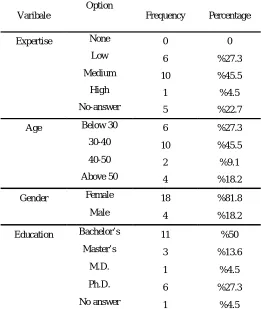
In the first phase, the Delphi process was administered among 22 individuals participating in the workshop of innovation. To this aim, a questionnaire was developed by reviewing the portfolio of ethical codes within the framework of six main codes including transparency, documentation and privacy, intellectual property rights, competition and dynamicity, access, and durability. The participants’ responses were analyzed after collecting the data. Then, in order to start the second phase, a questionnaire involving the feedback on experts’ views in the first phase was developed. (In the second phase, two experts did not answer the questionnaire and were dropped out of the study). After analyzing the results and achieving the expected level of agreement among the experts, the importance of each code was evaluated. Thus, if the output of test was less than five hundredth (0.05), it could be concluded with 95percent significance that the importance of the codes were different from each other. The most and the least important codes from the viewpoint of the experts can be observed in the table of mean ranks (table1).
Table 1: Characteristics of the Experts
Percentage Frequency
Option Varibale
0 0
None Expertise
27.3 % 6
Low
45.5 % 10
Medium
4.5 % 1
High
22.7 % 5
No-answer
27.3 % 6
Below 30 Age
45.5 % 10
30-40
9.1 % 2
40-50
18.2 % 4
Above 50
81.8 % 18
Female Gender
18.2 % 4
Male
50 % 11
Bachelor’s Education
13.6 % 3
Master’s
4.5 % 1
M.D.
27.3 % 6
Ph.D.
4.5 % 1
No answer
8.Findings
In present study, 22 individuals were selected for participation in Delphi process whose characteristics regarding four indicators of age, gender, education, and level of expertise (according to their own views) are as following:
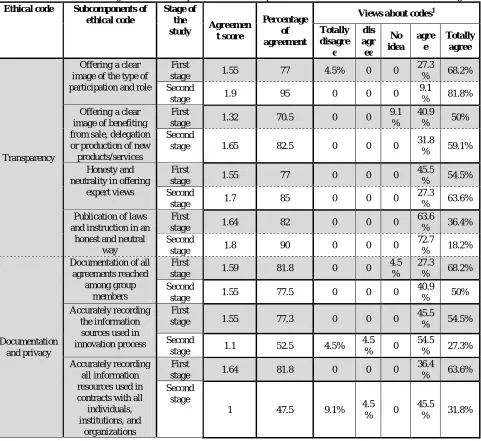
Investigation of the agreement of experts on sub-components of ethical codes of the process of innovation management in the first and second stages of Delphi process.
Volume 2, Issue 8, August 2013
Page 143
transparency is 88 percent which indicates a high level of agreement among experts. In the ethical code of “documentation and privacy”, in the first stage, the agreement of the experts about one of the sub-components was over 70 percent and for all other components was over 80 percent. In the second stage, this value has decreased for all sub-components (the average reduction is 16 percent). However, the percentage of agreement for most codes in both stages is over 50 percent. Therefore, the final mean score of agreement for the code of “documentation and privacy” is about 66 percent which shows the good level of agreement among experts. In the code of “intellectual property rights”, in the first stage, the agreement of the experts about two codes was over 70 percent and for others was about 68 percent. In the second stage, this value decreased for some components (the average change of experts’ agreement for all sub-components is about 1 percent of increase in agreement). Nevertheless, the percent of agreement for most codes in both stages is above 60 percent. Thus, the final mean score of agreement for the ethical code of “intellectual property rights” is about 75 percent indicating a good level of agreement among experts. In the ethical code of “competition and dynamicity”, in the first stage, the agreement of experts on some sub-components was over 70 percent and on some others was even over 90 percent In the second stage, this value increased for all sub-components. The average increase is about 8 percent. Also, the final mean score of the agreement for this ethical code is about 85% revealing a good level of agreement among experts.
Table 2: Agreement of the experts on the sub-components of ethical codes in the first and second stages
Views about codes1 Percentage of agreement Agreemen t score Stage of the study Subcomponents of ethical code Ethical code Totally agree agre e No idea dis agr ee Totally disagre e 68.2% 27.3 % 0 0 4.5% 77 1.55 First stage Offering a clear
image of the type of participation and role
Transparency 81.8% 9.1 % 0 0 0 95 1.9 Second stage 50% 40.9 % 9.1 % 0 0 70.5 1.32 First stage Offering a clear
image of benefiting from sale, delegation or production of new products/services 59.1% 31.8 % 0 0 0 82.5 1.65 Second stage 54.5% 45.5 % 0 0 0 77 1.55 First stage Honesty and
neutrality in offering expert views 63.6% 27.3 % 0 0 0 85 1.7 Second stage 36.4% 63.6 % 0 0 0 82 1.64 First stage Publication of laws
and instruction in an honest and neutral
way 18.2%
72.7 % 0 0 0 90 1.8 Second stage 68.2% 27.3 % 4.5 % 0 0 81.8 1.59 First stage Documentation of all
agreements reached among group members Documentation and privacy 50% 40.9 % 0 0 0 77.5 1.55 Second stage 54.5% 45.5 % 0 0 0 77.3 1.55 First stage Accurately recording the information sources used in
innovation process 54.5 27.3%
% 0 4.5 % 4.5% 52.5 1.1 Second stage 63.6% 36.4 % 0 0 0 81.8 1.64 First stage Accurately recording all information resources used in contracts with all
Volume 2, Issue 8, August 2013
Page 144
72.7% 22.7 % 0 0 0 88.1 1.76 First stage Observing the rulesof privacy 68.2% 22.7 % 0 0 0 87.5 1.75 Second stage 59.1% 36.4 % 0 0 0 80.9 1.62 First stage Recording the result
obtained in all stages of innovation process in legal authorities
Intellectual property rights 54.5% 36.4 % 0 0 0 80 1.6 Second stage 40.9% 54.5 % 4.5 % 0 0 68.2 1.32 First stage Providing authorities
with the information on risky behaviors or
illegal activities 31.8%
45.5 % 13.6 % 0 0 60 1.05 Second stage 54.5% 40.9 % 4.5 % 0 0 75 1.45 First stage Offering the reports
or result of tests observing all rights of relevant parts in innovation process 3.6 6 % 27.3 % 0 0 0 85 1.7 Second stage 54.5% 36.4 % 0 4.5 % 0 73.8 1.52 First stage Making necessary conditions for scientific exchanges Dynamicity and competitivenes s 54.5 31.8 0 0 0 81.6 1.63 Second stage 45.5% 45.5 % 4.5 % 0 0 71.4 1.38 First stage Investigating others’
jobs while respecting them 45.5 40.9 0 0 0 76.3 1.53 Second stage 59.1% 36.4 % 0 0 0 80.9 1.62 First stage Respecting the customers 68.2 18.2 0 0 0 89.5 1.79 Second stage 63.6% 31.8 % 0 0 0 83.3 1.67 First stage Valuing human capital 72.7 13.6 0 0 0 92.1 1.84 Second stage 45.5% 45.5 % 4.5 % 0 0 71.4 1.38 First stage Considering human benefits 59.1 22.7 4.5 0 0 81.5 1.58 Second stage 45.5% 40.9 % 4.5 % 0 0 72.5 1.4 First stage On-time information
to related parties
63.6 18.2 4.5 0 0 84.2 1.63 Second stage 77.3% 13.6 % 4.5 % 0 0 88.1 1.7 First stage Competition for offering higher quality 72.7 13.6 0 0 0 92.1 1.84 Second stage 40.9% 45.5 % 4.5 % 4.5 % 0 64.3 1.29 First stage Determining level of
access of all individuals to various projects in innovation
process accessibility 36.4% 45.5 % 4.5 % 0 0 68.4 1.32 Second stage 45.5% 50% 0 0 0 73.8 1.48 First stage Creating appropriate
portal for getting legal licenses 36.4% 45.5 % 0 0 0 72.2 1.44 Second stage 50% 40.9 % 4.5 % 0 0 73.8 1.43 First stage Predicting the
Volume 2, Issue 8, August 2013
Page 145
68.2% 13.6
% 4.5
% 0 0
86.8 1.68
Second stage parties at present and
future
36.4% 50%
4.5 % 4.5
% 0
61.9 1.24
First stage Respecting others’
fame, profession, and businesses
36.4% 45.5
% 4.5
% 0 0
68.4 1.32
Second stage
59.1% 31.8
% 4.5
% 0 0
78.6 1.52
First stage Reducing wastes, and
increasing recycling and use of reusable
energy resources 68.2%
18.2 % 0 0 0
89.5 1.79
Second stage
In the ethical code of “accessibility”, in the first stage of the process, the agreement of experts was over 64 percent. In the second stage, this value has increased for one sub-component and has decreased for another. (The average increase in the agreement of experts for all sub-components is 1.3 percent.). Also, the final means score of agreement for the ethical code of access is about 70 percent which refers to a good level of agreement among experts. In the ethical code of “sustainability”, in the first stage, the agreement of experts is over 61 percent which has increased for all sub-components in the second stage. (The average increase in the agreement of the experts is about 10 percent). Hence, the final mean score of agreement for the ethical code of durability is about 80 percent which shows a good level of agreement among experts (table3).
Volume 2, Issue 8, August 2013
Page 146
By reviewing the agreement score in the defined indices in the subcomponents of 6 factors under study, summing the scores and dividing them by the number of subcomponents, a new classification of the views of audiences toward the factors is obtained: the factor of transparency, competitiveness, and dynamicity in the first rank, the factor of intellectual property right and sustainability in the second rank, and factor of documentation and privacy, and accessibility are placed in the third rank. Therefore, the first ethical codes that must be considered, explained, and agreed on by innovation teams are the codes predicted in the factors of transparency, competitiveness, and dynamicity. In the next steps, the innovation teams must work on agreement on the ethical codes of intellectual property rights and sustainability.
9.Conclusion
Considering the results obtained above, the necessity of developing the basket of ethical codes at each stage of innovation and considering its comprehensiveness in the cycle of idea to product can be suggested as below:
In the pre-idea stage, presence of ethical codes of transparency, competitiveness, and dynamicity is required. Although presence of these codes until the end of innovation process is very important, their existence is more necessary at this stage.
In the stage of idea basket, the ethical codes of intellectual property and sustainability are required. In the stage of test basket, the codes of documentation and accessibility are very important and must be considered (Figure4).
Figure4 Dynamic Innovation Funnel
Transparency, Competitiveness and Dynamicity……….…
Intellectual Property Rights and Sustainability……… Documentation and privacy, and Accessibility………
References
[1] H.Chesbrough,J.de Jong, W.Vanhaverbeke, T.Kalvet, “Policies for Open Innovation- Theory, Framework and Cases”. VISION Era-Net, Helsinki, Finland.
[2] E. Claver, “Organizational culture for innovation and new technological behavior”. Journal of high technology management research 9 (1):55-68. 1988
[3] Y.Fassin,” Innovation and Ethics Ethical Considerations in the Innovation Business”. Journal of Business Ethics.27(1-2): 193–203. 2000.
[4] K .Martin,”Innovation, Ethics, and Business”, Business Roundtable Institute for Corporate Ethics. 2008
[5] N.Wickramasinghe,”Knowledge Management and Data Mining: Strategic Imperatives for Healthcare”. Proceedings of the 3rd Hospital of the Future Conference. 2003
[6] C.Chen,J. Huang,” Strategic human resource practices and innovation performance — The mediating role of knowledge management capacity”. Journal of Business Research (62) : 104–114. 2009
[7] M.Mol,J. Birkinshaw,” The sources of management innovation: When firms introduce new management practices”. Journal of Business Research(62):1269–1280. 2009.
[8] S.Apak,S. G.Tuncer,N. Atay, E.Koşan,” Insights From Knowledge Management to Radical Innovation: “Internet
Banking Applications in the European Union”. Procedia - Social and Behavioral Sciences (41):45 – 50
[9] http://en.wikipedia.org/wiki/Mass_collaboration. 2012.
[10]P. Drucker,” The discipline of innovation”. Harvard Business Review. 5-8. 1998
[11]S.Michael, J.Butterworth, “Using "iLab" to manage hundreds & thousands of ideas in a mass ideation process”. 2005.[online].Available:http:// www.innovationtools.com. [Accessed:May.05.2012]
[12]T.Santonen,” Creation the Foundations for mass innovation: implementing national open innovation system (NOIS) as a part of higher education”. 2007
Volume 2, Issue 8, August 2013
Page 147
[14]K.Kaufman, V,Desotelle, “The link between ethics & innovation” 2002. [online].Available:http://www.wholesysteminnovation.com.[ Accessed: December.09. 2011]
[15]T.Gonzalez, et al. " Exploiting innovative opportunities in global purchasing: An assessment of ethical climate & relationship performance". Journal of Industrial marketing management 37( 1): 69-82. 2008
[16]R.Havemann,P. Webster.”Does ethical investment pay? EIRIS research and other studies of ethical investment and
financial performance”. 1999. [5 August 2010].
www.eiris.org/files/research%20publications/doesethicalinvestmentpay99.pdf
[17]Greene, I.1992." The Ethics & Development of Innovation Projects".[online].Available:http:// www.cipo.ic.gc.ca.[ Accessed: July.08. 2011]
[18]J. verloop, Insight in Innovation: Managing Innovation by Understanding the Laws of Innovation, Elsevier, 29.2004
[19]H. Moir, “A question of balance review of patentable subject matter”. Australian national university. ".[online].Available: http:// Available at: www.acip.gov.au. [Accessed: February.10. 2012]
[20]M.Torabi,”Thinking Architecture In Knowledge Management”.Mirmah:Tehran,Iran. , 2007
AUTHOR
Maryam Goodarzi received the M.S.c degree in Industrial Engineering- system management and productivity from Tarbiat Modares University in 2011.Currently, she is Master of Innovation Initiative in Tehran University of Medical Sciences.
*Corresponding author: Mashallah Torabi
Dr. Mashallah Torabi received the degree in dentistry from Shahid Beheshti Universiy in
1993. Currently, He is a Faculty member ,Secretary of Innovation Initiative and Advisor to Chancellor in Information Technology scope of Tehran University of Medical Sciences. His interests is in innovation management, innovationethics, lean thinking, competency mapping and ehealth.
Jayran Zebardast received the degree in Nursing from Tehran University of Medical Sciences in 2002.She is an expertise of patient education in emergency department of Imam Khomeini hospital ( a teaching general hospital of Tehran University of Medical Sciences).Her interests is in academic writing and data analyzing research in all medical fields and do as consulter in Deputy of research in Imam Khomeini Hospital, Tehran University of Medical Science, too .
Dr. Reza Safdari is faculty member of Tehran University of medical sciences, Faculty of allied medicine, department of health information management.
Mrs. Daryadokht Masroor Roodsari is Master of science (medical-surgical nursing education)
Faculty member of Tehren University of medical sciences, senior lecturer-instructors at medical-surgical- nursing department of nursing & midwifery ,Diploma in social science from Massey University (1999), Manager of Education Development Office at Nursing & Midwifery School.
Dr. Tahmineh Akbarzadeh received her ph.D degree in medicinal chemistry fromTehren University of medical sciences. She is assistant professor in medicinal chemistry department, school of pharmacy, Tehran University of Medical Sciences.
Dr. Azar Mehri received the M.S.c degree in Speech Therapy from University of Welfare and Rehabilitation Sciences in 2002.She is Member of academic staff, Speech Therapy Department of Rehabilitation Faculty in Tehran University of Medical Sciences (TUMS) and PhD Candidate in Speech Therapy.
Member of academic staff, Speech Therapy Department, Rehabilitation Faculty, Tehran University of Medical Sciences
Dr. Jamshid Hadjati received his ph.D in medical immunology from Tehren University of medical sciences in 1993. He is professor in immunology department of Tehren University of medical sciences and his main research focus in fomor immunology. He is representative of medical school in innovation office in innovation office of the university.