International Journal of Applied And Pure Science and
Agriculture
www.ijapsa.com
EFFECT OF BIOFERTILIZERS ON YIELD ATTRIBUTING CHARACTERS
AND YIELD OF OKRA (
ABELMOSCHUS ESCULENTUS
(L.) MOENCH)
Anisa N. A.1, Dr.Baby Lissy Markose2, Dr.Salykutty Joseph3
1,2,3
Department of Olericulture, College of Horticulture, Kerala Agricultural University, Thrissur, Kerala, India
Abstract
Field experiments were conducted to assess the effect of biofertilizers on okra in Kerala during Kharif in a Randomised Block Design with 13 treatments and 3 replications. The variety Arka Anamika was treated with FYM and three different biofertilizers (Azospirillum, Arbuscular Mycorrhizal Fungi and Frateuria) in different combinations. Performance with respect to yield and yield attributing characters were best in the treatment where combined application of all the three biofertilizers along with double dose of FYM was given (T8). This was closely followed by the
treatment where full dose of FYM, ¾ of inorganic fertilizers and biofertilizers (T10) were applied.
Keywords: Okra, Yield, Azospirillum, Arbuscular Mycorrhizal Fungi, Frateuria
I. INTRODUCTION
Okra (Abelmoschus esculentus (L.) Moench) is one of the most important vegetable crops
grown for its tender green fruits. In India okra occupies an area of 4.5 lakh ha with a production of 48.03 lakh tonnes [1]. It has high nutritive value, therapeutic benefits and export potential. Nutritional requirement of vegetables is very high due to its short duration and hence usually chemical fertilizers are used for vegetable production. This has disturbed the natural balance of the soil, by destroying the beneficial microorganisms which maintain the health and fertility of the soil by their metabolic activities. The beneficial plant microbe interactions in the rhizosphere are the primary determinants of plant health and soil fertility. The lost biological activity in the soil, due to excess use of chemical fertilizers, can be restored slowly by incorporating artificially multiplied cultures of beneficial microorganisms in the form of biofertilizers.
Biofertilizers are carrier based preparations containing live or latent cells of efficient strains of beneficial microorganisms in a viable state intended for seed, soil or root application with the objective of increasing the number of such microorganisms and accelerating certain microbial process to augment the extent of availability of nutrients in a form which can be easily assimilated by the plants [2]. They influence the total soil microflaura, soil enzyme activity and in turn soil health [3]. They produce growth promoting substances and vitamins and help to maintain soil fertility and suppress the incidence of pathogen and control diseases [4]. As a cost effective supplement to chemical fertilizers, biofertilizers can help to economize the high investment needed for fertilizer use [5]. These non-conventional sources of nutrients are gaining immense importance as they improve long term sustainability of soil which ultimately results in improved yield and yield components.
In this context the present study was conducted to assess the effect of biofertilizers on yield and yield and yield attributing characters of okra and also to investigate the effectiveness of biofertilizers, when applied along with chemical fertilizers
II. MATERIALS AND METHODS
International Journal of Applied and Pure Science and Agriculture (IJAPSA) Volume 02, Issue 2, [February - 2016] e-ISSN: 2394-5532, p-ISSN: 2394-823X
@IJAPSA-2016, All rights Reserved 60 plot size adopted was 3.6 x 3.6 m with a spacing of 60 x 45 cm. The manures and fertilizers were
given as per Package of Practices recommendation of Kerala Agricultural University (FYM - 12 t ha-1;
N: P2O5: K2O - 50:8:25 kg ha-1). All the biofertilizers (Azospirillum, Arbuscular Mycorrhizal Fungi
and Frateuria) were given as soil application @ 2 kg ha-1 along with FYM.
The treatment combinations were T1 = FYM + Azospirillum, T2 = FYM + AMF, T3 =
FYM + Frateuria, T4 = FYM + Azospirillum + AMF, T5 = FYM + Azospirillum + Frateuria, T6 =
FYM + AMF + Frateuria, T7= FYM + Azospirillum + AMF + Frateuria, T8 = FYM (double dose) +
Azospirillum + AMF + Frateuria, T9 = FYM (as per POP) + ½ (NPK) + Azospirillum + AMF +
Frateuria, T10 = FYM (as per POP) + ¾ (NPK) + Azospirillum + AMF + Frateuria, T11 = POP +
Azospirillum + AMF + Frateuria, T12 = Azospirillum + AMF + Frateuria and T13 = Manures and
fertilizers as per POP recommendation (control).
The source of nitrogen, phosphorus and potassium were urea, factomphos and muriate of
potash. The bioinoculants Azospirillum and Arbuscular Mycorrhizal Fungi were procured from
College of Agriculture, Vellayani, Trivandrum, Kerala and Frateuria was obtained from T-Stanes
and Company, Coimbatore, Tamil Nadu. Observations were recorded on fruit weight, fruit girth, number of fruits per plant, yield per plant and total fruit yield. Data relating to each character was analysed by applying the Analysis of Variance (ANOVA) and the means were compared using Duncan’s Multiple Range Test (DMRT). MSTATC was used for computation and analysis of data.
III. RESULTS AND DISCUSSION
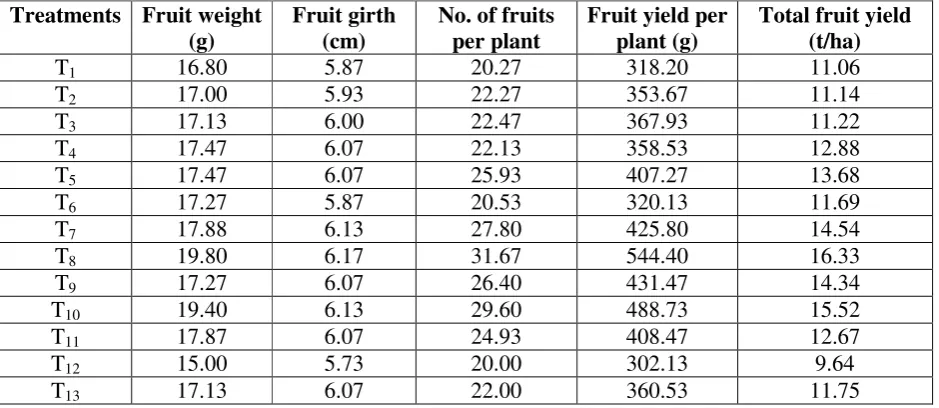
Inoculation of all the three biofertilizers along with double dose of FYM (T8) recorded the
highest fruit weight (19.80 g) and fruit girth (6.17 cm) compared to control (Table 1). It was followed
by T10 where FYM, inorganic (¾ NPK) fertilizers and all the three biofertilizers were applied.
Application of FYM might have helped the soil to improve the nutrient status, water holding capacity, physical, chemical and biological properties which in turn helped better absorption of nutrients and expression of better biometrical parameters. FYM also provided room for better establishment of inoculated microorganisms along with accumulation of excess humus content [6]. Conjoint application of FYM, inorganic fertilizers and biofertilizers might have acted complementary and supplementary to each other and resulted in adequate and slow, but steady supply of nutrients
resulting in better parameters in T8 and T10
Number of fruits per plant showed significant differences among the treatments and it ranged from 20.00 to 31.67. The highest number of fruits per plant (31.67) was recorded in the treatment
where double dose of FYM was applied along with Azospirillum, AMF and Frateuria (T8), which was
43.95 per cent more than control. T10 (FYM as per POP + ¾ NPK + Azospirillum, AMF, Frateuria
each @ 2 kg ha-1) also recorded a comparatively higher fruit number.
Table 1: Comparison of yield and yield attributing characters in okra
Treatments Fruit weight (g)
Fruit girth (cm)
No. of fruits per plant
Fruit yield per plant (g)
Total fruit yield (t/ha)
T1 16.80 5.87 20.27 318.20 11.06
T2 17.00 5.93 22.27 353.67 11.14
T3 17.13 6.00 22.47 367.93 11.22
T4 17.47 6.07 22.13 358.53 12.88
T5 17.47 6.07 25.93 407.27 13.68
T6 17.27 5.87 20.53 320.13 11.69
T7 17.88 6.13 27.80 425.80 14.54
T8 19.80 6.17 31.67 544.40 16.33
T9 17.27 6.07 26.40 431.47 14.34
T10 19.40 6.13 29.60 488.73 15.52
T11 17.87 6.07 24.93 408.47 12.67
T12 15.00 5.73 20.00 302.13 9.64
T13 17.13 6.07 22.00 360.53 11.75
Significant differences were noticed with respect to fruit yield (Table 1). Combined application
of all the three biofertilizers along with double dose of FYM (T8) recorded the highest fruit yield per
plant (544.40 g) and total fruit yield(16.33 t ha-1). It was 50.99 per cent and 38.97 per cent higher than
the control. Application of FYM, inorganic (¾ NPK) fertilizers and biofertilizers (T10) also recorded
35.56 per cent more fruit yield per plant (488.73 g) and 32.08 per cent more total yield (15.52 t ha-1)
than the control. It could be observed that the activity of microorganisms in promoting fruit yield was more pronounced when it was enriched with double dose of FYM, and the more so, when it was further supplemented with lower dose of chemical fertilizers. This suggests that recommended dose of NPK could be replaced with double dose of FYM along with all the three biofertilizers. It also suggests that application of all the three biofertilizers along with judicious application of inorganic fertilizers and FYM could save 25 per cent of inorganic fertilizers.
Application of double dose of FYM might have created better soil condition due to higher rate of multiplication of inoculated microbes leading to enrichment and mobilisation of bound nutrients and improvement in soil aggregation. FYM provides macro and micro nutrients, increase the water holding capacity and aeration for better root formation [9,10]. Decomposition of FYM increased solubility of nutrients by forming humic complex which are easily assimilated by plants [11]. All these might have made quick mobilisation and availability of nutrients which could have resulted in increased yield attributes like fruit weight, fruit length and number of fruits ultimately resulting in higher yield.
The higher yield observed in T10 might be due to the supply of additional nutrients as well as
improvement in physical and biological properties of soil by organics and inorganics. Active and rapid multiplication of microorganisms in rhizosphere creating a favourable condition for nutrient
availability and uptake, secretion of hormones like IAA, cytokinin, vitamin B12, GA [12,13] and
supply of antibacterial and antifungal compounds [14] and micronutrients might have favoured growth and yield.
Response of biofertilizers were better at lower dose of chemical fertilizers. Azospirillum might
International Journal of Applied and Pure Science and Agriculture (IJAPSA) Volume 02, Issue 2, [February - 2016] e-ISSN: 2394-5532, p-ISSN: 2394-823X
@IJAPSA-2016, All rights Reserved 62 substances [16]. Better crop due to all these factors might have helped in increasing photosynthetic rate and more physiological and biochemical activities which in turn resulted in increased yield and yield components.
The findings of the present study indicated that combined application of all the three biofertilizers along with double dose of FYM was the best, with respect to yield. The second best performance was obtained when FYM, inorganic fertilizers (¾) and biofertilizers were applied signifying that a reduction of 25 per cent chemical fertilizers is possible by using biofertilizers.
BIBLIOGRAPHY
[1] NHM [National Horticulture Mission]. (2010). Area, production statistics 2009-2010. Ministry of Agriculture,
Government of India Available: http://nhb.gov.in/ statistics /area production-statistics.html [8 June 2011].
[2] Rao, N.S.S. (1995). Biofertilizers in Agriculture and Forestry (3rd Ed.). Oxford and IBH Publishing, New Delhi, 242p
[3] Dar, R.A., Gupta A.K. and Samnotra R.K. (2010). Effect of integrated nutrient management on seed yield
contributing parameters of okra. Asian J. Hortic. 4(2): 263-266.
[4] Bagyaraj, D.J. (2003). Biofertilizers : Present position and future prospective. Biofertilizer News Letter. pp. 3-7.
[5] Pandey, V. and Kumar, D. (2002). Biofertilizers for sustainable agriculture.Agric. Today5: 44-47.
[6] Hayworth, F., Cleawer T.J. and Bran, J.M. (1996). The effects of different manorial treatments on the yield and
mineral composition of early potato. J. Hortic. Sci. 41(3): 225-241.
[7] Dar, R.A., Gupta A.K. and Samnotra R.K. (2010). Effect of integrated nutrient management on seed yield
contributing parameters of okra. Asian J. Hortic. 4(2): 263-266.
[8] Prabhu, M., Natarajan S., Srinivasan K. and Pugalendhi L. (2006). Integrated nutrient management in cucumber.
Indian J. Agric. Res. 40(2): 123-126.
[9] Nirmala, R and Vadivel, E (1999). Effect of combined application of organic manures and biofertilizers on growth
and productivity of cucumber. S. Indian Hortic. 47(1-6): 252-254
[10] Kirad, K. S., Barche S. and Singh D.B. (2010). Integrated butrient management on growth, yield and quality of
carrot. Karnataka J. Agric. Sci. 23(3): 542-543.
[11] Jasrotia, R.S and Sharma, C.M. (1998). A note on phosphorus and FYM application on French bean (Phaseolus
vulgaris L.) under mid hill condition. Veg. Sci. 25(1): 197-198.
[12] Bahadur, A. and Manohar, R.K. (2001). Response of okra to biofertilizers. Veg. Sci.28(2): 197-198.
[13] Devi, H.J., Maity T.K., Parta N.C.and Thapu U. (2002). Response of brinjal (Solanum melongena L.) to different
sources of nitrogen. Veg. Sci. 29(1): 45-47.
[14] Sood, R. and Vidyasagar (2008). Nitrogen Economy through the use of biofertilizers on yield of summer squash
(Cucurbita pepo L.) Crop Res. 36(1-3): 204-207.
[15] Kandasamy, D., Samuel G.M. and Oblisami. G. (1985).Influence of VA-mycorrhizae and phosphobacteria on growth
of brinjal and chillies in nursery. S. Indian Hortic. 33: 172-176.
[16] Sreenivasa, M.N. (1994). VA Mycorrhiza in conjunction with organic ammendemnets improves growth and yield of