Comparative Analysis of Computer Network
Protocols in Wireless Communication Technology
Sunny Orike
*and Tamuno-omie Joy Alalibo
Department of Computer Engineering, Rivers State University, Port Harcourt, Nigeria.
Date of publication (dd/mm/yyyy): 17/05/2019
Abstract – This paper aims to compare and analyse the various computer network protocols associated with wireless communication technology. The following wireless communication technologies were investigated and compared: wireless personal area network (WPAN), wireless local area network (WLAN), wireless metropolitan area network (WMAN) and wireless wide area network (WWAN). The comparison was based on the latest networking standards in terms of their frequency of operation, bandwidth, optimal operating ranges, modulation schemes, channel architecture, maximum data rate, maximum transmit power and other points of interest. Results of the comparison were tabulated and appropriate recommendations made.
Keywords – Computer Network, IEEE, Protocols, Standards, Wireless Technology.
I. I
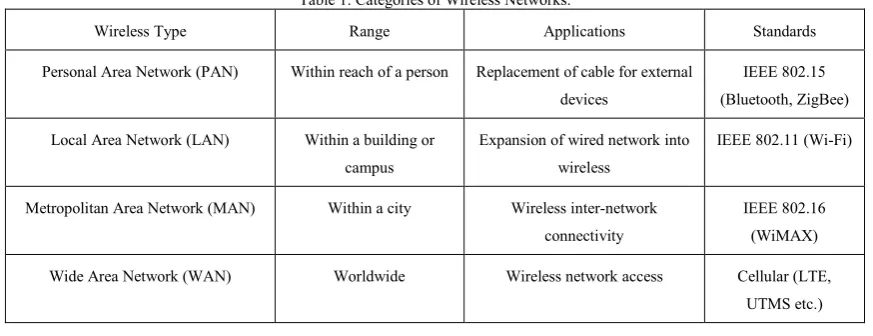
NTRODUCTIONWireless protocols are standards that allow networking devices to exchange information through radio wave- literally without wires. Different types of wireless connections, technologies and systems enable devices to communicate information with one another and to the worldwide web (TCP/IP networks) with no physical links. Table 1 shows the types of wireless networks. These diverse kinds of wireless technologies are assembled to utilize standards put in place mostly by the Institute of Electrical and Electronics Engineers (IEEE).
Table 1. Categories of Wireless Networks.
Wireless Type Range Applications Standards
Personal Area Network (PAN) Within reach of a person Replacement of cable for external devices
IEEE 802.15 (Bluetooth, ZigBee)
Local Area Network (LAN) Within a building or campus
Expansion of wired network into wireless
IEEE 802.11 (Wi-Fi)
Metropolitan Area Network (MAN) Within a city Wireless inter-network connectivity
IEEE 802.16 (WiMAX)
Wide Area Network (WAN) Worldwide Wireless network access Cellular (LTE, UTMS etc.)
II. W
IRELESSP
ERSONALA
REAN
ETWORK(WPAN)
T
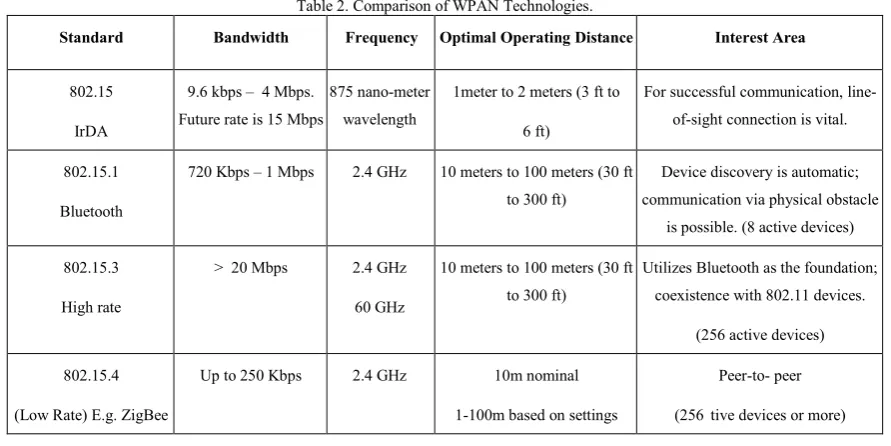
ECHNOLOGIESWPAN technologies are intended to cover zones around 10 meters. Infrared Data Association (IrDA) and Bluetooth are two basic instances of Wireless PAN. However, IrDA is now an obsolete technology. Advancement in this area incorporates IEEE802.15.4a (Zigbee) and IEEE802.15.3c (Ultra-Wide Band). Table 2 shows the features of WPAN technologies.
A.
IEEE 802.15.1: Bluetooth and Bluetooth Low Energy (BLE)
Ultra-High Frequency (UHF) for data exchange. Bluetooth works in the 2400-2483.5 MHz range inside the 2.4 GHz Industrial Scientific Medical (ISM) frequency band. Data is divided into packets and transmitted using one of 79 channels allocated to Bluetooth (every one of which has 1 MHz in transfer speed). Bluetooth was originally intended for continuous, streaming data applications, which implies that lots of data transfer is possible at close range [12, 20].
BLE was standardized and entered into the wireless communication market as Bluetooth 4.0. BLE makes use of less power than standard Bluetooth. Its low power utilization makes it valuable in equipment, for example, smart watchers, trackers, and other connected devices so as to remotely transmit data without strongly trading off the power in the phone of users. Just like Bluetooth, BLE works in the 2.4 GHz ISM band. However, in contrast to classic Bluetooth, BLE stays in sleep mode continually until the connection is started. The actual duration for connection is just a couple of mS, not at all like Bluetooth which would take ~100mS. The connection durations are so short is because that the transfer rates of data are so high at 1 Mb/s. Bluetooth can deal with a great deal of data, however devours battery life rapidly and costs significantly more. BLE are mostly used in applications that exchange small amount of data, therefore it can operates without consuming much battery power and at a cheaper rate [12, 20].
B.
IEEE 802.15.3: High Rate WPAN
The IEEE standard for a high-data-rate WPAN, IEEE 802.15.3, is a protocol to give adequate quality of service and content distribution for real-time applications. It can be utilized in multimedia wireless network which includes real time video and music. The first standard employs a conventional 2.4-GHz frequency carrier as the physical transmission layer [1]. IEEE 802.15.3a is the next standard that proposed to define an alternative physical layer. Recently, the UWB- based proposals plan to give over 110Mbps for distance of 10 meters and 480Mbps for distance of 2 meters, which will permit High-definition (HD) video streaming and extremely fast transfer of files [1].
IEEE 802.15.3c supports millimeter-wave (mm WAV) wireless PAN such as Gi-Fi (Gigabits Fidelity or Gigabit Wireless) which has data rate ten times higher that of Wi-Fi. Gi-Fi is the first transceiver fabricated on a CMOS chip [11]. The single chip measures about 5mm2 chip with 1mm antenna operating at a frequency of 60 GHz
(57-64GHz unlicensed frequency band) that consumes power of about 2 milliwatt or less during its operation. It has speed of up to 5 Gbps for transfer of large videos and other information wirelessly within fractions of seconds within indoor environment-usually within a 10 meter. This protocol supports Orthogonal Frequency Division Multiplexing (OFDM) modulation scheme and Multiple Input Multiple Output (MIMO) technology. The Gi-Fi specification uses adaptive beam forming to overcome the problem of higher propagation loss (usually in 2.5GHz & 5GHz bands). Gi-Fi can be used as mobile data backhaul through which 3G and 4G networks providers can offload some of the data [11].
C.
IEEE 802.15.4: Low WPAN
less expensive wireless applications. The air interface or radio interface is kept simple so that reliable small data transfer is possible [2]. The most popular frequency band (licence free) used the 2.4 GHz (2400 MHz) band. However, recently consideration is given to frequency groups like 314-316 MHz, 430-434 MHz, and 779-787 MHz (China), the 950 MHz-956 MHz band (Japan) and UWB variants of IEEE 802.15.4. The radio interface arrangements depend on direct sequence spread spectrum (DSSS) strategies utilizing binary or offset quadrature phase shift keying (i.e. BPSK or OQPSK), and furthermore amplitude shift keying (ASK). This protocol supports star topology and mesh topology (allowing nodes connection to each other through various pathways) thus improving data exchange range and giving better stability (even with failure of a single connected node) [2].
ZigBee is a wireless technologies based on the PAN IEEE's 802.15.4 standardized mainly for networks used for Machine-to-Machine (M2M) communication [3]. The ability of ZigBee to connect many devices together at the same time makes it very useful in industrial applications and smart home applications. Zigbee has fixed maximum data rates for each band allowing 250 kbps at 2.4 GHz, 40 kbps at 915 MHz, and 20 kbps at 868 MHz [3]. Zigbee protocol provides encryption using 128-bit AES (Advanced Encryption Standard) on the application layer of the network and security features are present in the network layer and link layer [22]. The technology is economical, has a high throughput, low duty cycle, low latency and consume small amount of power, which allow products to make the most of battery life [2, 3, 22]. Unlike Bluetooth where point-to-point transmission of data takes place between two high-powered devices over a short distance, Zigbee does not concentrate on point to point communication [4]. Zigbee focuses on mesh networking whereby communication among nodes or devices can occur at distance about 70 meters and it is possible to cover greater distances by relaying data from one node to another inside a network [5]. It is commonly used to replace Bluetooth and Wi-Fi in some applications that require low-powered devices and not so much bandwidth.
Table 2. Comparison of WPAN Technologies.
Standard Bandwidth Frequency Optimal Operating Distance Interest Area
802.15
IrDA
9.6 kbps – 4 Mbps. Future rate is 15 Mbps
875 nano-meter wavelength
1meter to 2 meters (3 ft to
6 ft)
For successful communication, line-of-sight connection is vital.
802.15.1
Bluetooth
720 Kbps – 1 Mbps 2.4 GHz 10 meters to 100 meters (30 ft to 300 ft)
Device discovery is automatic; communication via physical obstacle
is possible. (8 active devices)
802.15.3
High rate
> 20 Mbps 2.4 GHz
60 GHz
10 meters to 100 meters (30 ft to 300 ft)
Utilizes Bluetooth as the foundation; coexistence with 802.11 devices.
(256 active devices)
802.15.4
(Low Rate) E.g. ZigBee
Up to 250 Kbps 2.4 GHz 10m nominal
1-100m based on settings
Peer-to- peer
(256tive devices or more)
III. W
IRELESSL
OCALA
REAN
ETWORK(WLAN)
T
ECHNOLOGIESA.
IEEE 802.11: Wi-Fi
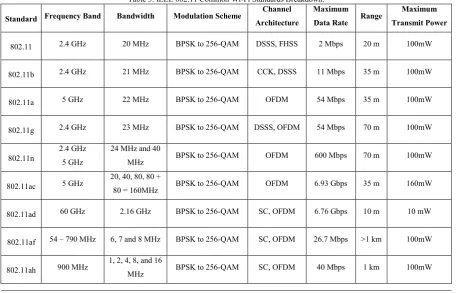
IEEE 802.11 standard was released in 1999 for Wireless Fidelity (Wi-Fi) [19]. The term Wi-Fi is amostly used to refer to WLAN, since Wi-Fi is popular and other WLAN technologies are based on Wi-Fi standard [19]. Table 3 shows the six common Wi-Fi standards. Wi-Fi makes use of radio waves (RF) to enable communication among devices connected to it. Mostly, this technology provides connection between internet routers and devices like computer and mobile devices. It can also provide connectivity among hardware components. Wi-Fi can make use of both the global 2.4GHz UHF and 5GHz ISM frequency bands. The 2.4 GHz ISM band is more popular, even though it is vulnerable to interference from some Bluetooth devices, microwave ovens and cordless phones [5]. IEEE 802.11b, 802.11g, and 802.11n operate on 24 GHz band. Over the years, several amendments were made to the IEEE 802.11 standard [7, 19]. The popular versions are explained below:
IEEE 802.11a standard, released in 1999, operates at 3.7 GHz or 5GHz and has a bandwidth of approximately 20 – 22 MHz and possible data transfer rate up to 54 Mbps (can alternate to 48, 36, 24, 18, 12, and 6 Mbps) [8]. For modulation, this standard specifies the OFDM scheme and it make use of Single Input Single Output (SISO) antenna technology. IEEE802.11a, when operating at 5GHz, has indoor and outdoor ranges from 35m to 125m, but when operating at 3.7GHz, the outdoor range extends to 5km. The standard is less susceptible to interference when compare to 802.11b because of the high operating frequency of 5GHz [8, 21].
IEEE 802.11b was also released 1999 and has bandwidth of 22MHz. Its improvement over 802.11a is in terms of range, providing indoor and outdoor ranges of 35 meters to 140 meters. However, it is quite slow compared to 802.11a with maximum transfer rate of 11 Mbps (with alternative of 5.5, 2, and 1 Mbps) when operating 2.4 GHz frequency band [8, 9, 21]. The 802.11b make use of SISO antenna technology and utilizes only Direct Sequence Spread Spectrum (DSSS) modulation scheme. IEEE802.11b is different from IEEE802.11, providing wireless functionality practically similar to Ethernet. The IEEE802.11b standard is more susceptible to interference because of the way that the frequency range of 2.4GHz is getting packed with carriers, thus there is higher risk of interference [8, 21].
IEEE 802.11g (also known as Wi-Fi G) was approved in 2003 and it has combine features from 802.11a and 802.11b. This standard has bandwidth of 20 MHz and provides maximum data rate of 54 Mbps in the 2.4 GHz operating frequency. For modulation, OFDM or DSSS scheme was used. The antenna technology employed by this standard is SISO technology which helped achieved distance range of 35-140 meters for indoor/outdoor range respectively. IEEE802.11g is prone to interference from other RF devices in the same band especially Bluetooth [8, 9, 21].
IEEE 802.11n (also known as Wi-Fi N) was introduced in 2009 and it was the first standard to make use of MIMO technology, whereby multiple antennas are used for sending and receiving signals. This standard utilizes OFDM modulation scheme. It also uses dual-band techniques whereby transmission of data takes across two frequencies - 2.4 GHz and 5 GHz - to give a higher transfer speed of 300 - 450 Mbps, which depends on the antennas’ numbers used. IEEE802.11n gives improved bandwidth of 20 - 40 MHz and covers distance ranges of 75 meters and 250 meters for indoor and outdoor ranges respectively [3, 7, 8].
technology to boost speed, better coverage and better performance. It supports data transfer rate almost 1 Gbps and indoor range of 35 meters [6, 8, 9].
IEEE 802.11ad, approved in 2012, was made for network of speeds in multiple Gigabit level and high-performance. This protocol has operating frequency of 60 GHz (millimeter wave band). It provides very fast data rate for very short distance communication. It makes use of beamforming antenna technique to focus signals in certain direction and reduce signal lost that usually occur in the 60 GHz frequency band. It offers up to 6.7 Gbps data rate, however, its access covers a very short distance within 3.3 meters from the access point and the chip is expensive to produce [6, 9, 23].
IEEE 802.11af (also known as White-Fi) was introduced in 2014 and the idea behind this protocol is spectrum sharing. This protocol allows the transmission of information through unutilised white spaces or television spectrum frequencies in UHF band and Very High Frequency (VHF) band, which lies between 54 MHz and 790 MHz. IEEE802.11af can be utilized for low power devices to cover wide area. One of the main differences that separate 802.11af from other 802.11 standard is Geolocation Database (GDB), that is use to store allowable frequencies and operating parameters for white space devices in terms of geographic area to satisfy regulatory requirement. However, geolocation brings a lot of complexities in the UHF, it needs costly, band-specific equipment and white spaces are not accessible all over, especially in huge urban areas thus it is not a worldwide standard [6, 24].
IEEE 802.11ah (also known as Wi-Fi HaLow) was standardised in 2016 and published in 2017, and it created for Wi-Fi networks, sensors and controllers having long distance coverage and low data rate. The operating frequency is below 1 GHz bands (including 908 - 928 MHz), which gives longer range for data transmission up to 347 Mbps. it is capable of penetrating through walls and building better than high frequency networks such as IEEE802.11ad. However, worldwide standard for 900 MHz is inaccessible [6, 9, 12].
Table 3. IEEE 802.11 Common Wi-Fi Standards Breakdown.
Standard Frequency Band Bandwidth Modulation Scheme
Channel Architecture
Maximum
Data Rate Range
Maximum Transmit Power
802.11 2.4 GHz 20 MHz BPSK to 256-QAM DSSS, FHSS 2 Mbps 20 m 100mW
802.11b 2.4 GHz 21 MHz BPSK to 256-QAM CCK, DSSS 11 Mbps 35 m 100mW
802.11a 5 GHz 22 MHz BPSK to 256-QAM OFDM 54 Mbps 35 m 100mW
802.11g 2.4 GHz 23 MHz BPSK to 256-QAM DSSS, OFDM 54 Mbps 70 m 100mW
802.11n
2.4 GHz 5 GHz
24 MHz and 40
MHz BPSK to 256-QAM OFDM 600 Mbps 70 m 100mW
802.11ac 5 GHz
20, 40, 80, 80 +
80 = 160MHz BPSK to 256-QAM OFDM 6.93 Gbps 35 m 160mW
802.11ad 60 GHz 2.16 GHz BPSK to 256-QAM SC, OFDM 6.76 Gbps 10 m 10 mW
802.11af 54 – 790 MHz 6, 7 and 8 MHz BPSK to 256-QAM SC, OFDM 26.7 Mbps >1 km 100mW
802.11ah 900 MHz
1, 2, 4, 8, and 16
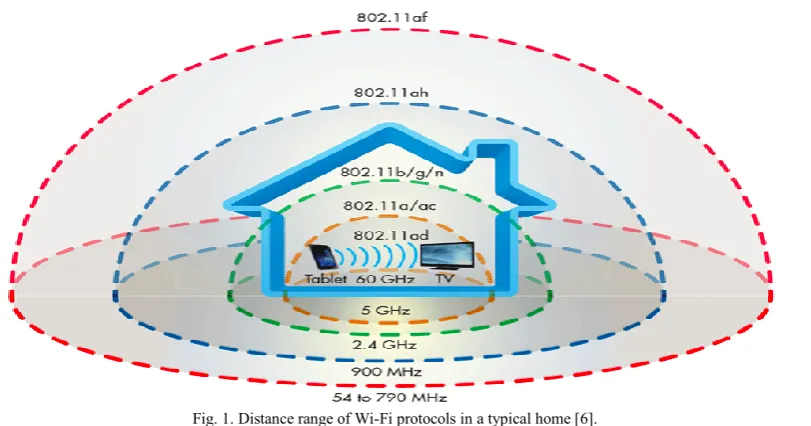
Fig. 1. Distance range of Wi-Fi protocols in a typical home [6].
IV. W
IRELESSM
ETROPOLITANA
REAN
ETWORKS(WMAN)
T
ECHNOLOGYIEEE 802.16 is a set of broadband standards used for wireless connectivity in metropolitan area networks (MANs). It permits specific predetermined point-to-multipoint broadband wireless systems that operate in the 10-66 GHz licensed spectrum. Table 4 shows the features of IEEE 802.16 and its amendments. WiMAX is a wireless communication network that uses this protocol.
A.
IEEE 802.16: WiMAX
Worldwide Interoperability for Microwave Access (WiMAX) wireless technology is dependent on the IEEE-802.16a/REVd/e that initially take care of the Wireless Local Loop (WLL) technologies with radio spectrum from 10 to 66 GHz [10]. Recently, these specifications were extended below 10 GHz but the frequencies generally utilized are 3.5 and 5.8 GHz for IEEE802.16d (fixed access), and 2.3, 2.5 and 3.5 GHz for IEEE802.16e (Mobile WiMAX) depending on the country [10]. WiMAX refers specifically to interoperable executionsof the IEEE 802.16 wireless family [13, 21]. Wi-Fi access is restricted to a 4-to-6 mile radius, which is similar in range to a cell-phone zone. However, WiMAX has more powerful line-of-sight antennas in its transmitting station for data transmission within a 30 mile radius of the transmitter to WiMAX-enabled computers or routers, thus permitting WiMAX to accomplish its greatest range [3, 12, 21]. WiMAX enables data to be exchanged at a rate of 30-40 Mbps and it is useful for indoor and outdoor connectivity, but outdoor connection is stronger. Key technologies in WiMAX incorporate OFDM to empower it give high data transfer without the selective fading and other issues with signal format. Its MIMO antenna technology makes use of multipath propagation of signals to either enable activity with lower signal strength levels, or allows for higher data rates. It also provides good Quality-of-Service (QoS) and security (i.e. authentication, encryption) for data traffic [10, 13, 21].
Table 4. Features of IEEE 802.16.
Standard Spectrum Channel
Conditions
Speed (Bit rate)
Modulation Mobility Channel
Bandwidth
Typical Cell Radius IEEE 802.16 10-66GHz Only
line-of-sight
32 – 134 Mbps QPSK 16QAM 64QAM
Fixed 20, 25 and 28 MHz 1.62 – 4.83 km
IEEE 802.16a/ 802.16REVd
< 11GHz
Non-Line-of-sight technique
Maximum of 75 Mbps, 20MHz channelization
OFDM 256 subcarrier QPSK 16QAM
64QAM
Fixed Option available for selection between 1.25 and 20 MHz
Standard Spectrum Channel Conditions
Speed (Bit rate)
Modulation Mobility Channel
Bandwidth
Typical Cell Radius antenna gain and
transmit power) IEEE 802.16e
(Mobile WiMAX)
< 6GHz
Non- Line-of-sight
28 – 125 Mbps, OFDMA 256 subcarrier QPSK 16QAM
64QAM
Pedestrian mobility,
regional roaming
Selectable between 1.25 and 20 MHz
1.62 – 4.83 km
V. W
IRELESSW
IDEA
REAN
ETWORKS(WWAN)
T
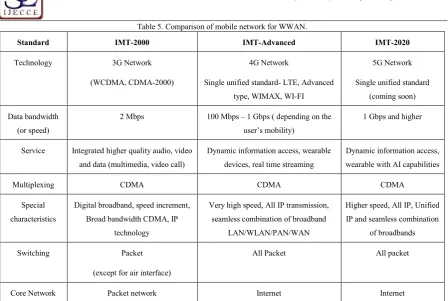
ECHNOLOGIESWWAN provides network coverage to large geographical area by wirelessly connecting different large areas together. Typically, WWANs are shared data networks having low data rates depending on the way the network is used, and they are normally owned by service providers. WWANs are often referred to as 3G and 4G networks for the reason that WWANs generally utilized connections offered by 3G and 4G mobile networks (see Table 5) [15]. The frequency range of operation for mobile communication systems is 450 MHz - 3600 MHz [26]. The standards for mobile networks are usually specified by International Telecommunication Union.
A.
IMT-2000-3G Network
ITU developed the International Mobile Telecommunications for the year 2000 (IMT-2000), which envelops worldwide specifications for mobile communication in 3G networks [13]. The aim was to have only one global standard to provide multimedia services for mobile broadband however technological advancement brought about amendments to the standards [13]. IMT-2000 frequency bands include1885-2025 MHz and 2110-2200 MHz (terrestrial). In year 2000, frequency bands 2500-2520 MHz and 2670-2690 MHz (satellite) and also GSM bands of 806 to 960 MHz, 1429 to 1501 MHz and 1710 to 1885 MHz were added. IMT-2000 supports data transmission in both circuit-switched (CS) and packet-switched (PS) traffics. IMT-2000 provides worldwide coverage by incorporating both satellite and terrestrial systems, and all radio systems (cell, LAN, satellite, and cordless) are utilized to handle large variety of telecommunication services such as internet, video, multimedia etc. The standard also offers high spectrum efficiency and data transfer rates of 2 Mbps, which is the rate for indoor situation. For high mobility, it offers up to 144 kbps while for restricted or slow mobility, the transfer rate is 384 kbps [13].
B.
IMT-Advanced - 4G Network
IMT-Advanced provides better capabilities and functionality than that of IMT-2000, which is meant for mostly for 4G networks such as LTE and LTE-advanced, IEEE 802.16m (WMAN-Advanced) and IEEE 802.16e (Mobile WiMAX) [14]. This standard supports pure switched data transmission which means that only IP packet-switched traffics. IMT-Advanced provides scalable bandwidth of 5 – 20MHz (sometimes up to 40 MHz). It takes into consideration the economic and service demands in multi-user situations and handles the data rates with respect to the users’ need; supporting wide range of data rates for different situations. The target data transfer speed for high mobility (mobile access) is about 100 Mbps and for stationary/low mobility is about 1 Gbps. IMT-Advanced for 4G networks make use of OFDMA and MIMO technology and it supports interoperability with existing wireless standards and provides flawless connectivity and handovers across multiple networks [11, 14, 25].
mobile communication and broadband wireless access (BWA). It makes use of TDD and H-FDD modes, and scalable channel bandwidth of 1.25 – 10 MHz (even up to 20 MHz). The standard operates at frequency band of 2 – 6 GHz and it can offer about 75 Mbps within distance range of about 15 km (10 Miles). Line-of-sight coverage can be about 50 km using 10 – 60 GHz operating frequency. OFDMA, Scalable-OFDMA, MIMO and good QoS are supported for better transmission and data rate [17, 18].
IEEE 802.16m,released in 2010, is a WiMAX-Advanced standard for both fixed WiMAX and mobile WiMAX. It has improvement on the IEEE 802.16 WMAN-OFDMA specification of the air interface in order to satisfy the IMT-Advanced requirements for mobile networks. It operates under license bands specified by IMT-Advanced. IEEE 802.16m standard make use of both FDD and TDD modes, and supports scalable operating bandwidth from 5 – 20 MHz. It also uses multi-carrier operation, beamforming and compulsory 2 x 2 MIMO (options up to 8x8) for single-user and multi-user connections. Its cell range and coverage is from 5 km to 100 km, depending on users’ connection and mobility. Using carrier aggregation, this standard will mostly likely give support to data rates of about 100 Mbps for vehicular access (120 – 350 km/h) and of about 1 Gbps for stationary/pedestrian access (0 – 10 km/h). IEEE802.16m provides interoperability with Wi-Fi, Bluetooth, 3G systems and other wireless communication systems [17].
LTE Advanced, designed by the 3rd Generation Partnership Project (3GPP) group, is a noteworthy upgrade of the LTE standard to satisfy the specifications for IMT-Advanced. LTE architecture is based on EUTRA (Evolved Universal Terrestrial Radio Access) system to replace GSM, UMTS and HSPA technologies. LTE-Advanced has operating frequency of 699 MHz to 3.8 GHz. It makes use of carrier aggregation (CA) used for both FDD and TDD modes to increase its bandwidth and bitrate. The maximum bandwidth of aggregated carrier is 100 MHz (addition of 5 carriers), but the scalable bandwidth options can be 1.4, 3, 5, 10, 15 or 20 MHz. OFDMA and Single Carrier Frequency Division Multiplexing Access (SC-FDMA) are used. Therefore LTE-advanced is equipped to give peak data transfer speed to and fro the users’ equipment at about 3 Gbps and 1.5 Gbps respectively. It has spectral multiplexing whereby MIMO technique is employed to increase transmission bitrate through two or more data stream by two or more different antennas (MIMO 2 x 2). LTE-advanced can accommodate larger number of active clients simultaneously [16, 25, 26].
C. IMT-2020 - 5G Network
Table 5. Comparison of mobile network for WWAN.
Standard IMT-2000 IMT-Advanced IMT-2020
Technology 3G Network
(WCDMA, CDMA-2000)
4G Network
Single unified standard- LTE, Advanced type, WIMAX, WI-FI
5G Network
Single unified standard (coming soon)
Data bandwidth (or speed)
2 Mbps 100 Mbps – 1 Gbps ( depending on the user’s mobility)
1 Gbps and higher
Service Integrated higher quality audio, video and data (multimedia, video call)
Dynamic information access, wearable devices, real time streaming
Dynamic information access, wearable with AI capabilities
Multiplexing CDMA CDMA CDMA
Special characteristics
Digital broadband, speed increment, Broad bandwidth CDMA, IP
technology
Very high speed, All IP transmission, seamless combination of broadband
LAN/WLAN/PAN/WAN
Higher speed, All IP, Unified IP and seamless combination
of broadbands
Switching Packet
(except for air interface)
All Packet All packet
Core Network Packet network Internet Internet
Table 6 shows the feature of popular wireless networks under each standard. Amendments are carried out on these standards as technology advances.
Table 6. Comparison between wireless network standards.
Standard IEEE 802.15 IEEE 802.15.3c IEEE 802.11
a/b/n/g/x
IEEE 802.16 IMT2000 IMT-Advanced
Popular technology Bluetooth Gi-Fi Wi-Fi WiMAX UMTS HSPA EUTRA Operating Frequency 2.4GHz 57-64GHz 2.4GHz / 5 GHz 2.3-3.5GHz ~2GHz 699 MHz to 3.8 GHz
Transfer Rate of Data 800Kbps 5Gbps 11Mbps – 7 Gbps 30 – 200Mbps 1/ 14Mbps 500Mbps – 1Gbps
Range 10m 10m 100m 1 – 15km 50km 5 – 100 Km radius
VI. C
ONCLUSIONA comparative analysis of the different standards for wireless communications was presented in this paper. IEEE 802.15 standard for WPAN was mainly for short range communication. Gi-Fi is transducer IC recently introduced under 502.15.3c to have data speed up to 5 Gbps for distance of about 10meters. For WLAN, there are improvements to the original IEEE802.11 to improve in data transfer speed, distance coverage and to utilise unused television frequency spectrum. MIMO technology, high-speed in IEEE 802.11n and long range communications in IEEE802.11ah are the emerging areas of interest in this group. WiMAX (IEEE802.16) and Mobile-WiMAX (IEEE 802.16e) provide good coverage at a high transfer rate for mobile devices and WMAN. For WWAN, cellular networks such 3G LTE provides best for covering large areas as connection can easily transfer for cell to cell. MIMO antenna technology and OFDM modulation scheme are used by the recent standards to enhance quality, performance, data transfer, large distance coverage and reduce loss ofsignals.
R
EFERENCES[1] "IEEE 802.15", En.wikipedia.org. [Online]. Available: https://en.wikipedia.org/wiki/IEEE_802.15 [Accessed: 28/01/2019].
[2] I. Poole, "IEEE 802.15.4 Technology & Standard: Radio-Electronics.Com", Radio-electronics.com [Online]. Available: https://www.radio-electronics.com/info/wireless/ieee-802-15-4/wireless-standard-technology.php. [Accessed: 29/01/2019].
[4] E. Betters and C. Hall, "What is ZigBee and why is it important for your smart home? - Pocket-lint", Pocket-lint, 2018. [Online]. Available: https: // www.pocket-lint.com/ smart-home/ news/ 129857 - what-is-zigbee-and-why-is-it-important-for-your-smart-home. [Accessed: 27- Feb- 2019].
[5] I. Poole, "What is ZigBee | Wireless Networking Technology | Tutorial", Radio-electronics.com [Online]. Available: https://www.radio-electronics.com/info/wireless/zigbee/zigbee.php. [Accessed: 26- Feb- 2019].
[6] B. Ray, "WiFi's Future: Examining 802.11ad, 802.11ah HaLow (& Others)", Link-labs.com, 2018 [Online]. Available: https://www.link-labs.com/blog/future-of-wifi-802-11ah-802-11ad. [Accessed: 28- March- 2019].
[7] I. Poole, "IEEE 802.11 Standards | Wi-Fi Specifications | Radio-Electronics.com", Radio-electronics.com, 2018 [Online]. Available: https://www.radio-electronics.com/info/wireless/wi-fi/ieee-802-11-standards-tutorial.php. [Accessed: 21- March- 2019].
[8] R. Abdelrahman, A. Mustafa and A. Osman, "A Comparison between IEEE 802.11a, b, g, n and ac Standards", IOSR Journal of Computer Engineering, vol. 17, no. 5, 2015.
[9] K. Shaw, "802.11: Wi-Fi speeds and standards explained", Network World, 2018 [Online]. Available: https://www.networkworld.com/ article/3238664/wi-fi/80211-wi-fi-speeds-and-standards-explained.html. [Accessed: 19/03/2019].
[10] I. Poole, "WiMAX Frequencies | WiMAX Band & Spectrum | Radio-Electronics.com", Radio-electronics.com, 2018. [Online]. Available: https://www.radio-electronics.com/info/wireless/wimax/frequencies-spectrum.php. [Accessed: 27- Jan- 2019].
[11] B.I. Bakare and T.J. Alalibo, “Gigabit Fidelity (GI-FI) as future wireless technology in Nigeria,” International Journal of Engineering Science Invention (IJESI), vol. 7, no. 12, ver.3, pp. 1-6, 2018.
[12] B. Ray, "5 Types of Wireless Technology for TheIoT", Link-labs.com, 2015. [Online]. Available: https: //www.link-labs.com/BLOG/TYPES-OF-WIRELESS-TECHNOLOGY. [Accessed: 29/01/2019].
[13] "IMT-2000 - Telecom ABC", Telecomabc.com, 2018 [Online]. Available: http://www.telecomabc.com/i/imt-2000.html. [Accessed: 30/01/2019].
[14] "IMT-Advanced - Telecom ABC", Telecomabc.com, 2018 [Online]. Available: http://www.telecomabc.com/i/imt-advanced.html. [Accessed: 01/02/ 2019].
[15] "Wireless wide area networks: A primer on WWAN technology and uses", Search Enterprise WAN, 2011. [Online]. Available: https://searchenterprisewan.techtarget.com/tutorial/Wireless-wide-area-networks-A-primer-on-WWAN-technology-and-u.ses. [Accessed: 01- Jan- 2019].
[16] J. Wannstrom, “LTE-Advanced”, 3gpp.org, 2013. [Online]. Available: https://www.3gpp.org/technologies/keywords-acronyms/97-lte-advanced. [Accessed: 1 - Apr – 2019].
[17] M. Muller, "IEEE 802.16m Technology Introduction, White Paper", Cdn.rohde-schwarz.com, 2010. [Online]. Available: https:// cdn.rohde-schwarz.com/pws/dl_downloads/dl_application/application_notes/1ma167/1MA167_3e_IEEE_80216m_technology.pdf. [Accessed: 08- Apr- 2019].
[18] M.A.M. Emhammed and H.Y. Hwa, “Optimization Handover Procedure in IEEE 802.16E Network,” International Journal of Scientific & Engineering Research, Vol. 5, Iss. 2, pp. 803-809, Feb. 2014. [Online]. Available: https://www.ijser.org/researchpaper/ Optimization-Handover-Procedure-in-IEEE-802-16E-Netwok.pdf. [Accessed: 8 - Apr – 2019].
[19] S. Kaushik, “An overview of technical aspect for Wi-Fi networks technology,” International Journal of Electronics and Computer Science Engineering (IJECSE, ISSN: 2277-1956), vol. 1, no. 01, pp. 28-34, 2012.
[20] C. Gomez, J. Oller and J. Paradells, “Overview and evaluation of Bluetooth low energy: An low-power wireless technology,” Sensors, vol. 12, no. 9, pp. 11734 – 53, 2012.
[21] S. Banerji and R. S. Chowdhury, “Wi-Fi & WiMAX: A Comparative Study,” Indian Journal of Engineering, vol. 2, no. 5, 2013 [Online]. Available: https://arxiv.org/ftp/arxiv/papers/1302/1302.2247.pdf [Accessed: 28-March-2019].
[22] X. Fan, F. Susan, W. Long and S. Li, "Security Analysis of Zigbee", Pdfs.semanticscholar.org, 2017. [Online]. Available: https://pdfs.semanticscholar.org/3d1d/5a51d05cde08b6e52afd5bd7bc325b487a10.pdf. [Accessed: 26- March- 2019].
[23] T. Nitsche, C. Cordeiro, A. B Flores, E. W. Knightly, E. Perahia and J. Widmer, “IEEE 802.11 ad: directional 60 GHz communication for multi-Gigabit-per-second Wi-Fi,” IEEE Communications Magazine, vol. 52, no. 12, pp. 132-141, 2014.
[24] A. B. Flores, R. E. Guerra, E. W. Knightly, P. Ecclesine and S. Pandey, “ IEEE 802.11 af: A standard for TV white space spectrum sharing,” IEEE Communications Magazine, vol. 51, no. 10, pp. 92-100, 2013.
[25] F. Firmin, “The Evolved Packet Core”, 3gpp.org. [Online]. Available: http://www.3gpp.org/technologies/keywords-acronyms/100-the-evolved-packet-core [Accessed: 08- Apr- 2019].
[26] J. Parikh and A. Basu, “Effect of Operating Frequency on Performance of LTE and LTE-Advanced Systems,” International Journal of Advanced Research in Electrical, Electronics and Instrumentation Engineering, Vol. 3, no. 6, pp. 9890 – 95, June 2014. [Online]. Available: http:// www.rroij.com/open-access/effect-of-operating-frequency-on-performance-of-lte-and-lteadvanced-systems.pdf. [Accessed: 1 - Apr – 2019].
[27] A. Gupta and R. K. Jha, “A survey of 5G network: Architecture and emerging technologies,” IEEE access, 3, 1206-1232, 2015.
A
UTHORSP
ROFILE’
Dr. Sunny Orike obtained his Bachelor of Technology degree in Computer Engineering from Rivers State University of
Science and Technology (now Rivers State University) in 1998, MSc in Computing from Robert Gordon University, Aberdeen, United Kingdom, and PhD in Artificial Intelligence from Heriot-Watt University, Edinburgh, UK in 2015. He is a Senior Lecturer and currently the Head, Department of Computer Engineering, Rivers State University, Port Harcourt, Nigeria. His research interests are in the areas of Computer Networks, Artificial Intelligence, Big Data Analytics and Cloud Computing. Dr. Orike is a Registered Engineer with Council for Regulation of Engineering in Nigeria (COREN) and a corporate member of Nigerian Society of Engineers (NSE); an active member of several professional bodies.
email id: [email protected].
Tamuno-omie Joyce Alalibo earned her Bachelor of Technology degree in Computer Engineering from Rivers State