Volume -4, Issue - 1, January - February - 2018, Page No. 17 - 23
Corresponding Author: K . Shilpa, Page No. 17 - 23
Pag
e17
ISSN: 2455 - 1597
A Single Switch Similar Resonant Power Convertor for Electrical Phenomenon Generation Application
K.Shilpa
2
Asst proff, Dept of EEE, SVS Institute of Technology, Hanamkonda, T.S INDIA.
D.Kumara Swamy
3
Assoc proff, H.O.D, Dept of EEE, SVS Institute of Ttechnology, Hanamkonda, T.S INDIA
V. Divyasri , E.Shylaja , J.Sagar , V.Srinivas
1
B Tech scholars, Dept of EEE, SVS Institute of Technology, Hanamkonda, T.S INDIA.
Abstract
This paper develops one switch similar resonant power convertor for electrical phenomenon generation application. This
circuit topology integrates a single-switch similar resonant electrical converter with zero voltage change (ZVS) with
energy interference diode with zero current change (ZCS).
The energy interference diode with an instantaneous current output filter filters the output stage of the single-switch
similar resonant electrical converter. Only 1 active power switch is employed for power energy conversion to scale back
the value of active power switches and management circuits. The active power switch is controlled by pulse breadth
modulation (PWM) at a set change frequency and a continuing duty cycle. Once the resonant convertor is operated at
discontinuous physical phenomenon mode, the electrical device current through the resonant tank might deliver the goods
ZCS of energy interference diode. Consequently, high energy conversion potency is ensured.
Operational principles square measure derived, and analysis is distributed supported equivalent circuits for the projected
power convertor below totally different operational modes. The operational principles of the convertor were verified
employing a thirty two.4- W, 70-KHz experimental photovoltaic-powered load system. Given close to chosen circuit
parameters, the active power switch is operated with ZVS, and a measured energy conversion potency of the projected
topology of ninety seven.3% is achieved.
Experimental results demonstrate a satisfactory performance of the projected topology that is especially suited to the
energy conversion applications in renewable energy generation applications.
Keywords: ZCS, ZVS, Energy, PWM, Circuits, Topology.
Introduction
NOW-A-DAYS, most power used that is used to meet our daily needs is obtained from fossil fuels. Owing to increases in
consumption, fossil fuel sources may be exhausted in the near future. The Kyoto agreement on the global reduction of
greenhouse gas emissions that are produced by the burning of fossil fuels seeks a reduction in the use energy from such
sources. However, Taiwan is a highly energy-dependent nation, which meets approximately 97% of its energy needs by
importing fuels. Environmental pollution and greenhouse gas emissions are becoming significant environmental issues in
the country. Therefore, renewable energy has become attractive in recent years, following the implementation of a policy
for sustainable development and mitigation of environmental pollution in Taiwan. Accordingly, means of generating
© IJERGS, All Rights Reserved.
Pag
e18
Pag
e18
Pag
e18
Pag
e18
Pag
e18
Pag
e18
Pag
e18
Pag
e18
Pag
e18
Pag
e18
Pag
e18
Pag
e18
Pag
e18
Pag
e18
Pag
e18
Pag
e18
Pag
e18
Pag
e18
Pag
e18
Pag
e18
Pag
e18
PV power generation systems have been regarded as the most promising future sources of energy because of their
advantages, such as the absence of a need for fuel and the associated cost saving, low maintenance, and lack of noise.
Fortunately, Taiwan is located in a subtropical zone that is close to the equator, and southern Taiwan, in particular,
experiences strong sunshine in the summer.
Consequently, the energy collected on PV arrays is utilized as the source of a renewable energy for reduction of fossil fuel
energy. If the direct-current (dc) output of renewable energy generation systems is directly connected to a battery energy
storage system (BESS), then the output voltage of the dc output source of the renewable energy generation system will be
fixed to the voltage of the BESS, so the renewable energy generation system cannot always operate optimally. Hence, a
dc/dc interface must be installed between the renewable energy generation system and the BESS to ensure that the
renewable energy generation system always operates at its optimum operating points.
Power electronics use switching circuits to transform energy and control power flow. Power semiconductor switches
critical components of power electronic circuits. The simplest method for controlling power semiconductor switches is
pulse width modulation (PWM) . The PWM approach is to control power flow by interrupting current or voltage by
switching with control of the duty cycles. Conventionally, the voltage across or current through the semiconductor switch
is abruptly altered; this approach is called hard-switching PWM. Because of its simplicity, relatively low current stress,
and ease of control, hard-switching PWM approaches have been preferred in modern power electronics converters. Owing
to the rapid developments of new power device technologies, the switching speed of power devices has increased greatly.
Therefore, PWM power converters can now operate at a much higher switching frequency, reducing the size of passive
components, reducing the overall cost of the system. However, the converter switching loss also increases in proportion to
the frequency. The increases in dv/dt and di/dt caused by the increased speed increase stress on the device and system
electromagnetic interference noise. These effects set an upper limit on the frequencies at which conventional
hard-switching PWM converters can operate. In the last few decades, various research studies have been performed to improve
the switch transition to overcome this inherent problem of hard-switching PWM converters. By solving these high voltage
and current stress problems, energy conversions using resonant converters have been important in ensuring both high
performance and supporting energy conservation applications in renewable energy generation systems.
Resonant converters are extensively utilized in the application of renewable energy generation systems. The basic
requirements of resonant converters are their small size and high efficiency. A high switching frequency is required to
achieve small size. However, the switching loss increases with the switching frequency, reducing the efficiency of the
resonant converters. To solve this problem, some soft-switching approaches must be used at high switching frequencies.
Zero voltage switching (ZVS) and zero-current switching (ZCS) techniques are two commonly used soft-switching
methods. In these techniques, either voltage or current is zero during the switching transition, substantially reducing the
switching loss and increasing the reliability of resonant converters in renewable energy generation systems. Traditional
ZCS converters operate with constant on-time control. They must operate with a wide range of switching frequencies
when the ranges of the input source and load are wide, making the filter circuit design difficult to optimize. However, the
traditional ZVS scheme eliminates capacitive turn-on losses and decreases the turnoff switching losses by reducing the
© IJERGS, All Rights Reserved.
Pag
e19
Pag
e19
Pag
e19
Pag
e19
Pag
e19
Pag
e19
Pag
e19
Pag
e19
Pag
e19
Pag
e19
Pag
e19
Pag
e19
Pag
e19
Pag
e19
Pag
e19
Pag
e19
Pag
e19
Pag
e19
Pag
e19
Pag
e19
Pag
e19
This work develops a novel single-switch highly efficient converter with ZVS topology based on the traditional ZVS
concept for renewable energy generation applications.
It’s important features include a simple circuit structure, ease of control, soft switching for active power devices, low
switching losses, and high energy conversion efficiency. This novel single-switch high-efficiency converter with ZVS
topology can be considered to be an extension of the traditional ZVS power converter. It utilizes a capacitor across the
active power switch in the novel single-switch power converter to generate a freewheeling state with a traditional ZVS
power converter, enabling the novel converter to operate with a constant frequency and a markedly much reduced
circulating energy.
This paper proposes a novel single-switch resonant power converter that has only a single ended structure and is therefore
unlike the traditional ZVS converter, which must have an isolated circuit to trigger the active power switch. The use of a
novel single-switch resonant power converter in the dc/dc energy conversion stage in a renewable energy generation
system provides many advantages, such as a low number of components, low cost, and high power density. These
characteristics, as well as the fact that the novel ZVS resonant power converter has only a single active power switch,
cause the novel power converter to have a very simple structure, low switching losses, a small volume, and a low weight.
In addition, since the commutations in the active power switch of the resonant power converter are performed at zero
voltage, the switching losses are very low, resulting in very high efficiency.
Circuit Description
Fig: Basic Circuit Diagram Of A Single Switch Similar Resonant Power Converter
© IJERGS, All Rights Reserved.
Pag
e20
Pag
e20
Pag
e20
Pag
e20
Pag
e20
Pag
e20
Pag
e20
Pag
e20
Pag
e20
Pag
e20
Pag
e20
Pag
e20
Pag
e20
Pag
e20
Pag
e20
Pag
e20
Pag
e20
Pag
e20
Pag
e20
Pag
e20
Pag
e20
Mode I-Betweenωt0 and ωt1: Prior to Mode I, the active power switch S is off. The resonant tank current iLs is positive and exceeds the dc input current iLm. The power switch must be turned on only at zero voltage.
Fig: Equivalent Circuit of Mode II
Mode II-between ωt1 and ωt2: In this period, the switch S remains in the ON state. Fig. 4 shows the equivalent circuit. The line voltage is applied to the choke inductor Lm, and iLmincreases continuously.
Fig: Equivalent Circuit of Mode III
Mode III-between ωt2 and ωt3: In Mode III, the active power switch S remains in the ON state and the input dc current iLm continuously increases. The choke inductor current iLmflows through the active power switch S.
Fig: Equivalent Circuit of Mode IV
Mode IV-Between ωt3 and ωt4:At the beginning of Mode IV, the active power switch S is switched off. The capacitor current iC becomes iLm. Then, the capacitor voltage vc rises from zero to a finite positive value. For ZVS operation, S is
© IJERGS, All Rights Reserved.
Pag
e21
Pag
e21
Pag
e21
Pag
e21
Pag
e21
Pag
e21
Pag
e21
Pag
e21
Pag
e21
Pag
e21
Pag
e21
Pag
e21
Pag
e21
Pag
e21
Pag
e21
Pag
e21
Pag
e21
Pag
e21
Pag
e21
Pag
e21
Pag
e21
Fig: Equivalent Circuit of Mode V
Mode V-Between ωt4 and ωt5:In Mode V, the active power switch S remains in the OFF state. The inductor current iLs is positive, and the energy-blocking diode D is turned on, yielding a resonant stage between inductor Ls and capacitor C.
Fig: Equivalent Circuit of Mode VI
Mode VI-Between ωt5 and 2π:This cycle begins at ωt5 when capacitor voltage vc resonates from negative values to zero
[24]. The active power switch S is turned on when ωt = 2π to eliminate switching losses.
Matlab Results
A single-switch similar resonant power converter is designed and used in a renewable energy generation system as an
example to demonstrate the relevant theory. The input of the proposed novel single-switch resonant power converter was
connected to a small-scaled solar energy generation system that consisted of a dc source with an output voltage of 15 V.
Fig: Trigger Signal And Voltage Waveforms Of The Active Power Switch.
The conduction losses of the new single-switch similar resonant power converter are proportional to the forward voltage
© IJERGS, All Rights Reserved.
Pag
e22
Pag
e22
Pag
e22
Pag
e22
Pag
e22
Pag
e22
Pag
e22
Pag
e22
Pag
e22
Pag
e22
Pag
e22
Pag
e22
Pag
e22
Pag
e22
Pag
e22
Pag
e22
Pag
e22
Pag
e22
Pag
e22
Pag
e22
Pag
e22
active power switch and ZCS operation of the energy-blocking diode of this new converter, the switching frequency must
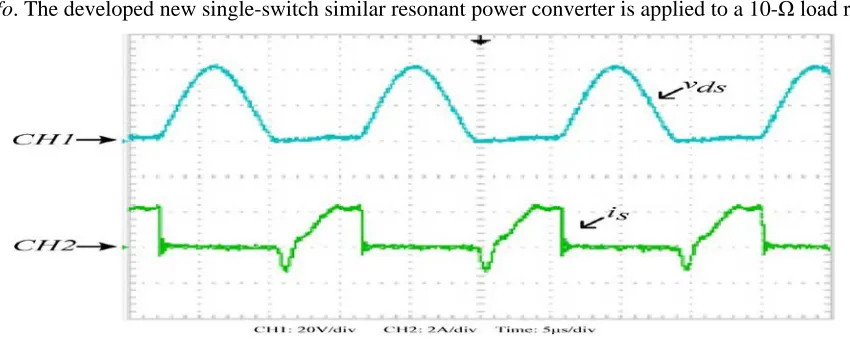
satisfy fs < fo. The developed new single-switch similar resonant power converter is applied to a 10-Ω load resistor.
Fig :Voltage And Current Waveforms Of The Active Power Switch
To reduce the input current ripple and maintain the stability of the output voltage, the low-pass filters at the
input and output terminals, which use a choke inductor and electrolytic capacitor, are set to Lm = 8 mH and Co = 220
μF, respectively. The low-pass filter is designed to be small, light, and low cost. Conclusion
In this paper, a new single-switch similar resonant power converter with an energy-blocking diode has been designed
for use in a solar energy generation system. The structure of the proposed converter is simpler and cheaper than other
resonant power converters, which require numerous components. The novel resonant converter is analyzed, and
performance characteristics are presented. The developed novel single-switch resonant power converter offers the
advantages of soft switching, reduced switching losses, and increased energy conversion efficiency. The output power
can be determined from the characteristic impedance of the resonant tank by adjusting the switching frequency of the
converter. The new single-switch similar resonant power converter is supplied by a solar energy generation system to
yield the required output conditions. The experimental results reveal the effectiveness of the developed novel
single-switch resonant power converter in solar energy generation. When the high-frequency new single-single-switch similar
resonant power converter is applied to a resistive load, the satisfactory energy conversion efficiency is 97.3%.
References
1. J. Parikh and K. Parikh, “Growing pains: Meeting India’s energy needs in the face of limited fossil fuels,” IEEE
Power Energy Mag., vol. 10, no. 3, pp. 59–66, May 2012.
2. J. I. Nishizawa, “A method to avoid dangers caused by fossil fuels,” Proc. IEEE, vol. 96, no. 10, pp. 1559–1561,
Oct. 2008.
3. P. Thounthong, B. Davat, S. Rael, and P. Sethakul, “Fuel cell highpower applications,” IEEE Ind. Electron. Mag.,
vol. 3, no. 1, pp. 32–46, Mar. 2009.
4. W. Wongsaichua, W. J. Lee, S. Oraintara, C. Kwan, and F. Zhang, “Integrated high-speed intelligent utility tie unit
© IJERGS, All Rights Reserved.
Pag
e23
Pag
e23
Pag
e23
Pag
e23
Pag
e23
Pag
e23
Pag
e23
Pag
e23
Pag
e23
Pag
e23
Pag
e23
Pag
e23
Pag
e23
Pag
e23
Pag
e23
Pag
e23
Pag
e23
Pag
e23
Pag
e23
Pag
e23
Pag
e23
5. Z. Liang, R. Guo, J. Li, and A. Q. Huang, “A high-efficiency PV moduleintegrated DC/DC converter for PV energy
harvest in FREEDM systems,” IEEE Trans. Power Electron., vol. 26, no. 3, pp. 897–909, Mar. 2011.
6. M. S. Lu, C. L. Chang, W. J. Lee, and L. Wang, “Combining the wind power generation system with energy storage
equipment,” IEEE Trans. Ind. Appl., vol. 45, no. 6, pp. 2109–2115, Nov./Dec. 2009.
7. T. K. A. Brekken, A. Yokochi, A. V. Jouanne, Z. Z. Yen, H. M. Hapke, and D. A. Halamay, “Optimal energy
storage sizing and control for wind power applications,” IEEE Trans. Sustain. Energy, vol. 2, no. 1, pp. 69–77, Jan.
2011.
8. A. M. Rahimi and A. Emadi, “Discontinuous-conduction mode DC/DC converters feeding constant-power loads,”
IEEE Trans. Ind. Electron., vol. 57, no. 4, pp. 1318–1329, Apr. 2010.
9. F. Liu, J. Yan, and X. Rua, “Zero-voltage and zero-current-switching PWM combined three-level DC/DC
converter,” IEEE Trans. Ind. Electron., vol. 57, no. 5, pp. 1644–1654, May 2010.
10. W. Li, J. Xiao, Y. I. Zhao, and X. He, “PWM plus phase angle shift (PPAS) control scheme for combined multiport
DC/DC converters,” IEEE Trans. Power Electron., vol. 27, no. 3, pp. 1479–1489, Mar. 2012.
11. C. M. Wang, “A novel ZCS-PWM flyback converter with a simple ZCSPWM commutation cell,” IEEE Trans. Ind.
Electron., vol. 55, no. 2, pp. 749–757, Feb. 2008.
12. Y. M. Chen, Y. C. Liu, and S. H. Lin, “Double-input PWM DC/DC converter for high-/low-voltage sources,” IEEE
Trans. Ind. Electron., vol. 53, no. 5, pp. 1538–1545, Oct. 2006.
13. C. Liu, A. Johnson, and J. S. Lai, “DC/DC converter for low-voltage fuel cell applications,” IEEE Trans. Ind. Appl.,
vol. 41, no. 6, pp. 1691–1697, Nov./Dec. 2005.
14. R. M. Cuzner, D. J. Nowak, A. Bendre, G. Oriti, and A. L. Julian, “Mitigating circulating common-mode currents
between parallel soft-switched drive systems,” IEEE Trans. Ind. Appl., vol. 43, no. 5, pp. 1284–1294, Sep./Oct.
2007.
15. M. Ilic and D. Maksimovic, “Interleaved zero-current-transition buck converter,” IEEE Trans. Ind. Appl., vol. 43,