VOLUME 39, ARTICLE 46, PAGES 1241
,
1290
PUBLISHED 18 DECEMBER 2018
https://www.demographic-research.org/Volumes/Vol39/46/ DOI: 10.4054/DemRes.2018.39.46
Research Article
Birth and employment transitions of women in
Turkey: The emergence of role incompatibility
Ayşe Abbasoğlu Özgören
Banu Ergöçmen
Aysıt Tansel
© 2018 Ayşe Abbasoğlu Özgören, Banu Ergöçmen & Aysıt Tansel.
This open-access work is published under the terms of the Creative Commons Attribution 3.0 Germany (CC BY 3.0 DE), which permits use, reproduction, and distribution in any medium, provided the original author(s) and source are given credit.
1 Introduction 1242
2 Theoretical and empirical considerations 1244
2.1 Theoretical framework 1244
2.2 Previous empirical studies 1245
3 The context of Turkey: Structural, economic, cultural, and
institutional dimensions
1247
4 Data and methods 1249
4.1 Data 1249
4.2 Methodology 1251
4.3 Variables 1252
4.3.1 Dependent variable and baseline hazard 1252
4.3.2 Explanatory variables 1253
5 Results and discussions 1256
5.1 Descriptive findings 1256
5.2 Results of the multivariate analyses 1257
5.2.1 The relationship running from employment to fertility 1258
5.2.2 The relationship running from fertility to employment exit and
entry 1260
5.2.3 Interaction effects of employment and fertility variables and
calendar period on transitions
1264
6 Conclusion and discussion 1266
7 Acknowledgments 1269
References 1273
Birth and employment transitions of women in Turkey:
The emergence of role incompatibility
Ayşe Abbasoğlu Özgören1
Banu Ergöçmen2
Aysıt Tansel3
Abstract
BACKGROUND
The available evidence on the relationship between fertility and employment among women in developing countries paints an ambiguous picture. In Turkey there have been considerable structural changes since the 1960s, related to the incompatibility between women’s roles as mother and worker.
OBJECTIVE
This study analyzes the two-way relationship between employment and fertility in Turkey over a 35-year period, including the correlates of the risks of first, second, third, and fourth and higher-order conceptions, and of the transitions from non-employment to employment and from employment to non-employment.
METHODS
The study adopts piecewise constant exponential event history modeling using data from the 2008 Turkey Demographic and Health Survey, mainly its event history data on ever-married women.
RESULTS
There is a two-way negative association between fertility and employment among women in Turkey. The characteristics of jobs that favor compatibility between worker and mother roles increase the risk of conception. Exiting employment is temporarily increased by fertility, due either to pregnancy or having an infant. Fertility in all its dimensions decreases the risk of entry into employment.
1 Hacettepe University Institute of Population Studies, Ankara, Turkey.
Email:[email protected].
CONCLUSIONS
Contextual changes related to the incompatibility of the roles of mother and worker have transformed the fertility–employment relationship in Turkey from being insignificant to being strongly negative, in line with the role incompatibility hypothesis.
CONTRIBUTION
This is the first study to use event history analysis to analyze the relationship between women’s fertility and employment in a developing country. As regards Turkey, it is the first to follow a decadal approach to the issue, and has important policy implications for the country.
1. Introduction
main reasons for focusing on Turkey, the first of which is policy-oriented. The fertility rate has been declining in Turkey since the 1950s and has reached replacement level (2.10 in 2016 according to Turkish Statistical Institute (TURKSTAT 2016)). When the fertility rate stabilized around the replacement level, this drew attention to the risk that it might fall below replacement level in the near future, and policymakers became alarmed. Meanwhile, employment among women has always remained at low levels. The government has begun to encourage both fertility and employment among women, although public discourse seems to favor the former over the latter and effective reconciliation mechanisms have only recently been developed. Investigating the relationship between women’s fertility and employment will elucidate the effect of prioritizing pronatalist over pro-employment policies on the employment status of women in Turkey.
The second reason for focusing on Turkey is the lack of research on women’s work and maternity, despite the considerable structural changes in these life events that have taken place since the 1960s, which both resulted in and were a result of the demographic transformation. The sectoral shift in female employment from agriculture to the service sector is one such change, although structural changes have not been accompanied by cultural or institutional changes. The low institutionalization of childcare, the dominance of women’s role as carer in the patriarchal family model, and the social norm that prioritizes motherhood over employment are all characteristics of the country’s history that continue today, leading women to work in unpaid or non-wage jobs that offer no social security benefits or not to work at all. Accordingly, there is an apparent need to re-study the work‒fertility relationship in Turkey within this new context using a methodology that makes a thorough analysis of women’s entire work and fertility histories. Addressing this need, this study aims to contribute to the literature with an analysis of how employment in Turkey has been related to fertility, and vice versa, over a period of more than 35 years, taking into account both the timing and order of events.
2. Theoretical and empirical considerations
2.1 Theoretical framework
The two main theoretical frameworks that explain the relationship between fertility and female employment in sociodemographic literature are the (maternal) role incompatibility hypothesis and the societal response hypothesis (Narayan and Smyth 2006). The societal response hypothesis applies to industrialized countries and tries to find an explanation for the negative to positive change in the relationship between fertility and female employment after the 1980s (Brewster and Rindfuss 2000; Engelhardt, Kögel, and Prskawetz 2004). In the Turkish context, the role incompatibility hypothesis is the appropriate approach to studying the relationship between women’s fertility and employment. This has already been verified in Stycos and Weller’s (1967) study of Turkey, using data from a survey carried out in 1963.
The role incompatibility hypothesis argues that “an inverse relationship between women’s work and fertility occurs only when the roles of worker and mother conflict” (Mason and Palan 1981: 551). The roles of mother and worker are most incompatible when the job is outside the home, and in locations where people believe that mothers or close relatives should care for children (Dixon-Mueller 1994). On the other hand, when roles are compatible, no relationship is expected between fertility and women’s employment.
In most specifications of this hypothesis there are two mechanisms determining the level of conflict between the two roles: (1) the organization of production (nature of the task), and (2) the (social) organization of childcare (Mason and Palan 1981; Stycos and Weller 1967). The former mechanism relies heavily on the level of industrialization in a society. In rural undeveloped countries, women are likely to work in places close to their children and may have a more flexible schedule than women living in industrialized societies. In industrial societies on the other hand, women tend to work in places that are distant from their children, such as factories, offices, or stores, and are more likely to have a relatively inflexible schedule (Mason and Palan 1981). Weller (1977) also notes this separation of the home and gainful employment and the relatively inflexible hours of employment in industrialized settings, and writes about the incompatibility of the roles of mother and worker. Lehrer and Nerlove (1986: 182) addressing this incompatibility in industrialized societies, claim that “the demands of working are in conflict with the demands of childcare.” In other words, “there is a strain between the mother and worker roles.”
gendered division of household labor, in which the role of child-rearing is ascribed to women and the role of worker and breadwinner to men. This can result in women developing a negative attitude to work outside the home, and/or lead them to choose a job that is compatible with their role as a mother. In developing countries, various social norms may co-exist, depending on place of residence and region, and the macro outcomes could be a result of the dichotomy between traditional women choosing a motherhood role versus modern women choosing a career. Traditional/modern settings within a country can be accounted for by controlling for whether the place of residence or location is urban or rural, and by educational variables (parental as well as individual), which may differ depending on the level of development. Women’s characteristics that Matysiak (2011b) defines as material aspirations and orientation towards family or paid work can to some extent be controlled for with these residential and educational variables.
The second mechanism that determines the level of conflict between the roles of worker and mother is the organization of childcare, based on the fact that it is easy to work outside the home if parental surrogates are cheaply available in the form of relatives, friends, or state agencies (Stycos and Weller 1967). It is expected that the decline of extended family households and the decreasing pool of domestic servants will result in an inverse relationship between fertility and employment.
This micro-level study of the female employment–fertility nexus in Turkey uses the contextual explanations of the role incompatibility hypothesis, as well as other possible mediating factors. The mechanisms affecting the degree of conflict between the roles of worker and mother are controlled for by contextual variables such as urban– rural place of residence, calendar effects, and the organization of work in time.
2.2 Previous empirical studies
While an inverse relationship between fertility and female labor force participation was identified in developed countries in the 1960s, cross-sectional data suggested that, it tended to be weak or absent in developing countries (Concepcion 1974). In his multi-country analysis, Caceres-Delpiano (2012) claims that fertility affected employment among women negatively in developing countries in the 1990s and 2000s. Studies of
developing countries look predominantly at Latin America,4 and a review of this
literature has provided different conclusions. According to Schockaert (2005), the
4 Aguero and Marks (2008) on Peru, Guatemala, Colombia, Bolivia, Nicaragua, and the Dominican Republic;
findings are affected by contextual variables like developmental and fertility levels as well as the period of the study, but overall a weakening association can be identified in Latin America. Unlike in developed countries, this can be explained by the declining number of wage earners employed in modern jobs and increasing number of non-wage-earning females.
None of the studies of the relationship between fertility and employment in developing countries has employed event history analysis, mainly due to a lack of retrospective data. In developed countries most of the studies using event history analysis find a negative relationship between fertility and women’s employment, albeit that some of the findings are contrary. Matysiak and Vignoli’s (2008) important meta-analysis considers these different findings: it is restricted to longitudinal studies covering the period 1990–2006 and analyzes the transition of women to birth and to
employment5. Their univariate analysis reveals that “the effect of young children on
mothers’ entry into employment is negative and significant, whereas the effect of women’s employment on childbearing is zero.” The magnitude of the effect size is found to be influenced by controlling for partner characteristics, social background of the respondent, macro characteristics, and women’s job characteristics. Finally, the influence of birth order in the negative effect of women’s work on childbearing is much lower in the first parity than in higher-order parities.
The few studies that analyze the relationship between fertility and employment of
women in Turkey are all unidirectional.6 An early study by Stycos and Weller (1967)
uses data from a survey carried out in 1963 in both rural and urban areas. After controlling for place of residence, employment status, education, and exposure to contraception within marriage, they find no relationship between employment status and fertility, but they do find a relationship with residence and education, which can be attributed to the compatibility of the roles of mother and worker in areas where women are mostly employed as unpaid workers in the agricultural sector. Özar and Günlük-Şenesen (1998) analyze the determinants of female non-participation in the urban labor force using a field survey in four Turkish cities: İstanbul, Ankara, İzmir, and Adana. The results of their logit analysis indicate no significant effect of existence, number, or
5 Covers 30 papers, 90 effects for transition of women to birth, and 29 papers, 58 effects of young children
aged 0–6 for transition of women to employment.
6 There is also a study by Farooq and Tuncer (1974) that analyzes this relationship indirectly, as a by-product
age of children on female labor non-participation. The third study is that of Şengül and Kıral (2006), which analyzes the effect of decisions related to fertility on female labor force participation, using the sex of the first child as the instrumental variable. Basing their analysis on the Household Labor Force Survey from the first quarter of 2003, they find that having children, especially the presence of children aged below seven, decreases the probability of working among women in Turkey. Finally, Greulich, Dasre, and Inan (2016) analyze the determinants of fertility decline in Turkey, focusing on the birth of a third child and using data from the Survey of Income and Living
Conditions (SILC) for the 2006–2011 period. Their findings indicate that stable7
employment among women, especially in the formal sector, is negatively correlated with the birth of a third child, and that employment in the agricultural sector is also
negatively associated with a third birth, albeit to a lesser degree.8
3. The context of Turkey: Structural, economic, cultural, and
institutional dimensions
Today, with its declining levels of fertility and mortality, Turkey has entered the final stage of its demographic transition. The decline in fertility started in the 1950s and gained pace after the 1970s. According to the TDHS-2013 findings the fertility rate for 2010–2013 was just above the replacement level at 2.26, but the fertility transition in Turkey was not uniform. For the same period, regional differences in the country’s fertility levels ranged between a total fertility rate of 1.93 in the Western region and 3.41 in the Eastern region (HUIPS 2014).
The structural factors most associated with the onset of fertility transition in Turkey were female education and urbanization rather than employment of women. The female labor force participation rate has always been low in Turkey and has not exceeded 36% since 1988 (Tansel 2001; TURKSTAT 2014). Turkey has the lowest female labor force participation rate among OECD member states (34% in 2013, OECD 2014); and half of employed women are non-wage earners (49.8% in 2008, according to TDHS). Furthermore, the number of unpaid female family workers in agriculture is still high (32.4%), and despite the decline over time, social security coverage is at a historic low among employed women.
7 Unchanged during the three-month observation period.
8 Two descriptive studies find a negative association between employment of women and fertility in Turkey.
The share of women employed in the agriculture sector has been declining, while the number employed in the services sector has been steadily increasing (Tansel 2001). This sectoral shift in the female labor market has made it difficult for women to balance mother and worker roles, and the continuing patriarchal regime where childcare takes place in the country has made the problem worse. As Turkey has modernized and developed, the family care regime has become more patriarchal rather than more egalitarian in the country. During the financial liberalization and the economic downturns of 1994, 2001, and 2008–2009 there was a substantial increase in the number of women entering the labor market, due to the added-worker effect in response to husbands losing their jobs (Ayhan 2015; Değirmenci and İlkkaracan 2013). However, women’s employment outcomes depended on their education level: Those with a low level of education tended to enter the labor market on a temporary basis as a secondary earner to the main ‘breadwinner’ to overcome the financial problems of the family. By contrast, educated women (high school or higher) left the labor market for family reasons such as marriage, because it was what the husband wanted, or to assume a bigger role in household duties. The lack of mechanisms for the reconciliation of family and work led to the continuation of the patriarchal family model (İlkkaracan 2010).
A number of cultural factors are embedded in the relationship between women’s fertility and employment. Social values and norms in Turkey prioritize motherhood over work, although the societal role of woman includes both family responsibilities and work. In a survey on Family, Employment and Gender in Turkey, carried out in coordination with the International Social Survey Program (ISSP) (Çarkoğlu and Kalaycıoğlu 2013), 69% of respondents thought that “an ideal situation for the work– family life of a family with a pre-school-aged child is for the father to be full-time employed and the mother to stay at home.” However, the working role of women is not completely discarded in Turkey: According to this ISSP Survey, 67% of the respondents agreed that both men and women should contribute to the household budget.
An effective work and family reconciliation mechanism in Turkey would lessen the incompatibility of the roles of worker and mother. However, until recently family policies have been passive, favoring civil servant women or poor families (Bozçağa 2013). In the 2015 ranking of paid maternity leave in OECD countries, Turkey (16.0 months) places slightly below the OECD average (17.7 months). Under the Civil Servants Law no. 657, mothers working in the civil service receive full pay during maternity leave, while under Labor Law no. 4857 working women receive two-thirds of
their salary from the Social Security Institution after their maternity leave is over.9 No
9 By contrast, paternal leave for male civil servants under Civil Servants Law no. 657 was increased from 3 to
regulation on parental leave exists in Turkey, although some flexible work schemes came into effect with Law no. 6663 of 10 February 2016. Only civil servants receive a cash transfer related to caregiving, in the form of a family allowance. In May 2015 a new regulation was passed giving a birth allowance to all women with Turkish
citizenship,10 but the cash transfers are too low to affect fertility or employment
outcomes. There are also conditional cash transfers, which target only the poorest families.
The last but not the least of the reconciliation mechanisms, nursery provision for pre-school-age children, is minimal in Turkey. There is no provision for children under three, and since 2004 Turkey has ranked last in the participation of children aged three to five in pre-primary education or primary school (OECD 2016); the current rate is 30.9%, compared to the 2012 OECD average of 82.0%. Early childhood care takes place at home, and the main caregiver is the mother, even if she is working. According to the TDHS-2008, 30.4% of employed women with a child under six take care of their children themselves. The results of TDHS-1998, 2003, 2008, and 2013 indicate that the share of care given by relatives to children aged under six while the mother is working has remained stable at around 38%, showing that in the last four decades childcare has changed very little in Turkey.
4. Data and methods
4.1 Data
This study uses data from the 2008 Turkey Demographic and Health Survey (TDHS-2008), the fourth of the Turkish DHS series and the ninth national demographic study in the country since 1968. In the past the TDHS collected data on birth histories, along with summary data on the marriages, migrations, and employment histories of ever-married women. The TDHS-2008, was the first to include full histories of births, marriages, migration, and employment of ever-married women, and this study makes use of this rich retrospective information. In the TDHS-2008 the dates of each event were recorded in months and years, which were recoded into century month codes in the analyses. Month and year information of all live birth events of women and all marriages (and divorces) of women were collected independent of their age. Data on migration and employment events, on the other hand, corresponds to the period from
they were given 5 days on April 23, 2015. It is notable that this is still lower than the 2015 OECD average of 6.3 days (OECD 2016).
10 The By-Law on the Birth Allowance, dated 23 May 2015, states that every mother will get a lump sum cash
the age of twelve until the date of the interview. The migration history section of the TDHS-2008 covers information on the province (from which the region variable is constructed) and whether each place of residence was urban or rural, for places where the respondent lived for at least six months after age twelve. The employment history
covers all jobs of women from the age of twelve that lasted for at least six months.11
The start month and year, the sector, public–private differentiation, home–non-home place, social security coverage, and end month and year were recorded for all these jobs. This detailed information enabled construction of the various time-varying explanatory and control variables in this study.
The TDHS-2008 is based on 10,525 completed household interviews, and 7,405 completed individual interviews with ever-married women aged 15–49 years. The data required cleaning, and some cases had to be dropped due to missing information on
dates that could not be imputed.12 The final dataset for the analysis of conceptions
comprised 6,977 ever-married women, and the data set for the analyses of transitions from/to employment and non-employment comprised 5,088 employment and 7,903 non-employment spells, respectively.
11 The current job was included in the history regardless of its duration.
12 Employment history of 119 cases (1.6% of total, and 2.9% of ever-employed women) had to be rearranged
so that at each time only one job existed. Additionally, some month entry and/or exit data was rearranged manually, looking at answers to the question: “How long have you worked in this job?” There were 240 of these cases, amounting to 3.3% of the total and 5.9% of ever-employed women. Imputations for the missing or unknown month data were carried out assuming the months were randomly distributed. For the start of jobs the percentages of month imputations are 16.1, 9.2, 7.8, 8.1, 7.9 for the first, second, third, fourth, and fifth job, respectively (corresponding unweighted numbers are 658, 103, 27, 9, 3). For the ending month of the job the percentages of imputed months are 13.0, 9.4, 6.5, 11.1 for the first, second, third, and fourth job, respectively (corresponding number of cases are 343, 60, 13, 7). As expected, the share of imputed months increases while moving backwards in history. After imputations, some adjustment still had to be carried out as some end months could be before the start of the next job. There were 47 of these cases, 0.6% of all cases and 1.2% of ever-employed women. In an iterative setting, imputations were re-carried out assuming the months were randomly distributed.
Event histories of migration required less data cleaning. The migration histories of 27 cases were corrected. The years of 7 cases were derived from looking at other questions, such as “How long did you stay at this place?” and “What was the reason for your migration?” Month imputations related to migration history were carried out taking into account the question: “For how long did you live in …..?” (the percentages of imputed cases are 6.1, 5.9, 4.9, 4.6, 1.0, 2.6 for first, second, third, fourth, fifth, and sixth migration, corresponding to 253, 78, 26, 10, 1, 1 cases).
The marriage history data required the least cleaning. Year information was derived for 2 cases, and missing or unknown months for the start of first and second marriage were imputed for 0.4% and 4.9% respectively (28 and 9 cases); and for the end of first marriage for 9.0% (45 cases).
Retrospective survey data may suffer from recall errors. Inaccuracy in full employment history data may increase due to employment patterns being less salient and more complex, longer recall periods, and nonpresence of time-anchoring biographical details in respondents’ lives (Shattuck and Rendall 2017). As part-time, irregular, or unpaid jobs are more complex and harder to recall, in the TDHS-2008 the respondent was given elaborate information at the beginning of the employment history module: “As you know, some women sell small things, sell goods at the market, work on the family farm or business, look after children, work as housemaids, etc. Please include these kinds of jobs as well.” The survey’s employment history data collection did not record jobs that lasted less than six months or overlapping jobs, which we believe decreased the complexity of the module. This was a drawback, since shorter spells of unemployment were ignored. Although irregular, seasonal, and unpaid jobs, which are mostly part-time, are recorded provided that they last over six months, the data does not distinguish between part-time and full-time employment, which is another limitation. The average length of the recall period is 15.5 years (the difference between the interview date and the start of the first job), and the mean length of the first job is 8.7 years. Maternity leave is not counted as a period of inactivity or unemployment for employed women. The first jobs started at early ages: 40.9% of first jobs started between the ages of 12 and 16, and 29.2% between 17 and 21. Additionally, 89.8% of ever-married women had at least one child by the date of the interview, which implies that women may have recalled the employment dates in relation to the dates of their marriage or first childbirth. These data figures and features indicate that recall errors are within an acceptable range, although they cannot be measured exactly.
4.2 Methodology
This study uses event history analyses to investigate the determinants of pregnancy, given non-pregnancy separately for different conception orders; entering employment, given non-employment; and exiting employment, given employment. To this end we
use a hazard approach with piecewise constant exponential modeling.13
Our models of pooled conceptions of order four and higher, and employment and non-employment entries and exits, contain multi-episode data, which means more than one event for each individual. As Allison (2010) notes, if repeated events are observed for an individual, the standard strategy is to reset the clock to zero each time an event
13 Hazard models assume that the hazard rate (dependent variable) is dependent on duration since the onset of
occurs, and to treat the intervals between events as distinct observations. Our repeated-event models make two assumptions: (1) that the dependence of the hazard on time since the last event has the same form for each successive event, i.e., no stratification is applied, and (2) individuals are independent, while birth intervals for each individual
are dependent.14,15
4.3 Variables
4.3.1 Dependent variable and baseline hazard
There are three main groups of models for analyzing the events of conception, employment exit, and employment entry. The observation window opens with the first marriage of the woman for the first conception model and employment models, and previous births for the models of second and higher-order conceptions. The observation window closes at interview date or migration abroad if emigration exists in the woman’s life history.
In our conception models the dependent variables are transitions to first, second, third, and fourth and higher-order conceptions. Date of pregnancy is measured as seven
months before the date of the live birth,16 while the baseline is the period since the first
marriage, the period since the first birth, the period since the second birth, and the period since the preceding birth, depending on the order of conception. Periods are measured in months, and the cut-off points are 12, 24, 36, 48, 60, 84, and 120 months, meaning eight segments.
14 In general, it is expected that people with short birth intervals will continue to give birth frequently. As long
as the explanatory variables in the model account for the dependence, the assumption of independence will not be violated. In most cases, however, the independence assumption is false, at least to some degree. This leads to (1) still asymptotically unbiased coefficient estimates, but (2) standard error estimates biased downward (Allison 1984). In this regard, repeated events only affect the variance of the estimates, and not the means. There is a need to correct for standard errors in our multivariate analyses. As suggested in Cleves et al. (2008), one solution would be to fit a standard piecewise constant exponential model, adjusting the standard errors of the estimated parameters to account for the possible correlation. This is done by specifying option vce (cluster CASEID) to streg, setting the id variable as the pregnancy. This provides a robust estimate of variance, as described in the context of the Cox regression of Lin and Wei (1989), with added adjustment for clustering.
15 To minimize the effects of violations of the independence assumption, additional explanatory variables that
represent the characteristics of the individual’s prior event history can be used. The most basic of these variables are the number of prior events and the length of previous interval. Accordingly, we use the order of conception as an explanatory variable in our multi-episode conception model, and order of job/non-employment episode and years of job/non-employment/non-job/non-employment after marriage in the models of job/non-employment exit and employment entry.
16 Our selection of seven months is based on the fact that in the TDHS, birth history intervals can be a
In the employment exit and entry models the dependent variables are transition to non-employment and employment, respectively. The baseline is the period since entry into work in the employment exit model and the period since entry into non-employment (exit from previous job or first marriage if never worked before) in the employment entry model. The periods are segmented with the same cut-off points as in the fertility models.
4.3.2 Explanatory variables
The explanatory variables are employment status as a time-varying variable, and employment status before marriage as a time-fixed variable, which are constructed as dummy variables within the categories of ‘non-employed’ and ‘employed.’ Table 1 presents descriptive statistics of the explanatory variables as occurrence of conceptions and exposure times to the risks for each conception model, expanded based on the sector of employment (agriculture or non-agriculture), public versus private
employment, wage status of employment,17 and social security coverage of
employment. In the TDHS the employed category includes both paid and unpaid workers. The category of non-employed was taken as synonymous with inactive rather than unemployed, in that that data contains no information on whether inactive women were seeking work or not.
Employment prior to marriage is a dummy variable that indicates whether or not the woman worked before marriage. Those who were employed before marriage may be more career- than family-oriented, although in Turkey marriage strongly influences women giving up work, and interrupts employment. According to TDHS-2008 data, marriage was the most frequently stated reason for leaving employment by ever-married women, accounting for 26.6% of all jobs ended (3,595 jobs), and so this time-fixed variable may not reveal conception intensities after marriage within the context of Turkey.
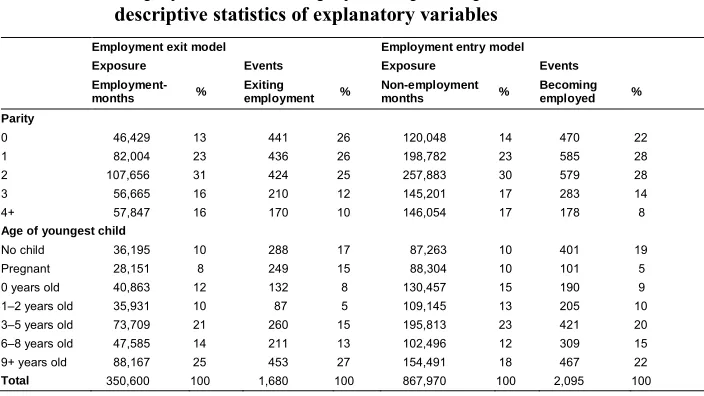
Table 2 presents descriptive statistics of the explanatory variables in the employment exit and entry models, in which three time-varying fertility variables, namely number of living children, age of youngest child, and a composite variable of the two, are used in the three separate models for each event. These variables are constructed in a similar way to the covariates in Andersson’s (1997) model analyzing the impact of children on divorce risk among Swedish women. Parity is the number of
17 The wage earner category of the variable of wage status includes workers with the status of employer,
living children, and is divided into five levels from parity 0 to parity 4 and above. Although in empirical studies there is no consensus on the sign of the effect of parity on employment entry and exit, a negative relationship can be expected in Turkey due to the social norms associated with mothers in society, where mothers are seen as having primary responsibility for childcare. That said, higher parity might result in greater economic need in the family, causing women to enter the labor force as a second breadwinner and resulting in higher risks of employment entry and lower risks of employment exit. The age of the youngest child is another important fertility dimension affecting employment exit and entry, as shown in the previous section. Women may temporarily abstain from work during periods of pregnancy and for a couple of years after the birth of a child and may return to work once the youngest child comes of
school age. The composite parity–age-of-child variable18 is based on the interactions of
parity and the age-of-youngest-child variable,19 in which childless women fall into a
separate category that cannot interact with age of the youngest child by definition.20,21
18 Descriptives of this variable are not presented in this paper, but available upon request. Relative risks of
employment exit and entry by this variable ‘ceteris paribus’ are plotted in figures.
19 It has categories of ‘no child,’ ‘no child pregnant,’ ‘one child pregnant,’ ‘one child 0 years old,’ ‘one child
1–2 years old,’ ‘one child 3–5 years old,’ ‘one child 6–8 years old,’ ‘one child 9+ years old,’ ‘two children pregnant,’ ‘two children 0 years old,’ ‘two children 1–2 years old,’ ‘two children 3–5 years old,’ ‘two children 6–8 years old,’ ‘two children 9+ years old,’ ‘three children pregnant,’ ‘three children 0 years old,’ ‘three children 1–2 years old,’ ‘three children 3–5 years old,’ ‘three children 6–8 years old,’ ‘three children 9+ years old,’ ‘four or above children pregnant,’ ‘four or above children 0 years old,’ ‘four or above children 1–2 years old,’ ‘four or above children 3–5 years old,’ ‘four or above children 6–8 years old,’ and ‘four or above children 9+ years old.’
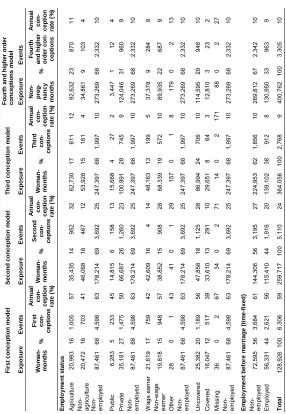
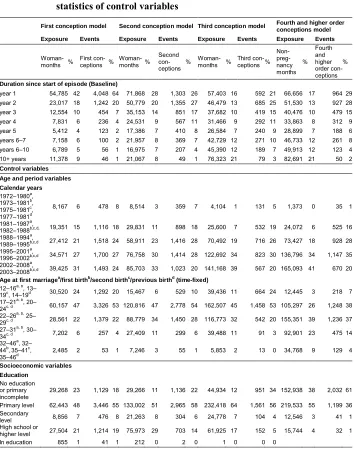
Table 1: Women or non-pregnancies exposed to birth risk(*), descriptive
statistics of explanatory variables
Note: (*) Conceptions leading to a live birth. The variables are time-varying unless otherwise stated. 'Woman-months” is the total number of months that women are exposed to the risk of becoming a mother. “Events” indicates the number of conceptions resulting in live births. Interpretation: Non-employed women were childless and not pregnant for 87,461 months. 4,598 non-employed women conceived their first live child. Their annual conception rate for a first live child was thus 63%.
Source: TDHS-2008.
Table 2: Employment or non-employment spells exposed to exit risk(*),
descriptive statistics of explanatory variables
Employment exit model Employment entry model Exposure Events Exposure Events
Employment-months %
Exiting employment %
Non-employment months %
Becoming employed % Parity
0 46,429 13 441 26 120,048 14 470 22
1 82,004 23 436 26 198,782 23 585 28
2 107,656 31 424 25 257,883 30 579 28
3 56,665 16 210 12 145,201 17 283 14
4+ 57,847 16 170 10 146,054 17 178 8
Age of youngest child
No child 36,195 10 288 17 87,263 10 401 19
Pregnant 28,151 8 249 15 88,304 10 101 5
0 years old 40,863 12 132 8 130,457 15 190 9
1–2 years old 35,931 10 87 5 109,145 13 205 10
3–5 years old 73,709 21 260 15 195,813 23 421 20
6–8 years old 47,585 14 211 13 102,496 12 309 15
9+ years old 88,167 25 453 27 154,491 18 467 22
Total 350,600 100 1,680 100 867,970 100 2,095 100
Note: *Exit risk is exiting employment in employment model and exiting non-employment in non-employment model. The variables are time-varying.
5. Results and discussions
5.1 Descriptive findings
compatibility between the roles of worker and mother encourage fertility, aside from jobs in the public sector. Fertility peaked at 25–29 years in Turkey in 2008, but this is subject to change according to employment status and job characteristics: For non-employed women, those working in the agricultural sector, and those in the non-wage-earning group, fertility peaks at 20–24 years. By contrast, a delay in birth is observed among women working in the public sector.
For women aged 40–49 at the time of the interview, completed fertility measured by the mean number of children ever born (CEB) is higher for never-employed women (3.85) than that for employed women (3.09) and there are also differences related to job
characteristics.22
Table 3: Age-specific fertility rates per 1,000 women for the three years preceding the survey, and the mean number of children ever born by employment status(*), TDHS-2008
Mother’s age at
birth 15–19 20–24 25–29 30–34 35–39 40–44 45–49 TFR (women 15–49)
Mean CEB (women 40–49)
Employment Never employed 38 146 146 100 43 16 5 2.46 3.85
Non-employed 77 152 131 87 46 7 0 2.50 3.03
Employed 29 93 111 64 25 11 1 1.67 3.09
Sector Agriculture 30 138 137 81 32 15 1 2.17 3.64
Industry 19 61 113 54 0 0 0 1.23 3.20
Service 33 71 96 55 25 8 0 1.44 2.44
Public versus
private PublicPrivate 4029 10192 116110 13855 6920 120 10 1.592.33 1.973.20
Status Wage-earner 27 66 103 70 26 7 2 1.51 2.85
Non-wage earner 33 131 123 58 24 14 0 1.92 3.26
Social Security
Uncovered 29 113 115 54 23 13 1 1.74 3.37
Covered 30 50 106 82 31 4 0 1.52 2.10
Turkey 36 127 132 90 36 10 1 2.16 3.34
Note: *Non-employed: non-employed in last three years, employed: ever-employed in last three years.
5.2 Results of the multivariate analyses
In this section we present the results of the dynamic analyses of the transitions during all life course spells under observation, in three parts: (1) the relationship running from employment to fertility, (2) the relationship running from fertility to employment exit
22 The fertility decline over the last decades is reflected in the difference between TFR and the mean CEB,
and entry, and (3) interactions between employment status and conception. Results related to the associations of other covariates with the dependent variables are presented and discussed in the Appendix.
5.2.1 The relationship running from employment to fertility
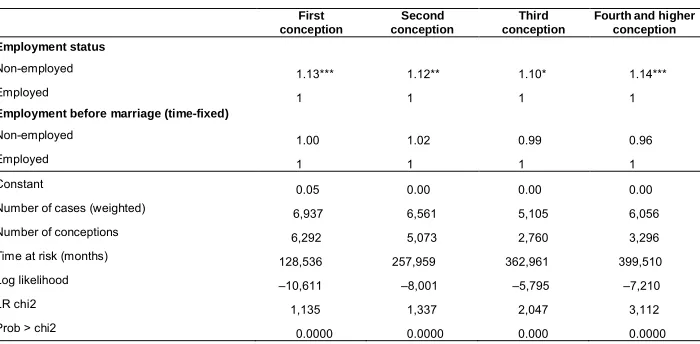
Table 4 presents the findings of the estimated piecewise constant proportional hazard models of births of different orders by employment variables when standardized for all covariates. The employment of women is negatively associated with family size, with non-employed women having 1.13 times more risk of having a first birth than employed women. For second, third, and fourth and higher-order births the hazard ratios are 1.12, 1.10, and 1.14 respectively for non-employed versus employed women. Employment status before marriage, on the other hand, appears to have no effect on the risk of giving birth in any order. This is an expected result, since exiting employment due to marriage and the likely prioritization of family roles over career after marriage is common. Employment after marriage, on the other hand, is an influential determinant of conception risk, and likely provides a better understanding of the differentiations in women’s career and family orientations.
Table 4: Relative risk of conception by employment variables, Turkey 1972–2008a
First conception
Second conception
Third conception
Fourth and higher conception Employment status
Non-employed 1.13*** 1.12** 1.10* 1.14***
Employed 1 1 1 1
Employment before marriage (time-fixed)
Non-employed 1.00 1.02 0.99 0.96
Employed 1 1 1 1
Constant 0.05 0.00 0.00 0.00
Number of cases (weighted) 6,937 6,561 5,105 6,056
Number of conceptions 6,292 5,073 2,760 3,296
Time at risk (months) 128,536 257,959 362,961 399,510
Log likelihood –10,611 –8,001 –5,795 –7,210
LR chi2 1,135 1,337 2,047 3,112
Prob > chi2 0.0000 0.0000 0.000 0.0000
Note: 10 %; ** 5 %; *** 1 %.a Model where other covariates presented in Table A-2 are controlled for. The variables are time-varying
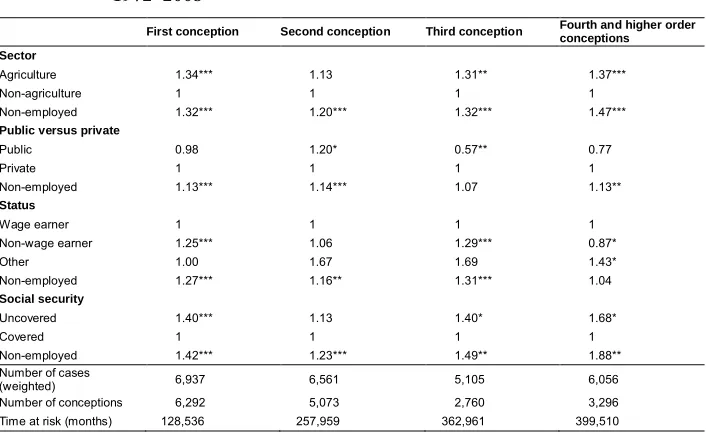
Table 5 presents the results of the models in which the employment status variable is replaced by one of the variables related to job characteristics. Sector of employment has a crucial role in transition to motherhood or higher-order births, with employment in the agricultural sector increasing the risk of conception compared to employment in the non-agricultural sector. The risk ratios indicate that the non-employment effect is very similar to the agricultural sector effect, and this finding is in line with the role incompatibility hypothesis, which suggests that no relationship exists between women’s employment and fertility in spheres in which the roles of worker and mother are compatible. The public–private sphere of employment is influential after first birth, with women employed in the public sector subject to higher risks of a second birth (20% higher than those working in the private sector), and lower risks of higher-order births. Working as a non-wage earner increases the risk of transition to first, second, and third births, but decreases that of higher-order births. For higher-order births, income constraints may come into play, in that non-wage earner women are employed mostly in unpaid or low-paying jobs. Working in a job that is not covered by social security is associated with a higher risk of birth than working in a job that is covered. In short, being employed compared to being non-employed is found to affect the transition
to conception negatively,23 and job characteristics such as working in the agricultural
sector, working as a non-wage earner (unpaid or self-employed), which favor compatibility between women’s roles as worker and mother, and working without any social security increase the risk of conception. This increased risk may also result from lower indirect costs of non-employment due to these women’s lower stock of human capital. Being employed in the public sector, where the availability of employment insurance and stable jobs enables women to have as many births as they desire, is associated with a lower risk of conception except for second order births, confirming the presence of a two-child norm in Turkey.
The results presented above prevail provided that we control for the various factors presented in Section A-1. Among these factors, women’s educational level requires further emphasis, as it has been a crucial determinant of the onset of fertility transition in Turkey (Behar 1995; Kağıtçıbaşı 1982; Shorter 1969). The multivariate results suggest the higher the woman’s educational level, the lower the risk of having a birth of any order. Parental education is also negatively associated with fertility, in line with the
view of intergenerational transmission of educational attainment.24 According to the
human capital approach, investment in education leads to higher productivity and higher earnings (Cohn and Geske 1990), which are reflected in job characteristics.
23The only exception to this is that non-wage earning women have lower risks of fourth and higher-order
conceptions.
24 See, for instance, Patacchini and Zenou (2011) and Riphahn and Trübswetter (2011) for evidence on
Educated women in our sample, who as wage earners are more inclined to choose jobs with social security in the non-agricultural sector and have a higher opportunity cost of non-employment, may choose to forego bearing children. Educated women in Turkey are also more career-oriented, have more egalitarian gender and family norms, and postpone or avoid marriage and fertility (Yüksel-Kaptanoğlu, Abbasoğlu Özgören, and Keskin 2015).
Table 5: Relative risk of conception by type of employment, Turkey’ 1972–2008a
First conception Second conception Third conception Fourth and higher order conceptions Sector
Agriculture 1.34*** 1.13 1.31** 1.37***
Non-agriculture 1 1 1 1
Non-employed 1.32*** 1.20*** 1.32*** 1.47***
Public versus private
Public 0.98 1.20* 0.57** 0.77
Private 1 1 1 1
Non-employed 1.13*** 1.14*** 1.07 1.13**
Status
Wage earner 1 1 1 1
Non-wage earner 1.25*** 1.06 1.29*** 0.87*
Other 1.00 1.67 1.69 1.43*
Non-employed 1.27*** 1.16** 1.31*** 1.04
Social security
Uncovered 1.40*** 1.13 1.40* 1.68*
Covered 1 1 1 1
Non-employed 1.42*** 1.23*** 1.49** 1.88**
Number of cases
(weighted) 6,937 6,561 5,105 6,056
Number of conceptions 6,292 5,073 2,760 3,296
Time at risk (months) 128,536 257,959 362,961 399,510
Note: * 10 %; ** 5 %; *** 1 %.a Each separate model in which other covariates and explanatory variables are controlled for. The
variables are time -varying.
5.2.2 The relationship running from fertility to employment exit and entry
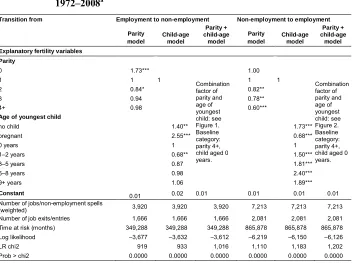
is lower than for women with an infant. The age of the child has no effect on the risk of exiting employment once the youngest child completes the age of six.
The multivariate model with the composite fertility variable, which is the composite parity–of-child variable based on the interactions of parity and the age-of-youngest-child variables (Figure 1), shows that first pregnancy is the most influential factor in job exit. Women who are pregnant with their second or third child also demonstrate a higher risk of employment exit. For women with one or two children the risk of employment exit, which peaks in pregnancy, declines until the youngest child reaches the age of two. After that age the risk of exit from employment tends to remain stable. The fact that job exit intensity is highly dependent on the age of the youngest child rather than parity implies that it is temporarily increased by fertility due to pregnancy and having an infant.
The results of the models of employment entry are presented in the last two columns of Table 6, in which it can be seen that in contrast to the employment exit model, child parity is effective. Child parity decreases job entry intensity among non-employed women. Zero parity, which includes childless women as well as women pregnant with their first child, has no association with employment entry among women. This can be expected, as pregnancy decreases and being childless increases the risk of entry into employment, their net effect being nil. Pregnancy is strongly associated with fewer employment entries, as would be expected. On the other hand, having no child and/or having a child older than one year is associated with higher risks of entry into employment. As the age of the youngest child increases, the risk of job entry increases. The relative risks of job entry with respect to the composite fertility variable indicate that being childless and non-pregnant is associated with a higher risk of employment entry (Figure 2). Above all, pregnancy is associated with a lower risk of employment entry, and as the youngest child grows older the risk of entry increases for all parity groups. When the youngest child completes the age of nine the risk of employment entry declines, albeit slightly.
Table 6: Relative risk of job exit and job entry by fertility variables, Turkey 1972–2008a
Transition from Employment to non-employment Non-employment to employment Parity
model
Child-age model
Parity + child-age
model
Parity model
Child-age model
Parity + child-age model Explanatory fertility variables
Parity
Combination factor of parity and age of youngest child: see Figure 1. Baseline category: parity 4+, child aged 0 years.
Combination factor of parity and age of youngest child: see Figure 2. Baseline category: parity 4+, child aged 0 years.
0 1.73*** 1.00
1 1 1 1 1
2 0.84* 0.82**
3 0.94 0.78**
4+ 0.98 0.60***
Age of youngest child
no child 1.40** 1.73***
pregnant 2.55*** 0.68***
0 years 1 1
1–2 years 0.68** 1.50***
3–5 years 0.87 1.81***
6–8 years 0.98 2.40***
9+ years 1.06 1.89***
Constant 0.01 0.02 0.01 0.01 0.01 0.01 Number of jobs/non-employment spells
(weighted) 3,920 3,920 3,920 7,213 7,213 7,213
Number of job exits/entries 1,666 1,666 1,666 2,081 2,081 2,081
Time at risk (months) 349,288 349,288 349,288 865,878 865,878 865,878
Log likelihood –3,677 –3,632 –3,612 –6,219 –6,150 –6,126
LR chi2 919 933 1,016 1,110 1,183 1,202
Prob > chi2 0.0000 0.0000 0.0000 0.0000 0.0000 0.0000
Figure 1: Relative risk of non-employment, ever-married employed women, Turkey, 1972–2008, by parity and age of youngest child (composite fertility variable)
Note: Calendar year, age at start of job, education, type of place of residence, region, mother tongue, parental education, marital status, order of job, work experience after marriage, sector of job, and social security coverage of job are controlled for.
Figure 2: Relative risk of employment, ever-married non-employed women, Turkey, 1973–2008, by parity and age of youngest child (composite fertility variable)
Note: Calendar year, age at start of non-employment, education, type of place of residence, region, mother tongue, parental education, marital status, order of non-employment episode, and years of non-employment after marriage are controlled for.
0.0 0.5 1.0 1.5 2.0 2.5 3.0 3.5 4.0 4.5 5.0
No child Pregnant 0 years 1–2 years 3–5 years 6–8 years 9+ years
Parity 1 Parity 2 Parity 3 Parity 4+ Parity 0
0.0 0.5 1.0 1.5 2.0 2.5 3.0 3.5 4.0 4.5 5.0
No child Pregnant 0 years 1–2 years 3–5 years 6–8 years 9+ years
5.2.3 Interaction effects of employment and fertility variables and calendar period on transitions
The interaction models with calendar year and employment status by order of conception show the relative risks of conception by employment status and calendar period (Figure 3) and the descriptive statistics of these interaction variables are presented in Table A-4. It can be observed that in past calendar periods the risk of conceiving a child of any order was higher, and that this is most pronounced for transitions to parities two and three. Antinatalist population policies in Turkey, such as the Population Planning Law of 1965 and the Family Planning Law of 1983, may have played a role in the decline of the risk of having a second or third birth. A comparison of the relative risks with respect to employment status reveals that non-employed women have a relatively higher risk of transition to a next birth compared to employed women in almost all calendar periods. The exceptions are the 1975–1995 period for the transition from second to third birth, and the period prior to 1981 for the transition to fourth and higher-order births. The relative risks of first and third conceptions are almost the same for non-employed and employed women until the second half of 1990s. However, beginning in 1995, which saw the start of a period of financial
liberalization and crises and recoveries in Turkey,25 a change occurs, with the relative
risks of first and third conceptions for employed women going into decline and the relative risk among non-employed women remaining stable. The 1994 economic crisis may have caused employed women to postpone motherhood entry and having a third child, and this change in intention may have carried over into the post-1994 economic crisis period. The sectoral shift in the employment of women from agriculture to the service sector may have influenced these differentiations in birth intensities between employed and non-employed women. For conceptions of order two, and four and higher, on the other hand, the relative risks of employed and non-employed women have been converging over time, leading to almost no differentiation.
The interactive effects of parity or age of youngest child and calendar period are presented for the employment exit and entry models in Figure 4, and their descriptive statistics in Table A-5. Looking at how the trends of transition to employment and non-employment evolved over time, it is apparent that both job exit and job entry intensities increased in the period of financial liberalization. Except for the childless category, the parity variable appears to be associated with higher differentials in the relative risk of entering employment, but not that of leaving. The increase in the risk of job exit after the 1994 economic crisis is particularly valid for women with no children, including women pregnant with their first child. Women with one and two living children saw a
25 Severe economic crises were witnessed in 1994 and 2001, while 1998 and 1999 saw three less severe
high and increasing risk of job entry after the 1989–1995 period. Finally, a look at the age-of-youngest-child variable reveals that pregnant women have been the most negatively affected over time. The relative risk of transition to non-employment for pregnant women increased very rapidly after 1992, diverging from the other groups of women, while the relative risks are affected little by the age of the youngest child in any calendar period. The relative risk of entry into employment increased after 1992, except for pregnant women and those with infants.
Overall, the interaction models with calendar year and fertility variables for employment entry and exit indicate that the employment outcomes of pregnant women were affected the most by the macro context. For them, economic downturns seem to considerably increase the relative risk of transition to non-employment and to decrease their relative risk of transition to employment.
Figure 3: Interaction effects of employment status and calendar period on birth events, standardized for other factors, Turkey
a) Transition from marriage to first conception b) Transition from first birth to second conception
c) Transition from second birth to third conception d) Transition from previous birth to next conception for fourth and higher-order conceptions
Note: Bars indicate 95% confidence intervals. 0.0
0.5 1.0 1.5 2.0 2.5 3.0 3.5 4.0
R
e
la
ti
v
e
ri
s
k
Non-employed Employed
0.0 0.5 1.0 1.5 2.0 2.5 3.0 3.5 4.0
R
e
la
ti
v
e
ri
s
k
Non-employed Employed
0.0 1.0 2.0 3.0 4.0 5.0 6.0
R
e
la
ti
v
e
ri
s
k
Non-employed Employed
0.0 1.0 2.0 3.0 4.0 5.0 6.0
R
e
la
ti
v
e
ri
s
k
Figure 4: Interaction effects of fertility variables and calendar period on events of employment exit and entry, standardized for other factors, Turkey a) Transition from employment to non-employment by
parity
b) Transition from employment to non-employment by age of youngest child
c) Transition from non-employment to employment by parity
d) Transition from non-employment to employment by age of youngest child
Note: Bars indicate 95% confidence intervals.
6. Conclusion and discussion
This study analyzes the two-way relationship between women’s employment and fertility in Turkey using retrospective individual-level data. Specifically, we analyze the association of the employment status and job characteristics of women with the risk of first, second, third, and fourth and higher-order conceptions, and the association of fertility and its parity-age dimensions with exit from and entry into employment among women, using a hazard approach with piece-wise constant exponential modeling.
Our overall findings suggest a two-way negative association between fertility and employment among women in Turkey. Important contextual developments have taken place since Stycos and Weller’s 1967 study, which found no change in employment
0.0 0.5 1.0 1.5 2.0 2.5
1972–1988 1989–1995 1996–2002 2003–2008
R
e
la
ti
v
e
ri
s
k
0 1 2 3 4+
0.0 1.0 2.0 3.0 4.0 5.0
1972–1988 1989–1995 1996–2002 2003–2008
R
e
la
ti
v
e
ri
s
k
No child Pregnant 0 years old
1–2 years old 3–5 years old 6–8 years old 9+ years old
0.0 0.5 1.0 1.5 2.0 2.5
1973—1988 1989—1995 1996—2002 2003—2008
R
e
la
ti
v
e
ri
s
k
0 1 2 3 4+
0.0 2.0 4.0 6.0
1973–1988 1989–1995 1996–2002 2003–2008
R
e
la
ti
v
e
ri
s
k
No child Pregnant 0 years old
status relating to fertility due to compatibility of mother and worker roles in Turkey. In line with the role incompatibility hypothesis, the contextual evolution appears to have changed the association between employment and fertility among women in Turkey from insignificant to strongly negative by favoring the incompatibility of women’s roles as worker and mother since the second half of the 1960s. The contextual changes that have taken place in Turkey are mainly in the nature of the jobs undertaken by women, and much of this can be attributed to the sectoral shift from agricultural jobs to service sector jobs. We controlled for this sectoral change through the use of retrospective information on job characteristics.
A limitation of this study is that the organization of childcare could not be included in the analyses due to a lack of data related to childcare in the family in an event history setting. Nonetheless, based on related macro-level variables and given that no opportunity exists to test for this at the micro level, it can be concluded that the sectoral change in jobs has not been accompanied by any apparent change in social organization in terms of the institutionalization of childcare in Turkey. A second limitation of the data has been the lack of information on part-time versus full-time differentiation of jobs. In studies employing event history analysis of women’s employment–fertility nexus this differentiation is taken into account (Budig 2003; Drobnic 2000; Drobnic, Blossfeld, and Rohwer 1999). Women may prefer to switch to part-time work – an important characteristic of flexible employment schemes – to combine their mother and worker roles. In Europe, flexible work opportunities and strategies to combine the two roles have not developed equally. The highest rates of part-time employment among women with children are observed in Western European countries, while in Greece, Spain, Portugal, and Central and Eastern European (CEE) countries (except Estonia and Latvia) women rarely switch to part-time employment but rather leave work (Matysiak 2011a). In Turkey the part-time employment rate is close to the OECD average and has recently become an available option in legislation for
civil servant mothers while their children are below school age.26 This legislation helps
women combine the responsibilities of worker and mother, but it also puts women at an economic disadvantage since while they are working part-time, wages and other benefits are paid in proportion to the time worked. Part-time work is not the only tool used as a labor market indicator of family–work reconciliation: the possibility of organizing working hours – another flexibility tool – and the magnitude of barriers to labor market entry are other determinants of the level of conflict between working and mothering (Matysiak 2011c), which in the case of Turkey could be used as other structural tools for the reconciliation of women’s working and family lives.
26 The Law on the Amendment to the Income Tax Law, numbered 6663 and dated 29 January 2016, facilitates
The third limitation of the study is the impossibility of incorporating partner characteristics – especially employment and level of education – into the analyses due to the structure of the data. The TDHS-2008 includes only current or last partner’s education and activity status at the time of the interview. On the other hand the event history data of women used involves historical information on all marriages of women, implying that at any specific time in the past, partner information is missing for divorced or widowed women, making a partner-merge impossible.
Our findings have important policy implications for Turkey. As the total fertility rate in Turkey has reached replacement level the transformation of the demographic structure from a young to an aged population has caused concern in administrative bodies. A traditional and pronatalist approach has been adopted, reflected in the introduction in public discourse since 2008 of the President’s motto of “at least three children.” The persistent low rates of employment among women have not been given equal priority in government discourse. Recently the reconciliation of work and family life has entered the government’s agenda with the aim of creating family-oriented policies, although it is too early to label Turkey an active family policy adopter. The findings of this study indicate that fertility, in all its dimensions – pregnancy, age of children, and parity – decreases the risk of entry into employment among inactive women. Unless they are accompanied by reconciliation mechanisms, the effect of pronatalist policies will be to further deter the employment of women in Turkey.
Childcare arrangements play an essential role in facilitating the relationship between work and family (except in English-speaking countries (Luci-Greulich and Thevenon 2013). Considering the low childcare provision in Turkey, instituting childcare would constitute an efficient reconciliation policy. However, for family policies to be effective they have to comply with the norms and the social life in which the majority of the society want to live (Neyer and Andersson 2008). In Turkey the importance of motherhood in the social and political discourse is such that it may prevent mothers from sending their 0–3 aged children to crèches. To present homecare as the only childcare option has gender-biased implications such as withdrawal of mothers from the labor market. In 2017, in ten pilot cities in Turkey, childcare subsidies were introduced for Turkish citizens who were grandparents with grandchildren under the age of three. Although this pilot policy has not been expanded and was not applied in succeeding years, a childcare subsidy payment to grandmothers could be an effective reconciliation mechanism assisting women to combine their family and working lives.
Another promising path would be comparative cross-country studies. The changing association between women’s employment and fertility in Turkey from insignificant to strongly negative is similar to that experienced in developing countries
(other than those in Latin America27), and the current situation is similar to developed
countries in the pre-1985 period. The institutional context and the reconciliation of work and family in the experience of developed countries playing an important role in changing the way this relationship is presented. It will be interesting to see whether Turkey and other developing countries experience a similar change in contextual developments and the fertility–female employment relationship to that experienced by their developed counterparts. Accordingly, cross-country studies involving both developing and developed countries, taking into account the institutional context, will be of great interest in shedding light on the question of the linkages between women’s fertility and employment.
7. Acknowledgments
This paper forms part of the PhD thesis of Ayşe Abbasoğlu Özgören, prepared under the supervision of Banu Ergöçmen and Aysıt Tansel. Much of the empirical part of the thesis was carried out during Abbasoğlu Özgören’s research visit to the Stockholm University Demography Unit (SUDA), funded by a scholarship from TUBITAK with a 2214/A International Doctoral Research Fellowship. The authors are grateful to Gunnar Andersson for his technical supervision and to SUDA for their hospitality.
27 As noted in Section 2.2, the relationship between fertility and female labor force participation was weak or
References
Aguero, J.M. and Marks, M.S. (2008). Motherhood and female labor force
participation: Evidence from infertility shocks. American Economic Review
98(2): 500–504.doi:10.1257/aer.98.2.500.
Ahn, N. and Mira, P. (2002). A note on the changing relationship between fertility and
female employment rates in developed countries. Journal of Population
Economics15(4): 667–682.doi:10.1007/s001480100078.
Akgeyik, T. (2017). Türkiye’de kadınların işgücü piyasasına katılımını etkileyen faktörler: TÜİK verileri üzerine bir analiz [Factors that affect labor force participation of women in Turkey: Analysis of data from Turkish Statistical
Institute]. Sosyal Siyaset Konferansları (Journal of Social Policy Conferences)
70(1): 31–53.
Allison, P.D. (1984). Event history analysis: Regression for longitudinal event data.
Beverly Hills: SAGE.doi:10.4135/9781412984195.
Allison, P.D. (2010). Survival analysis. In: Hancock, G.R. and Mueller, R.O. (eds.).The
reviewer’s guide to quantitative methods in the social sciences. New York: Routledge: 413–425.
Andersson, G. (1997). The impact of children on divorce risks of Swedish women.
European Journal of Population 13(2): 109–145. doi:10.1023/A:1005803001
129.
Ayhan, S.H. (2015). Evidence of Added Worker Effect from the 2008 Economic Crisis. Bonn: Institute for the Study of Labor (IZA Discussion Papers 8937).
Beguy, D. (2009). The impact of female employment on fertility in Dakar (Senegal)
and Lome (Togo).Demographic Research20(7): 97–127.doi:10.4054/DemRes.
2009.20.7.
Behar, C. (1995). The fertility transition in Turkey: Reforms, policies, and family
structure. In: Obermeyer, C.M. (ed.). Family, gender and population in the
Middle East. Cairo: The American University in Cairo Press.
Boratav, K. (2008).Türkiye iktisat tarihi, 1908–2007. Ankara: İmge Kitabevi.
Bozçağa, T. (2013). Women and the welfare state regime of Turkey. Turkish Policy
Brewster, K.L. and Rindfuss, R.R. (2000). Fertility and women’s employment in
industrialized nations. Annual Review of Sociology 26: 271–296. doi:10.1146/
annurev.soc.26.1.271.
Budig, M.J. (2003). Are women’s employment and fertility histories interdependent?
An examination of causal order using event history analysis. Social Science
Research32(3): 376–401.doi:10.1016/S0049-089x(03)00012-7.
Caceres-Delpiano, J. (2012). Can we still learn something from the relationship between fertility and mother’s employment? Evidence from developing
countries.Demography49(1): 151–174.doi:10.1007/s13524-011-0076-6.
Çarkoğlu, A. and Kalaycıoğlu, E. (2013). Türkiye’de Aile, İş ve Toplumsal Cinsiyet.
İstanbul: Istanbul Policy Center.
Cleves, M., Gould, W.W., Gutierrez, R.G., and Marchenko, Y. (2008).An introduction
to survival analysis using Stata. Texas: Stata Press.
Cohn, E. and Geske, T.G. (1990). The economics of education. Oxford: Pergamon
Press.
Concepcion, M.B. (1974). Female labour force participation and fertility.International
Labour Review109(5–6): 503–517.
Cruces, G. and Galiani, S. (2007). Fertility and female labor supply in Latin America:
New causal evidence.Labour Economics14(3): 565–573.doi:10.1016/j.labeco.
2005.10.006.
Dayıoğlu, M. and Kırdar, M.G. (2010). Determinants of and trends in labor force participation of women in Turkey. Ankara: World Bank (Welfare and Social
Policy Analytical Work Program 5).doi:10.1596/27853.
Değirmenci, S. and İlkkaracan, İ. (2013). Economic crises and the Added Worker Effect in the Turkish labor market. New York: Levy Economics Institute (Levy Economics Institute Working Papers 774).
Dixon-Mueller, R. (1994). Women’s rights and reproductive choice: Rethinking the
connections. In: Mazur, L.A. (ed.). Beyond the numbers: A reader on
population, consumption, and the environment. Washington, D.C.: Island Press: 227–241.
Drobnic, S. (2000). The effects of children on married and lone mothers’ employment
in the United States and (West) Germany.European Sociological Review16(2):