(UDC: 615.279.073/.074)
Understanding antioxidant properties of natural compounds at the atomic
scale
F. Di Meo1, E. Anouar2, P. Podloucka1,3, G. Fabre1,3, P.Trouillas1,3*
1
School of Pharmacy, Université de Limoges, 2 rue du Docteur Marcland, Limoges Cedex, France
Atta-ur-Rahman Institute For Natural Product Discovery (RiND), Universiti Teknologi MARA, 42300 Bandar Puncak Alam, Selangor D. E, Malaysia
3
Regional Center of Advanced Technologies and Materials, Department of Physical Chemistry, Faculty of Science, Palacký University, 17. listopadu 1192/12, 77146 Olomouc, Czech
Republic
*Corresponding author
Abstract
Quantum calculations (mainly DFT) and molecular dynamics are increasingly effective tools to evaluate the physico-chemical properties of natural and bio-inspired antioxidants. Thermodynamic parameters (mainly bond dissociation enthalpies (BDE) of the O-H phenolic bond) allowed an accurate prediction of the Free Radical Scavenging Capacity of natural and hemi-synthetic compounds. Based on the Transition State and the Marcus Theories (for atom- and electron-transfers, respectively), kinetics was also evaluated providing a better prediction of the antioxidant behaviour in solution or in the organism. Also pro-oxidant effects have been studied including the oxidatively-induced dimerization capacity. In this case, thermodynamic and kinetic calculations explain regio- and stereo-selectivity. MD simulations have been performed to provide an accurate picture of the interaction between natural antioxidants (polyphenols and other -conjugated derivatives) and lipid bilayer membranes. Molecular dynamics allows evaluation of the ability of these molecules to approach and penetrate the membrane, and to predict their “exact” location and orientation.
Keywords: Antioxidants, polyphenols, DFT, free radical scavenging mechanisms, lipid bilayer
membranes
1. Introduction
E, vitamin C, glutathione, licopen, lipoic acid, -caroten, melatonin, metformin, curcumin, and also enzymes (catalase, superoxide dismutase and glutathione peroxidase).
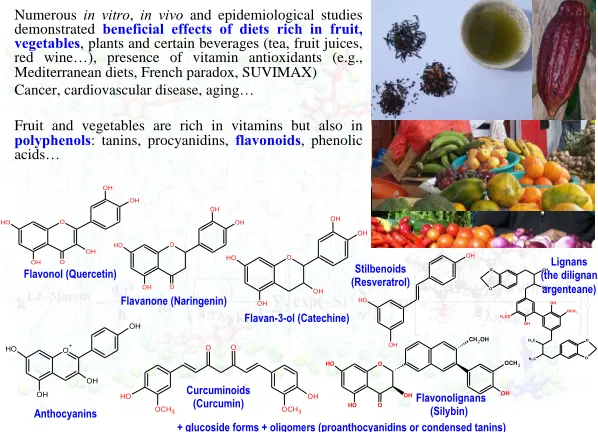
Polyphenols constitute one of the widest sources of natural antioxidants (Fig. 1) (Rice-Evans et al. 1996). Chemically, these compounds contain at least one phenol moiety in their chemical structure. They are largely distributed in the plant kingdom particularly in food plants i.e., fruit, vegetables, spices, oils, chocolate and different sorts of beverage (e.g., tea, wine, beer and fruit juices). Polyphenols are known for their numerous biological activities and as potential therapeutic compounds against various diseases (e.g., cardiovascular diseases, cancer, liver diseases and liver pathologies). In addition to their biological activities, they are known as powerful antioxidants i.e., free radical scavengers, lipid peroxidation inhibitors and metal chelators. Over the past years, numerous joint experimental and theoretical studies rationalized the structure-antioxidant properties for large series of polyphenols. Different physico-chemical parameters (descriptors) have been identified to correlate with the antioxidant capacity (Anouar et al. 2009a; Anouar et al. 2009c; Calliste et al. 2010; Di Meo et al. 2013; Kozlowski et al. 2007a; Kozlowski et al. 2007b; Trouillas et al. 2008; Trouillas 2006).
Fig. 1. Characteristic examples of polyphenols having various biological activities including
antioxidants activities.
The major mechanism of free-radical scavenging has been shown to be H-atom transfer from the active OH group(s) of the phenolic antioxidant (ArO-H) to the free radical (R•), following:
ArO-H + R• → ArO• + R-H
Four mechanisms may drive this reaction: (Di Meo et al. 2013; Musialik et al. 2009; Trouillas et al. 2011; Zhang et al. 2006)
i) HAT (H-atom transfer) and PCET (proton-coupled electron transfer)
This is the direct HAT, which is purely governed by the homolytic dissociation of the O-H bond of the active OH groups. PCET is distinguished from the pure HAT as it involves several molecular orbitals. PCET occurs in an H-bonding pre-reaction complex in which the proton
O OH OH OH O H O Flavanone (Naringenin)
Numerous in vitro, in vivo and epidemiological studies demonstrated beneficial effects ofdiets rich in fruit, vegetables, plants and certain beverages (tea, fruit juices, red wine…), presence of vitamin antioxidants (e.g., Mediterranean diets, French paradox, SUVIMAX) Cancer, cardiovascular disease, aging…
Fruit and vegetables are rich in vitamins but also in
polyphenols: tanins, procyanidins, flavonoids, phenolic acids… O OH OH OH O H O OH Flavonol (Quercetin) O OH OH OH O H OH Flavan-3-ol (Catechine) Flavonolignans (Silybin)) O O H O H OH O
CH2OH
OH OCH3 OH O H OH OCH3 O H OCH3 OH O O Stilbenoids (Resveratrol) Curcuminoids (Curcumin)
+ glucoside forms + oligomers (proanthocyanidins or condensed tanins) CH3 CH3 C H3 C H3 O O O O OH OH OCH3
H3CO
transfer occurs along the H-bond to one of the lone pair of the O-atom of the free radical. This transfer is coupled to the electron transfer that occurs from a lone pair of the antioxidant to the SOMO (singly occupied molecular orbital) of the free radical.
ii) ET-PT (Electron Transfer - Proton Transfer)
Depending on the oxidative system reacting with ArO-H, this mechanism could also occur as a secondary mechanism.The first step of this reaction (i.e. ArO-H + R• → ArOH+• + R-) leads to the formation of the radical cation ArOH+•, which easily undergoes heterolytic dissociation leading to the same final products than those yielded by PCET (i.e. ArO• + R-H).
iii) SPLET (Sequential Proton-Loss-Electron-Transfer)
In this mechanism a proton is lost prior to electron transfer from the subsequent anion to the free radical (i.e. ArO-H → ArO- + H+; ArO- + R• → ArO• + R-; R- + H+ → RH). This mechanism is strongly enhanced under alkaline conditions, which may favour the first step (i.e., proton loss). Again the same final products as with PCET and ET-PT are formed (i.e. ArO• +
R-H).
iv) AF (Adduct Formation)
ArO-H + R• → [ArOH-R]• → metabolites or ArO• + RH
This mechanism is relatively specific to •OH free radicals. It has been observed in radiolytic solutions. The radical may add on double bonds and aromatic rings.
The four mechanisms exhibit the same thermodynamic balance since reactants and products are the same (ΔGCPET = ΔGET-PT = ΔGSPLET
= ΔGAF). Consequently this process is well-described by the capacity to remove an H-atom from the polyphenol. The O-H bond dissociation enthalpy (BDE) has been found as the descriptor of choice to rationalize the antioxidant activity (Anouar et al. 2009b; Kozlowski et al. 2007b; Trouillas et al. 2006; Trouillas et al. 2008). Density functional theory (DFT) has appeared very efficient to estimate this thermodynamic parameter. We recently demonstrated that DFT can also efficiently estimate kinetics of the first three mechanisms (PCET, ET-PT and SPLET), which is mandatory in order to tackle the relative importance of these different mechanisms of free radical scavenging. Both thermodynamics and kinetics of free radical scavenging will be described in section 3.1 and 3.2, respectively. The corresponding methodologies of calculation are developed in sections 2.1 and 2.2.
To be efficient as lipid peroxidation inhibitor, antioxidants must be active as free radical scavenger but, as for other biological activities, the compounds must interact and penetrate lipid bilayer membranes. Force fields and molecular dynamic (MD) simulations can now accurately simulate supramolecular assemblies including lipid bilayers. These simulations may provide a true molecular picture of the equilibrated location and orientation of a molecule in membranes. We recently published such works on antioxidants compounds, providing a molecular picture of their capacity to incorporate lipid bilayer membranes. This will be summarized in section 3.3.
2. Methods of Calculation
2.1. Thermodynamics
performed at the same level of theory, which confirms the absence of any imaginary frequency for GS and allows to estimate enthalpies (H).
The integral-equation-formalism polarizable continuum model (IEF-PCM) was used to take into account the solvent effect. PCM models consider the studied structure confined in a shape-adapted cavity surrounded by a dielectric continuum characterized by its macroscopic dielectric constant ( = 78.4 for water). Calculations were performed in water to understand the behaviour in a very polar solvent, while calculations in the gas phase appeared to be a good estimation of behaviour under non-polar conditions (e.g., inside lipid membrane). Indeed PCM calculations using the benzene dielectric constant ( = 2.27) provided very similar enthalpies to the gas phase values (data not shown). (Anouar et al. 2009c; Calliste et al. 2010; Di Meo et al. 2012; Gažák et al. 2013; Kosinova et al. 2011a; Kosinova et al. 2011b; Kozlowski et al. 2007a; Kozlowski et al. 2007b; Trouillas et al. 2013; Trouillas et al. 2008; Trouillas 2006; Velu et al. 2013; Zatloukalová et al. 2011)
BDEs are calculated as follows:
BDE = H(ArO•, 298K) + H(H•, 298K) – H(ArOH, 298K)
2.2. Kinetics
Concerning PCET, the transition states (TSs) were confirmed by the presence of one imaginary frequency assigned to the normal mode corresponding to the reaction studied (i.e., O-H bond cleavage and the concomitant O-H or C-H bond formation in the polyphenol and the free radical, respectively). TSs were also confirmed by the calculation of the minimum energy path (MEP) evaluated with the IRC (intrinsic reaction coordinate) algorithm as implemented in the Gaussian09 program. The activation barriers were corrected by scaling factors of 0.9686 and 0.9537 for B3P86 and MPWB1K, respectively.
Hybrid functionals (e.g., B3P86) are shown to underestimate the energy of the transition states (TSs) of various reactions including HAT. Meta-GGA hybrid functionals such as MPWB1K appear to be more accurate to reproduce ΔG#PCET values. Therefore, all the activation barriers involving HAT (PCET) were evaluated at the (U)MPWB1K/6-31+G(d,p) level.
The rate constants of PCET were calculated within the conventional TST framework:
# G ( ). ( ) b exp CPET CPET T TST T kT
k k
h RT
G#PCETis calculated as the difference in Gibbs energy between the TS and the reactants; (T)
is the transmission coefficient; kb is the Boltzmann constant; and T is the temperature (298K).
The (T) transmission coefficient associated to quantum tunneling along the reaction coordinate was evaluated by the Skodje & Truhlar (S/T) method. (Anouar, et al. 2009a; Di Meo, et al. 2013)
Concerning ET-PT and SPLET, the Marcus-Levich-Jortner formalism was used, the rate constant of the electron transfer (for the ET-PT and SPLET mechanisms) between the donor (quercetin) and the acceptor (the free radical) is expressed as: (Di Meo, et al. 2013)
' 2 ' 2 2 4 ' exp ! ' ) exp( 4 1 4 T k G S S T k V h k b S S b S RP Marcus LJ wheres the external reorganization energy related to the electronic and nuclear polarization of the solvent,
VRP the electronic coupling term, calculated between antioxidant MOs and free radical SOMO, in the geometry of the complexes-of-approach. The coupling Vij between two orbitals
i and j (belonging to molecules i and j, respectively) can be classically recast in an atomic orbital basis set:
µ
j i j iµ j
i
ij
h
c
c
h
V
), the Huang-Rhys factor S (=i/ħ) is directly related to the internal reorganization, and ’ a vibrational quantum number.
The summation runs over all vibrational levels of effective modes.
All quantum calculations were performed using the Gaussian 09 package.
2.3. Interaction with membranes
Different types of lipids can be used e.g., DOPC (1,2-dioleoyl-sn-glycero-3-phosphatidylcholine) as the most abundant lipid in mammal cell membranes and PLPC (1-palmitoyl-2-linoleoyl-sn-glycero-3-phosphatidylcholine), is often used experimentally to observe differences in the lipid peroxidation activity. In our calculations, the former model comprised 128 DOPC molecules, in which the oleoyl chains contain one double bond between carbons C9 and C10. The latter model contained 144 PLPC molecules. For these phospholipids, the palmitic chain is a fully saturated fatty acid, whereas the linoleyl chain contains two double bonds (C9=C10 and C12=C13). The presence of the double bonds makes PLPC more sensitive to oxidation. In both lipid bilayer models, both leaflets contain the same number of molecules. The structures of the lipids were taken from the literature and a united-atom Berger's force field was used. The bilayers were oriented perpendicularly to the z-axis of the box containing the molecular assembly. The bilayers were first equilibrated in the absence of any antioxidant. They were surrounded by an explicit SPC water model and the physiological concentration of NaCl (0.15 mol.L-1) in water was used. The MD simulations were carried out using the GROMACS 4.0.7 package with periodic boundary conditions in all directions.
The conformations of the antioxidants were optimized using the hybrid DFT functional B3P86 combined with the 6-31+G(d,p) basis set B3P86/6-31+G(d,p). The topology was generated from the PRODRG2 Beta server using the Gromos53a6 force field. The partial atomic charges were assigned using the program Antechamber and RESP method after single point calculation at the HF/6-31G* level.
After the equilibration step, in which the system was heated to 310K, several MD simulations were carried out from different initial orientations and positions (in the middle of the lipid bilayer or outside the bilayer in the bulk water). The v-rescale thermostat controlled the temperature; the pressure was kept constant using the anisotropic Berendsen barostat at 1 bar. All bonds were constrained by the LINCS algorithm. The electrostatic interactions were evaluated using the smooth particle-mesh Ewald method. Both the long-range and Lennard-Jones interactions were truncated at 1.4 nm. The MD simulations were performed with different random initial velocities sampled according to a Maxwell distribution.
convergence, 20 to 80 ns windows of constraint simulation were used. The free energy profiles were reconstructed from the last part of the MD simulations. (Košinová, et al. 2011; Podloucka, et al. 2013)
3. Results and Discussion
3.1. Thermodynamic descriptors
Over the past decade, our group has extensively contributed to the effort of using theoretical calculations to rationalize the antioxidant properties of series of natural compounds. Performing joint experimental and theoretical works, the adapted methodologies have been identified to accurately describe and even predict the free radical scavenging capacity of many polyphenols. Thermodynamic descriptors, mainly the bond dissociation enthalpies (BDE) of the O-H groups were efficiently evaluated and correlated to the antioxidant capacity. These are major descriptors that can be used to quickly screen the antioxidant capacity of large series of compounds, which is adapted with the sake of industrial applications. (Anouar et al. 2009c; Calliste et al. 2010; Di Meo et al. 2012; Gažák et al. 2013; Kosinova et al. 2011a; Kosinova et al. 2011b; Kozlowski et al. 2007a; Kozlowski et al. 2007b; Trouillas et al. 2013; Trouillas et al. 2008; Trouillas 2006; Velu et al. 2013; Zatloukalová et al. 2011)
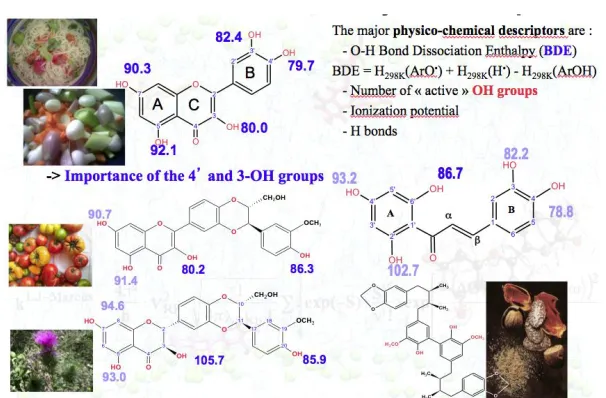
Number of OH groups. As the free radical action is mainly assigned to the HAT capacity from the OH groups, the number of OH groups is obviously an important descriptor. From a general overview, active compounds have usually more than 2 or 3 OH groups. Nonetheless, this descriptor (number of OH groups) is not independent i.e., what is mandatory for the antioxidant activity is the number of active OH group(s). In other words, the antioxidant activity correlates with the number of OH groups having a low BDE (i.e., high HAT capacity).
Fig. 2. Structure activity relationship established according to thermodynamic descriptors, mainly O-H BBE.
The presence of a catechol moiety is particularly efficient; its role is slightly enhanced in the presence of the 2,3-double bond since -electron delocalization helps to stabilize the subsequent ArO• radical (e.g., BDE of the 4‟-OH group is lower for flavonols compared to flavanones). Again, -conjugation may appear as an important descriptor.
3.2. Kinetic Descriptors
As thermodynamics is not enough when dealing with in vitro and vivo activities in which numerous competitive reactions exist, rate constants should be evaluated. They are rather difficult to obtain experimentally and experimental data cannot easily distinguish between the different mechanisms. Quantum calculations may appear as an innovative and promising tool to evaluate these kinetic rate constants. These calculations have been performed on quercetin, taken as a prototype, characteristic of the wide flavonoid-subclass of polyphenols. (Anouar et al. 2009a; Di Meo et al. 2013)
With this aim, the pre-reaction complexes (formed between the antioxidant and the free radicals) are crucial in the different mechanisms. They drive the bimolecular approach. Concerning the PCET mechanism, H-bonding complexes (HB-type complexes) are formed; while concerning ET-PT and SPLET both H-bonding and -stacking interactions (-type complexes) are allowed (Fig. 3). These complexes involved non-covalent interactions that must be carefully evaluated (e.g., using DFT-D).
Whatever the polarity of the solvent, ET-PT is totally inefficient due to the high instability of the ArOH•+ radical cation, except for the specific case of the •OH free-radical.
Fig. 3. Importance of non-covalent pre-reaction complexes formed betweenthe antioxidant (e.g., quercetin) and the free radicals (e.g., ROO•).
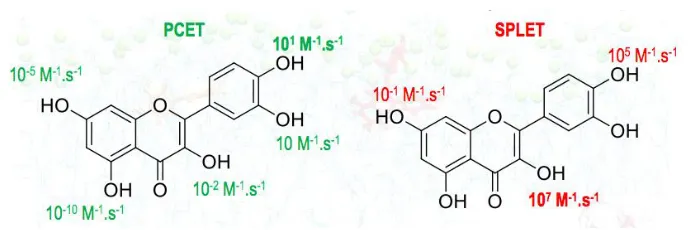
In polar solvents, e.g., in plasma, the pH is ranging from 7.35 to 7.45, so that quercetin is partially deprotonated. Both PCET (from the neutral form) and SPLET (from the deprotonated form) are in competition, the latter appearing as the fastest and hence as the dominant process in agreement with the literature. Nonetheless, an important point highlighted in the present work is that this competition strongly depends on the pre-reaction complex and the deprotonation site. From a statistical point of view, SPLET offers much more possibilities since the number of complexes-of-approach with free radicals associated to high rate constants is higher with SPLET than with PCET (Fig. 4). For an effective scavenging by H-atom abstraction, the free radicals should approach: i) all OH groups and the aromatic rings to form complexes (e.g., []C) with SPLET, or ii) only the OH groups with a low BDE (i.e., 3-OH, 3‟-OH and 4‟-OH) with PCET. In the case of SPLET, the 3-OH group as also a major role, together with the 4‟-OH group (Fig. 4).
Fig. 4. Kinetic structure activity relationship.
These conclusions are drawn out for quercetin, which is a relevant model of antioxidant highly representative of flavonoids. However, it must be stressed that these results can easily be extrapolated to a large class of compounds including other natural polyphenols, bioavailable metabolites and new hemi synthetic derivatives. Quantum chemistry is shown here as a powerful tool to rationalize structure antioxidant activity relationships for both thermodynamic and kinetic aspects. In this way, this tool appears as very promising to support experimental expertise in food chemistry, cosmetology and pharmaceutical applications. Even if the evaluation of kSPLET appears quantitatively accurate, that of kPCET requires further methodological developments to reach accuracy for a broad class of antioxidants.
3.3. Interaction of polyphenol antioxidant with lipid bilayer membranes
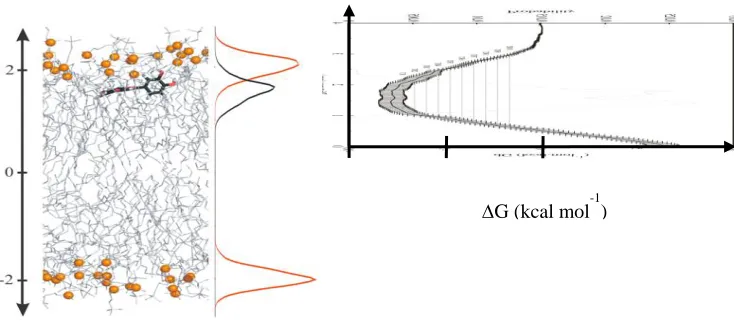
Molecular dynamic simulations provide a molecular picture of the capacity of natural antioxidants to interact with lipid bilayer membranes. Quercetin and quercetin metabolites incorporate into the DOPC lipid bilayer, most of these compounds lying just below the surface of bilayer close to the polar head region (Fig. 5). Their exact penetration depth and orientation in bilayer is largely determined by their polarity, charges and H-bonding capacity. The position of quercetin and its metabolites in lipid bilayers depends on i) the type of substituent ii) the substituted OH group and iii) charge of the compound. This picture might differ in polyunsaturated and/or oxidized lipid bilayers, for which changings of location/orientation should be systematically evaluated in future.
The partial decrease of lipid peroxidation inhibition observed for 3'-O-methyl-quercetin and quercetin-3-O-glucuronide compared to quercetin is partially explained by their location and orientation in lipid bilayer. For both compounds the substituents pull the compounds very close to the surface in comparison with quercetin. As a consequence, the active OH groups may be less efficient as regenerator of vitamin E and even less efficient at direct LOO• free radical scavenging. For quercetin-3'-O-sulfate, the charged sulfate group pulls the compound out of
lipid bilayer, thus explaining its weaker inhibition activity compared to
Fig. 5. (Left) Snapshot of the location of quercetin in a DOPC lipid bilayer and average position of the center of mass (black) and phosphorus atoms (red). (Right) Free energy profile showing
the potential well of the equilibrated position.
MD simulations demonstrate that flavonoids are concentrated at the lipid bilayer/water interface, just below the membrane surface. Insertion of non-polar groups increases the penetration depth (methoxy derivatives) while insertion of polar groups decreases the penetration depth (sulfate, glucuronide). Positions and orientations make these compounds potential protector against exogenous attacks (e.g., oxidative stress) being i) potentially active as lipid peroxidation inhibitors mainly by the scavenging of free radicals initiating lipid oxidation and occasionally those produced during lipid peroxidation propagation or ii) potential regenerators of antioxidants incorporated in the membrane such as vitamin E. (Košinová et al. 2011; Podloucka et al. 2013).
As flavonoids and their derivatives are preferentially localized in the membrane or on the membrane/water interface, they concentrate in a relatively narrow membrane region. This is of great significance because even if their concentration in food is relatively low, the spatial confinement of flavonoids inside membranes greatly enhances their local concentration in this vital region, thus increasing their importance for in vivo biological activities including oxidative stress defense.
Acknowledgements
The authors thank the “Conseil Re ional du Limousin” for financial support and CALI (CAlcul en LImousin) for computing facilities. Research in Limoges is also supported by the COST action CM0804 “Chemical Biology with Natural Compounds”. The Mons- Limoges collaboration is supported by FNRS. The authors gratefully acknowledge the support by the Operational Program Research and Development for Innova-tions−European Regional Development Fund (project CZ.1.05/ 2.1.00/03.0058 of the Ministry of Education, Youth and Sports of the Czech Republic).
Извод
Разумевање антиоксидантских карактеристика природних једињења
на нивоу атома
F. Di Meo1, E. Anouar2, P. Podloucka1,3, G. Fabre1,3, P.Trouillas1,3*
1
School of Pharmacy, Université de Limoges, 2 rue du Docteur Marcland, Limoges Cedex, France
Atta-ur-Rahman Institute For Natural Product Discovery (RiND), Universiti Teknologi MARA, 42300 Bandar Puncak Alam, Selangor D. E, Malaysia
3
Regional Center of Advanced Technologies and Materials, Department of Physical Chemistry, Faculty of Science, Palacký University, 17. listopadu 1192/12, 77146 Olomouc, Czech
Republic
*Corresponding author
Резиме
Кванто-механички прорачуни (углавном DFT) и молекулска динамика су све ефикаснија средства за процену физичко-хемијских особина природних и био-инспирисаних антиоксиданата. Термодинамички параметри (углавном енталпија дисоцијације (BDE) O-H фенолне везе) омогућавају да се предвиди способност природних и синтетичких хемијских једињења да реагују са слободним радикалима. Kинетичка процена на основу прелазних стања и Маркусове теорије (за трансфер атома и електрона, респективно), урађена је да би се боље објаснило понашање антиоксиданата у раствору или у организму. Такође су проучавани утицаји прооксиданата, укључујући и капацитет димеризације индуковане оксидацијом. У овом случају, термодинамички и кинетички прорачуни дају објашњење регио- и стерео- селективности. MД симулације су извршене да би се добила јасна слика о интеракцији између природних антиоксиданата (полифенола и других -конјугованих деривата) и двослојних липидних мембрана. Молекулском динамиком се процењује способност ових молекула да се приближе и прођу кроз мембрану, као и предвиђање њихове „тачне“ локације и оријентације.
Кључне речи: Антиоксиданти, полифеноли, DFT, механизми уклањања слободних
радикала, двослојне липидне мембране
References
Anouar E., Calliste C.A., Kosinova P., Di Meo F., Duroux J.L., Champavier Y., Marakchi K., Trouillas P., (2009a). Free Radical Scavenging Properties of Guaiacol Oligomers: A Combined Experimental and Quantum Study of the Guaiacyl-Moiety Role. Journal of Physical Chemistry A, 113, 13881-13891.
Anouar E., Kosinova P., Kozlowski D., Mokrini R., Duroux J.L., Trouillas P., (2009c). New aspects of the antioxidant properties of phenolic acids: a combined theoretical and experimental approach. Physical Chemistry Chemical Physics, 11, 7659-7668.
Burton G.W., Doba T., Gabe E., Hughes L., Lee F.L., Prasad L., Ingold KU., (1985). Autoxidation of biological molecules. 4. Maximizing the antioxidant activity of phenols. J Am Chem Soc, 107, 7053-7065.
Calliste CA, Kozlowski D, Duroux JL, Champavier Y, Chulia AJ, Trouillas P. A new antioxidant from wild nutmeg. Food Chemistry, 118, 489-496, 2010.
Di Meo F., Lemaur V., Cornil J., Lazzaroni R., Duroux J.L., Olivier Y., Trouillas P., (2013). Free Radical Scavenging by Natural Polyphenols: Atom versus Electron Transfer. The Journal of Physical Chemistry A, 117, 2082-2092.
Di Meo F., Sancho Garcia J.C., Dangles O., Trouillas P., (2012). Highlights on Anthocyanin Pigmentation and Copigmentation: A Matter of Flavonoid π-Stacking Complexation To Be Described by DFT-D. Journal of Chemical Theory and Computation, 8, 2034-2043. Gažák R., Trouillas P., Biedermann D., Fuksová K., Marhol P., Kuzma M., Křen V., (2013).
Base-catalyzed oxidation of silybin and isosilybin into 2,3-dehydro derivatives. Tetrahedron Letters, 54, 315-317.
Košinová P., Berka K., Wykes M., Otyepka M., Trouillas P., (2011). Positioning of Antioxidant Quercetin and Its Metabolites in Lipid Bilayer Membranes: Implication for Their Lipid-Peroxidation Inhibition. The Journal of Physical Chemistry B, 116, 1309-1318.
Kosinova P., Di Meo F., Anouar E.H., Duroux J.L., Trouillas P., (2011a). H-atom acceptor capacity of free radicals used in antioxidant measurements. International Journal of Quantum Chemistry, 111, 1131-1142.
Kosinova P., Gazak R., Duroux J.L., Lazzaroni R., Kren V., Assfeld X., Trouillas P., (2011b). Dimerisation process of silybin-type flavonolignans: insights from theory. ChemPhysChem, 12, 1135-1142.
Kozlowski D., Marsal P., Steel M., Mokrini R., Duroux J.L., Lazzaroni R., Trouillas P., (2007a). Theoretical Investigation of the Formation of a New Series of Antioxidant Depsides from the Radiolysis of Flavonoid Compounds. Radiation Research, 168, 243-252. Kozlowski D., Trouillas P., Calliste C., Marsal P., Lazzaroni R., Duroux J.L., (2007b). Density Functional Theory Study of the Conformational, Electronic, and Antioxidant Properties of Natural Chalcones. Journal of Physical Chemistry A, 111, 1138-1145.
Musialik M., Kuzmicz R., Pawlowski Tomasz S., Litwinienko G., (2009). Acidity of hydroxyl groups: an overlooked influence on antiradical properties of flavonoids. Journal of Organic Chemistry, 74, 2699-2709.
Podloucka P., Berka K., Fabre G., Paloncyova M., Duroux J.L., Otyepka M., Trouillas P., (2013). Lipid Bilayer Membrane Affinity Rationalizes Inhibition of Lipid Peroxidation by a Natural Lignan Antioxidant. The Journal of Physical Chemistry B, 10.1021/jp3127829. Rice-Evans C., Miller N.J., Paganga G., (1996). Structure-antioxidant activity relationships of
flavonoids and phenolic acids. Free Radical Biology & Medicine, 20, 933-956.
Trouillas P., Bergès J., Houée-Lévin C., (2011). Toward understanding the protein oxidation processes: •OH addition on tyrosine, phenylalanine, or methionine? International Journal of Quantum Chemistry, 111, 1143-1151.
Trouillas P., Marchetti C., Bonnefont-Rousselot D., Lazzaroni R., Jore D., Gardès-Albert M., Collin F., (2013). Mechanism of one-electron oxidation of metformin in aqueous solution. Physical Chemistry Chemical Physics, Accepted.
Trouillas P., Marsal P., Siri D., Lazzaroni R., Duroux J.L. (2006). A DFT study of the reactivity of OH groups in quercetin and taxifolin antioxidants: The specificity of the 3-OH site. Food Chemistry, 97, 679-688.
Silybin and 2,3-Dehydrosilybin Flavonolignans: A Joint Experimental and Theoretical Study. Journal of Physical Chemistry A, 112, 1054-1063.
Trouillas P., Marsal P., Siri D., Lazzaroni R., Duroux, J.L. (2006). A DFT study of the reactivity of OH groups in quercetin and taxifolin antioxydants: The specificity of the 3-OH site. Food Chemistry, 97, 10.
Velu S.S., Di Meo F., Trouillas P., Sancho-Garcia J.C., Weber J.FF., (2013). Regio- and Stereocontrolled Synthesis of Oligostilbenoids: Theoretical Highlights at the Supramolecular Level. Journal of Natural Products, 10.1021/np300705p.
Zatloukalová M., Křen V., Gažák R., Kubala M., Trouillas P., Ulrichová J., Vacek J., (2011). Electrochemical investigation of flavonolignans and study of their interactions with DNA in the presence of Cu(II). Bioelectrochemistry, 82, 117-124.