Challenges Facing The Adoption Of Project
Management Practices On Cdf Projects Success
In Kapenguria Constituency, West Pokot County
Stephen Arapel Yatich, Dr. William SakatakaMsc Student Project Management Jomo Kenyatta University of Agriculture and Technology, Kenya, PhD Senior Lecturer Jomo Kenyatta University of Agriculture and Technology, Kenya
Email: [email protected]
ABSTRACT: The CDF has, since its establishment in the year 2003, become entrenched as a key instrument of rural development. The main objective of the research was to establish challenges facing the adoption of project management practices on CDF projects success in Kenya with focus on Kapenguria Constituency in West Pokot County. Whereas various developments have been achieved in terms of CDF set projects, there remains an outcry and dissatisfaction from stakeholders and community members seen as beneficiaries on the management of the projects. This is blamed on ineffective or lack of proper project planning and design tools and principles conducted by Constituency Development Fund Committee (CDFC). The study adopted descriptive survey design and involved the researcher using pre-designed questionnaire and administering the same to respondents. The questionnaire included both closed and open ended questions. The population of study was 30 respondents who were composed of CDF Project Management Committee (10), CDF Manager (1) and opinion leaders/project beneficiaries (19). The study was justified by the fact that despite numerous reviews, CDF projects remain partially ineffective. It was significant for present and future project implementation undertaking in order to make them effective in improving development in the Constituency. The findings of the study indicate that the use of planning tools in project planning is above average although it still faces challenges like lack of necessary knowledge-ability, equipment and commitment. The study results also indicate that cor-ruption and misappropriation of funds, inadequate monitoring and evaluation of the projects initiated at community level and poor prioritization of com-munity needs by the management committees were the major challenges facing implementation of the projects. This is supported by what Kibebe and Mwirigi (2014) observed in their journal on factors influencing effective implementation of CDF projects in Kimilili constituency. It was also established that there is a good process of project selection but there was a sheer disregard of such processes. The study recommends that, there should be a policy direction to address skill gap in the membership of CDF committee members and PMCs in charge of various projects concerning the planning process, that for project success all stakeholders must be involved in the planning process, that all planning procedures should be adhered to in order to achieve successful project implementation in Kapenguria Constituency, and last but not least that there should be adequate measures and goodwill to curb corruption and misappropriation of funds intended to benefit community members.
Keywords: Project Management; Project management practices; Projects, CDF.
1
I
NTRODUCTIONThe Constituencies Development Fund was established through an Act of parliament in 2003 as a public funded kitty that targets development projects at the grassroots level, Kenya Gazette Supplement No. 107 (Act No.11). It is one of the several devolved funds set up by the Government to mitigate poverty and to harmonize the spread of development throughout the country. The Constituency Development Fund was introduced in Kenya in 2003 with the passage of the CDF Act 2003 by the 9th Parliament of Kenya. It aims at ensuring a portion of the Government Annual Revenue is earmarked for constituencies to finance development projects qualified on a priority basis arrived at by members of a Constituency. The CDF program comprises of an annual budgetary allocation equivalent to 2.5% of the total national revenue, though the Kenya parliament recently passed a motion to increase the fund to7.5% of the total national revenue. Allocations to the 210 constituencies are clearly spelled out in the CDF Act, where 75% of the fund is allocated equally among all the constituencies. Given the mosaic of expenditure decisions on a myriad of local projects, and because of the relaxed rules on how and where expenditure is to be incurred, the CDF can be construed as a delegated form of fiscal decent realization, because the program allows local people to make their own expenditure decisions that reflect their tastes and preferences and maximizes their welfare [1]. Constituency Development Funds (CDFs) are found in 23 countries worldwide, Micah Challenge Zambia (2012). CDF program channel funds from central government through to each constituency to spend on development projects intended to address local needs.
Although CDFs operate differently in each context, one core defining feature is that constituency legislators have some influence over how the funds are spent in their area, (Center for International Development, 2009). Across Zambia, CDFs have been used to fund a variety of local development projects, e.g. classroom blocks, sink boreholes, the construction of small roads etc. In most constituencies, community members attested to some positive benefits from CDF projects [2]. Various developments through CDF fund have been achieved in terms of set projects although there is an outcry and dissatisfaction from stakeholders on the management of the projects funded by the kitty and this is blamed on ineffective or lack of proper project planning and design principle conducted by Constituency Development Fund Committee (CDFC). On the other hand, there are many success stories attributed to CDF kitty as envisaged in the magnitude of established projects. This research will look at the degree of adoption of project planning and design tools and principles on CDF projects in Kenya, a case of Kapenguria constituency. The research target group will be CDF manager (Kapenguria Constituency), CDF project managers/management committees (PMCs), CDF development committees and local communities/beneficiaries.
2
STATEMENT
OF
THE
PROBLEM
challenges, some of which include: The organization structure in managing CDF projects and Project identification criteria. A similar research conducted by Institute of Economic Affairs (2006) in all Kenyan constituencies indicated that sharing of CDF within the constituency is not always a smooth exercise. According to Kerote [4], relevant field methodologies that call for effective management of funds have been inadequate in allowing maximum utilization of local resources. He also noted that vital components of project implementation, project identification, monitoring and evaluation have not fully been managed by the committees in the constituencies. Due to the needs at the constituency level and the weak mechanisms of ensuring equity in the distribution of CDF projects within the constituencies, some parts in a Constituency feel short-changed in the process. According to the CDF Status Report, December 2009, by the Institute for Social Accountability (TISA), CDF contributes over 10% to all development in Kenya. The implementation of CDF has been marred by repeated accusation of abuse of funds, patronage due to excessive powers of the MP, incomplete projects, a lack of technical capacity, poor planning and more of other weaknesses which threaten to undermine the very success of the fund. This is a problem because many projects set and intended to benefit community members stall not because the funds are limited or inadequate but due to lack of proper expertise to implement the projects within a specific time frame. The important project management principles are not well applied by the CDF project management committees (PMCs) to oversee the completion of the set projects. The Constituency Development (Amendment) Act 2007 requires that meetings be held at the location level where community members get the opportunity to identify development projects for implementation. These are then prioritized by the Constituency Development Fund Committee (CDFC) after an analysis of the same. Whereas a number of constituencies have adhered to this requirement, a number are still facing challenges like “roadside declaration” by some MPs of development with regards to projects to be implemented in their constituencies. Some MPs have taken it upon themselves to decide on the projects to be implemented without any community input and this has led to implementation of projects that do not respond to the needs of the community. The research study problem therefore is to determine the challenges on the adoption of project management practices on CDF projects In Kapenguria Constituency, West Pokot County.
3
OBJECTIVES
3.1 General objective
To establish challenges facing the adoption of project man-agement practices on CDF projects success in Kapenguria Constituency, West Pokot County
3.2 Specific objectives
i. To determine the project planning tools used by CDF Committee on projects success in Kapenguria Constituency.
ii. To establish the challenges faced by CDF Committee in developing project scope for projects success in Kapenguria Constituency.
iii. To establish the criteria used by CDF Committee to come up with project schedule for implementation as
a way of ensuring successful execution of the same at Constituency level.
iv. To establish the criteria used by the CDF Committee in determining project budget and funding for successful implementation of projects.
4
JUSTIFICATION
The research title has two topical issues/elements; project management and CDF. It also has project management mechanic i.e. project management practices/principles. The area of study is one of the many areas in Kenya where CDF projects have been established. It draws a lot of success stories as a result of the set projects coupled with challenges and therefore the need to establish the challenges on the adoption of project management practices on these projects. The research title aims at answering the following question: why are there many successful cases of CDF projects as well as challenges/failures? Many researchers concentrate on the management and effect of the CDF fund itself leaving out the projects set by the kitty. This research is unique on its own because it uses a project management mechanic; project management practices/principles and one topical element; CDF. This research is important because the knowledge that is generated from it will assist in informing policy formulation by relevant authorities in regard to CDF projects planning process and implementation. This research will benefit CDF authorities at national level as well as at the constituency level to adopt proper project management practices for successful implementation and sustainability of the set projects. It will also benefit the community members who are the direct beneficiaries of the kitty of what will be expected of them at any given stage of projects implemented.
5
SCOPE
The research focused on the challenges facing the adoption of project management practices on CDF projects in Kapenguria constituency. The research target group was CDF manager (Kapenguria Constituency), CDF project managers / management committees (PMCs), CDF development committees and local communities. Kapenguria Constituency is situated in West Pokot County and according to Mzalendo Report [3] it has an area of 2317 km2 (Ranked 52 of Constituencies) and Population of 181,063 (Ranked 90 of Constituencies). Since the inception of the fund, the Constituency has a total of 384 CDF projects up to 2013.
6
LITERATURE
REVIEW
6.1 Theory of Project
model and the thermostat model. In management-as-planning, management at the operations level is seen to consist of the creation, revision and implementation of plans. This approach to management views a strong causal connection between the actions of management and outcomes of the organization. The dispatching model assumes that planned tasks can be execut-ed by a notification of the start of the task to the executor. The thermostat model is the cybernetic model of management con-trol that consists of the following elements: there is a standard of performance; performance is measured at the output; the possible variance between the standard and the measured value is used for correcting the process so that the standard can be reached. This is related to the study because the re-searcher would like to understand challenges on the applica-tion of project planning and design tools and principles and how can this influence the outcome of CDF projects from initia-tion to the execuinitia-tion stage. According to Koskela [6], the con-ceptualization of a project is a transformation of inputs to out-puts and the principles to be considered include the total trans-formation of a project can be decomposed into manageable and well-understood sub-transformations, tasks. A project can be realized in an optimal manner by realizing each task in an optimal sequence. In other words, project performance can be performed by improving the tasks. In this theory, the assump-tions are that; tasks are independent, except sequential rela-tionships, they are discrete and bounded, uncertainty as to requirements and tasks are low, all work is captured by top-down decomposition of the total transformation and require-ments exist at the outset and they can be decomposed along with work.
6.2 Theory of Management
Under theory of Management, there is theory of planning and the conceptualization is that there is a managerial part and an effecter part in the project; the primary function of the managerial part is planning, and the primary function of the effecter part is to translate the resultant plan into action. The principles involve; knowing the current state of the world, the desired goal state, and the allowable transformations of state that can be achieved by actions, a series of actions, the plan, can be deduced. The plan is translated into reality by the effecter part of the organization. There are a number of assumptions which include; translating a plan into action is a simple process, by following directions and that the internal planning of a task is a matter of the person to whom the task has been assigned.
6.4 Theory of execution
The conceptualization is that managerially, execution is about dispatching tasks to work stations and the principle is; when, according to the plan, the time has arrived to begin task exe-cution, it is authorized to start, in speech or in writing. The the-ory also has assumptions which argue that the inputs to the task and the resources to execute it are ready at the time of authorization; the task is fully understood, started and com-pleted according to the plan once authorized.
6.5 Theory of control
The conceptualization of this theory is that; there is a process to be controlled, a unit for performance measurement, a standard of performance and a controlling unit (thermostat control).The principle is that the possible variance between the standard and the measured value is used for correcting the
process so that the standard can be reached. Theory‟s as-sumptions are; the process is of continuous flow type, the per-formance of which is measured at aggregate terms and that the process can easily be corrected by the control available.
7
CONCEPTUAL
FRAMEWORK
The research examined the components of project planning and design that influence project success. These components included; project scope, project planning team, project deliverables and WBS, resource requirement, project schedule, time& cost, project budget and risk planning. When these components are applied in a relevant way in a typical project, the end result will be a successful project, for example; deciding on the correct project scope, having the correct project planning team and reasonable resource requirement etc. This conceptual framework will borrow from the project constraint model.
Fig showing conceptual framework of the study
the research in question. Literature review will focus on project scope, project planning team, project deliverables and WBS, resource requirement, project schedule, time& cost, project budget and risk planning.
7.1 The project scope
According to Cho, C. and Gibson [8], poor scope definition is recognized by industry practitioners as one of the leading causes of project failure, adversely affecting projects in the areas of cost, schedule, and operational characteristics. Pro-ject scope is the part of proPro-ject planning that involves deter-mining and documenting a list of specific project goals, deliv-erables, tasks, costs and deadlines. The documentation of a project's scope, which is called a scope statement, terms of reference or statement of work, explains the boundaries of the project, establishes responsibilities for each team member and sets up procedures for how completed work will be verified and approved. During the project, this documentation helps the project team remain focused and on task. The scope statement also provides the project team with guidelines for making decisions about change requests during the project. It is primarily concerned with defining and controlling what is or is not included in the project, (PMBOK Guide, Fourth Edition) It is natural for parts of a large project to change along the way, so the better the project has been "scoped" at the begin-ning, the better the project team will be able to manage change. When documenting a project's scope, stakeholders should be as specific as possible in order to avoid scope creep, a situation in which one or more parts of a project ends up requiring more work, time or effort because of poor plan-ning or miscommunication. Effective scope management re-quires good communication to ensure that everyone on the team understands the scope of the project and agrees upon exactly how the project's goals will be met. As part of project scope management, the team leader should solicit approvals and sign-offs from the various stakeholders as the project pro-ceeds, ensuring that the finished project, as proposed, meets everyone's needs (Rachel Lebeaux,2012).These are the func-tional elements that, when completed, make up the end deliv-erable for the project. The scope itself is generally identified up front so as to give the project the best chance of success. (Although scope can potentially change during the project life-cycle, a concept known as „scope creep‟).The common suc-cess measure for the scope aspect of a project is its inherent quality upon delivery. Project scope is one of the elements in a triple constraint of a project. The major take-away from the Triple Constraint, is that it is a triangle, is that one cannot ad-just or alter one side of it without in effect, altering the other sides. So for example, if there is a request for a scope change mid-way through the execution of the project, the other two attributes (cost and time) will be affected in some manner thus how much or how little is dictated by the nature and complexity of the scope change. As an added example, if the schedule appears to be tight and the project manager determines that the scoped requirements cannot be accomplished within the allotted time, both cost and time will be affected.
7.2 Project planning team
According to McDonald (2005), if no members of a planning team have had similar project experience then the estimate of cost is correlated with average team experience, with teams having greater average team experience producing higher total cost estimates. If at least one member of the planning
out timeline with goals and objectives is vital to the success of a project. Each team member should have a copy of all relevant deadlines and expectations to stay on schedule. Target dates should be included so that the entire team understands the expectations and each member can be held accountable for their part of the project. Having a little extra time built into your schedule will reduce the stress level of the team members, and the flexibility to adjust projected timetables and deadlines will aid in a smoother facilitation of the project. Creating equity within the team is paramount. It is important to encourage all members of the team to participate and contribute equally. Fostering initiative in team members is vital. Equity in participation and initiative are important ingredients to any successful team project. When team members feel that not all of their teammates are "pulling their weight", emotions can rise, grumbling ensues, and conflict within the group will follow. Team members must be willing to be creative and take risks. According to Temme and Katzel, (1995), risk taking plays a major role in the creative process.
7.3 Project deliverables and WBS
According to Project Management Body of Knowledge Guide (2000), a project deliverable is the output that must be produced to complete a project or task. A deliverable can result from the need to satisfy an external contractual obligation, or the need to fulfill an internally planned activity. Many project-oriented organizations require the concept of deliverables to effectively track the tangible outputs from a project and to provide a mechanism to measure project performance. Work breakdown structure (WBS) tool can improve work interface management [9]. This can be generalized to apply to all the phases of a construction project (design, equipment procurement, transport, delivery, installation, and testing, as well as hand-over activities), to the different partners (main contractors, subcontractors, and suppliers), and even internally to the teams working on different parts of a system for the same contractor. Specific requirements and constraints at work interfaces that are technical, organizational, temporal, and geographical in nature have to be made transparent so that they can be managed and resolved to avoid unnecessary reworks and delays. A deliverable differs from a project milestone in that a milestone is a measurement of progress toward an output whereas the deliverable is the result of the process. For a typical project, a milestone might be the completion of a product design while the deliverable might be the technical diagram of the product. A work breakdown structure (WBS), in project management and systems engineering, is a deliverable-oriented decomposition of a project into smaller components. WBS is a hierarchical and incremental decomposition of the project into phases, deliverables and work packages (PMBOK). It is a tree structure, which shows a subdivision of effort required to achieve an objective; for example a program, project, and contract. In a project or contract, the WBS is developed by starting with the end objective and successively subdividing it into manageable components in terms of size, duration, and responsibility (e.g., systems, subsystems, components, tasks, subtasks, and work packages) which include all steps necessary to achieve the objective. The concept of work breakdown structure developed with the Program Evaluation and Review Technique (PERT) by the United States Department of Defence (DoD), was introduced by the U.S. Navy in 1957 to support the development of its Polaris missile
program. While the term "work breakdown structure" was not used, this first implementation of PERT did organize the tasks into product-oriented categories.
7.4 Resource requirement
According to Piet Joubert [10], resources are the means we use to achieve project objectives. The primary resource is obviously people with applicable skills and competencies. The other main grouping of resources we need include capital, facilities, equipment, material and information. In order to ensure a cost effective application of required resources we must perform a proper needs analysis in order to define the project goals and objectives. The project‟s baseline that must be resourced will be known after a requirement specification has been completed. The WBS is the base document for determining resource requirements. The requirement specification will spell out the real requirements to achieve through the specific project. This will include the following processes; resource estimation which is a structured prediction of the cost and other resources required to execute a task. One of the primary functions of the process is to establish a control basis. Therefore the more accurate the estimation, the more reliable the control system becomes. According to F. Brian Talbot, (1982) in Resource-Constrained Project Scheduling with Time-Resource Trade-offs approach, the objective functions permitted are minimize project duration, minimize project cost given performance payments and penalties, and minimize the consumption of a critical resource. In his book, Talbot [11], identified resource acquisition as another process which refers to the process of physically securing the necessary inputs. All resources required have to be paid for in some way or another. To him, the resources which may be required in a project include those which are limited on a period-to-period basis such as skilled labour, as well as money, which are consumed and constrained over the life of the project. At the planning stage the user of Resource-Constrained Project Scheduling with Time-Resource Trade-offs approach is permitted to identify several alternative ways, or modes, of accomplishing each job in the project. Each mode may have a different duration, reflecting the magnitude and mix of the resources allocated to it. From the foregoing analysis, the financing of a project therefore plays an essential role in the acquisition process. The acquisition process must be managed properly to take care of possible seasonal shortages, labour disputes, equipment breakdowns, competing demands, delayed deliveries and other things that may go wrong. The project plan may have to be modified to accommodate or work around supply problems The same analysis appears to point to resource levelling as another important aspect which ensures resource demand does not exceed resource availability and vice versa. We don‟t want extreme peaks and valleys in the execution of the tasks. The first step is usually to move non critical tasks with float to a later date. If you are forced to reschedule a task on the critical path it would influence the completion dates of successive tasks.
7.5 Project schedule
change in the work of a subcontractor might affect schedules of other subcontractors, as well as the project deadline. The project schedule should reflect all of the work associated with delivering the project on time. Without a full and complete schedule, the project manager will be unable to communicate the complete effort, in terms of cost and resources, necessary to deliver the project. The building blocks of a schedule start with a Work Breakdown Structure (WBS). The WBS is a hierarchical reflection of all the work in the project in terms of deliverables. In order to produce these deliverables, work must be performed. In project management, a schedule is a listing of a project's milestones, activities, and deliverables, usually with intended start and finish dates. Those items are often estimated in terms of resource allocation, budget and duration, linked by dependencies and scheduled events. A schedule is commonly used in project planning and project portfolio management parts of project management. Project scheduling deals with establishment of time tables and dates during which various resources such as equipment and personnel will be used to perform the activities required to complete the project. Schedules are the cornerstone of planning and control system (PMBOK Guide, Fourth Edition). The schedule itself can be presented in several ways such as a time table or Gantt chart which is a bar chart that shows the relationship of activities over time. Schedules provide essential communications and coordination links between the individuals and organizations that are participating in the project. By developing a schedule, the project manager is planning the project; by authorizing work according to the schedule, start of each task he/she triggers the execution of the project and by comparing the actual execution dates of tasks with the scheduled dates he/she monitors the project.
7.6 Critique of the existing literature relevant to the study
The literature review has found out the importance of application of project planning and design principles and in as much as this can improve or increase the result of project implementation process, strict adoption of these principles is still a challenge due to weak systems in our institutions. The use of project planning and design tools/principles is crucial for successful completion of projects but however, this does not directly translate into quality and timely projects without the necessary competence of CDF managers and committees. The relevance in some parts of the literature review is also another issue, for example; the concept of work breakdown structure which is stated to be developed with the Program Evaluation and Review Technique (PERT) by the United States Department of Defence (DoD) and that it was introduced by the U.S. Navy in 1957 to support the development of its Polaris missile program. Although the technique was very important in planning the United States Department of Defence activities, the literature review in this section lacks relevancy in terms of applicability and currency i.e. it is not a Kenyan scenario. Another area of inadequacy is on correctness and assumptions, for example; according to Temme and Katzel, (1995), Team members must be willing to be creative and take risks and that risk taking plays a major role in the creative process. This is an assumption and does not always guarantee success in a project undertaking. In a project which has a good planning and design framework, its success will highly be assured and is often reliable as compared to just taking risks. The literature review therefore in
this section based on an assumption which is not always correct. The inception of CDF kitty in 2003 through an Act of parliament did not come with proper framework on how the projects funded by the kitty should be handled technically to ensure that their implementation succeed to fulfil their intended purpose. Most of projects delegation is guided politically instead of putting project management principles or tools in place.
7.7 Research gap
The literature review looked into the adoption of project planning and design principles and tools on CDF projects in Kapenguria Constituency. It found that their use can help fast track implementation of projects, for example: prudent use of resources and allocation, time and cost management, putting in place the right project team and preparation of correct budget estimates. However this has been overemphasized forgetting the systems and structures in Kenyan scenario especially the Kapenguria Constituency case which come into play to affect the applicability of the project planning and design principles and tools. Despite advantages provided by use of project planning and design principles and tools in implementation of projects, little effort has been paid in the applicability in Kenya on CDF projects especially in Kapenguria Constituency. Risk management strategies like accepting risk and transfer of risk proves to be a challenge in the implementation of CDF projects in Kenya because use of third parties like insurance companies to manage risk outcomes may not be factored in the kitty hence a problem in the overall execution of projects. Further, the organization structure in managing CDF projects and Project identification criteria are not well highlighted in the CDF Act (2003) revised (2007). No study of this specific kind has been carried out in Kapenguria Constituency and furthermore, the research focuses on CDF projects and not the CDF kitty with emphasis on project planning and design tools and principles adoption challenge.
8
RESEARCH
METHODOLOGY
8.1 Research design
Research design constitutes the blue print for collection, measurement and analysis of data [13]. According to McMillan and Schumacher (1984), research design defines how a study is being planned, conducted and procedures and techniques that are used to answer the research questions. The research adopted a survey design and involved the researcher using pre-designed questionnaire and provided the same to respondents. The questionnaire included both closed and open ended questions
8.2 Target population
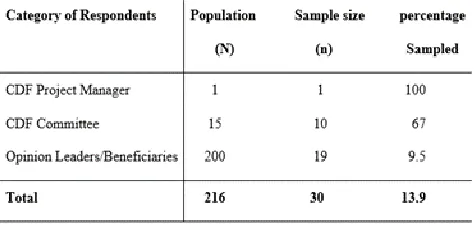
According to Kenya Institute of Management (KIM, 2009), target population defines all the subjects in the research study. The research population used 30 respondents who were drawn from CDF project management committee (10), CDF Manager (1) and project beneficiaries (19)
8.3 Sample size
type of frame which involved a list of elements in the population. The researcher sampled 30 respondents who were drawn from CDF project management committee (10), CDF Manager (1) and opinion leaders/project beneficiaries (19).
8.4 Sample and sampling techniques
According to Scott Smith (2013), it is common for the population to be unknown or approximated. A sample therefore is a set or a group on which data is obtained from in research study. It is less than the entire or total population. Typically, the population is very large making a study of all values in the population impossible or impractical. The sample usually represents a subset of manageable size. An unbiased (representative) sample which is a set of objects chosen from a complete sample using selection process will be used in the research. The research employed stratified sampling technique which is a method of sampling from a population. When subpopulation within overall population vary, it is advantageous to sample each subpopulation (stratum) independently. Stratification is the process of dividing members of the population into homogeneous subgroups before sampling. The strata should be mutually exclusive: every element in the population must be assigned to only one stratum. The strata should also be collectively exhaustive: no population element can be excluded. Simple random sampling or systematic sampling is applied within each stratum. This often improves the representation of the sample by reducing sampling error. According to Kerlinger (1983), a percentage of 10-30 of the population will be representative of the entire population for research. In this case, the research used the simple random sampling technique within each stratum. To acquire the sample size the following sampling process was done as indicated below in figure 3.1.
Table showing Summary of the sampling process
8.5 Instruments
The researcher used pre-designed questionnaire and provided the same to respondents. The questionnaire included both closed and open ended questions.
8.6 Data collection procedure
This is the process of gathering and measuring information on variables of interest in an established systematic manner that enables one answer stated research questions, test hypotheses and evaluate outcome. Regardless of the field of study or preference for defining data (quantitative, qualitative), accurate data collection is essential to maintaining integrity of research. The researcher issued out a questionnaire with both closed and open questions to selected respondents for collection of primary data.
8.7 Pilot test
This refers to mini versions of a full-scale study (feasibility studies), as well as the specific pre-testing of a particular research instrument such as a questionnaire or interview schedule. It is a crucial element of a good study design. It does not guarantee success in the main study, but it does increase the likelihood. It also refers to feasibility studies which are done in preparation for the main study (Polit et al, 2001:467). It is the process of trying out of a particular research instrument (Baker 1994: 182-3). The researcher issued out few questionnaires to few selected respondents before the main study to test its quality, adequacy and whether it is realistic or workable [14].
8.8 Data Processing and analysis
This is a process of putting meaning to collected data. A combination of both qualitative and quantitative techniques was used for data analysis. Data was coded and analyzed using SPSS and Microsoft Excel. Descriptive statistics including percentages, frequency distribution tables and pie/charts were employed.
9 FINDINGS AND DISCUSSION
9.1 Response Rate
The total number of questionnaires administered for the study was 30 and all of them were returned. Reasons that relate to the high return rate were that contact persons were appointed individuals of good repute. The researcher also sent a remind-er through their email addresses.
9.2 Respondents’ Profile
The respondents‟ characteristics included gender representation, the role profile of the respondents, age distribution and the education levels of the respondents. These characteristics were critical in enabling the researcher gain insights in to the phenomenon under study and assisted in getting water tight information [15].
9.3 Distribution by Gender
The respondents were asked to state their gender to determine whether each gender is fairly represented 80% of the respondents were male while 20% were female as indicated in Figure 4.1. This is against the two thirds majority provided by the constitution (2010). The reasons may attribute to men being the majority was that the culture of the dominant community in the constituency seems to discriminate against the women on leadership positions and girl child education.
9.4 Distribution by Age
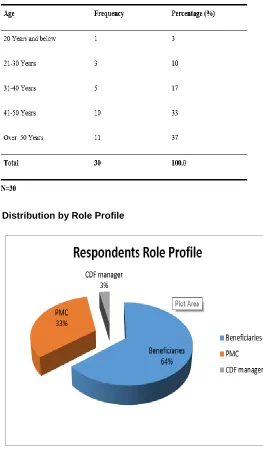
The researcher found that it was important to collect data on the age of the respondents. Age plays a critical role in understanding how people of different ages view the implementation of projects, to larger extent older employees are more experienced and are likely to relate issues more directly than relatively younger employees. It was also meant to determine whether the respondents were young, mature or old. The results are shown in table below
Table showing Age distribution
Distribution by Role Profile
Figure showing Respondents Role Profile
The research population used 30 respondents who were drawn from CDF project management committee (10), CDF Manager (1) and project beneficiaries (19). The project benefi-ciaries included PMCs of the CDF projects in the grassroots and opinion leaders in the constituency.
9.5 Distribution by Education Level
The level of education was critical in this study as it indicated the level of theoretical concepts exposure for the respondents that may influence their job performance. The findings are shown in table below.
Table showing Education Levels of the respondents
16% of those interviewed had a college certificate as their highest level of education, 33% had diplomas, 37% had undergraduate degrees, non-had a master‟s degree, while another 7% had other qualifications like „O‟ Level, A‟ Level and primary certificates
9.6 Project Planning
99% of the respondents stated that they have a policy framework regarding the use of project planning & Design principles/tools in their organizations however only 80% of the respondents agreed that they actually use them. When asked why they have not instituted the use of these tools most of the respondents (60%) said that there was lack of appropriate training to use them while 40% of those who do not use these tools blamed lack of appropriate equipment like laptops or insufficient equipment.
9.7 Project Planning & Design Tools
The research sought to know whether the respondents use project planning and design tools in project management in their different roles or whether they have knowledge of their use in their organisations. The responses are as illustrated in table below.
40% of the respondents stated that they use WBS as their preferred tool for planning, 27% use Gharnt charts while 2% used other tools like project management software like Microsoft office project.
9.8 Challenges in Using Project Planning Tools
The study had opined to determine the challenges in applying project planning and design tools/principles on CDF projects. The respondents listed the challenges as summarized in table below.
Table showing Challenges in Using Project Planning Tools
47% of the respondents stated that lack of adequate knowledge on the use of planning tools was the major chal-lenge in using them while 16% observed that the work in the office is too demanding for them to follow up projects with planning tools. 27% of the respondents observed that lack of domesticated planning tools that are appropriate for the local scenario was a major challenge to project planners.
9.8 Project Planning Rate
30% of those who admitted to be using project planning tools stated that they rate their use as „very good‟, 45% as „good‟ while 25% rated the use of these tools as „not good‟. However 90% of the respondents agreed that use of these tools con-tributed to project success because they make the objectives of the project clearer, while 10% observed that these tools contribute to failure of the project because their application is haphazard.
9.9 Challenges in Developing Project Scope
The study sought to determine the challenges that project managers in charge of projects funded by CDF face while developing project scope. Their responses are summarized as in table below.
Table showing Challenges in Developing Project Scope
In their work to develop project scope, the respondents observed that corruption and misappropriation of funds was the major hindrance at 20% while inadequate monitoring and evaluation of the projects and poor decision making because of sidelining the community members had 16% and 13% mention respectively. Poor prioritization of community needs by the management committees was mentioned by 13% of the respondents as the major challenge in developing project scope. Other challenges mentioned but by few respondents included political interference and lack of commitment by the CDF management committee
9.10 Scope implementation
From the research findings the following were the responses from the respondents in relation to their participation in scope development and implementation.
From the data, 27% of the respondents agree that they understand project scope clearly but what is most worrying is the 17% who stated that they strongly disagree that they understand project scope clearly. Although majority of the respondents agree that they work towards achieving the project scope it is evident from the data that majority are not involved in scope preparation as shown by the mean of 2.8.
9.11 Project Scheduling
Project scheduling is an important process in project planning and implementation. From the research findings the following were the responses in relation to CDF projects scheduling process.
Table showing Project Scheduling
20% of those surveyed strongly disagreed that timelines are clearly stated and adhered to, while 40% disagree to the same. This indicates failure of PMCs to draw clear timelines and ensure that they are adhered to in the project implementation process. However majority of the respondents agree (67%) that project management plan is prepared for all projects they are involved in.
9.12 Project selection and funding
The study sought to determine what criteria CDF committee use to identify projects for implementation/funding. 30% of the respondents stated that project identification was dictated by lack of a particular facility in the constituency. 27% stated that project identification was as a result of request made by influ-ential people while another 27% believed that projects are picked as a result of roadside declaration by the area MP. 15% of the respondents stated that projects were selected after a needs assessment is done.
9.13 Project selection criteria
Table showing Project Selection
30% of the respondents agree to there being a good process of project selection, while 30% strongly agree that there is a good project selection process. A majority however, state that the criterion for project selection is not adhered to as indicated by 27% who strongly disagree and 33% who disagree that the criterion for project selection is adhered to. Majority of the respondents agree that stakeholder interests are not identified and analysed before a project is selected for funding as indicated by the mean of 3.47. A substantial percentage of the respondents stated that either some completed projects have never been utilised or some completed projects are being used for the purposes they were not meant for as indicated by the mean of 2.8 and 3.57 respectively. However a good percentage (67%) agreed that cost and time used by project team members is tracked throughout the project life cycle thus making efficiency and success of the project achievable.
10 SUMMARY OF FINDINGS
10.1 Project Planning Measures
10.2 Challenges in Developing Project Scope
The study sought to determine the challenges faced by CDF Committee in developing project scope. The study indicates that Corruption and misappropriation of funds, inadequate monitoring and evaluation of the projects initiated at community level and poor prioritization of community needs by the management committees were the major challenges affecting development of project scope. This is supported by what Kibebe and Mwirigi (2014) observed in their journal on factors influencing effective implementation of CDF projects in Kimilili constituency.
10.3 Project Schedule
The study found that project timelines are neither clearly stated nor adhered to, this may result to delayed project delivery. This indicates failure of PMCs to draw clear timelines and ensure that they are adhered to in the project implementation process. However majority of the respondents agree (67%) that project management plan is prepared for all projects they are involved in.
10.4 The Criteria for Determining Project Budget and Funding
It was established that there is a good process of project selection but the study also brings out the sheer disregard of such processes. The failure to adhere to project selection criteria as set out in the Constituency Development (Amendment) Act 2007 may explain the belief that some completed projects have not achieved their objectives. It was deduced that stakeholder interests are not identified and analysed before a project is selected for funding as indicated by the mean of 3.47 however a good percentage (67%) agree that cost and time used by project team members is tracked throughout the project life cycle therefore making efficiency and success of the project achievable.
CONCLUSION
The main objectives to be addressed by this study were (a) to establish the challenges faced by CDF Committee in developing project scope, (b) to establish the criteria used by CDF Committees to come up with project schedule for implementation as a way of ensuring successful execution of the same at Constituency level (c) to determine the project planning tools used by CDF Committee in Kapenguria Constituency and (d) to establish the criteria used by the CDF Committee in determining project budget and funding. The study findings reveal that the major challenges faced by CDF Committee in developing project scope were corruption and lack of appropriate monitoring and evaluation. The second objective which was to establish the criteria used by CDF Committees to come up with project schedule; majority of the respondents felt that it needed proper attention by project management committees. Regarding the third objective, there appeared to be a general agreement that poor planning and lack of adequate resources are the major challenges in project implementation. The findings provide that the planning process be clearly defined. Lastly, concerning project selection the study found out that stakeholder involvement was deficient.
RECOMMENDATIONS
The study recommends that: (a) there should be a policy direction to address skill gap in the members of CDF committee members and PMCs in charge of various projects concerning project planning process, (b) for project success all stakeholders must be involved in the planning process, (c) all planning procedures should be adhered to in order to achieve successful project implementation in Kapenguria Constituency, (d) there should be adequate measures and goodwill to curb corruption and misappropriation of funds intended to benefit community members, (e) there is need for PMCs and CDF Committee to be trained on scope development and implementation, capacity building on monitoring and evaluation of projects, (f) PMCs should adhere to project management plan and ensure that it is prepared for all projects, (g) there should be a good process for project selection whereby stakeholder interests are considered, cost and time used by project team members tracked throughout project life cycle, (h) reasonable amount of resources in terms of finances should be allocated to identified projects for successful implementation.
A
CKNOWLEDGMENTIt seems all dissertations are a journey, the result of which never fully accounting for the process undergone. My journey, notably influenced by those around me, has certainly shaped my behaviour, and to a far greater extent than is illustrated in this collection of words. To the following, I owe my deepest gratitude and appreciation. Dr. Sakataka who has been the main supervisor in the journey of developing the proposal and subsequently the project; he has walked the road with me since day one. Thank you for the time you invested and faith you had in my abilities. You have been my main collaborator, both inspiring and challenging me to test and qualify my creations and positions. You have set high expectations because you believed that I can achieve them and you have allowed me to fail and try again when I did not. You not only invited me to an arena of research, but allowed me to engage in the process and practice entrepreneurship at multiple levels. Thank you for the many different ways you have coached and supported me in the creation of this project.
R
EFERENCES[1] World Bank. 2000. World Development Report 2000/2001: Attacking Poverty. World Development Report; New York: Oxford University Press. © World Bank.
https://openknowledge.worldbank.org/handle/10986/1 1856 License: CC BY 3.0 IGO.
[2] Anderson, T., & Shattuck, J. (2012). Design-Based Research A Decade of Progress in Education Re-search? Educational Researcher, 41(1), 16–25.
[3] Cooke- Davies, T.J. (2002). The “Real” success Fac-tors on Projects. International journal of Project Man-agement Vol 20: 185-190.
[5] Tsai, C.-W., & Shen, P.-D. (2009). Applying web-enabled self-regulated learning and problem-based learning with initiation to involve low-achieving stu-dents in learning. Computers in Human Behaviour, 25(6), 1189–1194.
[6] Anders Richtner and Par Ahlstrom, (2010): Organiza-tional Slack and Knowledge Creation in Product De-velopment Projects: The Role of Project Deliverables.
[7] Unwin, P. T. H. (2009). ICT4D: Information and com-munication technology for development. Cambridge University Press.
[8] Cho, C. and Gibson Jr., G. (2001). ”Building Project Scope Definition Using Project Definition Rating In-dex.” J. Archit. Eng., 7(4), 115–125.TECHNICAL PA-PERS.
[9] Chua, D. and Godinot, M. (2006). ”Use of a WBS Ma-trix to Improve Interface Management in Projects.” J. Constr. Eng. Manage., 132(1), 67–79.TECHNICAL PAPERS.
[10]Rogers, E. M. (2010). Diffusion of innovations. Simon and Schuster.
[11]F. Brian Talbot, (1982): Resource-Constrained Project Scheduling with Time- Resource trade-offs: The non-pre-emptive Case.
[12]Feng, C., Liu, L., and Burns, S. (2000). ”Stochastic Construction Time-Cost Trade-Off Analysis.” J. Comput. Civ. Eng., 14(2), 117–126.TECHNICAL PA-PERS.
[13]Kothari C.R. (2008), Research Methodology: Methods and Techniques (2nd Ed). New Delhi.
[14]Mugenda, A. G. (2008). Social science research: The-ory and principles. Nairobi: Applied.
[15]Osoo, W., & Onen, D. (2008). A General Guide to Writing Research Proposal and Report (2nd Ed.). Makerere University: Makerere University Printery.
[16]Paxton, S. J., McLean, S. A., Gollings, E. K., Faulk-ner, C., & Wertheim, E. H. (2007). Comparison of face-to-face and internet interventions for body image and eating problems in adult women: An RCT. Inter-national Journal of Eating Disorders, 40(8), 692–704.
[17]PMBoK, A. (2000). Guide to the project Management body of knowledge. Project Management Institute, Pennsylvania USA.
[18]Raymond L &Bargeron, F. (2007), Project Manage-ment Information systems: An empirical study of their Impact on Project managers and project success.
[19]S. Mohammad H.Mojtahedi, (2010): Project Risk Iden-tification and Assessment Simultaneously using
Multi-attribute group decision making technique.
[20]Analyses of the Qualitative Data Collected from Program Implementers. In Development and Evalua-tion of Positive Adolescent Training through Holistic Social Programs (PATHS) (pp. 135–148). Springer.
Retrieved from
http://link.springer.com/chapter/10.1007/978-981-4451-54-3_9