A Comprehensive Survey of Techniques/Methods
for Content Based Image Retrieval System
Vidya Kalpavriksha Laxmi Kullur
PG Student PG Student
Department of Computer Network Engineering Department of Computer Network Engineering Visvesvaraya Technological University, Jnana Sangama,
Machhe, Belagavi, Karnataka 590018
Visvesvaraya Technological University, Jnana Sangama, Machhe, Belagavi, Karnataka 590018
R. H. Goudar Associate Professor
Department of Computer Network Engineering
Visvesvaraya Technological University, Jnana Sangama, Machhe, Belagavi, Karnataka 590018
Abstract
In this paper a comprehensive survey on various methods being used for Content Based Image Retrieval (CBIR) using color, shape and texture is been presented. Image retrieval is a process of extracting the contents of a image. This extraction of the contents of the image from large amount of database is not easy. The complete process of this retrieval is called “content based image retrieval”. The paper explains various methods of CBIR based on their related features. By using these methods and different techniques analyzing, searching, storing, browsing, retrieving and similarity of images from the image database can be done automatically. Based on color, the methods include RGB images, RGB color space, RGB color model, HSV color model, color moments, color correlogram etc. Based on shape the methods include Scale Invariant Feature Transform (SIFT), Histogram of oriented gradients (HOG),Nearest neighbor search method, Euclidean distance algorithm method, Prewitt operator method etc. Based on texture the methods included are Co-occurrence matrix, Color Correlogram, Color texture moments, Local Binary Pattern(LBP), Brodatz Texture Album and CUReT Dataset methods.
Keywords: CBIR, Color, Shape, Texture
________________________________________________________________________________________________________
I. INTRODUCTION
CBIR was originated in the year 1992. CBIR is also called as query by image content (QBIC) and it is a field of representing, organizing and searching of images based on content and retrieval of images from database with similarity feature. Based on similarity feature it will search images that are similar to query image. In this paper various methods of colour, shape and texture have been discussed in the further sections. The following figure (1) illustrates these methods. These methods are used in field of statistics, pattern recognition, signal processing, and computer vision. Color has light that is intersected with some particular objects. In a CBIR system, color has visual feature and the size of an image is individual in nature.
II. COLOR
RGB Images:
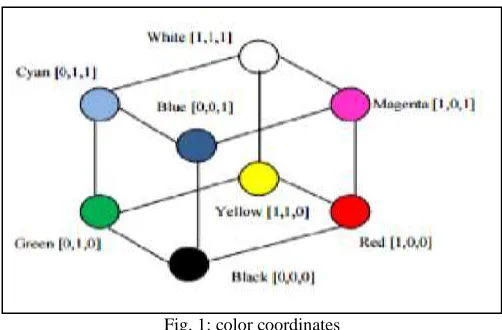
Fig. 1: color coordinates
RGB use true color image and donot have palette. Each pixel have R,G,B intensities. R,G,B components have 8 bits for every channel and have 16 million colors. RGB images have 24-bit images that are stored by graphics file format.
RGB Color Space:
Color space have different range of colors that camera usually captures, printer prints that image and a monitor displays it. Editing color space has RGB color model such as Adobe RGB and sRGB color spaces, and it is independent in nature. Color space represents both analog and digital form. Color space is based on CMYK color, or secondary colors are given as CMYK, C represents Cyan color, M represents Magenta color, Y represents Yellow color and K represents Black color. M that has Magenta color is represented on X axis, C that has Cyan color on Y axis, and Y that has yellow color on Z axis.
Fig. 2: comparision between RGB and CMYK
CMYK and RGB Comparison, RGB shows how this RGB Color is displayed in computer monitor and how CMYK is displayed in printer that uses subtractive colors
RGB Color model:
In this system, diagonal have matrices that has all zero values (0,0,0) represented in pure black color and (1,1,1) represented in pure white color, between this black and white color grayscale color is present.
Additive colors are R,G,B and mixing of all these three colors result in pure white color. Subtractive colors are C,M,Y,K and mixing of all these colors result in pure black color.
HSV Color model:
Color moments:
Color moment describes probability distribution of colors in an image and how different colors are distributed throughout the entire image and used in image retrieval system, each image represents some object and it compares how colors are distributed between two similar images and retrieves similar images based on their similar score. Smaller the score the more similar will be the images. nine moments are used for RGB color and twelve moments are used for CMYK color. Color moments aim is to compare two similar images
Color Correlogram:
For image indexing and comparison of images, color correlogram is mostly used. This color correlogram calculates spatial relationship. Color is low-level feature. Color corrrelogram says how color changes as distance vary in pixels.
Color Coherence vector:
CCV represents color coherence vector. Coherence classifies pixels as two methods, they are coherent or incoherent method. Coherent method represents continuous region that have some size but incoherent pixels don’t have region for some size. Both coherent and incoherent pixels represent separate histogram and has feature vector that represents some spatial information. Coherence value depend on large and small red color pixels, if this color pixel have large contents of red pigments then that image have high value of coherence and if color red pixel have small region content then that image shows very low value of coherence.
Color Histogram:
In many applications color histograms are used. This color histogram will compare images and display the result. These color histogram are efficient and insensitive in nature. One disadvantage is it does not provide any spatial information to the user but rather it will only tell which color whether it may be RGB values or what type of color is present in an image and also it will tell you the quantity of an image.
Color space selection:
This color space selection method is represented by LFT(Local Fourier Transform) method. This method has good performance. HSV color space is nonlinear transform for each cube. This cube represents RGB-cube that is used in color vision method. Main disadvantage of HSV is that the values are having zero saturation and also in HSV space method is has fourier transform method and most widely used by hue channel. This Hue value is stored in scalar value, this scalar value has high frequency for soft.
Clustering in RGB:
RGB clustering is done only on the file of input image. Here 3 bands of data are compressed into one and rescales 24-bit data to 8-bit data. Grouping of data in images is done by clustering method. Clustering method represents grid method. In grid method object is having some space so each space in each cell forms a grid structure. Clustering method have hard clustering that is K-mean algorithm and this K-K-mean algorithm was proposed by MacQueen in 1967. Different performance with different color space represents the clustering method such as RGB, HSV, CIE, YUV and CMYK are five different models. RGB is repeatedly used among all these color space methods. Color image have 3 color components. These 3 color components range from 0-255. HSV model is also known as cylindrical model.
Color indexing:
Color indexing have numerical expression and is main root for color moments. Color indexing represents color for particular object, simple numerical expression used by color index. Smaller numerical expression used by color index. If value of color index is small, the more blue or hotter the object is represented by color index. If value of color index is larger, the more red or color the object is represented. Color indexing has fast search analysis and retrieves information using DCD (Dominant Color Descriptor) method.
Dominant Color Descriptor (DCD):
Color quantization:
In this Color quantization method, number of distinct colors used in image are totally reduced and decreased. The main intention is original image should have exact match with the new image. Color quantization is mainly used in computer graphics application.
HSV Color space:
Computer graphics and visualization methods widely used by HSV color space method. Hue describes differences in colors and also represents which type of color it is, saturation used to add white light to a color and value represents light intensity or brightness of an image. HSV color space has two methods, they are chromatic and achromatic methods, HSV is always superior method and also this method improves efficiency and reduces complexity in an image.
Co-occurrence matrix:
This method represents the distribution of pixel values in an image such as grayscale values. This method was proposed by R.M. Haralick, this represents the distance between pixels in an image.
P. Color Dominant:In color spectrum, dominant color can be explained by its wavelength. In human vision color dominant of an image is represented by Homogenous color pixels. Image indexing is based on concept of color dominant method in image.
III. SHAPE
Shape is usually represented in figures or verbally and people use terms such as elongated, rounded etc. Shape is an one of the primitivefor content based image retrieval (CBIR) and it is an important visual feature. Perimeter, area, eccentricity, symmetry these are the some shape features.
Scale Invariant Feature Transform (SIFT):
The Scale Invariant Feature Transform (SIFT) method consists of two parts: (1) STFT detector and (2) SIFT descriptor. The key points of descriptions will be calculated by the SIFT descriptor. The key points which are mapped on the image will be calculated by the SIFT detector.
Histogram of oriented gradients (HOG):
The Histogram of Oriented Gradients (HOG) method divides the image into small parts called cells. Then these HOG features are taken out of these cells. And this method is used to check which kind of object present in image. This procedure is done based on calculating the number of gradient directions.
Nearest neighbour search method:
This method is unattended method and is also a type of searching method. Here the searching process will done by the type of object present in the image. The nearest neighbour method displays result either as negative or positive class.
Euclidean distance algorithm method:
In this Euclidean distance algorithm method, the query image feature vector is calculated and also this method is used to compare two vector features and default method of implementation. After this comparison the difference is obtained. If it is small then it is considered as similar image for the database image. Usually this searching is based on the similarity between images and not exactly matching of images.
Wavelet transforms method:
Orbitory function is represented by this method and orbitory function is nothing but superposition of a set of basic functions. From a single prototype wavelet these basic functions are obtained and is called mother wavelet.
Edge detection method:
This method detects the colour difference and provides an edge based on it. The colour variance of an image will be detected by using this method. Output of this edge detection method will be shape of flame. From this edge detection method equations are obtained. The following equation shows how to calculate the edge in an image.
1) Vertical edges are detected by following expressions:a,b= |a,b –a+1,b| (1) For a=1---N-1; And for b =1---N;
2) Horizontal edges are detected by following expressions:a,b = |a,b –a,b+1| (2) For a=1---N; and for b=1---N-1; 3) Here we are combining the eq(1) and eq(2) than we get eq(3) that detect both vertical and horizontal edge a,b = |a,b–a+1,b –a,b+1|
Gradient based edge detection method:
The maximum and minimum in the first order derivative of the image which will be calculated by using this method. Edges will detected by using this method only. In this method when the first order derivative will be maximum and the second order derivative will be zero.
Laplacian based edge detection method:
To find edges of an image the Laplacian based edge detection method searches the zero crossings in the second order derivative. It will calculate the derivative of the image and highlight its location and it even contains the one-dimensional shape of ramp
Sobel’s edge detection method:
The sobel’s edge detection method includes pair of kernels. To run edges horizontally and vertically relative to the pixel these kernels are used. The main advantages of this method is simplicity and detection of edges.
Robert’s edge detection method:
The sobel’s edge detector method is similar to Robert’s system. But the difference in this method is that it uses the diagonal convolution operator. When detecting diagonal edges in a given image, Robert’s filter is considered to be more effective.
Prewitt edge detector method:
In this method the convolution kernels are chosen with help of every pixel of the gradient magnitude. By using best pixel the orientation of a pixel and edge magnitude will be calculated. The image is convolved with different set of convolution kernels in different orientations which are sensitive to edges by using Prewitt edge detector method. Here under noisy conditions, this method possesses the better performance.
Columnar mean method:
This method uses RGB colour space for image retrieval and it performs feature extraction through calculating average row and column from each RGB plane separately.
Canny edge operator:
Image smoothing is first step to implement canny edge detector. Sobel operator does function in both vertical and horizontal direction of an image and also finds gradient for that particular image. Canny edge detector is a most desirable edge detector. To get good result user can apply the slope magnitude technique.
3D deformable model:
This model has 3D model that consists of high resolution effect and adds some force to inside and outside vertices of the model and also moves this model according to the forces applied to it, till it meets the desired destination. If force is applied to inside the model then it calculates the curvature. If force is applied to outside the model, then it calculates restoration filter method.
Prewitt operator method:
This method is widely used in image processing because it has advantages of finding edge in image. Edge is nothing but direction and size of image. We are using this method to calculate the gradient of image so this method is effective.
IV. TEXTURE
Texture represented by texel meaning texture elements, depend on how many texture are described in image. Features of textureinclude regularity, color distribution, contrast and complexity. Various methods in texture is given as follows:
Co-occurrence matrix:
This co-occurrence matrix is good texture method and has luminance property. Luminance represents some number of clusters such as grey values.
The Color Correlogram:
Color texture moments:
This method is based on low-level features and contains 8 orthogonal templates. This classify the texture and segment images and this texture method is based on local Fourier Transform method(LFT).
Local Binary Pattern (LBP):
This is powerful feature for texture classification and proposed in 1994. This improves performance detection in datasets and combined with HOG(Histogram of Oriented Gradients).
Brodatz Texture Album:
In texture classification, this method is used as benchmark dataset. It consists of 112 textures of Brodatz texture album and here only one image is scanned from texture album. Only by using single image, all textures are represented. Figure (3) Sample of 4 images that represents Brodatz texture album.
Fig. 3: sample of images for the Brodatz texture album
CUReT Dataset:
The C word represents Columbia, U word represents Utrecht, R word represents Reflectance and T word represents Texture(CUReT). In this method textures have 61 fields of different texture and having 92 images each have only one class as below
Fig. 4: sample of images for the CUReT Texture album
VisTex Dataset:
The Vision Texture(VisTex) dataset was proposed by Massachusetts Institute of Technology(MIT). This method has multiple textures that show real world objects and video textures. Sample images of dataset as texture are depicted below Figure (5)
Fig. 5: sample of four images for the VisTex Dataset Texture
DynTex Dataset:
The DynTex stands for Dynamic Texture database which have high quality dynamic texture videos. Dynamic texture includes water that has waves in a beach, smokes that is dynamic in nature, fire, a flag that blows in a wind. These are dynamic in nature and include segmentation. Sample images are given as follows
V. CONCLUSION
A content based search method that detects the basic content of a particular image like colour, shape and texture. Various methods of content based image retrieval based on their related feature are described and explained based on all the features like color, shape and texture methods each in detail. Hence by using all these methods one can automatically search and retrieve the images from image database.
REFERENCES
[1] Dubey, S.R., Singh, S.K., Singh, R.K “Local neighbourhood-based robust colour occurrence descriptor for colou r image retrieval”, IET Image Process,
2015
[2] Prajkta . More, “Content Based Image Retrieval Using Sobel’s Edge Detection Algorithm” (ICARI), ISBN, 2014.
[3] Neha Sharma, “Retrieval of Image by Combining the Histogram and HSV Features Along with Surf Algorithm”, International Journal of Engineering
Trends Tech, Volume4 Issue7, July 2013.
[4] DJeyabharathi and Dr.A. Suruliandi," Performance Analysis of Feature Extraction and Classification Techniques in CBIR", 2013 International Conference