https://doi.org/10.5194/amt-12-839-2019 © Author(s) 2019. This work is distributed under the Creative Commons Attribution 4.0 License.
A novel post-processing algorithm for Halo Doppler lidars
Ville Vakkari1,2, Antti J. Manninen3, Ewan J. O’Connor1,4, Jan H. Schween5, Pieter G. van Zyl2, and Eleni Marinou6,7
1Finnish Meteorological Institute, Helsinki, 00101, Finland
2Unit for Environmental Sciences and Management, North-West University, Potchefstroom, 2520, South Africa 3Institute for Atmospheric and Earth System Research, University of Helsinki, Helsinki, 00014, Finland 4Department of Meteorology, University of Reading, Reading, UK
5Institute for Geophysics and Meteorology, University of Cologne, Cologne, Germany 6IAASARS, National Observatory of Athens, Athens, 15236, Greece
7Institute of Atmospheric Physics, German Aerospace Center (DLR), 82234 Oberpfaffenhofen, Germany
Correspondence:Ville Vakkari ([email protected])
Received: 21 September 2018 – Discussion started: 23 October 2018
Revised: 16 January 2019 – Accepted: 25 January 2019 – Published: 7 February 2019
Abstract. Commercially available Doppler lidars have now been proven to be efficient tools for studying winds and tur-bulence in the planetary boundary layer. However, in many cases low signal-to-noise ratio is still a limiting factor for utilising measurements by these devices. Here, we present a novel post-processing algorithm for Halo Stream Line Doppler lidars, which enables an improvement in sensitiv-ity of a factor of 5 or more. This algorithm is based on im-proving the accuracy of the instrumental noise floor and it enables longer integration times or averaging of high tem-poral resolution data to be used to obtain signals down to −32 dB. While this algorithm does not affect the measured radial velocity, it improves the accuracy of radial velocity uncertainty estimates and consequently the accuracy of re-trieved turbulent properties. Field measurements using three different Halo Doppler lidars deployed in Finland, Greece and South Africa demonstrate how the new post-processing algorithm increases data availability for turbulent retrievals in the planetary boundary layer, improves detection of high-altitude cirrus clouds and enables the observation of elevated aerosol layers.
1 Introduction
Turbulent mixing in the planetary boundary layer (PBL) is one of the most important processes for air quality, weather and climate (e.g. Garratt, 1994; Baklanov et al., 2011; Ryan, 2016). Mixing layer height (MLH), i.e. the height of the layer
that is connected with the surface on timescales of less than 1 h, is a central parameter describing PBL turbulence (e.g. Seibert et al., 2000). Continuous measurement of MLH with good temporal resolution is not trivial, though. For instance, aerosol backscatter profiles have been commonly used to es-timate MLH (Seibert et al., 2000; Pal et al., 2013). The ben-efit is that aerosol backscatter profiles can be obtained rou-tinely with high temporal resolution (e.g. Emeis et al., 2008), but as this method is not a direct measure of turbulent mix-ing, it is prone to erroneous interpretation, especially dur-ing morndur-ing and evendur-ing transition periods of the convective PBL (Schween et al., 2014).
Development of fibre-optic Doppler lidar systems during the last 5 to 10 years has enabled direct, long-term obser-vation of MLH with temporal resolutions of typically a few minutes or better (e.g. Tucker et al., 2009; O’Connor et al., 2010; Pearson et al., 2010; Schween et al., 2014; Vakkari et al., 2015; Smalikho and Banakhm 2017; Bonin et al., 2017, 2018). Long-range Doppler lidar systems typically have a blind range with a minimum usable distance of 50–100 m; hence scanning Doppler lidar is the only realistic option for covering the full range of MLH from close to ground level up to a few kilometres with good temporal resolution (Vakkari et al., 2015).
distri-bution (Lothon et al., 2009), e.g vertical wind speed variance and skewness, as well as turbulent kinetic energy dissipation rate, Doppler lidar measurements enable the diagnosis of the sources of turbulence within the PBL (Hogan et al., 2009; Harvey et al., 2013; Tuononen et al., 2017; Manninen et al., 2018).
Velocity measurements using fibre-optic Doppler lidar systems operating at 1.5 µm wavelength depend on light scat-tering from aerosol particles and cloud droplets as these are small enough to behave as tracers of atmospheric motion. In very clean atmospheric environments, the lack of scatter-ing particles becomes a limitscatter-ing factor for utilisscatter-ing these sys-tems (e.g. Manninen et al., 2016). Development of new, more powerful yet eye-safe Doppler lidar systems has helped to overcome this limitation to a large degree (e.g. Bonin et al., 2018); yet decreasing the instrumental noise level through post-processing of the data allows the utilisation of weaker signals and can lead to major improvements in data coverage (Manninen et al., 2016). The post-processing algorithm by Manninen et al. (2016) has the added benefit of improving the accuracy of the signal-to-noise ratio (SNR), which leads to more accurate uncertainty estimates of the measured radial velocity (Rye and Hardesty, 1993; Pearson et al., 2009). This is especially important for the retrieval of turbulent properties under weak signal conditions, as uncertainty in instrumental noise level propagates into turbulent properties and wind re-trievals (O’Connor et al., 2010; Vakkari et al., 2015; Newsom et al., 2017). Naturally, post-processing methods can be ap-plied to historical data sets as well.
Here we present an improved post-processing algorithm for Halo Photonics Stream Line Doppler lidars, which are currently widely used for PBL research (O’Connor et al., 2010; Pearson et al., 2010; Harvey et al., 2013; Hirsikko et al., 2014; Schween et al., 2014; Päschke et al., 2015; Vakkari et al., 2015; Banakh and Smalikho, 2016; Tuononen et al., 2017; Bonin et al., 2018). Building on the work by Manni-nen et al. (2016), we show that, by changing the way instru-mental noise level is determined during periodic background checks, the sensitivity can be improved by as much as a fac-tor of 5; by averaging high time resolution data, signals with an SNR as low as−32 dB can be utilised. Case studies from different environments in Finland, Greece and South Africa are presented to demonstrate how the new post-processing algorithm increases data availability for turbulent retrievals in the PBL, improves detection of high-altitude cirrus clouds and enables observation of elevated aerosol layers 2 to 4 km above ground level.
Next, in Sect. 2 we introduce the Halo Photonics Stream Line, Stream Line Pro and Stream Line XR lidars used in this study. Section 3 describes the improved SNR post-processing algorithm, and in Sect. 4 the three case studies are presented, followed by concluding remarks.
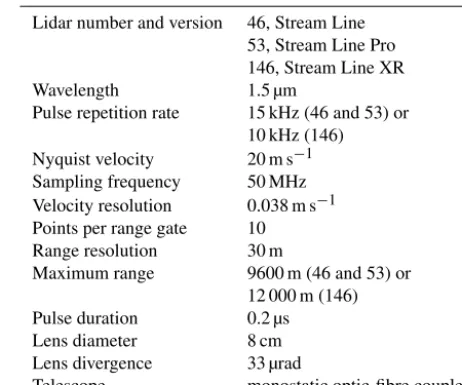
Table 1.Specifications for Halo Doppler lidars utilised in this study.
Lidar number and version 46, Stream Line 53, Stream Line Pro 146, Stream Line XR Wavelength 1.5 µm
Pulse repetition rate 15 kHz (46 and 53) or 10 kHz (146) Nyquist velocity 20 m s−1 Sampling frequency 50 MHz Velocity resolution 0.038 m s−1 Points per range gate 10
Range resolution 30 m
Maximum range 9600 m (46 and 53) or 12 000 m (146) Pulse duration 0.2 µs Lens diameter 8 cm Lens divergence 33 µrad
Telescope monostatic optic-fibre coupled
2 Instrumentation and measurements
In this study we utilise data from three different versions of Halo Photonics scanning Doppler lidars (Pearson et al., 2009): lidar 46 is a Stream Line system, lidar 53 is a Stream Line Pro system and lidar 146 is a Stream Line XR sys-tem. All Halo Photonics Stream Line versions are 1.5 µm pulsed Doppler lidars with a heterodyne detector that can switch between co- and cross-polar channels (Pearson et al., 2009). The Stream Line and the more powerful Stream Line XR lidars are capable of full hemispheric scanning, and the scanning patterns are user-configurable. The Stream Line Pro version is designed for harsher environmental conditions with no exterior moving parts, which limits the scanning to within a cone of 20◦from the vertical. In this study, however, we only utilise vertically pointing measurements in co-polar mode, and thus there is no practical difference between the limited and fully scanning versions.
The minimum range for all instruments is 90 m, and stan-dard operating specifications for the different versions are given in Table 1. The telescope focus of the Stream Line and Stream Line Pro lidars is user-configurable between 300 m and infinity, whereas the Stream Line XR focus cannot be changed. Integration time per ray is user-adjustable and can be optimised between high sensitivity (long integration time) and high temporal resolution (short integration time) depend-ing on the environmental conditions and research questions. In the measurements utilised in this study, 7 s integration time is used for lidars 46 and 53, while lidar 146 is operated with 10 s integration time.
uncertainty in vr (σvr) from SNR according to O’Connor et al. (2010). As discussed earlier, in calculating turbulent parameters from Doppler lidar observations, accurateσvr is needed to differentiate turbulence from instrumental noise (e.g. O’Connor et al., 2010; Vakkari et al., 2015; Newsom et al., 2017).
We present case studies of Halo Doppler lidar measure-ments at three different locations with three different instru-ments. Lidar 53 was deployed at Finokalia, Crete, Greece (35.34◦N, 25.67◦E), on 8 July 2014. Lidar 46 was de-ployed at Welgegund, South Africa (26.57◦S, 26.94◦E), on 6 September 2016 and lidar 146 was deployed at Helsinki, Finland (60.20◦N, 24.96◦E), on 1 and 6 May 2018.
Additionally, we utilise collocated Raman lidar measure-ments at Finokalia. These measuremeasure-ments were carried out using the OCEANET PollyXT multiwavelength Raman and polarization lidar system of the Leibniz Institute for Tropo-spheric Research (TROPOS). A detailed description of the instrument and its measurements is provided in Engelmann et al. (2016) and Baars et al. (2016), respectively. In brief, Pol-lyXT operates using a Nd:YAG laser that emits light pulses at 1064 nm with a repetition frequency of 20 Hz. The radi-ation frequency is doubled and tripled, resulting in the si-multaneous emission of 355, 532 and 1064 nm in the atmo-sphere. The receiver features 12 channels that enable mea-surements of elastically (three channels) and Raman scat-tered light (387 and 607 channels for aerosols, 407 for water vapour) as well as depolarisation state of the incoming light (355 and 532 nm) and near-range measurements (two elastic and two aerosol Raman channels). In this study, the mea-surements at 1064 nm are used. The lidar meamea-surements at Finokalia were collected during the 2014 CHARacterization of Aerosol mixtures of Dust and Marine origin experiment (CHARADMExp) on the northern coast of Crete, Greece.
3 Improved background check handling algorithm 3.1 Signal-to-noise ratio in Halo Doppler lidars
Halo Doppler lidars measure the noise level during periodic background checks, typically once an hour, in which the scanner is set to point to an internal (limited scan) or ex-ternal target mounted on the instrument itself (hemispheric scan) so that no atmospheric signal is recorded. The raw sig-nal from the amplifier during the background check (Pbkg)
is saved as a profile in ASCII files (“Background_ddmmyy-HHMMSS.txt”) with the range resolution configured for the normal measurement mode. For most Stream Line and Stream Line Pro firmware versions, Pbkg is written on one
line with a fixed precision of six decimals but a varying field width for each range gate. In Stream Line XR firmware, the Pbkgvalue at each range gate is written on its own line.
In most Stream Line and Stream Line Pro instruments, the profile Pbkg(z)is flat (constant with range) or presents
Figure 1. (a)Pbkg measured by lidar 46 on 6 September 2016 at 23:00 UTC and Pbkg measured by lidar 146 on 1 May 2018 at 10:00 UTC.Pfit is also indicated for both systems.(b) 2-D his-togram of meanPbkgvs.T for lidar 46.(c)2-D histogram of mean
Pbkgvs.T for lidar 146.
a small linear increase with increasing distancezfrom the lidar (Fig. 1a);Pbkg(z)following a second-order polynomial
can also occur (Manninen et al., 2016). For Stream Line XR instruments,Pbkg(z)can vary between a linear and an inverse
exponential shape (Fig. 1a), for which the inverse exponen-tialPbkg(z)can be represented as
Pbkg(z)= b1
exp(b2·zb3)
, (1)
whereb1,b2andb3are scalars and can be determined from
a least-squares fit.
In Stream Line and Stream Line Pro lidars, the magnitude ofPbkgincreases non-linearly with instrument internal
on T; however, the amplifier alternates randomly between a high mode (Pbkg≈3.6×10⁸for lidar 146) and a low mode
(Pbkg≈3.2×10⁸for lidar 146) as seen in Fig. 1c.
Further-more, it appears that the inverse exponentialPbkgshape only
occurs in the low mode, but not all low-modePbkg profiles
follow Eq. (1).
The Halo Doppler lidar firmware accounts for changes in Pbkglevel by calculating SNR as
SNR0=
A0·P0(z) Abkg·Pbkg(z)
−1, (2)
whereP0(z)is the raw signal from the amplifier during each
measurement,Pbkg(z)has been obtained during the previous
background check and scalar scaling factorsA0andAbkgare
determined online for eachP0andPbkgprofile. Here, we
de-note the unprocessed SNR output by the instrument as SNR0.
Note thatA0andAbkgare not saved by the firmware, which
means that the high and low mode in Stream Line XR lidars cannot be identified in the SNR0time series.
Equation (2) is straightforward to determine online as there are no assumptions about the shape ofPbkg, and it gives
a reasonably good first estimate of SNR. However, Eq. (2) is vulnerable to inaccuracy in determining A0andAbkg as
well as to any deviation from the actual noise level during measurement ofPbkg. An offset inA0inflicts a constant
off-set in SNR0in a single profile, while an offset inAbkg does
the same for all profiles between two background checks (cf. Manninen et al., 2016). The magnitude of typical offsets in A0 andAbkgvaries from instrument to instrument; in some
cases they can have a major effect on data coverage (Manni-nen et al., 2016).
In all Halo Doppler lidarsPbkgcontains a small but
vary-ing offset from the actual noise level at each range gate be-cause of the finite duration of the background check. These offsets appear as a small constant offset in SNR0 at each
range gate between two background checks. To minimise the effect of offset in Pbkg, the integration time of background
check measurement was originally designed to be 6 times as long as the integration time in measurement mode. The dura-tion of the background check is user-configurable; however, for long integration times of up to 6 min considered in this paper such long background checks are not a viable option. In the next section we present an improved algorithm to cor-rect SNR0for inaccuracies inA0,AbkgandPbkg.
3.2 Improved SNR post-processing algorithm
Whether Pbkg(z)is linear or follows some other functional
form is readily determined by fitting expected functions to it (cf. Manninen et al., 2016). For Stream Line and Stream Line Pro lidars we consider a second-order polynomial to repre-sentPbkg(z)better than a linear fit if it has at least 10 % lower
root-mean-squared (rms) error than the linear fit toPbkg(z).
For Stream Line XR we consider Eq. (1) to representPbkg(z)
better if it has at least 5 % lower rms error than the linear fit
toPbkg(z). Furthermore, knowing the typical noise level of a
certain instrument, a rms threshold can be applied to discard bad fits and to flag periods of increased uncertainty.
Denoting the selected fit toPbkg(z)asPfit(z), the residual
is
Pbkg,res(z)=Pbkg(z)−Pfit(z). (3)
AveragingPbkg,res(z)over a large number of Pbkg(z)
pro-files reveals a persistent structure in the residual (Fig. 2a). This part ofPbkg,res(z)originates in the amplifier response
to the transmitted pulse, denoted here asPamp(z), and it is
the main reason for using the gate-by-gate definedPbkg(z)
profile in SNR calculation by the manufacturer. However, Pamp(z)stays reasonably constant over time and can be
ob-tained from a long enough data set ofPbkg(z). Here, we used
a discrete wavelet transform with a Symmlet order 8 wavelet as a low-pass filter to de-noise the averagedPbkg,res(z). As
shown in Fig. 2a,Pamp(z)is instrument-specific and needs to
be determined individually for each device.
In Stream Line and Stream Line Pro lidars,T has a small effect onPamp(z)as seen in Fig. 2b. However, this can be
addressed based on a suitably longT data set andPbkg,res(z)
by determiningPamp(z)as a function of the internal
temper-ature. In practice, at least 300Pbkg(z)profiles are required
to obtain a reliable estimate ofPamp(z). Consequently, for an
11-month measurement campaign at Welgegund, we could determinePamp as a function of T at 1◦C resolution from
25 to 31◦C (Fig. 2b). ForT <23◦C orT >35◦C we could only determine aggregatePampprofiles, but then these
tem-perature ranges comprise only 9 % of the measurements in this data set. For optimal data quality, additional temperature stabilisation could be applied to ensure thatPampis always
in the well-characterised temperature range.
In Stream Line XR lidars,Pamp does not depend onT;
however,Pamphas to be determined separately for the high
and low mode ofPbkg(see Fig. 1c). For lidar 146, we define Pbkghigh mode as meanPbkg>3.4×10⁸andPbkglow mode
as meanPbkg<3.4×10⁸, respectively. As seen in Fig. 2c, Pampfor these two modes differs substantially.
We consider the sum ofPfit(z)andPamp(z)as the best
es-timate for the actual instrumental noise level during a back-ground check:
Pnoise(z)=Pfit(z)+Pamp(z). (4)
Using Eq. (2), we can move from a Pbkg-based SNR (i.e.
SNR0) to a Pnoise-based, corrected SNR (denoted here as
SNR1) simply as
SNR1(z)=(SNR0(z)+1)·
Pbkg(z) Pnoise(z)
−1. (5)
Next, we utilise the Manninen et al. (2016) algorithm to iden-tify any possible bias in theA0toAbkgratio. In short,
Figure 2. (a)Lidar 46Pbkg,resaveraged from 20 August 2016 to 14 June 2017 (7193 background checks). Lidar 53Pbkg,resaveraged from 1 January 2014 to 30 November 2015 (16 802 background checks).Pampis plotted for both systems.(b)First 100 range gates of lidar 46Pampcalculated for different ranges ofT.(c)Lidar 146
Pbkg,resaveraged from 12 January to 31 May 2018.Pbkg,resis aver-aged separately for highPbkgmode (1375 background checks) and for lowPbkgmode (1623 background checks).Pampis plotted for both modes.
first to time series of SNR1. Note that typically cloud and
aerosol signal is easier to discern in SNR1than in SNR0, and
thus cloud screening is applied after Eq. (5). Then, first- and second-order polynomial fits are calculated for each cloud-screened profile of SNR1(z), and a rms threshold is used to
select the appropriate fit, similar to determiningPfit(z).
De-noting the selected fit to cloud- and aerosol-free measure-ments as SNRfit(z)we obtain
SNR2(z)=
SNR1(z)+1
SNRfit(z)+1
−1, (6)
which is our final corrected SNR.
Note that to correct only for the bias in theA0 toAbkg
ratio, a scalar denominator in Eq. (6) would be sufficient. However, using the fitted profile SNRfit(z)as the
denomina-tor accounts for possible changes in the slope ofPnoisesince
the last background check.
3.2.1 Implications for Stream Line XR lidars
The calculation of SNR2 with Eq. (6) relies on the fitting
to cloud- and aerosol-free measurements. For Stream Line and Stream Line Pro lidars, which do not exhibit the inverse exponential Pbkg shape, SNRfit(z) will capture the shape
of the actual noise level in nearly all cases. However, for Stream Line XR lidars the randomly occurring inverse ex-ponentialPbkg(z)shape (Fig. 1a) is almost always masked
by aerosol and/or cloud signal during measurement. Thus, it is not possible to correct for changes in shape ofPnoise(z)
with SNRfit(z)during post-processing. However, the
magni-tude of uncertainty inPnoise(z)can be estimated from the
av-erage depth of the inverse exponential dip inPbkg(z)during
background checks (see Fig. 3a).
Now asA0is not saved, it is not possible to tell whether the
amplifier was operating in high or low mode during measure-ment. Consequently, the difference inPampfor the amplifier
high and low modes also adds to the uncertainty in SNR for Stream Line XR systems, but, compared to the effect of the inverse exponential shape ofPbkg(z), the effect ofPampis
ap-proximately 10 times smaller. However, any possible bias in theA0toAbkgratio can be corrected, and this is readily done
by applying a linear fit to SNR1(z)at range gates 100–400
(for which SNR is not affected by inverse exponentialPbkg)
and using this as SNRfit(z)in Eq. (6).
In practice, there are two options for SNR post-processing for Stream Line XR lidars. The first option is to accept the fitted Eq. (1) forPfit(z)when it describesPbkg(z)better. With
this approach SNR2may overestimate the actual SNR if the
shape ofPnoisechanges from Eq. (1) to being linear after the
background check. Correspondingly, a change from a linear Pnoise to the inverse exponential shape during measurement
results in SNR2underestimating the actual SNR.
The second option for Stream Line XR SNR post-processing is to calculate a linear fit to Pbkg(z) based on
range gates 100–400 and to always use this forPfit(z). In
this case, we only use high-modePamp(z)in calculating the
noise level (Eq. 4) and denote it asPnoise0 (z). Consequently SNR0
2 is the lower limit of the actual SNR, which can be
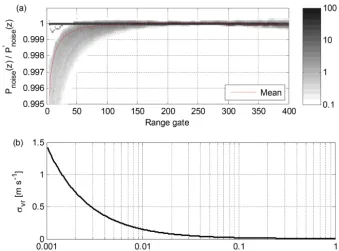
Figure 3. (a)2-D histogram of the ratio ofPnoise(z)(best estimate) toPnoise0 (z)(linear fit only) for lidar 146 background checks. The mean of the ratio is also indicated.(b)σvras a function of SNR for lidar 146.
Uncertainty in SNR leads to uncertainty in σvr, as σvr is
mostly a function of SNR (Pearson et al., 2009). However, σvr decreases rapidly with increasing SNR (Fig. 3b).
There-fore, even the worst-case underestimation in SNR only has a limited effect onσvrif SNR is even moderately high (>0.03,
−15.2 dB). On the other hand, for observations >2000 m away from the lidar, where signals are typically low, the un-certainty in SNR is also low (Fig. 3a). In the end, unun-certainty in SNR and its effects inβandσvrneed to be evaluated
indi-vidually for each profile in Stream Line XR lidars.
4 Case studies
4.1 Welgegund 6 September 2016
On 6 September 2016 lidar 46 was operating at Welgegund, South Africa, and a time series of SNR in vertically point-ing measurement mode for this day is presented in Fig. 4. In this case, SNR0is very close to 0 when there are no clouds
or aerosol present (Fig. 4a), indicating that the online cal-culation of A0 and Abkg is quite successful. However, the
presence of small but varying offsets inPbkg(z)is apparent
in Fig. 4a as horizontal stripes in SNR0time series between
the background checks conducted on the hour.
In the SNR1 time series (Fig. 4b) the horizontal stripes
have been removed by applying the smooth Pnoise-based
background using Eq. (5). At the same time, the elevated aerosol layer at 2000–4000 m above ground level (a.g.l.) be-comes easily discernible. Small biases in theA0toAbkgratio
become visible as vertical stripes, for instance between 05:00 and 06:00 UTC in Fig. 4b, which are then corrected for in the time series of SNR2(Fig. 4c).
Comparing the standard deviation of SNR (σSNR) for
cloud- and aerosol-free range gates shows a clear improve-ment in the noise level with the new post-processing al-gorithm (Fig. 4d). The main advantage of the new post-processing algorithm is that it enables averaging SNR; for SNR0any offsets inPbkg(z)become the limiting factor. This
is clearly seen in Fig. 4d, which showsσSNRfor SNR2
de-creases with increasing integration time per profile following theσ/
√
N rule closely as expected, but increasing integra-tion time has little effect onσSNRfor SNR0.
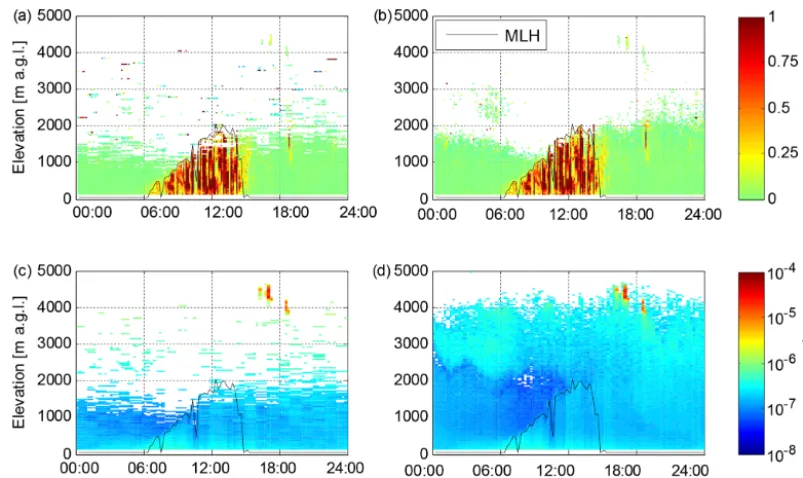
Figure 5 demonstrates how the lower noise floor with the new post-processing algorithm allows vertical wind speed variance (σw2) up to 2000 m a.g.l. (i.e. up to the top of the mixed layer) to be determined on this day. Furthermore, by averaging the originally 7 s data to 168 s integration time per profile and applying the new post-processing algorithm, the SNR threshold at the 3σlevel (see Fig. 4d) can be decreased from 0.0032 (−25 dB) for SNR0 to 0.00065 (−32 dB) for
SNR2. Consequently, β can be retrieved for the elevated
aerosol layer at 2000–4000 m a.g.l. (Fig. 5c, d). Note that the offsets inPbkg(z)result in horizontal stripes in the 168 s
in-tegration timeβcalculated from SNR0in Fig. 5c.
Figure 4.Data from lidar 46 at Welgegund on 6 September 2016.(a)Time series of the SNR0profile in vertically pointing mode.(b)Time series of the SNR1profile in vertically pointing mode.(c)Time series of the SNR2profile in vertically pointing mode.(d)σSNRas a function of integration time per profile for SNR0and SNR2for range gates at 4800–9000 m a.g.l. Alsoσ/
√
N, whereσisσSNRat an integration time of 7 s (original integration time per profile) andNis the number of averaged profiles, is included in(d).
6 September 2016), a 75◦elevation angle velocity azimuth display (VAD) scan was utilised for horizontal wind retrieval every 15 min. With the new post-processing algorithm, the SNR threshold for wind retrieval could be decreased from 0.0045 to 0.0032. This decrease in the SNR threshold en-abled the wind retrieval for 2–13 range gates more from each VAD scan; on average, winds could be determined from 7.5 additional range gates per VAD scan. That is, vertical cov-erage of wind retrievals increased on avcov-erage by 200 m with the new post-processing.
Wind retrievals at lower SNR will have higher uncer-tainty due to higher instrumental noise in radial velocity measurement; yet enhanced SNR will enable more accurate
determination of the instrumental uncertainty in wind re-trievals. However, as a major fraction of the uncertainty in retrieved winds arises in atmospheric turbulence (Newsom et al., 2017), the more accurate SNR will only have a limited effect on the overall uncertainty in the wind retrieval. There-fore, the uncertainty in each wind retrieval should be eval-uated, e.g. with the methodology of Newsom et al. (2017), before the wind retrievals are disseminated.
4.2 Helsinki 1 and 6 May 2018
Figure 5.Data from lidar 46 at Welgegund on 6 September 2016.(a)Time series of theσw2profile, for which a threshold of 0.0031 (2σ) has been applied to SNR0.(b)Time series of theσw2profile, for which a threshold of 0.0021 (2σ) has been applied to SNR2. In(a)and(b)the instrumental noise contribution toσw2has been subtracted.(c)Time series ofβobtained with 168s integration time from SNR0;βhas been filtered with a threshold of 0.0032 (3σ) applied to SNR0.(d)Time series ofβobtained with 168 s integration time from SNR2;βhas been filtered with a threshold of 0.00065 (3σ) applied to SNR2. Mixing layer height (MLH) determined from panels(b)and(d)is also indicated.
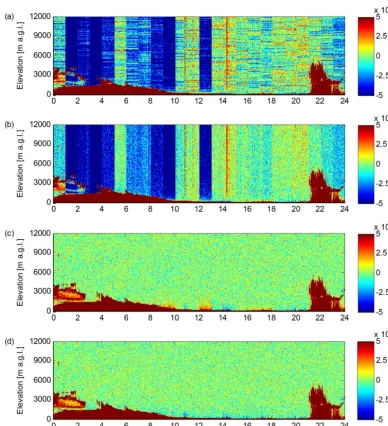
XR lidar at its worst. In Fig. 6a, SNR0is negative, e.g. from
01:00 to 05:00, 06:00 to 10:00 and 12:00 to 13:00 UTC be-cause of an erroneousAbkg coefficient. On the other hand,
the individual profiles with unrealistically high SNR0around
11:00, 14:00 to 15:00 and 20:00 to 21:00 UTC indicate er-rors in theA0coefficient. Additionally, horizontal stripes in
SNR0time series similar to lidar 46 (Fig. 4a) indicate
off-sets inPbkg(z). The reason for poor determination ofA0and Abkgfor lidar 146 seems to be thatPbkg(z)is frequently
non-linear, unlike for lidar 46, for example.
The new post-processing algorithm corrects the errors in A0 and Abkg as well as the stripes due to offsets in Pbkg(z) as seen in Fig. 6c. However, Fig. 6c shows that Pbkg(z)changing between the inverse exponential and
lin-ear shape causes over- and underestimation of SNR2in the
lowest 1500 m a.g.l. For instance, positive SNR2in the
low-est 1000 m at 12:00 to 13:00 UTC and negative SNR2in the
lowest 1000 m at 14:00 to 15:00 UTC are due to noise level shape changes between background check and measurement modes. During these periods, the lidar signal is fully atten-uated by a cloud within the lowest 200 m, and consequently SNR2in the 200–1000 m range should be zero. In Fig. 6d,
SNR02is only calculated using a linear fit toPbkg(z)as
dis-cussed in Sect. 3.2.1. This removes the overestimate of SNR at 12:00–13:00 UTC, but cannot correct the underestimates.
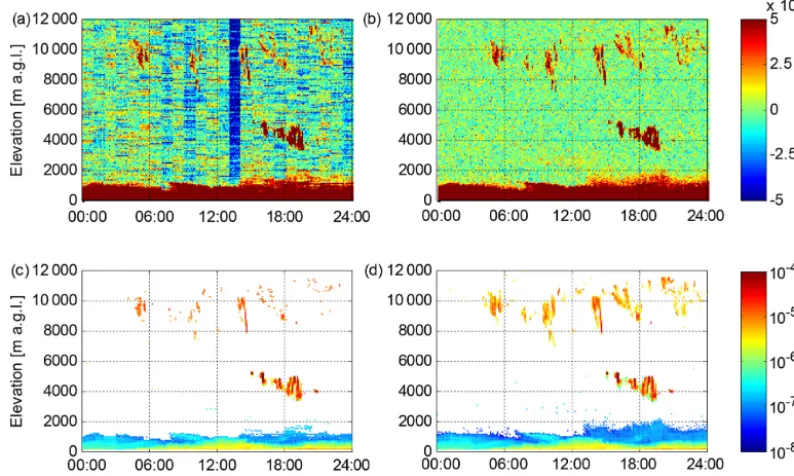
Measurements with lidar 146 on 1 May 2018 at Helsinki present much less noisy SNR0than on 6 May 2018, as seen in
Fig. 7a. On this day there are cirrus clouds present at 8000– 12 000 m a.g.l., but the stripes due to offsets inPbkg(z)make
it difficult to distinguish the clouds from noise in SNR0.
Applying the new post-processing algorithm and increasing integration time from 10 to 60 s for this day enables the SNR threshold at the 3σ level to be lowered from 0.0035 (−24.5 dB) for SNR0to 0.0012 (−29 dB) for SNR2. This
re-sults in a significant increase in data coverage for the cirrus clouds, as shown in Fig. 7c and d.
4.3 Finokalia 8 July 2014
Time series of SNR in vertically pointing mode with lidar 53 on 8 July 2014 at Finokalia, Greece, are presented in Fig. 8. On this day, SNR0 is close to 0 for 4000–9600 m a.g.l.
el-evation (Fig. 8a), indicating that the online calculation of A0 andAbkg is quite successful. Only at 00:00–01:00 and
20:00–21:00 UTC is SNR0negative, indicating a small offset
inAbkg. However, horizontal stripes in the SNR0time series
between the background checks are apparent in Fig. 8a, indi-cating the presence of small but varying offsets inPbkg(z).
Figure 6.Data from lidar 146 at Helsinki on 6 May 2018.(a)Time series of the SNR0profile in vertically pointing mode.(b)Time series of the SNR1profile in vertically pointing mode.(c)Time series of the SNR2profile in vertically pointing mode.(d)Time series of the SNR02 (always based on a linear fit toPbkg(z))profile in vertically pointing mode.
agreement between the two systems is reasonably good. Fur-ther averaging of SNR2, in this case up to 350 s integration
time, allows the determination ofβ for the elevated aerosol layers. With this long integration time we can reach a 3σ SNR threshold of 0.00059 (−32 dB) for SNR2. For SNR0,
offsets inPbkg(z)are the limiting factor in determining the
SNR threshold, and at the 3σ level only 0.0044 (−24 dB) can be achieved.
5 Conclusions
In this paper we have presented an improved SNR post-processing algorithm for Halo Doppler lidars. For Stream
Line and Stream Line Pro lidars, this method enables accu-rate SNR andβretrievals from the first usable gate onwards. For Stream Line XR lidars, we identified a previously un-known source of uncertainty in the near-range (<1500 m) SNR due to variations in the noise floor of these systems. We present a method to estimate the magnitude of this source of uncertainty, although it cannot be completely eliminated.
Figure 7.Data from lidar 146 at Helsinki on 1 May 2018.(a)Time series of the SNR0profile in vertically pointing mode.(b)Time series of the SNR2profile in vertically pointing mode.(c)Time series ofβobtained with 60 s integration time from SNR0;βhas been filtered with a threshold of 0.0035 (3σ) applied to SNR0.(d)Time series ofβobtained with 60 s integration time from SNR2;βhas been filtered with a threshold of 0.0012 (3σ) applied to SNR2.
Figure 9. (a)Vertical profiles of SNR from PollyXT at 1064 nm wavelength and SNR2from lidar 53 at Finokalia on 8 July 2014. Both profiles are obtained at 21:00 UTC; the integration time of the lidar 53 profile is 350 s, and the integration time of the PollyXT profile is 360 s.(b)Time series of PollyXT SNR at 1064 nm wavelength with 360 s integration time at Finokalia on 8 July 2014.(c)Time series of PollyXT attenuated backscatter at 1064 nm wavelength with 360 s integration time at Finokalia on 8 July 2014.
point-by-point-defined noise floor. The improved SNR post-processing algorithm removes this source of error by intro-ducing a more accurate, continuous noise floor. Independent of the noise floor, online scaling of raw signal from the am-plifier by the firmware fails occasionally. This source of er-ror in SNR was targeted by Manninen et al. (2016), and their algorithm is adapted here as part of the improved SNR post-processing algorithm (Eq. 6). Correcting for these two sources of error in SNR enables data to be retrieved at much lower SNR than before. By increasing integration time per profile to a few minutes, SNR down to 6×10⁻⁵(−32 dB) can be utilised.
Our analysis shows that even if the technical specifications of two Doppler lidar systems are identical, their instrumental noise characteristics can be quite different (Fig. 2). There-fore, the lidar operator should inspect each system individ-ually to ensure the highest data quality. Note that this algo-rithm or similar processing is needed to define the instrumen-tal noise level even if raw spectra are utilised instead of the processed data. The algorithm presented here can be applied in semi-operational use as long as at least 300 background checks (acquired in 2 weeks of measurements with typical configuration) are available for characterising the amplifier response to the transmitted pulse. A MATLAB implementa-tion of this algorithm is available through GitHub (Manni-nen, 2019).
We have demonstrated that the improved SNR post-processing can help to retrieve turbulent properties up to the top of the mixed layer under low aerosol load. With en-hanced SNR, the instrumental noise contribution to radial ve-locity variance can be estimated with better accuracy, which will improve the quality of turbulent parameter retrievals. The reduced noise floor enables horizontal wind retrievals with a lower SNR threshold and increases data availabil-ity, depending on atmospheric conditions. Furthermore, we have demonstrated that a combination of reduced noise floor and increased integration time allows detection of elevated aerosol layers with Stream Line and Stream Line Pro lidars. Even for the more powerful Stream Line XR lidars, the new SNR post-processing can increase data availability, e.g. in the case of high-altitude cirrus clouds. In conclusion, the improved SNR post-processing introduced in this paper en-hances the capabilities of Halo Doppler lidars in studying at-mospheric turbulence in weak signal conditions and opens up new possibilities for studying elevated aerosol layers, such as volcanic ash, Aeolian dust or biomass burning smoke.
Appendix A
Competing interests. The authors declare that they have no conflict of interest.
Acknowledgements. We gratefully acknowledge financial support by TOPROF (COST Action ES1303) and North-West University for measurements at Welgegund. CHARADMExp was an exper-imental campaign of the National Observatory of Athens (NOA) and was supported by the ESA-ESTEC project “Characterization of Aerosol mixtures of Dust And Marine origin”, contract no. IPL-PSO/FF/lf/14.489. We acknowledge Ronny Engelmann and Holger Baars from TROPOS for providing Raman lidar data and financial support through the High-Definition Clouds and Precipitation for advancing Climate Prediction research program (HD(CP)2; FKZ: 01LK1209C and 01LK1212C), funded by the Federal Ministry of Education and Research in Germany (BMBF), ACTRIS under grant agreement no. 262254 of the European Union Seventh Framework Programme (FP7/2007-2013) and ACTRIS-2 under grant agreement no. 654109 of the European Union’s Horizon 2020 research and innovation programme.
Edited by: Ulla Wandinger
Reviewed by: two anonymous referees
References
Baars, H., Kanitz, T., Engelmann, R., Althausen, D., Heese, B., Komppula, M., Preißler, J., Tesche, M., Ansmann, A., Wandinger, U., Lim, J.-H., Ahn, J. Y., Stachlewska, I. S., Amiridis, V., Marinou, E., Seifert, P., Hofer, J., Skupin, A., Schneider, F., Bohlmann, S., Foth, A., Bley, S., Pfüller, A., Gian-nakaki, E., Lihavainen, H., Viisanen, Y., Hooda, R. K., Pereira, S. N., Bortoli, D., Wagner, F., Mattis, I., Janicka, L., Markowicz, K. M., Achtert, P., Artaxo, P., Pauliquevis, T., Souza, R. A. F., Sharma, V. P., van Zyl, P. G., Beukes, J. P., Sun, J., Rohwer, E. G., Deng, R., Mamouri, R.-E., and Zamorano, F.: An overview of the first decade of PollyNET: an emerging network of automated Raman-polarization lidars for continuous aerosol profiling, At-mos. Chem. Phys., 16, 5111–5137, https://doi.org/10.5194/acp-16-5111-2016, 2016.
Baklanov, A. A., Grisogono, B., Bornstein, R., Mahrt, L., Zilitinke-vich, S. S., Taylor, P., Larsen, S. E., Rotach, M. W., and Fer-nando, H. J. S.: The Nature, Theory, and Modeling of Atmo-spheric Planetary Boundary Layers, B. Am. Meteorol. Soc., 92, 123–128, https://doi.org/10.1175/2010BAMS2797.1, 2011. Banakh, V. A. and Smalikho, I. N.: Lidar observations of
atmo-spheric internal waves in the boundary layer of the atmosphere on the coast of Lake Baikal, Atmos. Meas. Tech., 9, 5239–5248, https://doi.org/10.5194/amt-9-5239-2016, 2016.
Bonin, T. A., Choukulkar, A., Brewer, W. A., Sandberg, S. P., We-ickmann, A. M., Pichugina, Y. L., Banta, R. M., Oncley, S. P., and Wolfe, D. E.: Evaluation of turbulence measurement techniques from a single Doppler lidar, Atmos. Meas. Tech., 10, 3021–3039, https://doi.org/10.5194/amt-10-3021-2017, 2017.
Bonin, T. A., Carroll, B. J., Hardesty, R. M., Brewer, W. A., Hajny, K., Salmon, O. E., and Shepson, P. B.: Doppler Lidar Observa-tions of the Mixing Height in Indianapolis Using an Automated
Composite Fuzzy Logic Approach, J. Atmos. Ocean. Tech., 35, 473–490, https://doi.org/10.1175/JTECH-D-17-0159.1, 2018. Emeis, S., Schäfer, K., and Münkel, C.: Surface-based remote
sens-ing of the mixsens-ing-layer height – a review, Meteorol. Z., 17, 621– 630, 2008.
Engelmann, R., Kanitz, T., Baars, H., Heese, B., Althausen, D., Skupin, A., Wandinger, U., Komppula, M., Stachlewska, I. S., Amiridis, V., Marinou, E., Mattis, I., Linné, H., and Ansmann, A.: The automated multiwavelength Raman polarization and water-vapor lidar PollyXT: the neXT generation, Atmos. Meas. Tech., 9, 1767–1784, https://doi.org/10.5194/amt-9-1767-2016, 2016.
Garratt, J.: Review: the atmospheric boundary layer, Earth-Sci. Rev., 37, 89–134, https://doi.org/10.1016/0012-8252(94)90026-4, 1994.
Harvey, N. J., Hogan, R. J., and Dacre, H. F.: A method to diagnose boundary-layer type using Doppler lidar, Q. J. Roy. Meteor. Soc., 139, 1681–1693, https://doi.org/10.1002/qj.2068, 2013. Hirsikko, A., O’Connor, E. J., Komppula, M., Korhonen, K.,
Pfüller, A., Giannakaki, E., Wood, C. R., Bauer-Pfundstein, M., Poikonen, A., Karppinen, T., Lonka, H., Kurri, M., Heinonen, J., Moisseev, D., Asmi, E., Aaltonen, V., Nordbo, A., Rodriguez, E., Lihavainen, H., Laaksonen, A., Lehtinen, K. E. J., Laurila, T., Petäjä, T., Kulmala, M., and Viisanen, Y.: Observing wind, aerosol particles, cloud and precipitation: Finland’s new ground-based remote-sensing network, Atmos. Meas. Tech., 7, 1351– 1375, https://doi.org/10.5194/amt-7-1351-2014, 2014.
Hogan, R. J., Grant, A. L., Illingworth, A. J., Pearson, G. N., and O’Connor, E. J.: Vertical velocity variance and skewness in clear and cloud-topped boundary layers as revealed by Doppler lidar, Q. J. Roy. Meteor. Soc. A, 135, 635–643, 2009.
Lothon, M., Lenschow, D. H., and Mayor, S. D.: Doppler lidar mea-surements of vertical velocity spectra in the convective planetary boundary layer, Bound.-Lay. Meteorol., 132, 205–226, 2009. Manninen, A: HALO lidar toolbox, GitHub, available at:
https://github.com/manninenaj/HALO_lidar_toolbox (last ac-cess: 16 January 2019), 2019.
Manninen, A. J., O’Connor, E. J., Vakkari, V., and Petäjä, T.: A gen-eralised background correction algorithm for a Halo Doppler li-dar and its application to data from Finland, Atmos. Meas. Tech., 9, 817–827, https://doi.org/10.5194/amt-9-817-2016, 2016. Manninen, A. J., Marke, T., Tuononen, M., and O’Connor,
E. J.: Atmospheric Boundary Layer Classification with Doppler Lidar, J. Geophys. Res.-Atmos., 123, 8172–8189, https://doi.org/10.1029/2017JD028169, 2018.
Marke, T., Crewell, S., Schemann, V., Schween, J. H., and Tuononen, M.: Long-Term Observations and High-Resolution Modeling of Midlatitude Nocturnal Boundary Layer Processes Connected to Low-Level Jets, J. Appl. Meteorol. Clim., 57, 1155–1170, https://doi.org/10.1175/JAMC-D-17-0341.1, 2018. Newsom, R. K., Brewer, W. A., Wilczak, J. M., Wolfe, D. E.,
Oncley, S. P., and Lundquist, J. K.: Validating precision esti-mates in horizontal wind measurements from a Doppler lidar, At-mos. Meas. Tech., 10, 1229–1240, https://doi.org/10.5194/amt-10-1229-2017, 2017.
Lidar, and Independent Evaluation from Balloon-Borne In Situ Measurements, J. Atmos. Ocean. Tech., 27, 1652–1664, https://doi.org/10.1175/2010JTECHA1455.1, 2010.
Pal, S., Haeffelin, M., and Batchvarova, E.: Exploring a geophysical process-based attribution technique for the determination of the atmospheric boundary layer depth using aerosol lidar and near-surface meteorological measurements, J. Geophys. Res.-Atmos., 118, 9277–9295, 2013.
Päschke, E., Leinweber, R., and Lehmann, V.: An assessment of the performance of a 1.5 µm Doppler lidar for operational vertical wind profiling based on a 1-year trial, Atmos. Meas. Tech., 8, 2251–2266, https://doi.org/10.5194/amt-8-2251-2015, 2015. Pearson, G., Davies, F., and Collier, C.: An Analysis of the
Per-formance of the UFAM Pulsed Doppler Lidar for Observing the Boundary Layer, J. Atmos. Ocean. Tech., 26, 240–250, https://doi.org/10.1175/2008JTECHA1128.1, 2009.
Pearson, G., Davies, F., and Collier, C.: Remote sensing of the trop-ical rain forest boundary layer using pulsed Doppler lidar, At-mos. Chem. Phys., 10, 5891–5901, https://doi.org/10.5194/acp-10-5891-2010, 2010.
Ryan, W. F.: The air quality forecast rote: Recent changes and future challenges, J. Air Waste Manage., 66, 576–596, https://doi.org/10.1080/10962247.2016.1151469, 2016. Rye, B. J. and Hardesty, R. M.: Discrete spectral peak estimation in
incoherent backscatter heterodyne lidar. I. Spectral accumulation and the Cramer-Rao lower bound, IEEE T. Geosci. Remote, 31, 16–27, 1993.
Schween, J. H., Hirsikko, A., Löhnert, U., and Crewell, S.: Mixing-layer height retrieval with ceilometer and Doppler lidar: from case studies to long-term assessment, Atmos. Meas. Tech., 7, 3685–3704, https://doi.org/10.5194/amt-7-3685-2014, 2014. Seibert, P., Beyrich, F., Gryning, S.-E., Joffre, S., Rasmussen, A.,
and Tercier, P.: Review and intercomparison of operational meth-ods for the determination of the mixing height, Atmos. Environ., 34, 1001–1027, https://doi.org/10.1016/S1352-2310(99)00349-0, 2000.
Smalikho, I. N. and Banakh, V. A.: Measurements of wind turbu-lence parameters by a conically scanning coherent Doppler li-dar in the atmospheric bounli-dary layer, Atmos. Meas. Tech., 10, 4191–4208, https://doi.org/10.5194/amt-10-4191-2017, 2017. Tucker, S. C., Senff, C. J., Weickmann, A. M., Brewer, W. A.,
Banta, R. M., Sandberg, S. P., Law, D. C., and Hardesty, R. M.: Doppler Lidar Estimation of Mixing Height Using Turbulence, Shear, and Aerosol Profiles, J. Atmos. Ocean. Tech., 26, 673– 688, https://doi.org/10.1175/2008JTECHA1157.1, 2009. Tuononen, M., O’Connor, E. J., Sinclair, V. A., and Vakkari,
V.: Low-Level Jets over Utö, Finland, Based on Doppler Li-dar Observations, J. Appl. Meteorol. Clim., 56, 2577–2594, https://doi.org/10.1175/JAMC-D-16-0411.1, 2017.