
D E B A T E
Open Access
Instrumentation issues in implementation science
Ruben G Martinez
1*, Cara C Lewis
2,3and Bryan J Weiner
4Abstract
Background:Like many new fields, implementation science has become vulnerable to instrumentation issues that potentially threaten the strength of the developing knowledge base. For instance, many implementation studies report findings based on instruments that do not have established psychometric properties. This article aims to review six pressing instrumentation issues, discuss the impact of these issues on the field, and provide practical recommendations.
Discussion:This debate centers on the impact of the following instrumentation issues: use of frameworks, theories, and models; role of psychometric properties; use of‘home-grown’and adapted instruments; choosing the most appropriate evaluation method and approach; practicality; and need for decision-making tools. Practical
recommendations include: use of consensus definitions for key implementation constructs; reporting standards (e.g., regarding psychometrics, instrument adaptation); when to use multiple forms of observation and mixed methods; and accessing instrument repositories and decision aid tools.
Summary:This debate provides an overview of six key instrumentation issues and offers several courses of action to limit the impact of these issues on the field. With careful attention to these issues, the field of implementation science can potentially move forward at the rapid pace that is respectfully demanded by community
stakeholders.
Keywords:Instruments, Implementation, Dissemination, Psychometrics, Mixed methods
Background
For centuries it has been said that,‘science is measure-ment’[1], which raises the question: Is measurement ne-cessarily scientific? In the case of new fields such as implementation science, the answer is often ‘no’ [2]. A number of instrumentation issues could threaten the strength of implementation science’s developing know-ledge base. A paradox has emerged whereby researchers appear to be investigating implementation initiatives with instruments that may not be psychometrically sound. However, in order to draw conclusions from data and confidently generalize findings, instruments must consistently measure what they are purported to meas-ure—a test only strong psychometrics can affirm [3,4]. It is possible that the demand for the implementation of evidence-based practices (EBPs) may outpace the science
if instrumentation issues are not addressed in a principled manner [2,5]. One consequence of these instrumentation issues is that implementation strategy effectiveness cannot yet be easily understood [6]. Without careful attention to these issues, implementation science faces the risk of con-structing ‘a magnificent house without bothering to build a solid foundation’[7,8].
The purpose of this debate is to discuss the following six critical instrumentation issues and to provide recom-mendations for limiting their impact on implementation science: use of frameworks, theories, and models; role of instrument psychometric properties; use of ‘ home-grown’and adapted instruments; choosing the most ap-propriate evaluation method and approach; practicality; and need for decision-making tools. Practical and meth-odological recommendations are provided. Interested readers may refer to Additional file 1 to learn behavioral health-focused implementation researcher perspectives on these issues.
* Correspondence:[email protected]
1
Department of Psychology, Virginia Commonwealth University, 806 West Franklin St., Richmond, VA 23220, USA
Full list of author information is available at the end of the article
Discussion
Instrumentation issue #1: use of frameworks, theories, and models
Issue
The growing number of models and diversity of con-struct definitions may promote similar measurement of disparate constructs or unique measurement of syn-onymous constructs, making it difficult to report find-ings in a common language [5,9-11] and/or compare findings across studies [6,12].
Overview
Implementation research is best conducted when guided by theory [10,12]. Theory and measurement are recipro-cally related. Theory defines the content of a construct and describes the relation among constructs. Measure-ment of constructs can then help to revise and refine theory development. Tabak and colleagues identified over 60 relevant models that characterize the dissemin-ation and implementdissemin-ation process [12]. The panoply of models reflects a growing evidence base [13] and re-quires careful operationalization of constructs. Each model has a unique structure and varying foci, incorpo-rates variable constructs, and delineates distinct con-struct definitions [5,14]. Although many implementation science models demonstrate considerable overlap, very few articles aid researchers in demystifying the literature landscape [12]. The Consolidated Framework for Imple-mentation Research (CFIR) is a meta-theoretical frame-work generated to address the lack of uniformity in the implementation science theory landscape, minimize overlap and redundancies, separates ideas that had been formerly seen as inextricable, and create a uniform lan-guage for domains and constructs [15]. However, neither the CFIR nor other existing resources explicitly state how construct definitions diverge between frameworks, models, and theories. This may lead to confusion when determining which model and which instruments to use. This issue is also highlighted because the use of diver-gent models can directly impact measurement. Two likely consequences are: models define different con-structs the same way (i.e., different terms, same content; synonymy), which yields the same items for measuring ‘different things,’or models define the same construct in different ways (i.e., same term, different content; hom-onymy), which gives rise to the use of different items for measuring the ‘same thing.’ These problems reflect lin-guistic ambiguity, conceptual ambiguity, or both.
Without a consensus language or careful construct operationalization, the instrument’s construct validity and cross-study comparisons of results may be com-promised [3,9,16]. For example, the construct of appro-priateness is used synonymously with perceived fit, relevance, compatibility, suitability, usefulness, and
practicability [17]. These constructs may be conceptu-alized as the ‘same’ across research teams. However, results from Chaudoir et al.’s recent systematic review of implementation instruments at the item level indi-cate that unique items (i.e., different content) are used to measure these different constructs [18]. Therefore, these constructs may actually represent nuanced, unique factors.
Recommendations
To build the implementation science knowledge base, identification of key constructs associated with succinct, theoretically informed definitions is critical. Researchers are encouraged to embed investigations in a theoretical framework that will allow a test of predictors, modera-tors, and mediators of the implementation process and outcomes. Despite the rapid growth of implementation science, it remains unclear which factors are critical for successful implementation, in part because of inadequate and inconsistent use of theory, terminology, and meas-urement. Tabaket al.’s [12] review has importantly posi-tioned researchers to critically engage theory and determine which implementation strategies work when, for whom, and under what conditions.
Consensus terms and definitions may eliminate redun-dancies in instrument development (issue #6) and build cumulative knowledge [11]. The CFIR wiki (i.e., ‘a site that can be modified or contributed to by users’[19]) is a coordinated effort that encourages researchers (‘users’) to establish and refine implementation-specific terms and definitions, including specific examples of how con-structs are operationalized in the extant literature [20]. The CFIR Wiki presents numerous advantages, as it al-lows for ongoing communication among researchers, which is critical to the field’s rapid development. Clear definitions, such as those available on the CFIR Wiki, may facilitate researchers’ selection of appropriate in-struments for constructs under investigation.
Instrumentation issue #2: need to establish instrument psychometric properties
Issue
Unless instruments’ psychometric properties are evalu-ated, confidence cannot be placed in study findings and/ or interpretations.
Overview
Psychometric validation of instruments is arguably among one of the most important aspects of developing a strong empirical foundation for any field [3,22]. Despite this, psy-chometrics are frequently absent from implementation sci-ence articles [3,23]. Chaudoir et al.’s review revealed that only 48.4% of the identified instruments reported on the criterion-related validity of the instruments; their review did not assess whether instruments had established reliabil-ity or construct validreliabil-ity [18]. Chor et al.’s review of mea-sures purported to predict adoption revealed that only 52.5% exhibited anyestablished psychometrics [24]. There are several probable reasons for this de-emphasis on psy-chometrics, including the field’s nascent state and the chal-lenging nature of the ‘real world’setting placing demands on researchers. Although practicality of instrumentation is inherently important in implementation science where studies are conducted in the field (issue #5), we argue that these factors should not take priority if it leads to com-promising psychometrics. Simply put, the quality of the study depends on the quality of the instrumentation.
Recommendations for reliability reporting
Reliability can be defined broadly as the consistency of scores obtained from an administered instrument [25]. Reliability assessment is most often focused on measures of internal consistency [26], which demonstrates the ex-tent to which items that propose to measure the same general construct produce similar scores in a particular sample. However, internal consistency is not always the most appropriate or important measure of reliability. Test-retest reliability is critical to evaluate when a con-struct is not expected to change over time, whereas inter-rater reliability is relevant for instruments by which multiple observers rate a target behavior. Researchers should report on the most appropriate assessment of an instrument’s reliability.
Recommendations for validity reporting
Although there are many kinds of validity (e.g., construct, content, concurrent, divergent, criterion-referenced), val-idity can loosely be defined as an instrument’s ability to obtain responses representative of the constructs that the developers intended it to measure [3,4,25]. Validity assess-ment determines how appropriate and useful an instru-ment is for use in a given setting or interpretation [4].
Validity assessment is touted as‘the most important con-sideration in test evaluation’[4].
The first step to establishing construct validity is care-fully defining the construct. Researchers might then engage experts in the initial identification of instrument items, as-sess face validity with the target population, and pilot the instrument with a sample large enough for assessing valid-ity statistically (e.g., through a factor analysis). Whenever possible, structural validity should be assessed and reported to determine whether the assumption of unidimensionality is met or whether multifactorial latent constructs underlie the data. For additional details on how to maximize validity from the beginning stages of instrument development, readers are referred to published resources [4,27-29].
Finally, criterion-related validity is especially important to report in implementation science given the reciprocal relation between instrument validity and theoretical frameworks. Theoretical frameworks specify hypothe-sized relations among constructs, and information on concurrent and predictive validity can be used to evalu-ate and inform theorized relations to refine the theories that guide implementation science [2]. Unfortunately, there remains a dearth of literature delineating the pre-dictive validity of instruments [18]. Building in oppor-tunities to evaluate the impact of factors on the success of an implementation is perhaps one of the most critical understudied areas in implementation science.
General reporting standards
Reliability and validity are viewed as the most basic and ne-cessary psychometric properties that allow for accurate interpretation of data [3,4,29]. Implementation studies employing instruments without establishing these two forms of psychometrics should alert readers to interpret findings with caution. We are not discouraging the use of instruments that do not have robust psychometrics; indeed, this is a necessary step toward establishing an instrument’s psychometric quality for a given use. A bottom-up process, referred to as epistemic iteration or knowledge acquisition, is important [30]. Through repeated measurement, wherein researchers utilize developing instruments and report psy-chometric properties obtained from different samples in different settings, the field can discontinue use of unreliable, invalid instruments and confidently administer psychomet-rically sound instruments. Finally, journals that publish em-pirical implementation science articles may wish to follow the lead of psychology, which has established reporting standards for instrument psychometric properties [25].
Instrumentation issue #3: use of‘home-grown’and adapted instruments
Issue
development or assessing and reporting psychometrics may compromise the portability of implementation out-comes to real-world settings [17].
Overview
The development of new instruments for implementation science is essential, and when done properly allows for re-liable and valid interpretations of data [27]. However, in the fast-paced, high-demand field of implementation sci-ence there are numerous constraints (e.g., time, lack of ex-pertise) that force investigators to create ‘home-grown’ instruments, defined as instruments created quickly ‘in house’to assess a construct in a particular study sample, but without engaging proper test development procedures [17]. Home-grown instruments tend to be appropriate only for one-time use, thereby limiting the capacity for cross-study comparisons.
It can be resource-intensive and challenging to conduct a thorough literature review for relevant, accessible, and practical instruments. Given the interdisciplinary nature of implementation science, the literature landscape is broadly dispersed with relevant instruments emerging from disciplines including sociology, engineering, psych-ology, etc. [13]. This issue is exacerbated by the fact that, until recently, there has been no systematic effort to iden-tify or evaluate instruments to promote ease of access (issue #6). Further still, systematic reviews demonstrate that few instruments are available to assess structural- and patient-level constructs [18]. An additional challenge that researchers face is the lack of sharing of instruments in developmental stages. Moreover, it appears that some of the strongest instruments with demonstrated predictive validity (e.g., the Organizational Social Context; [31]), are proprietary.
Finally, although the dissemination of generic instru-mentation would promote ease of use across studies and cross-study comparisons of findings, dissemination of spe-cific instrumentation may be necessary to accurately predict implementation outcomes. Unfortunately, the lat-ter (specific instrumentation) requires researchers working in other areas to adapt instruments by shortening their length or modifying wording. Ultimately, instrument modification may continue to be necessary, but in many instances authors do not report on how instruments are adapted or how adaptations affect the instrument’s psy-chometric properties [32].
Recommendations
To decrease resources allocated to the development of re-dundant instruments and reduce the dissemination of in-struments that are not validated for use in a particular setting, we recommend the following. First, researchers may wish to consider relevant models (e.g., [12,21]) to guide the identification of salient constructs. Second, researchers
may consider accessing instrument repositories (e.g., SIRC IRP; GEM; issue #6) or published reviews e.g., [18,24] to identify available instruments or to determine whether in-strument development is necessary. If a relevant inin-strument is identified but needs modification, authors should report exactly how the instrument was adapted (to promote repli-cation and transparency), and report the effect of the adap-tation on the instrument’s psychometrics properties. Should relevant instruments not be available, the following steps may serve to guide instrument development [27,33,34].
Step one: defining the construct
The first step of instrument construction should include carefully defining what the construct is and is not, ideally based on existing theory or available definitions.
Step two: initial item development
After the construct has been defined, relevant items need to be generated. It is important to leverage the expertise of colleagues when identifying the initial pool of items. Until comparisons of generic and specific instruments reveal in-cremental predictive validity, we argue for researchers to focus on the development of generically worded items that could be used beyond the study for which it is being developed.
Step three: initial item administration
Items from the initial pool should be administered to a small, representative sample of respondents to assess face validity, identify missing items, and assess whether the language is appropriate, potentially through a think-aloud technique [35].
Step four: initial item analysis
Once a response set has been obtained, researchers should remove irrelevant or difficult to understand items.
Step five: administration with a larger sample
A second administration is critical to assess the psycho-metric properties of the instrument (issue #2). This sam-ple could be the target samsam-ple, could occur in the context of the study, and would be ideally powered to assess reliability and validity of the instrument.
Step six: creating a report
instrument [27] and will contribute to a cycle of meth-odological rigor not consistently seen in implementation science.
Instrumentation issue #4: choosing the most appropriate evaluation method and approach
Issue
Use of one method (e.g., self-report) or one approach (e.g., qualitative, quantitative inquiry) may not be appropriate for the study questions, can lead to method bias, and/or limit the strength and contribution of research.
Overview
There are numerous methods (e.g., self-report, observation, administrative data) by which investigators can assess out-comes and other constructs in an implementation initiative. Self-report allows researchers to learn participant percep-tions (i.e., thoughts and feelings). Observation is a means for collecting observable data. Administrative data can pro-vide low-burden accounts of an organization’s functioning. Three main evaluation approaches exist: qualitative, quanti-tative, and mixed methods. Quantitative approaches are typically used when theory exists and has led to the devel-opment of an instrument (self-report) or method (adminis-trative data) suitable for assessing the construct of interest [36]. Qualitative research is often utilized to develop theory, explore themes, and obtain rich information not captured by the constrained response options of self-report [36]. Mixed methods serve multi-faceted functions (see below in recommendations). In sum, each method or approach is used to address different aims and so should be carefully selected.
Self-report is perhaps the most commonly used method for obtaining data in an implementation initiative. Use of self-report makes good sense given that many salient con-structs pertain to perceptions of individuals involved (e.g., barriers, facilitators). Moreover, the advantages of self-report are numerous, namely that they appear to be rela-tively pragmatic in the absence of existing observational infrastructures [37], and self-report instruments have re-vealed significant predictors of implementation outcomes such as adoption and fidelity [18]. Unfortunately, the dis-advantages of self-report methodology are often over-looked. Self-report is prone to biases such as social desirability, leniency bias, and even an individual’s mood [37,38]. For instance, a meta-analysis suggests that while self-report measures and implicit measures of attitudes are related, factors such as social desirability, degree of introspection from the individual, and spontaneity of re-sponses to the instrument affect the degree of the relation [39]. According to Greenwald et al. implicit attitude in-struments, such as those utilized in social cognition re-search (e.g., Harvard Implicit Association Test), appear to capture a unique perspective (i.e., different from
self-report), and demonstrate strong predictive validity [40]. Thus, even when perceptions are the focus, self-report in-struments may not be the optimal method. Finally, studies have shown that for some key implementation outcomes, such as fidelity to the innovation, self-report tends to pro-vide an overestimate of actual use of the EBP when com-pared with observation [41]. In sum, we argue for the careful consideration of when to use self-report versus in-dependent observation, administrative data, etc.
Similar to the need to carefully select the instrumenta-tion method, implementainstrumenta-tion science researchers are charged with the difficult task of selecting between quanti-tative, qualiquanti-tative, and mixed methods approaches. Be-cause the field of implementation science is still relatively new, the use of mixed-methods approaches (i.e., combin-ation of both qualitative and quantitative) is encouraged [36,42-44]. Utilizing mixed-methods can provide critical, comprehensive insight into barriers and facilitators of the implementation process [36]. Additionally, use of mixed-methods eliminates shared method variance, a problem at-tributable to the use of a single measurement approach resulting in skewed results [38]. While mixed-methods can be comprehensive, there are inherent weaknesses, par-ticularly that analyzing qualitative data requires significant time and resources.
Recommendations
When designing an implementation study, investigators should carefully select a method and approach to data col-lection that is driven by specific aims, extant literature, quality of existing instruments, and the feasibility of employing the ideal methods and approaches. Self-report measures are appropriate when perceptions are the target, but even so (as in the case of attitudes), observation may be optimal. Certain implementation outcomes (e.g., adoption, penetration, fidelity, sustainability; [17]) may require inde-pendent observation for accurate assessment. Researchers should consider their options for diversifying assessment methods, including: multi-informant approaches [45], dir-ect observation [46], as well as administrative [47] and existing data such as those captured within the soon to be ubiquitous electronic health records [48]. To aid in the de-cision of whether and when to use mixed methods, Palinkas et al. [36] provide a useful overview of the structure, function, and process of mixed-methods and document five reasons for their use based on a review of the implementa-tion science literature: to understand the implementaimplementa-tion process; to engage in both exploratory and confirmatory research; to examine both the content and context of the implementation; to assess consumer perspectives; and, to offset or compensate for one particular method.
based on their research questions and the extant litera-ture. For instance, if researchers wish to report on the effectiveness of an intervention they may choose quanti-tative evaluation strategies that allow for sophisticated statistical analyses. Researchers that intend to perform exploratory research on the barriers to implementing an EBP in a novel setting may utilize qualitative inquiry to gather detail-rich data. Researchers that plan to investigate observable outcomes as well as understand a nuanced as-pect of their implementation process may choose to utilize mixed-methods. Although multiple (self-report and obser-vation) and mixed-methods (quantitative and qualitative) may present additional challenges to the evaluation process (e.g., cost, personnel resources, time), careful de-sign may ultimately provide critical insights into the im-plementation process and remove the disadvantages presented by a single evaluation approach.
Instrumentation issue #5: practicality Issue
Given that implementation science takes place in real world settings, identifying practical or pragmatic [49] instruments is critical.
Overview
Both researchers and stakeholders require practical (e.g., accessible) or pragmatic (e.g., actionable) instruments [49]. Unfortunately, practical or pragmatic qualities may not be a top priority in the initial stages of ‘proper’ in-strument development [27]. This means that implemen-tation researchers have to carefully construct the instrument battery prioritizing only those constructs and items considered to be critical to evaluate the impact of the implementation. This process often results in a di-lemma wherein researchers must choose between instru-ments that are practical versus those with validated psychometrics.
Recommendations
Given the need for ongoing instrument development in implementation science, instrument developers might wish to consider the following four categories of practicality.
Cost
It is sometimes the case that developers create proprietary instruments. While it is understood and appreciated that a great deal of work goes into the creation and psychomet-ric validation of these instruments, it may be important for instrument developers to avoid commercialization to move implementation science forward.
Accessibility
Although researchers creating ‘home-grown’ instruments (issue #4) might not have had an adequate sample size to
establish the instrument’s psychometric properties (issue #2), researchers might still share their instrument in an existing repository (issue #6) or in the publication summarizing their work to enable others to contribute to the evidence base.
Length
Developers should be conscious of the instrument length to promote use in resource-demanding settings. Several validated instruments tapping pertinent implementation science constructs include hundreds of items (per con-struct). Thus, even though it is desirable to assess more than one construct in an implementation evaluation, it is typically impractical for researchers or stakeholders to administer such time-consuming instruments. An add-itional advantage to creating shorter instruments is that of minimizing respondent errors due to ‘fatigue and carelessness’[38].
Language
The use of common or easy-to-understand language is key to instrument practicality. Complex language or am-biguity of items can cause respondent error, potentially leading to skewed results [38]. Developers should follow guidelines set forth by Walsh and Betz [27], including piloting instruments with a representative group.
Finally, Glasgow and Riley recently put forth criteria for ‘pragmatic’ behavioral health measures [49]. Specif-ically, Glasgow and Riley [49] state that instruments (measures) should be important to stakeholders, low burden, actionable, and sensitive to change. We argue that these pragmatic qualities may also be important for implementation-specific instruments. Stakeholders may wish to use implementation instruments to prospect-ively assess organizational needs and contexts (to select implementation strategies), monitor implementation strat-egy impacts, and refine implementation processes to optimize outcomes. Attending to these qualities through-out the development and testing process could increase the utility of instruments to advance the science and prac-tice of implementation.
Instrumentation issue #6: need for decision-making tools Issue
Despite the relatively young state of implementation sci-ence, there are many instruments available, making the need for decision tools and repositories a priority.
Overview
systematic reviews [18,24], remains somewhat elusive and overwhelming for researchers. To aid researchers in building the foundation of implementation science based on robust instrumentation, repositories equipped with decision tools are critical.
Recommendations
Largely in response to the issues raised throughout this debate, teams from the NIMH-funded SIRC IRP [50] and the National Cancer Institute (NCI)-funded Grid-Enabled Measures project (GEM) [51] have attempted to identify and categorize implementation science instruments. These teams endeavor to disseminate valid, reliable, and prag-matic instruments.
The SIRC IRP, supported in kind by National Institutes of Mental Health (NIMH), employs a multi-faceted, collabora-tive rigorous methodology that attempts to compile, organize, and empirically rate instruments tapping the CFIR [15] and implementation outcomes constructs [17]. The SIRC IRP will be available to SIRC membersaand aims to assist researchers in identifying relevant, psychometrically validated, and practical instruments. The SIRC IRP meth-odology produces head-to-head graphical comparisons of
psychometric properties for all available instruments to serve as a decision-aid for researchers.
The NCI GEM Project is a collaborative web-based tool with the goal of ‘supporting and encouraging a community of users to drive consensus on best measures and share the resulting data from use of those measures’ [51]. The GEM project allows users to add their own constructs and definitions, upload their instruments, and give instruments a rating from one to five stars to pro-mote comparison and selection based on validity, reli-ability, and pragmatic properties. Ultimately, each team seeks to create decision-making tools for optimal instru-ment selection to promote the ease with which researchers can engage methodologically rigorous evaluation.
Summary
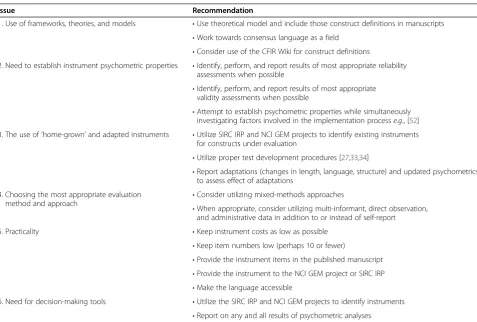
A number of instrumentation issues have been raised that potentially threaten the methodological rigor of a promising field. This debate presented specific issues in hopes of promoting careful consideration of how to limit the effect of these issues on the field. Recommendations included reporting standards, a succinct guide to instru-ment developinstru-ment, and decision aids for researchers to en-gage. Table 1 depicts a concise summary of the identified
Table 1 Overview of instrumentation issues and recommendations
Issue Recommendation
1. Use of frameworks, theories, and models •Use theoretical model and include those construct definitions in manuscripts
•Work towards consensus language as a field
•Consider use of the CFIR Wiki for construct definitions
2. Need to establish instrument psychometric properties •Identify, perform, and report results of most appropriate reliability assessments when possible
•Identify, perform, and report results of most appropriate validity assessments when possible
•Attempt to establish psychometric properties while simultaneously investigating factors involved in the implementation processe.g., [52]
3. The use of‘home-grown’and adapted instruments •Utilize SIRC IRP and NCI GEM projects to identify existing instruments for constructs under evaluation
•Utilize proper test development procedures [27,33,34]
•Report adaptations (changes in length, language, structure) and updated psychometrics to assess effect of adaptations
4. Choosing the most appropriate evaluation
method and approach •
Consider utilizing mixed-methods approaches
•When appropriate, consider utilizing multi-informant, direct observation, and administrative data in addition to or instead of self-report
5. Practicality •Keep instrument costs as low as possible
•Keep item numbers low (perhaps 10 or fewer)
•Provide the instrument items in the published manuscript
•Provide the instrument to the NCI GEM project or SIRC IRP
•Make the language accessible
6. Need for decision-making tools •Utilize the SIRC IRP and NCI GEM projects to identify instruments
•Report on any and all results of psychometric analyses
issues and recommendations. Ultimately, through this art-icle, implementation researchers might be more equipped to think critically about instrument development and administration, the factors influencing the quality of in-strumentation, the limitations and strengths of different instrumentation methods and evaluation approaches, and which instruments possess adequate psychometric properties. The fact remains that without psychomet-rically validated instruments, investigators cannot be confident that instruments measure the purported con-structs consistently. It is hoped that the recommendations provided will lead to improvements in implementation science evaluation.
Endnote
a
Interested readers can register for SIRC membership at the following webpage: http://www.societyforimple-mentationresearchcollaboration.org/.
Additional file
Additional file 1:This file contains a survey regarding instrumentation issues that was distributed to the Society for Implementation Research Collaboration (SIRC) Network of Expertise and the Association of Behavioral and Cognitive Therapies Dissemination and Implementation Science Special Interest Group (ABCT DISSIG) listservs.Additionally, information on the creation of the instrument, demographic information of the respondents, and a summary of the results are provided [2,12,15,53-68].
Abbreviations
CFIR:Consolidated framework for implementation research; EBP: Evidence-based practice; GEM: Grid-enabled measures project; NCI GEM: National cancer institute grid-enabled measures project; NIMH: National institutes of mental health; SIRC: Society for implementation research and collaboration; SIRC IRP: Society for implementation research and collaboration instrument review project.
Competing interests
The authors declare that they have no competing interests.
Authors’contributions
RGM and CCL initially conceptualized this manuscript. CCL is the Seattle Implementation Research Collaborative Implementation Review Project (SIRC IRP) PI. BJW oversees a SIRC IRP team of investigators at UNC producing findings reported throughout this manuscript. RGM trains and oversees the work of SIRC IRP investigators across sites. RGM initially drafted the manuscript in collaboration with CCL and consultation from BJW; BJW and CCL provided critical edits to the manuscript. All authors read and approved the final manuscript.
Acknowledgements
The preparation of this manuscript was supported, in kind, through the National Institutes of Health R13 award entitled,‘Development and Dissemination of Rigorous Methods for Training and Implementation of Evidence-Based Behavioral Health Treatments’granted to PI: KA Comtois from 2010–2015. Dr. Bryan J. Weiner’s time on the project was supported by the following funding: NIH CTSA at UNC UL1TR00083.
Author details 1
Department of Psychology, Virginia Commonwealth University, 806 West Franklin St., Richmond, VA 23220, USA.2Department of Psychological and Brain Sciences, Indiana University, 1101 E. 10th St., Bloomington, IN 47405, USA.3Department of Psychiatry & Behavioral Sciences, University of Washington, 1959 NE Pacific Street, Box 356560, Rm BB1644, Seattle, WA 98195-6560, USA.41102-C McGavran-Greenberg Hall, University of North Carolina at Chapel Hill, 135 Dauer Drive, Campus Box 7411, Chapel Hill 27599-7411, USA.
Received: 19 November 2013 Accepted: 26 August 2014
References
1. Siegel AE:Sidney Siegel: a memoir. InDecision and Choice, Contributions of Sidney Siegel.Edited by Messick and Brayfield. New York, NY: McGraw-Hill; 1964. 2. Proctor EK, Landsverk J, Aarons G, Chambers D, Glisson C, Mittman B:
Implementation research in mental health services: an emerging science with conceptual, methodological, and training challenges.Adm Policy Ment Health2009,36:24–34.
3. Cook DA, Beckman TJ:Current concepts in validity and reliability for psychometric instruments: theory and application.Am J Med2006, 119:166.e17–166.e16.
4. Downing SM, Haladyna TM:Test item development: validity evidence from quality assurance procedures.Appl Meas Educ1997,10:61–82. 5. Proctor EK, Brownson RC:Measurement Issues in Dissemination and
Implementation Research. InDissemination and Implementation Research in Health: Translating Science to Practice.Edited by Brownson R, Colditz G, Proctor E. New York, NY: Oxford University Press, Inc; 2012.
6. Grimshaw J, Eccles M, Thomas R, MacLennan G, Ramsay C, Fraser C, Vale L: Toward evidence based quality improvement.J Gen Intern Med2006, 21:S14–S20.
7. Achenbach TM:Advancing assessment of children and adolescents: commentary on evidence-based assessment of child and adolescent disorders.J Clin Child Adolesc2005,34:541–547.
8. Hunsley J, Mash EJ:Evidence-based assessment. InThe Oxford handbook of clinical psychology.; 2011:76–97.
9. Michie S, Fixsen D, Grimshaw JM, Eccles MP:Specifying and reporting complex behaviour change interventions: the need for a scientific method.Implement Sci2009,4:40.
10. Michie S, Johnston M, Francis J, Hardeman W, Eccles M:From theory to intervention: mapping theoretically derived behavioural determinants to behaviour change techniques.Appl Psychol2008,57:660–680.
11. Rabin BA, Brownson RC, Haire-Joshu D, Kreuter MW, Weaver NL:A glossary for dissemination and implementation research in health.J Public Health Manag Pract2008,14:117–123.
12. Tabak RG, Khoong EC, Chambers DA, Brownson RC:Bridging research and practice: models for dissemination and implementation research. Am J Prev Med2012,43:337–350.
13. Weinert CR, Mann HJ:The science of implementation: changing the practice of critical care.Curr Opin Crit Care2008,14:460–465. 14. Aarons GA, Hurlburt M, Horwitz SM:Advancing a conceptual model of
evidence-based practice implementation in public service sectors. Adm Policy Ment Health2011,38:4–23.
15. Damschroder LJ, Aron DC, Keith RE, Kirsh SR, Alexander JA, Lowery JC: Fostering implementation of health services research findings into practice: a consolidated framework for advancing implementation science.Implement Sci2009,4:50.
16. Messick S:Validity of psychological assessment: validation of inferences from persons' responses and performances as scientific inquiry into score meaning.Am Psychol1995,50:741–749.
17. Proctor EK, Silmere H, Raghavan R, Hovmand P, Aarons GA, Bunger A, Griffey R, Hensley M:Outcomes for implementation research: conceptual distinctions, measurement challenges, and research agenda. Adm Policy Ment Health2011,38:65–76.
18. Chaudoir SR, Dugan AG, Barr CHI:Measuring factors affecting
implementation of health innovations: a systematic review of structural, organizational, provider, patient, and innovation level measures. Implement Sci2013,8:22.
20. Consolidated Framework for Implementation Research (CFIR) Wiki. In http://cfirwiki.net/wiki/index.php?title=Main_Page.
21. May C:Towards a general theory of implementation.Implement Sci2013,8:18. 22. Stichter J, Conroy MA:A critical analysis of the role of measurement on
the validity of emotional and behavioral disorders (EBD) research. Behav Disorders2004,30:7–18.
23. Weiner BJ:A theory of organizational readiness for change. Implement Sci2009,4:67.
24. Chor KHB, Wisdom JP, Olin S-CS, Hoagwood KE, Horwitz SM:Measures for predictors of innovation adoption.Adm Policy Ment Health2014, 1–29. 25. Association AER:American Psychological Association, National Council on Measurement in Education: The standards for educational and psychological testing.Washington, DC: American Psychological Association; 1999. 26. Streiner DL:Starting at the beginning: an introduction to coefficient
alpha and internal consistency.J Pers Assess2003,80:99–103. 27. Walsh WB, Betz NE:Tests and assessment.Englewood Cliffs, NJ:
Prentice-Hall Inc; 1995.
28. Eyde LD, Robertson GJ, Krug SE:Responsible Test Use: Case Studies for Assessing Human Behavior.Washington, DC:
American Psychological Association; 1995.
29. Osipow SH:Developing instruments for use in counseling. J Couns Dev1991,70:322–326.
30. Kendler KS:The dappled nature of causes of psychiatric illness: replacing the organic–functional/hardware–software dichotomy with empirically based pluralism.Mol Psychiatry2012,17:377–388.
31. Glisson C, Landsverk J, Schoenwald S, Kelleher K, Hoagwood KE, Mayberg S, Green P:Assessing the organizational social context (OSC) of mental health services: Implications for research and practice.
Adm Policy Ment Health2008,35:98–113.
32. Martinez RG, Lewis CC:Instrumentation Issues in Implementation Science. In Seattle, WA: Presented at Seattle Implementation Research Conference; 2013. 33. Hinkin TR:A brief tutorial on the development of measures for use in
survey questionnaires.Organ Res Methods1998,1:104–121.
34. DeVellis RF:Scale development: Theory and applications.Thousand Oaks, CA: Sage Publications; 2011.
35. Collins D:Pretesting survey instruments: an overview of cognitive methods.Qual Life Res2003,12:229–238.
36. Palinkas LA, Aarons GA, Horwitz S, Chamberlain P, Hurlburt M, Landsverk J: Mixed method designs in implementation research.Adm Policy Ment Health2011,38:44–53.
37. Squires JE, Hutchinson AM, Boström A-M, O'Rourke HM, Cobban SJ, Estabrooks CA:To what extent do nurses use research in clinical practice? A systematic review.Implement Sci2011,6:21.
38. Podsakoff PM, MacKenzie SB, Lee J-Y, Podsakoff NP:Common method biases in behavioral research: a critical review of the literature and recommended remedies.J Appl Psychol2003,88:879–903. 39. Hofmann W, Gawronski B, Gschwendner T, Le H, Schmitt M:A
meta-analysis on the correlation between the Implicit Association Test and explicit self-report measures.Pers Soc Psychol Bull2005,31:1369–1385. 40. Greenwald AG, Poehlman TA, Uhlmann EL, Banaji MR:Understanding and
using the Implicit Association Test: III. Meta-analysis of predictive validity. J Pers Soc Psychol2009,97:17.
41. Martino S, Ball S, Nich C, Frankforter TL, Carroll KM:Correspondence of motivational enhancement treatment integrity ratings among therapists, supervisors, and observers.Psychother Res2009,19:181–193.
42. Kimberly J, Cook JM:Organizational measurement and the implementation of innovations in mental health services. Adm Policy Ment Health2008,35:11–20.
43. Dattilio FM, Edwards DJA, Fishman DB:Case studies within a mixed methods paradigm: toward a resolution of the alienation between researcher and practitioner in psychotherapy research.
Psychother Theor Res Pract Train2010,47:427–441.
44. Gaglio B, Glasgow RE:Evaluation approaches for dissemination and implementation research. InDissemination and implementation research in health: translating science to practice.Edited by Brownsone RC, Colditz GA, Proctor EK. New York, NY: Oxford University Press; 2012:327–356. 45. McLeod BD, Jensen-Doss A, Ollendick TH:Diagnostic and behavioral
assessment in children and adolescents: a clinical guide.New York, NY: The Guilford Press; 2013.
46. Stange KC, Zyzanski SJ, Smith TF, Kelly R, Langa DM, Flocke SA, Jaén CR: How valid are medical records and patient questionnaires for physician
profiling and health services research?: A comparison with direct observation of patient visits.Med Care1998,36:851–867.
47. English DJ, Brandford CC, Coghlan L:Data-based organizational change: the use of administrative data to improve child welfare programs and policy.Child Welfare2000,79:499–515.
48. Powell BJ, McMillen JC, Proctor EK, Carpenter CR, Griffey RT, Bunger AC, Glass JE, York JL:A compilation of strategies for implementing clinical innovations in health and mental health.Med Care Res Rev2012, 69:123–157.
49. Glasgow RE, Riley WT:Pragmatic measures: what they are and why we need them.Am J Prev Med2013,45:237–243.
50. Society for Implementation Research Collaboration Instrument Review Project. In http://www.societyforimplementationresearchcollaboration.org/ sirc-projects/sirc-instrument-project/.
51. National Cancer Institute Grid-Enabled Measures Project. In http://www.gem-beta.org.
52. Aarons GA:Mental health provider attitudes toward adoption of evidence-based practice: the Evidence-Based Practice Attitude Scale (EBPAS).Ment Health Serv Res2004,6:61–74.
53. Rogers EM:Diffusion of innovations.New York, NY: Simon and Schuster; 2003. 54. Kramer DM, Cole DC:Sustained, intensive engagement to promote
health and safety knowledge transfer to and utilization by workplaces. Sci Commun2003,25:56–82.
55. Jacobson N, Butterill D, Goering P:Development of a framework for knowledge translation: understanding user context.J Health Serv Res Pol2003,8:94–99. 56. Greenhalgh T, Robert G, Macfarlane F, Bate P, Kyriakidou O:Diffusion of
innovations in service organizations: Systematic review and recommendations.Milbank Q2004,82:581–629.
57. Dodson EA, Brownson RC, Weiss SW:Policy dissemination research. In Dissemination and implementation research in health: translating science to practice.Edited by Brownson RC, Colditz GA, Proctor EK. New York, NY: Oxford University Press; 2012:437–458.
58. Atun R, de Jongh T, Secci F, Ohiri K, Adeyi O:Integration of targeted health interventions into health systems: a conceptual framework for analysis.Health Policy Plan2010,25:104–111.
59. Glasgow RE, Vogt TM, Boles SM:Evaluating the public health impact of health promotion interventions: the RE-AIM framework.
Am J Public Health1999,89:1322–1327.
60. Wandersman A, Duffy J, Flaspohler P, Noonan R, Lubell K, Stillman L, Blachman M, Dunville R, Saul J:Bridging the gap between prevention research and practice: the interactive systems framework for dissemination and implementation.Am J Community Psychol2008, 41:171–181.
61. Farkas M, Anthony WA:Bridging science to service: using Rehabilitation Research and Training Center program to ensure that research-based knowledge makes a difference.J Rehabil Res Dev2007,44:879–892. 62. Damush T, Bravata D, Plue L, Woodward-Hagg H, William L:Facilitation of
Best Practices (FAB) Framework: Stroke QUERI Center Annual Report. Am J Prev Med2008,43:337–350.
63. Feldstein AC, Glasgow RE:A practical, robust implementation and sustainability model (PRISM) for integrating research findings into practice.Jt Comm J Qual Patient Saf2008,34:228–243.
64. Bowen S, Zwi AB:Pathways to‘evidence-informed’policy and practice: a framework for action.PLoS Med2005,2:e166.
65. Fixsen DL, Naoom SF, Blase KA, Friedman RM, Wallace F:Implementation research: A synthesis of the literature.Tampa, FL: University of South Florida, Louis de la Parte Florida Mental Health Institute, The National
Implementation Research Network; 2005.
66. Glisson C, Schoenwald SK:The ARC organizational and community intervention strategy for implementing evidence-based children's mental health treatments.Ment Health Serv Res2005,7:243–259. 67. Kitson A, Harvey G, McCormack B:Enabling the implementation of evidence
based practice: a conceptual framework.Qual Health Care1998,7:149–158. 68. Torrey WC, Lynde DW, Gorman P:Promoting the implementation of
practices that are supported by research: The National Implementing Evidence-Based Practice Project.Child Adolesc Psychiatr Clin N Am2005, 14:297–306.
doi:10.1186/s13012-014-0118-8
Cite this article as:Martinezet al.:Instrumentation issues in
![Bis[1 (ethoxycarbonylmethyl)pyridinium] bis(1,2 dicyanoethene 1,2 dithiolato κ2S,S′)nickelate(II)](data:image/gif;base64,R0lGODlhAQABAIAAAP///wAAACH5BAEAAAAALAAAAAABAAEAAAICRAEAOw==)