PROFILES OF REACTIVITY TO BULLYING VICTIMIZATION: GENETIC AND FAMILY ENVIRONMENT PREDICTORS
Meridith Lyn Eastman
A dissertation submitted to the faculty at the University of North Carolina at Chapel Hill in partial fulfillment of the requirements for the degree of Doctor of Philosophy in the Department
of Health Behavior in the Gillings School of Global Public Health.
Chapel Hill 2016
Approved by: Susan Ennett Robert Faris Vangie Foshee Kari North
ii ©2016
iii ABSTRACT
Meridith Lyn Eastman: Profiles of Reactivity to Bullying Victimization: Genetic and Family Environment Predictors
(Under the direction of Vangie Foshee)
This dissertation identified profiles of internalizing (anxiety and depression) and
externalizing (delinquency and violence against peers) reactivity to bullying victimization (Aim 1) and then examined the influence of bullying characteristics (type—i.e., direct, indirect, dual— and frequency) (Aim 2), family characteristics (parental warmth and family conflict) (Aim 3), and selected genetic polymorphisms (5-HTTLPR, BDNF, and MAOA) (Aim 4) on membership in these profiles. The sample for addressing Aims 1-3 was 1,196 bullying victims who participated in the Context/Linkages Study in three North Carolina counties in Fall 2003 when they were in grades 8-10. The sample for addressing Aim 4 was a subset (n=281) of bullying victims who provided a biospecimen for genotyping. Five profiles were identified using latent profile analysis (Aim 1): a non-reactive profile and four profiles that captured combinations of internalizing and externalizing. Associations between bullying type and frequency on membership in these
iv
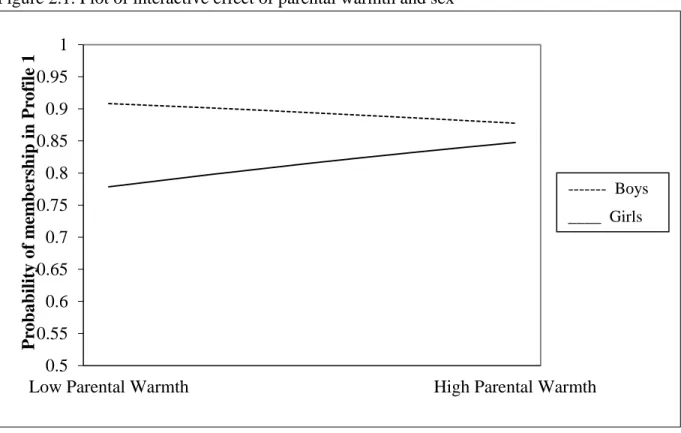
each other profile. More frequent victimization increased odds of membership in the two high internalizing reactivity profiles compared to the non-reactor profile. Aim 3 tested the stress-buffering effects of parental warmth and the exacerbating effects of family conflict using logistic regression. The effects of parental warmth were different for boys and girls, with girls
v
vi
ACKNOWLEDGEMENTS
This dissertation could not have been accomplished without the invaluable guidance and mentorship of Vangie Foshee. I am extremely grateful for the expert contributions of each of my committee members: Susan Ennett, Robert Faris, Kari North, H. Luz McNaughton Reyes, and Daniela Sotres-Alvarez. I am also appreciative of the programming and statistical technical assistance provided by Chris Wiesen at the Odum Institute. Lastly, I am grateful to friends and family, near and far, for providing social and emotional support throughout my educational journey.
vii
TABLE OF CONTENTS
LIST OF TABLES ... ix
LIST OF FIGURES ... xi
LIST OF ABBREVIATIONS ... xii
CHAPTER 1: SPECIFIC AIMS ... 1
CHAPTER 2: DEFINITION OF BULLYING VICTIMIZATION... 6
CHAPTER 3: LATENT PROFILES OF INTERNALIZING AND EXTERNALIZING REACTIVITY TO BULLYING AMONG ADOLESCENT VICTIMS (MANUSCRIPT #1) ... 7
Introduction ... 7
Method ... 13
Analytic Sample ... 14
Measures ... 15
Analysis Strategy ... 18
Results ... 21
Latent Profile Analysis of Internalizing and Externalizing Reactivity to Bullying Victimization ... 21
Analytic Sample and Reactivity Profile Descriptive Statistics ... 24
Tests of Association between Bullying Type and Frequency with Reactivity Profiles ... 27
Discussion ... 37
CHAPTER 4: FAMILY CHARACTERISTICS ASSOCIATED WITH LATENT PROFILES OF EXTERNALIZING AND INTERNALIZING AMONG ADOLESCENT VICTIMS OF BULLYING (MANUSCRIPT #2) ... 45
Introduction ... 45
Parental Warmth ... 46
Family Conflict ... 48
viii
Analytic Sample ... 50
Measures ... 51
Analysis Strategy ... 54
Results ... 57
Assessing the Buffering Effects of Parental Warmth ... 57
Assessing the Exacerbating Effects of Family Conflict ... 62
Discussion ... 66
CHAPTER 5: ASSOCIATIONS BETWEEN 5-HTTLPR, BDNF, AND MAOA GENOTYPES AND LATENT PROFILES OF INTERNALIZING AND EXTERNALIZING AMONG ADOLESCENT VICTIMS OF BULLYING (MANUSCRIPT #3) ... 71
Introduction ... 71
5-HTTLPR ... 73
BDNF ... 75
MAOA ... 77
Method ... 80
Analytic Sample ... 81
Genotyping ... 82
Measures ... 82
Analysis Strategy ... 85
Results ... 86
Associations between 5-HTTLPR Genotype and Reactivity Profile Membership ... 86
Associations between BDNF Genotype and Reactivity Profile Membership ... 87
Associations between MAOA Genotype and Reactivity Profile Membership ... 88
Discussion ... 93
CHAPTER 6: SUMMARY... 96
ix
LIST OF TABLES Table
1.1 Distributions of the trichotomized delinquency and violence
against peers scales ...16 1.2 Parameters of fit for 1-6 profile solutions for reactivity to
bullying victimization ...22 1.3 Profile prevalences, means (for internalizing reactivity), item
response probabilities (for externalizing reactivity), and classification probabilities for the 5 profiles of reactivity to
bullying victimization ...23 1.4 Distributions of bullying type and frequency across profiles ...26 1.5 Adjusted associations (OR and 95% CI) between direct
bullying victimization and reactivity profile membership ... 28 1.6 Adjusted associations(OR and 95% CI) between indirect
bullying victimization and reactivity profile membership with Profile 2 (high internalizers, moderate externalizers) as the
reference category ...29
1.7 Adjusted associations(OR and 95% CI) between indirect bullying victimization and reactivity profile with Profile 3
(high internalizing, high externalizing) as the reference category ...30
1.8 Adjusted associations(OR and 95% CI) between dual bullying
victimization and reactivity profile membership ...32
1.9 Adjusted associations(OR and 95% CI) between frequency
of bullying victimization and reactivity profile membership ...34 2.1 Results of final binary logistic regression model testing the
buffering effect of parental warmth hypotheses
(Hypotheses 1 and 2) ...58 2.2 Results of multinomial logistic regression testing the
buffering effect of parental warmth for girls (n=715) ...61 2.3 Results of final binary logistic regression model testing the
exacerbating effect of family conflict hypotheses
x
2.4 Results of multinomial logistic regression testing the exacerbating effect of family conflict ...65 3.1 Binary logistic regression (OR and 95% CI) of reactivity profile
membership on 5-HTTLPR genotype ...87 3.2 Binary logistic regression (OR and 95% CI) of reactivity profile
membership on BDNF genotype ...88 3.3 Binary logistic regression (OR and 95% CI) of reactivity profile
membership on MAOA genotype ...88 3.4 Results of Chi-Square Test for distribution of short alleles
of 5-HTTLPR by bullying victimization reactivity profile ...89 3.5 Results of Chi-Square Test for distribution of Met alleles
of BDNF by bullying victimization reactivity profile...89 3.6 Results of Chi-Square Test for distribution low-activity MAOA
alleles by bullying victimization reactivity profile ...90 3.7 Results of Chi-Square Test for distribution of short alleles
of 5-HTTLPR by dichotomized bullying victimization reactivity
profile ...90 3.8 Results of Chi-Square Test for distribution of Met alleles
of BDNF by dichotomized bullying victimization reactivity
profile ...91 3.9 Results of Chi-Square Test for distribution of low-activity alleles
of MAOA by dichotomized bullying victimization reactivity profile ...91 3.10 Binary logistic regression (OR and 95% CI) of membership in
the high internalizing profiles on additive 5-HTTLPR and BDNF
putative allele scale ...92 3.11 Binary logistic regression (OR and 95% CI) of membership
in any reactivity profile on additive 5-HTTLPR,BDNF,
xi
LIST OF FIGURES Figure
xii
LIST OF ABBREVIATIONS 5-HTTLPR Serotonin transporter linked polymorphic region BDNF Brain derived neurotrophic factor
fMRI Functional magnetic resonance imaging LPA Latent profile analysis
MAOA Monoamine oxidase-A
SCT Social Cognitive Theory
1
CHAPTER 1: SPECIFIC AIMS
Although often experienced in childhood and adolescence, bullying has far-reaching consequences that extend across the life course. Approximately 11% of US school children in grades 6-10have been victims of bullying (Nansel et al., 2001) and between 20-40% of children experience bullying at least once during their school careers (Shetgiri, Lin, & Flores, 2013). Numerous studies have found that bullying victimization has negative effects in
childhood and adolescence and, furthermore, evidence suggests that victims of bullying are at heightened risk for psychological maladjustment in adulthood (Arseneault, Bowes, & Shakoor, 2010; Copeland, Wolke, Angold, & Costello, 2013; Hawker & Boulton, 2000; Menard, 2002). Not all bullying victims, however, respond to bullying in the same way (Arseneault, Bowes, & Shakoor, 2010). For some, victimization may result in internalization; others may experience externalizing problems. Another set of victims may experience both simultaneously (Arseneault, Bowes, & Shakoor, 2010). These findings suggest that there are different typologies, or profiles, of reactivity to victimization. The purposes of this dissertation were to 1) identify profiles of reactivity to bullying victimization and 2) examine predictors of reactivity profile membership.
2
determine the number of subpopulations—or profiles—that exist for a given set of outcomes, with what probability each individual is in each profile, and determine which variables most strongly predict profile membership (Collins & Lanza, 2010). Further, the use of LPA allows researchers to consider multiple outcomes simultaneously in the identification of profiles. In this study, reactivity profiles that reflect internalizing and externalizing responses were identified. The predictors of reactivity profiles membership that were examined in this dissertation were characteristics of the bullying victimization, aspects of the victim’s family environment, and the victim’s genotype for a select group of genes that have been found to influence reactivity to peer rejection and exclusion.
Characteristics of the bullying victimization were examined as predictors of reactivity profile membership because previous research suggests that reactivity to being bullied may vary depending on the type of bullying experienced--direct or indirect--and on the frequency of the bullying. Direct bullying may include physical acts of aggression but also name calling—
anything that requires a face-to-face interaction—whereas indirect consists of spreading rumors, attempts at social exclusion, and talking behind the victim’s back (Arseneault, Bowes, &
3
This dissertation also examined the influence of family warmth and family conflict as predictors of reactivity profile membership. Previous work by Bowes and colleagues identified the importance of family warmth in minimizing internalizing responses to childhood bullying victimization (Bowes, Maughan, Caspi, Moffitt, & Arseneault, 2010). In a 2013 study on adolescent victims of frequently bullying, Sapouna and Wolke (2013) found that victims who reported low levels of family conflict were among the most resilient, reporting low levels of depression and delinquency (Sapouna & Wolke, 2013). No study, however, has examined the role of the family context in explaining patterns of reactivity among victims of bullying.
Studies also suggest that biological factors, such as one’s genotype, may influence
reactivity to bullying (Beaver, Mancini, DeLisi, & Vaughn, 2011). Several genes, including 5-HTTLPR, BDNF, and MAOA have been found to influence sensitivity to peer rejection and peer exclusion. Eisenberger and colleagues (2007) conducted a study that simulated social exclusion (via a game of “cyberball”) while comparing brain activity to participants’ self-reported social distress (Eisenberger, Way, Taylor, Welch, & Lieberman, 2007). fMRI data showed that areas of the amygdala and dorsal anterior cingulate cortex that correspond to self-reported social
4
allele of the Val66Met polymorphism being more likely to experience depression following a stressful life event (Hosang, Shiles, Tansey, McGuffin, & Uher, 2014).
In summary, this dissertation addressed the following specific research aims:
Aim 1) Identify profiles of reactivity to bullying victimization in a sample of adolescents who have been victims of bullying;
Aim 2) Quantify the influence of bullying characteristics (type and frequency) on reactivity profile membership;
Aim 3) Quantify the influence of the family environment (parental warmth and family conflict) on reactivity profile membership; and
Aim 4) Quantify the influence of genotype (5-HTTLPR, BDNF, and MAOA) on reactivity profile membership.
Data for addressing Aims 1-3 of this dissertation were from a seven-wave longitudinal study of adolescent health risk behaviors (the Context/Linkages Study). The analytic sample consisted of 1,196 adolescents who reported that they had been victims of bullying in the Fall 2003 study questionnaire. The sample for Aim 4 consisted of 281 adolescents who reported that they had been victims of bullying in the Fall 2003 study questionnaire and who also provided genotyped biospecimens in a follow up study (the Genes in Context Study).
Three manuscripts were prepared for the dissertation. Manuscript 1 identified reactivity profiles and examined associations between characteristics of bullying and the reactivity profiles. Manuscript 2 examined associations between family characteristics and reactivity profile
5
discusses the definition of victims of bullying. Chapters 3-5 consist of the three manuscripts. Chapter 6 provides an overall summary and conclusions.
6
CHAPTER 2: DEFINITION OF BULLYING VICTIMIZATION
One of the most common definitions of bullying used in the literature is that of Dan Olweus, developed in 1978 (Olweus, 1978). Olweus distinguishes bullying from other forms of aggression because bullying 1) occurs between individuals of the same age group; 2) is
characterized by an imbalance of power between the aggressor and the victim; and 3) occurs over a period of time (Olweus, 1978). The first part of this definition attempts to distinguish bullying from child maltreatment, which is when an adult acts aggressively toward a child. The second part of the definition highlights the difference between bullying and fighting that may occur in the context of a friendship or other more ‘equal’ peer relationship. The third
7
CHAPTER 3: LATENT PROFILES OF INTERNALIZING AND EXTERNALIZING REACTIVITY TO BULLYING AMONG ADOLESCENT VICTIMS (MANUSCRIPT #1)
Introduction
Bullying is a pervasive public health problem. Between 20-40% of children experience bullying at least once during their school careers (Shetgiri, Lin & Flores, 2013), and
approximately 11% of US school children in grades 6-10have been a victim of bullying (Nansel et al., 2001). The past 20 years have exhibited a change in how researchers and the general public view bullying (Piquero, Connell, Piquero, Farrington, & Jennings, 2013). Experiencing bullying was once considered a normal part of growing up, a rite of passage to be endured (Adams & Lawrence, 2011). However, media attention about suicides and acts of school
violence, such as shootings at Columbine High School and Virginia Tech, which were attributed to retaliation for bullying, has called into question long-held lassez-faire attitudes about bullying (Dukes, Stein, & Zane, 2009). In response, educators, mental health practitioners, and
researchers have increased their focus on understanding the negative impact that bullying can have on its victims. This study focused on identifying variation in reactivity to bullying and examined bullying characteristics associated with that variation. The term “reactivity” is being used based on longitudinal studies that have found that bullying victimization predicts the internalizing and externalizing attributes examined in this dissertation; however, longitudinal data needed to test for reactivity are not used in the present study.
8
for psychological maladjustment in adulthood (Arseneault, Bowes, & Shakoor, 2010; Copeland, Wolke, Angold, & Costello, 2013; Hawker & Boulton, 2000; Menard, 2002). Not all bullying victims, however, respond to bullying in the same way (Arseneault, et al., 2010). For some, being bullied may result in internalizing problems (i.e., those that are harmful to self). These negative impacts include a range of deleterious mental health conditions including heightened social isolation, depression, and anxiety (Forero, McLellan, Rissel, & Bauman, 1999; Hawker & Boulton, 2000; Kaltiala-Heino, Rimpelä, Rantanen, & Rimpelä, 2000; Karatzias, Power, & Swanson, 2002; Nansel et al., 2001; Veenstra et al., 2005; Wolke, Woods, Bloomfield, & Karstadt, 2001).
Others may experience externalizing sequelae (i.e., those that are harmful to others) of bullying victimization. These include violent behavior towards others, carrying a weapon (Arseneault, Walsh, Trzesniewski, Newcombe, Caspi, Moffit, 2006; Kim, Leventhal, Koh, Hubbard, & Boyce, 2006; Liang, Flisher, & Lombard, 2007; Nansel, Overpeck, Haynie, Ruan, & Scheidt, 2003), and becoming a perpetrator of bullying behaviors (Barker, Arseneault, Brendgan, Fontain, & Maughan, 2008). Notably, in a sample of 3,932 adolescents in the Edinburgh Study of Youth Transitions and Crime, Barker et al. (2008) found that, in mid-adolescence,
victimization increased the likelihood of bullying perpetration to a greater extent than bullying perpetration increased the likelihood of victimization (Barker, et al., 2008). This longitudinal study suggests that among bully/victims (i.e., students that are both bullies and victims of bullying), bullying perpetration is a response to victimization, rather than the other way around.
Another set of victims may experience both types of sequelae simultaneously
9
twofold increased likelihood of depressive symptoms as well as increased likelihood of carrying a weapon, theft, and violent behavior in grade 11 (Hemphill et al., 2011). Similarly, in a cross-sectional study, Hampel et al (2009), measured antisocial behavior and anger control problems (externalizing) and distress and negative self-appraisal (internalizing) among 6-9th graders and found that victims experienced these outcomes (i.e., internalizing and externalizing) concurrently (Hampel, Manhal, & Hayer, 2009).
This variation in response to bullying victimization suggests that there may be different typologies, or profiles, of reactivity to victimization. Many studies examining the consequences of bullying victimization focus on either internalizing or externalizing responses. Such variable-centered approaches that focus on a single outcome ignore underlying heterogeneity in reactivity to bullying victimization and exclude complex reactions that incorporate internalizing and externalizing elements. By grouping individuals into categories based on similarity with one another and differences from those in other categories, person-centered approaches such as latent profile analysis can unmask this underlying heterogeneity to reveal group differences in patterns of responses to bullying (Muthén & Muthén, 2000; Laursen & Hoff, 2006). The first aim of this study was to determine whether there are different profiles of reactivity to bullying in a sample of adolescents who have been victims of bullying based on patterns of responses across a range of indicators of internalizing and externalizing behaviors.
LPA is a type of mixture modeling, a set of statistical models that assumes that
10
In this study, we examined profiles of reactivity that emerged when examining two internalizing outcomes (anxiety and depression) and two externalizing outcomes (delinquency and physical violence against peers) among a sample of 8th-10th graders who self-identified as being a victim of bullying. Based on extant literature on varying responses to bullying we hypothesized
(Hypothesis 1) that four profiles would be identified through LPA: one profile high on internalizing and low on externalizing, one profile low on internalizing and high on
externalizing, one profile high on both internalizing and externalizing, and one profile low on both internalizing and externalizing.
Studies that have examined the influence of bullying victimization on different internalizing and externalizing outcomes have found that consequences differ depending on characteristics of victimization, including type of bullying experienced and frequency of victimization. The second aim of this study was to determine if characteristics of the bullying victimization (type and frequency) are associated with membership in reactivity profiles.
11
Wolke, 2012). Although this study uses the terms direct and indirect to indicate the types of bullying examined, in the review of the literature that follows, we use the language of the respective study authors to summarize their findings about bullying type and internalizing and externalizing sequelae.
The relationship between bullying type and internalizing and externalizing outcomes was examined in a cross-sectional study of 6-9th graders in which Hampel et al. (2009) found that direct bullying victimization was more strongly associated with antisocial behavior and anger control problems, whereas indirect victimization was more strongly associated with emotional distress and negative self-image (Hampel et al.,2009). In a predominately African American sample of 8th graders, Sullivan and colleagues (2006), found that physical victimization was significantly related to perpetration of bullying and delinquent behaviors, whereas relational victimization was more strongly related to perpetration of relational bullying. Both associations were stronger for boys than girls (Sullivan, Farrell, & Kliewer, 2006). In a final example using a sample of 9th graders, Storch and colleagues (2005), found that relational victimization—but not overt victimization—predicted social phobia in both genders one year following victimization (Storch, Masia‐Warner, Crisp, & Klein, 2005). These studies suggest that type of bullying experienced plays a role in the type of internalizing and/or externalizing response displayed by the victim. The present study examined whether experiencing direct bullying (physical and verbal overt forms of bullying), indirect bullying (actions to harm social relationships), or dual victimization (i.e., both direct and indirect) were associated with reactivity profile membership.
We hypothesized (Hypothesis 2) that adolescents who experienced any direct
12
hypothesis is supported by the empirical literature summarized above, but also by Social Cognitive Theory (SCT) (Bandura, 1986). SCT posits that individuals model behavior they witness and experience in their social contexts. If an adolescent experiences direct bullying, SCT suggests that he/she may copy this behavior and respond by victimizing his/her peers or by externalizing in some other way. In contrast, we hypothesized (Hypothesis 3) that adolescents who experienced any indirect victimization would have greater likelihood of membership in profiles characterized by high internalizing reactivity than in profiles characterized by low internalizing reactivity. This hypothesis is rooted in the empirical literature cited above, but also reflects the subtlenature of indirect bullying. Because the harm against the victim is perpetrated not via direct attack, but rather through manipulation of social relationships, an effective external target for response may be difficult to identify. Direct confrontation with the perpetrator, for example, would not necessarily be effective in extinguishing a socially harmful rumor. Without an effective external target, frustrated victims may internalize the experience, leading to
depression and anxiety. Further, we hypothesized (Hypothesis 4) that adolescents who experienced dual victimization would have greater likelihood of membership in the profile characterized by high internalizing and high externalizing than in the other profiles, thereby exhibiting characteristics of victims of both direct and indirect bullying.
13
Klomek and colleagues (2009) found in a mixed-gender sample of 9-12 graders in New York State, that the more frequent involvement in bullying (either as a victim or a perpetrator; no distinction made between bullying types), the more likely an individual was to be depressed, to have serious suicide ideation, or to have attempted suicide (Klomek et al., 2009). Champion and Clay (2007) also found that more frequently victimized children responded to victimization (overt and relational victimization analyzed together) with more intense feelings of anger, more motivation to retaliate, less motivation to improve the situation, and more frequent intentions to aggress in a sample of Midwestern 4-6 graders (Champion & Clay, 2007). Taken together, these studies suggest that greater frequency of victimization has the potential to intensify the
victimization experience regardless of bullying type, therefore intensifying both internalizing and externalizing reactivity among victims. We hypothesized (Hypothesis 5) that greater frequency of victimization would be associated with greater likelihood of membership in the higher reactivity profiles than in the non-reactive profile.
As noted above, sex differences have been observed in reactivity to bullying
victimization. Therefore the third aim of this study was to examine whether the hypothesized associations between bullying type and frequency and reactivity profiles varied by sex of the victim.
Method
14
expulsion (1-4 students per wave). Response rates in this study were high, ranging from 89% at wave 1 to 73% at wave 7. Parents had the opportunity to refuse consent for their child’s
participation by returning a written form or by calling a telephone number. Trained data
collectors administered the questionnaires in classrooms. Assent was obtained from adolescents immediately prior to the survey administration from students whose parents had consented. The Institutional Review Board for the University of North Carolina at Chapel Hill approved the study.
Analytic Sample
The current study used the fourth wave of data, which was collected from the adolescents in Fall 2003, when they were in grades 8 to 10. This wave of data was used for the current analyses because assessments of bullying were introduced at this wave and the greatest number of students reported being a victim of bullying during this wave, thereby maximizing sample size for the present study. Despite the availability longitudinal data, use of multiple waves (e.g., victimization status at wave 4 to create profiles of internalizing and externalizing at wave 5) would not capture a full history of victimization—only victimization in the prior 3 months could be used in developing profiles. Additionally, latent profile analysis does not allow for the
controlling of prior waves’ levels of internalizing and externalizing. Therefore, wave 4 was used for the cross-sectional latent profile analysis. A total of 5,017 adolescents, from 8 middle schools, 2 K-8 schools, 3 alternative schools, and 6 high schools (19 schools total), completed the wave 4 questionnaire (79.1% of those eligible). At the time of the questionnaire
administration, data collectors provided each student with a Student Directory that alphabetically listed enrolled students along with a unique four-digit peer identification number for each
15
up to five peers who had been mean to them or who had picked on them in the past 3 months (i.e., bullied them). The analytic sample for the current study was limited to the 1,196
adolescents (23.8% of those who completed questionnaires) who indicated that any school peer had bullied them. The sample was 59.8% female. 56.9% reported their race as White, 27.5% Black or African-American, 4.1% Hispanic or Latino, 2.4% American Indian or Native
American, 1.3% Asian or Pacific Islander, 4.7% Multiracial (mixed race), and 1.7% Other (total 41.7% Non-white).
Measures
Indicators for Latent Profile Analysis.
Internalizing.Internalizing symptoms were assessed with items from the Revised Children’s Manifest Anxiety Scale (Reynolds & Richmond, 1979) and the Short Mood and Feelings Questionnaire (Angold, Costello, Messer, & Pickles, 1995). Four items from the Revised Children’s Manifest Anxiety Scale assessed anxiety (e.g., “I worried about what was going to happen” and “I worried when I went to bed at night”) within the past three months and
four items from the Short Mood and Feelings Questionnaire assessed feelings of depression (e.g., “I did everything wrong” and “I was tired a lot”). Responses ranged from 0 (“strongly disagree”) to 4 (“strongly agree”). Responses for the four anxiety items were summed to create the anxiety score (alpha =.86, M=8.34, SD=4.95, range=0-16); responses for the four depression items were summed to create the depression score (alpha = .86, M=6.47, SD=4.96, range=0-16). The distribution of both of these internalizing indicators was approximately normal; no
transformation of these variables was required for analysis.
16
with which the respondent skipped school, damaged property, threatened a teacher, or threatened someone with a weapon (Farrell, Kung, White, & Valois, 2000). Response options were:
0=none; 1=1-2 times; 2=3-5 times; 3=6-9 times; and 4=10 times or more. Responses to these items were summed to create a composite delinquent behaviors score (alpha=.80, M=1.16, SD=2.77, range=0-16). Physical violence against peers was measured with six items that captured how often in the past 3 months the respondent pushed, grabbed, shoved, or kicked a peer; slapped or scratched a peer; twisted a peer’s arm or bent back a peer’s fingers; hit a peer with a fist or with something else hard; beat up a peer; or assaulted a peer with a knife. Response options were: 0=none; 1=1-2 times; 2=3-5 times; 3=6-9 times; and 4=10 times or more. These six items were summed to create a composite physical violence against peers score
(alpha=0.88, M=1.93, SD=4.18, range=0-24). The distributions of these two externalizing indicators were heavily right-skewed, violating the assumption of normality required for LPA. Thus, each of these externalizing outcomes was trichotomized after reviewing univariate statistics such that 0=none, 1=some, and 2=a lot of externalization. Cutoffs for the categories were based on univariate statistics so that the “a lot” category captured individuals at
approximately the 90th percentile for the outcome and above, the “none” category consisted of individuals reporting no externalization, and individuals with scores between 0 and the
approximate 90th percentile cutoff fell into the “some” category. Table 1.1 shows the composite score ranges and the percentile cutoffs for each of the three categories of each variable, as well as the number of adolescents in each category of each variable.
Table 1.1 Distributions of the trichotomized delinquency and violence against peers scales
Score range Percentile N
Delinquency
None 0 0-63rd 775
Some 1-2 64th -88th 283
17
Score range Percentile N
Violence against peers
None 0 0-60th 753
Some 2-4 61th-88th 313
A lot 5-24 89th-100th 130
Bullying Characteristics
Bullying type. Adolescents were asked to indicate whether each student that they
nominated as someone who had been mean to them or who picked on them in the past 3 months had “physically attack[ed] you in any way (hitting, shoving, tripping)?”, “ma[de] fun of you or call[ed] you names to your face,” and or “talk[ed] badly about you behind your back or tr[ied] to get others not to be friends with you”. A dichotomous direct bullying type variable was created such that 1 indicated that a peer had physically attacked them in some way or made fun of them or called them names to their face and 0 indicated that a peer had not done these things to them. A dichotomous indirect bullying type variable was created such that 1 indicated that a peer had talked badly about them behind their back or tried to get others not to be friends with them and 0 indicated that a peer had not done these things to them. A dichotomous dual
victimization type variable was created where 1 indicated that the adolescent was both directly and indirectly bullied and 0 indicated that the adolescent experienced only one type of
victimization (either direct or indirect).
Bullying frequency. Each respondent was asked to indicate the frequency with which
18 Control Variables
To control for potential confounding effects, control variables used in analyses assessing associations between the bullying characteristics and reactivity profiles were respondent race, grade in school, and parental education. Respondent race was coded as 0=White, 1=Non-white, where non-white represented Black or African-American, Hispanic or Latino, American Indian or Native American, Asian or Pacific Islander, Multiracial (mixed race), and Other. The grade variable captured whether the student was in grade 8, 9, or 10 at the time of the assessment. Parental education was coded as 0=Did not graduate from high school, 1= Graduated from high school, 2=Some college or tech school, 3=Graduated from community college or tech school, 4= Graduated from college, 5=Graduate or professional school. Sex was treated as a moderator variable and was coded female=0, male=1.
Analysis Strategy
The analytic approach undertaken consisted of three major steps. First, latent profile analysis was conducted to identify the profilesof reactivity to bullying from anxiety, depression, delinquency, and physical violence against peers and to assign participants to profiles based on the highest probability of membership. The latent profile analysis was conducted in Mplus 7 using the expectation maximization algorithm with the robust maximum likelihood (MLR) estimator for the indicators of anxiety, depression, delinquency, and physical violence against peers. In these analyses, missing data were handled using full information maximum likelihood (FIML). 9.8% of observations were missing on anxiety, 10.3% on depression, 4.1% on
19
models: Akaike Information Criterion (AIC), Bayesian Information Criterion (BIC),
bootstrapped likelihood ratio test (BLRT), and entropy. AIC (Akaike, 1974) and BIC (Schwarz, 1978) are relative fit statistics where lower numbers indicate improved model fit as compared to higher numbers. These statistics are based upon the log likelihood—the logarithm of the
likelihood ratio--which expresses how many times more likely the data fit under a k profile model than a k-1 profile model. The p value for the bootstrapped likelihood ratio test (BLRT; McLachlan & Peel, 2000) represents the results of a test that assesses whether a model of k profiles represents a better fit for the data than a model of k-1 profiles. P values of <.05 indicate that the k profile model better suits the data than a model of k-1 profiles. Lastly, entropy is a criterion that measures classification certainty and can range from 0-1 (Celeux & Soromenho, 1996). Higher values indicate that profiles have good separation; that is, that profiles are more distinct from one another. An entropy value of .80 represents good separation between the profiles (Ramaswamy et al., 1993). After the number and nature of the reactivity profiles were identified, individuals were assigned to their most likely profile based on their vector of posterior probabilities (that is, the set of values describing the likelihood of being assigned to that profile, given the data). Profile membership was subsequently used as the outcome in multinomial logistic regression models, described further below in step three, to quantify the association between type (direct, indirect, or dual) and frequency of bullying victimization and profile membership.
20
multiple comparisons of proportions developed by Zar (1999) were conducted using the
compprop macro written by Elliott and Reisch (2006). One-way analysis of variance (ANOVA) tested for significant differences in mean levels of bullying frequency across identified reactivity profiles. Tukey’s test was used to identify significant differences in mean levels of frequency between each reactivity profile. Listwise deletion was used so that only observations with complete data on bullying characteristics were included in the analysis.
The third step in the analysis was to conduct a series of multinomial logistic regressions using SAS v9.4 to test the hypotheses related to associations between bullying type (direct, indirect, or dual) and frequency with reactivity profile membership and whether these
associations differed by sex. Note that type and frequency were not tested in the same models due to multicollinearity and also because models required different comparison groups depending upon the hypothesis being tested. We first tested for significance of the interactive effects of sex and bullying characteristics (direct, indirect, dual, and frequency) on reactivity profile membership. In all cases, interactions were found to be non-significant; therefore, interaction terms were dropped from subsequent models. We then tested for main effects of bullying characteristics and sex on reactivity profile membership controlling for the demographic characteristics. Rather than selecting a single reference category (i.e., the reactivity profile used for comparison) for all models, such as the largest profile, for example, the reference category for the logistic regression models necessarily varied according to the hypothesis being tested (see Results). In all cases, resulting odds ratios represent the likelihood of membership in each profile relative to the specified reference category.
21
regression models fit on the imputed datasets. 18.1% of observations were missing on parental education, 9.1% were missing on race, and 3.5% were missing on bullying frequency. There were no missing data on gender, grade, bullying type, or latent profile. The multiple imputation models included all variables (including interactions) that were included in the logistic regression models as recommended by Allison (2002). With the exception of the nominal variable
representing the latent profile, all variables in the multiple imputation models were quantitative in nature (either binary, ordered categorical, or continuous). Dummy variables representing each level of the nominal latent profile variable were created to ensure that the imputation procedure appropriately recognized the latent profiles as categorical. Minimum and maximum values were specified to ensure that plausible values were imputed for all variables. Twenty imputations were run based on recommendations by Graham and colleagues (2007).
Results
Latent Profile Analysis of Internalizing and Externalizing Reactivity to Bullying Victimization
22
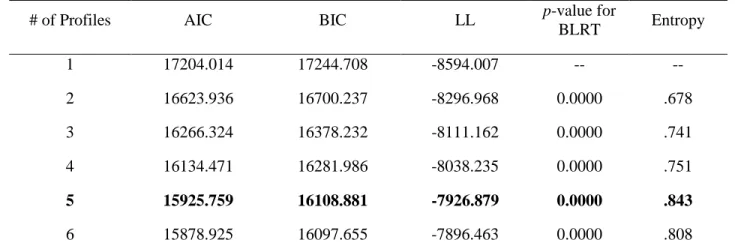
distinctions because it produced multiple profiles with very similar moderate amounts of internalizing and externalizing reactivity. Taking together the parameters of fit and these
conceptual considerations, the five-profile model was determined to be the best representation of the data, rather than the four profiles that we hypothesized.
Table 1.2 Parameters of fit for 1-6 profile solutions for reactivity to bullying victimization
# of Profiles AIC BIC LL p-value for
BLRT Entropy
1 17204.014 17244.708 -8594.007 -- --
2 16623.936 16700.237 -8296.968 0.0000 .678
3 16266.324 16378.232 -8111.162 0.0000 .741
4 16134.471 16281.986 -8038.235 0.0000 .751
5 15925.759 16108.881 -7926.879 0.0000 .843
6 15878.925 16097.655 -7896.463 0.0000 .808
AIC=Aikake Information Criterion; BIC=Bayesian Information Criterion; LL=log likelihood; BLRT=Bootstrap Likelihood Ratio Test
Note: Best fitting model in bold
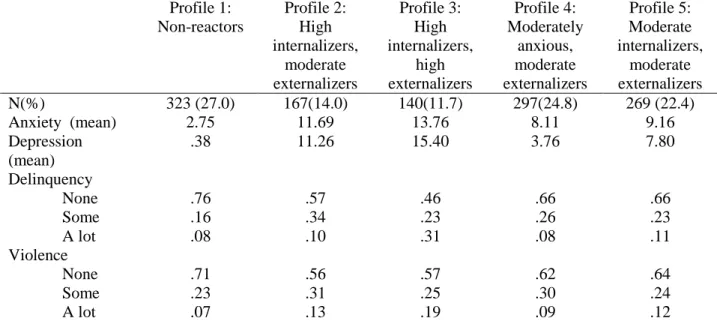
The five profiles showed distinct characteristics (See Table 1.3). Profile 1, named the “non-reactors,” consisting of 27% of the sample, had the lowest mean levels of anxiety (M=2.75) and depression (M=0.38), and its members had the greatest probability of reporting no
externalizing behaviors (76% reported no delinquency and 71% reported no violence). Profile 2, comprising 14% of the sample, consisted of adolescents reporting high levels of anxiety
23
(0.31) and violence against peers (0.19). Profile 3, therefore, was named the “high internalizers, high externalizers”. Probabilities of reporting “some” externalizing behaviors for this profile were 0.23 for delinquency and 0.19 for violence against peers. Profile 4 was the second largest profile, consisting of 24.8% of the sample. This profile showed moderately high levels of anxiety (M=8.11), yet comparatively low levels of depression (M=3.76). These adolescents, the
“moderately anxious, moderate externalizers”, had medium probabilities of reporting “some” delinquency and violence against peers (0.26 and 0.30, respectively) and low probabilities of reporting “a lot” of externalizing behaviors (0.08 for delinquency and 0.09 for violence against peers). Lastly, Profile 5 consisted of 22.4% of the sample and reflects internalizing scores that are in the middle when compared to other profiles (anxiety M=9.16; depression M=7.80) and levels of externalizing behaviors similar to Profile 4. These “moderate internalizers, moderate externalizers” reported medium mean levels of depression and anxiety (M =7.80 and 9.16, respectively) and medium probabilities of reporting “some” and “a lot” of delinquency and violence against peers (0.11 and 0.23 for delinquency; 0.12 and .24 for violence against peers). Table 1.3 Profile prevalences, means (for internalizing reactivity), item response probabilities (for externalizing reactivity), and classification probabilities for the 5 profiles of reactivity to bullying victimization Profile 1: Non-reactors Profile 2: High internalizers, moderate externalizers Profile 3: High internalizers, high externalizers Profile 4: Moderately anxious, moderate externalizers Profile 5: Moderate internalizers, moderate externalizers
N(%) 323 (27.0) 167(14.0) 140(11.7) 297(24.8) 269 (22.4)
Anxiety (mean) 2.75 11.69 13.76 8.11 9.16
Depression (mean)
.38 11.26 15.40 3.76 7.80
Delinquency
None .76 .57 .46 .66 .66
Some .16 .34 .23 .26 .23
A lot .08 .10 .31 .08 .11
Violence
None .71 .56 .57 .62 .64
Some .23 .31 .25 .30 .24
24 Profile 1: Non-reactors Profile 2: High internalizers, moderate externalizers Profile 3: High internalizers, high externalizers Profile 4: Moderately anxious, moderate externalizers Profile 5: Moderate internalizers, moderate externalizers Classification probability
.95 .88 .92 .86 .86
Analytic Sample and Reactivity Profile Descriptive Statistics
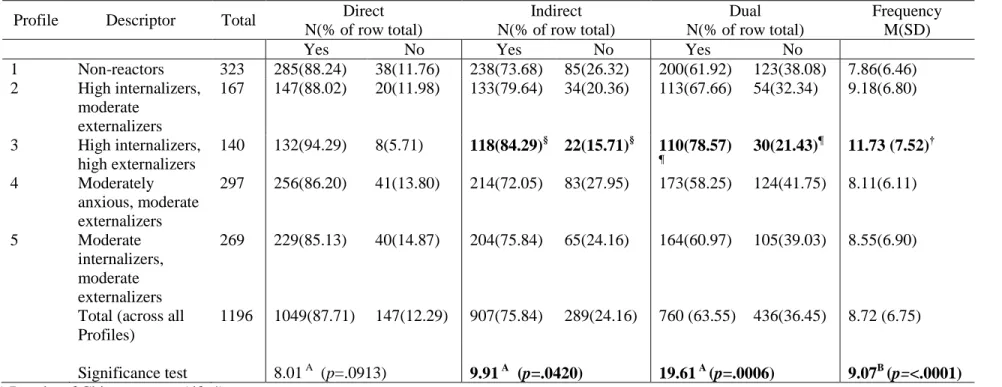
Results from the bivariate descriptive statistics indicated that indirect victimization (Χ2(4, N=1196)=9.91, p=.0420), dual victimization (Χ2(4, N=1196)=19.61, p=.0006), and frequency of victimization (F(4,1149)=9.07, p=<.0001) were significantly associated with membership profile, whereas direct bullying was not associated with reactivity profile (Χ2(4, N=1196)=8.01, p=.0913) (See Table 1.4).
The post hoc Tukey-type test for pairwise comparisons indicated that the proportion of those in Profile 3 (high internalizers, high externalizers) who experienced indirect bullying (84.29%) was significantly higher than the proportion of those in Profile 1 (non-reactors) (74.68%) and in Profile 4 (moderately anxious, moderate externalizers) (72.05%) who
experienced indirect bullying. No other differences in proportions experiencing indirect bullying were significant.
25
Table 1.4. Distributions of bullying type and frequency across profiles Profile Descriptor Total Direct
N(% of row total)
Indirect N(% of row total)
Dual N(% of row total)
Frequency M(SD)
Yes No Yes No Yes No
1 Non-reactors 323 285(88.24) 38(11.76) 238(73.68) 85(26.32) 200(61.92) 123(38.08) 7.86(6.46) 2 High internalizers,
moderate externalizers
167 147(88.02) 20(11.98) 133(79.64) 34(20.36) 113(67.66) 54(32.34) 9.18(6.80)
3 High internalizers, high externalizers
140 132(94.29) 8(5.71) 118(84.29)§ 22(15.71)§ 110(78.57)
¶
30(21.43)¶ 11.73 (7.52)†
4 Moderately anxious, moderate externalizers
297 256(86.20) 41(13.80) 214(72.05) 83(27.95) 173(58.25) 124(41.75) 8.11(6.11)
5 Moderate internalizers, moderate externalizers
269 229(85.13) 40(14.87) 204(75.84) 65(24.16) 164(60.97) 105(39.03) 8.55(6.90)
Total (across all Profiles)
1196 1049(87.71) 147(12.29) 907(75.84) 289(24.16) 760 (63.55) 436(36.45) 8.72 (6.75)
Significance test 8.01 A (p=.0913) 9.91 A (p=.0420) 19.61 A (p=.0006) 9.07B (p=<.0001)
A Results of Chi square test (df=4) B Results of ANOVA F test (df=4,1149)
† Tukey’s test indicated significantly higher mean than all other Profiles, alpha=0.05
§ Post hoc Tukey-type test indicated significant difference of proportions between Profile 3 vs. Profile 1 and 4 ¶ Post hoc Tukey-type test indicated significant difference of proportions between Profile 3 vs. Profile 1, 4, and 5
27
Tests of Hypothesized Associations between Bullying Type and Frequency with Reactivity Profiles
Direct victimization. Our first set of multinomial logistic regression models tested Hypothesis 2 that adolescents who experienced any direct victimization would have a greater likelihood of membership in profiles characterized by high externalizing reactivity than in profiles not characterized by high externalizing reactivity. Reflecting the LPA results, this hypothesis required comparing Profile 3 (high internalizers, high externalizers) against each of the other profiles. Profile 3, therefore, was used as the reference category in the multinomial logistic regression models testing hypothesis 2.
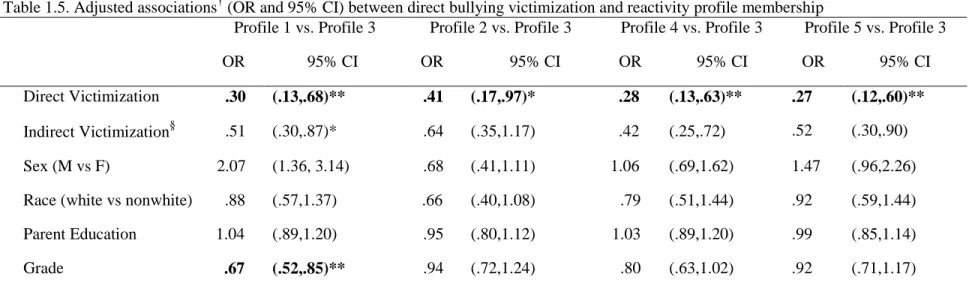
Table 1.5 displays the results of the test of association between direct bullying victimization and reactivity profile membership, adjusting for demographic variables and
Table 1.5. Adjusted associations† (OR and 95% CI) between direct bullying victimization and reactivity profile membership
Profile 1 vs. Profile 3 Profile 2 vs. Profile 3 Profile 4 vs. Profile 3 Profile 5 vs. Profile 3
OR 95% CI OR 95% CI OR 95% CI OR 95% CI
Direct Victimization .30 (.13,.68)** .41 (.17,.97)* .28 (.13,.63)** .27 (.12,.60)**
Indirect Victimization§ .51 (.30,.87)* .64 (.35,1.17) .42 (.25,.72) .52 (.30,.90) Sex (M vs F) 2.07 (1.36, 3.14) .68 (.41,1.11) 1.06 (.69,1.62) 1.47 (.96,2.26) Race (white vs nonwhite) .88 (.57,1.37) .66 (.40,1.08) .79 (.51,1.44) .92 (.59,1.44) Parent Education 1.04 (.89,1.20) .95 (.80,1.12) 1.03 (.89,1.20) .99 (.85,1.14)
Grade .67 (.52,.85)** .94 (.72,1.24) .80 (.63,1.02) .92 (.71,1.17)
Note: Profile 1= Non-reactors; Profile 2= High internalizers, moderate externalizers; Profile 3=High internalizers, high externalizers (reference category); Profile 4= Moderately anxious, moderate externalizers; Profile 5=Moderate internalizers, moderate externalizers.
†Adjusted odds ratios (OR) estimated from a multinomial logistic regression of reactivity to bullying profile membership on direct bullying victimization adjusting for covariates shown in the table.
§ Indirect victimization is used as a control variable in this model. Results of hypothesis tests regarding indirect victimization are reported in Tables 6 and 7.
*p<.05 **p<.01
29
Indirect victimization. The next set of logistic regression models tested Hypothesis 3 that adolescents who experienced any indirect victimization would have greater likelihood of membership in profiles characterized by high internalizing reactivity than in profiles
characterized by low internalizing reactivity. LPA identified two profiles with higher
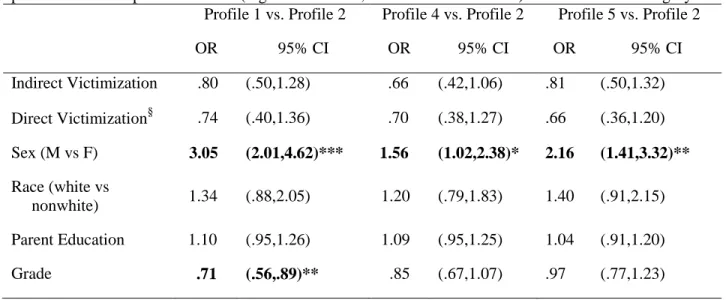
internalizing reactivity: Profile 2 (high internalizers, moderate externalizers) and Profile 3 (high internalizers, high externalizers). Three profiles have lower internalizing reactivity: Profile 1 (non-reactors), Profile 4 (moderately anxious, moderate externalizers), and Profile 5 (moderate internalizers, moderate externalizers). Our multinomial logistic regression, therefore, required two sets of contrasts: Profile 2 compared to Profile 1, 4, and 5 and Profile 3 compared to Profile 1, 4, and 5. We begin our presentation of results for this hypothesis with the multinomial logistic regression models that used Profile 2 as the reference category in comparison to Profile 1, 4, and 5. These results are presented in Table 1.6.
Table 1.6 shows that, contrary to Hypothesis 3, indirect bullying victimization was not significantly associated with membership in any of the lower internalizing reactivity profiles when compared to Profile 2.
Table 1.6. Adjusted associations† (OR and 95% CI) between indirect bullying victimization and reactivity profile membership with Profile 2 (high internalizers, moderate externalizers) as the reference category
Profile 1 vs. Profile 2 Profile 4 vs. Profile 2 Profile 5 vs. Profile 2
OR 95% CI OR 95% CI OR 95% CI
Indirect Victimization .80 (.50,1.28) .66 (.42,1.06) .81 (.50,1.32) Direct Victimization§ .74 (.40,1.36) .70 (.38,1.27) .66 (.36,1.20) Sex (M vs F) 3.05 (2.01,4.62)*** 1.56 (1.02,2.38)* 2.16 (1.41,3.32)**
Race (white vs
nonwhite) 1.34 (.88,2.05) 1.20 (.79,1.83) 1.40 (.91,2.15) Parent Education 1.10 (.95,1.26) 1.09 (.95,1.25) 1.04 (.91,1.20)
30
Note: Profile 1= Non-reactors; Profile 2= High internalizers, moderate externalizers (reference category); Profile 3=High internalizers, high externalizers; Profile 4= Moderately anxious, moderate externalizers; Profile 5=Moderate internalizers, moderate externalizers
†Adjusted odds ratios (OR) estimated from a multinomial logistic regression of reactivity to bullying profile membership on direct bullying victimization adjusting for covariates shown in the table. § Direct victimization is used as a control variable in this model. Results of hypothesis tests regarding direct victimization are reported in Table 5.
*p<.05 **p<.01 ***p<.0001
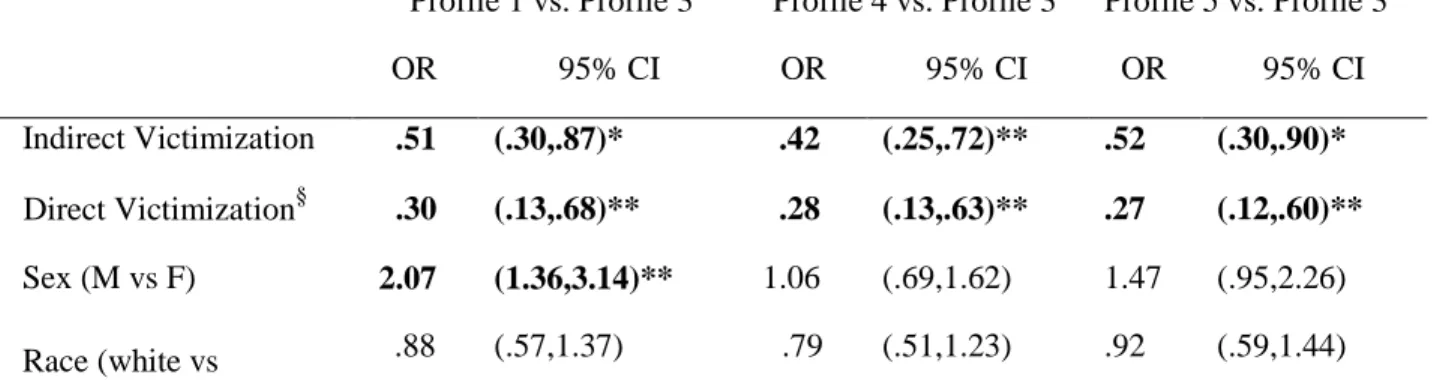
Table 1.7 presents the results of multinomial logistic regression of reactivity profile membership on indirect bullying victimization with Profile 3 (high internalizers, high externalizers) as the reference category. The results show that, consistent with Hypothesis 3, there was a significant association between indirect victimization and membership in the lower internalizing profiles (Profile 1, non-reactors; Profile 4, moderately anxious, moderate
externalizers; and Profile 5, moderate internalizers, moderate externalizers) as compared to Profile 3 and controlling for direct bullying victimization and demographic variables. Adolescents who experienced indirect victimization had 49% lower odds of membership in Profile 1 (OR=.51, 95% CI: .30,.87), 58% lower odds of membership in Profile 4 (OR=.42, 95% CI:.25,.72), and 48% lower odds of membership in Profile 5 (OR=.52, CI: .30, .90) compared to Profile 3.
Table 1.7. Adjusted associations† (OR and 95% CI) between indirect bullying victimization and reactivity profile with Profile 3 (high internalizing, high externalizing) as the reference category
Profile 1 vs. Profile 3 Profile 4 vs. Profile 3 Profile 5 vs. Profile 3
OR 95% CI OR 95% CI OR 95% CI
Indirect Victimization .51 (.30,.87)* .42 (.25,.72)** .52 (.30,.90)*
Direct Victimization§ .30 (.13,.68)** .28 (.13,.63)** .27 (.12,.60)**
31
Profile 1 vs. Profile 3 Profile 4 vs. Profile 3 Profile 5 vs. Profile 3
OR 95% CI OR 95% CI OR 95% CI
nonwhite)
Parent Education 1.04 (.89,1.20) 1.03 (.89,1.20) .99 (.85,1.14)
Grade .67 (.52,.85)** .80 (.63,1.02) .92 (.71,1.17)
Note: Profile 1= Non-reactors; Profile 2= High internalizers, moderate externalizers; Profile 3=High internalizers, high externalizers (reference category); Profile 4= Moderately anxious, moderate externalizers; Profile 5=Moderate internalizers, moderate externalizers.
†Adjusted odds ratios (OR) estimated from a multinomial logistic regression of reactivity to bullying profile membership on direct bullying victimization adjusting for covariates shown in the table. § Direct victimization is used as a control variable in this model. Results of hypothesis tests regarding direct victimization are reported in Table 5.
*p<.05 **p<.01
Taking together the results of the multinomial logistic regression contrasts using Profile 2 (high internalizers, moderate externalizers) and then Profile 3 (high internalizers, high
externalizers) as the reference category, we conclude that our hypothesis regarding indirect bullying victimization was only partially supported. Significant associations between indirect bullying victimization and reactivity profile membership, independent of direct bullying victimization, were found only when Profile 3 was the referent high internalizing profile.
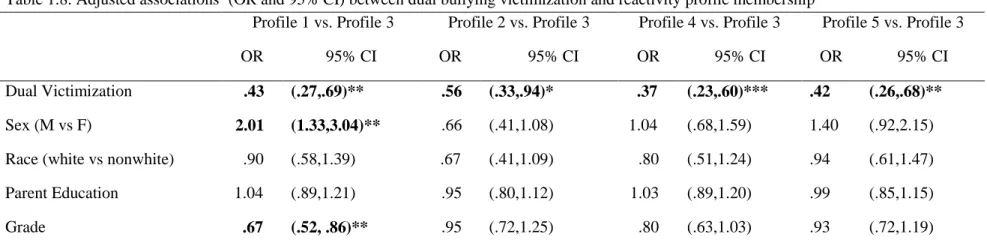
Table 1.8. Adjusted associations† (OR and 95% CI) between dual bullying victimization and reactivity profile membership
Profile 1 vs. Profile 3 Profile 2 vs. Profile 3 Profile 4 vs. Profile 3 Profile 5 vs. Profile 3
OR 95% CI OR 95% CI OR 95% CI OR 95% CI
Dual Victimization .43 (.27,.69)** .56 (.33,.94)* .37 (.23,.60)*** .42 (.26,.68)**
Sex (M vs F) 2.01 (1.33,3.04)** .66 (.41,1.08) 1.04 (.68,1.59) 1.40 (.92,2.15) Race (white vs nonwhite) .90 (.58,1.39) .67 (.41,1.09) .80 (.51,1.24) .94 (.61,1.47) Parent Education 1.04 (.89,1.21) .95 (.80,1.12) 1.03 (.89,1.20) .99 (.85,1.15)
Grade .67 (.52, .86)** .95 (.72,1.25) .80 (.63,1.03) .93 (.72,1.19)
Note: Profile 1= Non-reactors; Profile 2= High internalizers, moderate externalizers; Profile 3=High internalizers, high externalizers (reference category); Profile 4= Moderately anxious, moderate externalizers; Profile 5=Moderate internalizers, moderate externalizers.
†Adjusted odds ratios (OR) estimated from a multinomial logistic regression of reactivity to bullying profile membership on direct bullying victimization adjusting for covariates shown in the table.
*p<.05 **p<.01 ***p<.0001
33
Consistent with Hypothesis 4, adolescents who experienced both types of victimization were indeed more likely to be in Profile 3 (high internalizing, high externalizing) than in any of the other reactivity profiles. They had 57% lower odds of membership in Profile 1 (non-reactors) as compared to Profile 3 (OR=.43, 95% CI: .27,.69), 44% lower odds of membership in Profile 2 compared to Profile 3 (OR=.56, 95% CI: .33,.94), 63% lower odds of membership in Profile 4 compared to Profile 3 (OR:.37, 95% CI: .23,.60), and 58% lower odds of membership in Profile 5 compared to Profile 3 (OR=.42, 95% CI: .26,.68).
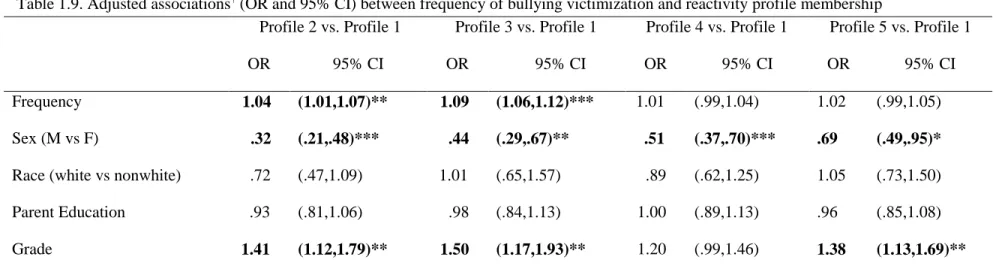
Frequency of victimization. Our last set of multinomial logistic regression models tested Hypothesis 5 that greater frequency of victimization would be associated with greater likelihood of membership in the higher reactivity profiles than in the non-reactor profile. To test this
hypothesis, Profile 1(non-reactors) was used as the reference category against which membership in each other profile was compared. Table 1.9 summarizes the results of the multinomial logistic regression testing this hypothesis. We found that frequency of victimization was significantly associated with membership in Profiles 2 and 3 (the high internalizing profiles), with each one unit increase in bullying frequency being equivalent to a 4% (OR=1.04, 95% CI: 1.01,1.07) and a 9% (OR=1.09, 95% CI: 1.05, 1.12) respective increase in odds of profile membership compared to Profile 1. Hypothesis 5, then, was only partially supported. Frequency of bullying
Table 1.9. Adjusted associations† (OR and 95% CI) between frequency of bullying victimization and reactivity profile membership
Profile 2 vs. Profile 1 Profile 3 vs. Profile 1 Profile 4 vs. Profile 1 Profile 5 vs. Profile 1
OR 95% CI OR 95% CI OR 95% CI OR 95% CI
Frequency 1.04 (1.01,1.07)** 1.09 (1.06,1.12)*** 1.01 (.99,1.04) 1.02 (.99,1.05) Sex (M vs F) .32 (.21,.48)*** .44 (.29,.67)** .51 (.37,.70)*** .69 (.49,.95)*
Race (white vs nonwhite) .72 (.47,1.09) 1.01 (.65,1.57) .89 (.62,1.25) 1.05 (.73,1.50) Parent Education .93 (.81,1.06) .98 (.84,1.13) 1.00 (.89,1.13) .96 (.85,1.08)
Grade 1.41 (1.12,1.79)** 1.50 (1.17,1.93)** 1.20 (.99,1.46) 1.38 (1.13,1.69)**
Note: Profile 1= Non-reactors (reference category); Profile 2= High internalizers, moderate externalizers; Profile 3=High internalizers, high externalizers; Profile 4= Moderately anxious, moderate externalizers; Profile 5=Moderate internalizers, moderate externalizers.
†Adjusted odds ratios (OR) estimated from a multinomial logistic regression of reactivity to bullying profile membership on direct bullying victimization adjusting for covariates shown in the table.
*p<.05 **p<.01 ***p<.0001
35
Associations between demographic variables and reactivity profiles. Associations between a set of demographic variables (sex, race, parental education, and grade) and reactivity profiles were tested in all models, with varying profiles used as the comparison profile and adjusting for varying bullying characteristics. Race and parental education were not associated with reactivity profile membership in any of the models, but there were significant associations between sex and reactivity profile membership and grade and reactivity profile membership in nearly all models.
In our test of Hypothesis 3 regarding indirect bullying, using Profile 2 (high internalizers, moderate externalizers) as the reference category, we found a significant
association between sex and reactivity to bullying profile membership. Compared to girls, boys had approximately three times the odds of membership in Profile 1 (non-reactors) compared to Profile 2 (OR=3.05, 95% CI: 2.01, 4.62), 1.56 times the odds of membership in Profile 4 (moderately anxious, moderate externalizers) compared to Profile 2 (OR=1.56, 95% CI: 1.02,2.38) and over two times the odds of membership in Profile 5 (moderate internalizers, moderate externalizers) compared to Profile 2 (OR=2.16, 95% CI:1.41,3.32). Significant associations between sex and reactivity profile membership were also found when we used Profile 3 (high internalizers, high externalizers) as the reference category to test Hypothesis 3. In this model, boys had higher odds than girls of being in Profile 1(non-reactors) as compared to Profile 3 (OR=2.07, 95% CI:1.36, 3.14). Similarly, when testing Hypothesis 4 regarding dual victimization and reactivity profile membership with Profile 3 (high internalizers, high
36
(Hypothesis 5) we found that, compared to girls, boys had 68% lower odds of membership in Profile 2 compared to Profile 1 (OR=.32, 95% CI: .21,.48), 56% lower odds of membership in Profile 3 compared to Profile 1 (OR=.44, 95% CI: 29.,.67), 49% lower odds of membership in Profile 4 compared to Profile 1 (OR=.51, 95% CI:.37,.70), and 31% lower odds of membership in Profile 5 compared to Profile 1 (OR=.69, 95% CI:.49, .95). Taken together, the significant associations between sex and reactivity profile membership across these models suggest that girls are at higher risk for membership in all reactivity profiles (compared to the non-reactive profile) than boys.
We also found a significant association between grade and reactivity profile membership in all models. In testing the hypothesis between direct bullying victimization and reactivity profile membership (Hypothesis 2) using Profile 3 (high internalizers, high externalizers) as the reference category, we found a significant association between grade and reactivity profile membership (OR=.67; 95% CI: .52, .85), with each one-year increase in grade being associated with 33% decreased odds of membership in the non-reactors profile (Profile 1) as compared to the high internalizers, high externalizers profile (Profile 3). There was also a significant
association between grade and reactivity profile in our test of the relationship between indirect bullying victimization and reactivity profile membership (Hypothesis 3) using Profile 2 as the reference category, with each one year increase in grade associated with 29% lower odds of being in Profile 1 compared to Profile 2 (OR=.71, 95% CI:.56,.89). When using Profile 3 as the reference category to test Hypothesis 3, we found each one year increase in grade to be
37
compared to Profile 3 (OR=.67, 95% CI:.52,.86). With regard to frequency of victimization and reactivity profile membership (Hypothesis 5), we found that, for each 1 year increase in grade level, students had a 41% increase in odds of membership in Profile 2 compared to Profile 1 (OR=1.41, 95% CI: 1.12,1.79), 50% increase in odds of membership in Profile 3 compared to Profile 1 (OR=1.50, 95% CI:1.17,1.93) and 38% increase in odds of membership in Profile 5 compared to Profile 1 (OR=1.38, 95% CI:1.13,1.68). On the whole, results across all models suggest that the risk for internalizing and externalizing reactivity to bullying victimization increases as adolescents advance from grade 8-10.
Discussion
We expected to find variation in reactivity to bullying victimization with LPA and our results confirmed the presence of subgroups of reactivity within our sample. Our first hypothesis was that four profiles of reactivity would be identified through LPA: one group high on
38
measured in this study: anxiety and depression. Our person-centered approach enabled the detection of the co-existence of internalizing and externalizing reactivity in our profiles, revealing more than could have been learned in a single outcome, variable-centered study. Of note, internalizing and externalizing problems coexist in all of the reactivity profiles,
underscoring the importance of secondary interventions that address both types of responses among victims of bullying victimization.
Kretschmer and colleagues (2015) identified four profiles of maladjustment along dimensions of internalizing (withdrawal, somatic complaints, anxiety) and externalizing (delinquency, aggression) in early adolescence. These profiles consisted of Low
[maladjustment], Internalizing, Externalizing, and Comorbid groups (Kretschmer et al., 2015). The present study and Kretschmer et al. used different measures to identify profiles, but readers of Kretschmer et al. there is some degree of comorbidity present even in the Internalizing and Externalizing profiles.
The descriptive analysis detected important distinctions among the profiles in terms of bullying characteristics experienced. Of note, Profile 3 (high internalizers, high externalizers) had the highest proportion of members who experienced indirect bullying and dual victimization and also had a mean frequency of victimization that was significantly higher than that in all other profiles. In testing our hypotheses, we further examined the relationship between bullying
characteristics and reactivity profile membership.
Supporting Hypothesis 2 and in harmony with findings by Hampel et al.(2009) and Sullivan et al., (2006) we found that direct bullying victimization was associated with
39
be an attractive method for dealing with victimization for some. Such bully/victims or “aggressive victims” (Pellegrini, Bartini, & Brooks, 1999) may be captured in our high internalizing, high externalizing profile as well as all of the profiles that capture some
externalizing. Due to the cross-sectional nature of our analysis, we cannot determine whether the externalizing behaviors in our profiles preceded or followed the bullying victimization; however, as noted previously, work by Barker and colleagues (2008) suggests that victimization precedes perpetration rather than the other way around. Equivalent longitudinal research on the
temporality of victimization and delinquency is lacking. Work by Hampel and colleagues (2009) identified anger control problems and negative self-appraisal as potential psychological
adjustment factors that may mediate the relationship between direct victimization and externalizing reactivity. Longitudinal analyses are needed to test the significance of these psychological adjustment factors and their respective roles in the experience of direct victimization and externalizing reactivity.
Our hypothesis regarding indirect bullying victimization (Hypothesis 3) was only partially supported. Significant associations between indirect bullying victimization and profile membership were found only when Profile 3 (high internalizers, high externalizers) was the referent high internalizing profile for comparisons against lower internalizing groups (Profiles 1,4, and 5). Researchers (e.g., Baldry & Winkel, 2008; Rigby & Slee, 1999) have suggested that, because of the covert nature of indirect victimization, victims may not report incidents of
bullying to teachers and parents, leading to feelings of frustration and powerlessness.
40
direct bullying to act out against peers in retaliation. The present study, however, suggests that this may not be the case. Victims of indirect bullying that were higher internalizers (compared to lower internalizing groups) also reported high levels of externalizing behaviors.
Adolescents who experienced both types of bullying victimization were also more likely than those who experienced only one type of victimization to be in profile 3 (high internalizers, high externalizers) compared to any other profile. While either type of victimization is
damaging, dual victimization appears to be particularly deleterious. Our findings are consistent with those of Hampel and colleagues (2009) who found that although both types of victimization in their study were associated with poor coping and emotional and behavioral problems, students who were direct and indirect/relational victims displayed the most unfavorable pattern of
maladaptive coping and emotional and behavioral problems.
We found that frequency of bullying victimization was significantly associated with reactivity profile, with increased frequency associated with increased likelihood of membership in Profile 2 (high internalizers, moderate externalizers) and Profile 3 (high internalizers, high externalizers) than in the non-reactor profile (Profile 1). This finding is consistent with Penning and colleagues’ work (2010) which found that increased frequency of bullying led to an increase in trauma symptoms and with Champion & Clay (2007), who found frequency to be associated with intense anger and motivation to retaliate. Repeated victimization, therefore, seems to have an intensifying effect on both internalizing symptoms and externalizing behaviors among victims of bullying. This is supported in the descriptive analyses by the finding that adolescents in
Profile 3 (high internalizing, high externalizing) had significantly higher mean frequency of victimization than any of the other profiles. Multinomial logistic regression found that
41
victimization, perhaps suggesting that internalizing symptoms are particularly sensitive to repetitive victimization.
Taking together findings from all of our multinomial logistic regression models, it appears that girls are at heightened risk for membership in all reactivity profiles (vs. the non-reactor profile) compared to boys when controlling for type and frequency of bullying victimization, race, parent education, and grade. While studies show that the prevalence of bullying victimization is the same for girls and boys (Kochenderfer-Ladd, Ladd, & Kochel, 2009), our results suggest that the experience of victimization may be more damaging for girls. One potential explanation is that girls—more so than boys--are socialized to maintain and protect social relationships (Carbone-Lopez, Esbensen, & Brick, 2010). The social failure represented by bullying victimization may, therefore, be felt more acutely by girls than boys.
Interestingly, although previous research has reported that rates of bullying tend to decrease as children advance through high school/secondary school (Smith, Madsen, &
Moody, 1999; Sourander Helstela, Helenius, Piha, 2000), the present study suggests that the risk for internalizing and externalizing reactivity increases as adolescents advance from grade 8-10. Maccoby (1988) postulated that adolescents are more upset than younger children when peer relationships are damaged (e.g., because of bullying) due to the concomitant loss of emotional support. It is possible that the increasing importance of peer relationships as adolescents advance in grades makes bullying victimization more damaging, even though it may occur less