Dependently Typed Functional Programs
and their Proofs
Conor McBride
Doctor of Philosophy
University of Edinburgh
Abstract
Research in dependent type theories [M-L71a] has, in the past, concentrated on its use in the presentation of theorems and theorem-proving. This thesis is concerned mainly with the exploitation of the computational aspects of type theory for programming, in a context where the properties of programs may readily be specified and established. In particular, it develops technology for programming with dependent inductive fami-lies of datatypes and proving those programs correct. It demonstrates the considerable advantage to be gained by indexing data structures with pertinent characteristic infor-mation whose soundness is ensured by typechecking, rather than human effort.
Type theory traditionally presents safe and terminating computation on inductive datatypes by means of elimination rules which serve as induction principles and, via their associated reduction behaviour, recursion operators [Dyb91]. In the programming language arena, these appear somewhat cumbersome and give rise to unappealing code, complicated by the inevitable interaction between case analysis on dependent types and equational reasoning on their indices which must appear explicitly in the terms. Thierry Coquand’s proposal [Coq92] to equip type theory directly with the kind of pattern matching notation to which functional programmers have become used over the past three decades [Bur69, McB70] offers a remedy to many of these difficulties. However, the status of pattern matching relative to the traditional elimination rules has until now been in doubt. Pattern matching implies the uniqueness of identity proofs, which Martin Hofmann showed underivable from the conventional definition of equal-ity [Hof95]. This thesis shows that the adoption of this uniqueness as axiomatic is sufficient to make pattern matching admissible.
A datatype’s elimination rule allows abstraction only over the whole inductively de-fined family. In order to support pattern matching, the application of such rules to spe-cific instances of dependent families has been systematised. The underlying analysis extends beyond datatypes to other rules of a similar second order character, suggesting they may have other roles to play in the specification, verification and, perhaps, deriva-tion of programs. The technique developed shifts the specificity from the instantiaderiva-tion of the type’s indices into equational constraints on indices freely chosen, allowing the elimination rule to be applied.
Elimination by this means leaves equational hypotheses in the resulting subgoals, which must be solved if further progress is to be made. The first-order unification algorithm for constructor forms in simple types presented in [McB96] has been ex-tended to cover dependent datatypes as well, yielding completely automated solution to a class of problems which can be syntactically defined.
The justification and operation of these techniques requires the machine to construct and exploit a standardised collection of auxiliary lemmas for each datatype. This is greatly facilitated by two technical developments of interest in their own right:
a more convenient definition of equality, with a relaxed formulation rule allowing elements of different types to be compared, but nonetheless equivalent to the usual equality plus the axiom of uniqueness;
a type theory, OLEG, which incorporates incomplete objects, accounting for their
‘holes’ entirely within the typing judgments and, novelly, not requiring any no-tion of explicit substituno-tion to manage their scopes.
A substantial prototype has been implemented, extending the proof assistant LEGO [LP92]. A number of programs are developed by way of example. Chiefly, the in-creased expressivity of dependent datatypes is shown to capture a standard first-order unification algorithm within the class of structurally recursive programs, removing any need for a termination argument. Furthermore, the use of elimination rules in specify-ing the components of the program simplifies significantly its correctness proof.
Acknowledgements
Writing this thesis has been a long hard struggle, and I could not have done it without a great deal of friendship and support. I cannot thank my official supervisor Rod Burstall enough for his constant enthusiasm, even when mine was straining at times. Supervi-sions with Rod, whatever else they achieved, always managed to make me happy. It has also been a pleasure to be part of the LEGO group, and indeed, the LFCS as a whole. My slightly less official supervisors, successively James McKinna, Healf Goguen and Martin Hofmann, deserve my warmest gratitude. I hope I have done them justice. A word of thanks, too, must go to Randy Pollack for his implementation of LEGO—if it were not for his code, I could not have built mine.
My friends and family have been a constant source of love and encouragement. Thank you, all of you. Finally, I cannot express how much I appreciate the flatmates I have lived with over the last four years. Phil, Carsten, Melanie, even Firkin the cat, your for-bearance is something for which I shall always be profoundly grateful. Your friendship is something I treasure.
Declaration
Table of Contents
Chapter 1 Introduction 6
1.1 overview . . . 7
1.2 this thesis in context . . . 10
1.3 implementation . . . 15
Chapter 2 OLEG, a type theory with holes 16 2.1 the OLEG core . . . 17
2.2 the OLEG development calculus . . . 25
2.2.1 positions and replacement . . . 30
2.2.2 the state information order . . . 32
2.3 life of a hole . . . 34
2.4 displaying an OLEG state . . . 35
2.5 basic component manipulations . . . 37
2.6 moving holes . . . 39
2.7 refinement and unification . . . 40
2.8 discharge and other permutations . . . 43
2.9 systems with explicit substitution . . . 45
2.10 sequences, telescopes, families, triangles . . . 46
Chapter 3 Elimination Rules for Refinement Proof 52 3.1 propositional equality (definition deferred) . . . 54
3.2 anatomy of an elimination rule . . . 55
3.3 examples of elimination rules . . . 57
3.4 legitimate targets . . . 61
3.5 scheming with constraints . . . 63
3.5.1 simplification by coalescence . . . 66
3.5.2 what to fix, what to abstract . . . 67
3.5.3 abstracting patterns from the goal . . . 69
3.5.4 constraints in inductive proofs . . . 70
3.6 an elimination tactic . . . 71
3.6.1 preparing the application . . . 72
3.6.2 fingering targets . . . 73
3.6.3 constructing the scheme . . . 75
3.6.4 proving the goal . . . 77
3.6.5 tidying up . . . 77
3.7 an example— . . . 78
3.7.1 constructing . . . 80
3.7.2 proving . . . 81
3.7.3 proving . . . 83
3.7.4 proving the ‘introduction rules’ . . . 85
Chapter 4 Inductive Datatypes 87 4.1 construction of inductive datatypes . . . 89
4.1.1 simple inductive datatypes like . . . 89
4.1.2 parameterised datatypes like . . . 92
4.1.3 datatypes with higher-order recursive arguments, like . . 94
4.1.4 dependent inductive families like the s . . . 96
4.1.6 record types . . . 101
4.2 a compendium of inductive datatypes . . . 103
4.3 abolishing -types and reinventing them . . . 103
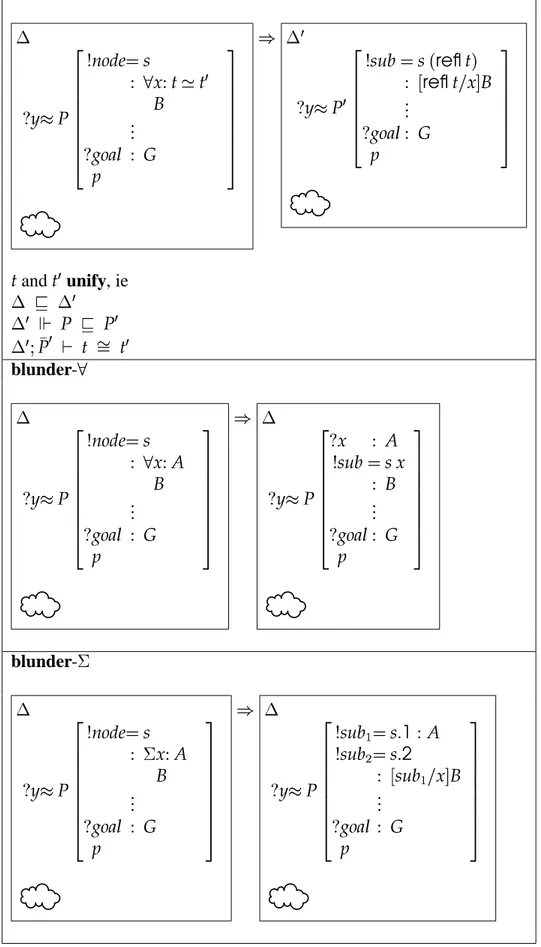
4.3.1 the blunderbuss tactic . . . 105
4.4 constructingCaseandFix . . . 108
4.4.1 case analysis for datatypes and relations . . . 108
4.4.2 the guarded fixpoint principle . . . 110
Chapter 5 Equality and Object-Level Unification 117 5.1 two nearly inductive definitions of equality . . . 118
5.1.1 Martin-L¨of’s identity type . . . 118
5.1.2 uniqueness of identity proofs . . . 119
5.1.3 , or ‘John Major’ equality . . . 119
5.1.4 equality for sequences . . . 120
5.1.5 the relationship between! and . . . 124
5.2 first-order unification for constructor forms . . . 127
5.2.1 transition rules for first-order unification . . . 129
5.2.2 an algorithm for constructor form unification problems . . . . 133
5.2.3 conflict and injectivity . . . 136
5.2.4 cycle . . . 140
5.2.5 a brief look beyond constructor form problems . . . 149
Chapter 6 Pattern Matching for Dependent Types 152 6.1 pattern matching in ALF . . . 155
6.2 interactive pattern matching in OLEG . . . 157
6.2.1 computational aspects of elimination . . . 158
6.2.2 conservativity of pattern-matching over OLEG . . . 162
6.3 recognising programs . . . 173
6.3.1 recursion spotting . . . 174
6.3.2 exact problems . . . 175
6.3.3 splitting problems . . . 176
6.3.4 empty problems . . . 177
6.4 extensions . . . 178
6.4.1 functions with varying arity . . . 178
6.4.2 more exotic recursion . . . 181
Chapter 7 Some Programs and Proofs 184 7.1 concrete categories, functors and monads . . . 184
7.1.1 records for categories . . . 185
7.1.2 records for functors . . . 187
7.1.3 records for ‘concrete’ monads . . . 188
7.2 substitution for the untyped" -calculus . . . 192
7.2.1 #$ ,&%' and(%) +* . . . 194
7.2.2 the substitution monad splits the renaming functor . . . 201
7.3 a correct first-order unification algorithm . . . 210
7.3.1 optimistic optimisation . . . 212
7.3.2 optimistic unification . . . 216
7.3.3 dependent types to the rescue . . . 217
7.3.4 correctness of,.-0/ . . . 221
7.3.5 what substitution tells us about the occurs check . . . 226
7.3.6 positions . . . 230
7.3.7 % +* and12 34 -5 . . . 233
7.3.8 comment . . . 236
8.1 further work . . . 242
Appendix A Implementation 245
Bibliography 247
Chapter 1
Introduction
‘The philosophers have merely interpreted the world in various ways. The point, however, is to change it.’ (Marx and Engels)
Computer programs are not expected to make sense. In fact, they are seldom expected to work, which is as much as to say that computer programmers are not expected to make sense either. This is understandable—programming is primarily a form of giving orders.
Nonetheless, there are grounds for optimism. This is because programmers do not really want genuinely stupid orders to be obeyed, and we understand that the more sense we are able to make, the shorter our orders need be. The benefit comes by taking the sense within the programmer’s mind and manifesting it explicitly in the program.
From named variables and looping constructs through to functional abstraction and method encapsulation, the evolution of programming languages has greatly facilitated the programmer who actively seeks to make sense. In particular, type systems now allow so much sense to be made that they are even becoming compulsory in some industrial programming languages. Where the purpose of typing in C is to indicate the number of bits left an array subscript should be shifted, strongly typed languages like Java genuinely reduce the gullibility with which machine faces human.
It is with the objective of promoting sense in programs that I have pursued the research documented in this thesis. Its main purpose is to show the advantage a dependent type system lends to the cause of principled programming.
Briefly, the principal contributions are these:
parts of constructions explained entirely within the judgments of the calculus— the state of a theorem prover may thus be represented as a valid judgment
the identification of what must be added to conventional type theories (such as those underlying LEGO or COQ) to facilitate pattern matching for dependent types (as implemented in ALF)
a systematic view of elimination rules, leading to the use of derived elimination rules to characterise and indeed specify programs in a compact and powerful way
1.1
overview
This thesis records my development of technology to support functional programming over dependent datatypes by pattern matching and structural recursion in an intensional type theory. This technology also suggests novel tools and techniques for reasoning about such programs. Let me give an overview, identifying the innovations.
I open with an account of a theorem proving in a type theory, OLEG,1 which is based on Luo’s ECC [Luo94], but includes an account of ‘holes’2 in terms. There is a lot of theorem proving in this thesis. Some of it is done by hand. Much of it is done by ma-chines, manufacturing and exploiting standard equipment for working with datatypes and equational problems. I therefore feel obliged to give a precise treatment not only of theorems but also theorem proving.
The novelty is that holes are handled much as other variables and accounted for by binding entirely within the judgments of the system. This system is workable because the core calculus of terms is embedded in a ‘development calculus’, which is where the hole-bindings are to be found—a core term in the scope of a hole may nonetheless refer to that hole. The effect of the separation is to prevent troublesome interaction between computation and holes. Consequently, terms (called ‘partial constructions’) in the development calculus enjoy the property that one may safely be replaced by another of the same type—remarkably good behaviour for a dependent type system.
As a result, theorem proving in OLEG consists exactly of editing OLEG judgments in ways which are guaranteed to preserve their derivability. Although OLEG is more
1The name ‘OLEG’ is a tribute to Randy Pollack’s proof assistant LEGO. The new treatment of
partial proofs required only a minor rearrangement.
2also known as ‘metavariables’, ‘existential variables’, ‘question marks’ and many other names
restrictive than systems with explicit substitution, those restrictions will not hinder us in the slightest.
The inductive datatypes we shall be concerned with are much like those of LEGO,
COQ[Coq97] or ALF [Mag94]. Their elements are introduced by constructor symbols
whose recursive arguments satisfy a strict positivity condition. Recursive computation and inductive proof are provided in the old-fashioned ‘elimination rule’ style. This necessitated the innovation of principled tactical support for such rules, documented in chapter three. However, the technology is not restricted to elimination rules arising from datatypes.
The contribution from this thesis to the methodology of program verification lies in the use of derived elimination rules to capture the leverage exerted by a given piece of information on an arbitrary goal. The abstraction of the predicate in an induction principle or the return type in a datatype fold operator point the way. Given a piece of information, we have been indoctrinated to ask what we can deduce from it—we should rather ask how we can deduce what we want from it. The tactics of chapter three were developed to support datatype elimination rules, but they allow us to exploit a wide class of rules which similarly abstract the type of their conclusions. I give numerous examples capturing the behaviour of programs in this way, and I believe I demonstrate the efficacy of the policy.
Once we understand elimination rules, we may give proper attention to inductive datatypes. In particular, we may use chapter three’s technology to derive from each ‘conventional’ eliminator a pair of alternative eliminators which usefully untangle the treatment of case analysis and recursion on structurally smaller terms. This gives ef-fectively the same presentation as the Case andFix constructs which are primitive notions in COQ. The equivalence was established by Eduardo Gim´enez [Gim94]— only minor adaptations are required to mechanise his construction. Chapter four is reassuringly unremarkable.
Case analysis on a restricted instance of an inductive family (henceforth a subfamily) inevitably involves equational reasoning. For example, we may define the family of lists indexed by their length—when analysing the instance constrained to contain only nonempty lists, we rule out the ‘nil’ constructor because the list it generates does not satisfy that constraint. More generally, for each constructor, we must represent at the object-level the constraint that its return type unifies with the subfamily under analy-sis. These constraints are similar to the unification problems which arise in ‘unfolding’ transformations for logic programs [TS83, GS91]. My MSc work involved a system-atic solution for simply typed problems in constructor form, implemented in the form
of a tactic [McB96].
Chapter five extends the treatment to dependent types. Of necessity, this requires us to compare sequences of terms where later elements may have propositionally equal but computationally distinct types, an area which has always proved troublesome for intensional type theory. I present a new, slightly more relaxed definition of equality which scales up to sequences without significant attendant clumsiness. It turns out to be equivalent to the more traditional inductive definition augmented by the axiom that identity proofs are unique. So equipped, we may easily prove for each datatype its ‘no confusion’ property—constructors are injective and disjoint—in the form of a single elimination rule. I also give a systematic proof that each datatype contains no cycles. It is these lemmas which justify the transitions of the unification tactic.
In [Coq92], Thierry Coquand characterises a class of ‘pattern matching’ programs over dependent types which ensure that patterns cover all possibilities (deterministically) and that recursion is structural. This is the class of programs made available (with unrestricted recursion) in the ALF system [Mag94]. Chapter six contains the principal metatheoretic result of this thesis, confirming that the same class of programs can be constructed from traditional datatype elimination rules, given uniqueness of identity proofs. The meta-level unification in Coquand’s presentation is performed at the object level by the tactic developed in chapter five.
By way of illustration, if not celebration, the work of the thesis closes with two sub-stantial examples of verified dependently typed programs. Both concern syntax:
substitution for untyped" -terms, shown to have the properties of a monad
a structurally recursive first-order unification algorithm, shown to compute most general unifiers
It is well understood, at least in the type theory community, that we may only really make sense of terms relative to a context which explains their free variables. Both of these examples express that sense directly in their data structures, a gain which is reflected in the correctness proofs.
Neither example is new to the literature of program synthesis and verification. Substi-tution has been treated recently [BP99, AR99] via polymorphic recursion, and I include it simply to show that dependent types easily offer the same functionality, without re-course to counterfeiting index data at the type level.
The existing treatments of unification turn on the use of an externally imposed termi-nation ordering. The novelty here is that by indexing terms with the number of
vari-ables which may occur in them, we gain access to computation over that index—this is enough to capture the program for structural recursion. Witness the benefit from a program which captures much more precisely the sense of the algorithm it implements.
Both developments adopt the methodology of characterising the behaviour of their sub-programs by means of elimination rules. Establishing program correctness becomes sufficiently easy that in presenting the proofs, I cut corners only where to do otherwise would be monotonous in the extreme.
I would like to apologise for the length and linearity of this thesis. I hope it is not nearly as much trouble to read as it was to write.
1.2
this thesis in context
‘I do press you still to give me an account of yourself, for you certainly did not spring from a tree or a rock 67676 ’ (Penelope. Odyssey, Homer)
I sprang from a little-known Belfast pattern-matcher in 1973. I have spent my whole life surrounded by pattern matching, I have implemented pattern matching almost ev-ery year since 1988, and now I am doing a PhD about pattern matching with Rod Burstall. Fortunately, my mother was not a computer scientist. Enough about me.
Martin-L¨of’s type theory [M-L71a] is a well established and convenient arena in which computational Christians are regularly fed to logical lions—until relatively recently, much more emphasis has been placed on type theory as a basis for constructive logic than for programming. Comparatively boring programs have been written; compara-tively interesting theorems have been proven. This is a pity, as the expressiveness of type theory promises much benefit for both. But things have changed.
Induction on the natural numbers was presented explicitly in different guises by Pascal and Fermat in the seventeenth century, although it has been used implicitly for a lot longer. Frege and Dedekind independently gave inductive definitions an explanation in impredicative set theory. ‘Structural induction’ had been widely used in mathematical logic [CF58, MP67] by the time Burstall introduced the notion of inductive datatypes to programming, with elements built from constructor functions and taken apart by case analysis [Bur69].
Inductive datatypes have escaped from programming languages [McB70, BMS80]3
and arrived in type theory [M-L84, CPM90]. Since then, they have become more
3My father’s LISP-with-pattern-matching was a programming language which escaped from an
expressive, with the indexing power of dependent type theory giving a natural home to inductive families of types [Dyb91]. For example, as hinted above, the polymorphic datatype98 , with constructors
:8<;=>8
?
;78 @;=>8
?
@A;=B>8
can be presented in a usefully indexed way as vectors—lists of a given length:
)
CD; ECGF
?
;7H @A; ICKJ )
?
@A; ICL(J
Typing is strong enough to tell when a vector is empty, so potentially disastrous de-structive operations like ‘head’ and ‘tail’ can be safely defused.
However, there are significant ways in which dependent datatypes are more troublesome—the question is ‘what datatypes shall we have and how shall we com-pute with them?’. The datatypes and families proposed by Thierry Coquand, Christine Paulin-Mohring and Peter Dybjer have been integrated with type theory in a number of variations.
Zhaohui Luo’s UTT [Luo94] is closest to the traditional presentation, equipping fam-ilies based on safe ‘strictly positive’ schemata with elimination constants doubling as induction principles and recursion operators. This is a conservative treatment for which the appropriate forms of good behaviour were established by Healf Goguen [Gog94]. Unfortunately, recursion operators make somewhat unwieldy instruments for program-ming, as anyone who has ever added natural numbers in LEGO[Pol94] will tell you.
Thierry Coquand’s 1992 presentation of pattern matching for dependent types [Coq92], implemented in the ALF system by Lena Magnusson [Mag94], was shown to be non-conservative over conventional type theory by Hofmann and Streicher, since it implies uniqueness of identity proofs [HoS94]. Pattern matching for the full language of in-ductive families is contingent on unification, which is needed to check whether a given constructor can manufacture an element of a given family instance. Unification, once it escapes from simple first-order syntaxes, becomes frightening to anyone with a well developed instinct for survival, although some do survive.
Subsequent systems in the ALF family, such as Agda [Hal99], have been much more cautious about what datatypes they will allow, in order to be much more generous with facilities for working with them. In particular, the question of unification is avoided by forbidding datatype constructors to restrict their return types to a portion of the family
(eg, empty vectors, nonempty vectors). Families are declared in a similar manner to datatypes in functional programming languages:
M5&MN#EM5,.OQPSRT67676UPWVYX
GZ RT676[6
Z\^] 67676
The indicesPTR_6[676(P`V are distinct variables, indicating that each constructor
, what-ever its domain types
Z
R_6[676 Z\
, its range is over the entire family Pattern matching over an instantiated subfamily just instantiates theP ’s in the types of the constructors, rather
than generating an arbitrarily complex unification problem.
This is a sensible restriction with a sound motivation. It is also a serious one, for-bidding, for example, the formulation of the identity type—the reflexivity constructor restricts its return type to the subfamily where the indices are equal. As we decompose elements of these datatypes, their indices can only become more instantiated—Agda datatype indices only ‘go up’.
Some of the power lost in this way is recaptured by computing types from data. For example, the type of vectors, although not a datatype in Agda can be computed from the length index:
aC F X bb
aC &J X 8.cd aCeJ+f
This kind of computed type is good for data which are in some way measured by the indices—elements are finite, not because they contain only finitely many constructor symbols per se, but because, as we decompose them, their indices recursively ‘go down’ some well-founded ordering. There is no place, in this setting, for inductive families whose indices, like those of the stock exchange, can go down as well as up.
The practical limitations of this system require further exploration. Certainly, the re-moval of unification from the pattern matching process makes it considerably more straightforward to implement attractively and to grasp. It has been even been im-plemented outside the protective environment of the interactive proof assistant—in Lennart Augustsson’s dependently typed programming language, Cayenne [Aug98]. Cayenne allows general recursion, hence its typechecker requires a boredom threshold to prevent embarrassing nontermination. Of course, the programs which make sense do typecheck, and some interesting examples are beginning to appear [AC99].
On the other hand, two recent examples—both implementations of first-order unifica-tion, as it happens—cannot be expressed as they stand in this restricted system. Ana
Bove’s treatment [Bove99] shows that a standard Haskell implementation of the algo-rithm can be imported almost systematically into type theory. However the general recursion of the original is replaced by ‘petrol-powered recursion’4over an inductively defined accessibility predicate [Nor88] which can be expressed in ALF, but not its successors.
My implementation, in chapter seven of this thesis, is dependently typed, and exploits the power of ‘constraining constructors’ to represent substitutions as association lists in a way which captures the idea that each assignment gets rid of a variable. Variables are from finite sets indexed by size,
J , and terms are trees over a number of variables, &
J . Association lists, MghJ , represent substitutions fromg variables to terms
overJ :
M
i;=M5>JjJ
Pk;=
&g @A;=(
g lm;=MB>gYJ
M
nPj@olm;=MBW&gYJ
Having said that, I am quite sure that ‘gravity-powered’ unification can be implemented in Agda using the restricted type system. I only use association lists because my ap-plication of substitutions is delayed and incremental. If you are happy to apply substi-tutions straight away, a functional representation suffices. Nonetheless, theM type
stands as a useful data structure—a ‘context extension’—which one might reasonably hope to represent as a datatype.
The COQ system [Coq97] has inductive families of types with strictly positive
schemata [P-M92, P-M96]. However, they have moved away from the traditional ‘one-step’ elimination operator, following a suggestion from Thierry Coquand: they now divide elimination into aCaseanalysis operator and a constructor-guardedFix -point operator. Eduardo Gim´enez’s conservativity argument [Gim94] is bolstered by a strong normalisation proof for the case of lists [Gim96]—he has recently proved strong normalisation for the general case [Gim98]. Bruno Barras has formalised much of the metathory for this system [Bar99], including the decidability of typechecking.
This Case-Fix separation is a sensible one, and it makes practical the technology in this thesis—working in what is effectively Luo’s UTT [Luo94], I start from the traditional ‘one-step’ rule, but I have mechanised the derivation ofCaseandFixfor each datatype. Everything which then follows applies as much to COQas to LEGO.
There is, though, a noticeable gap between programming byCasewithFixin COQ
and programming by pattern matching in ALF or Cayenne. This gap has been ad-dressed by the work of Cristina Cornes [Cor97]. She identifies a decidable class of
second-order unification problems which captures many pattern matching programs viewed as collections of functional equations. Solving these problems mechanically, she has extended COQwith substantial facilities for translating such programs in terms ofCaseandFix.
This takes the form of a macroCaseswhich allows pattern matching style decompo-sition of multiple terms from unconstrained inductive families (eg 4J —vectors of
arbitrary length) and combines withFix to yield recursive function definition in the style of ML. Although the full gamut of dependent families can be defined, she has adopted an Agda-like solution to the problem of computing with them.
The task of implementing pattern matching for constrained instances of inductive fam-ilies (or ‘subfamfam-ilies’, eg
S
2(J —nonempty vectors) she leaves to the future. Where
she leaves is where I arrive. I have not attempted to duplicate her machinery for the translation of equational programs. Rather, I have concentrated on the problem of case analysis for subfamilies, the last gap between her work and dependent pattern matching in ALF.
As I have already mentioned, we have known for some time that dependent pattern matching is not conservative—it implies the uniqueness of identity proofs, which does not hold in Hofmann’s groupoid model of type theory [HoS94, Hof95]:
5p
/ ;rqs8t;vu[wyxTz(6{qs|5;a8}6~qs;E|>!W|`6 !
|
5p
/ 8 | d$
|sfX
d$
|sf
This points to a very real connection between pattern matching and the power of equal-ity in type theory. Case analysis on inductive subfamilies (also known as ‘inversion’) necessarily involves equational reasoning—for each constructor, we must check that its return type unifies with the subfamily we are analysing. These unification problems re-semble those which arise in unfold/fold program transformation [BD77, TS83, GS91]. They are treated at the meta-level in ALF [Coq92, Mag94].
Cristina Cornes made some progress in this area with her tactics for inverting induc-tively defined relations over simply typed data in COQ[CT95]. My MSc project was to import this technology for LEGO. I made explicit the separation between, on the one hand, the splitting of the family into its constructors, with the subfamily constraints becoming object-level equations, and on the other hand, the simplification of those constraints. I implemented a complete first-order unification algorithm for object-level equations over constructor forms in simple types [McB96].
The uniqueness of identity proofs contributes directly to the extension of this first-order unification algorithm to dependent types, yielding explicit object-level solutions
to the same class of unification problems which ALF handles implicitly.5 The last gap between programming with datatypes in LEGO or COQ and pattern matching in ALF has now been bridged.
Building that bridge has involved many engineering problems and the development of some, I feel, fascinating technology. In particular, the tactic which I built for deploying the elimination rules of inductive datatypes has a potential far beyond that purpose. I have begun to explore the use of rules in that style for specifying and proving properties of programs: this thesis contains several examples.
1.3
implementation
I have implemented a prototype version of the technology described in this thesis as an extension to LEGO. It contributed to, rather than benefiting from the full analysis set out here. Nonetheless, let me emphasise at this stage that although the prototype could work better, it does work.
Enough technology has been implemented to support all the example programs and proofs in this thesis. They have all been built with OLEG’s assistance and checked
with LEGO—core OLEG is a subset of LEGO’s type theory for which Randy Pollack’s
typechecker runs unchanged. Sometimes I have had to hand-crank techniques I have subsequently shown how to mechanise, but the developments described in the thesis are an honest account of real machine proofs.
5In fact, ALF rejects cyclic equations as unification problems which are ‘too hard’, while I disprove
Chapter 2
O
LEG
, a type theory with holes
Although you have just started reading this chapter, I have nearly finished writing it. When I started, a long time ago, I intended it to be an unremarkable summary of a familiar type theory, present largely out of the need to present the notational conven-tions used in this thesis. However, despite my best intenconven-tions, this chapter does contain original work—it describes a type theory, OLEG, which gives an account of incomplete constructions quite different from those in existing use.
Let me say from the outset that I did not set out to invent such a thing. For some years I have been writing programs which construct LEGO proofs of standard datatype
equipment—constructor injectivity and so forth—together with tactics to deploy them. I began, in my MSc work, with direct synthesis of proof terms in the abstract syntax— this was, frankly, rather painful. However, as time went on, the tools I was building myself looked more and more like a theorem-prover. Eventually, the penny dropped— synthetic programming and proof is only for clever people with nothing better to do; busy people and stupid machines need an analytic framework with a sound treatment of refinement. What had previously been ‘voodoo’, an ad hoc assortment of syntactic trickery, became OLEG, a type theory for machines as well as people.
OLEG was thus manifest in code long before it was rationalised in this chapter. I
put it together with the help of many spare parts from Randy Pollack’s LEGO code.
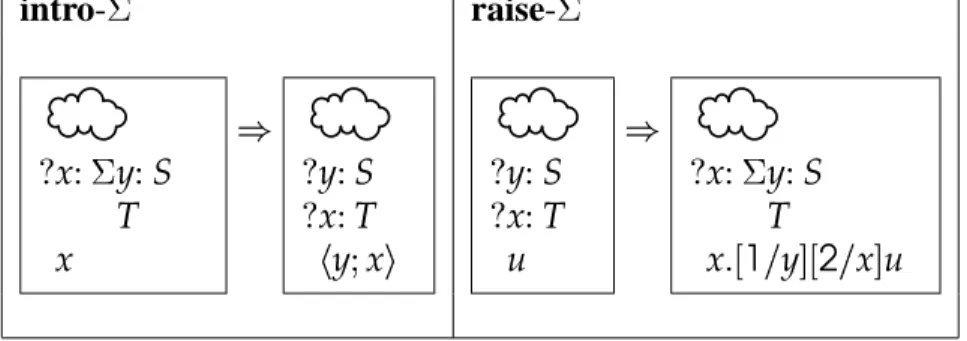
LEGO’s treatment of ‘metavariables’ is remarkable in what it allows—too remarkable, in fact. Scope is not quite managed properly, so that the reliability of LEGO still lies in the final typecheck of the completed term. I did not consider it my business to repair this problem—I was looking for a more convenient way to represent proofs-with-holes for mechanical manipulation. I hit upon the idea of binding holes in the context because it required very little alteration of the term syntax, and because it made operations like refinement’s ‘turn the unknown premises into subgoals’ just a matter of
turningq s into s. This treatment of holes resonates strongly with Dale Miller’s explicit
binding of existential variables in the ‘mixed’ quantifier prefix of unification problems [Mil91, Mil92].
At the time, explicit substitution was not even an issue. If I had wanted to main-tain the scope of holes via such technology (as is found in the ALF family [Mag94] and Typelab [vHLS98]), I should have had to re-engineer the whole LEGO syntax,
re-duction mechanism and typechecker. As it turned out, my adaptations were minimal. There is a profound reason for this—where explicit substitution relies on ingenuity, OLEG relies on cowardice. Instead of repairing the troublesome interactions between holes and computation by propagating bits of stack through the term structure, OLEG
simply forbids them.
However, let me keep you in suspense no longer. OLEG consists of a computational
core—Luo’s ECC [Luo94] with local definition [SP94] but without -types—wrapped
in a development calculus, in much the same way that Extended ML [KST94] wraps core Standard ML [MTH90]. My reason for the separation is precisely the aforemen-tioned cowardice with respect to holes and computation.
Extended ML’s treatment of holes profits from the fact that, in simple type systems, it is always safe to replace a term (eg, the placeholder ‘?’) with another of the same type. Although there is no way that core terms in a dependent type theory could ever hope to have such a replacement property (for a counterexample see section 2.2), it does hold for the terms (or ‘partial constructions’) of OLEG’s development layer. This single
metatheorem does most of the work in OLEG’s successful reconstruction of refinement
proof as we know it.
2.1
the O
LEG
core
DEFINITION: universes, identifiers, bindings, terms
universes Y;E;X'ax
]
u[wyxTz
where is a natural number
identifiers ;E;XP
]+] 67676
Let us allow ourselves countably many identifiers.
I define families of bindings and terms indexed by the finite set of variables
^
identifiers are only used where they are meaningful.1
For any set
of variables, and anyP not in
the sets
of bindings of
extending
andu
of terms over
are defined inductively2as follows:
}
u
qsP;
u
">P;
>
u
PX
;
u
u
¡
(
u
¡
u
¢
@
u
S£4¤¦¥[§
¢
6¨@
u
Binding is the means of attaching to an identifier properties such as ‘type’, ‘value’ and any other behavioural attributes in which we may be interested. A structural linguist, following Saussure [Sau16], might point out that identifiers, like words, have no intrin-sic significance. Variables, on the other hand, are signs. Binding creates a sign, linking signifier and signified.
Syntactically, a binding is a binding operator, followed by an identifier, followed by a sequence of properties each introduced by a special piece of punctuation, eg ‘:’ for ‘type’ or ‘=’ for ‘value’. The binding operator determines the computational role of the variable. I would encourage you to think of bindings as important syntactic entities in their own right, and the ‘.’ as a combinator which attaches a binding to its scope which, by convention, extends rightwards as far as possible.
OLEG’s core binding operators comprise the usual q (often written © ) for universal
quantification and " for functional abstraction, together with
(pronounced ‘let’) rep-resenting local definition. I describe those bindings where the bound variable occurs nowhere in its scope as fatuous.
As usual, application is indicated by juxtaposition and associates leftwards. I shall denote by P
Z
that variable P occurs free in term
Z
. WhenPǻ
Z
, I shall freely abbreviate qsPG;
6
Z
by
D¬
Z
. Further, otherwise identical consecutive bindings of distinct variables may be abbreviated with commas, ">P;
6W"
;
6
Z
, for example, becoming"=P
;
6
Z
.
®
-convertible terms are identified, with ¯ representing the consequent notion of
syn-tactic identity. Let ° n±
P`²
Z
denote the result of substituting
for free occurrences of
P in
Z
. Formally, we might prefer to live in a de Bruijn-indexed world [deB72]; infor-mally, let us grant ourselves the luxury of names and the associated luxury of ignoring the issue of variable capture.
1My ulterior motive is to prepare the ground for the application of dependently typed functional
programming to syntax in chapter seven.
Having introduced all this syntax, let us abuse it wherever it suits us. We are not machines, and we can suppress inferrable information which machines might demand. To be sure, the machines are catching up, with work on implicit syntax from [Pol90] and beyond. I do not propose to give any mechanistic account of the arguments I shall omit, the parentheses I shall drop and the ad hoc notations I shall introduce—the purpose is purely presentational.
DEFINITION: contexts and judgments
The set ³´¶µ2´ of contexts is defined inductively:
·v¸ ³s´¶µ=´ ¹
³s´¶µ=´
u>º P»ª ¹ ¹¼
P;
³s´¶µ=´
¹ ³´¶µ2´
=
u2º P»ª ¹ ¹A¼
PX
;
} ³´¶µ2´
Note that we may treat a context ‘forgetfully’ as a set of variables, hence
u=º is the set of terms over
¹
.
If ¹
³s´¦µ2´, then½ º is the set of
¹
-judgments. If ¾
½ º , we may assert
that ¾ holds by writing
¹À¿
¾
½
º contains context validity and typing judgments:
valid
½
º
@
Z u>º @;
Z
½
º
In many presentations, a context is an assignment of types to identifiers. Here, value assignments are also permitted. Let us also indulge in a slight abuse of notation and write whole bindings in the context, effectively annotating entries with binding oper-ators and perhaps additional properties.3 Seen as a data structure, for example in the
implementation of LEGO, a context is a stack of bindings. We can recover the ‘formal’
contexts defined above simply by forgetting the extra annotations. We shall often need to check whether a given variable has a particular property, whether or not it may have others. Let us, for example, write¹¼
PQ;
Z
¼y¹SÁ
for a context whereP has the property that
its type is
Z
, regardless of other annotations.
As we explore a term, each variable we encounter is given its meaning by the stack of bindings under which we have passed. A variable is not a name; it is a reference to a
3
binding. Names arise as a social phenomenon—just as in the story of Rumpelstiltskin, naming things gives us power over them.
Let us now define computation with respect to a context. We should feel no apprehen-sion at this. Quite the reverse, syntax only makes sense relative to the context which explains its signs. Goguen’s typed operational semantics for type theory [Gog94] nec-essarily and naturally involves the context, significantly reducing the cost of metathe-ory. Although the contextual information he requires is active in typing and passive in computation, this is more an accident of ECC than an inevitable restriction. Com-pagnoni and Goguen’s more recent typed operational semantics for higher-order sub-typing [CG99] exploits the potential to the full.
MANTRA:
¹
is with me, wherever I go.
I, too, feel strongly provoked to exploit the potential he reveals by increasing the activ-ity of the context in computation. Real programming language implementations keep values in stacks.
We may still employ the usual technique of supplying a number of contraction schemes which indicate the actual computation steps, together with a notion of com-patible closure which allows computation to occur anywhere within a term.
DEFINITION: contraction schemes
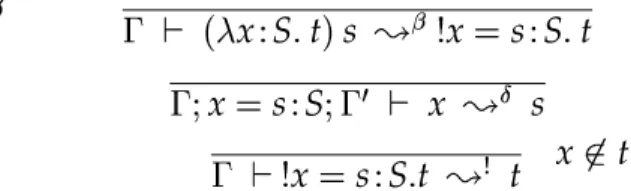
OLEG’s contraction schemes are shown in table 2.1.
Subterms susceptible to the ,à or
contraction schemes are, respectively, -, à - and
-redexes. Note that the property of being aà -redex is implicitly context-dependent. A
term is in normal form if it contains no redexes.
It is perhaps helpful to think ofÄÆÅ andÄÈÇ as ‘work’, whileÄÊÉ is ‘waste disposal’.
As a fan of Fritz Lang’s 1926 classic silent film, ‘Metropolis’, I like to imagine what computation sounds like: Â -reduction sounds like paper-shuffling; Ã -reduction sounds
like filing cabinets and photocopiers;
pops like sudden suction.
DEFINITION: compatible closure
IfÄÊË is a contraction scheme, its compatible closure,Ä
Ë
 dv">PÌ; 67@&f ÄÆÅ PLX ; 6Í@ à ¹¼ PLX ; ¼y¹SÁο PÏÄÈÇ ¹À¿ PGX ; 6¨@ÐÄÊÉ@ P.ª @
Table 2.1: contraction schemes
¹Ñ¿ ÄÊË Á ¹Ñ¿ Ä Ë Á ¹Ñ¿ Ä Ë Á ¹À¿ @ÒÄ Ë Á @ ¹«¿ @ÒÄ Ë @ Á ¹À¿ @ÒÄ Ë @ Á ¹À¿ Ä Ë Á ¹Ñ¿ qsPÓ; 6 Z Ä Ë qsPÌ; Á 6 Z ¹À¿ Ä Ë Á ¹«¿ "=PÌ; 6Ô@ÐÄ Ë ">PÌ; Á 6Ô@ ¹À¿ Ä Ë Á ¹À¿ PLX ; 6¨@ÐÄ Ë PGX Á ; 6Í@ ¹À¿ Ä Ë Á ¹À¿ PX ; 6@ÒÄ Ë PGX ; Á 6Í@ ¹¼y¢ º ¿ @ÐÄ Ë @ Á ¹«¿Õ¢ º 6@ÒÄ Ë ¢ º 6¨@ Á
Table 2.2: compatible closure
¹«¿ ×Ö X Z ¹À¿ Ø Z
¹À¿hÙ ØÏ ¹«¿ }Ø
Z ¹Ñ¿ÚÙ Ø Z ¹À¿ 'ax Ø u[wyxTz ÛYÜ ¹Ñ¿ u[wyxTz¨ Ø u[wyxTz \ ¹À¿ ÝÖ X Á ¹¼ qsP; Á ¿ Z Ø Z Á ¹À¿ qsPÓ; 6 Z Ø qsPÌ; Á 6 Z Á
empty ·(¸
¿
valid
declare
¹Ñ¿
;Ìu[wyxTz ¹¼y¢
PÌ; ¿
valid
¢
.Þ
q
"Sß
define
¹À¿
;
¹¼ PGX
;
¿
valid
prop
¹À¿
valid
¹À¿
'axÈ;Ìu[wyxTzaà
type
¹À¿
valid
¹À¿
u[wyxnz ;Qu[wyxnzBá
R
var
¹¼ PQ;
¼y¹ Á ¿
valid
¹¼ PQ;
¼y¹SÁ¿ PÑ;
imp
¹¼ qsP;
¿Úâ
;Ì'ax ¹Ñ¿
qsPÌ;
6
â
;Q'ax
all
¹À¿
;u[wyxTz ¹¼
qsP;
¿
Z
;Ìu[wyxTz¨ ¹À¿
qsPÌ;
6
Z
;Qu[wyxTz
abs
¹¼ "=P;
¿ @};
Z
¹Ñ¿ "=PÓ;
6Ô@;qsPÓ;
6
Z
app
¹À¿
¡
;ãqsPÌ;
6
Z
¹À¿
;
¹À¿
¡
;
PX
;
6
Z
let
¹¼ PLX
;
¿ @;
Z
¹À¿
PX
;
6Í@;
PGX
;
6
Z
cuml
¹À¿ @;
¹À¿ @;
Z
¹À¿
Ø Z
METATHEOREM: Church-Rosser
¹À¿
Ö
X
@
implies existence of a common reductä such that
¹À¿ å
ä
¹À¿
@
å
ä
METATHEOREM: strengthening
¹¼
º
¼¹ Á ¿ @;
Z
Pª ¹ Á
@
Z
implies
¹¼y¹SÁο @;
Z
METATHEOREM: subject reduction
¹À¿
;
Z
¹À¿ å
@
implies
¹À¿ @;
Z
METATHEOREM: strong normalisation
¹À¿ @;
Z
ensures that@ is strongly normalising.
METATHEOREM: cut
¹¼ PGX
;
¼y¹SÁο @;
Z
implies
¹¼
°
±
P`² ¹SÁο
°
±
PW²@};K°
±
PW²
Z
Henceforth, I shall elide the context in casual discussion. I writeÄ for the union of the
labelled compatible closures, andå
for its finite transitive closure. A term is strongly normalising if admits only finite sequences of reductions. The smallest equivalence relation closed underå
is called conversion and denoted
Ö
X .
Observe that
-binding allows us to avoid meta-level substitution in describing compu-tation. Explanations of identifiers are activated by putting them into the context, not by propagating them through terms. The traditional -contraction
d("=PQ;
6Í@(f
Ä °
±
PW²I@
becomes a ‘noisier’ reduction sequence
d("=PQ;
6Í@(f
Ä Å
PLX
;
6Í@Ä ÇæÍæÍæ
PGX
;
69°
±
PW²I@Ä É °
±
P²@
Following Luo, I combine the notions of conversion and universe inclusion in a type cumulativity preorder with respect to Ö
X :
DEFINITION: cumulativity
The cumulativity relation, Ø
, is defined inductively in table 2.3.
In [Luo94], Luo shows that
Ø
is antisymmetric and hence a partial order with respect to
Ö
X . In fact, every well-typed term@ (under
¹
) has a principal type
Z
in the sense that
¹Ñ¿ @;
Z Á çè
¹À¿
Z Ø Z Á
.
Consequently it will be my habit to omit the index in u[wyxTz where uncontroversial—
this phenomenon is known as typical ambiguity [HP91]. In practice, the cumulativity constraints required to ensure consistency of any development can be stored as a finite directed graph and checked for offending cycles.
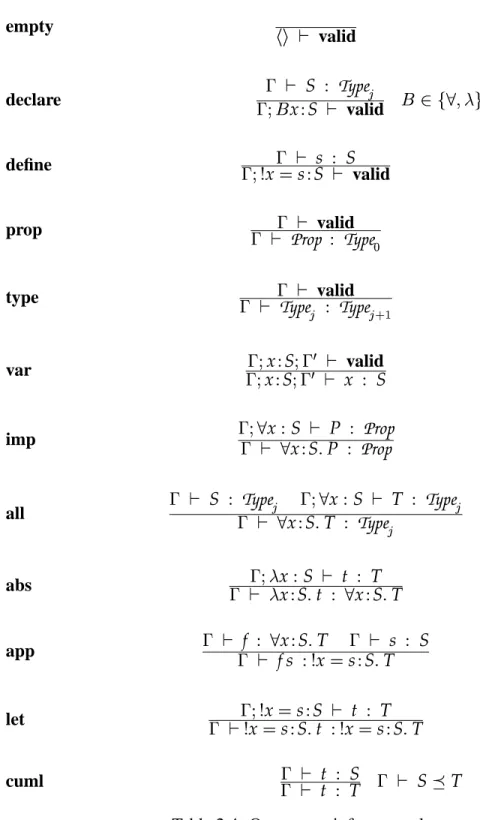
The system of inference rules for the validity of contexts and typing judgments in the OLEG core calculus is given in table 2.4. The formulation is slightly unusual in that it involves no meta-level substitution in types—the same job is done by the computa-tional behaviour of local definition, as performed by the cuml rule.
All the usual metatheoretic properties (see table 2.5) hold as we might expect them to. They contribute no insight unavailable from the Luo’s treatment of ECC in [Luo94]. Severi and Poll have shown how to extend dependent type systems with local defini-tions [SP94]. The Church-Rosser property follows by the ‘parallel reduction’ argu-ment of Tait and Martin-L¨of, as modernised by Takahashi[Tak95]. Subject reduction,
strengthening and cut follow by induction on typing derivations, differing only in mi-nor details from the proofs for ECC. I have omitted weakening from the list because it is a special case of the monotonicity property which I shall prove in section 2.2.2.
Strong normalisation for the OLEGcore is a direct consequence of strong normalisation
for ECC. In the style of Severi and Poll, a type-preserving translation maps OLEG
terms to ECC terms adding apparently pointless  -redexes
4, so that each step in an
OLEG reduction sequence can then be simulated by a step in an ECC reduction of its translation. Consequently, an infinite reduction sequence for a well-typed OLEG term becomes an infinite reduction sequence for a well-typed ECC term, and we know that no such thing exists.
The interesting aspect of OLEG is its development superstructure. Let us now give our
attention to that.
2.2
the O
LEG
development calculus
‘You can’t put a hole where a hole don’t belong.’ (Bernard Cribbins)
Holes stand for the parts of constructions we have not yet invented. Every hole should tell us two things about the candidates which may fill it:
their type,
Z
the context, ¹
, of variables they may employ
We may ascribe these properties to the hole itself, by way of convenient abbreviation. The point is that it must be safe to fill such a hole with any @ such that
¹ ¿ @h;
Z
. Solutions must be locally checkable if working with holes is to be practicable.
As I have already mentioned, the treatment of holes for simple type systems is greatly helped by the fact that terms do not ‘leak’ into types. Consequently, any subterm may safely be replaced by another of the same type, without affecting the type of the containing term—local checkability of hole solutions is just one special case. Holes may safely be represented by unlabelled ? symbols, as typing places no dependency between them.
4It may help to think of the translation to ECC as tying old tin cans onto terms to make the ECC
However, the application of a dependently typed function smuggles the argument term into the result type—this is why the replacement property fails. Consider the following example, in a context defining an equality symbol for natural numbers:
"!êé ;
¬
¬
'ax "2ë7ì{íéÑ;rqsJÒ;
6J!)é'J "WîðïWñ
é
;rqsg
Jj;
6Bgò!êéJ
¬
J!)é)g
It may be reasonable to infer that
îðïWñ
é
Ód¦ë[ì~í5éNÔfó;Ô[!+é5
but we may not instantiate any of the ?s and retain this typing unless we instantiate them all—îðïWñ
é ’s first two arguments appear in the required type of
d¦ë[ì~í5éÔf.
Somehow we must represent the information that the three ?s in îôïWñ
é
Ójd¦ë[ì~í5éÔf
signify the same, and what more natural way could we choose than to give them a single sign?
Hence, let us invent a new binding operator ‘?’ (pronounced ‘hole’) to introduce vari-ables standing for holes in a proof which must be instantiated by a common candidate of an appropriate type. We may now add to the context
BP;
and infer
îðïWñ
é
PQPGd¶ë7ì{íéÛPofó;APW!)é)P
When we think of a suitable candidate, we may ‘solve the hole’ by changing the
-binding to, say,
PGX^FÌ;
, and the typing will stand.
However, the danger has not gone away. We could quite reasonably infer
îðïWñ
é
d(BJÒ;
6BJêfdvJÒ;
6BJêfd¦ë[ì~í5éNBJj;
6BJ+fó;ÍJÐ;
6õJÛ!)éNBJÐ;
6BJ
since one binding BJG;
6~J is syntactically identical to another, even if we regard the
bound variables as distinct (indeed, not in the same scope). We are not free to solve one without the others, so we must avoid this situation.
The point is that although there is nothing wrong with holes leaking into types, disas-ter strikes if we permit -bindings to do so. The OLEG development calculus ensures
that -bindings are always in safe places—ie, that they may always be solved
indepen-dently. Indeed, this arises as a corollary of a more general replacement property, just like in the simply typed case.
By introducing an explicit binding operator for holes, OLEGfollows Dale Miller’s lead
[Mil91, Mil92] in representing the state of the system as a judgment whose context or ‘mixed prefix’ explains the variously quantified variables involved.
The OLEG development calculus represents the store of a theorem prover directly at the judgment level. Theorem provers tend to contain four kinds of information:
assumptions
proved theorems
unproved claims
partial proofs of claims
These four components are each represented by a form of binding—respectively, the four given in the definition below. A state is a context of such bindings. The terms of the development calculus are called partial constructions.
DEFINITION: states, components and partial constructions
states ö´U÷~´vz
·&¸ ö´U÷r´Uz
ø«
ö´v÷~´vz ù
³
ø ¼
ù
ö´v÷~´Uz
components ³
for
P
Sú
u
"=P; }
³
=
u
PX
;
³
u
BP; }
³
û
}
u
BPü
û
;
³
partial constructions
@
u
@
ù
³ ý
S£4¤¦¥r§ ùÎ6
ý
Observe that partial proofs, or ‘guesses’ are attached to holes with a ‘ü ’ symbol,
indi-cating that they have not the computational force of
-bound values attached with ‘=’. Indeed, we may view any state
ø
as a core context by forgetting all but the ‘:’ and ‘=’ properties of each variable. This, in particular, means that guesses are invisible to the core.
States ø
in the development calculus are equipped with ø
-judgment forms þz&ÿ$½
corresponding to those of the core. If ¾
þz&ÿ$½ , we may assert that ¾ holds by
writing
ø ¾ .
þz&ÿ$½ is given by
valid þz(ÿ$½
ý
Z
u
ý
;=u
þz(ÿ$½
Even the abstract form of the typing judgment contains an important piece of information—the development calculus does not extend the type system, only the lan-guage of terms. Holes are never bound to the right of the ‘:’. This only serves to emphasise the analytic view that types come before terms—we do not explain terms with types, we search for terms inside types.
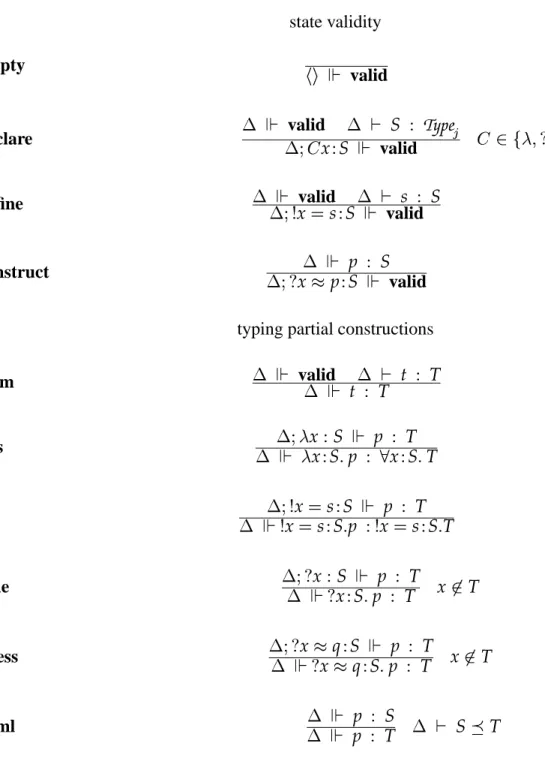
Table 2.6 shows the new inference rules. Note that core judgmentsø ¿
¾ only validate
ø
viewed forgetfully as a core context—any guesses in ø
will not be checked. This accounts for the extraø
valid premises appearing in some rules.
The analogous metatheoretic properties from table 2.5 continue to hold for this ex-tended system. The parallel reduction treatment for Church-Rosser and the derivation inductions for subject reduction, strengthening and cut can easily be adapted. Strong normalisation for the development calculus reduces to strong normalisation for the core by a translation argument which adds the assumptionvgj|JWÐ;4qs8t;vu[wyxnz(68 at the
root of the context and turning -bindings into
-bindings: every hole without a guess,
P;
, becomesPGü (gÐ|JW
;
, then the translated guesses become
-bound values.
The core terms are embedded in the partial constructions. The forgetful interpretation of states as core contexts allows variables to appear in partial constructions via the term rule. The effect of the core/development separation is thus to restrict where holes may be bound. A partial construction containing no -bindings is said to be pure, that
is, expressible as a core term. Pure terms may, of course, refer to variables -bound in
their context.
In particular, -bindings cannot occur inside applications or
-bound values. This is enough to ensure that they have no interaction whatever with computation. -bindings
state validity
empty ·&¸
valid
declare
ø
valid ø ¿
;u[wyxTz
ø
¼
ùPQ;
valid ù
Þ
"
2ß
define
ø
valid ø ¿
;
ø
¼
PGX
;
valid
construct
ø
ý
;
ø ¼ BPLü
ý
;
valid typing partial constructions
term
ø
valid ø ¿ @;
Z
ø @};
Z
abs
ø ¼ "=Pk;
ý
;
Z
ø ">PÌ;
6
ý
;ãqsPÓ;
6
Z
let
ø
¼
PLX
;
ý
;
Z
ø m PLX
;
6
ý
;
PX
;
6
Z
hole
ø ¼ BPk;
ý
;
Z
ø PÌ;
6
ý
;
Z
Pª
Z
guess
ø ¼ PLü
û
;
ý
;
Z
ø BPLü
û
;
6
ý
;
Z
P.ª Z
cuml
ø
ý
;
ø
ý
;
Z
ø
¿
Ø Z
are allowed to appear in ‘guesses’—partial constructions attached to holes as potential solutions. However, unlike
-bindings, guesses are merely typechecked annotations— they have no computational behaviour and hence no effect on subsequent typing.
In fact, the only contraction scheme at the partial construction level is
-contraction removing spent value bindings.
ø t PGX ; 6 ý Ä É ý P.ª ý
All the other computations occur within embedded terms via the closure rules given below. Of courseà -reduction in terms can exploit
-components in the context.
ø ¿ @ÒÄ Ë @ Á ø @ÒÄ Ë @ Á ø ¿ Ä Ë Á ø "=PQ; 6 ý Ä Ë ">PÌ; Á 6 ý ø ¿ Ä Ë Á ø BPÌ; 6 ý Ä Ë BPÌ; Á 6 ý ø ¿ Ä Ë Á ø D PGX ; 6 ý Ä Ë PX Á ; 6 ý
ø ¿
Ä Ë Á ø m PLX ; 6 ý Ä Ë PGX ; Á 6 ý ø û Ä Ë û Á ø BPü û ; 6 ý Ä Ë BPü û Á ; 6 ý
ø ¿
Ä Ë Á ø PLü û ; 6 ý Ä Ë BPü û ; Á 6 ý ø ¼ ù ý Ä Ë ý Á ø ù 6
ý
Ä
Ë
ù 6
ý
Á
A crucial role is played by the side-conditions in the hole and guess rules. These insist that although the term under a -binding may exploit the bound variable, its type may
not. Without them, we should have to allow -bindings in types. Furthermore, these
restrictions simply reflect the natural ways in which holes arise—in a refinement style proof, we only make claims motivated by the need to construct an inhabitant of a type which we already know.
The inability to leak into types is something partial constructions share with terms in simply typed systems. We should expect the replacement property to follow easily, and in exactly the same manner—replacing the typing subderivation for the replaced term.
2.2.1
positions and replacement
The positions
are formed from the partial constructions
by deleting one sub-partial construction. A position
â
â
which collects the components under which the deletion point lies. If ý
, thenâ ° ý
² denotes the partial construction obtained by inserting ý at
â
’s deletion point. Positions are defined inductively as follows
DEFINITION: positions
ForP Sú S â S _£2¤¦¥~§ ³ 6 â â } u û S£4¤¦¥r§ BPGü â ; 6 û ° ý ²9X ý ø ¼ X ø dõ³ 6 â fr° ý ²9Xh³ 6 â ° ý ² ø ¼ ³ 6 â X ø ¼ ³ ¼ â d(BPGü â ; 6 û fr° ý ²9XmBPü â ° ý ²7; 6 û ø ¼ BPLü â ; 6 û X ø ¼ â
Crucially, any derivation of
ø â ° ý ²Ê; Z
follows from a subderivation of some
ø ¼ â ý ; .
We may compose positions, writingâ̼(â
Á
for the position obtained by replacing the
inâ
byâ
Á
. Clearly d âQ¼(â Á fr° ý ²KX â ° â Á ° ý ²E² and âQ¼(â Á X â̼ â Á .
METATHEOREM: replacement
If ø â ° ý ²Û; Z
follows from ø ¼
â
ý
;
Ù
and ø ¼
â ý Á ; Ù then ø â ° ý Á ²; Z PROOF
The proof is by induction over the derivation ofø â
°
ý
²G;
Z
, then case analysis on the position.
In all cases where the position is
, ieâ
°
ý
²ÛX
ý , the typing derivations for
â
°
ý
² and
ý
must be the same, yielding thatÙ
is
Z
—the conclusion is exactly the typing ofý
Á
.
We only need the strength of the induction when the position is nontrivial.
term—
is the only position
abs
We have ø
">PÌ; 6 â ° ý ²;qsPÌ; 6 Z
so we must have
ø ¼ "=P; â ° ý ²Û; Z following from ø ¼ "=P; ¼ â ý ; Ù Suppose ø ¼ "=P; ¼ â ý Á ; Ù Inductively ø ¼ "=P; â ° ý Á ²; Z Hence ø ">PÌ; 6 â ° ý Á ²ò;ãqsP; 6 Z
let, hole
We go under the component in the same way as for abs.
guess
If the position goes under the component, the above argument applies. If the position goes into the guess:
We have ø
BPGü
â
°
ý
²7;
6
û
;
Z
so we must have
ø
â
°
ý
²;
following from
ø
¼
â
ý
;
Ù
Suppose ø ¼
â
ý
Á
;
Ù
Inductively
ø
â
°
ý
Á
²Û;
Hence
ø BPGü
â
°
ý
Á
²[;
6
û
;
Z
Note that the typing ofû
and the side-conditionP ª
Z
are not affected by the change of guess.
To claim that the simplicity of this theorem belies its utility is to misunderstand the pragmatics of theory. There is no utility without simplicity.
2.2.2
the state information order
We shall need a little more metatheoretical apparatus before we are ready to reconstruct theorem proving in OLEG. In particular, we shall need a notion of ‘progress’ between
OLEG states. The idea is that a state
ø Á
‘improves’ø
if it contains at least as much information—
ø
Á
must simulate the behaviour of every variable in
ø
.
DEFINITION: state information order
For valid statesø
and ø Á
, we sayøhø Á
, if
For eachP Nø
, ifø ¿ PÕ;
Z
thenø ÁÒ¿ PÕ;
Z
.
For eachP Nø
, if
ø
¿
PYÄÈÇ
then
ø
Á¿
P
Ö
X
.
is clearly a preorder.
Notice that inserting new components intoø
moves it up the order. So does replacing a type-only binding or -with-guess by a
-binding of an appropriately typed value. Fur-thermore, guesses may be added to holes, removed or modified at will, so long as their