515
Learning A Unified Named Entity Tagger From Multiple Partially
Annotated Corpora For Efficient Adaptation
Xiao Huang1,2, Li Dong3∗, Elizabeth Boschee1, Nanyun Peng1,2 1Information Sciences Institute, University of Southern California
2Department of Computer Science, University of Southern California
3Outreach, Inc.
{huan183, lidong}@usc.edu, {boschee, npeng}@isi.edu
Abstract
Named entity recognition (NER) identifies typed entity mentions in raw text. While the task is well-established, there is no universally used tagset: often, datasets are annotated for use in downstream applications and accord-ingly only cover a small set of entity types relevant to a particular task. For instance, in the biomedical domain, one corpus might an-notate genes, another chemicals, and another diseases—despite the texts in each corpus con-taining references to all three types of enti-ties. In this paper, we propose a deep struc-tured model to integrate these “partially an-notated” datasets tojointlyidentify all entity types appearing in the training corpora. By leveraging multiple datasets, the model can learn robust input representations; by build-ing a joint structured model, it avoids po-tential conflicts caused by combining several models’ predictions at test time. Experiments show that the proposed model significantly outperforms strong multi-task learning base-lines when training on multiple, partially an-notated datasets and testing on datasets that contain tags from more than one of the training corpora.1
1 Introduction
Named Entity Recognition (NER), which identi-fies the boundaries and types of entity mentions from raw text, is a fundamental problem in natu-ral language processing (NLP). It is a basic com-ponent for many downstream tasks, such as rela-tion extracrela-tion (Hasegawa et al., 2004; Mooney and Bunescu,2005), coreference resolution (Soon et al., 2001), and knowledge base construction (Craven et al.,1998;Craven and Kumlien,1999).
∗
Work done while the author was at USC ISI. 1The code and the datasets will be made available at
https://github.com/xhuang28/NewBioNer
One problem in NER is the diversity of en-tity types, which vary in scope for different do-mains and downstream tasks. Traditional NER for the news domain focuses on three coarse-grained entity types:person,location, and organi-zation(Tjong Kim Sang and De Meulder,2003). However, as NLP technologies have been applied to a broader set of domains, many other entity types have been targeted. For instance,Ritter et al. (2011) add seven new entity types (e.g., product,
tv-show) on top of the previous three when an-notating tweets. Other efforts also define differ-ent but partially overlapping sets of differ-entity types (Walker et al., 2006; Ji et al., 2010;Consortium, 2013; Aguilar et al., 2014). These non-unified annotation schemas result in partially annotated datasets: each dataset is only annotated with a subset of possible entity types.
One approach to this problem is to train individ-ual NE taggers for each partially annotated dataset and combine their results using some heuristics. Figure 1 shows an example that demonstrates the possible shortcomings of this approach, using the biomedical domain as a case study.2 Here, we train four separate models on four partially annotated datasets: AnatEM (Pyysalo and Ana-niadou, 2013) annotated for the anatomy type, BC2GM (Smith et al., 2008) for the gene type, JNLPBA (Kim et al., 2004) for cell types, and Linnaeus (Gerner et al., 2010) for the species
type. We can see that the models’ predictions contradict each other when applied to the same test sentence—making it a challenge to accurately combine them.
In this paper, we propose a deep structured model to leverage multiple partially annotated datasets, allowing us to jointly identify the union
2https://corposaurus.github.io/
Figure 1: An example sentence from the CellFinder corpus (Neves et al.,2012) showing the challenges in combin-ing the output of individual NE taggers. TheGoldrow is the human annotations in CellFinder. The rows below are predictions made by models trained on datasets that each contain only a subset of the CellFinder types. Note that the individual taggers’ predictions can conflict with each other, making it challenging to combine them. (Note: we renamed CellFinder’sCell ComponenttoCell Typeto fit it in the space above.)
of all entity types presented in the training data. The model leverages supervision signals across diverse datasets to learn robust input representa-tions, thus improving the performance for each en-tity type. Moreover, it makes jointpredictions to avoid potential conflicts among models built on different entity types, allowing further improve-ment for cross-type NER.
Experiments on both real-world and synthetic datasets show that our model can efficiently adapt to new corpora that have more types than any individual dataset used for training and that it achieves significantly better results compared to strong multi-task learning baselines.
2 Problem Statement
We formally define the problem by first defining our terminology.
Global Tag Space.LetCidenote a corpus, and
TCi denote the set of entity types that are tagged
in corpus Ci. When there are a set of corpora
C={C1, C2, ..., Cn}, each has its own tag space
concerning different entity types, the global tag space is defined as the union of the local tag space. Formally,TC=TC1 ∪TC2 ∪...∪TCn.
Partially Annotated Corpus. If TCi $ TC,
thenCiis a partially annotated corpus.
Global Evaluation. When a model is trained on a set of partially annotated corporaCand pre-dicts tags for the whole global tag space TC, we say it is makingglobal predictions. Accordingly, the evaluation of the models’ performance onTC is calledglobal evaluation.
Our goal is to train a single unified NE tagger from several partially annotated corpora for ef-ficient adaptation to new corpora that have more types than any individual dataset used during training. Formally, we have a set of corpora C = {C1, C2, ..., Cn}, and we propose to train
a joint model on C such that it makes predic-tions for theglobal tag spaceTC. One benefit of this joint model is that it can be easily adapted to a new tag space TCu where TCu ⊆ TC, and
TCu*TCi,∀Ci∈C.
3 Background and Related Work
In this section, we first introduce neural architec-tures for NER which our work builds upon and then summarize previous work on imperfect an-notation problems.
3.1 Neural Architectures for NER
With recent advances using deep neural networks, bi-directional long short-term memory networks with conditional random fields (BiLSTM-CRF) have become standard for NER (Lample et al., 2016). A typical architecture consists of a BiL-STM layer to learn feature representations from the input and a CRF layer to model the inter-dependencies between adjacent labels and perform joint inference.Ma and Hovy(2016) introduce ad-ditional character-level convolutional neural net-works (CNNs) to capture subword unit informa-tion. In this paper, we use a BiLSTM-CRF with character-level modeling as our base model. We now briefly review the BiLSTM-CRF model.
BiLSTMs. Long Short Term Memory networks (LSTMs) (Hochreiter and Schmidhuber,1997) are a variation of RNNs that are designed to avoid the vanishing/exploding gradient problem (Bengio et al.,1994). Specifically, BiLSTMs take as input a sequence of wordsx={xk|k∈ N }and output
a sequence of hidden vectors: H = {hk|k ∈ N }
BiLSTMs combine a left-to-right (forward) and a right-to-left (backward) LSTM to capture both left and right context. Formally, they produce a hidden vectorh˜i = [
− →
hi;
←−
hi]for each input, where
− →
←−
hi are produced by the forward and the backward
LSTMs respectively;[; ]denotes vector concatena-tion.
Character-level Modeling. Following Wang et al.(2018), we use a BiLSTM for character-level modeling. We concatenate the hidden vector of the space after a word from the forward LSTM and the hidden vector of the space before a word from the backward LSTM to form a character-level repre-sentation of the word: hci = [−h→ic;←h−ci]. The word-level BiLSTM then takes the concatenation ofhc i
and the word embedding as inputxi = [ei;hci]to
learn contextualized representations.
Neural-CRFs. Conditional Random Fields (CRFs) (Lafferty et al., 2001) are sequence tag-ging models that capture the inter-dependencies between the output tags; they have been widely used for NER (McCallum and Li,2003;Lu et al., 2015;Peng and Dredze,2015,2016,2017). Given a set of training data{xi,yi}N, a CRF minimizes
negative log-likelihood:
min Θ −
X
i
logP(yi |xi; Θ), (1)
P(yi|xi; Θ) =
Gold Energy P artition =
St(yi)
P
y0St(y0) (2)
where y0 is any possible tag sequence with the same length as yi, St(y0) is the potential of the
tag sequence y0, and St(yi) is the potential of the gold tag sequence. The numerator St(yi) is
called the gold energy function, and the denom-inator P
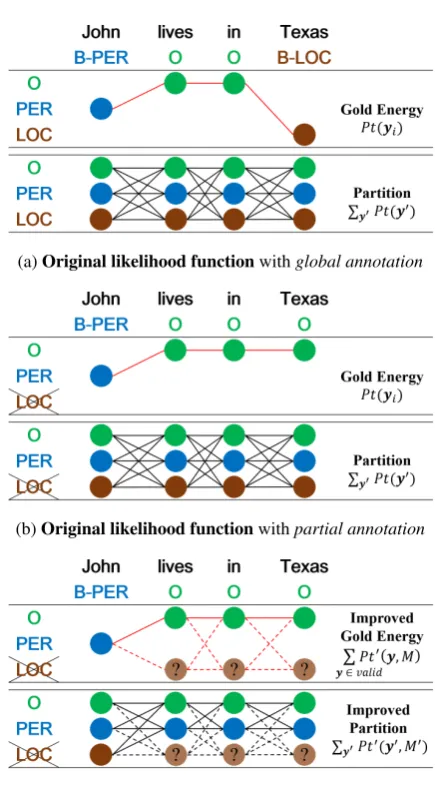
y0St(y0) is the partition function. The likelihood function using globally annotated data is illustrated in Figure 2a. The potential of a tag sequence can be computed as:
St(y) =
|y|
Y
t=1
Score(y[t],y[t−1]) (3)
where y[t]is the tth element iny (y[−1]is the start of the sequence), and
Score(y[t],y[t−1]) = exp (tr(y[t],y[t−1]))∗
exp (em(y[t]))
(4)
wheretr(y[t],y[t−1])is the transition score from y[t−1]toy[t], andem(y[t])is the emission score of y[t] computed based on the output h˜t of the
BiLSTM.
3.2 Learning from Imperfect Annotations
Learning from multiple partially annotated datasets could be more generally thought of as learning from imperfect annotations. In that broad sense, there are several notable areas of prior work. One of the most prominent concerns learning from incomplete annotations (noisy labels), where some occurrences of entities are neglected in the annotation process and falsely labeled as non-entities (negative). A related problem is learning from unlabeled data with distant supervision.
A major challenge of all these settings, includ-ing ours, is that a positive instance might be la-beled as negative. A well-explored solution to this problem is proposed byTsuboi et al. (2008), which instead of maximizing the likelihood of the gold tag sequence, we maximize the total likeli-hood for all possible tag sequences consistent with the gold labels. Tsuboi et al. (2008); Yang and Vozila(2014) applied this idea to the incomplete annotationsetting; Shang et al.(2018);Liu et al. (2014) applied it to theunlabeled datawith distant supervision setting; and Greenberg et al. (2018) applied it to thepartial annotationsetting. While this is a general solution, its primary drawback is that it assumes a uniform prior on all labels con-sistent with the gold labels. This may have the result of overly encouraging the prediction of en-tities, resulting in low precision.
To tackle the problem of incomplete annota-tions,Carlson et al.(2009);Yang et al.(2018) ex-plored bootstrap-based semi-supervised learning on unlabeled data, iteratively identifying new en-tities with the taggers and then re-training the tag-gers. Bellare and McCallum(2007); Li and Liu (2005);Fernandes and Brefeld(2011) explored an EM algorithm with semi-supervision.
For thepartial annotationproblem, most previ-ous work has focused on building individual tag-gers for each dataset and using single-task learn-ing (Liu et al.,2018) or multi-task learning (Crich-ton et al., 2017; Wang et al., 2018). In single-task learning, each model is trained separately on each dataset Ci, and makes local predictions on
TCi. Based on the neural-CRF architecture,
multi-task learning uses a different CRF layer for each dataset Ci (each task) to make local predictions
on TCi, and shares the lower-level representation
predictions and have to apply heuristics to com-bine the model predictions, resulting in the colli-sion problem demonstrated in Figure1.
To the best of our knowledge, Greenberg et al. (2018) is the only prior work trying to build a uni-fied model from multiple partially annotated cor-pora. We will show that their model, which is rem-iniscent ofTsuboi et al.(2008), is a special case of ours and that our other variations achieve better performance. In addition, they only evaluated the model on the training corpora while we conduct evaluations to test the model’s ability to adapt to new corpora with different tag spaces.
4 Model
As mentioned above, we use a BiLSTM-CRF with character-level modeling as our base model. Our goal is to build a unified model to make global predictions. That is, our model will be jointly trained on multiple partially annotated datasets C and make predictions on the global tag space TC. Such a unified model will enjoy the benefit of learning robust representations from multiple datasets just like multi-task learning while main-taining a joint probability distribution of the global tag space to avoid possible conflicts from individ-ual models.
4.1 Naive Approach
A simple solution to the problem is to merge all the datasets into one giant corpus. A single model can then be trained on this corpus to make global pre-dictions. However, such a corpus will be missing many correct annotations, since each portion will be annotated with only a subset of the target entity types. Figure2bshows an example: here, a loca-tion (Texas) exists but is labeled as a non-entity, because the original dataset from which this sen-tence is drawn does not annotate locations at all. As a result, this approach suffers fromfalse penal-tieswhen applying the original likelihood function (Eq. 2-4) to train the model, meaning that it pe-nalizes predictions that correctly identify entities with types that are not annotated for a particular sentence.
4.2 Improving the Gold Energy Function
One way to improve performance is to explicitly acknowledge the incompleteness of the existing “gold” annotations and to give the model credit for predicting any tag sequence that is consistent with
(a)Original likelihood functionwithglobal annotation
(b)Original likelihood functionwithpartial annotation
(c)Improved likelihood functionwithpartial annotation
Figure 2: Illustration of original (2a, 2b) and im-proved (2c) likelihood functions. Each figure has two parts upper and lower that illustrate the gold energy (numerator) and the partition (denominator) respec-tively. Solid lines represent tag sequences that are fully considered in the functions. Dashed lines represent tag sequences that are discounted. The sentences in2band 2care not annotated withLOC.
the partial annotations. This can be done by mod-ifying the CRF’s gold energy function, illustrated in the upper part of Figure2c. Specifically, in this example, John is labeled as PER, so PER is the only possible correct tag at that position. How-ever, lives, in, and Texas are labeled as O (non-entity), which here means only that they may not bePER—but any of them could beLOC, since lo-cations are not annotated for this sentence. There-fore, any sequence that assigns eitherO orLOC
[image:4.595.306.524.59.452.2]that are consistent with the gold annotations, en-couraging the model to predict other consistent la-bels when the gold label isO.Tsuboi et al.(2008) propose a specific solution that applies this idea on incomplete annotations: instead of maximizing the likelihood of the gold tag sequence when op-timizing the CRF model, they maximize the total likelihood of all possible tag sequences consistent with the gold labels. This approach is later used byGreenberg et al. (2018) to handle the problem of partial annotation. We will address a potential problem with their method and propose a general-ized version in Section4.4.
4.3 Improving the Partition Function
Modifying the gold energy function will give credit to a system for producing alternative entity labels for words tagged as O in the partially an-notated training. A different solution is to sim-plynot penalizepredictions of such alternative la-bels. This can be done by modifying the partition function and keeping the gold energy function un-changed. The lower part of Figure2cgives an il-lustration. As stated above, LOC is a consistent alternative entity label forlives,in, andTexas. We therefore exclude from our calculations any paths that includeLOCat any of those positions. More generally, we exclude all such consistent but alter-native tag sequences from the computation of the CRF’s partition function. Section4.4gives formal definitions with equations. The improved partition function sets the model free to predict alternative labels without penalty (as long as they are consis-tent with the known gold annotations), but it does not give them any positive credit for doing so (as in the previous approach). We hypothesize that the improved partition function would work better than the improved gold energy function in our set-ting because it addresses thefalse penalties prob-lem more precisely. We will verify this hypothesis in our experiments.
4.4 Discounting Alternative Sequences
There is a potential problem with naively applying the improved gold energy function: when the gold label isO, the model is encouraged to predict other consistent labels as strongly as it is encouraged to predict O. However, manyOlabels are confi-dent annotations ofO. As a result, naively training with the improved gold energy function tends to over-predict entities and not predict Os. To miti-gate this problem, we discount the energy of tag
sequences that go through alternative labels. This can be achieved by introducing a hyper-parameter M(mask) ∈ [0,1]as a discounting factor for the gold energy function. Formally, we modify Eq3 to:
St0(y, M) =
|y|
Y
t=1
(Score(y[t],y[t−1])∗mask(y[t], M)),
where
mask(y[t], M) =
(
M, ify[t]∈alternative
1, Otherwise .
wherealternativeis the set of alternative labels. We thus have the improved gold energy function:
Improved Gold Energy= X
y∈valid
St0(y, M),
(5) wherevalidis the set of all tag sequences that are consistent with the gold sequence, including the gold sequence itself.
Similarly, for the improved partition function, we can use the same strategy to discount the en-ergy of alternative sequences rather than com-pletely removing them. We thus introduce another M0 ∈ [0,1] and the improved partition function becomes:
Improved P artition=X
y0
St0(y0, M0), (6)
4.5 Combining Improved Functions
For generality, we combine the improved gold en-ergy and the improved partition function to make a new likelihood function as our final model:
Improved LH =
P
y∈validSt
0(y, M)
P
y0St0(y0, M0)
(7)
is the same as proposed in Section4.3. We have a general perspective of all the models by simply treatingM andM0as hyper-parameters.
Note that for theNaive Model, sinceM! = M, the Equation 7 is not always a valid likelihood function3. This may partially explain why the
Naive Model performs so poorly under this set-ting. We posit that the model will work the best whenM =M0.
5 Experimental Setup
5.1 Datasets
Our goal is to train a unified NER model on mul-tiple partially annotated datasets. This model will make global predictions and can efficiently adapt to new corpora that contain tags from more than one training corpus. To fully test this capability, we would need a single test set annotated with all types of interest. However, the motivation behind this effort is that such a dataset typically does not exist. We therefore take two approaches to approx-imate such an evaluation.
In the first evaluation setting, we take advantage of the fact that although there may not be asingle
dataset annotated with all types of named entities of interest, there exist several datasets that cover types from more than one of the training corpora. Specifically, we are able to select test corpora that each cover types of interest from multiple train-ing corpora. Table 1 shows the biomedical cor-pora we use and their entity types. For example, we use BC5CDR for global evaluation, because its entity types (ChemicalandDisease) cover mul-tiple training corpora (BC4CHEM for Chemical
andNCBIforDisease).
In the second evaluation setting, we create synthetic datasets from the CoNLL 2003 NER dataset to simulate training and global evaluations. Specifically, the CoNLL 2003 dataset is annotated with four entity types: location, person, organi-zation, and miscellaneous entities. We randomly split the training set into four portions, each con-taining only one entity type (all other types are re-moved). In this setting, the four portions of the training set are used for training and the
origi-3
This may be confusing because whenM = 0, M0 = 1 it looks exactly the same as the original CRF likelihood func-tion. But in the partial annotation setting, this means that the scores of alternative sequences will be zero in the numerator but non-zero in the denominator, which makes the total likeli-hood less than 1. It suggests that the original CRF likelilikeli-hood function is not suitable for the partial annotation setting.
For Training Corpus Entities
BC2GM GP
BC4CHEM Chemical NCBI Disease
JNLPBA
GP, DNA, Cell-type, Cell-line, RNA Linnaeus Species
For Global Evaluations Corpus Entities
BC5CDR Chemical, Disease
BioNLP13CG GP, Disease, Chemical, others
[image:6.595.310.528.63.191.2]BioNLP11ID GP, Chemical, others
Table 1: Details of the biomedical corpora. “others” denotes NE types that do not appear in the training cor-pora, and thus are not evaluated.
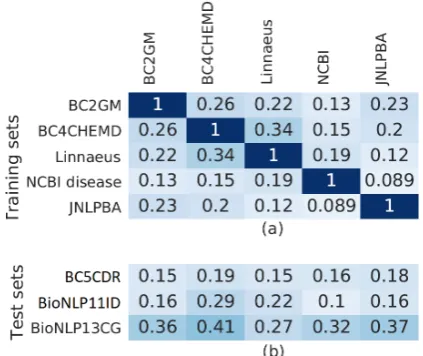
Figure 3: (a) The mention-level overlap among training sets. (b) The mention-level overlap between training datasets and evaluation datasets.
nal dataset with all entities annotated is used as a global corpus.
More details about all the datasets can be found in AppendixA.1.
5.1.1 Biomedical Dataset Analysis
[image:6.595.310.522.256.434.2]opposite direction) to construct B’. We then com-pute the pairwise overlap coefficient between A’ and B’ according to the following criterion:
overlap(A0, B0) = |A
0∩B0|
min(|A0|,|B0|).
Figure 3 shows the heat maps. For the training group, BC2GM, BC4CHEMD, and Linnaeus are considerably overlapped, although they are anno-tated with different entity types (GP, Chemical, and Species). This confirms our assumption that although the datasets are annotated for a subset of entity types, they contain other types that are un-labeled.4
5.2 Hyper-parameters.
We borrow most of the best hyper-parameters re-ported by Wang et al. (2018). The hidden sizes of the BiLSTMs are tuned, and the best value we found is 100 for the character-level BiLSTM, and 300 for the word-level BiLSTM. We also tuned both discounting factors M andM0 in the range of [0,0.2,0.4,0.6,0.8,1.0]. It turns out that M = 0, M0 = 0(using improved partition function) and M = 1, M0 = 1 (using improved gold energy function) make two local optimums. Therefore we report the performance of three special cases of our proposed framework, withM, M0 = [0,0],
[1,1], and[0,1](the naive model), respectively.
5.3 Compared Models.
We compare different variations of our unified model and other models in different settings. We first train models on all training corpora, and then perform evaluations under two scenarios: (1)
no-supervision: directly evaluating the trained models on each global corpora; (2) limited-supervision: fine-tuning the models on a small subset of the training portion of each global cor-pus before the evaluations.
Under both scenarios, we report performance of four different models:
• MTM/MTM-vote: Train a multi-task model (MTM) on training corpora, using a separate CRF for each corpus. (This is the current state-of-the-art structure (Wang et al.,2018) when evaluated on the training corpora.)
4We further verified this conclusion by computing the heat
maps on the original datasets. The overlaps betweenBC2GM
andBC4CHEMD, andBC2GMandLinnaeusare nearly0.
– Under the no-supervision setting, we heuristically combine all existing CRF’s predictions to make global predictions. Specifically, we apply two heuristics to resolve conflicts while preserving entity chunk-level consistency. First, where predictions from more than one model overlap, we expand each predic-tion’s boundary to the outermost posi-tion. Second, we always favor the dictions of named entities over the pre-dictions of non-entity.5
– Under the limited-supervision setting, for each global corpus, we add a new CRF and train it along with the LSTMs.
• Unified-01: Use the naive training approach described in4.1; this corresponds to our uni-fied model with settingsM = 0, M0 = 1.
• Unified-11: Use the improved gold energy function described in 4.2; this corresponds to our unified model with settings M = 1, M0= 1and is equivalent to the model pro-posed byGreenberg et al.(2018).
• Unified-00: Use the improved partition func-tion proposed in4.3; this corresponds to our unified model with settingsM = 0, M0 = 0.
Among the compared models, Unified-01 (the naive model) andMTM/MTM-Voteare either sim-ple or commonly used methods and thus are treated as baselines. Unified-00 is a novel ap-proach. Although Greenberg et al. (2018) used the approach of Unified-11, they only evaluated the model on training corpora/tasks while we ap-ply it for task adaptation. Moreover, it is a special case of our proposed framework, thus we argue that people can simply tuneMandM0to get good performance for adaptations to new tasks.
6 Results
As mentioned above, we compare the results of four different approaches in no-supervision and limited-supervision settings, both with real-world biomedical data and synthetic news data.
As a sanity check, we also evaluate the models on the test sets of the training corpora. The results can be found in Appendix A.2. It is shown that
5A lower recall and f1 score was observed in the initial
Corpus
Trained on Other Biomedical Datasets Traind on CoNLL BC5CDR BioNLP13CG BioNLP11ID CoNLL 2003
F P R F P R F P R F P R
MTM-Vote 63.6 64.4 62.8 61.0 56.7 65.9 50.4 44.8 57.5 83.9 88.4 79.8
Unified-01 42.7 93.7 27.6 37.5 72.5 25.3 23.6 50.8 15.4 01.6 97.8 00.8
Unified-11 70.2 73.8 67.0 67.7 64.0 71.9 53.2 47.1 61.1 80.1 84.6 76.1
[image:8.595.80.521.64.163.2]Unified-00 73.8 84.1 65.7 69.7 68.1 71.5 52.7 49.4 56.5 84.8 90.0 80.2
Table 2: Results for task adaptation in the no-supervision setting. The best f1 score in each column that is signifi-cantly better than the second best is bold-faced, while those are better but not signifisignifi-cantly are underlined. All the significance tests are conducted using mention-level McNemar’s Chi-square test, with p-value=0.01.
50 100 150 200 250 300 350 400 72
74 76 78 80 82
BC5CDR
STM (2k) MTM UM-01 UM-11 UM-00
50 100 150 200 250 300 350 400 68
70 72 74 76 78 80 82
BioNLP13CG
STM (2k) MTM UM-01 UM-11 UM-00
50 100 150 200 250 300 350 400 72
74 76 78 80 82 84 86
BioNLP11ID
STM (2k) MTM UM-01 UM-11 UM-00
50 100 150 200 250 300 350 400 67.5
70.0 72.5 75.0 77.5 80.0 82.5 85.0
CoNLL 2003
STM (all) MTM UM-01 UM-11 UM-00
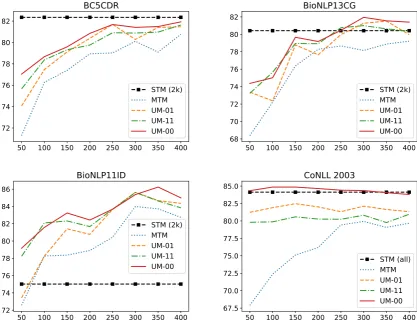
Figure 4: Plot of f1 scores for task adaptation in the limited-supervision setting. X-axis represents the number of sentences used for fine-tuning. STM(2k)is a STM trained on 2k sentences sampled from the global corpus, and
STM(all)is trained on the entire training set of the corpus.
our MTM performs comparably with state-of-the-art systems evaluated on the training corpora, and thus is a strong baseline.
6.1 No-Supervision Setting
Table 2 demonstrates the results for task adapta-tion in the no-supervision setting. We report pre-cision and recall in addition to f1 scores to better show the differences between the models.
Comparing on f1 scores, Unified-00 (our new
model) significantly outperforms all other mod-els on three out of four datasets, demonstrating its effectiveness. Unified-11 also achieves good re-sults, with higher recall but lower precision than
[image:8.595.87.505.231.553.2]en-tities. We also found that the model achieves better performance whenM = M0, which supports our hypothesis in4.5that the model works better with a valid likelihood function.
6.2 Limited-Supervision Setting
To further demonstrate the models’ ability to adapt to new datasets with a small amount of supervi-sion, we sample a small subset of the training por-tion of each global evaluapor-tion corpus to fine-tune the trained models. We show the performance of the models fine-tuned with different amounts of sampled data. For each global corpus, we show a single-task model (STM) trained on it with a rea-sonable amount of data (two thousand sentences for the biomedical corpora). In the CoNLL 2003 setting, we train the STM on the entire training data for a fair comparison, because all other mod-els are first trained on the four training portions, which essentially look through the entire training set (just partially annotated). The results of the STMs are used as benchmarks. Experimental re-sults are presented in Figure4.
Firstly, with much less training data, all the models achieve comparable or noticeably better performance than the STMs trained from scratch, demonstrating that training on the partially anno-tated corpora does help to boost performance on global evaluation corpora. Additionally, MTMs are worse than all the unified models, because they only share the LSTM layers, but lose all the knowledge in the CRFs when adapted to new cor-pora. The unified models have the advantage that they can reuse the robust CRFs learned from a large amount of data. This is more obvious in the CoNLL 2003 evaluation setting, where the unified models that reuse the pre-trained CRFs achieve good performance trained with only 50 sentences, but the MTM, which does not reuse the CRFs, needs a larger amount of training data to catch up. In general,Unified-00, our novel approach pro-posed here, still performs the best on every dataset. We note that althoughUnified-01has an extremely low recall on the CoNLL 2003 dataset in the no-supervision setting, it works surprisingly well in the limited-supervision setting. On the other hand, Unified-00 and Unified-11 generally per-form better thanUnified-01on real-world biomed-ical datasets, especially when fine-tuned on less data. Again, since all the unified models are spe-cial cases of our proposed framework, we argue
that, for adapting to new datasets, people can sim-ply tune the discounting factorsM andM0 to get good results.
7 Conclusion and Future Work
In this paper, we propose a unified model that learns from multiple partially annotated datasets to makejointpredictions on the union of entity types appearing in any training dataset. The model inte-grates learning signals from different datasets and avoids potential conflicts that would result from combining independent predictions from multiple models. Experiments show that the proposed uni-fied model can efficiently adapt to new corpora that have more entity types than any of the train-ing corpora, and performs better than the baseline approaches.
In future work, we plan to explore other al-gorithms (e.g. imitation learning) that allow the model the explore the unknown space during train-ing, using delayed rewards to decide whether the model should trust its exploration. Analysis of the global evaluation results suggests that the unified model is under-predicting, meaning there is still room for improvement specifically on recall. We plan to explore further changes to the current ob-jectives to encourage more entity predictions.
Finally, the approach proposed in this paper also does not handle entity types of varying granular-ities or tagsets with mismatched guidelines (e.g. one dataset annotates only for-profit companies as
ORG and one annotates all formalized groups). Effectively modeling these complications is an in-teresting area for future work.
Acknowledgements
References
Jacqueline Aguilar, Charley Beller, Paul McNamee, Ben V. Durme, Stephanie Strassel, Zhiyi Song, and Joe Ellis. 2014. A comparison of the events and re-lations across ACE, ERE, TAC-KBP, and FrameNet annotation standards. InACL Workshop: EVENTS.
Kedar Bellare and Andrew McCallum. 2007. Learn-ing extractors from unlabeled text usLearn-ing relevant databases. In Sixth international workshop on in-formation integration on the web.
Yoshua Bengio, Patrice Simard, and Paolo Frasconi. 1994. Learning long-term dependencies with gradi-ent descgradi-ent is difficult. IEEE Transactions on Neu-ral Networks.
Andrew Carlson, Scott Gaffney, and Flavian Vasile. 2009. Learning a named entity tagger from gazetteers with the partial perceptron. In AAAI Spring Symposium: Learning by Reading and Learning to Read.
Linguistic Data Consortium. 2013. DEFT ERE anno-tation guidelines: Relations v1.1. Linguistic Data Consortium, Philadelphia.
Mark Craven and Johan Kumlien. 1999. Constructing biological knowledge bases by extracting informa-tion from text sources. InISMB.
Mark Craven, Andrew McCallum, Dan PiPasquo, Tom Mitchell, and Dayne Freitag. 1998. Learning to ex-tract symbolic knowledge from the world wide web. Technical report, Carnegie-mellon univ pittsburgh pa school of computer Science.
Gamal Crichton, Sampo Pyysalo, Billy Chiu, and Anna Korhonen. 2017. A neural network multi-task learn-ing approach to biomedical named entity recogni-tion. BMC bioinformatics.
Rezarta Islamaj Do˘gan, Robert Leaman, and Zhiyong Lu. 2014. Ncbi disease corpus: a resource for dis-ease name recognition and concept normalization.
Journal of biomedical informatics.
Eraldo R Fernandes and Ulf Brefeld. 2011. Learn-ing from partially annotated sequences. In Joint European Conference on Machine Learning and Knowledge Discovery in Databases, pages 407–422. Springer.
Martin Gerner, Goran Nenadic, and Casey M Bergman. 2010. Linnaeus: a species name identification sys-tem for biomedical literature. BMC bioinformatics.
Nathan Greenberg, Trapit Bansal, Patrick Verga, and Andrew McCallum. 2018. Marginal likelihood training of bilstm-crf for biomedical named entity recognition from disjoint label sets. InProceedings of the 2018 Conference on Empirical Methods in Natural Language Processing, pages 2824–2829.
Takaaki Hasegawa, Satoshi Seki, and Ralph Grishman. 2004. Discovering relations among named entities from large corpora. InACL.
Sepp Hochreiter and J¨urgen Schmidhuber. 1997. Long short-term memory.Neural computation.
Heng Ji, Ralph Grishman, Hoa Trang Dang, Kira Grif-fitt, and Joe Ellis. 2010. Overview of the tac 2010 knowledge base population track. InTAC.
Jin-Dong Kim, Tomoko Ohta, Yoshimasa Tsuruoka, Yuka Tateisi, and Nigel Collier. 2004. Introduc-tion to the bio-entity recogniIntroduc-tion task at jnlpba. In
JNLPBA. ACL.
Jin-Dong Kim, Yue Wang, and Yamamoto Yasunori. 2013. The genia event extraction shared task, 2013 edition-overview. In BioNLP Shared Task 2013 Workshop.
Martin Krallinger, Florian Leitner, Obdulia Rabal, Miguel Vazquez, Julen Oyarzabal, and Alfonso Va-lencia. 2015. Chemdner: The drugs and chemical names extraction challenge. Journal of Cheminfo.
John Lafferty, Andrew McCallum, and Fernando CN Pereira. 2001. Conditional random fields: Prob-abilistic models for segmenting and labeling se-quence data. InICML.
Guillaume Lample, Miguel Ballesteros, Sandeep Sub-ramanian, Kazuya Kawakami, and Chris Dyer. 2016. Neural architectures for named entity recognition. InNAACL.
Xiao-Li Li and Bing Liu. 2005. Learning from positive and unlabeled examples with different data distribu-tions. InECML.
L. Liu, J. Shang, F. Xu, X. Ren, H. Gui, J. Peng, and J. Han. 2018. Empower Sequence Labeling with Task-Aware Neural Language Model. InAAAI.
Yijia Liu, Yue Zhang, Wanxiang Che, Ting Liu, and Fan Wu. 2014. Domain adaptation for crf-based
chinese word segmentation using free annotations.
In Proceedings of the 2014 Conference on Em-pirical Methods in Natural Language Processing (EMNLP), pages 864–874. Association for Compu-tational Linguistics.
Yanan Lu, Donghong Ji, Xiaoyuan Yao, Xiaomei Wei, and Xiaohui Liang. 2015. Chemdner system with mixed conditional random fields and multi-scale word clustering. Journal of cheminformatics.
Xuezhe Ma and Eduard Hovy. 2016. End-to-end se-quence labeling via bi-directional lstm-cnns-crf. In
ACL.
Raymond J Mooney and Razvan C Bunescu. 2005. Subsequence kernels for relation extraction. In
NIPS.
Mariana Neves, Alexander Damas, Andreas Kurtz, and Ulf Leser. 2012. Annotating and evaluating text for stem cell research. InBioTxtM workshop at LREC on Building and Evaluation Resources.
Nanyun Peng and Mark Dredze. 2015. Named en-tity recognition for chinese social media with jointly trained embeddings. In Proceedings of the 2015 Conference on Empirical Methods in Natural Lan-guage Processing (EMNLP), Lisboa, Portugal.
Nanyun Peng and Mark Dredze. 2016. Improving named entity recognition for chinese social media via learning segmentation representations. InACL.
Nanyun Peng and Mark Dredze. 2017. Multi-task domain adaptation for sequence tagging. In Pro-ceddings of the ACL Workshop on Representation Learning for NLP.
Sampo Pyysalo and Sophia Ananiadou. 2013. Anatomical entity mention recognition at literature scale.Bioinformatics.
Alan Ritter, Sam Clark, Oren Etzioni, et al. 2011. Named entity recognition in tweets: an experimental study. InEMNLP.
Erik F Sang and Fien De Meulder. 2003. Intro-duction to the conll-2003 shared task: Language-independent named entity recognition. arXiv preprint cs/0306050.
Jingbo Shang, Liyuan Liu, Xiang Ren, Xiaotao Gu, Teng Ren, and Jiawei Han. 2018. Learning named entity tagger using domain-specific dictio-nary. arXiv preprint arXiv:1809.03599.
Larry Smith, Lorraine K Tanabe, Rie Johnson nee Ando, Cheng-Ju Kuo, I-Fang Chung, Chun-Nan Hsu, Yu-Shi Lin, Roman Klinger, Christoph M Friedrich, Kuzman Ganchev, et al. 2008. Overview of biocreative ii gene mention recognition. Genome biology.
Wee Meng Soon, Hwee Tou Ng, and Daniel Chung Yong Lim. 2001. A machine learning ap-proach to coreference resolution of noun phrases.
Computational linguistics.
Erik F Tjong Kim Sang and Fien De Meulder. 2003. Introduction to the conll-2003 shared task: Language-independent named entity recognition. In
CoNLL at HLT-NAACL.
Yuta Tsuboi, Hisashi Kashima, Shinsuke Mori, Hiroki Oda, and Yuji Matsumoto. 2008. Training
condi-tional random fields using incomplete annotations.
InProceedings of the 22nd International Conference on Computational Linguistics (Coling 2008), pages 897–904. Coling 2008 Organizing Committee.
Christopher Walker, Stephanie Strassel, Julie Medero, and Kazuaki Maeda. 2006. Ace 2005 multilingual training corpus.LDC.
Xuan Wang, Yu Zhang, Xiang Ren, Yuhao Zhang, Marinka Zitnik, Jingbo Shang, Curtis Langlotz, and Jiawei Han. 2018. Cross-type biomedical named entity recognition with deep multi-task learning.
CoRR.
Chih-Hsuan Wei, Yifan Peng, Robert Leaman, Al-lan Peter Davis, Carolyn J Mattingly, Jiao Li, Thomas C Wiegers, and Zhiyong Lu. 2015. Overview of the biocreative v chemical disease re-lation (cdr) task. InBC V Workshop.
Fan Yang and Paul Vozila. 2014. Semi-supervised chi-nese word segmentation using partial-label learning with conditional random fields. InEMNLP.
Corpus Named Entities Sents Tokens Mentions
BC2GM Gene/Protein 20,131 569,912 24,585
BC4CHEM Chemical 87,685 2,544,305 84,312
NCBI Disease 7,287 184,167 6,883
JNLPBA
Gene/Protein, DNA, Cell-type, Cell-line, RNA
24,806 595,994 59,965
Linnaeus Species 23,155 539,428 4,265
Table 3: Statistics for the Training Corpora
Corpus Named Entities Sents Tokens Mentions BC5CDR Chemical,
Disease 13,938 360,373 28,789
BioNLP13CG Gene/Protein,Disease, Chemical, Others
1,906 52,771 6881
BioNLP11ID Gene/Protein, Chemical, Others
5178 166416 11084
Table 4: Statistics for global evaluation corpora. “Oth-ers” denote the NEs which do not appeared in training data, thus are not evaluated.
A Appendix
A.1 Datasets
Below we introduce the datasets in the biomedicine domain and the news domain.
A.1.1 Biomedicine domain: Local training group
The training group consists of five datasets:
BC2GM, BC4CHEM, NCBI-disease, JNLPBA, and Linnaeus. The first two datasets are from different BioCreative shared tasks (Smith et al., 2008; Krallinger et al., 2015; Wei et al., 2015).
NCBI-disease is created by Do˘gan et al. (2014) for disease name recognition and normalization.
JNLPBA comes from the 2004 shared task from joint workshop on natural language processing in biomedicine and its applications (Kim et al., 2004), andLinnaeusis a species corpus composed by Gerner et al.(2010). More information about the datasets can be found in Table3.
Below are detailed descriptions of the datasets:
BC2GMis a gene/protein corpus. The annota-tion is Gene. It’s provided by the BioCreative II Shared Task for gene mention recognition.
BC4CHEMis a chemical corpus. The annota-tion is Chemical. It’s provided by the BioCreative IV Shared Task for chemical mention recognition.
Articles Sentences Tokens Training set 946 14,987 203.621
Development set 216 3,466 51,362
Test set 231 3,684 46,435
Table 5: Statistics for the CoNLL 2003 NER dataset
NCBI-diseaseis a disease corpus. The annota-tion is Disease. It was introduced for disease name recognition and normalization.
JNLPBA consists of DNA, RNA, Gene/Protein, Cell line, Cell Type. The an-notation is same as the NE names, except the Gene/Protein is annotated with Protein. It was provided by 2004 JNLPBA Shared Task for biomedical entity recognition.
Linnaeus is a species corpus. The annotation is Species. The original project was created for entity mention recognition.
A.1.2 Biomedicine domain: Global evaluation group
We reemphasize here that the purpose of the global evaluation is to test the model’s ability to making global predictions and efficiently adapt to global corpora. While no corpus is globally annotated, we identify several existing corpora to approxi-matethe global evaluation. Each test corpus is an-notated with asupersetof several training corpora to test the model’s generalizability outside of the local tag spaces.
The global evaluation group contains three datasets: BC5CDR, BioNLP13CG, and
BioNLP11ID. Each is annotated with multiple entity types. BC5CDR comes from the BioCre-ative shared tasks (Smith et al., 2008;Krallinger et al.,2015;Wei et al.,2015). BioNLP13CGand
BioNLP11IDcome from the BioNLP shared task (Kim et al., 2013). More information about the global evaluation datasets can be found in Table4. Below are detailed descriptions of the datasets:
BC5CDR is a chemical and disease corpus. The annotation is Chemical and Disease. It’s pro-vided by BioCreative V Shared Task for chemical and disease mention recognition.
Corpus BC2GM BC4CHM NCBI JNLPBA Linnaeus
STM 79.9 88.6 84.1 72.7 87.3
MTMCrichton et al.(2017) 73.2 83.0 80.4 70.1 84.0
MTMWang et al.(2018) 80.7 89.4 86.1 73.5
-MTM (ours) 80.3 89.2 85.8 73.5 88.5
Unified-01 70.9 83.5 79.8 80.9 79.9
Unified-11 74.2 84.1 80.5 80.9 80.7
[image:13.595.119.483.63.179.2]Unified-00 79.1 87.3 84.0 83.8 83.9
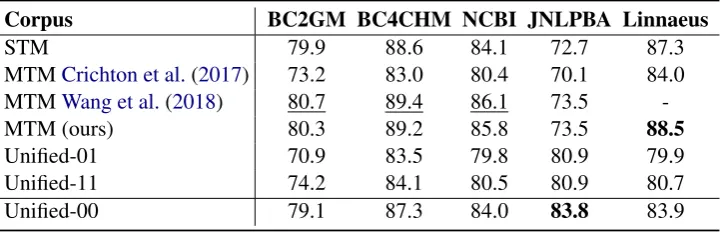
Table 6: Local evaluation (f1 scores). The best results that are significantly better than the second best are bold-faced, while those are best but not significantly better than the second best are underlined. All the significance tests are conducted using mention-level McNemar’s Chi-square test, with p-value=0.01.
There are inconsistencies between the entity type names in different datasets, mainly due to different granularities. To remove this unnec-essary noise, we manually merged some entity types. For example, we unify Gene and Protein into Gene/Protein as they are commonly used in-terchangeably; we merge “Simple Chemical” to “Chemical” and leave the problem of entity type granularity for future work. The information in Table3and4reflects the merged types.
A.1.3 News domain: CoNLL 2003 NER dataset
We use the CoNLL 2003 NER dataset ((Sang and De Meulder,2003)) to evaluate the models in news domain. More information about the dataset can be found in Table 5. We use synthetic data from the dataset to simulate local training and global evaluation. Specifically, the CoNLL 2003 NER dataset is annotated with four entity types: loca-tion, person, organizaloca-tion, and miscellaneous en-tities. We randomly split the training set into four portions, each contains only one entity type re-spectively, with other types changed to ”O”. The models are trained on the four training portions and we test on the original test set with all entity types annotated.
A.1.4 Data split
For the news domain, we use the default train, dev, test portion of the CoNLL 2003 NER dataset. For the biomedicine domain, we follow the data split inCrichton et al.(2017) for both the training and the evaluation groups. All datasets are divided into three portions: train, dev, and test. We train the model on the training set of the training group and tune the hyper-parameters on the correspond-ing development set. Global evaluations are per-formed on the test set of the evaluation group.
A.2 Local Evaluation
For a sanity check, we evaluate the models on the training corpora and compare the results with state-of-the-art systems. In this setting, all the models are trained on the training set of the train-ing corpora (without fine-tuntrain-ing on global eval-uation corpora) and evaluated on their test set. The results are shown in Table 6. STM is the single-task models we implemented, following the settings in Wang et al. (2018). The SOTA is achieved by Wang et al. (2018) with multi-task model, which is shown in the table asMTMWang et al.(2018). They trained their model onBC2GC,
BC4CHM,NCBI,JNLPBA, andBC5CDR.MTM (ours)is the multi-task model we trained on our five training corpora and used as a baseline in the global evaluations. It has the same architecture as Wang et al.(2018).
As we can see, MTM Wang et al. (2018)