i
Abstract
There is an increasing drive to achieve sustainability agenda, as well as climate change challenges. The construction industry is facing increasing pressure to address environmental performance earlier in the design process. For UK buildings, design is believed to be the key in delivering the low carbon agenda. Hence, a fundamental change to designers’ approach in designing for low impact buildings is needed. The ways design decisions are made can greatly influence the outcomes of design. Fundamental design decisions taken early in the design process have far-reaching environmental impacts later on. Better informed design, from the earliest conceptual stage, will improve the design of individual buildings, and help achieve low impact buildings. For this reason, tools have become a necessity for the early and on-going consideration of environmental performance and an important delivery mechanism to aid architects’ design and decision making to deliver the low impact buildings. However, the existing decision support tools had not addressed in full the expectation of architects. Design-decision support tools, specifically the Building Performance Energy Simulation (BPES) are not fully integrated into the design process, to enable UK architects to make informed decision especially at the early stage of the design process. Thus, the study seeks to provide a decision support framework for architects to achieve low carbon housing (LCHs) design in the United Kingdom (UK). It sets out to determine how UK architects can achieve the design; what the needs of architects are in BPES tools characteristics to deliver the design and what design decision tasks are required, towards development of the decision support framework.
ii
architectural practices to investigate the fitness of purpose between decision-support tools and design decision-making to achieve low carbon housing.
Data analysis revealed that there is a lack of fitness between existing decision support tools, in the form of Building Performance Energy Simulation (BPES) tools, and the various stages of the design process. It emerged that architects use BPES tools, primarily at the later stage of the process. Support for the early design stage remains poor, especially at the conceptual stage of the design process. The findings confirmed that design decisions for LCHs vary significantly in terms of level of accuracy, flexibility, and detail. At the early stages of the process, as relatively little information is available, flexibility and approximation in BPES tools is more relevant to support design decisions. As the design develops, and more information becomes available, precision and higher level of detail in BPES tools is required.
iii
Acknowledgements
First, I thank the Lord almighty for being by my side throughout the years of this programme. I am grateful to my supervisory team particularly my Director of Studies, Professor Lamine Mahdjoubi, who inspired, as well as helped me to shape the focus of the study. I am indebted to my other supervisors, Professor Paul Olomolaiye and Dr Colin Booth, who believed in my ability to tackle the research. They provided invaluable feedback on my efforts; they have been unfailingly positive and supportive. I would also like to thank Professor Ming Sun whose thoughtful input in the early stage of the research helped shape its direction. I am indebted for his critical perspectives, which greatly improved the presentation of the arguments at the early stage of the study. My special thanks also go to Dr Paul White, and all the team at Expression Maths for giving me invaluable help and guidance in my statistical analyses needs.
I acknowledge the financial support of the Faculty of Environment and Technology, University of the West of England, Bristol. I am also grateful to colleagues within the school who assisted me in one way or the other.
I am indebted to my family and friends for their moral support and practical assistance. I wish to express my sincere thanks and appreciation to all these people, and some who I have not mentioned, but without whose support, assistance, and encouragement, this work would not have been completed.
iv
Declaration
I, the undersigned, hereby confirm and declare that this thesis ‘Developing Decision Support Framework for Low Carbon Housing design and delivery in the UK’, submitted for assessment is my own work. Materials of other authors (equations, tables, figures, texts and software) used in this work are accordingly acknowledged at the point of their use. A full list of the references used is also included.
………. Abiola Olayemi Baba Date: April, 2012.
v
Table of Contents
Abstract………..i
Acknowledgements……… iii
Declaration………...iv
Table of Contents………... v
List of Figures………... xi
List of Tables……….. xii
Chapter One: Introduction ... 1
1 Introduction ... 1
1.1 Research Background ... 1
1.2 Problem Definition ... 4
1.3 Rationale for the Research ... 5
1.4 Research Aim and Objectives ... 6
1.5 Research Questions ... 7
1.6 Research Methods ... 8
1.7 Organisation of Thesis ... 10
1.8 Summary ... 11
Chapter Two: Climate Change, Housing Regulations and Guidance ... 12
2 Introduction ... 12
2.1 Energy Use and Climate Change ... 12
2.2 Sustainable and Low Carbon Housing ... 16
2.2.1 Sustainability in Housing ... 16
2.2.2 Low Energy and Passive Housing Design ... 19
2.2.3 Low Carbon Housing and Barriers to its Design in UK ... 22
2.2.4 Rationale for Low-Carbon Housing Design ... 23
2.2.5 Policy for Low Carbon Housing Design in the UK ... 25
2.3 Information for Low Carbon Housing Design ... 26
2.3.1 Housing Policies and Regulations ... 26
2.3.2 Building Regulations, Part L1A ... 29
2.3.3 Code for Sustainable Homes ... 31
2.3.4 Green Guide to Specification ... 38
vi
2.4.1 Environmental Assessment and Sustainable Buildings... 40
2.4.2 Environmental Tools at Local and National level ... 44
2.5 Existing Guidance and Tools in the UK ... 46
2.5.1 Planning and Early Design Requirements ... 46
2.5.2 Building Regulations Compliance Tools ... 48
2.5.3 Tools for Sustainability in the UK ... 49
2.6 Summary ... 52
Chapter Three: Design and Decision Delivery Tools ... 53
3 Introduction ... 53
3.1 The Role of Architects ... 53
3.1.1 Architects’ Role in the Traditional Building Delivery Process ... 53
3.1.2 Architects’ Role in Low Carbon Housing Design and Delivery .... 55
3.1.3 Low Carbon Housing Design Principles for UK Architects ... 57
3.2 Design tools and BIM ... 58
3.2.1 Computer based drafting and design tools ... 58
3.2.2 Revit Architecture Suite and BIM ... 62
3.3 Decision Support and Building Performance Simulation (BPS) Tools 65 3.3.1 Decision Support Tools ... 65
3.3.2 Background to BPS Tools ... 67
3.3.3 Application of BPS Tools... 69
3.3.4 Choice of Building Performance Simulation ... 71
3.4 Building Performance Energy Simulation (BPES) Tools ... 73
3.4.1 BPES Tools Functions... 73
3.4.2 Critique of BPES Tools ... 74
3.5 Summary ... 75
Chapter Four: Design Process and Decision Making Framework ... 76
4 Introduction ... 76
4.1 Design and RIBA Outline Plan of Works ... 77
4.1.1 Design and its Process ... 77
4.1.2 RIBA Outline Plan of Works ... 78
4.1.3 RIBA Outline Plan of Work as the Base Line Model ... 79
4.1.4 The RIBA Design Model and Sustainability ... 81
4.1.5 RIBA Design Stages and Sustainability Assessment ... 84
4.1.6 Critique of the RIBA Outline Plan of Work... 87
4.2 Conventional Design Process ... 88
vii
4.2.2 Critique of the Conventional Design Process... 91
4.3 Integrated Building Design Process ... 94
4.4 Other Type of Design Processes ... 95
4.4.1 Purely Theoretical Models ... 95
4.4.2 Rational and Reflex -in -Action Process Model ... 96
4.5 Decision Making ... 98
4.5.1 Decision Making in the Design Process and Sustainability ... 98
4.5.2 Decision Making at the Early Design Stage ... 100
4.5.3 Human Decision-Making Process ... 105
4.5.4 Decision-Making Models and Support Framework ... 107
4.6 Past Models and Frameworks ... 108
4.7 Summary ... 110
5 Introduction ... 111
5.1 Case Based Documentary Study and Analysis ... 112
5.1.1 Rationale for Case- Based Documents Identification ... 113
5.1.2 Credibility of Documents ... 114
5.1.3 Concept Adopted for the Case-Based Documentary Study ... 115
5.1.4 Analysis of the Case -Based Documents ... 116
5.2 Case Based Documents ... 119
5.2.1 Hansen and Knudsrup (2005) ... 120
5.2.2 Pearl (2004) ... 121
5.2.3 Reed and Gordon (2000) ... 122
5.2.4 Energy Star Building Design Guidance ... 123
5.2.5 Federal Facilities and Housing Design Guidance ... 123
5.2.6 Discussion on the Integrated Design Process ... 125
5.3 Level 5, Case-Based Documents ... 126
5.3.1 Case study 1: The Old Apple Store, Stawell, Somerset ... 126
5.3.2 Case Study 2: CO2 Zero, Bristol ... 129
5.3.3 Case Study 3: Mid Street, South Nutfield, Surrey ... 130
5.3.4 Synthesis of Case studies: Design Information Requirements (DIR) 132 5.4 IBDP and Design Information Requirements (DIR) ... 133
5.4.1 Discussion of some other factors in the IBDP ... 137
5.5 Summary ... 143
6 Introduction ... 144
6.1 Research Design and Methodology ... 146
6.1.1 Research Design ... 146
viii
6.1.3 Research Methodology ... 147
6.2 Research Methods ... 152
6.2.1 Mixed Method Approach ... 154
6.2.2 The Paradigm of the Mixed Method Approach... 154
6.2.3 Approach Adopted in the Review Chapters ... 157
6.3 Data Collection ... 158
6.3.1 Interview Design ... 158
6.3.2 Interview Analysis ... 164
6.3.3 Questionnaire Design ... 166
6.3.4 Questionnaire Survey Analysis ... 176
6.4 Development and Evaluation of the DSF ... 177
6.4.1 Rationale and Development for the Framework ... 178
6.4.2 Validation of Research Findings and Evaluating the DSF ... 178
6.5 Research Ethics and Confidentiality ... 179
6.6 Summary ... 180
Chapter Seven: Analysis of Interview Findings ... 181
7 Introduction ... 181
7.1 Overview and Scope of the Interview ... 181
7.2 Interview Findings ... 182
7.2.1 Interviewees’ Profile ... 182
7.3 Design and Decision Support Tools ... 184
7.3.1 Decision Support Presentation ... 189
7.3.2 Barrier(s) to Low Carbon Housing Design and Delivery in UK .. 191
7.4 Statutory and Non Statutory Regulations: CSH ... 195
7.4.1 Uptake on other Statutory and Non-statutory Regulations in UK 197 7.5 Design Information Requirements (DIR) ... 198
7.6 Summary ... 199
Chapter Eight: Results and Analysis of Questionnaire Survey ... 201
8 Introduction ... 201
8.1 Overview of the Questionnaire Design and Response Rate ... 202
8.1.1 Response Rate ... 202
8.1.2 Years of experience ... 203
8.2 BPES Tools and Analysis ... 205
8.2.1 Early Simulation Tools (ETs)... 205
8.2.2 Detail Simulation Tools (DSTs) ... 206
ix
8.3 BPES Tools and Degree of Frequency ... 207
8.3.1 Early Simulation Tools (ETs) and Degree of Frequency ... 207
8.3.2 Detail Simulation Tools and Degree of Frequency ... 208
8.4 BPES Tools and Stages of Design that needs Focus ... 209
8.4.1 ETs and Stages of Design Process that needs focus ... 210
8.4.2 DSTs and Stages of Design Process that needs focus ... 211
8.5 Other Information and Degree of Frequency ... 212
8.5.1 Other Information and Stages of Design Process that need focus 215 8.6 Decision making and Stages of Design ... 216
8.6.1 ETs and Decision making... 218
8.6.2 ETs and Decision Making at stages of Design Process... 219
8.6.3 DSTs and Decision Making ... 220
8.6.4 DSTs and Decision Making at different Stages of Design process 221 8.6.5 The Green Guide to Specification and Decision Making ... 222
8.6.6 Green Guide to Specification and Decision Making ... 223
8.7 Reliability ... 224
8.8 Summary ... 225
Chapter Nine: BPES Tools and Development of the Decision Support Framework ... 227
9 Introduction ... 227
9.1 Existing BPES Tools and Stages of the Design Process ... 227
9.1.1 Preparation Stages ... 228
9.1.2 Concept Stage ... 229
9.1.3 Design Development Stage ... 230
9.1.4 Technical Design Stage ... 233
9.2 BPES Tools Appraisal ... 236
9.3 The DSF Conception and Development ... 239
9.3.1 Developing the DSF ... 240
9.4 Design Process in the DSF ... 243
9.4.1 Preparation and Design Phases in the DSF ... 243
9.4.2 Post Design and Pre-Construction Phase ... 245
9.5 Summary ... 246
Chapter Ten: Discussions of Research Findings and Implications ... 247
10 Introduction ... 247
10.1 Design-Decision and Support Tools ... 247
x
10.1.2 BPES Tools and Decision Making in the Design Process ... 250
10.1.3 Ambiguity and Limitation of Design Tools... 253
10.2 Statutory Regulations: Code for Sustainable Homes ... 254
10.2.1 Cost of Low Carbon Housing Design and Delivery in the UK 255 10.3 Implication of the Study ... 256
10.3.1 Implications for Practice ... 256
10.3.2 Implication for Theory ... 259
10.4 Validation of Research Findings ... 260
10.4.1 External Validation ... 260
10.5 Summary ... 262
Chapter 11: Conclusions and Recommendations ... 263
11 Introduction ... 263
11.1 Achievement of Research Objectives and Questions ... 263
11.2 Recommendations ... 266
11.2.1 Recommendations for Software Developers ... 266
11.2.2 Recommendations for Practice ... 271
11.2.3 Recommendations for Researchers... 273
11.2.4 Recommendations for Policy Makers ... 276
11.3 Contribution to Knowledge ... 276
11.3.1 Dissemination of Research ... 278
11.4 Limitations ... 278
11.5 Scope for Future Work ... 279
11.6 Reflective Summary ... 280
11.6.1 Conclusion ... 281
References ... 283
Appendix 1 : Case Based Documents ... 310
Appendix 2a : Interview Questionnaire ... 318
Appendix 2b : Interview Transcripts ... 320
Appendix 3: Questionnaire Survey ... 326
Appendix 4: Low Carbon House……… 329
xi
List of Figures
Figure 1.1: Research Design of Chapters and Objectives in the Thesis ... 9
Figure 2.1: Initiators of UK low energy housing developments ... 19
Figure 2.2: Code for Sustainable Homes ... 32
Figure 4.1: The DSS decision-making process... 108
Figure 5.1: Method of DIR Development... 119
Figure 5.2: Phases of an integrated design process ... 120
Figure 5.3: Iterations in decision making ... 121
Figure 6.1: Chapter Layout ... 145
Figure 6.2: Research Methods ... 153
Figure7.1: Nvivo-Result-Preview-on-Key-Words-related to Tools ... 188
Figure 7.2: Nvivo keywords preview on key words related to Cost ... 195
Figure 8.1: Years of Experience ... 204
Figure 9.1: Wizards in eQUEST ... 231
Figure 9.2: General workflow in the schematic design wizard of eQUEST .. 231
Figure 9.3: Data Flow of DOE -2.1 engine ... 234
Figure 9.4: DIR from the IBDP ... 241
xii
Lists of Tables
Table 2.1: UK Emission Reduction Targets ... 15
Table 2.2: UK Government Policy Framework on Energy Efficiency ... 27
Table 2.3: Major developments in British building control legislation ... 30
Table 2.4: Design of new houses to various level of the CSHs ... 34
Table 2.5: Advantage of CSH over Eco-Homes ... 37
Table 2.6: Examples of existing green building rating tools ... 43
Table 2.7: Rating system by assessment area ... 44
Table 4.1: Design Process stages split into phases ... 80
Table 4.2: Green Overlay to the RIBA Plan of Works-1 ... 82
Table 4.3: Green Overlay to the RIBA Plan of Works-2 ... 83
Table 4.4: Preferred decision-making techniques for personality types... 106
Table 6.1: Questionnaire Validation ... 172
Table 6.2: Survey Software for Questionnaire Administration ... 174
Table 7.1: Identification of the key word ‘TOOL’ -1 ... 186
Table 7.2: Identification of the key word ‘TOOL’ -2 ... 187
Table 7.3: Key word identification ‘Design Process/Stages’ ... 190
Table 7.4: Identification of the Key word ‘Cost’-1 ... 193
Table 7.5: Identification of the Key word ‘Cost’-2 ... 194
Table 8.1: Respondent years of experience ... 204
Table 8.2: Degree of Frequency ... 208
xiii
Table 8.4: Percentage distribution of DSTs and Stages of Design Process.... 211
Table 8.5: Other Types of Tools and other Information for LCH design ... 213
Table 8.6: Percentage distribution on BIM and Green guide ... 215
Table 8.7: Contingency table of Decision Making and Stages of design ... 217
Table 8.8: Chi square Statistical test between ETs and Decision making ... 219
Table 8 .9: Percentage distribution in the use of ETs and Dm1-Dm5 ... 219
Table 8.10: Chi square Test between DSTs and Dm1-Dm5 ... 221
Table 8.11: Percentage distribution of DSTs and Dm1 -Dm5... 222
Table 8.12: Chi square test between Green Guide and DM ... 223
Table 8.13: Percentage distribution in Green Guide and Decision Making ... 224
Table 8.14: Reliability Test ... 224
Table 8.15: Reliability Analysis ... 225
Table 9.1: Existing BPES Tools at Stages of Design Process ... 228
Table 9.2: Functions of Tools and Application ... 236
Table 9.3: Contrasting Capabilities of existing BPES tools ... 237
Table 9.4: Strengths and Weaknesses of BPES tools in the UK ... 238
1
Chapter One: Introduction
1
Introduction
This study seeks to provide a decision support framework for architects to achieve low carbon housing (LCH) design in the United Kingdom (UK). It investigates the requirements of decision-support tools to support the various stages of the design process to deliver low impact housing.
This is the introductory chapter, which presents the background study, problem definition and the rationale of the research. The aim, objectives, outline of the research methods and overview of the thesis are also presented in this chapter. The content of the chapter can be summarised as follows:
Research Background; Problem Definition;
Rationale for the Research; Research Aim and Objectives; Research Methods;
Organisation of Thesis; and Summary.
1.1
Research Background
Climate change is caused by emission of greenhouse gases into the atmosphere. The consequences of it, coupled with the long term and persistent nature of its impact highlights the need for government intervention. Hence, tackling of energy use through design and development of buildings has become a priority for the UK government, towards adapting low carbon action to have impact on the climate change (Crosbie et al., 2010).
2
from a large number of disciplines (Dibley et al., 2012). Within the building industry, the housing sector alone was responsible for over a quarter (twenty-eight per cent) of the total carbon emission (DEFRA, 2005). The current trend is that this will increase due to new technologies, such as digital radios, plasma TVs, and air conditioning requiring higher energy inputs (CLG, 2007a; Seyfang, 2008). Forbes (2007) posits the existence of environmental concerns in light of anthropogenic climate change have impact on the housing sector, because it is the major energy-consuming, and carbon dioxide producing sectors. Despite some buildings having green credentials, Scofield (2002) observed, they were found to be responsible for as much energy consumption and pollution as comparable to conventional buildings.
This is because, environmental design decisions are taken late in the design process to validate design after critical decisions have already been made (Dunsdon et al., 2006). Early in the design, architects often make decisions regarding the building form, orientation, fenestrations and construction materials with little or no support (Hong et al., 2000). These issues have been observed to have important implications in achieving the low impact building agenda. The way design decisions are made have great influence on the outcome of the design. Fundamental design decisions taken early in the design process have far reaching environmental impacts later on.
Consequently, it is increasingly acknowledged that in order to address climate change challenges, a fundamental alteration to designing for low impact building (LIB) is needed. Thus, design and decision support mechanisms, such as building performance energy simulation (BPES) tools that aid architects’ design and decision making, as well as fitting into various stages of the design process, have become a necessity for the early and on-going consideration of environmental performance. It has also become important for the delivery of low impact housing, especially in the UK.
3
with planning permission requiring technical substantiations of how carbon dioxide emissions target will be met (Royal Institute of British Architects, 2009b). Yet, available design and decision support tools are often criticised as raising barriers between disciplines and between successive design phases (TSB, 2009). These concerns were also reiterated by Dunsdon et al., (2006), who acknowledged that tools in trend, especially those relating to the design of new homes in the UK, such as energy simulation tools, are inadequate to support and inform the design of low carbon buildings, especially at the early stage of the design process. They referred to the fact that simulation tools currently available are only proficient in performing decision already made by the architects before the energy assessment and, consequently there exists low-level adoption of these tools by architects.
Subsequently, rather than playing a role of decision support in the design, analysis is used primarily to verify and rationalise decisions already made (Hopfe and Hensen, 2009). Limitations in both tools and process pose challenges to the integration of simulation in early design. The conversion of 3D models between design and analysis representations is not well supported by existing data transformation mappings, and typically requires expert translation and interpretation (Augenbroe et al, 2004). Furthermore, most simulation tools necessitate detailed information about a building’s construction and services before even an indicative analysis can be performed; information that may not be available at the conceptual design stage (Ellis and Mathews, 2001). These incompatibilities inhibit the development of an interactive information exchange network where design and simulation analysis processes are active simultaneously, and serve as barrier, rather than to reinforce conventional practice (Nicholas and Burry, 2007).
4
challenged to deliver a ‘new generation’ of tools in the design for LIB (Hong
et al., 2000; Morbitzer et al.,2001; Mirani and Mahdjoubi,2012).
1.2
Problem Definition
Traditionally, architects tend to follow an essentially iterative process by which the existing simulation methods have been primarily used to assess designs at the later stages of the process. This is because energy performance has not been a major concern for architects. It has been seen as a subsequent responsibility of service engineers, who are tasked with implementing an already formulated design by adding mechanical systems to address indoor environment conditions (Soebarto and William, 2001). Consequently, if simulation tools are used in design at all by architects, their use is usually confined to optimisation and verification at detailed design development, or late in the project, rather than at conceptual design, where most of the important decisions relating to energy efficiency components are made (Soebarto and William, 2001).
Morbitzer (2003) carried out a survey, which questioned UK architects on the reasons for the limited use of simulation within the architectural design process. The findings revealed that architects are visual professionals and they see simulations as being too abstract. Consequently, the role of energy analysis has been simply to give endorsement to a completed design, rather than to assist the designer during the design process (Morbitzer, 2003). This issue was also stressed by Rudy and Jaksch (2004), who reported that, computer-based design guidance is still largely based on the working concerns of engineers and reflects little of the case-based reasoning style of architects. It was further supported by Lawson (2010) who stated that the downside of the use of such precise programs in the early design stage tends to limit creativity and can encourage poor design.
5
made the following observations about the current generation of design and decision support tools:
Design support at the conceptual stage is particularly poor;
Designers cannot easily predict the impact of alternative design decisions on building performance and cost, whether capital cost, whole life financial cost or carbon cost;
Design professionals work in different ways, through sketches, physical models, 2D and 3D computer representations, and analytically, thus have different requirements for representing and communicating design developments;
Current tools only address the needs of one specialism or specific phase of the design process;
Many current tools are not ‘mainstream’ or accessible to professionals in smaller practices; and
Available tools do not help communicate the impact of design options and decisions between professionals or between professional designers and their clients. It is difficult to incorporate learning from design outcomes in subsequent designs.
Clearly, better-informed design, from the earliest conceptual stages, will improve the design of individual buildings. Consequently, a new generation of tools to support design-decision-making is needed (Hong et al., 2000; Morbitzer et al., 2001).
1.3
Rationale for the Research
6
guides, design tools, although so many, and from variety of sources, seem not to be sufficient towards realisation of the specified target for new homes design in the UK. This is in support of researchers such as William and Lindsay (2007), who argue, the information base available to undertake sustainable review is inadequate.
The construction industry is facing increasing pressure to deliver low carbon buildings (Royal Institute of British Architects, 2009a). Designers, especially architects, have been identified as central to the delivery of low carbon buildings. They play a crucial role in achieving the low carbon targets for homes in the UK because their decisions at the conceptual stage of the design have a major impact on the performance of the building (Oyedele and Tham, 2007). However, existing tools have not been adopted widely by architects, because they do not fit in with the way architects make design decision at various stages of the design process. Hence, adequate decision-support tools to support designers to achieve low carbon housing are seen as critical to achieve more environmentally efficient buildings. Consequently, it is important for architects to have appropriate BPES tools that are in tune with design decisions (Mahdavi, 1998; Soebarto and Williams, 2001) at the various stages of the design process. These tools need be in a format easily understood and interpreted by non-specialist designers (Mahdavi and Silvana, 2003), such as the architects.
1.4
Research Aim and Objectives
7
1. Review low carbon housing design in the UK along with design and Building Performance Energy Simulation (BPES) tools.
2. Evaluate the state-of-the art of BPES tools and other support for architects to deliver the design in UK.
3. Design and develop a theoretical model of design information requirements to deliver low carbon buildings;
4. Develop a decision support framework that defines the characteristics of design decision-support (BPES) tools;
5. Determine the adequacy between design decisions, taken at the various stages of the design process, and Building Performance Energy Simulation (BPES) tools;
6. Outline the implication of research findings on practice, policy and research communities.
1.5
Research Questions
Achievement of the stated aim (to develop the decision support framework) and implication of research towards recommending the findings on practice, policy and research communities, necessitates the qualitative and quantitative elements to answer the following research questions:
What are the requirements of architects in decision support tools, at the different stage of the design process?
Why are UK architects not using the existing design -decision support tools?
If at all they do, what stage (s) of the design process do they use the tools?
What stage of the design process do architects make major design decision?
What are the design decision tasks for architects to deliver the design? How can UK architects achieve low carbon housing design?
8
opinion, questionnaire comments, and textual analysis into the design and interpretation of the quantitative data. This is to provide a deeper understanding of the problem than statistical analysis alone. On the wider context of contribution to knowledge and towards fulfilling the main aim of the research, literatures on integrated design processes (IDP) of /low energy/sustainable housing were reviewed. In this way a conceptual model of the design information requirements, comprising the design decision tasks at each stage of the design process were established, towards the development of the decision support framework, which also, define the characteristics of Building Performance Energy Simulation (BPES) tools, to enable architects achieve the low carbon housing design in the UK.
1.6
Research Methods
A mixed-method approach has been adopted in this study. It has substantial advantages especially when qualitative and quantitative methods are used (Adeyeye et al., 2007; Osmani and O’Reilly, 2009; Isiadinso et al., 2011). Key concepts relating to low carbon housing design in the UK are first examined. Based on this analysis, existing design and decision support tools and other information, which relates to the design and its delivery, were identified to develop informed questions for the qualitative, semi structured, face-to-face in-depth interviews, and the quantitative online questionnaire survey.
9
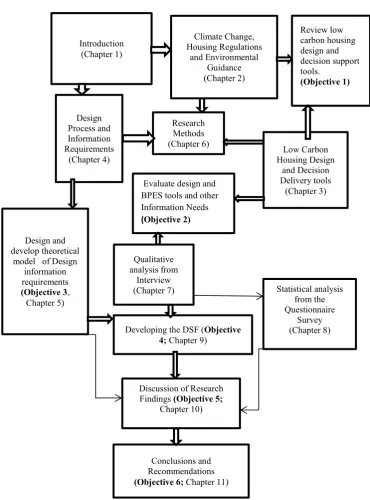
The case-based documentary study and analysis of integrated design processes helped to develop the theoretical model of design information requirements. The analysis assisted in the development of the decision support framework. The research design process is outlined in Figure 1.1.
Climate Change, Housing Regulations and Environmental Guidance (Chapter 2) Review low carbon housing design and decision support tools. (Objective 1) Design and develop theoretical
model of Design information requirements (Objective 3, Chapter 5) Low Carbon Housing Design and Decision Delivery tools (Chapter 3) Introduction (Chapter 1) Design Process and Information Requirements (Chapter 4) Qualitative analysis from Interview
(Chapter 7) Statistical analysis
from the Questionnaire
Survey (Chapter 8) Developing the DSF (Objective
4; Chapter 9)
Conclusions and Recommendations (Objective 6; Chapter 11)
Research Methods (Chapter 6)
Evaluate design and BPES tools and other
InformationNeeds
(Objective 2)
Discussion of Research Findings (Objective 5;
[image:22.595.167.538.204.705.2]Chapter 10)
10
1.7
Organisation of Thesis
Chapter one provides the rationale and context for the study, and outlines the aim and objectives of the research (Figure 1.1).
Chapter two reviews the available literature that address issues on climate change, sustainability, existing regulations, and standards in the UK housing sector. It further discussed the building regulations, Code for sustainable homes (CSH), housing policies, and other relevant guidance.
Chapter three focuses on low carbon housing design and decision delivery tools. It identifies design tools, along with definitions and characteristics of BPES tools for low carbon housing design.
Chapter four examines design information requirements, and decision making at various stages of the design process.
Chapter five presents the theoretical model of design information requirements that helps the classification of the design tasks in the decision support framework.
Chapter six provides a rationale for the methodology and adopted research methods of the study.
Chapter seven presents the results of the interviews with a sample of practicing architects to shed light on the adequacy/inadequacy of the decision support tools, along with their requirements to support architects’ design-decision making.
Chapter eight presents the findings from the questionnaire survey, which seeks to elucidate the relationship between design-decision support tools and information requirements/decision-making at the various stages of the process.
Chapter nine presents the proposed DSF.
11
Chapter eleven presents the conclusions and evaluates the objectives of the research. The recommendations from the research are also discussed.
1.8
Summary
This is the introductory chapter, which outlines the rationale and context for the research. It also highlighted the aim and objectives of the research, as well as presenting an overview of the research methods adopted for this study. The structure and organisation of the thesis was also outlined.
12
Chapter Two: Climate Change, Housing
Regulations and Environmental Guidance
2
Introduction
The aim of this chapter, is to define the requisites and rationales that surround the term ‘low carbon housing and its design’ in the UK. The chapter serves as the background study, as well as fulfilling the first part of objective one, which is to review low carbon housing design in the UK.
To accomplish this, there is the need to appraise existing research efforts through both published/unpublished academic work and documentary studies of relevant reports. In summary, the chapter sets out to review the following issues:
Energy Use and Climate Change; Sustainable and Low Carbon Housing; Information for Low Carbon Housing Design; Environmental Guidance;
Existing Guidance and Tools in the UK, and Summary.
2.1
Energy Use and Climate Change
13
The fourth assessment report on Intergovernmental Panel on Climate Change (IPCC) estimated that between 1970 and 2004, global greenhouse gas emission rose by 70 per cent (IPCC, 2007). From the period of 2004 to 2006, overall costs of fuel and light increased by 35%, while gas prices increased by 45% and electricity prices by 29% in real terms. These price increases represent significant challenges to the fuel poverty targets (Department of Trade and Industry, 2007). The increases are estimated to have driven up total fuel poverty levels by around 1.6 million households in England alone, with income improvements offsetting this by around 300,000 households and energy efficiency improvements by a further 100,000 households. This leads to an estimated additional 1.2 million households in fuel poverty in 2006 compared to 2004. On the central price/income scenario it was estimated that 1.5 million households will remain in fuel poverty in 2010 and 700,000 in 2016 (Department of Trade and Industry, 2007). This includes the effect of installing energy efficiency measures under the fuel poverty programmes.
Estimates of energy used by and in buildings vary, and are highly dependent on the criteria included, in particular, how electricity is generated. Oreszczyn and Lowe (2010) consider 45 per cent to be a conservative estimate for current UK energy use. This, was due to both the general decline in the industrial sector over time and adoption of energy efficient practices (United Nations Environmental Programme, 2009). Hence, if heating, cooling and water heating energy consumption can be reduced to near zero then significant savings can be made in CO2 emissions. The energy consumption during the operational phase of a building depends on a wide range of interrelated factors such as climate and location; level of demand, supply, and source of energy; function and use of building; building design and construction materials; and the level of income and behaviour of occupants. Climatic conditions and the type of environment of which a building is found, affect every aspect of a building’s energy use over its lifetime. Most countries and even states within countries have multiple climate zones.
14
ministry department dedicated to energy efficiency (World Energy Council, 2008). The experience of countries that have implemented energy efficiency measures, following the two major energy crises of the 1970s, show that current barriers to energy efficiency in buildings can be overcome. To do this, UNEP (2009) states that decision makers must have a number of essential ‘building blocks’ in place. These include energy performance requirements, information about the building sector, the capability to analyse this data and the ability to coordinate and facilitate policies, which address Green House Gas (GHG) emissions from buildings (United Nations Environmental Programme, 2009).
15
The Intergovernmental Panel on Climate Change (IPCC) established how climate change is linked to the release of carbon dioxide into the atmosphere, caused from the use of fossil fuels into the built environment (IPCC, 2007). Hence, the Climate Change Act established a legally binding target to reduce the UK’s greenhouse gas emissions by at least eighty per cent. The scientific consensus is that the eighty per cent reduction over 1990 baseline levels of world green gas emissions is required by 2050 for the developed world to stand a good chance of avoiding the dangerous climate change (Boardman, 2007; Adeyeye et al., 2007; Energy Savings Trust, 2008; Reeves et al., 2010). To drive progress and set the UK on a pathway towards this target, the Act introduced a system of carbon budgets which provide legally binding limits on the amount of emissions that may be produced in successive five-year periods, started in 2008 (Table 2.1) (Morant,2012).
Table 2.1: UK Emission Reduction Targets
Carbon Budget Percentage Reduction over Base year(1990)
2008 to 2012 22%
2013 to 2017 28%
2018 to 2022 34%
2023 to 2027 50%
2050 80%
Source: Morant (2012)
16
Some researchers (Goodbun,2008; Broer and Titheridge,2010), however, argue that there exists an equally high level of confusion and uncertainty regarding the precise nature and scale of climatic change, along with the difference that various levels of reduction in the greenhouse gas emission will make to the degree of the problem. Levine et al., (2007) emphasised how climate change literacy, awareness of technological, cultural, and behavioural choices, are important preconditions to fully operating policies. Applying these policy approaches needs to go ‘hand in hand’ with programmes that increase the building-design profession (Levine etal., 2007). This includes, producing tools that fit architects’ design and decision making, along with awareness of the necessary information for design and delivery of low carbon housing stock in the UK. This will reduce carbon emission right from the onset of the architectural design, as well as promote climate change literacy within the profession and the construction industry at large.
2.2
Sustainable and Low Carbon Housing
2.2.1 Sustainability in Housing
‘Sustainability’ is any development that meets the needs of the present without compromising the ability of future generations to meet their own needs. The present inhabitants of the world have a duty to pass it on to the next generation in a state which is no worse than it is now (Brundtland, 1987). Cole (1999) claimed, sustainability emerged as an overarching notion for the environmental discourse and must, therefore, give direction to the structure and application of environmental assessment methods.
17
‘sustainability’ as being inadequate. Their belief is that sustainable development takes place on different scales, and, as such, the quality and availability of water, soil pollution, and noise nuisance etc., all play various roles at different local and regional levels.
The concept of ‘sustainability’ was developed as a result of an adage and a challenge associated with, amongst other things: participatory design processes; planning practices; the economy; the environment; health; nature conservation in urban areas; ecological dimensions; compact human settlements and livable cities (Lawrence, 2000). However, Sodager and Fieldson (2008) argue that tackling environmental sustainability alone is not enough, as there is need for a holistic approach to address all three principles of sustainable development. The holistic approach suggested by Sodager and Fieldson (2008) relies on the collaboration of all stakeholders in the building industry to quantify and interpret emissions throughout the building lifecycle. They further addressed the following three questions:
Why sustainable buildings are required?
What defines a sustainable building?
How they can be obtained?
18
In the UK, the term, ‘sustainable housing,’ emerged as a support alliance in the early 1970s. It was then characterised as an advocacy coalition due to the deep ‘green’ environmental values and beliefs, shared by members whose political activities focused on practical demonstration and life style choice. Sustainable homes were then seen as an extension of the members' deep values and government policy. However, by the 1990s, government and other mainstream institutions became interested in sustainable housing as a solution to a range of policy problems (Baba et al., 2012a).
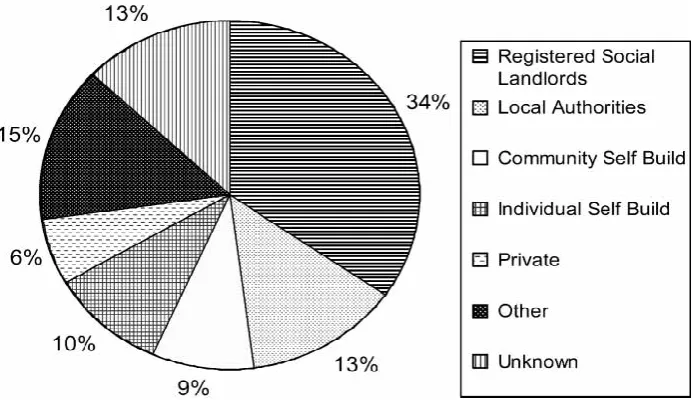
In the broad literature on sustainable housing, `sustainable' seems to refer to a wide range of concepts. However, it is about ecology and the environment, more than technology. It is also about social cohesion, community sustainability, citizen participation, and lifestyles. The term ‘sustainable housing’ in its broadest sense, is to ensure a better quality of life, not just for now but also, for future generations. It should combine protection of the environment, sensible use of natural resources, economic growth, and social progress (Edwards and Turrent, 2005). This notion goes back to the 1990s, but until recently was simply regarded as a methodical or social construct useful in bringing together a heterogeneous set of policies (like the building regulations and planning policy) that directly or indirectly (energy policy and fuel poverty) affect housing sustainability. Sustainable housing is not a new term, as a small number of designers had actually embraced and designed it in the UK. The majority of the design (sustainable housing) is within the social housing sector (Figure 2.1) (Lovell, 2005).
In the last few years, there have been extensive developments in sustainable housing. Several publications have also addressed issues surrounding the term ‘sustainable housing or low energy housing’. This ranges from how to build an individual Eco House (Roaf, 2001; Vale and Vale, 2002) to low energy community housing (eco village) like the Beddington village in London (Bio-Regional Development Group, 2007), built by Bill Dunster. Pamphlets had
19 SSource: Lovell (2005)
Source: Lovell (2005)
Exhibitions, seminars, and conferences, including Eco-build, also target various sustainability issues. The Royal Institute of British Architects (RIBA) contributes through holding exhibitions, working collaboratively with other stakeholders on sustainability issues, and most recently, the introduction of the Green Overlay to the RIBA Outline plan of work. The introduction of the CSH has also increased coverage of sustainable housing in the UK. It has continued to grow in popularity because the government, local authorities, private sector, media, and the public have all acknowledged the seriousness of sustainability, especially in relation to climate change.
2.2.2 Low Energy and Passive Housing Design
[image:32.595.158.505.111.311.2]Low-energy housing is any type of house, which from design, technologies, and building products, uses less energy from any source, than a traditional or average contemporary house. The practice of sustainable design and architecture, low energy building, energy efficient landscaping and low-energy houses, often use active solar and passive solar building design techniques and components to reduce their energy expenditure (Feist, 2005). The meaning of the term 'low-energy house' has changed over time. In Europe, it refers to a
20
house that uses around half of the German or Swiss low-energy standards for space heating. The annual heat requirement of low-energy houses (LEH) is below 70 kWh/(m2a) (Feist, 1997). The heat consumption of low-energy houses is thus at least 50% lower than required by the 1984 German Ordinance. Good thermal insulation, reduced thermal bridges, air tightness, low-energy glazing and mechanical ventilation are decisive features (Feist, 2007).
Low-energy buildings typically use high levels of insulation, energy efficient windows, low levels of air infiltration and heat recovery ventilation, to lower heating and cooling energy (Hansen and Knudstrup, 2005). It should be noted that national standards vary considerably around the world, and 'low-energy' developments in one country may not meet the 'normal practice' in another. Amongst these standards, the passive house concept is regarded as one of the more successful approaches (Hansen and Knudstrup, 2005); hence, many countries look towards Germany to learn how to achieve similar results (Gauzin-Müller, 2002).
Passive solar building design techniques or active solar technologies are also sometimes used, to achieve low energy buildings. The solar building designed homes may use hot water heat recycling technologies to recover heat from showers and dishwashers, while lighting and miscellaneous energy use is alleviated with fluorescent lighting and efficient appliances (Fosdick, 2012). Professor Bo Anderson suggested the idea of the passive house in 1987 (Hansen and Knudstrup, 2005). Since then, it has been further developed by Dr. Wolfgang Feist (Feist, 2010). A passive house (PH) is a building in which the heat requirement is so low that a separate heating system is not necessary and there is no loss of comfort; in Germany, this is the case if the annual heat requirement is below 15 kWh/(m2a). Through efficient electricity usage, the total end-use energy requirement inclusive of household electricity and domestic hot water is lower than 33 kWh/(m²a ) (Feist, 1997).
21
regarded as an engineering method (Hansen and Knudstrup, 2005). To achieve the design, the following guidelines are usually applied:
Compact form and good insulation: All components of the exterior shell of the house are insulated to achieve a U-factor that does not exceed 0.15 W/(m²K) (0.026 Btu/h/ft²/°F) (Feist,1997);
Southern orientation and shade considerations: Passive use of solar energy is a significant factor in passive house design (Hansen and Knudstrup, 2005);
Energy-efficient window glazing and frames: Windows (glazing and frames, combined) should have U factors not exceeding 0.80 W/(m²K) (0.14 Btu/h/ft²/°F), with solar heat-gain coefficients around 50 per cent (Feist,2005);
Building envelope air-tightness: Air leakage through unsealed joints must be less than 0.6 times the house volume per hour (Hansen and Knudstrup, 2005);
Passive preheating of fresh air: Fresh air may be brought into the house through underground ducts that exchange heat with the soil. This preheats fresh air to a temperature above 5°C (41°F), even on cold winter days (O'Keefe, et al. 2010).
Highly efficient heat recovery from exhaust air using an air-to-air heat exchanger: Most of the perceptible heat in the exhaust air is transferred to the incoming fresh air (heat recovery greater than 80per cent) (Hansen and Knudstrup, 2005);
Hot water supply using regenerative energy sources: Solar collectors or heat pumps provide energy for hot water (Hansen and Knudstrup, 2005);
22
2.2.3 Low Carbon Housing and Barriers to its Design in UK
The Carbon Trust define a low carbon building as one that uses significantly less energy and emits less carbon than current industry benchmarks while providing a comfortable and productive space. However, it is generally perceived across the industry that a ‘low carbon building’ is one that achieves an Energy Performance Certificate rating of ‘A’ or a BREEAM rating of Excellent (Morant, 2012). Low carbon building (LCB) is used by various literatures to cover the whole suite of new and future buildings that have low carbon footprints, and specifically designed and engineered with the intention to reduce CO2. This, according to Williams (2007), is a building that emits significantly less CO2 than conventional buildings over their lifetime.
The various technologies for LCBs will play a major factor towards achieving Government targets for new domestic homes from 2016 to 2050. Roaf et al., (2004) identified the potential role of the LCBs technologies and construction in the built environment towards reduction of energy use in modern society. The technologies and construction will invariably contribute positively and clearly to the climate change agenda (Roaf et al., 2004), outlined in Section 2.1. Goodbun (2008) argues that most of what is packaged and discussed within construction as being sustainable practices is actually just carbon emission reduction. Although, the development of a wide range of low carbon technologies, materials and processes is essential to secure our future, on their own they can only, at best, delay the onset of climate change (Goodbun, 2008). Thus, low carbon housing derived from definitions of sustainable housing; low energy housing; and low carbon buildings, can be referred to as dwelling (house or flat) or housing development whose energy consumption is at a level below that demanded by the current building standards. It can also be defined as housing developments which exceed the current UK energy building regulations by incorporating one or more of the following features:
23
For the purpose of this study, low carbon housing in the UK as a ‘catch all’
term refers to homes built in the last five to six years to higher standards of energy efficiency than that required by the applicable building regulations. These include those built to Levels 3, 4, and 5 of the Code for Sustainable Homes (CSH).
Nevertheless, there are barriers to the design and delivery of low carbon housing in the UK. Many studies and articles on policy measures have discussed barriers to energy efficiency, either to illustrate the need for policy measures or to explain why the tools are not as successful as expected. The number of barriers are substantial and higher in the building sector than any other sector (Ürge-Vorsatz and Koeppel, 2007). Barriers such as: economic/financial barriers; hidden costs and benefits; market failures; behavioral and organisational constraints, political and structural barriers and information barriers were recognised in Urge-Vorsatz and Koeppel (2007), while those to sustainable housing design were emphasised in Hakkinen and Belloni (2011). Adeyeye et al., (2007), nevertheless, documented barriers to the integrated low energy architectural design process.
However, the barriers to adoption of LCH design methods , which this study is addressing is in the fact that existing decision support tools had not addressed in full the expectation of architects. Design-decision support tools, specifically the Building Performance Energy Simulation (BPES) are not fully integrated into the design process, to enable UK architects to make informed decision especially at the early stage of the design process. This is due to lack of fitness of the tools with the stages of the design process. Thus, there is the need for tools that provide better decision support for architects at various stages of the design process. The tools should be able to integrate with information typically available for each stage of the design process.
2.2.4 Rationale for Low-Carbon Housing Design
24
simultaneously reducing the contribution they make to CO2 emissions. Housing plays a significant part in the UK's emissions (CLG, 2007b). The Department for Environment, Food and Rural Affairs (DEFRA, 2005) further confirm how housing is responsible for over a quarter (28 per cent equivalent to around 150 million tonnes of carbon a year) of the UK's CO2 emissions. These are attributed to heating, lighting, and the running of domestic buildings, which include almost three-quarters of space and water heating, discussed in Section 2.1. Appliances and lighting account for around 22 per cent of the domestic emissions (Seyfang, 2008).
All these contribute to increase in carbon emissions from the housing sector; thus, there is need for a rethink in the way we build, design, and power our homes (CLG, 2007a). The following include the social, economic and environmental rationale for low carbon housing design in the UK.
Energy prices have raised dramatically in recent years, with average UK household gas bills rising by 109 per cent and electricity bills by 70 per cent, between January 2003 and March 2008. The average annual household fuel bills amount to £1060, resulting in a rise in fuel poverty. Energy-related indebtedness (measured in terms of consumers owing more than £600 on their utility bills) had also risen sharply in line with these increases. Between 2004 and 2007, it rose by 64 per cent for electricity consumers and by 19 per cent for gas customers (Energywatch, 2008).
25
Projections for the future indicate these trends will worsen. Climate change is expected to bring more periods of extreme hot weather in summer, with peak summer temperatures up to 7o C higher by the 2080s than today (Seyfang, 2008). Further, in the summer 2003, during the European heat wave, temperatures reached 38o C in the UK for the first time; this would become the norm (Hulme et al., 2002). Based on these changing conditions, the buildings we live and work in may not be able to cope with extreme high temperatures in the summer. A modelling study found that in traditional 19th century terraced houses, and 1960s-built houses, the reduced need for heating over the next 80 years will be offset by increased energy use for air conditioning, resulting in overall increases in emissions of 30- 40 per cent by the 2080s (Hacker et al., 2005).
All these calculations point to the need to retrofit existing buildings, and design new ones (Sodager and Fieldson, 2008). In this way, there will be no need to rely on air conditioning to maintain thermal comfort, but rather draw on cooling socio-technologies traditionally employed in warmer climates, such as shading from the sun, thermal mass to stabilise temperature, passive heating and cooling systems and afternoon siestas (Hacker et al., 2005; Seyfang, 2008).
2.2.5 Policy for Low Carbon Housing Design in the UK
26
stakeholders in the building sector, to design and implement policies effectively (Sustainable Development Commission, 2007). Pickvance (2009) categorises sustainable housing policy measures into four main types: domestic energy saving measures; sustainability rating scheme; building regulations and planning policy.
The following are some current policies from the DCLG (CLG, 2007a; CLG, 2007b) reports, with targets to increase the quality of new housing in the UK:
Construction rates should be on the increase to replace the demolished homes and to meet the rise in demand for housing due to growing population;
New Builds should make up a third of the housing stock by 2050; The New Builds construction should be equivalent to average
construction rate of 220 000 per annum; and
The new homes are to be built to a very high-energy efficient standard with an average net heating demand of 3000kWh pa in all new dwellings from 2020.
2.3
Information for Low Carbon Housing Design
2.3.1 Housing Policies and Regulations
27
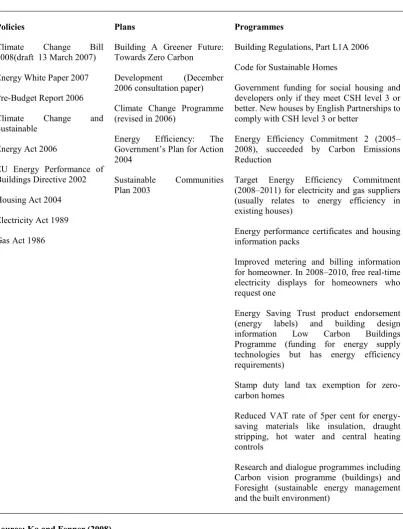
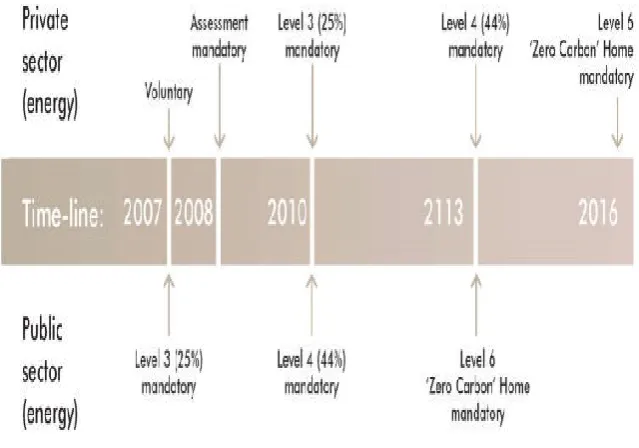
[image:40.595.146.550.190.720.2]The government’s policy on energy efficiency for new homes in the UK (Table 2.2) being the main target for reducing carbon emission, was compiled by Ko and Fenner (2008). Of importance in Table 2.1, is the building regulation, Part L1A and Code for Sustainable Homes (CSH).
Table 2.2: UK Government Policy Framework on Energy Efficiency in New Homes
Source: Ko and Fenner (2008) Policies
Climate Change Bill
2008(draft 13 March 2007)
Energy White Paper 2007
Pre-Budget Report 2006
Climate Change and
Sustainable
Energy Act 2006
EU Energy Performance of Buildings Directive 2002
Housing Act 2004
Electricity Act 1989
Gas Act 1986
Plans
Building A Greener Future: Towards Zero Carbon
Development (December
2006 consultation paper)
Climate Change Programme (revised in 2006)
Energy Efficiency: The
Government’s Plan for Action 2004
Sustainable Communities
Plan 2003
Programmes
Building Regulations, Part L1A 2006
Code for Sustainable Homes
Government funding for social housing and developers only if they meet CSH level 3 or better. New houses by English Partnerships to comply with CSH level 3 or better
Energy Efficiency Commitment 2 (2005– 2008), succeeded by Carbon Emissions Reduction
Target Energy Efficiency Commitment (2008–2011) for electricity and gas suppliers (usually relates to energy efficiency in existing houses)
Energy performance certificates and housing information packs
Improved metering and billing information for homeowner. In 2008–2010, free real-time electricity displays for homeowners who request one
Energy Saving Trust product endorsement (energy labels) and building design
information Low Carbon Buildings
Programme (funding for energy supply technologies but has energy efficiency requirements)
Stamp duty land tax exemption for zero-carbon homes
Reduced VAT rate of 5per cent for energy-saving materials like insulation, draught stripping, hot water and central heating controls
28
The various policies, plans, and programmes are having a slow uptake and seem not to be sufficient in taking UK on the trajectory towards the 2016 target for all new homes (Adeyeye et al., 2007; Osmani and O’Reilly, 2009). Bell and Lowe (2000) present a critique of the energy efficiency aspects of the building regulations for England and Wales, as related to dwellings. It is argued that a significant improvement in the regulations is required if large reductions in CO2 emissions are to be achieved with almost ninety per cent reductions in space heating (Bell and Lowe, 2000). Regulatory systems for the building sector vary between countries (Gann et al., 1998), and there appears to be increasing international convergence in the approach to regulation, with a strong emerging preference for ‘performance’ rather than ‘prescriptive’ regulations. Building regulations usually shape the architectural form, which many architects see as a set of rules to be adhered to (Gann et al., 1998). They are usually seen as ephemeral, even incidental, to the creative process of design (Fischer and Guy, 2009). Building regulations are entwined with, and are constitutive of architects’ practices; they influence aspects of creative practice and processes in architecture and, as such, ought to be given greater attention (Fischer and Guy, 2009).
Drawing on survey and interview data, Imrie and Street (2009) described and evaluated architects’ understanding of, and responses to, what they perceive to be increased exposure to risk and its regulation in the design process. Gann et al., (1998) and Imrie (2007) further conducted studies on the impact of regulation on the work of architects in terms of stifling or encouraging design creativity. They conclusively agreed, along with other researchers (Raman and Shove, 2000; Imrie and Street, 2009), that there is a gap on the wider impact of changing regulation on the working practices of design professionals.
29
cheap materials and the lack of enforcement of the building regulations (Chan, 2008; Lee, 2008; Imrie and Street, 2009).
There is plethora of regulations stemming from external sources relating to building form and performance and, seemingly, much emphasis on risk identification and its management, particularly in relation to the processes underpinning the development and delivery of building projects. In past years, there has been an expansion in the number of building regulations and a much greater emphasis on health and safety procedures. In 1999, the UK health and safety executive introduced the Construction and Design Management regulations (CDM) to identify hazards, reduce risk, save lives and eliminate injury. An extension to CDM regulations in April 2007 further requires architects to consider the safety of buildings’ end-users and make clients responsible for appointing a dedicated CDM co-coordinator (United States Geological Survey, 2008; Imrie and Street, 2009). Consequently, an implication of the CDM and the introduction of other regulations has become a responsibility placed on professionals, such as architects, to manage and reduce risk in the design and construction process.
2.3.2 Building Regulations, Part L1A
The UK building regulations are the statutory instruments that seek to ensure that the policies set out in the Building Act 1984 are carried out in the design and construction of buildings. Over the last few years in England and Wales, the building regulations have raised the standard of new build homes, with the thermal efficiency of new homes being considerably higher than the average UK housing stock (Sustainable Development Commission, 2007).
30
regulatory impact assessment, and consultation on proposal (HM Government, 2010)
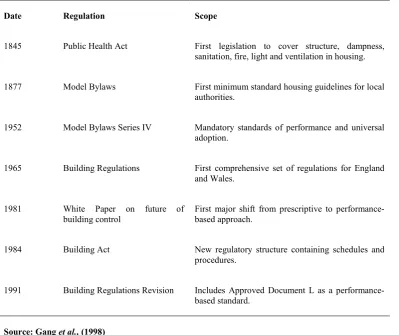
[image:43.595.138.538.423.758.2]Part L (Consumption of fuel and power) of the building regulations regulates energy efficiency of buildings. It has undergone regular revision, including further strengthening in 2010, to make new homes more thermally efficient. Currently, the minimum standards for new housing, acknowledged through Part L, ‘Conservation of fuel and Power’, is split into four parts with effectiveness since 1st, October 2010. The four parts are: Part L1a for new dwellings, Part L1b for existing dwellings, Part L2a for new buildings other than dwellings and Part L2b for existing buildings other than dwellings (CLG, 2010). Table 2.3 summarises the main legislation in the history of British building regulations; the rationale for the regulations, such as Part L, aimed at conserving fuel and power, has changed over time. The current version of building regulations, Part L1a (2010) at the time of writing this thesis, has some key changes in its design standards over the 2006 version.
Table 2.3: Major developments in British building control legislation
Date Regulation Scope
1845 Public Health Act First legislation to cover structure, dampness,
sanitation, fire, light and ventilation in housing.
1877 Model Bylaws First minimum standard housing guidelines for local
authorities.
1952 Model Bylaws Series IV Mandatory standards of performance and universal
adoption.
1965 Building Regulations First comprehensive set of regulations for England
and Wales.
1981 White Paper on future of
building control
First major shift from prescriptive to performance-based approach.
1984 Building Act New regulatory structure containing schedules and
procedures.
1991 Building Regulations Revision Includes Approved Document L as a
performance-based standard.
31
Raman and Shove (2000) followed the processes of revising Part L of the building regulations. They observed an increasing blurring of boundaries between business practice and regulation, due to both government’s decision to open up the process to private regulators and to the building industry’s ability to influence the policy-making process. The shift towards a performance-based building code should pave way towards new forms of government and industry interaction (Raman and Shove, 2000).
Todd et al., (2001) further reviewed the proposals for amending the energy efficiency provisions in the building regulations for dwellings. They identified the main requirements and changes in the building regulations Part L1a (2006) for new dwellings, along with the implications for designers and other professionals who will be involved with compliance issues. To support their argument, Todd et al., (2001) provide guidance on how compliance might be achieved. They concluded that the changes would make new dwellings twenty per cent more efficient than the current practice achieves.
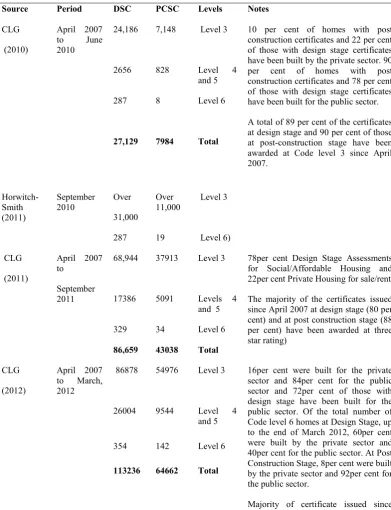
2.3.3 Code for Sustainable Homes
In the United Kingdom (UK), the standard used over the past years before 2007 for assessment of the environmental performance of grant-funded affordable housing was the Eco-Homes, now replaced by the Code for Sustainable Homes (CSH). McManus et al., (2010) declare CSH as the most important policy currently used to combat the issue of environmental standard and performance. The CSH is especially significant to the social housing sector because of their obligation to comply with the standard to produce a considerable increase in the sustainability quality of housing delivery in the UK (McManus et al., 2010). According to the former Office of the Deputy Prime Minster (ODPM), the CSH, if put in place, will sec