IITP:Supervised Machine Learning for Aspect based Sentiment Analysis
Deepak Kumar Gupta Indian Institute of Technology Patna
Patna, India
Asif Ekbal
Indian Institute of Technology Patna Patna, India
Abstract
The shared task on Aspect based Senti-ment Analysisprimarily focuses on mining relevant information from the thousands of online reviews available for a popular product or service. In this paper we re-port our works on aspect term extraction and sentiment classification with respect to our participation in the SemEval-2014 shared task. The aspect term extraction method is based on supervised learning algorithm, where we use different classi-fiers, and finally combine their outputs us-ing a majority votus-ing technique. For senti-ment classification we use Random Forest classifier. Our system for aspect term ex-traction shows the F-scores of 72.13% and 62.84% for the restaurants and laptops re-views, respectively. Due to some techni-cal problems our submission on sentiment classification was not evaluated. However we evaluate the submitted system with the same evaluation metrics, and it shows the accuracies of 67.37% and 67.07% for the restaurants and laptops reviews, respec-tively.
1 Introduction
Nowadays user review is one of the means to drive the sales of products or services. There is a grow-ing trend among the customers who look at the on-line reviews of products or services before taking a final decision. In sentiment analysis and opinion mining, aspect extraction aims to extract entity as-pects or features on which opinions have been ex-pressed (Hu and Liu, 2004; Liu, 2012). An aspect is an attribute or component of the product that
This work is licensed under a Creative Commons At-tribution 4.0 International License. Page numbers and pro-ceedings footer are added by the organizers. License details: http://creativecommons.org/licenses/by/4.0/
has been commented on in a review. For exam-ple:“Dell Laptop has very good battery life and click pads”. Here aspect terms arebattery lifeand click pads. Sentiment analysis is the task of iden-tifying the polarity (positive, negativeorneutral) of review. Aspect terms can influence sentiment polarity within a single domain. As an example, for the restaurant domain cheap is usually posi-tive with respect tofood, but it denotes a negative polarity when discussing the decor or ambiance (Brody and Elhadad, 2010).
A key task of aspect based sentiment analysis is to extract aspects of entities and determine the sentiment corresponding to aspect terms that have been commented in review document. In recent times there has been huge interest to identify as-pects and sentiments simultaneously. The method proposed in (Hu and Liu, 2004) is based on infor-mation extraction (IE) approach that identifies fre-quently occurring noun phrases using association mining. Some other works include the methods, vizthose that define aspect terms using a manually specified subset of the Wikipedia category (Fahrni and Klenner, 2008) hierarchy, unsupervised clus-tering technique (Popescu and Etzionir, 2005) and semantically motivated technique (Turney, 2002) etc. Our proposed approach for aspect term ex-traction is based on supervised machine learning, where we build many models based on different classifiers, and finally combine their outputs us-ing majority votus-ing. Before combinus-ing, the out-put of each classifier is post-processed with a set of heuristics. Each of these classifiers is trained with a moderate set of features, which are gen-erated without using any domain-specific knowl-edge and/or resources. Our submitted system for the second task is based on Random Forest (Breiman, 2001).
2 Tasks
The SemEval-2014 shared task on Aspect based Sentiment Analysis 1 focuses on identifying the
aspects of a given target entities and the senti-ment expressed towards each aspect. A bench-mark setup was provided with the datasets con-sisting of customer reviews with human-annotated annotations of the aspects and their polarity infor-mation. There were four subtasks, and we partic-ipated in the first two of them. These are defined as follows:
Subtask-1: The first task is related to aspect term extraction. Given a set of sentences with pre-identified entities, identify the aspect terms present in the sentence and return a list containing all the distinct aspect terms.
Substask-2: The second task addresses the as-pect term polarity. For a given set of asas-pect terms within a sentence, determine whether the polarity of each aspect term is positive, negative, neutral or conflict (i.e. both positive and negative).
3 Methods
3.1 Pre-processing
Each review is in the XML form. At first we ex-tract the reviews along with their identifiers. Each review is tokenized using the Stanford parser2and
Part-of-Speech tagged using the Stanford PoS tag-ger 3. At the various levels we need the
chunk-level information. We extract these information using the OpenNLP chunker available at4.
3.2 Aspect Term Extraction
The approach we adopted for aspect term extrac-tion is based on the supervised machine learn-ing algorithm. An aspect can be expressed by a noun, adjective, verb or adverb. But the re-cent research in (Liu, 2007) shows that 60-70% of the aspect terms are explicit nouns. The aspect terms could also consist of multiword entities such as “battery life” and “spicy tuna rolls” etc. As the classification algorithms we make use of Se-quential minimal optimization (SMO), Multiclass classifier, Random forest and Random tree. For faster computation of Support Vector Machine, SMO (Platt, 1998) was proposed. Random tree (Breiman, 2001) is basically a decision tree, and
1http://alt.qcri.org/semeval2014/task4/
2http://nlp.stanford.edu/software/lexparser.shtml 3http://nlp.stanford.edu/software/tagger.shtml 4http://opennlp.sourceforge.net/models-1.5/
in general used as a weak learner to be included in some ensemble learning method. Multiclass clas-sifier is a meta learner based on binary SMO. This has been converted to multiclass classifier using the pairwise method. In order to reduce the errors caused by the incorrect boundary identification we define a set of heuristics, and apply on each output. At the end these models are combined together us-ing a simple majority votus-ing.
We implement the following set of features for aspect terms extraction.
• Local context: Local contexts that span the preceding and following few tokens of the current word are used as the features. Here we use the previous two and next two tokens as the features.
• Part-of-Speech information: Part-of-Speech(PoS)information plays an important role in identifying the aspect terms. We use the PoS information of the current token as the feature.
• Chunk Information: Chunk information helps in identifying the boundaries of aspect terms. This is particularly more helpful to recognize multiword aspect terms.
• Root word: Roots of the surface forms are used as the features. We use the Porter Stem-mer algorithm5to extract the root forms.
• Stop word: We use the list of stop words available at6. A feature is defined that takes
the value equal to 1 or 0 depending upon whether it appears in the training/test set or not.
• Length: Length of token plays an important role in identifying the aspect terms. We as-sume an entity as the candidate aspect term if its length exceeds a predefined threshold value equal to five.
• Prefix and Suffix: Prefix and suffix of fixed length character sequences are stripped from each token and used as the features of classi-fier. Here we use the prefixes and suffixes of length upto three characters as the features.
5http://tartarus.org/martin/PorterStemmer/java.txt
• Frequent aspect term: We extract the the as-pect terms from the training data, and prepare a list by considering the most frequently oc-curring terms. We consider an aspect term to be frequent if it appears at least five times in the training data. A feature is then defined that fires if and only if the current token ap-pears in this list.
The output of each classifiers is post-processed with a set of hand-crafted rules, defined as below:
Rule 1: If the PoS tag of the target token is noun, chunk tag is I-NP (denoting the intermediate to-ken of a noun phrase) and the observed class of the previous token isO(other than aspect terms) then the current token should be assigned the class B-Aspect (denotes the beginning of an aspect term).
Rule 2: If the current token has PoS tag noun, chunk tagI-NPand the observed class of the im-mediately preceding token is B-Aspect then the current token should be assigned the classI-Aspect (denoting the intermediate token).
3.3 Polarity Identification
Polarity classification of aspect terms is the classi-cal problem in sentiment analysis. The task is to classify the sentiments or opinions into semantic classes such aspositive,negative, andneutral. We develop a Random Forest classifier for this task. In this particular task one more classconflictis in-troduced. It is assigned if the sentiment can either be positive or negative. For classification we make use of some of the features such as local context, PoS, Chunk, prefix and suffix etc., as defined in the previous Subsection. Some other problem-specific features that we implement for sentiment classifi-cation are defined as below:
• MPQA feature: We make use of MPQA subjectivity lexicon (Wiebe and Mihalcea, 2006) that contains sentiment bearing words as feature in our classifier. This list was pre-pared semi-automatically from the corpora of MPQA7 and Movie Review dataset8. A
fea-ture is defined that takes the values as fol-lows: 1 for positive; -1 for negative; 0 for neutral and 2 for those words that do not ap-pear in the list.
• Function words: A list of function words is 7http://cs.pitt.edu/mpqa/
8http://cs.cornell.edu/People/pabo/movie-review-data/
compiled from the web9. A binary-valued
feature is defined that fires for those words that appear in this list.
4 Experiments and Analysis
We use the datasets and the evaluation scripts as provided by the SemEval-2014 shared task orga-nizer.
4.1 Datasets
The datasets comprise of the domains of restau-rants and laptop reviews. The training sets con-sist of 3,044 and 3,045 reviews. There are 3,699 and 2,358 aspect terms, respectively. The test set contains 800 reviews for each domain. There are 1,134 and 654 test instances in the respective do-mains.
4.2 Results and Analysis
At first we develop several machine learning mod-els based on the different classification algorithms. All these classifiers were trained using the same set of features as mentioned in Section 3. We use the default implementations of these classi-fiers in Weka10. We post-process the outputs of
all the models using some heuristics. Finally, all these classifiers are combined together using ma-jority voting. It is to be noted that we determine the best configuration by carrying out different ex-periments on the development set, which is con-structed by taking a part of the training set, and fi-nally blind evaluation is performed on the respec-tive test set. We use the evaluation script provided with the SemEval-2014 shared task. The training sets contain multiword aspect terms, and so we use the standard BIO notation11 for proper boundary
marking.
Experiments show the precision, recall and F-score values 77.97%, 72.13% and 74.94%, respec-tively for the restaurant dataset. This is approxi-mately 10 points below compared to the best sys-tem. But it shows the increments of 4.16 and 27.79 points over the average and baseline mod-els, respectively. For the laptop dataset we ob-tain the precision, recall and F-score values of 70.74%, 62.84% and 66.55%, respectively. This is 8 points below the best one and 10.35 points
9http://www2.fs.u-bunkyo.ac.jp/ gilner/wordlists.html 10www.cs.waikato.ac.nz/ml/weka/
11B, I and O denote the beginning, intermediate and
Model precision recall F-score Random Tree 65.21 59.63 62.29 Random Forest 70.93 62.69 66.55 SMO 71.18 64.22 67.52 Multiclass 73.44 68.50 70.88 Ensemble 77.97 72.13 74.94 Best system 85.35 82.71 84.01 Average 76.74 67.26 70.78
[image:4.595.76.287.61.192.2]Baseline - - 47.15
Table 1: Result of Task-A for restaurants dataset with different classifiers (in %).
Model precision recall F-score Random Tree 56.52 56.17 56.34 Random Forest 58.38 58.02 58.19 SMO 63.62 63.22 63.39 Multiclass 65.30 64.90 65.09 Ensemble 70.74 62.84 66.55 Best system 84.80 66.51 74.55 Average 68.97 50.45 56.20
Baseline - - 35.64
Table 2: Results of aspect term extraction for lap-tops dataset with different classifiers (in %).
above the average system. Compared to the base-line it achieves more than 20 point increment. De-tailed evaluation results for all the classifiers are reported in Table 1 and Table 2 for restaurant and laptop datasets, respectively. Results show that multiclass classifier achieves the highest perfor-mance with precision, recall and F-score values of 73.44%, 68.50% and 70.88%, respectively for the restaurant dataset. The same model shows the highest performance with precision, recall and F-score values of 65.30%, 64.90% and 65.09%, re-spectively for the laptop dataset. Because of ma-jority ensemble we observe increments of 4.06% and 1.46% F-score points over the best individual model, respectively.
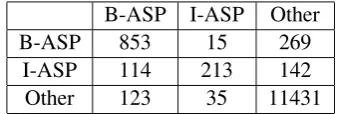
We also perform error analysis to understand the possible sources of errors. We show only the confusion matrix for Task-A in Table 3. It shows that in most cases I-ASP is misclassified as B-ASP. System also suffers because of the misclassifica-tion of aspect terms to others.
[image:4.595.331.500.62.119.2]Experiments for classification are reported in Table 4. Evaluation shows that the system achieves the accuracies of 67.37% and 67.07% for
B-ASP I-ASP Other B-ASP 853 15 269
I-ASP 114 213 142 Other 123 35 11431
Table 3: Confusion matrix for Task-A on restau-rants dataset.
Datasets #AspectTerms Identification#Correct Accuracy(in %)
Restaurants 1134 764 67.37
[image:4.595.75.290.243.374.2]Laptops 654 438 67.07
Table 4: Results of aspect terms polarity (in %).
the restaurants and laptops datasets, respectively. Please note that our system for the second task was not officially evaluated because of the techni-cal problems of the submitted zipped folder. How-ever we evaluated the same system with the of-ficial evaluation script, and it shows the accura-cies as reported in Table 4. We observe that the classifier performs reasonably well for the posi-tive and negaposi-tive classes, and suffers most for the conflict classes. This may be due to the number of instances present in the respective training set. Results show that our system achieves much lower classification accuracy (13.58 points below) com-pared to the best system for the restaurant datasets. However, for the laptop datasets the classification accuracy is quite encouraging (just 3.42 points be-low the best system). It is also to be noted that our classifier achieves quite comparable performance for both the datasets. Therefore it is more general and not biased to any particular domain.
5 Conclusion
In this paper we report our works on aspect term extraction and sentiment classification as part of our participation in the SemEval-2014 shared task. For aspect term extraction we develop an ensem-ble system. Our aspect term classification model is based on Random Forest classifier. Runs for both of our systems were constrained in nature, i.e. we did not make use of any external resources. Evalu-ation on the shared task dataset shows encouraging results that need further investigation.
References
Leo Breiman. 2001. Random forests. 45(1):5–32. S. Brody and N. Elhadad. 2010. An unsupervised
aspect-sentiment model for online reviews. In Pro-ceedings of NAACL, pages 804–812, Los Angeles, CA.
Angela Fahrni and Manfred Klenner. 2008. Old wine or warm beer: Target-specic sentiment analysis of adjectives. InSymsposium on Affective Language in Human and Machine, pages 60–63. The Society for the Study of Artificial Intelligence and Simulation of Behavior (AISB).
M. Hu and B. Liu. 2004. Mining and summarizing customer reviews. InProceedings of the 10th KDD, pages 168–177, Seattle, WAs.
B. Liu. 2007. Exploring Hyperlinks, Contents, and
Usage Data. Springer.
Bing Liu. 2012.Sentiment Analysis and Opinion
Min-ing. Synthesis Lectures on Human Language
Tech-nologies. Morgan & Claypool Publishers.
John C. Platt. 1998. Sequential minimal optimiza-tion: A fast algorithm for training support vector ma-chines. Technical report, ADVANCES IN KERNEL METHODS - SUPPORT VECTOR LEARNING. Ana-Maria Popescu and Oren Etzionir. 2005.
Ex-tracting product features and opinions from reviews. InProceedings of the Conference on HLT/EMNLP, pages 339–346.
P. D. Turney. 2002. Thumbs up or thumbs down?: Semantic orientation applied to unsupervised classi-fication of reviews. InProceedings of the 40th ACL, pages 417–424.