44
Multi-Label Transfer Learning for Multi-Relational Semantic Similarity
Li Zhang and Steven R. Wilson and Rada Mihalcea
Computer Science and Engineering University of Michigan
{zharry,steverw,mihalcea}@umich.edu
Abstract
Multi-relational semantic similarity datasets define the semantic relations between two short texts in multiple ways, e.g., similarity, relatedness, and so on. Yet, all the systems to date designed to capture such relations tar-get one relation at a time. We propose a multi-label transfer learning approach based on LSTM to make predictions for several rela-tions simultaneously and aggregate the losses to update the parameters. This multi-label re-gression approach jointly learns the informa-tion provided by the multiple relainforma-tions, rather than treating them as separate tasks. Not only does this approach outperform the single-task approach and the traditional multi-task learn-ing approach, it also achieves state-of-the-art performance on all but one relation of the Hu-man Activity Phrase dataset.
1 Introduction
Semantic similarity, or relating short texts or sen-tences1 in a semantic space – be those phrases, sentences or short paragraphs – is a task that re-quires systems to determine the degree of equiv-alence between the underlying semantics of the two sentences. Although relatively easy for hu-mans, this task remains one of the most difficult natural language understanding problems. The task has been receiving significant interest from the research community. For instance, from 2012 to 2017, the International Workshop on Seman-tic Evaluation (SemEval) has been holding the Semantic Textual Similarity (STS) shared tasks (Agirre et al.,2012,2013b,2015,2016;Cer et al.,
2017), dedicated to tackling this problem, with close to 100 team submissions each year.
In some semantic similarity datasets, an exam-ple consists of a sentence pair and a single anno-tated similarity score, while in others, each pair
1In this work, we do not consider word level similarity.
comes with multiple annotations. We refer to the latter asmulti-relational semantic similaritytasks. The inclusion of multiple annotations per exam-ple is motivated by the fact that there can be dif-ferent relations, namely difdif-ferent types of simi-larity between two sentences. So far, these rela-tions have been treated as separate tasks, where a model trains and tests on one relation at a time while ignoring the rest. However, we hypothesize that each relation may contain useful information about the others, and training on only one rela-tion inevitably neglects some relevant informarela-tion. Thus, training jointly on multiple relations may improve performance on one or more relations.
We propose a jointmulti-labeltransfer learning setting based on LSTM, and show that it can be an effective solution for the multi-relational semantic similarity tasks. Due to the small size of multi-relational semantic similarity datasets and the re-cent success of LSTM-based sentence representa-tions (Wieting and Gimpel,2018;Conneau et al.,
2017), the model is pre-trained on a large corpus and transfer learning is applied using fine-tuning. In our setting, the network is jointly trained on multiple relations by outputting multiple predic-tions (one for each relation) and aggregating the losses during back-propagation. This is differ-ent from the traditional multi-task learning set-ting where the model makes one prediction at a time, switching between the tasks. We treat the multi-task setting and the single-task setting (i.e., where a separate model is learned for each rela-tion) as baselines, and show that the multi-label setting outperforms them in many cases, achieving state-of-the-art performance on all but one relation of the Human Activity Phrase dataset (Wilson and Mihalcea,2017).
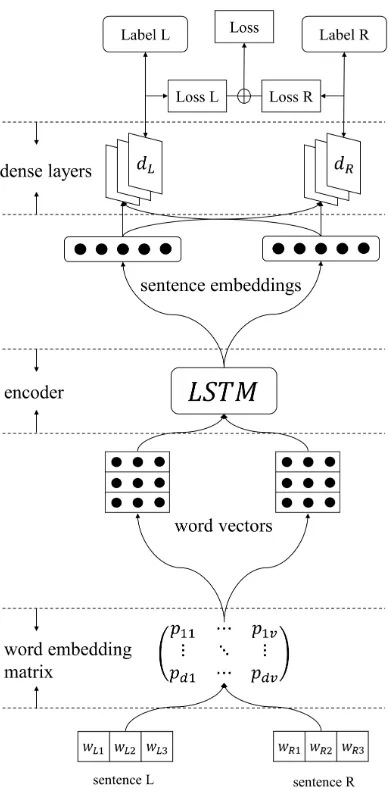
Figure 1: Overview of the multi-label architecture.
paired with other neural network architectures and applied to any dataset with multiple annotations available for each training instance.
2 Multi-Label Transfer Learning
We introduce a multi-label transfer learning set-ting by modifying the architecture of the LSTM-based sentence encoder, specifically designed for multi-relational semantic similarity tasks.
2.1 Architecture
We employ the “hard-parameter sharing” setting (Caruana, 1998), where some hidden layers are shared across multiple tasks while each task has its own specific output layer. As shown in Figure1, using an example of a semantic similarity dataset with two relations, sentence L and sentence R in a
pair are first mapped to word vector sequences and then encoded as sentence embeddings. Up to this step, the choice of the word embedding matrix and sentence encoder is flexible, and we outline our choice in the sections to follow. For each relation that has been annotated with a ground-truth label, a dedicated output dense layer takes the two sen-tence embeddings as input and outputs a probabil-ity distribution across the range of possible scores. The output dense layers follow the methods of Tai et al. (2015).
With two such dense output layers, two losses are calculated, one for each relation. The total loss is calculated as the sum of the two losses for back-propagation which updates all parameters in the end-to-end network.
2.2 Model
We use InferSent (Conneau et al.,2017) as the sen-tence encoder due to its outstanding performances reported on various semantic similarity tasks.
Due to the small sizes of the evaluation datasets, we use the sentence encoder pre-trained on the Stanford Natural Language Inference corpus (Bowman et al., 2015) and Multi-Genre Natu-ral Language Inference corpus (Williams et al.,
2018), and transfer to the semantic similarity tasks using fine-tuning. In this process, the output lay-ers for multi-label learning discussed above are stacked on top of the InferSent network, forming an end-to-end model for training and testing on se-mantic similarity tasks.
2.3 Comparison with Multi-Task Learning
Neither multi-task nor multi-label learning have been used for multi-relational semantic similarity datasets. For these datasets, either multi-task or multi-label learning can be achieved by treating each relation as a “task.” The key differences be-tween the two are the relations involved in each forward-backward pass and the timing of the pa-rameter updates.
Consider a training step in the two-relation ex-ample in Figure1:
A multi-task learning model would pick a batch of sentences pairs, only consider Label L, only calculate Loss L, and all parameters except those of dense layerdRare updated. Then, within the same batch,2 the model would only consider
Label R, only calculateLoss R, and all parameters except those of dense layerdLare updated.
A multi-label learning model (our model) would pick a batch of sentences pairs, consider both Label L and Label R, calculate Loss L and
Loss R, aggregate them as the total loss, and up-date all parameters.
3 Experiments
To show the effectiveness of the multi-label trans-fer learning setting, we experiment on three se-mantic similarity datasets with multiple relations annotated, and use one LSTM-based sentence en-coder that has been very successful in many down-stream tasks.
3.1 Datasets
We study three semantic similarity datasets with multiple relations with texts of different lengths, spanning phrases, sentences, and short paragraphs.
Human Activity Phrase (Wilson and Mihalcea,
2017): a collection of pairs of phrases regard-ing human activities, annotated with the followregard-ing four different relations.
• Similarity (SIM): The degree to which the two activity phrases describe the same thing, semantic similarity in a strict sense. Exam-ple of high similarity phrases:to watch a film
andto see a movie.
• Relatedness (REL): The degree to which the activities are related to one another, a general semantic association between two phrases. Example of strongly related phrases: to give a giftandto receive a present.
• Motivational alignment (MA): The degree to which the activities are (typically) done with similar motivations. Example of phrases with potentially similar motivations:to eat dinner with family membersandto visit relatives.
• Perceived actor congruence (PAC): The de-gree to which the activities are expected to be done by the same type of person. An exam-ple of a pair with a high PAC score:to pack a suitcaseandto travel to another state.
The phrases are generated, paired and scored on Amazon Mechanical Turk.3 The annotated
input.
3https://www.mturk.com/
scores range from 0to4for SIM, REL and MA, and−2 to2for PAC. The evaluation is based on the Spearman’s ρ correlation coefficient between the systems’ predicted scores and the human annotations. There are 1,000 pairs in the dataset. We also use the supplemental 1,373 pairs from Zhang et al. (2018) in which 1,000 pairs are randomly selected for training and the rest are used for development. We then treat the original 1,000 pairs as a held-out test set so that our results are directly comparable with those previously reported.
SICK (Marelli et al., 2014b,a): the Sentences Involving Compositional Knowledge benchmark, which includes a large number of sentence pairs that are rich in the lexical, syntactic and semantic phenomena. Each pair of sentences is annotated in two dimensions: relatedness and entailment. The relatedness score ranges from 1 to 5, and Pearson’sr is used for evaluation; the entailment relation is categorical, consisting of entailment, contradiction, and neutral. There are 4439 pairs in the train split, 495 in the trial split used for development and 4906 in the test split. The sentence pairs are generated from image and video caption datasets before being paired up using some algorithm. Due to the lack of human supervision in the process, some sentence pairs display minimal difference in semantic compo-nents, making the SICK tasks simpler than the others we study.
Typed-Similarity (Agirre et al., 2013b): a col-lection of meta-data describing books, paintings, films, museum objects and archival records taken from Europeana,4 presented as the pilot track in the SemEval 2013 STS shared task. Typically, the items consist of title, subject, description, and so on, describing a cultural heritage item and, some-times, a thumbnail of the item itself. For the pur-pose of measuring semantic similarity, we con-catenate all the textual entries such as title, creator, subject and description into a short paragraph that is used as input, although the annotations might be informed of the image aspects of the meta-data. Each pair of items is annotated on eight dimen-sions of similarity: general similarity, author, peo-ple involved, time, location, event or action in-volved, subject and description. There are 750
pairs in the train split, of which we randomly sam-ple 500 for training and 250 for development, and 721 in the test split. Pearson’sris used for evalu-ation.
3.2 Baselines
We compare the multi-label setting with two base-lines:
• Single-task, where each relation is treated as an individual task. For each relation, a model with only one output dense layer is trained and tested, ignoring the annotations of all other relations.
• Multi-task, where only one relation is in-volved during each round of feed-forward and back-propagation.
3.3 Experimental Details
In each experiment, we use stochastic gradient de-scent and a batch size of 16. We tune the learn-ing rate over{0.1,0.5,1,5}and number of epochs over{10,20}. For each dataset discussed above, we tune these hyperparameters on the develop-ment set. All other hyperparameters maintain their values from the original code.5 In the single-task setting, the model is trained and tested on each re-lation, ignoring the annotations of other relations. In the multi-task settings, the model is trained and tested on all the relations in a dataset. In the multi-task setting, relations are presented to the model in the order they are listed in the result tables within each batch.
4 Evaluation
The results are shown in Tables1, 2 and3. For every experiment (represented by a cell in the ta-bles), 30 runs with different random seeds are recorded and the average is reported. For each relation (each column in the tables), let the true mean performance of multi-label learning, single-task baseline and multi-single-task baseline be µMLL,
µsingle, µMTL, respectively. Two one-sided
Stu-dent’s t-tests are conducted to test if multi-label learning outperforms the baselines for that rela-tion. The significance level is chosen to be0.05. A down-arrow↓indicates that our proposed multi-label learning underperforms a baseline, while an up-arrow↑indicates that our proposed multi-label learning outperforms a baseline.
5https://github.com/facebookresearch/InferSent
5 Discussion
5.1 Results
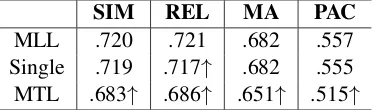
For the Human Activity Phrase dataset, the single-task setting already achieves state-of-the-art per-formances on SIM, REL and PAC relations, sur-passing the previous best results reported by Zhang et al. (2018), which achieved Spearman’s correlation coefficient of .710 in SIM, .715 in REL, .690 in MA and .549 in PAC. This ap-proach is based on fine-tuning a bi-directional LSTM with average-pooling pre-trained on trans-lated texts (Wieting and Gimpel, 2018). Using multi-label learning, our model is able to gain a statistically significant improvement in the perfor-mance of REL compared to the single-task setting, while maintaining performance for the other re-lations. The traditional multi-task setting, how-ever, performs significantly worse than the other settings.
For the entailment task on the SICK dataset, our multi-label setting outperforms the single-task baseline and the previous best results of In-ferSent. These best results consisted of an accu-racy of 86.3% achieved using a logistic regres-sion classifier and sentence embeddings gener-ated by pre-trained InferSent as features (Conneau et al., 2017). In the relatedness task, this set-ting achieved a Pearson’s correlation coefficient of .885, which even our our multi-label setting is un-able to beat. However, the multi-label setting does have a statistically significant performance gain compared to the single-task setting in the related-ness task, while the traditional multi-task setting underperforms the other settings.
rela-general author people time location event subject description
MLL .744 .721 .640 .713 .751 .611 .697 .737
Single .750↓ .690↑ .619↑ .712 .744↑ .606↑ .694↑ .718↑
[image:5.595.95.504.62.120.2]MTL .718↑ .689↑ .611↑ .697↑ .723↑ .579↑ .669↑ .714↑
Table 1: The performance in Pearson’sron the Typed-Similarity dataset, in accordance with the specification of the dataset to allow for direct comparison with previous results. The results of single task and multi-task learning (MTL) are followed by↑if it is statically significantly lower than those of multi-label learning (MLL), and they are followed by↓otherwise.
SIM REL MA PAC
MLL .720 .721 .682 .557
Single .719 .717↑ .682 .555
[image:5.595.89.277.201.256.2]MTL .683↑ .686↑ .651↑ .515↑
Table 2: The performance in Spearman’sρon the Hu-man Activity Phrase dataset.
Relatedness Entailment
MLL .882 86.7
Single .874↑ 86.4↑
MTL .871↑ 86.2↑
Table 3: The performance in Pearson’sron the SICK dataset, in accordance with the specification of the dataset to allow for direct comparison with previous re-sults.
tions mentioned above. Among the three transfer learning approaches, our multi-label setting is still superior, outperforming the single-task setting in over half of the relations, and outperforming the multi-task setting in all relations.
5.2 Empirical Recommendation
While our results above show that multi-label learning is almost always the most effective way to transfer sentence embeddings in multi-relational semantic similarity tasks, in some situations sim-ply training with one relation might yield better performance (such as the general similarity rela-tion in the Typed-Similarity dataset). This sug-gests that the choice of multi-label learning or single-task learning can be tuned as a hyperparam-eter empirically for the optimal performance on a task.
5.3 Other Considerations and Discussions
In the multi-label setting, we calculate the total loss by summing the loss from each dimension. We also explore weighting the loss from each
di-mension by factors of 2, 5 and 10, but doing so hurts the performance for all dimensions.
In the multi-task setting, we attempt different ordering of the dimensions when presenting them to the model within a batch of examples, but the difference in performance is not statistically sig-nificant. Furthermore, the multi-task setting takes aboutntimes longer to train than the multi-label setting, wherenis number of dimensions of anno-tations.
6 Conclusions
We introduced a multi-label transfer learning set-ting designed specifically for semantic similarity tasks with multiple relations annotations. By ex-perimenting with a variety of relations in three datasets, we showed that the multi-label setting can outperform single-task and traditional multi-task settings in many cases.
Future work includes exploring the perfor-mance of this setting with other sentence en-coders, as well as multi-label datasets outside of the domain of semantic similarity. This may in-clude NLP datasets annotated with author infor-mation for multiple dimensions, or computer vi-sion datasets with multiple annotations for scenes.
Acknowledgments
[image:5.595.96.265.308.365.2]References
Eneko Agirre, Nikolaos Aletras, Aitor Gonzalez-Agirre, German Rigau, and Mark Stevenson. 2013a.
Ubc_uos-typed: Regression for typed-similarity. In
Second Joint Conference on Lexical and Computa-tional Semantics (*SEM), Volume 1: Proceedings of the Main Conference and the Shared Task: Semantic Textual Similarity, pages 132–137, Atlanta, Georgia, USA. Association for Computational Linguistics.
Eneko Agirre, Carmen Banea, Claire Cardie, Daniel Cer, Mona Diab, Aitor Gonzalez-Agirre, Weiwei Guo, Inigo Lopez-Gazpio, Montse Maritxalar, Rada Mihalcea, German Rigau, Larraitz Uria, and Janyce Wiebe. 2015. Semeval-2015 task 2: Semantic tex-tual similarity, english, spanish and pilot on inter-pretability. InProceedings of the 9th International Workshop on Semantic Evaluation (SemEval 2015), pages 252–263, Denver, Colorado. Association for Computational Linguistics.
Eneko Agirre, Carmen Banea, Daniel Cer, Mona Diab, Aitor Gonzalez-Agirre, Rada Mihalcea, German Rigau, and Janyce Wiebe. 2016. Semeval-2016 task 1: Semantic textual similarity, monolingual and cross-lingual evaluation. InProceedings of the 10th International Workshop on Semantic Evalua-tion (SemEval-2016), pages 497–511, San Diego, California. Association for Computational Linguis-tics.
Eneko Agirre, Daniel Cer, Mona Diab, and Aitor Gonzalez-Agirre. 2012. Semeval-2012 task 6: A pi-lot on semantic textual similarity. In *SEM 2012: The First Joint Conference on Lexical and Compu-tational Semantics – Volume 1: Proceedings of the main conference and the shared task, and Volume 2: Proceedings of the Sixth International Workshop on Semantic Evaluation (SemEval 2012), pages 385– 393, Montréal, Canada. Association for Computa-tional Linguistics.
Eneko Agirre, Daniel Cer, Mona Diab, Aitor Gonzalez-Agirre, and Weiwei Guo. 2013b. *sem 2013 shared task: Semantic textual similarity. InSecond Joint Conference on Lexical and Computational Seman-tics (*SEM), Volume 1: Proceedings of the Main Conference and the Shared Task: Semantic Textual Similarity, pages 32–43, Atlanta, Georgia, USA. As-sociation for Computational Linguistics.
Samuel R. Bowman, Gabor Angeli, Christopher Potts, and Christopher D. Manning. 2015. A large anno-tated corpus for learning natural language inference. In Proceedings of the 2015 Conference on Empiri-cal Methods in Natural Language Processing, pages 632–642, Lisbon, Portugal. Association for Compu-tational Linguistics.
Rich Caruana. 1998. Multitask learning. InLearning to learn, pages 95–133. Springer.
Daniel Cer, Mona Diab, Eneko Agirre, Inigo Lopez-Gazpio, and Lucia Specia. 2017. Semeval-2017
task 1: Semantic textual similarity multilingual and crosslingual focused evaluation. In Proceedings of the 11th International Workshop on Semantic Evaluation (SemEval-2017), pages 1–14, Vancou-ver, Canada. Association for Computational Lin-guistics.
Alexis Conneau, Douwe Kiela, Holger Schwenk, Loïc Barrault, and Antoine Bordes. 2017. Supervised learning of universal sentence representations from natural language inference data. InProceedings of the 2017 Conference on Empirical Methods in Nat-ural Language Processing, pages 670–680, Copen-hagen, Denmark. Association for Computational Linguistics.
Marco Marelli, Luisa Bentivogli, Marco Baroni, Raf-faella Bernardi, Stefano Menini, and Roberto Zam-parelli. 2014a. Semeval-2014 task 1: Evaluation of compositional distributional semantic models on full sentences through semantic relatedness and textual entailment. InProceedings of the 8th International Workshop on Semantic Evaluation (SemEval 2014), pages 1–8, Dublin, Ireland. Association for Compu-tational Linguistics.
Marco Marelli, Stefano Menini, Marco Baroni, Luisa Bentivogli, Raffaella Bernardi, and Roberto Zam-parelli. 2014b. A sick cure for the evaluation of compositional distributional semantic models. In
Proceedings of the Ninth International Conference on Language Resources and Evaluation (LREC’14), pages 216–223, Reykjavik, Iceland. European Lan-guage Resources Association (ELRA).
Kai Sheng Tai, Richard Socher, and Christopher D. Manning. 2015. Improved semantic representations from tree-structured long short-term memory net-works. In Proceedings of the 53rd Annual Meet-ing of the Association for Computational LMeet-inguistics and the 7th International Joint Conference on Natu-ral Language Processing (Volume 1: Long Papers), pages 1556–1566, Beijing, China. Association for Computational Linguistics.
John Wieting and Kevin Gimpel. 2018. Paranmt-50m: Pushing the limits of paraphrastic sentence embed-dings with millions of machine translations. In Pro-ceedings of the 56th Annual Meeting of the Associa-tion for ComputaAssocia-tional Linguistics (Volume 1: Long Papers), pages 451–462, Melbourne, Australia. As-sociation for Computational Linguistics.
Adina Williams, Nikita Nangia, and Samuel Bowman. 2018. A broad-coverage challenge corpus for sen-tence understanding through inference. In Proceed-ings of the 2018 Conference of the North American Chapter of the Association for Computational Lin-guistics: Human Language Technologies, Volume 1 (Long Papers), pages 1112–1122, New Orleans, Louisiana. Association for Computational Linguis-tics.
Proceedings of the Eighth International Joint Con-ference on Natural Language Processing (Volume 1: Long Papers), pages 664–673, Taipei, Taiwan. Asian Federation of Natural Language Processing.