Modeling Complement Types in Phrase-Based SMT
Marion Weller-Di Marco1,2, Alexander Fraser2, Sabine Schulte im Walde1
1Institut f¨ur Maschinelle Sprachverarbeitung, Universit¨at Stuttgart
2Centrum f¨ur Informations- und Sprachverarbeitung,
Ludwig-Maximilians-Universit¨at M¨unchen
{dimarco|schulte}@ims.uni-stuttgart.de [email protected]
Abstract
We explore two approaches to model com-plement types (NPs and PPs) in an English-to-German SMT system: A simple abstract representation inserts pseudo-prepositions that mark the beginning of noun phrases, to improve the symmetry of source and tar-get complement types, and to provide a flat structural information on phrase bound-aries. An extension of this representation generates context-aware synthetic phrase-table entries conditioned on the source side, to model complement types in terms of grammatical case and preposition choice. Both the simple preposition-informed sys-tem and the context-aware syssys-tem signifi-cantly improve over the baseline; and the context-aware system is slightly better than the system without context information.
1 Introduction
SMT output is often incomprehensible because it confuses complement types (noun phrases/NPs vs. prepositional phrases/PPs) by generating a wrong grammatical case, by choosing an incorrect prepo-sition, or by arranging the complements in a mean-ingless way. However, the choice of complement types in a translation represents important infor-mation at the syntax-semantics interface: The case of an NP determines its syntactic function and its semantic role; similarly, the choice of preposition in a PP sets the semantic role of the prepositional phrase.
While the lexical content of a target-language phrase is defined by the source sentence, the exact choice of preposition and case strongly depends on the target context, and most specifically on the target verb. For example, the English verb phrase
to call for sth.can be translated into German byetw.
erfordern(subcategorizing a direct-object NP but no preposition) or by(nach) etw. verlangen (subcat-egorizing either a direct-object NP or a PP headed by the prepositionnach). Differences in grammat-ical case and syntactic functions between source and target side include phenomena like subject-object shifting:[I]SUBJlike [the book]OBJ vs.[das
Buch]SUBJ gef¨allt [mir]OBJ. Here, the English
ob-ject corresponds to a German subob-ject, whereas the English subject corresponds to the indirect object in the German sentence.
Selecting the wrong complement type or an in-correct preposition obviously has a major effect on the fluency of SMT output, and also has a strong im-pact on the perception of semantic roles. Consider the sentence John looks for his book. When the prepositionforis translated literally by the prepo-sitionf¨ur, the meaning of the translated sentence
John sucht f¨ur sein Buchshifts, such thatthe book
is no longer the object that is searched, but rather a recipient of the search. To preserve the source meaning, the prepositional phrase headed byfor
must be translated as a direct object of the verb
suchen, or as a PP headed by the prepositionnach. Since prepositions tend to be highly ambiguous, the choice of a preposition depends on various fac-tors. Often, there is a predominant translation, such asfor → f¨ur, which is appropriate in many con-texts, but unsuitable in other contexts. Such trans-lation options are often difficult to override, even when there are clues that the translation is wrong. Furthermore, even though prepositions are highly frequent words, there can be coverage problems if a preposition is not aligned with the specific prepo-sition required by the context, due to structural mismatches.
This paper presents two novel approaches to im-prove the modeling of complement types. A sim-ple approach introduces an abstract representation of “placeholder prepositions” at the beginning of
noun phrases on the source and target sides. The insertion of these placeholder prepositions leads to a more symmetric structure and consequently to a better coverage of prepositions, as all NPs are effectively transformed into PPs, and preposi-tions in one language without a direct equivalent in the other language can be aligned. Furthermore, the placeholder prepositions function as explicit phrase boundaries and are annotated with grammat-ical case, so they provide flat structural information about the syntactic function of the phrase. The placeholder representation leads to a significant improvement over a baseline system without prepo-sitional placeholders.
Our second approach enhances the abstract placeholder representation, and integrates source-side context into the phrase table of the SMT sys-tem to model different complement types. This is done by generating synthetic phrase-table en-tries containing contextually predicted prepositions. With this process, we aim to (i) improve the prepo-sition choice conditioned on the source sentence, and to (ii) manipulate the scores in the generated entries to favour context-appropriate translations. Generating phrase-table entries allows to create prepositions in contexts not observed in the paral-lel training data. The resulting phrase-table entries are unique for each context and provide the best selection of translation options in terms of comple-ment realization on token-level. This variant sig-nificantly outperforms the baseline, and is slightly better than the system with inserted placeholder prepositions.
2 Related Work
Our work is related to three research areas: using source-side information, previous approaches to model case and prepositions and the synthesis of phrase-table entries.
Source-side information has been applied to SMT before, often for the purpose of word sense disambiguation and improving lexical choice (Carpuat and Wu, 2007; Gimpel and Smith, 2008; Jeong et al., 2010; Tamchyna et al., 2014), but without a focus on synthesis or syntactic-semantic aspects such as subcategorization.
Prepositions are difficult to translate and respon-sible for many errors, as has been shown in many evaluations of machine translation. For example, Williams et al. (2015) presented a detailed error analysis of their shared task submissions, listing
the number of missing/wrong content and function words. For the language pair English–German, the combined number ofmissing/wrong/added prepo-sitions is one of the most observed error types. Agirre et al. (2009) were among the first to use rich linguistic information to model prepositions and grammatical case in Basque within a rule-based sys-tem, leading to an improved translation quality for prepositions. Their work is extended by Shilon et al. (2012) with a statistical component for ranking translations. Weller et al. (2013) use a combination of source-side and target-side features to predict grammatical case on the SMT output, but without taking into account different complement types (NP vs. PP). Weller et al. (2015) predict prepositions as a post-processing step to a translation system in which prepositions are reduced to placeholders. They find, however, that the reduced representation leads to a general loss in translation quality. Exper-iments with annotating abstract information to the placeholders indicated that grammatical case plays an important role during translation. We build on their observations, but in contrast with generating prepositions in a post-processing step, prepositions in our work are accessible to the system during de-coding, and the phrase-table entries are optimized with regard to the source-sentence. Finnish is a highly inflective language with a very complex case and preposition system. Tiedemann et al. (2015) experimented with pseudo-tokens added to Finnish data to account for the fact that Finnish morpholog-ical markers (case) often correspond to a separate English word (typically a preposition). Due to the complexity of Finnish, only a subset of markers is considered. The pseudo-tokens are applied to a Finnish–English translation system, but a manual evaluation remains inconclusive about the effective-ness of their method. For the preposition-informed representation in our work, we adapt both source and target language to obtain more isomorphic par-allel data. Also, we translateintothe morphologi-cally rich language, which requires morphological modeling with regard to, e.g., grammatical case and portmanteau prepositions (cf. section 3) to ensure morphologically correct output.
to
transform
nullprp
base
metals
into
gold
aus[APPR-Dat]
unedel[ADJA]
Metall<Neut><Pl>[NN]
empty[APPR-Acc]
Gold<Neut><Sg>[NN]
zu[PTKZU]
machen[VVINF]
from
base
metals
emptyprep
gold
to
[image:3.595.86.278.63.162.2]make
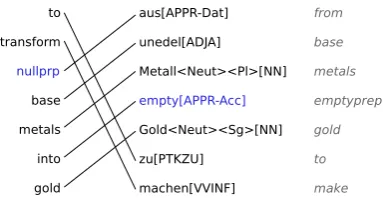
Figure 1: Example for preposition-informed repre-sentation with empty placeholders heading NPs.
are generated. They report an improvement in trans-lation quality for several language pairs. In con-trast, our approach concentrates on the generation of closed-class function words to obtain the most appropriate complement type given the source sen-tence. This includes generating word sequences not observed in the training data, i.e. adding/changing prepositions for a (different) PP or removing prepo-sitions to form an NP. A task related to synthesizing prepositions is that of generating determiners, the translation of which is problematic when translat-ing from a language like Russian that does not have definiteness morphemes. Tsvetkov et al. (2013) create synthetic translation options to augment the phrase-table. They use a classifier trained on local contextual features to predict whether to add or re-move determiners for the target-side of translation rules. In contrast with determiners, which are local to their context, we model and generate function words with semantic content which are subject to complex interactions with verbs and other subcate-gorized elements throughout the sentence.
3 Inflection Prediction System
We work with an inflection prediction system which first translates into a stemmed representation with a component for inflecting the SMT output in a post-processing step. The stemmed representation contains markup (POS-tags and number/gender on nouns and case on prepositions, as can be seen in figure 1) which is used as input to the inflection component. Inflected forms are generated based on the morphological featuresnumber,case, gen-derandstrong/weak, which are predicted on the SMT output using a sequence model and a morpho-logical tool (cf. section 6.1). Modeling morphol-ogy is necessary when modifying German prepo-sitions, as they determine grammatical case and changing a preposition might require to adapt the
inflection of the respective phrase, too. Portman-teau prepositions (contracted forms of preposition and determiner) are split during the synthesizing and translation process, and are merged after the inflection step. For more details about modeling complex morphology, see for example Toutanova et al. (2008), Fraser et al. (2012) or Chahuneau et al. (2013).
4 Preposition-Informed Representation Our first approach introduces a simple abstract rep-resentation that inserts pseudo-preposition markers to indicate the beginning of noun phrases. This representation serves two purposes: to adjust the source and target sides for structural mismatches of different complement types, and to provide in-formation about syntactic functions and semantic roles via the annotation of grammatical case.
Placeholders for empty prepositions are inserted at the beginning of noun phrases in both the source and target language. Figure 1 provides an example of the training data with two structural mismatches: the PP on the source sideinto goldcorresponds to the NPGold<Sg>[NN]on the target side, and the
NP on the source side (base metals) corresponds to the PPaus unedel Metallon the target side.
Without the placeholders at the beginning of noun phrases, the word alignment for these phrases con-tains either unaligned overt prepositions1, or
impre-cise one-to-many alignments containing preposi-tions such as “into gold→Gold<Sg>[NN]”, which
are wrong in many contexts.
The placeholder prepositions lead to a cleaner word alignment: the inserted empty preposition on the source side (innullprp base metals) is aligned to the overt preposition aus on the target side,
whereas the overt source preposition ininto gold
can be aligned to an empty preposition on the tar-get side. As a consequence of the improved word alignment, the resulting system has a better cover-age of individual prepositions, and the amount of prepositions being lumped together with an adja-cent word via alignment is reduced. In addition, the placeholder betweenMetallandGoldprovides an
explicit phrase boundary between a PP and a direct object NP. The annotation with grammatical case provides information about the syntactic function of a phrase, such as a subject (EMPTY-Nom) or a
direct object (EMPTY-Acc). For PPs, the case
sentence 1: nullprp beginners lookfor weaponsin different ways .
sentence 2: nullprp screenshot of the site that accepts nullprp ordersfor weapons.
1 2 3 4 5 6 7 8 9 10 11
NP/PP tag word func head head parent parV parV parN parN best-5
src src src src src trg src src trg src trg predicted
sentence
1 PP IN for prep weapon Waffe V look – – – nach-Dat 0.349
empty-Acc 0.224 empty-Nom 0.206 von-Dat 0.067 f¨ur-Acc 0.064
sentence
2 PP IN for prep weapon Waffe N – – order – f¨ur-Acc 0.559
[image:4.595.77.526.60.224.2]empty-Nom 0.184 von-Dat 0.087 nach-Dat 0.078 empty-Acc 0.053
Table 1: Source and target side features for the prediction of placeholders in the phrasefor weapons→
PREP Waffe<Pl>[NN]in two sentences, using the top-5 five predictions; appropriate prepositions are bold.
The prediction model corresponds to model (2) in table 7.
sents an indicator whether a preposition is part of a directional (accusative) or a locational (dative) PP.
5 Synthetic Phrase-Table Entries
Our second, extended approach generates synthetic phrases from intermediate generic placeholders. We combine source-side and target-side features to synthesize phrase-table entries that are unique for the respective source-side context.
5.1 Motivation and Example
The preposition-informed representation presents a straightforward solution to handle different struc-tures on the source and target side. However, there are two remaining issues: first, the distribution of translation probabilities might favour a comple-ment realization that is invalid for the respective context; and second, the required preposition might not even occur in the parallel training data as a translation of the source phrase. As a solution to these problems, we explore the idea of synthesizing phrase-table entries, in order to adjust the transla-tion optransla-tions to token-level requirements in a way that allows to take into account relevant informa-tion from the entire source sentence.
As a basis for the prediction of synthetic phrase-table entries, all empty and overt prepositions are replaced with a generic placeholderPREP. In the
prediction step, generic placeholders are trans-formed into an overt or an empty preposition. Ev-ery phrase can thus be inflected as either PP or NP, depending on the sentence context. The format of the synthesized phrases corresponds to that of the preposition-informed system, with one major difference: for each source phrase, a unique set of
target-phrases (possibly with new word sequences) is generated to provide an optimal set of translation options on token level.
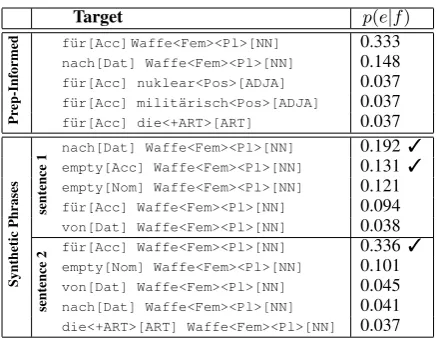
Table 1 illustrates the first step of the process: the two sentences above the table both contain the phrasefor weapons, which occur in different contexts. The predominant literal translation of
for is f¨ur, which is however only correct in the second sentence, modifying the noun order. In the context of the verblook, the prepositionnach
or the empty preposition are correct. Thus, for the underlying target phrasePREP Waffe<Pl>[NN],
different prepositions need to be available for different contexts: for the first sentence, the in-termediate placeholder entry should yield nach Waffe<Pl>[NN]andEMPTY-Acc Waffe<Pl>[NN];
for the second sentence, it should yield f¨ur Waffe<Pl>[NN](bold in table 1). In particular, it
is possible to generate target entries that have not been observed in the training data in combination with the source phrase. This is, for example, the case forEMPTY-Acc Waffe<Pl>[NN]which does
not occur as a possible translation option of for weaponsin the preposition-informed system.
5.2 Prediction Features
Target p(e|f)
Pr
ep-Inf
ormed
f¨ur[Acc] Waffe<Fem><Pl>[NN] 0.333 nach[Dat] Waffe<Fem><Pl>[NN] 0.148 f¨ur[Acc] nuklear<Pos>[ADJA] 0.037 f¨ur[Acc] milit¨arisch<Pos>[ADJA] 0.037 f¨ur[Acc] die<+ART>[ART] 0.037
Synthetic
Phrases sentence
1 nach[Dat] Waffe<Fem><Pl>[NN] 0.192 3 empty[Acc] Waffe<Fem><Pl>[NN] 0.131 3 empty[Nom] Waffe<Fem><Pl>[NN] 0.121 f¨ur[Acc] Waffe<Fem><Pl>[NN] 0.094 von[Dat] Waffe<Fem><Pl>[NN] 0.038
sentence
2 f¨ur[Acc] Waffe<Fem><Pl>[NN] 0.336 3 empty[Nom] Waffe<Fem><Pl>[NN] 0.101 von[Dat] Waffe<Fem><Pl>[NN] 0.045 nach[Dat] Waffe<Fem><Pl>[NN] 0.041 die<+ART>[ART] Waffe<Fem><Pl>[NN] 0.037
Table 2: The top-5 synthetic phrases according top(e|f)for the phrasefor weaponsbased on the
predictions from table 1. Phrases marked with3are correct in the respective context.
the target-side context is restricted to the phrase. The source-side features comprise the type of the aligned phrase (1), the tag (2) and the word (3), as well as the syntactic function of that phrase in the source sentence (4: subj, obj, prep), and the governed noun (5:weapon). Furthermore, the word (verb (8) or noun (10)) governing the aligned preposition is identified and used as a feature along-side with its tag information (7: V/N). The content words from the source side, head-src (5) and parent-V/N (9,11) are then projected to the target side, if present in the phrase. In addition, up to three words to the left or right of the placeholder provide target-side context, depending on the length of the target phrase. From these features, information about the verb and the syntactic role in the source sentence are probably most important. While the content of an NP (e.g.,to order weapons/cake/etc.) is not necessarily relevant to determine the realization of a placeholder2, the training also relies onfeature
n-gramssuch as noun-verb tuples or preposition-noun-verb triples, which contain important infor-mation about subcategorizational preferences.
As training data for this model, we use all ex-tracted source/target/alignment triples containing a relevant preposition from the preposition-informed system; the preposition with case annotation is used as the label. We record which sentence was used to extract each phrase in order to obtain the token-level source-side context. For the prediction
2Our experiments indicated that using features (5) and (6) as individual features tends to be harmful, whereas in combi-nation with other features they provide useful information.
task, the model is applied to phrase-table entries ob-tained on the placeholder representation: For each n-gram in the source sentence, the relevant phrase-table entries are identified and the respective fea-tures are extracted from the source sentence. Based on the top-5 predictions, along with the prediction scores, context-dependent phrase-table entries are generated. Since the complement realization also depends on lexical decisions in the target sentence (such as the verb), there are often several valid op-tions and there is no possibility to decide forone
particular realization without the actual target sen-tence context during the prediction step. We thus work with the set of n-best predictions to provide a
selectionof probable phrase-table entries given the source-sentence.
In this model, each preposition to be predicted is treated as one instance; this means that each preposition is predicted independently. In the case of several prepositions occurring in a single phrase, we consider all permutations of the respective n-best predictions.
5.3 Building the Phrase Table
To build the phrase-table with synthesized target phrases, we start by building a phrase table on data with generic placeholders, using the word alignments from the preposition-informed system. The entries are then separated into two groups: en-tries with and without placeholders. Enen-tries with-out placeholders do not need any further process-ing, and are kept for the final phrase table, includ-ing translation probabilities and lexical weights. Phrase-table entries whose target side contains a placeholder are then selected to undergo the predic-tion step.
A prediction for all phrases is not feasible, so we restrict the table to the top-20 entries according to
p(e|f). This filtering is applied to the phrase table
of the preposition-informed system; the phrase-table entries containing generic placeholders are then selected accordingly. With this process of phrase selection, the synthetic-phrase system and the preposition-informed system rely on the same set of underlying phrase-table entries.
5.4 Scores in Phrase and Reordering Table
A phrase table typically contains the translation probabilitiesp(f|e)andp(e|f), as well as the
lex-ical probabilitieslex(f|e) andlex(e|f). For the
[image:5.595.72.291.59.228.2]calculated based on the lexical weights of the in-dividual words. In contrast, the translation proba-bility of a newly generated phrase cannot be cal-culated. We consider the translation probability from the placeholder representation table as an ap-proximate translation probability independent of the actual preposition; the classifier (ME) score indicates how well a particular preposition fits into the target-phrase. We present three variants to esti-mate the translation probabilities and then explore several ways to use the scores as features to be optimized by MERT training.
SCORE-VARIANT1: The placeholder translation
probability and the ME scores are used as sepa-rate features. An indicator feature counts the pre-dicted prepositions. Non-synthesized phrases get a pseudo ME-score of 1, andexp(0)for the indicator
feature. In the case ofn >1prepositions, the ME
scores are multiplied, and the indicator feature is set toexp(n).
SCORE-VARIANT2: Variant 1 is extended with the
product of the placeholder translation probabilities and the ME score, to account for cases where lex-ically bad translation options received a high ME score and thus are boosted erroneously.
SCORE-VARIANT3A: We consider the placeholder
translation probability as the probability of a phrase to containsomepreposition and use it as the basis to calculate a score for the phrase to contain the predicted preposition, using the ME score. Note, however, that the prediction score does not provide the probability of the target phrase representing a translation of the source phrase, but only how well the predicted preposition fits into the target phrase; this leads to potentially high ME scores for bad translation options. For this reason, we “dampen” the prediction score with the lexical probability as an indicator for the quality of the source-target pair, resulting in the following formula:
Pprep(e|f) = PP laceHolder(e|f) * (ME + lex(e|f))
where ME is the prediction score and PP laceHolder
is the translation probability based on the place-holder representation. lexis the lexical probability
based on the phrase containing the generated prepo-sitions. In a variant (3b), the resulting translation probability scores are then normalized such that they sum to 1 with the entries without prepositions, whose probability mass remains unchanged and corresponds to that in the preposition-informed
sys-tem. This aims at obtaining a “real” probability dis-tribution with context-dependent scores for phrases containing prepositions that is as close as possible to that in the preposition-informed system: proba-bilities of phrases without prepositions remain the same, whereas the scores for the generated phrases are normalized to share the remaining probability mass given a source phrase.
In variants 1 and 2, the ME-based scores are used as additional features to the lexical and place-holder translation probabilities, whereas in variant 3, new phrase-translation probabilities are com-puted based on the placeholder probabilities and the prediction scores to replace the placeholder probabilities. Table 2 shows the generated entries and the scores forp(e|f)according to score variant
3b for the predictions from table 1; suitable trans-lation options are marked with3. For sentence 1, the two possible variantsnachandemptyare top-ranked, whereas the top entry from the preposition-informed system,f¨ur, is unlikely to be selected in this context. For sentence 2, the top-ranked preposi-tionf¨uris even more likely than in the preposition-informed system. The entries for both sentence 1 and sentence 2 show that the previous two top-ranked candidates (f¨ur Waffe<Pl>[NN]andnach Waffe<Pl>[NN]) are now expanded and take up the
top-5 positions for sentence 1 and the top-4 posi-tions for sentence 2. As a result, the lexically in-valid options on positions 3-5 from the preposition-informed system are disfavoured.
For the reordering table, we use the statistics from the placeholder representation. We assume that no changes in the reordering are caused by modifying the complement type or modifying prepositions; this assumption was verified experi-mentally (details are omitted).
6 Experiments and Results
We compare the preposition-informed system with the synthetic-phrases system where we explore dif-ferent ways to integrate the synthetic phrases.
6.1 Experimental Setup
System BLEU
baseline-1 Surface forms 19.17
baseline-2 Stemmed 19.35
prep-informed Stemmed +
∅-CASE 19.76
system (P-1)
prep-informed Stemmed +
∅-CASE-top-20 19.73
[image:7.595.73.291.62.134.2]system (P-2)
Table 3: Scores for baselines and preposition-informed system.
System Features used for MERT tuning BLEU
SP-1 SCORE-VARIANT-1 19.76
SP-2 SCORE-VARIANT-2 19.83
SP-3a SCORE-VARIANT-3 19.80
SP-3b SCORE-VARIANT-3, norm.Pprep(e|f) 19.86*
Table 4: Variants of the synthetic-phrases system. * marks significant improvement over system P-2 (with pair-wise bootstrap resampling with sample size 1,000 and a p-value of 0.05)
datasets are from the WMT2015 shared task. To predict the four morphological features num-ber, gender, case and strong/weak for inflecting the stemmed output, we trained 4 CRF sequence mod-els on the target-side of the parallel data. These features are predicted as a sequence of labels (i.e. case/number/etc of consecutive words in an NP/PP) at sentence level. For the prediction of the place-holder prepositions, we trained a maximum entropy model on the parallel training data. In contrast to the morphological features, each preposition in a phrase is predicted independently. For all models, we used the toolkit Wapiti (Lavergne et al., 2010). The German data was parsed with BitPar (Schmid, 2004) and German inflected forms were generated with the morphological resource SMOR (Schmid et al., 2004).
6.2 Baselines
We consider two baselines:
BASELINE-1: a standard phrase-based translation
system trained on surface forms without any form of morphological modeling.
BASELINE-2: a system with morphological
model-ing, as described in section 3. Portmanteau prepo-sitions are split into preposition and article prior to translation and merged in a post-processing step. Otherwise, prepositions are not modeled.
6.3 Results
The preposition-informed system contains overt prepositions and empty prepositions annotated with grammatical case at the beginning of noun phrases,
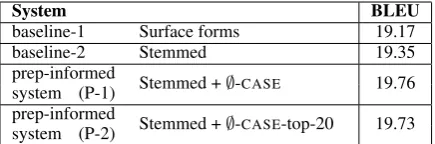
as described in section 4. Empty prepositions are simply deleted from the SMT output after trans-lation before generating inflected forms. The in-troduction of empty prepositions into the training data leads to statistically significant improvements in BLEU over both the surface system (baseline-1) and the inflection prediction system (baseline-2), cf. Table 3. Furthermore, restricting the phrase-table to the top-20 entries according top(e|f)
(sys-tem P-2) does not decrease performance.
Table 4 shows the results for the variants of the synthetic-phrases systems, which all significantly outperform baseline-2. Even though the difference is small, the best system (SP-3b) is significantly better than system P-2, the preposition-informed system using the top-20 translation table entries. It is, however, not significantly better than system P-1, which uses all phrase-table entries. This is rea-sonable considering that SP-3b is built from place-holder entries based on the same phrase inventory as system P-2.
The system with the lowest score (SP-1) uses lexical and placeholder phrase probabilities com-bined with the ME prediction scores and the count feature. System SP-2, extended with the product of the phrase translation probability and the ME score, yields a slightly better result. For system SP-3, in which new phrase-translation probabilities replace the placeholder probabilities, we compare a version with and without normalizedp(e|f)scores:
the normalization leads to a best overall score; all synthetic-phrases systems score in a similar range, however.
7 Discussion
In this section, we summarize the results and in par-ticular, discuss the use of newly generated phrases. We also attempt to analyze potential side-effects on the phrase table and present additional experiments to better handle these effects.
7.1 Summary of Results
The insertion of placeholder prepositions leads to an improvement over both baselines due to the cleaner alignment enabled by the more similar source and target sides. Furthermore, the empty prepositions can function as phrase boundaries and provide “flat structural” information in the form of annotated grammatical case.
preposition-SP-1 SP-2 SP-3a SP-3b
new 1489 1507 1391 1398
[image:8.595.88.271.62.95.2]regular 38132 34541 35101 33571
Table 5: Number of newly generated and regular phrase-table entries used to translate the test set (3003 sentences).
informed system that is able to generate new entries if needed. We explored different score settings, either as separate features (variants 1/2) or com-bined into a translation probability score in (variant 3). While all variants perform similarly, the best system is significantly better than the preposition-informed system built on the top-20 phrase-table entries. This shows that the proposed method of synthetic phrases indeed improves translation qual-ity. However, the difference is very small and only applies to one pair of system variants, which makes it difficult to draw a solid conclusion.
7.2 Use of Newly Generated Phrases
An important property in the presented method is the ability to generate new phrases. Table 5 shows the distribution of phrases used to translate the test set. For the 3003 sentences, roughly 1500 new phrases have been applied; on average, this corresponds to about one new phrase in one out of two sentences. Given that function words usually are thought to be well-covered in NLP training data, this number is substantial.
The following example illustrates how newly generated translation options can improve trans-lations by closing coverage gaps. Table 6 shows the translations for an input sentence (EN) of the preposition-informed system P-2 and the synthetic-phrases system SP-2. The two outputs are identical and both correct, except for the wrong preposition
zurin system P-2. To translate the sentence with the synthetic-phrases system, these new translation options3have been used:
the deutsche bahn→die∅-Nom deutsche Bahn
to improve∅the →auf-Acceine Verbesserung∅-Gen der railway line in →Eisenbahnlinie in-Dat
In particular, the phrase pair “to improve∅the→ auf-Acceine Verbesserung∅-Gen der” enables a translation with the correct preposition. Due to the segmentation of the sentence, the English verb
hopeis translated as part of another phrase, which excludes a translation as one unit such as hope
3Shown in inflected format for better readability.
EN nullprp the deutsche bahn hopes to improve nullprpthe kinzigtal railway line in the coming year. P-2 die deutsche Bahn hofftder kinzigtal Eisenbahnlinie im kommenden Jahr.zurVerbesserung SP-2 die deutsche Bahn hofftder kinzigtal Eisenbahnlinie im kommenden Jahr.auf eineVerbesserung
Table 6: Improved translation output by applying a newly generated translation option.
to → hoffen auf. Furthermore, there is a struc-tural shift between the source side phrase “hope to improveVERB”, and the German sentence with the structure “hofftPREPVerbesserungNOUN”. The incor-rectzuin the preposition-informed system would be a valid connection to a following verb, but can-not be used to introduce a PP in this context.
7.3 Side-Effects on the Phrase-Table
A recurring problem in the synthetic-phrases sys-tem are lexically wrong translations that are boosted due to unreasonably high ME scores in comparison to lexically more correct options. In particular, this is the case when infrequent words occur within a lexically wrong translation, which also happens to have lexical and phrase translation probabilities in a similar range as better transla-tion candidates. When predicting prepositransla-tions for such phrases, the ME model is often overly con-fident and outputs comparatively high prediction scores based on an insufficient amount of training examples4.
Consider as an example the English phrasefor bags and two of its translation options: “PREP
Taschen” (’bags’) and “PREPM¨ulls¨acke” (’garbage
bags’), which have similar translation and lexical probabilities. In the ME training data, there are only very few occurrences ofPREPM¨ulls¨acke. As
a result, the ME very confidently reproduces the seen training instances with a score around0.9for
the top-ranked preposition. In comparison, the pre-dictions forPREPTaschenare more balanced due
to more occurrences of this word, with a score of around0.55for the top-ranked preposition. Thus,
the incorrectf¨ur M¨ulls¨ackeoption is boosted by its prediction score and consequently gets chosen by the synthetic-phrases system.
SP-1 SP-2 SP-3a SP-3b (1) no infreq nouns 19.59 19.85 19.71 19.94*
(2) reduced data 19.82 19.58 19.73 19.64
Table 7: Results when filtering out infrequent nouns in the ME training data (1) or reducing the amount of source-target-alignment triples used for ME training (2). * marks significant improvement over system P-2.
this problem by weighting down the prediction scores using lexical and/or phrase translation prob-abilities. In addition, we also experimented with replacing infrequent words with dummy tokens to still benefit from lexical information while exclud-ing insufficiently represented words. The first line in table 7 shows the results for prediction models trained on data where infrequent nouns (freq < 25) occurring in the NP/PP (features 5 and 6 in table 1) are omitted when training the prediction ME. The general outcome is similar to the experi-ments reported in table 4, with variants SP-2 and SP-3b being slightly better. The result for system SP-3b is the overall best result. This suggests that a careful representation of infrequent lexical items in training data benefits the prediction quality.
In an attempt to reduce the training data to relevant entries, we restricted the source-target-alignment triples used to train the prediction ME to those occurring in the top-20 filtered table. Thus, all entries in the phrase-table are covered by the model, while infrequent and non-relevant training instances are mostly omitted. The results are listed in the second line in table 7; however, this model leads to generally worse results than the previous ones. We assume that removing a subset of training triples leads to a somewhat unbalanced training set.
7.4 Distribution in Phrase Table
Another, potentially negative, effect on the phrase distribution in the phrase table stems from integrat-ing the n-best predictions per place-holder entry: an already dominant translation option can be fur-ther reinforced if it does not only represent the top-most translation option (as in the preposition-informed or place-holder table), but can be ex-panded to several entries. An equally valid, but less probable translation option is then less acces-sible if its prediction scores are in the same range, as this translation is then dispreferred by its trans-lation scores and has to compete with several en-tries stemming from the original top translation
prep-informed synth-phrases
missing wrong missing wrong
verbs 32 11 23 10
nouns 2 15 2 17
prepositions 6 6 3 8
[image:9.595.314.520.62.123.2]gram. case – 4 – 3
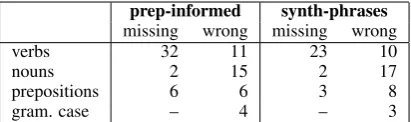
Table 8: Manual error analysis of 50 randomly selected sentences.
option. Consider the example of the phrase “ ex-pand nullprp their”: in the preposition-informed system, the lexically correct translationerweitern
EMPTY-Accihreis ranked third according top(e|f),
with two meaningless translations (only determiner or only preposition) as the two top-ranked transla-tions, which is already a bad starting point for trans-lation of the verb. In the synthetic-phrases system, “descendants” of the previously top-2 meaningless translations now are expanded and fill the positions 1-5, resulting in the correct translation option being ranked 6th.
This effect can also be positive by promoting lexically correct translation options (in cases where the leading translation is correct, but is closely fol-lowed by a less suited translation). For example, it can be seen in the example in table 2 where the lexically incorrect phrases are moved to lower po-sitions. However, it might also happen that literal translations are preferred over less common senses in cases of word sense ambiguities. A small manual evaluation (cf. next section) showed that slightly more verbs are translated with the synthetic phrases system. Verbs in English-to-German translation are often omitted during translation; the effect of en-hancing literal translations might be responsible for the observed tendency to translate more verbs.
The different score variants explored in the previ-ous section aim to find a combination that considers these factors, but the results show that it is a diffi-cult task to account for all possible interactions.
7.5 Manual Evaluation
We carried out a small manual evaluation for 50 sen-tences (length 10-20 words) randomly chosen from system SP-3b in table 7, the best overall system, in comparison to the preposition-informed system P-2. Two native speakers annotated errors concerning missing or incorrect verbs, nouns and prepositions, as well as incorrect grammatical case. Table 8 de-picts the outcome: The number of errors found in the categoriesprepositionand grammatical case
EN this is mainlyfrom the administrative budget ...due to the higher contribution P-2 das ist haupts¨achlichaus dem Verwaltungshaushalt ...aufdie h¨oheren Beitr¨age SP-3b das ist vor allemaus dem Verwaltungshaushalt ...wegenden h¨oheren Beitr¨agen
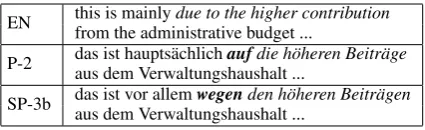
Table 9: Example for unclear error categories.
is found, however, for the number of translated verbs, which are known to be generally difficult for the language pair English-to-German. We as-sume that this is due to a tendency to strengthen literal translations, from which verbs might benefit as they are generally less well represented in the phrase-table.
Note, however, that there are other relevant fac-tors that this manual evaluation does not take into account, such as, e.g., the overall structure of the sentence. Furthermore, the evaluation of verbs and its subcategorized elements is often difficult as there might be several valid options for annotation, which is illustrated by the example in table 9. The translations of the two systems are nearly identi-cal, except for the prepositions heading the trans-lation fordue to the higher contribution(and con-sequently the realization of grammatical case in the respective phrases, which is correct given the respective preposition). The sentence produced by the synthetic-phrases system is correct, preserving the structure of the English sentence by translating
due toaswegen+Dative(wegen+Genitivewould be correct, too.). Thus, replacing the preposition
aufand adjusting the grammatical case in the sen-tence produced by the preposition-informed system would lead to the same, valid, translation. However, the prepositionaufstrongly triggers the reader to expect the verb zur¨uckf¨uhren (auf)(’to attribute (to)’) which also would lead to a valid translation. Such cases make the evaluation of prepositions and complement types difficult, as the error category (missing verborwrong preposition) is not always clear.
8 Conclusion and Future Work
We compared two approaches for modeling com-plement types in English-to-German SMT. Our ex-periments showed that explicit information about different complement types (insertion of empty placeholders) leads to improved SMT quality. The results of the synthetic-phrases system are slightly better than those of the preposition-informed sys-tem, with two variants being significantly better.
As the differences are rather small and apply only to some system pairs, it is difficult to draw a clear conclusion concerning the effectiveness of the synthetic-phrases method. Our analysis showed, however, that newly generated phrases are indeed used within the systems and help to improve trans-lation quality. We consider this a confirmation that the generation of synthetic phrases for handling subcategorization is a sound approach.
In future work, we plan to explore models that predict the complete targetphrasegiven the source phrase and subcategorization-relevant features in-stead of predicting the preposition in a target phrase.
Acknowledgments
This project has received funding from the Euro-pean Union’s Horizon 2020 research and innova-tion programme under grant agreement No 644402 (HimL), from the European Research Council (ERC) under grant agreement No 640550, from the DFG grantsDistributional Approaches to Semantic RelatednessandModels of Morphosyntax for Sta-tistical Machine Translation (Phase Two)and from the DFG Heisenberg Fellowship SCHU-2580/1.
References
Eneko Agirre, Aitziber Atutxa, Gorka Labaka, Mikel Lersundi, Aingeru Mayor, and Kepa Sarasola. 2009. Use of Rich Linguistic Information to Translate Prepositions and Grammatical Cases to Basque. In Proceedings of the 13th Annual Conference of the EAMT, Barcelona, Spain.
Marine Carpuat and Dekai Wu. 2007. Improving Sta-tistical Machine Translation using Word Sense Dis-ambiguation. InProceedings of the 2007 Joint Con-ference on Empirical Methods in Natural Language Processing and Computational Natural Language Learning, Prague, Czech Republic.
Victor Chahuneau, Eva Schlinger, Noah A. Smith, and Chris Dyer. 2013. Translating into Morphologically Rich Languages with Synthetic Phrases. In Proceed-ings of the 2013 Conference on Empirical Methods in Natural Language Processing (EMNLP), Seattle, Washington.
Jinho D. Choi and Martha Palmer. 2012. Getting the Most out of Transition-Based Dependency Parsing. In Proceedings of the 49th Annual Meeting of the Association for Computational Linguistics: Human Language Technologies, Portland, Oregon.
Word-Formation in SMT. InProceedings of the the Euro-pean Chapter of the Association for Computational Linguistics (EACL), Avignon, France.
Kevin Gimpel and Noah A. Smith. 2008. Rich Source-Side Context for Statistical Machine Translation. In Proceedings of the Third Workshop on Statistical Machine Translation, Columbus, Ohio.
Minwoo Jeong, Kristina Toutanova, Hisami Suzuki, and Chris Quirk. 2010. A Discriminative Lexicon Model for Complex Morphology. In In Proceed-ings of the Ninth Conference of the Association for Machine Translation in the Americas., Denver, Col-orado.
Thomas Lavergne, Olivier Capp´e, and Franc¸ois Yvon. 2010. Practical very large scale CRFs. In Proceed-ings the 48th Annual Meeting of the Association for Computational Linguistics (ACL), Uppsala, Sweden. Helmut Schmid, Arne Fitschen, and Ulrich Heid. 2004. SMOR: a German Computational Morphology Cov-ering Derivation, Composition, and Inflection. In Proceedings LREC 2004, Lisbon, Portugal.
Helmut Schmid. 2004. Efficient Parsing of Highly Ambiguous Context-Free Grammars with Bit Vec-tors. InProceedings of the International Conference on Computational Linguistics.
Reshef Shilon, Hanna Fadida, and Shuly Wintner. 2012. Incorporating Linguistic Knowledge in Statis-tical Machine Translation: Translating Prepositions. In Proceedings of the Workshop on Innovative Hy-brid Approaches to the Processing of Textual Data, EACL 2012, Avignon, France.
Aleˇs Tamchyna, Fabienne Braune, Alexander Fraser, Marine Carpuat, Hal Daum´e III, and Chris Quirk. 2014. Integrating a Discriminative Classifier into Phrase-based and Hierarchical Decoding. In The Prague Bulletin of Mathematical Linguistics, Num-ber 101, pages 29–41.
J¨org Tiedemann, Filip Ginter, and Jenna Kanerva. 2015. Morphological Segmentation and OPUS for Finnish-English Machine Translation. In Proceed-ings of the Tenth Workshop on Statistical Machine Translation, Lisbon, Portugal.
Kristina Toutanova, Hisami Suzuki, and Achim Ruopp. 2008. Applying Morphology Generation Models to Machine Translation. In Proceedings of ACL08-HLT, Columbus, Ohio.
Julia Tsvetkov, Chris Dyer, Lori Levin, and Archna Bhatia. 2013. Generating English Determiners in Phrase-Based Translation with Synthetic Translation Options. InProceedings of the Eighth Workshop on Statistical Machine Translation, Sofia, Bulgaria. Marion Weller, Alexander Fraser, and Sabine Schulte
im Walde. 2013. Using Subcategorization Knowl-edge to Improve Case Prediction for Translation to German. InProceedings of the Association for Com-putational Linguistics (ACL), Sofia, Bulgaria.
Marion Weller, Alexander Fraser, and Sabine Schulte im Walde. 2015. Target-Side Generation of Prepo-sitions for SMT. InProceedings of EAMT 2015, An-talya, Turkey.
![Table 1: Source and target side features for the prediction of placeholders in the phrase for weapons →PREP Waffe<Pl>[NN] in two sentences, using the top-5 five predictions; appropriate prepositions are bold.The prediction model corresponds to model (2) in table 7.](https://thumb-us.123doks.com/thumbv2/123dok_us/1480330.687698/4.595.77.526.60.224/prediction-placeholders-sentences-predictions-appropriate-prepositions-prediction-corresponds.webp)