Abstract— Although the wind turbines are nowadays the principal source of wind energy production, the technical information publicly known about these machines is still very scarce. Information related to failure modes, unavailability and maintenance costs of these systems remain confidential and only the manufacturer has knowledge about them.
To be able to optimize the efficiency, to guarantee the security and to negotiate better warranty and maintenance contracts, it is necessary to know more information about the operation and maintenance and replacement costs of subsystems of a wind turbine. To this end, and based on two years of operation, this paper exhaustively analyses an active power control system, of 21 identical wind turbines, installed in a wind farm in Portugal. The emphasis of this study is on its operation, availability and maintenance and replacement costs, obtaining, in particular, an estimate for the total maintenance cost of the active pitch control device, one of the most important components of the turbine, which automatically manages the position and operation of blades, according to wind direction and speed, thus maximizing gathered electrical power or stopping the operation whenever bad weather conditions exist.
Index Terms— Wind turbine, failure modes, pitch control system, maintenance costs.
I. INTRODUCTION
OR regular and economical generation of energy, it is necessary to maintain each wind turbine handling unit, take in account the environment conditions, operating conditions and others. According to Kumar and Pandey [1], the failure rate of each subsystem in a particular system depends upon the operating conditions and repair policies used. In the wind turbine, the active power control system assumes primordial importance, because: i) it is crucial in the optimization of the turbine efficiency; and ii) it is very important with regard to the safety of the turbine [2]. The problem is that this system reveals frequent failures and large residence time in failure compared to other systems of the machine [3]. Consequently, to guarantee a normal operation, it usually needs maintenance actions, which are
This work was financed with FEDER Funds by Programa Operacional Fatores de Competitividade – COMPETE and by National Funds by FCT – Fundação para a Ciência e Tecnologia, Project: FCOMP-01-0124-FEDER
M. Carvalho is with Polytechnic Institute of Cávado and Ave, Technology School, Campus of IPCA, 4750-810 Barcelos, Portugal, phone: +351 253 802260 e-mail: [email protected].
E. Nunes is with Centro Algoritmi, University of Minho, Campus de Gualtar, 4710-057, Braga, Portugal; e-mail: [email protected].
J. Telhada is with Centro Algoritmi, University of Minho, Campus de Gualtar, 4710-057, Braga, Portugal; e-mail: [email protected].
provided by the manufacturer only [4]. Moreover, these actions, specifically these maintenance costs, are unknown by the company that manage the wind farm. This situation does not facilitate, for example, the work of company managers who search for better warranty and maintenance contracts.
In an attempt to shed some light on this problem, the present work addresses, in particular, the pitch control system, which is a very important part of wind turbines, since it allows the optimization of the wind turbine efficiency along with the means that protect their operating safety and integrity in bad weather conditions. This study is based on an analysis of data collected from 21 wind turbines installed in a wind farm in Portugal, during two years. The data collected basically consist on the register of the exact time of occurrence of a particular state and the wind speed at the time of this occurrence in each turbine, allowing to performing some statistical analyses [5]. On the other hand, it was possible to gather complementary and additional information from semi-structured interviews to experts who thus shared their knowledge and experience on working with these systems.
These data were provided confidentially by the company that manages the farm. Because of this, the name of the company and the wind turbine brand are not revealed.
The wind farm that provided the information holds more than one type of turbines. The selection of the type of wind turbine to analyse was based on two main criteria:
i) being the most recent, and
ii) being in a greater number than the other types. The turbine under analysis has three rotor blades, active power control and nominal power of 2 MW.
The main objective of this paper consists in reporting the gathering process of information about wind turbine functioning and its failures and costs, and conducting some reliability analyses, providing an estimate for maintenance costs of an active power control system (pitch system) and, based on that, allowing to make better decisions relatively to maintenance of wind turbine.
A. Wind energy in Portugal
Wind energy is harnessing the kinetic energy supplied by the wind to produce mechanical energy (rotation of blades), which can then be transformed into electrical energy by a generator.
The wind has been used for thousands of years to meet the energy needs of human activity, e.g. for powering transportation (sailing boats), pumping water or permit the operation of industrial activities, as was the case of windmills, still visible at, for example, the top of many Portuguese hills.
Maintenance Costs of a Pitch Control Device of
a Wind Turbine
Mariana Carvalho, Eusébio Nunes and José Telhada1
As most renewable energy sources (except geothermal), wind energy is a form of solar energy that comes from the heating of the atmosphere by the sun, which sets in motion the air masses. The earth's rotation, shape and coverage of the land surface and the water levels influence the speed, direction and wind variability in a given place.
Wind energy is increasingly used to produce electricity. It is often decentralized to local use, such as in isolated places (e.g. agricultural farms), but, more and more, it is associated to medium and large electric production in wind farms consisting of several wind turbines connected to the general electric network system, in particular in Europe and other occidental countries. Figure 1 shows the wind generating capacity observed in Portugal and other European countries by December 2010 [6].
Table I shows the capacity of wind generation and the number of wind turbines in Portugal in 2010.
B. Paper Organization
The paper is structured as follows: Section II describes the normal operation of the wind turbine type under analysis. Specifically, it presents the maintenance policy of the wind farm, the main states detected on the wind turbine and a detailed description of the pitch system. Section III analyses and estimates the maintenance costs for an active power control system, namely the unavailability cost, preventive and corrective maintenance costs and replacement cost. It finalized with an estimate for the total cost of maintenance of an active power control system. Finally, Section IV synthetizes the main conclusions of this work.
II. DESCRIPTION OF A WIND TURBINE
All wind turbines, regardless of size, consist on the following components: the rotor (the part that runs on wind and where they attach the blades), the electrical generator, a speed control system and the tower. Wind turbines also have a security system that, in case of failure of any of their components, prevents movement of the blades and they are commonly used for horizontal axis, essentially consisting of a tower 50-120 meters in height, on top of which is a rotor with (typically) three blades (each paddle has a length of 25 to 45 meters), and the nacelle that houses the generator itself, as well as the control systems of the machine.
The wind sets into motion the vanes that perform 10 to 25 revolutions per minute, approximately. The generator contained in the nacelle turns the mechanical energy of this rotational motion into electrical energy. An automated real-time control allows the nacelle to rotate to always face the wind and the blades themselves permanently adjust its inclination to always maximize the energy captured (active power control).
Nowadays, the most commonly wind turbines installed in wind farms have a power of 2 to 3 MW (megawatts), which means that a turbine of this type can supply the electricity needs of 2 to 3 thousands homes.
In general, any energy produced by the turbine increases with the wind speed. However, this happens only to a certain limit. In case of strong winds, the turbine blades are guided and kept, by the pitch control, in line (parallel) with the wind in order to protect themselves. The windiest sites are generally along the sea or on mountain tops, due to the fact that the relief throttle has on the wind. In a particular place, the wind speed normally increases with height as the wind off the ground undergoes less friction with the surface. For this reason, the turbines are typically mounted on high towers.
A. Maintenance Policy of a Wind Turbine
Wind turbines maintenance is made exclusively by manufacturers. In the context of this paper, the contract that the wind farm has with the manufacturer assumes the execution of four interventions per year in each turbine, conducted at quarterly intervals. Specifically, the manufacturer performed an electrical preventive maintenance, a mechanical preventive maintenance, a visual inspection and also a lubrication operation. The manufacturer is also responsible for any corrective maintenance, whenever necessary, as well as some improvement maintenance that they consider fundamental. This service provided by the manufacturer is a necessary condition to offer the warranty of the system. The associated costs to the company are about 38 thousands euros per year per turbine.
[image:2.595.40.293.503.572.2]In reality, it is not possible to know the exact values for each preventive and/or corrective maintenances, since the maintenance contract with the company that manages the wind farm is formalized with the manufacturer for a 15 years period. The terms of the contract are absolutely confidential.
Fig. 1. Generating capacity of wind power base - Europe, December 2010 Source: [6]
TABLE I
GENERATING CAPACITY AND NUMBER OF WIND TURBINES IN PORTUGAL – DECEMBER 2010.Source: [6]
Wind farms in Portugal
Full operational In construction Total MW Turbines MW Turbines MW Turbines Mainland 3852,5 2027 435,3 216 4287,8 2243
Madeira 37,4 58 0,0 0 37,4 58
Azores 11,6 33 9,0 10 20,6 43
B. Main States of a Wind Turbine
A wind turbine consists of a large set of subsystems and components some of which are critical to fulfilling the mission of wind turbine that consists on producing electricity safely and efficiently. Many of these subsystems or components have multiple failure modes that may or may not compromise the efficiency and safety of the system (wind turbine). In our study, it was possible to identify dozens of states for a wind turbine from consulting the manufacturers' manuals.
In the sample of the 21 turbines analyzed during 2 years, were detected, on average, 6237 occurrences per turbine, with a standard deviation of 1851 records. They were found only 69 different states registered (from 125 theoretically possible in the manual operation of the turbine), each one with different frequencies and time of permanency on state. Effectively, many of these 69 states occurred infrequently or with negligible permanency time on state. Note that, if the state represents a failure and the consequent shutdown, the permanent time in that state represents downtime of the machine, which likely will lead to loss of energy production. Table II presents the listing with fourteen states that are more frequent and with more time of permanency in state. More details about the main states of wind turbines and related studies can be found in [7] and [8].
The states E9 and E11 are considered frequent and permanent. Analyzing the states with longer frequency and permanency than the states E9 and E11, it appears that none of them represents or may represent a failure. Additionally, not all of them even represent the stop of the turbine. The graph of Figure 2 gives an idea of the average times among the five more frequent and permanent observed states that effectively represent a failure in the turbine.
Furthermore, this system plays a crucial role in optimizing the efficiency of the turbine, as well as a decisive role in the safety of the machine. The description of this system is made in the following section.
C. Description of a Pitch Control Device
The purpose of a power control system is to prevent that, due to high wind speeds, the power of the electric generator be exceeded as well as relieve strain on the structure and components of the wind turbine. The active control (pitch) acts on the aerodynamic forces with the aim of controlling the loads and power.
In the active control, blades may undergo rotation about its longitudinal axis, which makes it changes the angle of attack of the blades with respect to the relative velocity of the wind. This process takes place, most often, through hydraulic systems, which respond to an electronic control which checks the power output. In the case of this being too high, the control triggers the mechanism. The main advantages of this system are related to its capability to limit the power for high wind speeds, facilitating the start-up operation, to diminish the efforts and to optimize power when the turbine is operating at partial load.
[image:3.595.318.524.56.167.2]When the wind speed exceeds the cutting speed, i.e. the maximum speed at which the turbine was designed to operate, or for a maintenance action, blades can be configured so that act as aerodynamic brake, stopping the movement of the rotor. Blades may then be placed in a position flag, to minimize aerodynamic efforts upon them and upon their mechanical components. Figure 3 shows a diagram of the different positions of the blade, including the position of flag, stopping the turbine.
Fig. 3. Exemplification of active power control. Source: [9]
Fig. 2. Average time (in days) spent in each of the more permanent five states of failure, per machine in two years
0 0,2 0,4 0,6 0,8 1 1,2 1,4 1,6
E9 E10 E11 E13 E14
Ti
m
e
(d
ay
s)
State
TABLEII
LIST OF FOURTEEN STATES WITH FREQUENT AND PERMANENT
OCCURRENCES
State i (Ei) Designation
E1 Turbine in operation
E2 Lack of wind
E3 Remote control
E4 Mains fault
E5 Maintenance
E6 Cable twisted
E7 Feeding fault
E8 Turbine reset
E9 Fault blade load control
E10 Yaw control fault
E11 Pitch control error
E12 Ice detection
E13 Anemometer interface
[image:3.595.51.281.390.573.2] [image:3.595.322.540.544.724.2]This system allows more efficient capture of wind energy, particularly in the speed range between the starting and the nominal, at which the turbine operates at partial load. D. Failure modes of the Pitch Control Device
The active power control system assumes primordial importance with regard to safety of the turbine. A flaw in this system, combined with adverse climatic situation (for example, a storm) may lead to an uncontrolled rotation speed of the blades and related catastrophic consequences, including, in the limit, a total destruction of the turbine.
The states which actively influence the reliability of the active control power are the E9 and the E11 states. These states are described in the next paragraphs.
State E9 – Fault blade load control: the control effort in the turbine is constantly monitored. The state E9 means that was exercised undue effort in the blade. The wind turbine is still operating, although with reduced power. The maintenance service has to rectify the effects of stress. The state E9 actively influences the state E11.
State E11 – Pitch control error: the turbine has a power control device which aims at adjusting the angles of the rotor blades in order to optimize the potency achieved by wind speed and thus ensuring an effective use of wind energy. The angles of the three blades are constantly monitored. When there is a difference in the angles of the blades (can be erroneously due to a measurement error), state E11 arises, which leads to a shutdown of the turbine. The engine restarts automatically. If the problem persists for a predefined number of times, the maintenance service will have to repair the fault.
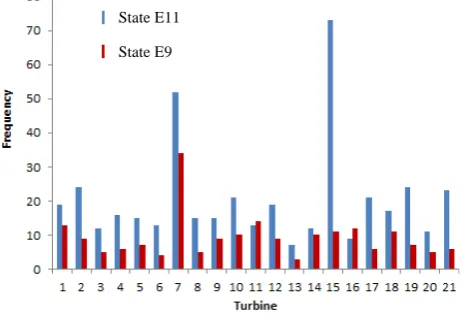
Figure 4 shows the frequency of occurrence of E9 and E11 in each of the 21 wind turbines analyzed during two years.
Note that the state E11 leads to stoppage of the turbine. The state E9, although not lead to a state of absolute unavailability, takes the turbine to an operating state of effort and reduced power, which is undesirable, both by the influence of this state in the state E11, but also by loss to generate energy inherent in a conditioning operation.
III. MAINTENANCE COSTS OF PITCH CONTROL DEVICE A. Introduction
Maintenance costs related to the two states, E9 and E11, are very difficult to estimate. The wind farm company only has the information that can be observed from the data made available to this study. From that, and with relevance to the analysis of maintenance costs, one can highlight the record of the exact time of occurrence of each state in each turbine and the wind speed at the time of that occurrence. Such information allows to estimate the cost of downtime, for the states E9 and E11, as well as the number of preventive and corrective maintenances carried out in the two years of study. However, the costs of corrective and preventive maintenance, and the number of replacements made, were not revealed by the manufacturer. One can only know approximate values from the expert’s experience, by this and others companies that manage wind farms and who were consulted in developing this work. Part of the information collected does not follow, therefore, statistical analysis, but rather statements of experts, based on their knowledge and experience and, therefore, they are subject to an increased level of uncertainty.
B. Unavailable Costs
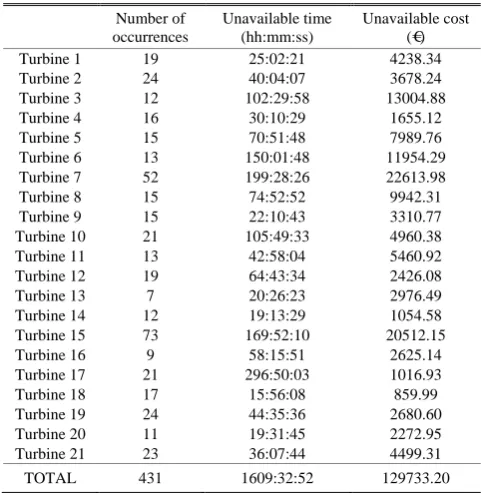
Tables III and IV summarize the frequency, duration and cost of the resulting unavailability of states E11 and E9, respectively, per turbine, in two years.
The cost of downtime shown in the last column of those tables was obtained with the knowledge of wind speed, constant in each record, and the ratio of power with wind speed, displayed in Figure 5.
The data of average wind speed and the respective wasted power by the turbine, and other details, resulting from the appearance of these two states can be found in [5]. The energy wasted in the occurrence of each state is given by:
Energy [MWh] = (Power [KW] × MDT[h])/1000 (1)
where the mean downtime (MDT) is the average time that a system is non-operational, for being in the states E9 or E11.
The cost of downtime was calculated, supposing that the energy produced is sold at 90€ per MWh.
[image:4.595.314.540.437.572.2]For the state E11, there were 431 failures in the 21 wind turbines in the years 2009 and 2010, which resulted in a total cost of unavailability of 129,733.20€ in the same period. Each failure had an average duration of approximately 4 hours and an unavailability cost of 301€.
[image:4.595.53.285.503.661.2]Fig. 5.Power curve as a function of wind speed
Fig. 4. Frequency of the E11 e E9 states, per turbine, during two years State E11
Table IV also presents the frequency, duration and cost of the resulting unavailability of the state E9 for each turbine in two years.
The same calculation, by using the Eq. (1), was used to determine the unavailable cost of the StateE9.
Table IV reveals that there were 196 failures related to the E9 state, which resulted in a total cost of unavailability of 108,276.40 €. This means that each failure had an average duration of approximately 5 hours and a cost of unavailability of 552.40€.
C. Preventive Maintenance Costs
For the preventive maintenance of the active power control system, experts mentioned the following:
Manpower: approximately 480€ (60€/h-man, always considering 2 men and 4 hours);
Lubricants: 100€;
Parts: variable (can take, or not, anything);
Displacement: variable (it can be done additionally with other works).
According to this information, it can be said that a preventive maintenance of the active power control system costs, at least, 580€, and that the time for its realization rounds 4 hours (which represents an approximate unavailability cost of 293€ due to preventive maintenance, assuming an average wind speed of 8 m/s).
D. Corrective Maintenance Costs
For corrective maintenance to the power control active system, experts report that when the maintenance team is called to intervene in the event of an error in this system (state E11), the maintenance usually consists in replacing the engine of the blade in which the error was detected. To ensure machine availability, repairs are never made on site. The motor is replaced and thereafter is repaired in the factory. The experts indicate that the cost of each engine is around 2,000€.
When the maintenance team make an intervention in the failure load control (state E9), usually they replace the sensor that somehow quantify the load exerted on the blade. A new sensor is around 50€.
Note that the repair is not carried out whenever one of the states, E9 or E11, is detected. The wind turbine has reaction mechanisms for these failures. The error manifested by the state E11, despite being a mandatory stop error, it has automatic restart. In the case of this restart fails for three times, the maintenance has to come in order to fix it. The error E9 is not a mandatory stop, but a loss of power and requires human intervention to resume with normal power (state E8), which does not mean that there is always maintenance work. This only occurs when the state E8 cannot put the machine in normal operation.
By analyzing data from the 21 wind turbines in the years 2009 and 2010, from 431 recorded instances of state E11, it resulted 53 repairs (replacements), i.e. 12.3% of cases requiring maintenance. Among the 196 occurrences of the state E9, 44 triggered a corrective maintenance, which corresponds to 22.4% of cases.
It remains to note that all instances of states E11 and E9 in 2009 and 2010 were immediately detected and recorded in the control system of each turbine. Moreover, the probability of not detecting a malfunction in the control system of active power is negligible, since it would be necessary to have a communication failure (state E3), and simultaneously a failure in the pitch system (denoted by state E11), so non detection costs were not considered. In the unlikely event of an occurrence of this kind, the consequences are unpredictable.
E. Replacement Costs
Technicians refer that a replacement of the entire active power control system of a blade will cost approximately
TABLEIV
DESCRIPTION OF THE E9STATE IN THE 21MACHINES IN THE YEARS
2009 AND 2010 Number of
occurrences
Unavailable time (hh:mm:ss)
Unavailable cost (€)
Turbine 1 13 45:51:39 7937.35
Turbine 2 9 3:38:29 430.03
Turbine 3 5 29:50:09 2062.18
Turbine 4 6 40:39:45 3317.17
Turbine 5 7 23:54:58 4116.96
Turbine 6 4 101:33:18 14475.69
Turbine 7 34 147:31:25 22322.40
Turbine 8 5 26:24:51 3609.12
Turbine 9 9 42:55:49 4626.94
Turbine 10 10 26:51:57 4945.14
Turbine 11 14 39:08:07 6794.74
Turbine 12 9 145:50:09 3260.08
Turbine 13 3 64:27:26 5319.53
Turbine 14 10 12:17:27 2006.23
Turbine 15 11 94:17:37 7117.12
Turbine 16 12 36:51:07 4005.19
Turbine 17 6 8:58:39 1656.35
Turbine 18 11 7:10:01 1317.56
Turbine 19 7 20:54:40 3858.10
Turbine 20 5 8:43:11 1204.83
Turbine 21 6 22:04:24 3893.69
TOTAL 196 949:55:08 108,276.40
TABLEIII
DESCRIPTION OF THE E11STATE IN THE 21MACHINES IN THE YEARS
2009 AND 2010 Number of
occurrences
Unavailable time (hh:mm:ss)
Unavailable cost (€)
Turbine 1 19 25:02:21 4238.34
Turbine 2 24 40:04:07 3678.24
Turbine 3 12 102:29:58 13004.88
Turbine 4 16 30:10:29 1655.12
Turbine 5 15 70:51:48 7989.76
Turbine 6 13 150:01:48 11954.29
Turbine 7 52 199:28:26 22613.98
Turbine 8 15 74:52:52 9942.31
Turbine 9 15 22:10:43 3310.77
Turbine 10 21 105:49:33 4960.38
Turbine 11 13 42:58:04 5460.92
Turbine 12 19 64:43:34 2426.08
Turbine 13 7 20:26:23 2976.49
Turbine 14 12 19:13:29 1054.58
Turbine 15 73 169:52:10 20512.15
Turbine 16 9 58:15:51 2625.14
Turbine 17 21 296:50:03 1016.93
Turbine 18 17 15:56:08 859.99
Turbine 19 24 44:35:36 2680.60
Turbine 20 11 19:31:45 2272.95
Turbine 21 23 36:07:44 4499.31
[image:5.595.47.288.80.327.2]10,000€. So, the replacement of the system of three blades will be around 30,000€.
F. Total Maintenance Costs
The annual total maintenance cost of the active power control system can be given by the following expression:
_
_ 11 _ 99 _
11 _
4
9 _ .º
11 _ .º
E U E U PM U PM
E CM
E CM
C C
C C
E CM of n C
E CM of n C
C
(2)
where:
C: total cost of maintenance of the active power control system of the 21 machines in the years 2009 and 2010 CM_E11: corrective maintenance of state E11
CM_E9: corrective maintenance of state E9 CPM: preventive maintenance cost of pitch system
CCM_E11: corrective maintenance cost of state E11
CCM_E9: corrective maintenance cost of state E9
CU_MP: unavailability cost, due to preventive maintenance
CU_E11: unavailability cost, due to state E11
CU_E9: unavailability cost, due to state E9
According to the information obtained about the costs, it was estimated, by Eq. (2), that the amount spent on maintenance of the active power control system of 21 wind turbines of the park, in the two years under review, was approximately 49,2873€. Thus, on average, the annual maintenance cost of each active power control system was around 11,735€.
Note that the only available information for the maintenance cost is that which prevails at the contract between the company and the manufacturer, i.e. 38,000€ per year per turbine. It is estimated, therefore, that 11,735€ is intended to maintain specifically the active power control system.
IV. MAIN CONCLUSIONS
The main objective of this paper was to provide an estimate for the maintenance costs of an active power control system of a wind turbine.
It was analyzed the information given by the company that manage the wind farm, which basically consists on the register of the exact time of occurrence of a particular state and the wind speed at the time of this occurrence in each turbine. By a detailed analysis of two years, of 21 identical wind turbines, it was found that there are two dependent states of wind turbine that are of particular interest, since they are states of a subsystem of the wind turbine, the active power control, that:
i) reveals frequent failures and large residence time in failure compared to other systems of the wind turbine; ii) it is crucial in the optimization of the turbine
efficiency; and
iii) it is very important with regard to the safety of the turbine.
The unavailability costs were determined, knowing the duration of the stop (or not fully operational), the average wind speed during this stop, thus deducting the costs for the the loss in the production of energy.
The number of preventive and corrective maintenances carried out in the two years of study was also counted from the data collected.
However, corrective and preventive maintenances and replacements costs are not disclosed by the manufacturer. We only know approximate values from the expert’s experience, from this and others companies that manage wind farms and who were inquired by the work team. Therefore, part of the information collected does not follow statistical analysis, but rather statements of experts, based on their knowledge and experience and, consequently, they are subject to uncertainty. In [8], the uncertainty provided by the expert’s opinions was modeled by Fuzzy Set Theory, which is an appropriate tool to deal with these uncertainty cases.
Planning the maintenance of complex systems, as the active power control system, is commonly associated with large amounts of data that are quickly processed and almost exists total dependence on historical references and on the quality and experience of experts and maintenance engineers. In this context, maintenance planning is often a very difficult process. Sometimes, unrealistic decisions come out from the process. It is expected that fuzzy set theory, applied in the planning process of maintenance systems, will then lead to more realistic results.
Until now, it was not public the maintenance cost of a wind turbine. This work presented an estimate for this cost. By this way, this work constitutes a start point for others studies on maintenance of wind turbines.
REFERENCES
[1] D. Kumar and P. C Pandey, “Maintenance planning and resource allocation in urea fertilizer plant,” Quality and reliability Engineering International Journal, vol. 9, pp. 411-423, 1993.
[2] E. Naranjo, A. Sumper, O. Bellmunt, A. Ferre, and M. Rojas, “Pitch control system design to improve frequency response capability of fixed-speed wind turbine systems,” European Transactions on Electrical Power, vol. 21, pp. 1984–2006, 2011.
[3] N. Julia and B. Lina, “Maintenance management of wind power systems using condition monitoring systems--life cycle cost analysis for two case studies,” IEEE Transactions on Energy Conversion, vol. 22(1), pp.223(7), 2007.
[4] H. Teresa, “Wind turbines: designing with maintenance in mind; Unscheduled maintenance costs can weaken a company's bottom line, so wind turbine manufacturers are beginning to design with maintenance in mind,” Power Engineering, vol.111, no. 5, pp.36(3), May 2007.
[5] Y. Qiu1, Y. Feng1, P. Tavner, P. Richardson, G. Erdos, and B. Chen, “Wind turbine SCADA alarm analysis for improving reliability,” Wind Energy. vol. 15, pp. 951–966, 2012.
[6] INEGI – Parques Eólicos em Portugal – dezembro de 2010. Available:
http://www.inegi.up.pt/publicacoes/outras/Parques_Eolicos_Dez10_re v.pdf.
[7] C. Cajazeira, E. Nunes, J. Telhada, and M. Carvalho, “RAM factors in the operation and maintenance phase of wind turbines,” in International Conference on Industrial Engineering and Operations Management (ICIEOM). Guimarães, Portugal, 2012, pp. ID315.1-ID315.10.
![Fig. 1. Generating capacity of wind power base - Europe, December 2010 Source: [6]](https://thumb-us.123doks.com/thumbv2/123dok_us/474944.545799/2.595.40.293.503.572/fig-generating-capacity-wind-power-europe-december-source.webp)
![Fig. 3. Exemplification of active power control. Source: [9]](https://thumb-us.123doks.com/thumbv2/123dok_us/474944.545799/3.595.322.540.544.724/fig-exemplification-active-power-control-source.webp)