RESEARCH ARTICLE
NUMERICAL INVESTIGATION OF NONLINEAR VOL
INTEGRAL EQUATIONS VIA
SINGLE-*,1
Sekar, S. and
21
Department of Mathematics, A.V.C. College (Autonomous), Mannampandal
Mayiladuthurai, Tamil Nadu, India.
2
Department of Mathematics, Vivekanandha Institute of Engineering and Technology for
Women, Elayampalayam, Tiruchengode
ARTICLE INFO ABSTRACT
Recently, Single
overcome the difficulties in solving some singular system problems. Preliminary experiments have shown that this method is usually more efficient than the other methods. In this article, STHW is developed to approximate the solution
equations. The obtained discrete solutions using the STHW are found to be very accurate and are compared with the exact solutions of the nonlinear Volterra
obtained show that STHW is more useful for solving nonlinear Volterra-Hammerstein integral equations and the solution can be obtained for any length of time
INTRODUCTION
Mathematical modeling has been used more and more in many areas such as in science, engineering, medicine, economics and social sciences. Differential equations are one of the important and widely used techniques in mathematical modeling. However, not many differential equations have an analytic solution and even if there is one, usually it is extremely difficult to obtain and it is not very practical. Thus, numerical methods are truly a crucial part of solving differential equations which cannot be neglected. Since the late 18th century, numerical
*Corresponding author: [email protected]
methods for solving differential equations have been developed continuously by many mathematicians. Later on in the 20
subject m
modern computers
approximating the solution of Hammerstein integral equations are known. For Fredholm Hammerstein integral equations, the classical method of successive approximations introduced in Tricomi
Nystrom method was presented in Lardy
collocation type method was developed in Kumar et al.
collocation Hammerstei
differential equations, and discussed its connection
ISSN:
0975-833X
International Journal of Current Research Vol. 33, Issue, 2, pp.099-103
Article History:
Received 27th November, 2010
Received in revised form 12th December, 2010
Accepted 30th December, 2010
Published online 11th February, 2011
Key words:
Nonlinear Volterra-Hammerstein integral equations;
Runge-Kutta method;
Single-term Haar wavelet series.
ARTICLE
ION OF NONLINEAR VOLTERRA-HAMMERSTEIN
-TERM HAAR WAVELET SERIES
2
Kumar, R.
Department of Mathematics, A.V.C. College (Autonomous), Mannampandal - 609 305,
Mayiladuthurai, Tamil Nadu, India.
Department of Mathematics, Vivekanandha Institute of Engineering and Technology for
Women, Elayampalayam, Tiruchengode - 637 205, Tamil Nadu, India.
Recently, Single-term Haar wavelet series (STHW) is introduced to overcome the difficulties in solving some singular system problems. Preliminary experiments have shown that this method is usually more efficient than the other methods. In this article, STHW is developed to approximate the solution of nonlinear Volterra-Hammerstein integral equations. The obtained discrete solutions using the STHW are found to be very accurate and are compared with the exact solutions of the nonlinear Volterra-Hammerstein integral equations. The results w that STHW is more useful for solving nonlinear Hammerstein integral equations and the solution can be obtained for any length of time.
methods for solving differential equations have been developed continuously by many mathematicians. Later on in the 20th century, this subject made great improvements in the context of modern computers. Several numerical methods for approximating the solution of Hammerstein integral equations are known. For Fredholm-Hammerstein integral equations, the classical method of successive approximations was introduced in Tricomi (1982). A variation of the Nystrom method was presented in Lardy (1981). A collocation type method was developed in Kumar et al. (1987). In Brunner (1982), Brunner applied a collocation-type method to nonlinear Volterra-Hammerstein integral equations and integro-differential equations, and discussed its connection ternational Journal of Current Research
103, February, 2011
INTERNATIONAL JOURNAL OF CURRENT RESEARCH
with the iterated collocation method. Guoqiang (1993) introduced and discussed the asymptotic error expansion of a collocation-type method for Volterra-Hammerstein integral equations. The methods in Kumar et al. (1987) and Guoqiang [1993] transform a given integral equation into a system of non-linear equations, which has to be solved with some kind of iterative method. In Kumar et al. (1987) the definite integrals involved in the solution may be evaluated analytically only in favorable cases, while in Guoqiang (1993) the integrals involved in the solution have to be evaluated at each time step of the iteration.
Orthogonal functions, often used to represent arbitrary time functions, have received considerable attention in dealing with various problems of dynamic systems. The main characteristic of this technique is that it reduces these problems to those of solving a system of algebraic equations, thus greatly simplifying the problem. Orthogonal functions have also been proposed to solve linear integral equations. Runge –Kutta methods are being applied to determine numerical solutions for the problems, which are modeled as Initial Value Problems (IVP’s) involving differential equations that arise in the fields of Science and Engineering by Alexander and Coyle (1990), Murugesan et al. (1999; 2000; 2001; 2003), Shampine [1994] and Yaakub and Evans (1999). Runge-Kutta methods have both advantages and disadvantages. Runge-Kutta methods are stable and easy to adapt for variable stepsize and order. However, they have difficulties in achieving high accuracy at reasonable cost, which were discussed recently by Butcher (2003).
Murugesan et al. (1999) have analyzed different second-order systems and multivariable linear systems via RK method based on centroidal mean. Park et al. (2004; 2005) have applied the RK-Butcher algorithm to optimal control of linear singular systems and observer design of singular systems (transistor circuits).Murugesan et al. (2004) and Sekar et al. (2004) applied the RK-Butcher algorithm to industrial robot arm control problem and second order IVP’s. In this paper, we are introducing here the STHW for finding the numerical solution of nonlinear
Volterra-Hammerstein integral equations with more accuracy.
STHW Method
The orthogonal set of Haar wavelets
h
i
t
is agroup of square waves with magnitude of
1
in some intervals and zeros elsewhere Sekar et al. (2011). In general,
t h1
2 t k
,h j
n where n k
j
2 ,
Z k j n k
j0,0 2j, , ,
1 2 1 , 1 2 1 0 , 1 1 t t t hNamely, each Haar wavelet contains one and just one square wave, and is zero elsewhere. Just these zeros make Haar wavelets to be local and very useful in solving stiff systems.
Any function y(t), which is square integrable in the interval [0,1]. Can be expanded in a Haar series with an infinite number of terms
(), 2 ,0 k i t h c t y j i i
i
(1)
where
i
2
j
k
,
j0,0k 2j,n,j,t
0,1where the Haar coefficients
1 0 ) ( 2 yt h t dtc i
j i
are determined such that the following integral square error
is minimized:
1 0 2 1 0 , dt t h c t y m i i i
where
N
j
m
2
j,
0
Usually, the series expansion Eq. (1) contains an infinite number of terms for a smooth y(t). If y(t) is a piecewise constant or may be approximated as a piecewise constant, then the sum in Eq. (1) will be terminated after m terms, that is
() ,
0,11 0
t t h c t h c ty T m
m m
0 1... 1
,T m
m t c c c
c (2)
0
1 ... 1
,T m
m t h t h t h t
h
where “T” indicates transposition, the subscript m in the parantheses denotes their dimensions. The integration of Haar wavelets can be expandable into Haar series with Haar coefficient matrix P[3].
hm
d
Pmmhm t,t 0,1where the m-square matrix P is called the operational matrix of integration and single-term
2
1
1
1
P
. Let us define [5-6]
t
h
t
M
t
h
m mT m
m
, (3)and
M
11
t
h
0
t
.
Eq.(3) satisfies
t
c
C
h
t
,
M
mm m
mm mwhere
c
m is defined in Eq.(2) andC
11
c
0.Nonlinear Volterra-Hammerstein integral equations
In the present article I am concerned with the application of STHWto the numerical solution of nonlinear Volterra-Hammerstein integral equations of the form
,
,
,0 1, 0
f t
kt sgs ys ds t ty
t
(4)
where f,g and k are given continuous functions, with g(s,y) nonlinear in y. Now I assume that (4) has a unique solution y to be determined. The method presented here does not requires the Kronecker product of matrices and there is no need for the operational matrix of integration. One main merit of using technique is that find the solution for any length of time.
Illustrative Examples Example 1
Consider the nonlinear Volterra-Hammerstein integral equation
,0 1
20 9 10 11 14 13 56 15
0 3 2
5 6 7
8
t t t t t t
t sy sds tt y
t
(5)
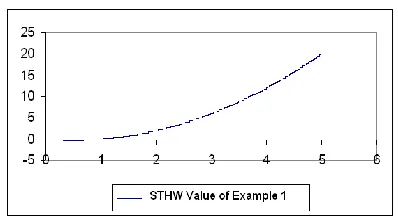
By applying the technique described in preceding section, (5) is solved. The computational results for discrete approximations (DA) and continuous approximations (CA) of y(t) with interval length 0.0001, together with the exact solution
t t t [image:3.504.266.463.160.274.2]y 2 are given in Figures 1 and 2.
Fig.1. Analytical Solution of Example 1
Fig. 2. STHW Solution of Example 1
Example 2
Consider the nonlinear Volterra-Hammerstein integral equation
, 2 ,0 10
f t
kt sy sds tt y
t
(6)
where k
t,s ts1,and
1.6 5 3 2 4
1 5 4 3 2
t t t t
t
f
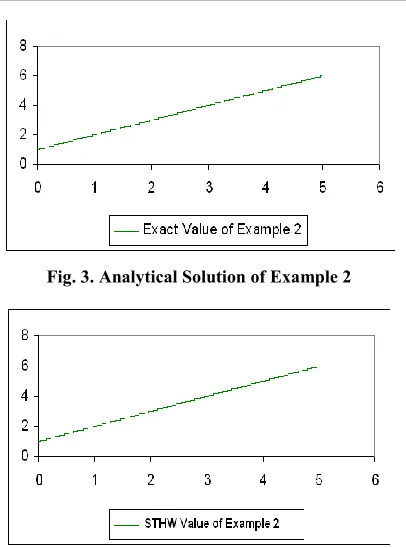
By using the method in section 2, Equation (6) is solved. The computational results for interval length 0.0001 together with exact solution
t t1 [image:3.504.265.464.309.419.2]Fig. 3. Analytical Solution of Example 2
Fig. 4. STHW Solution of Example 2
Example 3
Consider the equation
1 sin
3 sin
,0 10
2 2
t
t s y sds tt y
t
(7)
[image:4.504.255.470.45.173.2]By using the method in Section 2, Equation (7) is solved. The computational results for DA and CA of y(t) with interval length 0.0001, together with the exact solution y
t costare given in figures 5 and 6.Fig. 5. Analytical Solution of Example 3
Fig.6. STHW Solution of Example 3
Conclusion
The STHW are applied to solve nonlinear Volterra-Hammerstein integral equations. This method is simple. It uses only six pieces of information from the past and evaluates the driving function only six per step. However, the STHW method is very practical for computational purpose since considerable computational effort is required to improve accuracy. From the Figures 1-6, STHW fit well to these types of problems. This STHW provided a momentum for advancing numerical methods for solving nonlinear Volterra-Hammerstein equations.
REFERENCES
Alexander, R. K. and Coyle, J. J. 1990. Runge-Kutta methods for differential- algebric systems. SIAM J. of Numer. Anal., 27: 736-752. Brunner, H. 1982. Implicitly linear collocation method for nonlinear Volterra equations. J. Appl. Num Math., 9: 235-247.
Butcher, J. C. 2003, Numerical Methods for Ordinary Differential Equations, 2nd edn. John Wiley, New York.
Guoqiang, H. 1993. Asymptotic error expansion variation of a collocation method for Volterra-Hammerstein equations. J. Appl. Num Math., 13: 357-369.
Kumar, S. and Sloan, I. H. 1987. A new collocation-type method for Hammerstein integral equations. J. Math. Comp., 48: 123-129.
[image:4.504.36.246.495.608.2]Murugesan, K., Paul Dhayabaran, D. and Evans, D. J. 1999. Analysis of different second order multivariable linear systems using Single Term Walsh Series technique and Runge-Kutta method. Intern. J. Comp. Math., 72: 367-374. Murugesan, K., Paul Dhayabaran, D. and Evans, D.
J. 2000. Analysis of non-linear singular systems from fluid dynamics using extended Runge-Kutta methods. Intern. J. Comp. Math., 76: 239-266.
Murugesan, K., Paul Dhayabaran, D., Henry Amirtharaj, E. C. and Evans, D. J., 2001. A comparison of extended Runge-Kutta formulae based on variety of means to solve system of IVPs. Intern. J. Comp. Math., 78: 225-252. Murugesan, K., Paul Dhayabaran, D., Henry
Amirtharaj, E. C. and Evans, D. J. 2003. Numerical Strategy for the system of second order IVP’s using RK-Method on Centroidal Mean. Intern. J. Comp. Math., 80: 233-241. Murugesan, K., Sekar, S., Murugesh, V. and Park,
J. Y. 2004. Numerical solution of an industrial robot arm control problem using the RK-Butcher algorithm. Intern. J. Comp. Appl. in Tech., 19: 132-138.
Park, J. Y., Evans, D. J., Murugesan, K., Sekar. S. and Murugesh, V. 2004. Optimal control of singular systems using the RK-Butcher algorithm. Intern. J. Comp. Math., 81: 239-249. Park, J. Y., Murugesan, K., Evans, D. J., Sekar. S. and Murugesh, V. 2005. Observer design of singular systems (transistor circuits) using the RK-Butcher algorithms. Intern. J. Comp. Math., 82: 111-123.
Sekar, S., Murugesh, V. and Murugesan, K. 2004. Numerical Strategies for the system of second order IVPs using the RK-Butcher Algorithms. Intern. J. Comp. Sci. Appl., 1: 96 - 117.
Sekar, S and Paramanathan, E. 2011. A study on periodic and oscillatory problems using single-term Haar wavelet series. Intern. J. Cur. Res., 2: 097-105.
Shampine, L. F., 1994, Numerical Solution of Ordinary Differential Equations. Chapman & Hall, New York.
Tricomi, F. G. (1982). Integral Equation, Dover. Yaakub, A. R. and Evans, D. J. 1999. A fourth
orders Runge-Kutta RK (4, 4) method with error control. Int. J. Comp. Math., 71:383-411.