Developing a validation process for an adaptive
computer-based spoken English language test.
UNDERHILL, Nic.
Available from Sheffield Hallam University Research Archive (SHURA) at:
http://shura.shu.ac.uk/20468/
This document is the author deposited version. You are advised to consult the publisher's version if you wish to cite from it.
Published version
UNDERHILL, Nic. (2000). Developing a validation process for an adaptive computer-based spoken English language test. Doctoral, Sheffield Hallam University (United Kingdom)..
Copyright and re-use policy
See http://shura.shu.ac.uk/information.html
ProQuest Number: 10701115
All rights reserved
INFORMATION TO ALL USERS
The quality of this reproduction is dependent upon the quality of the copy submitted.
In the unlikely event that the author did not send a com plete manuscript and there are missing pages, these will be noted. Also, if material had to be removed,
a note will indicate the deletion.
uest
ProQuest 10701115
Published by ProQuest LLC(2017). Copyright of the Dissertation is held by the Author.
All rights reserved.
This work is protected against unauthorized copying under Title 17, United States C ode Microform Edition © ProQuest LLC.
ProQuest LLC.
789 East Eisenhower Parkway P.O. Box 1346
Developing a validation process for an
adaptive computer-based spoken English
language test
Nic Underhill
A thesis submitted in partial fulfilment of the
requirements of Sheffield Hallam University for the
degree of Doctor of Philosophy
Abstract
This thesis explores the implications for language test validation of developments in language teaching and testing methodology, test validity and computer-based delivery. It identifies a range of features that tests may now exhibit in novel combinations, and concludes that these combinations of factors favour a continuing process of validation for such tests. It proposes such a model designed around a series of cycles drawing on diverse sources of data.
The research uses the Five Star test, a private commercial test designed for use in a specific cultural context, as an exemplar of a larger class of tests exhibiting some or all of these features. A range of validation activities on the Five Star test is reported and analysed from two quite different sources, an independent expert panel that scrutinised the test task by task and an analysis of 460 test results using item-response theory (IRT). The validation activities are critically evaluated for the purpose of the model, which is then applied to the Five Star test.
A historical overview of language teaching and testing methodology reveals the communicative approach to be the dominant paradigm, but suggests that there is no clear consensus about the key features of this approach or how they combine. It has been applied incompletely to language testing, and important aspects of the approach are identified which remain problematic, especially for the assessment of spoken language. They include the constructs of authenticity, interaction and topicality whose status in the literature is reviewed and determinability in test events discussed.
The evolution of validity in the broader field of educational and psychological testing informs the development of validation in language testing and a transition is identified away from validity as a one-time activity attaching to the test instrument towards validation as a continuing process that informs the interpretation of test results.
In test delivery, this research reports on the validation issues raised by computer-based adaptive testing, particularly with respect to test instruments such as the Five Star test that combine direct face-to-face interaction with computer-based delivery.
In the light of the theoretical issues raised and the application of the model to the Five Star test, some implications of the model for use in other test environments are
Contents
Chapter Page
Chapter 1 Introduction: statement of issues and problems... 1
Chapter 2 Literature review 1: The evolution of language teaching and testing.... 8
Chapter 3 Literature review 2: Validity in language testing; testing spoken language; adaptive testing and item response theory... 61
Chapter 4 The instrument: the Five Star test and comparisons with other tests 130 Chapter 5 Data collection and research methodology...172
Chapter 6 Analysis and discussion of results... 214
Chapter 7 Discussion of critical thinking...300
Chapter 8 Derivation of theoretical model for continuous validation... 335
Chapter 9 Application of the model for validation of Five Star test... 385
Chapter 10 Conclusions, reflections and implications...403
Bibliography... 419
List of Figures
Figure Page
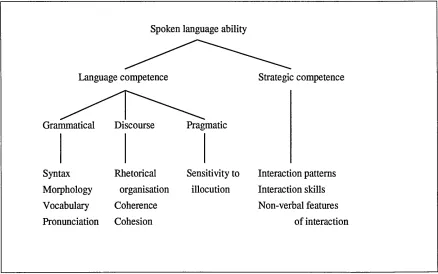
Figure 1 Model of spoken language ability used in the CASE project...41
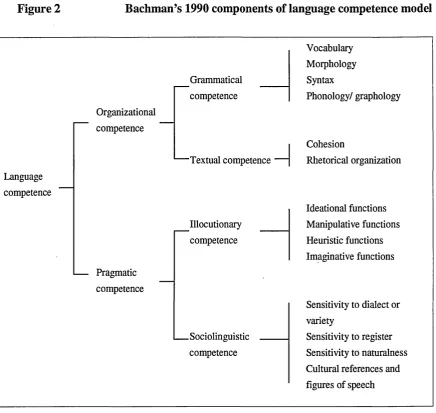
Figure 2 Bachman’s 1990 components of language competence model...43
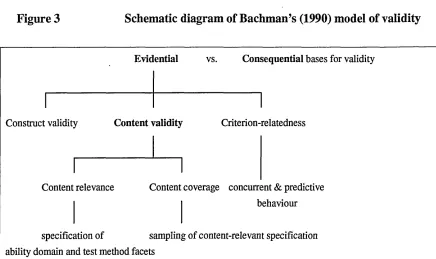
Figure 3 Schematic diagram of Bachman’s (1990) model of validity... 79
Figure 4 Language production scale (Palmer, 1981)...115
Figure 5 QUEST output of item-ability map... 284
Figure 6 Individual IRT learner map for candidate 001...286
Figure 7 Individual IRT learner map for candidate 356...288
Figure 8 Diagrammatic representation of model for continuing test validation 365 Figure 9 Common framework for pilot and main test cycles...369
List of Tables
Table Page
Table 1 Task-driven and construct-driven performance assessment... 48
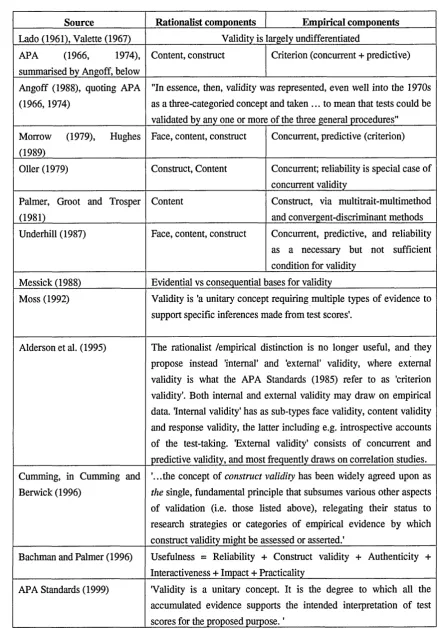
Table 2 Summary of major models of validity... 88
Table 3 Distinctive features of Five Star computer platform... 140
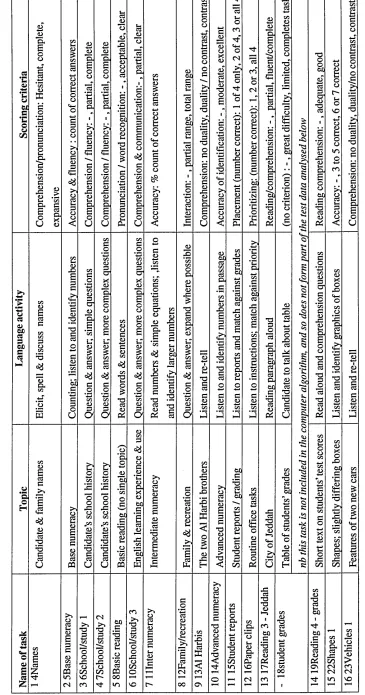
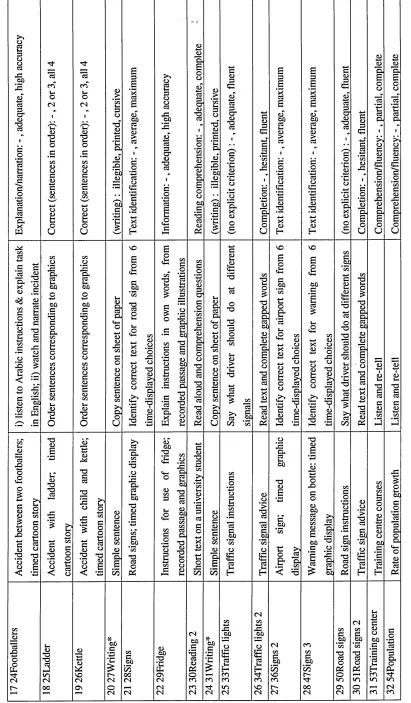
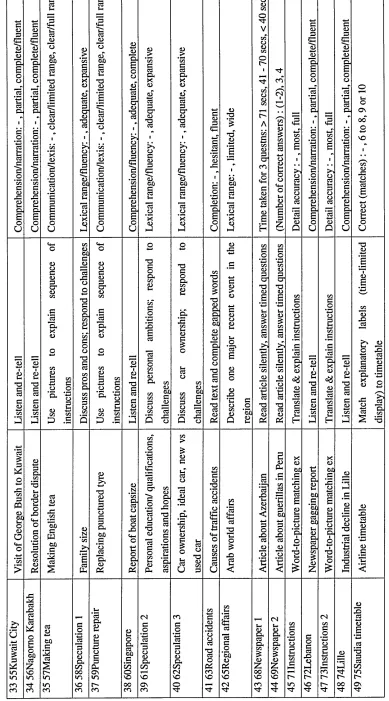
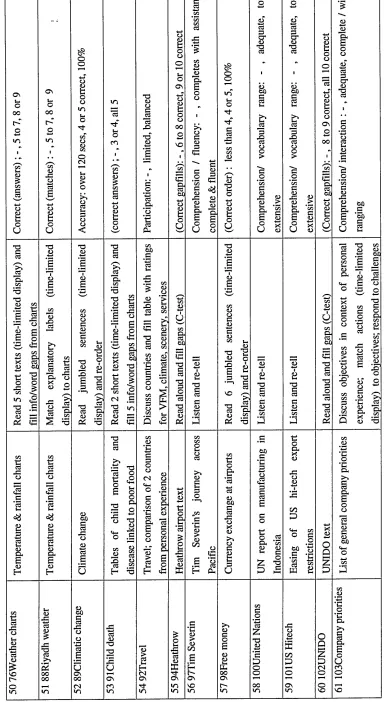
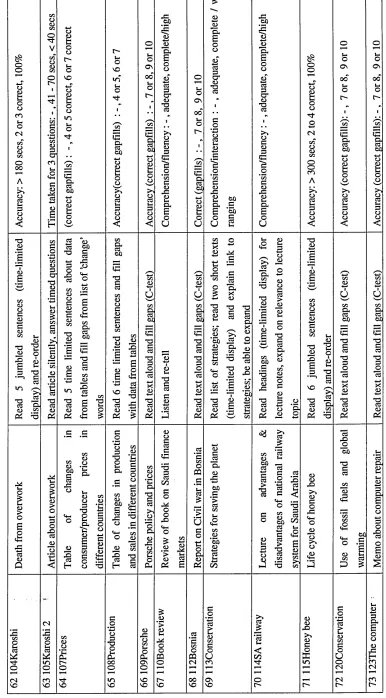
Table 4 Analysis of Five Star tasks and scoring criteria...143
Table 5 Summary of key communicative features...152
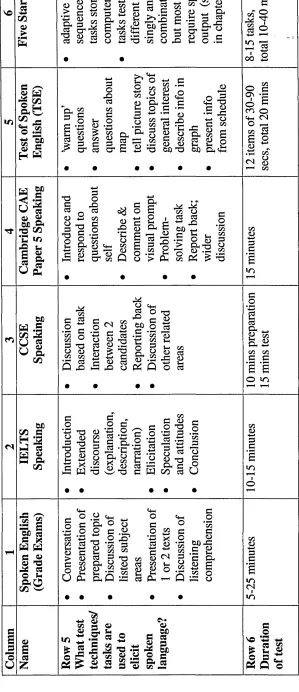
Table 6 Other current oral test formats...157
Table 7 Panel stage 1 proformas: language skills definitions... 183
Table 8 Panel stage 1 proformas: language skills allocations... 185
Table 9 Routes through Five Star tasks for panel stage 1...186
Table 10 Panel stage 2 pro formas: language skill and level allocations... 188
Table 11 External rating scale used for panel judgements of proficiency...191
Table 12 Panel rubric for interaction strategy exercise... 193
Table 13 Basis for panel consensus on skills allocation...216
Table 14 Non-significant consensus on skills allocation...217
Table 15 Panel judgements on skills allocation for each task... 218
Table 16 Frequency of skill allocations across all tasks...221
Table 17 Frequency of skill combinations across all tasks... 222
Table 18 Panel percentage judgements of skills underlying each task...223
Table 19 Panel ratings for proficiency levels required for each task... 227
Table 20 Sample of panellists’ comments and suggestions: first 15 tasks...231
Table 21 Panel stage 3 proformas...235
Table 22 Panel judgements of candidates’ interaction strategies...239
Table 23 Summary of interaction strategies by panel sub-groups...249
Table 24 Percentage of use of interaction strategies, by panel sub-groups...250
Table 25 Summary of interaction contribution and proficiency ratings...254
Table 26 Video test proficiency ratings...255
Table 27 Summary IRT statistics for the item (task) estimates...264
Table 28 Summary IRT statistics for the case (candidate) estimates... 265
Table 29 QUEST output for individual item estimates...267
Table 31 QUEST output for individual case (candidate) estimates... 274
Table 32 Comparison of item difficulty estimates between data sets... 290
Table 33 Correlations between IRT and panel estimates of task difficulty...292
Table 34 Panel consensus for misfitting tasks...293
Table 35 Summary of preliminaries to test validation model... 338
Table 36 Checklist of test characteristics for the validation model... 349
Table 37 Preliminary activities and sources of data for Five Star test... 387
Chapter 1 Introduction: statement of issues and problems
1.0 Introduction
1.1 Aims
1.2 Introduction to the instrument
1.3 Major issues
1.0 Introduction
This chapter briefly introduces the aims of this research, the test instrument on which
the data were collected, and summarises the issues which it raises which are explored in
more detail in later chapters.
The research grew out of a consultancy project to carry out a critical review of a new
computer-based test of English language proficiency. A major aim of the consultancy
was the preliminary validation of the pilot form of the test, in order to inform its
subsequent development, and some of the data collected was first analysed within the
scope of that project. However, the methodology adopted was constrained by the nature
of the test and the resources and timescale available for the consultancy, and it became
clear that the traditional approach to test validation could not provide a fully satisfactory
account. Specifically, the Five Star test is both adaptive (different subjects will take
different routes through the test, and be exposed to different tasks), and scored on a
partial credit basis (each task is scored on a three-point scale, rather than
dichotomously, as right or wrong). At the same time, it is a direct test of spoken
language that exhibits many features of the communicative approach to language
testing.
The Five Star test is introduced in section 1.2 below and described in more detail in
chapter four.
1.1 Aims
These are the aims of the research.
Aim 1 is to design a model appropriate for an adaptive test of spoken language
proficiency that allows for the validation to become a recurrent process as the test
evolves rather than a single procedure. The development of the model draws on a
number of strands: the evolution of language testing methodology, new approaches to
test validation, contrasting sources of data and the evolution of a new adaptive
computer-based language tests. The research explores the use of appropriate research
methods to analyse the expert panel and test record data sets in a way that supports a
continuing cycle of data collection, analysis and interpretation.
Aim 2 is to identify the distinctive features of the communicative approach to language
teaching and testing and to discuss their implications for the model for continuing
validation. The nature of interaction in particular is viewed as a criterial feature of
Aim 3 is to try out the model to validate the Five Star’ computer-based test of language
proficiency within its immediate social and cultural context. This builds on the initial
’expert panel’ data set collected during the consultancy project, and subjects it to further
analysis; and adds a second large dataset, using the item response theory (IRT) approach
to the analysis of test data, to complement and triangulate the expert panel data. The
Five Star test developer wrote at an early stage of the prototype "... the open
architecture aspect of computerisation would also mean that the existing aspects of the
[Five Star] test could be easily modified and new ones included" (Pollard, 1994:43) and
the validation process needs to be able to cope with this.
Aim 4 is to discuss the implications of aims 1, 2 and 3 to explore a procedure that can
be applied elsewhere for the validation of language proficiency tests that share some or
all of these key features. This seeks to identify the components of the continuing
validation process which can be transferred to other testing contexts, specifically, where
the continuing validation of 'direct' oral tests needs to be subjected to greater scrutiny.
The use of the model for the validation of a continuously changing test is envisaged.
Aim 5. As a result of aims 1, 2, 3 and 4, aim 5 is to contribute to and enrich, at a
theoretical level, the academic debate on issues surrounding language test validation.
Review of recent literature suggests that while the validation of adaptive tests has
become a current issue of debate in language testing, with use of the item-response
theory (IRT) in particular, such tests are almost always confined to objectively marked,
single-correct-answer only items.
The applicability of such validation procedures for non-dichotomous items in a test
procedure such as Five Star, based on live human interaction with an interlocutor (see
Appendix 1 Glossary), represents an extension of this work. This integration of
human-mediated interaction and assessment with computer-based adaptivity based on a
theoretical foundation of communicative methodology is unique in a language
proficiency test, and it is the elaboration of procedures for the continuing validation of
this novel combination of features that represents the contribution to theoretical debate
on language test validation.
1.2 Introduction to the instrument
The Five Star test is a computer-based test of English language proficiency; its name
derives from the scale of one (star) to five (stars) on which scores are reported. It was
developed by Saudi Development and Training (SDT), a subsidiary of British
Aerospace, specifically for use in the Saudi Arabian context to screen young adult
applicants for work positions and training programmes, and was first reported in Pollard
(1994) and Pollard and Underhill (1996). The piloting of the prototype test started in
1993. It has now been used with over 1000 members of the target population - male,
young adult Saudis seeking to enter the job market - mainly within the parent
organisation, but also on a limited basis with other companies.
The test offers a unique profile in being a) adaptive, b) computer-based but
interviewer-administered, and c) heavily dependent on interaction with a live interlocutor. It is
selection of the tasks presented by the computer but mediated and scored by the
interviewer. The act of scoring each task via the keyboard invokes the computer
algorithm which uses the information to select the next task for the test. Typically, a test
administration will involve between eight and 15 tasks and last anywhere between 10
and 40 minutes. Tests with candidates of higher levels of language proficiency involve
more tasks and take longer than those for more elementary users of English.
In the very wide range of English language tests in use around the world, the Five Star
test can be characterised as follows.
It is a proficiency test. It aspires to test a candidate’s overall proficiency in the English
language, and is not based on a specific syllabus or achievement or progress in a
specific course of study. It can in principle be equally applied to a candidate with a
limited command of English and to a candidate with a high level of proficiency.
It is a test of English for Speakers of Other Languages; crudely speaking, it is aimed at
non-native rather than native speakers of English. The pilot version is designed
exclusively for candidates whose mother tongue is Arabic.
It is live and direct; there is immediate ’real time’ verbal interaction with an interlocutor
who also assesses performance on each task (the ’interviewer’). The dialogue is not
scripted or predictable, except in general terms.
It is adaptive, in two respects. Firstly, the algorithm underlying the computer program
varies the selection of tasks to present to each candidate according to their performance
on previous tasks. Secondly, both the interviewer and the candidate may, in the nature
of live interaction, take the initiative to alter the focus or even the topic of the
conversation.
It is task-based. The test items consist of complex open-ended (for the most part)
activities that require the demonstration of a language skill or combination of skills,
rather than single questions to which there is a single correct answer. Performance on
each task is scored on a three-point scale.
It is culture specific. The test was designed specifically for use within the Kingdom of
Saudi Arabia, and makes extensive use of the Arabic language, in both script and
digitised sound.
It is topical. Some of the tasks require reference to recent local and regional knowledge
of the world in the social and geographical context of that culture.
The Five Star test, and these characteristics, are described in more detail in chapter four.
On a terminological note, the person taking the test is referred to as the ’candidate’, and
the person administering the test as the ’interviewer’. However, the interviewer
combines the roles of ’interlocutor’ and ’assessor’ and these terms are used when the
1.3 Major issues
The major issues raised are these.
a) How can recent thinking on test validation be applied to an adaptive test? How can
the IRT model be used? What are the advantages and disadvantages of an expert
panel and IRT as sources of validation evidence?
b) How can a validation process allow for the implications of the communicative
methodology for the continuing development of an adaptive test?
c) How can the IRT model be applied in a test where the questions are for the most
part open-ended tasks evaluated by a human interlocutor on a three-point
partial-credit scale, rather than the more conventional right-or-wrong objective items?
d) How do we deal with the concept of interaction that is central to a live oral test? Is it
a construct that can be operationalised and measured as a variable for each
individual? If it is not an individual trait, is it a feature that attaches to the event
rather than to the person? How can its impact on the test scores be described?
Chapter 2 Literature review 1: The evolution of language teaching and testing
2.0 Introduction
2.1 Language teaching and testing
2.2 The classical approach
2.3 The Direct method
2.4 The scientific revolution
2.5 The performance model
2.6 The oral and situational approaches
2.7 Learning and acquisition
2.8 Humanistic perspectives
2.9 The communicative approach: introduction
2.10 The communicative approach: British and American approaches to communicative testing
2.11 Problems with componential models of communicative competence
2.12 Work sample and cognitive approaches to assessment
2.13 The communicative approach: individualisation, task-based learning and authenticity
2.14 Discussion and summary
2.0 Introduction
This chapter gives an overview of the development of English language teaching
methodology. Key characteristics of the Five Star test are traced back to their origins in
the historical development of language testing and their origins identified in teaching
methodologies, in particular the communicative approach. The following chapter then
looks specifically at test validation issues in more detail.
2.1 Language teaching and testing
Current approaches to the validation of language tests, and their application to adaptive
and computer-based test technologies, are the culmination of a long history of
development, and this chapter summarises that evolutionary process to identify the
pedagogical and methodological sources of the present-day test characteristics.
A summary review of developments in linguistics, learning theory, language teaching
and testing over the last fifty years shows how the relationship has grown more complex
with the development of theoretical models in each area. For the purpose of this review,
we can identify a series of apparently discrete developments in teaching methodology,
but in reality certain themes recur and recombine in new contexts (a point made in both
Howatt (1984) and Richards and Rodgers (1986), two of the principal sources on which
the following summaries draw).
While the evolution of language teaching and testing theory has evolved in parallel in
the United States on the one hand and Britain and Europe on the other, with each
developments on each side informing the other, there have been nonetheless distinct
differences in approaches. Spolsky (1975), summarised in Valette (1977), identified
three phases of language testing: pre-scientific, psychometric-structuralist and
psycholinguistic-sociolinguistic. The dominant communicative approach can be
considered either as falling within the third of these phases or as a distinct fourth phase
(Weir, 1990). A rough congruence can usefully be drawn between these phases of
testing and related developments in teaching without a complete match being sought.
2.2 The classical approach
Until the late 19th century, the classical languages of Latin and Greek were held up as
ideal languages in the West, and the terminology used to describe their syntactical and
morphological forms, such as case and tense, was also used to analyse modem
languages. Any difficulty in the application of this terminological framework was an
indication of the modem language’s degeneracy, compared to the classical ideal. As
well as a desirable accomplishment in its own right, the practice of learning and
analysing a language was believed to be a valuable intellectual exercise.
The associated language teaching methodology was grammar-translation. It emphasised
accuracy, in the written language especially; knowing a language involved mastery of a
set of rules. There was no direct link with the real world of experience, as the goal of
instruction was to master a closed linguistic system. This was achieved by memorising
whole chunks of the system, from which the internal contrasts could then be deduced.
Areas of specific competence were typically grammar, vocabulary and stylistic rules for
example, being a late 19th century invention. There being little purpose in learning to
speak a dead language, speaking skills were subordinated to reading skills.
Learning techniques commonly used appropriate to a language as knowledge’ paradigm
were the deductive application of sets of rules combined with rote learning of
vocabulary and the numerous exceptions to those rules. Although every other
methodology since has been in some way a reaction against grammar translation, the
teaching and testing of language as a system of knowledge still remains a significant
influence today, particularly in state sector education systems:
It is still used in situations where understanding literary texts is the primary focus of foreign language study and there is little need for a speaking knowledge of the language. Contemporary texts for the teaching of foreign languages at college level often reflect Grammar Translation principles. These texts are frequently the products of people trained in literature rather than in language teaching or applied linguistics. Consequently, though it may be true to say that the Grammar Translation Method is still widely practised, it has no advocates. It is a method for which there is no theory. There is no literature that offers a rationale or justification for it or that attempts to relate it to issues in linguistics, psychology or educational theory. (Richards and Rogers, 1986:4)
The classical approach: testing
Testing followed the explicit characteristics of the teaching method, with a focus on
translation; reading and writing; deductive mastery of the rules; accuracy rather than
fluency; and an appreciation of its stylistic features rather than its use for
communication. Even where more communicative teaching techniques have entered the
classroom today, with a substantial timelag between innovations in teaching and testing
and the resource disincentive to introduce more labour-intensive testing communicative
methods, it is common to find language tests in use with exactly these grammar
translation characteristics. This is typically true of ministries of education where the
such cases, there is growing recognition that the tests are failing the students on at least
two counts. Firstly, the tests do not accurately reflect candidates’ performance in the
language skills that employers and higher education institutions now require, and
secondly, they exert a strong washback effect on classroom teaching. As a result, the
skills are neither taught nor tested.
2.3 The Direct method
The direct method was not so much a specific method as a general approach, grouping
together a series of methods, sometimes called ’natural methods’, that had in common a
sharp contrast with the classical approach:
There is little doubt that it was associated in the public mind with Berlitz, and ... Berlitz teachers like Wilfrid Owen used it to describe their work. Nevertheless, Berlitz himself did not, but preferred to stick to his own brand name'... The most reasonable explanation of [the origin of the name 'direct method1] is .. that nobody invented the term, but that it 'emerged'...as a useful generic label to refer to all methods of language teaching which adopted the monolingual principle as a cornerstone of their beliefs (Howatt, 1984:207-8)
The origin of the term 'natural method' is more straightforward: “It overemphasized and
distorted the similarities between naturalistic first language learning and classroom
foreign language learning ...” (Richards and Rogers, 1986:10)
Another element these different methods shared was an emphasis on the primacy of the
spoken language. “Interaction is at the heart of natural language acquisition, or
conversation as Lambert Sauveur called it when he initiated the revival of interest that
led eventually to the Direct method” (Howatt, 1984:192). Interaction remains both
While it was clear what the various methods grouped under the ’direct’ or ’natural’ labels
were reacting against, it was not so easy to identify what they stood for:
The Direct Method represented the product of enlightened amateurism. It was perceived to have several drawbacks. First, it required teachers who were native speakers or who had native-like fluency in the foreign language. It was largely dependent on the teacher’s skill, rather than on a textbook, and not all teachers were proficient enough in the foreign language to adhere to the principles of the method. Critics pointed out that strict adherence to Direct Method principles was often counterproductive, since teachers were required to go to great lengths to avoid using the [students’] native tongue, when sometimes a simple brief explanation in the student’s native tongue would have been a more efficient route to comprehension (Richards and Rogers, 1986:10)
The Direct Method was developed further in Britain by Daniel Jones and Harold Palmer
at London University in the early years of the 20th century and its central ideas picked
up again in the 1960s and 1970s. Palmer emphasized the importance of meaning, for
grammatical structures as well as vocabulary, to be presented and associated with
elements of the immediate environment, such as objects found in or brought into the
classroom.
In the United States, the shortage of sufficiently trained teachers and the “perceived
irrelevance of conversation skills in a foreign language for the average American
college student” resulted in a study recommending that “a more reasonable goal
.. .would be a reading knowledge of a foreign language...” and as a result “the emphasis
on reading continued to characterize foreign language teaching in the United States until
World War IT’ (Richards and Rogers, 1986:11)
The Direct method: testing
The same disadvantages that militated against the take-up of Direct Method in schools
also precluded its widespread application in testing. The lack of competent teachers and
the much greater costs of direct oral testing made it simply impractical in public
secondary and college systems. This remains true today where decisions are taken by
central government to introduce the teaching of a foreign language (typically English) in
the primary school, without the provision of extra specialist teachers. As a result,
English is often taught by teachers who themselves have only a poor spoken command
of the language. It was and is much more successful in private language schools, with
relatively small classes of more highly motivated learners, but these are precisely the
kind of students who have less need for examination and certification, so that there is
less incentive to develop formal assessment procedures.
Spolsky’s ’prescientific trend’ in language testing (Spolsky, 1975) subsumes both the
grammar-translation and direct methods. Summarising this trend in the United States,
where the oral emphasis of the direct method never really took hold, Valette says:
There is a lack of concern for statistical analysis, for objectivity, and for test reliability. The tests themselves are mainly written exercises: translation, composition or isolated sentences. In this “elitist” approach to testing, it is felt that the person who knows how to teach is obviously in the best position to judge the proficiency of the students. (Valette, 1977:308)
One reason for the predominance of written tests was the overriding concern for test
objectivity and reliability, on which criterion tests such as Five Star involving live
interlocutors, open-ended tasks and the elicitation of samples of natural-like speech
2.4 The scientific revolution
From the 1920s and 1930s the structuralist school of linguistics emerged in America,
most commonly associated with Bloomfield (1935). As descriptivists they could only
describe what they could observe; they considered that for scientific purposes the mind
did not exist because it could not be observed. It was in part a reaction against the
’armchair theorizing’ of the classical approach, but systematic and rigorous procedures
for language analysis were also necessitated by the fieldwork being undertaken by
Bloomfield and his contemporaries into North American Indian languages. Unable to
theorize from an armchair, the researcher’s complete ignorance of language under study
became a virtue, associated with scientific objectivity. Native speaker informants could
be used only in restricted ways to inform the analysis. The spoken language was again
the primary object of concern, and necessarily the only concern in the study of those
native American languages which lacked a written form. The development of
anthropological linguistics promoted a relativistic view that our native language affects
the way we view the world, and that therefore our understanding of a language cannot
be divorced from the contexts of its use. This became known as the Sapir-Whorf
hypothesis, from two of its early proponents, and it influenced both mainstream
language teaching (e.g. Lado, 1957) and within a single language group the work of
sociolinguists such as Hymes (1968) and Labov (1966).
During the Second World War the US military found themselves with a sudden and
massive need for language teaching, particularly of ’difficult’ (i.e. non Indo-European)
languages, and set about filling the gap with customary zeal. They realised the passive
requirements for the rapid teaching of an active conversational proficiency, and invited
the linguistic experts to adapt the structuralist linguistic paradigm to a teaching context.
They produced a language teaching methodology known as the structural approach (e.g.
Fries, 1945).
Behaviourist psychology shared with structuralist linguistics the scientific paradigm
requiring full observability and transparency, and they combined to produce a more
dogmatic version of the structuralist approach known as audiolingualism (e.g. Lado
1964). Learning is a conditioning process, and involves acquiring a set of habits. This
necessitated mechanical activities such as repetition, pattern practice, and the
manipulation of substitution tables, with a lack of concern for the conveyance of
meaning as external reference that made it ideally suited for extensive use in the
language laboratory.
Lado’s approach to content specification for teaching and testing was very much an
atomistic or discrete point approach. Starting with a contrastive analysis of the learner’s
mother tongue and target language, in different linguistic sub-disciplines (e.g.
morphology, syntax, lexis, phonology) and at different levels (e.g. phoneme, morpheme,
word and sentence level) an exhaustive list of discrete language items could be
generated on which to base mechanical language practice teaching and testing.
Although attractive as a mechanistic model reflecting the ’building blocks’ paradigm of
structuralist linguistics, it suffers from two related practical problems. Firstly, it is in
practice extremely difficult to design drills or test items that practise one element at one
level only. Secondly, it relies on the combination of building blocks being as predictable
complex at the clause and sentence level and it is only quite recently - in the 1980s and
1990s - that any serious attention has been paid to analysis at the level of discourse.
However, remnants of audiolingualism linger on, five decades later, in the American
Language Course sold as part of US defence contracts and in the continuing widespread
use of pattern practice drill exercises in language laboratories around the world.
Although pedagogically outdated, these offer students a high level of exposure to a clear
native speaker model of spoken language in contexts where local teachers may not be
able to provide this.
The scientific revolution: testing
Spolsky (1975) referred to this as the ’psychometric-structuralist’ trend in language
testing. The operationalisation of language proficiency for testing purposes in this
paradigm is straightforward. There is a single linear dimension of language proficiency,
which all tests reflect; some are better than others and, being more reliable, objective
tests are better than subjective tests. This was contrasted with the discrete-point
approach, which emphasized the differences between what tests measured rather than
the similarities.
During this period also statisticians such as Spearman and Pearson developed the
statistical tools which have formed the cornerstone of psychometric testing ever since:
correlation and regression, factor analysis, internal reliability coefficients and item
analysis. For Valette, language testing could be taken seriously as last: “The
psychometric-structuralist trend saw the entry of the experts into the field of language
testing” (1977:308). Much of the conceptual framework in psychological testing was
directly transferred along with the statistical techniques to language testing, although
not without questioning, at least in hindsight:
The application of procedures deriving from psychometric theory in the development of language tests has also met with criticism. Morrow (1979), for example, regards the quantification implied by the use of these methods as inappropriate in the assessment of language proficiency, and Cziko (1983) views psychometric methods as being based too heavily in a norm-referenced interpretation of scores... (Baker, 1997:5)
The impact of psychological measurement led to the positing of general language
proficiency and language learning aptitude as unidimensional, linear and stable personal
attributes. A heavy reliance on statistical procedures has been the dominant influence:
“The foundation for much of classical test theory was provided by Charles Spearman's
conception of an observed test score as being composed of a true score plus an error
component ... and most of the basic formulae which have proved to be particularly
useful in this theory appeared in Spearman's work in the early 1900s” (Baker, 1997:5)
The American secondary school system in general, and that of other countries
influenced by it, remains heavily biased towards objective forms of assessment and
statistical decision-taking, with the result that test methods that are evidently objective
are to be preferred to those that are not. Language tests have focused on individual items
that are atomistic, with a prescription that they should test only one language point at a
time (Lado, 1961).
This unidimensional view of language proficiency, and the preference for objective
testing and scoring methods that are susceptible to the rigour of statistical analysis,
resulted in a minimal role for oral testing that apparently contradicted the term 'audio-
During the past few decades oral language testing has had a great deal in common with physical fitness. Everyone thinks that it is a wonderful idea, but few people have taken time to do anything about it. During the prime period of audio-lingual methodology, for example, the teaching of oral production was the principal classroom objective, but the testing of oral proficiency was almost unknown. (Madsen and Jones, 1981:15).
This has also had a backwash effect on teaching methods, with students being reluctant
to devote study time to speaking skills when they know their ability will be tested by
objective tests of listening and reading only.
Where, for example, the American Language Course sold as part of the package of
defence contracts referred to above is still in use, the mismatch between the skills
needed on the one hand, and those taught and tested on the other, has become painfully
apparent. Describing the situation at the King Faisal Air Academy in Saudi Arabia in
1994, Al-Ghamdi said:
For a number of years, the American Language Course (ALC) together with its associated ... test, the English Comprehension Level (ECL), have been used as the main language teaching and testing programmes. The ALC is based on a structural syllabus with a heavy emphasis on lexical items, and is audiolingual in approach. The ECL reflects the psychometric-structuralist era as exemplified by Spolsky. It is a 100-item test of listening and reading comprehension ... It soon became obvious that cadets needed an additional range of language skills which were not addressed by the ALC. The increased complaints of Aeroscience instructors indicated that there are significant deficiencies in the existing English training programme and that changes should be introduced to bring the English training programme closer to the language skill requirements of the subsequent phases of training (Al-Ghamdi, 1994:5-6).
The results of a needs analysis following a data collection phase were simply that there
were major deficiencies in the cadets’ speaking ability and Al-Ghamdi goes on to
describe the particular problem areas in speaking and to describe how they set about the
elaboration of an oral test specifically to fill this gap.
2.5 The performance model
In the structuralist model, the ’rules of grammar’ were considered explicit and explicitly
teachable until Chomsky (1965) first elaborated the contrast between deep and surface
structure. For Chomsky, the rules of grammar are psychologically real, but cannot
necessarily be formulated. Although a revolution in hindsight, the ’transformational-
generative approach’ grew directly out of attempts to extend the explanatory power of
the structuralist model to account for irregular inflections and intuitively obvious
’transformational’ relations between sentence forms such as active/passive. The ultimate
failure of these attempts by American descriptive linguists in the 1940s and 50s such as
Harris, Hockett and Nida (Joos, 1957) necessitated the elaboration of a cognitive code
approach to explain how we could internalise and use deep-structure rules that could not
be explicitly taught.
Chomsky’s devastating critique of the behaviourist approach in a review of Skinner’s
'Verbal Behaviour' (Chomsky, 1959) brought the mentalist implications of his “deep
structure” into stark contrast with the structuralist/behaviourist paradigm that would on
principle accept observable data only.
Although associated with a cognitive code approach to the psychology of learning, in
direct opposition to the behaviourism of the structuralists, the transformational model
remained a linguistic concern, with little direct application to language teaching and
testing. Indeed, the location of competence at a ’deep level’, accessible only via the
surface level of performance, made it necessarily inaccessible to formal teaching or
Acquisition Device to explain how individual children can apparently be predisposed to
learn with such speed and facility the rules of any human language to which they are
exposed. This device necessarily operates only on languages to which they are exposed
before puberty and of which they can become, in a general sense, ’native speakers’. It
does not apply to adult learners of foreign languages, and Chomsky himself saw little
relevance in transformational generative grammar for language teaching or testing. In a
negative sense, however, it had a considerable impact on teaching methodology, in the
sense that it undermined the behaviourist and structuralist bases of audiolingualism. It
also laid the foundation, via Hymes (1970) and Morrow (1977, 1979) for the evolution
of the communicative approach.
2.6 The oral and situational approaches
In the 1950s and 60s in Europe, the growth in demand for English language teaching as
a commercial activity re-awakened interest in the direct method while drawing on a
continuing development from Palmer in a direct line through Hornby, Eckersley, Lee,
Haycraft and many others who were primarily language teachers rather than linguists or
academics. For example, Palmer (1922) was re-issued by Oxford University Press in
1964, Palmer (1932) in 1969. This British re-formulation was characteristically non-
ideological; there was certainly an emphasis on the learner’s habits and behaviour, but
with no theoretical commitment to behaviourism. It was claimed that insistence on the
use of English only as the target language in the classroom was intended to teach
students to think in English, and to discourage them from constantly translating to and
from their mother tongue; more pragmatically, a preference for the use of the target
language only suited the new commercial reality of multi-national groups of learners in
each classroom, where it was unrealistic to expect the teacher to speak every mother
tongue represented.
The emphasis on the primacy of the spoken rather than the written form (e.g. Billows,
1961) that was inherited from the direct method increasingly matched the needs of
language learners, and the term Oral Approach became widespread. For theoretical
bases, it drew on both the techniques of audiolingualism and the competence/
performance distinction. Pattern practice, in the form of substitution and transformation
drills, still had a major role to play, but so too did rule-based learning. However, rather
than the classical approach of ’give the rule and require its application’, the new direct
method invited learners to infer the rule for themselves, then apply it, in the belief that
this promotes a more profound internalisation.
What really distinguished the Oral Approach from the Direct Method was a more
systematic approach to syllabus content and progression:
An oral approach should not be confused with the obsolete Direct Method, which meant only that the learner was bewildered by a flow of ungraded speech, suffering all the difficulties he would have encountered in picking up the language in its normal environment and losing most of the compensating benefits of better contextualisation in those circumstances (Pattison 1964 in Richards and Rodgers,
1986:34)
This systematic identification and introduction of new language, both grammatical
structures and vocabulary, in a step-by-step ordered syllabus favoured the use of
specially-written coursebooks that presented the selected language items in a discrete
and ordered manner, with a consequent shift of the onus for syllabus design from class
teacher to course writer. The presentation of new lexical items in particular was felt to
than, for example in semantic sets, or the decontextualised words lists of the grammar
translation approach), and the pursuit of this principle became characterised as the
Situational Approach. As early as 1950, Hornby wrote about The situational approach
in language teaching’ (1950) and course texts and methodology books based on this
approach published in the 1960s and 70s included ’Situational English’ (Commonwealth
Office of Education, 1965), ’Situational Dialogues’ (Ockenden, 1972) and ’Situational
Lesson Plans’ (Davies et al., 1975). Howatt notes the situational approach being applied
in the Nuffield Foreign Languages Teaching Project (1984: 274)
While the linguistic theory underlying the Situational Approach was a stmcturalism
essentially similar to American structuralism, it also drew on a strain of functionalism in
British linguistics (Firth and Halliday) and anthropology (Malinowski and Fraser) that
saw context of use as an essential component to the study of language: “The emphasis
now is on the description of language activity as part of the whole complex of events
which, together with the participants and relevant objects, make up actual situations”
(Halliday et al., 1964, quoted in Richards and Rogers, 1986: 35). Rather than being seen
as a closed and independent system, language use is a purposeful activity related to
everyday life in the real world; we use language to do things. In its strong form, derived
from Malinowski’s 'context of situation', the meaning of an utterance can only be
determined with reference to the cultural and physical context in which it occurs
(Malinowski, 1923). This preoccupation with the context of language use remained in
the British tradition of English language teaching, and emerges in the concern of the
communicative approach to make explicit the functions and appropriate contexts of use
of the language that is being taught and tested.
23
The oral and situational approaches: testing
The specific focus on ’the situation’ as the unit for description of the target language
domain was reflected in testing as well as in teaching primarily through short role play
exercises. A physical and/or a social context was described, such as ’Imagine you’re
talking to a tourist information office and you want to find accommodation for the
night, but you’re concerned about the price’. Another participant, typically the
interviewer, would play the role of interlocutor in the role-play, and the candidate would
be instructed to find out certain information from him or her. Such mini-roleplays were
in use in the Cambridge main suite exams into the 1980s and are still used in modified
form in their CCSE exams (UCLES, 1995). Typically these situations were kept very
short, and the rubric to the candidate might simply be 'What would you say if ...' with
no time for preparation and little contextualisation to tap into strategic or interactional
competence.
The emphasis on oral fluency in lifelike contexts - performing in the language, rather
than demonstrating competence of it - anticipated the construct of communicative
competence and the discussion about how to assess it. The specific focus on oral work
necessitated reviewing the assumption of the unidimensional nature of language
proficiency. Knowing a language involved being able to use the language, and language
proficiency is a combination of abilities; we conventionally talk about the four skills of
listening, speaking, reading and writing (Heaton, 1975) and may divide each of them
into various subskills. Other sources yield other analyses; Carroll for example suggests
below sentence level); discourse features (above sentence level); reference study and
situation-handling skills. (Carroll, 1980: 22)
The elaboration of distinct language skills required that they be tested by distinctive
means. In testing methodology, there is still an underlying competence, but this is
inaccessible, and we can only get at it indirectly through different forms of surface
manifestation. This observable behaviour comes in different forms, corresponding to
different language skills; we therefore design different tests to test those different skills
and from this period we retain the structure of the major dominant language proficiency
tests today, such as IELTS (British Council) and the Cambridge main suite exams
(UCLES) which contain a battery of sub-tests, including a direct or semi-direct oral test.
While not comprising distinct sub-tests, the Five Star test provides an opportunity to test
these skills, individually and in combination, through different task types within a single
test event.
Concern over the objectivity of oral tests, and the need to improve the consistency of
assessment of live oral tests, combined with the more systematic approach to syllabus
specification, led to the development of marking keys incorporating those language
features, mostly grammatical forms, which would be expected to have been mastered at
each level of the test.
This model may be multi-dimensional, but two other assumptions remain: it is still
linear - everyone is measured on the same continuum from beginner to advanced; and
the traits are still stable, more or less. Inconsistencies between consecutive test results
techniques if they are consistently inconsistent should be discarded in favour of more
consistently consistent ones. Even the assumption of multi-dimensionality was not
universally agreed: as late as 1979, Oiler was proposing a central language competence
Unitary Competence Hypothesis (Oiler, 1979).
Although not greatly concerned with the situational context of use, Oiler was concerned
with a linguistic context greater than the individual test item, and his enthusiastic
espousal of integrative tests in contrast with the discrete-point atomistic paradigm
ushered in the third of Spolsky’s (1975) three phases, the psycholinguistic-
sociolinguistic phase of testing. In particular, what he called global integrative tests,
such as composition, cloze and dictation, are more than the sum of their parts and
’attempt to test a learner’s capacity to use many bits [of knowledge of the language] all
at the same time’ (Oiler, 1979: 37). However, because they are essentially indirect tests,
Weir described these ten years later as ’the discredited holy grails of the
psycholinguistic-sociolinguistic era’ (Weir, 1990: 12). Oiler also proposed a special sub
category of integrative tests drawing on the extra-linguistic context which he called
pragmatic, and these are considered in 3.2.2 below.
2.7 Learning and acquisition
In a series of books and articles published in the USA from the late 1970s, Krashen
(e.g. Krashen, 1981, 1982) developed a series of hypotheses that postulate, among other
constructs, a distinction between acquisition and learning. Acquisition is the
can also play a greater or lesser role in second or subsequent foreign languages.
Learning, by contrast, is a conscious, formal activity. This contrast holds a strong echo
of Chomsky’s Language Acquisition Device (Chomsky, 1965), and also of Palmer’s
distinction between ’spontaneous’ and ’studial’ capacities (Palmer, 1922).
Krashen’s interest in searching for a natural order of acquisition of elements of a second
language, within a strong American academic tradition known as second language
acquisition (SLA), culminated in collaboration with a language teacher Tracy Terrell to
produce The Natural Approach (Krashen and Terrell, 1983). The similarity in name to
the natural method, an alternative to the term Direct method mentioned above, was no
coincidence; both sought to reflect ways we learn languages naturally, although there
were importance differences.
In the Natural Approach there is an emphasis on exposure, or input, rather than practice; optimizing emotional preparedness for learning; a prolonged period of attention to what the language learners hear before they try to produce language; and a willingness to use written and other materials as a source of comprehensible input. The emphasis on the central role of comprehension in the Natural Approach links it to other comprehension-based approaches in language teaching (Richards and Rodgers, 1986: 129)
2.8 Humanistic perspectives
One of Krashen’s specific hypotheses was the Affective Filter Hypothesis. This states
that a learner’s level of anxiety and attitude to the foreign language can promote or
hinder his or her progress; a low affective filter will allow more input through.
Research into attitude and motivation in language learning has been a continuing if
minor contributor to language learning theory, since the seminal work of Gardner and
Lambert (1972).
A more direct concern for the learner as an individual was reflected in a number of
specific applications of humanistic psychology from the mid-1970s, such as Silent Way,
Community Language Learning and Suggestopedia. These are commonly if
simplistically grouped together under the label ’humanistic perspectives’.
Silent Way is associated with Caleb Gattegno, a charismatic former teacher of
mathematics who applied his insights in that field to language learning. While
Cuisenaire rods and charts are well-known physical aids associated with Silent Way,
there is a fully-developed rationale for which these aids are only the most visible and
perhaps most trivial manifestation (Gattegno, 1976)
Community Language Learning (CLL) was developed by Charles Curran, a professor of
psychology at Loyola University, Chicago. He employed counseling as a consistent
metaphor for learning, and applied Rogerian counseling techniques, with CLL the
specific application to language learning (Curran, 1976).
Suggestopedia was developed by the Bulgarian psychiatrist Georgi Lozanov. It aims to
optimise learning and memory by the power of suggestion, and specifying a detailed
attention to the learning environment involving music, rhythm, physical comfort, tone
of voice, and methods of delivery (Lozanov, 1978). As well as, or perhaps because of,
being the most dogmatic of the humanistic methods, suggestopedia has also aroused
While it is difficult to be specific about the impact of these particular methods, they
retain a niche on the syllabus of every ELT teacher education programme, and there is
no doubt that they have influenced a generation of English language teachers, through
their contribution to the progressively evolving views of other influential
methodologists such as Stevick (1976, 1980, 1982). They “blend what the student feels,
thinks and knows with what he is learning in the target language. Rather than self-denial
being the acceptable way of life, self-actualization and self-esteem are the ideals the
exercises pursue” (Moskowitz, 1978, quoted in Richards and Rodgers, 1986: 114)
There is a parallel between the 'learner as a whole person' of the humanistic methods
and 'learner as real world communicator' of the communicative approach; the former
has an internal focus within the individual and the latter an external one, but in both
cases the emphasis is on treating the learner as a person of equal value with their own
set of meanings and relationships. There is no catchphrase such as 'humanistic testing'
but there is certainly a recognition that in order to test communication through a
language rather than knowledge of it you must ask people to do real things that are
meaningful for them. This is reflected in discussion in later chapters of communicative
attributes such as authenticity, interaction and individualisation. Aspects of the design
of the Five Star test and the arrangement of the physical setting of the test event
(interviewer and candidate sitting side by side rather than the face-to-face confrontation
of the typical oral interview) are consciously intended to make it as natural as possible
(SDT no date) and reduce the lack of symmetry in the discourse of a typical oral
interview test (Pollard, 1998a).
2.9 The communicative approach: introduction
A seminal article by Hymes (1970) criticised Chomsky’s performance / competence
contrast, not for being wrong, but for being irrelevant to practical needs. Hymes quotes
Chomsky’s delineation of the ground of linguistics:
Linguistics theory is concerned primarily with an ideal speaker-listener, in a completely homogeneous speech community, who knows its language perfectly and is unaffected by such grammatically irrelevant conditions as memory limitations, distractions, shifts of attention and interest, and errors ... in applying his knowledge of the language in actual performance (Chomsky, 1965:3).
Hymes comments "From the standpoint of the children we seek to understand and help
such a statement may seem almost a declaration of irrelevance. All the difficulties that
confront the children and ourselves seem swept from view” (Hymes, 1970, quoted in
Brumfit and Johnson, 1979: 5) (he was originally speaking to a conference on
'Language Development Among Disadvantaged Children').
Hymes proposed a kind of competence that was much broader that Chomsky's, to
include appropriateness and acceptability: “There are rules of use without which the
rules of grammar would be useless” (page 15) and he is usually credited with coining
the term 'communicative competence' for this. The essence is that the communicative
effect of an utterance depends on much more that its mere grammaticality, and must
allow for sociocultural and contextual factors.
In the mid-1970s, this construct filtered through to language teaching, and in
conjunction with the situational approach led directly to the construction of non
The situational syllabus... is based upon predictions o f the situations in which the learner is likely to operate through the foreign language... one can envisage planning the linguistic content according to the semantic demands of the learner... What is proposed, therefore, is that the first step in the creation of a syllabus should be consideration of the content of probable utterances and from this it will be possible to determine which forms of language will be most valuable to the learner. The result will be a semantic or notional syllabus (Wilkins quoted in Brumfit and Johnson, 1979: 83-84).
Wilkins’ highly influential book was in fact called ’Notional Syllabuses’ (1976). This
essentially academic proposal was rapidly taken up by the English language teaching
profession in particular, whose services were in growing demand for job-related rather
than school-based or academic courses. There was a clear need for teaching, courses
and learning materials which were directly related to adult learners’ needs rather than
the abstract grammatical syllabus that had dominated hitherto. The message was
promulgated by the work being done by and through the Council of Europe and its
attempt to establish a ’common core unit/credit system’ among European languages
(Wilkins, 1972). Political and social diplomacy also favoured the notional syllabus over
the grammatical, in that situations of use could be described independently of any
particular language, in theory at least, whereas a grammatical syllabus must be largely
language-specific.
Between 1975 and 1985, the so-called ’communicative approach’ (CA) or
’communicative language teaching’ (CLT) revolutionised language teaching, and
remains the dominant paradigm today. Richards and Rogers identify four underlying
principles to CLT:
Language is a system for the expression of meaning
The primary function of language is for interaction and communication The structure of language reflects its functional and communicative uses
The primary units of language are not merely its grammatical and structural features, but categories of functional and communicative meaning as exemplified in discourse (Richards and Rogers, 1986: 71)
They go on to characterise communicative activities based directly on these principles
as involving real communication; carrying out meaningful tasks; and engaging the
learner in meaningful and authentic language use. There is therefore a direct contrast
with traditional and audiolingual practices of mechanical drills and pattern practice
activities which serve no real communicative purpose.
Even the methodology for introducing the language to be used could be re-examined in
the communicative terms. The systematic syllabus design of the oral or audiolingual
approaches demanded that the teacher present the target language for the lesson before
asking learners to try to use it, in controlled practice activities; Brumfit suggested a
post-communicative procedure might require learners to communicate first of all as best
they could with their available resources; this would throw up the language items they
lacked but need for effective communication; which the teacher could then present and
drill if necessary (Brumfit and Johnson, 1979:183). The task can be seen to be the focus
of the lesson, rather than a pre-ordained syllabus of structure or lexis, foreshadowing the
emergence of a methodology of task-based learning.
As well as a methodology of classroom activity, CLT was also realised through an
approach to programme content, premised on the transparency and predictability of the
situations or desired contexts of use of the individual learner. The ’strong’ form of this
was needs analysis, exemplified in its most extreme form by Munby’s ’Communicative
syllabus design’ (Munby, 1978) which borrowed the terminology of automation
(’communicative needs processor’, linguistic encoder’) to suggest that the process of
needs analysis was both objective and finite. Here, and in other work directly influenced
’communicative’ actually means Tased on a tightly-constrained analysis of the contexts
of use needed by the learner’. Needs analysis is essentially identical to the specification
of Target Language Use (TLU) now favoured by some authorities on testing (e.g.
Bachman and Palmer, 1996) although the heuristic framework for the analysis may
differ. The use of the word ’communicative’ to imply specific domains of use for an
individual remains an enduring ambiguity in all models of the communicative approach
that include a sociolinguistic component.
In practice, needs analysis is most useful when it serves to confirm what intuition and
common sense have already suggested. In a few cases, such as an airline hostess or a
waiter (Munby’s own examples), the contexts of use are highly predictable; in the great
majority of cases, they are less so, and in neither case will needs analysis allow for the
truly unpredictable utterance that is characteristic of genuine language use.
A unifying theme between CLT as methodology and CA as content specification has
been the use of authentic materials and the re-creation of patterns of interaction and
sequences of activity based on real life. This can become self-justifying, by suggesting
that the use of authentic materials in an authentic context must necessarily be good
practice. The nature of authenticity remains a live debate, and will be taken up below.
2.10 The communicative approach: testing
The term ’communicative’ is in widespread use, in both teaching and testing contexts,
and enjoys enough of a generally understood core meaning to be useful. However, part
of the difficulty of describing the communicative approach to testing