http://wrap.warwick.ac.uk/
Original citation:LHCb Collaboration (Including: Back, John J., Craik, Daniel, Dossett, D., Gershon, Timothy J., Kreps, Michal, Latham, Thomas, Pilar, T., Poluektov, Anton, Reid, Matthew M., Silva Coutinho, R., Wallace, Charlotte, Whitehead, M. (Mark) and Williams, M. P.). (2013) Measurement of D-0-(D)over-bar(0) mixing parameters and search for CP violation Using D-0 -> K+ pi(-) decays. Physical Review Letters, Volume 111 (Number 25). Article number 251801
Permanent WRAP url:
http://wrap.warwick.ac.uk/59081
Copyright and reuse:
The Warwick Research Archive Portal (WRAP) makes this work of researchers of the University of Warwick available open access under the following conditions.
This article is made available under the Creative Commons Attribution- 3.0 Unported (CC BY 3.0) license and may be reused according to the conditions of the license. For more details seehttp://creativecommons.org/licenses/by/3.0/
A note on versions:
The version presented in WRAP is the published version, or, version of record, and may be cited as it appears here.
Measurement of
D
0–
D
0Mixing Parameters and Search for
CP
Violation Using
D
0!
K
þDecays
R. Aaijet al.* (LHCb Collaboration)
(Received 25 September 2013; published 18 December 2013)
Measurements of charm mixing parameters from the decay-time-dependent ratio ofD0!Kþ to
D0!Kþ rates and the charge-conjugate ratio are reported. The analysis uses data, corresponding
to 3 fb1 of integrated luminosity, from proton-proton collisions at 7 and 8 TeV center-of-mass
energies recorded by the LHCb experiment. In the limit of charge-parity (CP) symmetry, the mixing parameters are determined to be x02¼ ð5:54:9Þ 105, y0¼ ð4:81:0Þ 103, and R
D¼ ð3:5680:066Þ 103. Allowing for CP violation, the measurement is performed separately for D0
andD0mesons yieldingAD¼ ð0:71:9Þ%, for the directCP-violating asymmetry, and0:75<jq=pj <1:24at the 68.3% confidence level, for the parameter describingCPviolation in mixing. This is the most precise determination of these parameters from a single experiment and shows no evidence for CPviolation.
DOI:10.1103/PhysRevLett.111.251801 PACS numbers: 11.30.Er, 12.15.Ff, 13.25.Ft, 14.40.Lb
Mass eigenstates of neutral charm mesons are linear combinations of flavor eigenstatesjD1;2i¼pjD0iqjD0i, where p and q are complex parameters. This results in
D0–D0oscillation. In the limit of charge-parity (CP) sym-metry, the oscillation is characterized by the difference in mass mm2m1 and decay width 21
between the D mass eigenstates. These differences are usually expressed in terms of the dimensionless mixing parameters xm= and y=2, where is the average decay width of neutralDmesons. IfCPsymmetry is violated, the oscillation rates for mesons produced asD0 andD0 can differ, further enriching the phenomenology. Both short- and long-distance components of the amplitude contribute to the time evolution of neutralDmesons [1–3]. Short-distance amplitudes could include contributions from non-standard-model particles or interactions, possi-bly enhancing the average oscillation rate or the difference betweenD0andD0meson rates. The study ofCPviolation inD0oscillation may lead to an improved understanding of possible dynamics beyond the standard model [4–7].
The first evidence forD0–D0oscillation was reported in 2007 [8,9]. By 2009, the hypothesis of no oscillation was excluded with significance in excess of 10 standard devia-tions [10] by combining results from different experiments [8,9,11–17]. In 2012, the LHCb experiment reported the first observation from a single measurement with greater than 5 standard deviation significance [18], which has been recently confirmed by the CDF experiment [19].
This Letter reports a search forCPviolation inD0–D0 mixing by comparing the decay-time-dependent ratio of
D0!KþtoD0 !Kþrates with the corresponding ratio for the charge-conjugate processes. An improved determination of theCP-averaged charm mixing parame-ters with respect to our previous measurement [18] is also reported. The analysis uses data corresponding to1:0 fb1 of integrated luminosity from pffiffiffis¼7 TeV ppcollisions recorded by LHCb during 2011 and 2:0 fb1 frompffiffiffis¼
8 TeV collisions recorded during 2012. The neutral D flavor at production is determined from the charge of the low-momentum pion þs in the flavor-conserving strong-interaction decayDþ!D0þ
s. The inclusion of
charge-conjugate processes is implicit unless stated otherwise. The Dþ!D0ð!KþÞþ
s process is denoted as right
sign (RS), and Dþ!D0ð!KþÞþ
s is denoted as
wrong sign (WS). The RS decay rate is dominated by a Cabibbo-favored amplitude. The WS rate arises from the interfering amplitudes of the doubly Cabibbo-suppressed
D0!Kþ decay and the Cabibbo-favored D0!
Kþdecay followingD0–D0oscillation, each of similar magnitude. In the limit of jxj, jyj 1, and assuming negligible CPviolation, the time-dependent ratio RðtÞ of WS-to-RS decay rates is [1–4]
RðtÞ RDþpRffiffiffiffiffiffiffiDy0tþx
02þy02
4 t
2
; (1)
where t is the decay time, is the average D0 lifetime, and RD is the ratio of suppressed-to-favored decay rates. The parameters x0 and y0 depend linearly on the mixing parameters as x0 xcosþysin and y0ycos xsin, where is the strong-phase difference between the suppressed and favored amplitudes AðD0!KþÞ= AðD0!KþÞ¼ ffiffiffiffiffiffiffiR
D
p
ei. Allowing forCPviolation, *Full author list given at the end of the article.
the WS ratesRþðtÞandRðtÞof initially producedD0and
D0 mesons are functions of independent sets of mixing parameters ðRD; x02; y0Þ. A difference between Rþ
D and R
Darises if the ratio between the magnitudes of suppressed
and favored decay amplitudes is notCPsymmetric (direct
CPviolation). Violation ofCPsymmetry either in mixing
jq=pjÞ1 or in the interference between mixing and decay amplitudes arg½qAðD0!KþÞ=pAðD0! KþÞÞ0 are usually referred to as indirect CP violation and would result in differences between
ðx02þ; y0þÞandðx02; y0Þ.
The LHCb detector [20] is a single-arm forward spec-trometer covering the pseudorapidity range 2< <5, designed for the study of particles containingborcquarks. Detector components particularly relevant for this analysis are the silicon vertex detector, which provides reconstruc-tion of displaced vertices ofb- and c-hadron decays; the tracking system, which measures charged particle mom-enta with relative uncertainty that varies from 0.4% at
5 GeV=cto 0.6% at100 GeV=c, corresponding to a typi-cal mass resolution of approximately8 MeV=c2for a two-body charm-meson decay; and the ring-imaging Cherenkov detectors, which provide kaon-pion discrimination [21]. The magnet polarity is periodically inverted, and approxi-mately equal amounts of data are collected in each configu-ration to mitigate the effects of detection asymmetries. The online event-selection system (trigger) [22] consists of a first-level hardware stage based on information from the calorimeter and muon systems, followed by a software high-level trigger.
Events withDþ candidates consistent with being pro-duced at the pp collision point (primary vertex) are selected following Ref. [18]. In addition, a WS candidate is discarded if resulting from aD0 candidate that, associ-ated with another pion, also forms a RS candidate with
MðD0þ
sÞwithin3 MeV=c2of the knownDþmass. This
removes about 15% of the WS background with negligible signal loss. The two-bodyD0þ
s mass MðD0þsÞis
com-puted using the known D0 andþ masses [23] and their reconstructed momenta [18]. In Ref. [18], we used events selected by the hardware trigger based on hadron calorime-ter transverse-energy depositions that were geometrically matched with signal final-state tracks. In the present ana-lysis, we distinguish two trigger categories. One category consists of events that meet the above trigger requirement (triggered-on-signal, TOS). The other comprises events with candidates failing the track-calorimeter matching and events selected based on muon hardware triggers decisions (TOS). The two subsamples contribute approxi-mately equal signal yields with similar purities. However, they require separate treatment due to their differing kine-matic distributions and trigger-induced biases.
The RS and WS signal yields are determined by fitting the MðD0þ
sÞ distribution of D0 candidates with
recon-structed mass within24 MeV=c2 of the known value. The
time-integrated MðD0þ
sÞ distributions are shown in
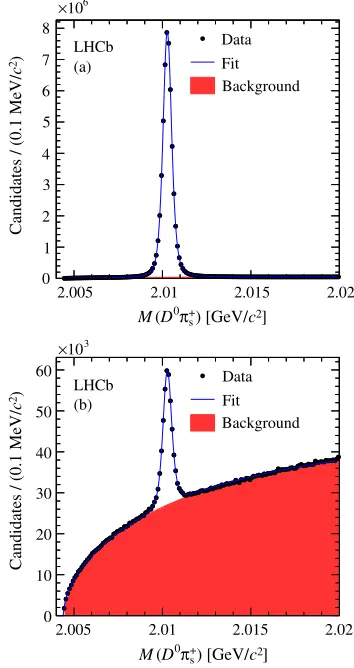
Fig. 1. The smooth background is dominated by favored
D0!Kþ decays associated with random þ
s
candi-dates. The sample contains1:15105(1:14105) signal WSD0(D0) decays and approximately 230 times more RS decays. Yield differences between D0 andD0 decays are dominated by differences in charm-anticharm production rates and reconstruction efficiencies. Each sample is div-ided into 13 subsamples according to the candidate’s decay time, and signal yields are determined for each using shape parametrizations determined from simulation and tuned to data [18]. We assume that for a givenD meson flavor, the signal shapes are common to WS and RS decays, while the descriptions of the background can differ. The decay-time-dependent WS-to-RS yield ratios Rþ andR observed in theD0 andD0samples, respectively, and their difference are shown in Fig.2. These are corrected for the relative efficiencies for reconstructing Kþ andKþ final states.
The mixing parameters are determined by minimizing a
2variable that includes terms for the difference between the observed and predicted ratios and for systematic devi-ations of parameters
] 2 c ) [GeV/ s + π 0 D ( M
2.005 2.01 2.015 2.02
)
2
c
Candidates / (0.1 MeV/
0 1 2 3 4 5 6 7 8 6 10 × Data Fit Background LHCb (a) ] 2 c ) [GeV/ s + π 0 D ( M
2.005 2.01 2.015 2.02
)
2
c
Candidates / (0.1 MeV/
3 10 × Data Fit Background LHCb (b) 0 10 20 30 40 50 60
FIG. 1 (color online). Distribution ofMðD0þ
sÞfor selected
(a) right-sign D0!Kþ and (b) wrong-sign D0!Kþ
candidates.
[image:3.612.347.524.343.677.2]2 ¼X
i rþ
i þrR~þi þ
i 2
þri rR~i
i
2
þ2
þ2B
þ2
p: (2)
The measured WS-to-RS yield ratio and its statistical uncertainty in the decay-time biniare denoted byri and
i , respectively. The predicted value for the WS-to-RS
yield ratioR~i corresponds to the time integral over biniof Eq. (1) including bin-specific corrections. These account for small biases due to the decay-time evolution of the approximately 3% fraction of signal candidates originating fromb-hadron decays (B) and of the about 0.5% compo-nent of peaking background from RS decays in which both final-state particles are misidentified (p) [18]. The rela-tive efficiencyr accounts for instrumental asymmetries in the K reconstruction efficiencies, mainly caused by
K mesons having a larger interaction cross section with matter thanKþmesons. These asymmetries are measured in data to be in the range 0.8%–1.2% with 0.2% precision and to be independent of decay time. They are derived from the efficiency ratio þr ¼1=r ¼ðKþÞ= ðKþÞ, obtained from the product ofD!Kþ andDþ!K0
Sð!þÞþ event yields divided by the
product of the corresponding charge-conjugate decay yields. No CP violation is expected or experimentally observed [23] in these decays. Asymmetries due to
CP violation in neutral kaons and their interaction cross sections with matter are negligible. The 1% asymmetry between DþandD production rates [24] cancels in this ratio, provided that the kinematic distributions are consis-tent across samples. We weight theD!Kþevents so that their kinematic distributions match those in the
Dþ!K0
Sþsample. Similarly, these samples are weighted
as functions of Kmomentum to match the RS momen-tum spectra. The parameters associated withB,p, and
rare determined separately forTOSandTOSsubsets and
vary independently in the fit within their Gaussian con-straints2
B,2p, and2[18].
To avoid experimenters’ bias in theCPviolation para-meters, the measurement technique is finalized by adding arbitrary offsets to the WS-to-RS yield ratios for the D0 andD0 samples, designed to mimic the effect of different mixing parameters in the two samples. To rule out global systematic uncertainties not accounted for in Eq. (2), the data are first integrated over the whole decay-time spec-trum and subsequently divided into statistically indepen-dent subsets according to criteria likely to reveal biases from specific instrumental effects. These include the num-ber of primary vertices in the events, the K laboratory momentum, the s impact parameter 2 with respect to the primary vertex, the D0 impact parameter 2 with respect to the primary vertex, the magnetic field orientation, and the hardware trigger category. The variations of the time-integrated charge asymmetry in WS-to-RS yield ratios are consistent with statistical fluctuations. Then, we inves-tigate decay-dependent biases by dividing the time-binned sample according to the magnet polarity and the number of primary vertices per event. In the TOS sample, differences of WS-to-RS yield ratios as functions of decay time for opposite magnet polarities yield 2 values of 12, 17, and 14 (for 12 degrees of freedom), for events with one, two, and more than two primary vertices, respec-tively. The corresponding2 values in theTOSsample, 9, 11, and 8, suggest a systematically better consistency. Hence, the statistical uncertainty of each of the WS-to-RS ratios in the TOS samples is increased by a factor offfiffiffiffiffiffiffiffiffiffiffiffiffi
17=12 p
, following Ref. [23]. These scaled uncertainties are used in all subsequent fits. Independent analyses of the 2011 and 2012 data yield consistent results. The ratio between RSD0 toD0 decay rates is independent of decay time with a 62%pvalue and a standard deviation of 0.16%, showing no evidence of correlations between particle iden-tification or reconstruction efficiency and decay time.
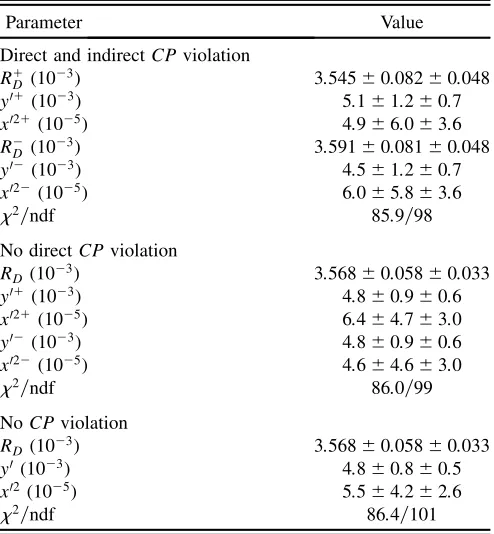
Three fits are performed to the data shown in Fig.2. The first allows direct and indirect CP violation, the second allows only indirectCPviolation by constrainingRD to a common value, and the third is a CP-conserving fit that constrains all mixing parameters to be the same in theD0 and D0 samples. The fit results and their projections are shown in TableIand Fig.2, respectively. Figure3shows the central values and confidence regions in theðx02; y0Þplane.
τ /
t
0 2 4 6 20
] -3 [10 − R − + R (c) ] -3 [10 − R CPV allowed No direct CPV No CPV (b) ] -3 [10 + R LHCb (a) -0.2 0 0.2 4 5 6 4 5 6
FIG. 2 (color online). Efficiency-corrected ratios of WS-to-RS yields for (a)Dþ decays, (b)D decays, and (c) their differ-ences as functions of decay time in units of D0 lifetime.
[image:4.612.75.272.45.279.2]For each fit, 104 WS-to-RS ratio data points are used, corresponding to 13 ranges of decay time, distinguishing
DþfromDdecays, TOS fromTOSdecays, and 2011 data from 2012 data. The consistency with the hypothesis of
CPsymmetry is determined from the change in2between the fit without and withCPviolation, taking into account the difference in number of degrees of freedom. The result-ingpvalue, for the fit with direct and indirect (indirect only)
CPviolation allowed, is 91% (81%), showing that the data are compatible withCPsymmetry.
The uncertainties incorporate both statistical and sys-tematic contributions, since all relevant syssys-tematic effects depend on the true values of the mixing parameters, and are thus incorporated into the fit2. These include the uncer-tainty in the fraction of charm mesons from b-hadron decays, and their bias on the observed decay time, the uncertainty in the fraction of peaking background, and the uncertainty in the determination of the instrumental asymmetry. The statistical uncertainty is determined in a separate fit and used to calculate the systematic component by subtraction in quadrature.
Direct CP violation would produce a nonzero inter-cept at t¼0 in the efficiency-corrected difference of WS-to-RS yield ratios betweenD0 andD0 mesons shown in Fig.2(c). It is parametrized by the asymmetry measured in the first fit AD ðRþDRDÞ=ðRþDþRDÞ ¼ ð0:7 1:9Þ%. IndirectCPviolation results in a time dependence of the efficiency-corrected difference of yield ratios. The slope observed in Fig. 2(c)is about 5% of the individual slopes of Figs. 2(a) and2(b) and is consistent with zero. From the results of the fit allowing for direct and indirect
[image:5.612.52.299.94.361.2]CP violation, a likelihood for jq=pjis constructed using the relationsx0 ¼ jq=pj1ðx0cosy0sinÞandy0¼ jq=pj1ðy0cos x0sinÞ. Confidence intervals are deri-ved with a likelihood-ratio ordering and assuming that the correlations are independent of the true values of the mixing parameters. The magnitude of q=pis determined to be 0:75<jq=pj<1:24 and 0:67<jq=pj<1:52 at the 68.3% and 95.5% confidence levels, respectively. Significantly more stringent bounds on jq=pj and addi-tional information on are available by combining the present results with other measurements [10], in particular, when also using theoretical constraints, such as the rela-tionship tan¼xð1 jq=pj2Þ=yð1þ jq=pj2Þ [25,26],
TABLE I. Results of fits to the data for different hypotheses on theCPsymmetry [27]. The reported uncertainties are statistical and systematic, respectively; ndf indicates the number of degrees of freedom.
Parameter Value
Direct and indirectCPviolation Rþ
D (103) 3:5450:0820:048
y0þ(103) 5:11:20:7
x02þ(105) 4:96:03:6
R
D (103) 3:5910:0810:048
y0(103) 4:51:20:7
x02(105) 6:05:83:6
2=ndf 85:9=98
No directCPviolation
RD(103) 3:5680:0580:033
y0þ(103) 4:80:90:6
x02þ(105) 6:44:73:0
y0(103) 4:80:90:6
x02(105) 4:64:63:0
2=ndf 86:0=99
NoCPviolation
RD(103) 3:5680:0580:033
y0(103) 4:80:80:5
x02(105) 5:54:22:6
2=ndf 86:4=101
-0.1 0 0.1 0.2
]
-3
[10
y'
0 2 4 6 8 10
LHCb (a)CPV allowed
68.3% CL 0
D
68.3% CL 0
D
]
-3
[10
2 x'
-0.1 0 0.1 0.2
No direct CPV
(b)
68.3% CL
0 D
68.3% CL
0 D
-0.1 0 0.1 0.2
No CPV
(c)
99.7% CL
95.5% CL
68.3% CL
FIG. 3 (color online). Two-dimensional confidence regions in theðx02; y0Þplane obtained (a) without any restriction onCPviolation,
(b) assuming no directCPviolation, and (c) assumingCPconservation. The dashed (solid) curves in (a) and (b) indicate the contours of the mixing parameters associated withD0(D0) decays. The best-fit value forD0(D0) decays is shown with an open (filled) point.
The solid, dashed, and dotted curves in (c) indicate the contours ofCP-averaged mixing parameters at 68.3%, 95.5%, and 99.7% confidence level (CL), respectively. The best-fit value is shown with a point.
[image:5.612.90.526.498.652.2]which applies in the limit that direct CP violation is negligible.
In summary,D0–D0 oscillation is studied usingDþ!
D0ð!KþÞþ decays reconstructed in the full sample of pp collisions, corresponding to 3 fb1 of integrated luminosity collected by the LHCb experiment in 2011 and 2012. AssumingCPconservation, the mixing parame-ters are measured to be x02 ¼ ð5:54:9Þ 105, y0 ¼ ð4:81:0Þ 103, and R
D¼ ð3:5680:066Þ 103.
The observed parameters are consistent with, 2.5 times more precise than, and supersede the results based on a subset of the present data [18]. StudyingD0andD0decays separately shows no evidence for CP violation and pro-vides the most stringent bounds on the parametersAD and
jq=pjfrom a single experiment.
We express our gratitude to our colleagues in the CERN accelerator departments for the excellent performance of the LHC. We thank the technical and administrative staff at the LHCb institutes. We acknowledge support from CERN and from the national agencies: CAPES, CNPq, FAPERJ, and FINEP (Brazil); NSFC (China); CNRS/IN2P3 and Region Auvergne (France); BMBF, DFG, HGF, and MPG (Germany); SFI (Ireland); INFN (Italy); FOM and NWO (Netherlands); SCSR (Poland); MEN/IFA (Romania); MinES, Rosatom, RFBR, and NRC ‘‘Kurchatov Institute’’ (Russia); MinECo, XuntaGal, and GENCAT (Spain); SNSF and SER (Switzerland); NAS Ukraine (Ukraine); STFC (United Kingdom); and NSF (U.S.A.). We also acknowl-edge the support received from the ERC under FP7. The Tier1 computing centres are supported by IN2P3 (France), KIT and BMBF (Germany), INFN (Italy), NWO and SURF (Netherlands), PIC (Spain), and GridPP (United Kingdom). We are thankful for the computing resources put at our disposal by Yandex LLC (Russia), as well as to the com-munities behind the multiple open source software pack-ages that we depend on.
[1] S. Bianco, F. Fabbri, D. Benson, and I. Bigi,Riv. Nuovo
Cimento26N7, 1 (2003).
[2] G. Burdman and I. Shipsey,Annu. Rev. Nucl. Part. Sci.53,
431 (2003).
[3] M. Artuso, B. Meadows, and A. A. Petrov, Annu. Rev.
Nucl. Part. Sci.58, 249 (2008).
[4] G. Blaylock, A. Seiden, and Y. Nir,Phys. Lett. B355, 555
(1995).
[5] A. A. Petrov,Int. J. Mod. Phys. A21, 5686 (2006). [6] E. Golowich, J. A. Hewett, S. Pakvasa, and A. A. Petrov,
Phys. Rev. D76, 095009 (2007).
[7] M. Ciuchini, E. Franco, D. Guadagnoli, V. Lubicz, M. Pierini, V. Porretti, and L. Silvestrini,Phys. Lett. B655,
162 (2007).
[8] B. Aubertet al.(BABARCollaboration),Phys. Rev. Lett.
98, 211802 (2007).
[9] M. Staricet al.(Belle Collaboration),Phys. Rev. Lett.98,
211803 (2007).
[10] Y. Amhis et al. (Heavy Flavor Averaging Group),
arXiv:1207.1158.
[11] T. Aaltonenet al.(CDF Collaboration), Phys. Rev. Lett.
100, 121802 (2008).
[12] L. Zhanget al.(Belle Collaboration),Phys. Rev. Lett.96,
151801 (2006).
[13] L. M. Zhanget al.(Belle Collaboration),Phys. Rev. Lett.
99, 131803 (2007).
[14] B. Aubertet al.(BABARCollaboration),Phys. Rev. Lett.
103, 211801 (2009).
[15] B. Aubertet al.(BABARCollaboration),Phys. Rev. D80,
071103 (2009).
[16] P. del Amo Sanchezet al.(BABARCollaboration),Phys.
Rev. Lett.105, 081803 (2010).
[17] D. Asneret al.(CLEO Collaboration),Phys. Rev. D86,
112001 (2012).
[18] R. Aaijet al.(LHCb Collaboration),Phys. Rev. Lett.110,
101802 (2013).
[19] T. Aaltonenet al.(CDF Collaboration), Phys. Rev. Lett.
111, 231802 (2013).
[20] A. A. Alves, Jr. et al. (LHCb Collaboration), JINST 3,
S08005 (2008).
[21] M. Adinolfiet al.,Eur. Phys. J. C73, 2431 (2013). [22] R. Aaijet al.,JINST8, P04022 (2013).
[23] J. Beringeret al.(Particle Data Group),Phys. Rev. D86,
010001 (2012), and 2013 partial update for the 2014
edition.
[24] R. Aaijet al.(LHCb Collaboration), Phys. Lett. B 718,
902 (2013).
[25] Y. Grossman, Y. Nir, and G. Perez,Phys. Rev. Lett.103,
071602 (2009).
[26] A. L. Kagan and M. D. Sokoloff,Phys. Rev. D80, 076008
(2009).
[27] See Supplemental Material at http://link.aps.org/
supplemental/10.1103/PhysRevLett.111.251801 for fits
results including correlation coefficients.
R. Aaij,40 B. Adeva,36M. Adinolfi,45C. Adrover,6A. Affolder,51 Z. Ajaltouni,5 J. Albrecht,9 F. Alessio,37 M. Alexander,50S. Ali,40 G. Alkhazov,29P. Alvarez Cartelle,36 A. A. Alves, Jr.,24 S. Amato,2S. Amerio,21
Y. Amhis,7 L. Anderlini,17,a J. Anderson,39 R. Andreassen,56J. E. Andrews,57R. B. Appleby,53 O. Aquines Gutierrez,10F. Archilli,18 A. Artamonov,34M. Artuso,58 E. Aslanides,6G. Auriemma,24,b M. Baalouch,5S. Bachmann,11J. J. Back,47A. Badalov,35C. Baesso,59V. Balagura,30W. Baldini,16R. J. Barlow,53
P. M. Bjørnstad,53 T. Blake,37 F. Blanc,38 J. Blouw,10 S. Blusk,58 V. Bocci,24 A. Bondar,33N. Bondar,29 W. Bonivento,15 S. Borghi,53 A. Borgia,58 T. J. V. Bowcock,51E. Bowen,39 C. Bozzi,16T. Brambach,9 J. van den Brand,41J. Bressieux,38D. Brett,53M. Britsch,10T. Britton,58N. H. Brook,45H. Brown,51A. Bursche,39
G. Busetto,21,dJ. Buytaert,37S. Cadeddu,15 O. Callot,7M. Calvi,20,e M. Calvo Gomez,35,f A. Camboni,35 P. Campana,18,37 D. Campora Perez,37A. Carbone,14,gG. Carboni,23,h R. Cardinale,19,i A. Cardini,15 H. Carranza-Mejia,49 L. Carson,52 K. Carvalho Akiba,2G. Casse,51 L. Castillo Garcia,37M. Cattaneo,37 Ch. Cauet,9 R. Cenci,57M. Charles,54 Ph. Charpentier,37S.-F. Cheung,54N. Chiapolini,39 M. Chrzaszcz,39,25 K. Ciba,37X. Cid Vidal,37G. Ciezarek,52P. E. L. Clarke,49M. Clemencic,37H. V. Cliff,46J. Closier,37C. Coca,28
V. Coco,40J. Cogan,6 E. Cogneras,5P. Collins,37 A. Comerma-Montells,35A. Contu,15,37 A. Cook,45 M. Coombes,45 S. Coquereau,8G. Corti,37 B. Couturier,37G. A. Cowan,49D. C. Craik,47M. Cruz Torres,59 S. Cunliffe,52R. Currie,49C. D’Ambrosio,37P. David,8P. N. Y. David,40A. Davis,56I. De Bonis,4K. De Bruyn,40
S. De Capua,53M. De Cian,11J. M. De Miranda,1 L. De Paula,2W. De Silva,56 P. De Simone,18 D. Decamp,4 M. Deckenhoff,9 L. Del Buono,8 N. De´le´age,4D. Derkach,54 O. Deschamps,5F. Dettori,41A. Di Canto,11
H. Dijkstra,37M. Dogaru,28S. Donleavy,51F. Dordei,11P. Dornan,52A. Dosil Sua´rez,36 D. Dossett,47 A. Dovbnya,42F. Dupertuis,38P. Durante,37R. Dzhelyadin,34A. Dziurda,25A. Dzyuba,29S. Easo,48 U. Egede,52
V. Egorychev,30S. Eidelman,33D. van Eijk,40 S. Eisenhardt,49U. Eitschberger,9 R. Ekelhof,9 L. Eklund,50,37 I. El Rifai,5 Ch. Elsasser,39A. Falabella,14,j C. Fa¨rber,11 C. Farinelli,40S. Farry,51 D. Ferguson,49 V. Fernandez Albor,36 F. Ferreira Rodrigues,1M. Ferro-Luzzi,37S. Filippov,32 M. Fiore,16,j C. Fitzpatrick,37 M. Fontana,10F. Fontanelli,19,i R. Forty,37 O. Francisco,2 M. Frank,37C. Frei,37M. Frosini,17,37,a E. Furfaro,23,h
A. Gallas Torreira,36 D. Galli,14,gM. Gandelman,2 P. Gandini,58Y. Gao,3J. Garofoli,58 P. Garosi,53 J. Garra Tico,46L. Garrido,35C. Gaspar,37R. Gauld,54E. Gersabeck,11M. Gersabeck,53T. Gershon,47Ph. Ghez,4
V. Gibson,46L. Giubega,28 V. V. Gligorov,37C. Go¨bel,59D. Golubkov,30 A. Golutvin,52,30,37 A. Gomes,2 P. Gorbounov,30,37 H. Gordon,37 M. Grabalosa Ga´ndara,5R. Graciani Diaz,35L. A. Granado Cardoso,37 E. Grauge´s,35G. Graziani,17 A. Grecu,28E. Greening,54S. Gregson,46 P. Griffith,44 L. Grillo,11 O. Gru¨nberg,60
B. Gui,58 E. Gushchin,32Yu. Guz,34,37 T. Gys,37C. Hadjivasiliou,58 G. Haefeli,38C. Haen,37S. C. Haines,46 S. Hall,52B. Hamilton,57 T. Hampson,45S. Hansmann-Menzemer,11N. Harnew,54S. T. Harnew,45J. Harrison,53
T. Hartmann,60J. He,37 T. Head,37V. Heijne,40K. Hennessy,51P. Henrard,5 J. A. Hernando Morata,36 E. van Herwijnen,37M. Heß,60A. Hicheur,1E. Hicks,51D. Hill,54M. Hoballah,5C. Hombach,53W. Hulsbergen,40
P. Hunt,54 T. Huse,51N. Hussain,54 D. Hutchcroft,51D. Hynds,50V. Iakovenko,43M. Idzik,26P. Ilten,12 R. Jacobsson,37A. Jaeger,11E. Jans,40P. Jaton,38A. Jawahery,57F. Jing,3M. John,54D. Johnson,54C. R. Jones,46 C. Joram,37B. Jost,37M. Kaballo,9 S. Kandybei,42W. Kanso,6 M. Karacson,37 T. M. Karbach,37I. R. Kenyon,44
T. Ketel,41B. Khanji,20O. Kochebina,7I. Komarov,38 R. F. Koopman,41 P. Koppenburg,40M. Korolev,31 A. Kozlinskiy,40 L. Kravchuk,32K. Kreplin,11M. Kreps,47G. Krocker,11P. Krokovny,33F. Kruse,9 M. Kucharczyk,20,25,37,e V. Kudryavtsev,33 K. Kurek,27T. Kvaratskheliya,30,37 V. N. La Thi,38D. Lacarrere,37
G. Lafferty,53 A. Lai,15 D. Lambert,49R. W. Lambert,41E. Lanciotti,37 G. Lanfranchi,18C. Langenbruch,37 T. Latham,47C. Lazzeroni,44R. Le Gac,6 J. van Leerdam,40J.-P. Lees,4R. Lefe`vre,5A. Leflat,31J. Lefranc¸ois,7
S. Leo,22 O. Leroy,6T. Lesiak,25 B. Leverington,11Y. Li,3 L. Li Gioi,5M. Liles,51R. Lindner,37C. Linn,11 B. Liu,3G. Liu,37S. Lohn,37I. Longstaff,50J. H. Lopes,2N. Lopez-March,38H. Lu,3D. Lucchesi,21,dJ. Luisier,38 H. Luo,49O. Lupton,54F. Machefert,7I. V. Machikhiliyan,30F. Maciuc,28O. Maev,29,37S. Malde,54G. Manca,15,k G. Mancinelli,6J. Maratas,5U. Marconi,14P. Marino,22,l R. Ma¨rki,38J. Marks,11G. Martellotti,24A. Martens,8 A. Martı´n Sa´nchez,7M. Martinelli,40D. Martinez Santos,41,37D. Martins Tostes,2A. Martynov,31A. Massafferri,1
R. Matev,37Z. Mathe,37 C. Matteuzzi,20E. Maurice,6A. Mazurov,16,37,j J. McCarthy,44A. McNab,53 R. McNulty,12B. McSkelly,51B. Meadows,56,54 F. Meier,9M. Meissner,11M. Merk,40D. A. Milanes,8 M.-N. Minard,4J. Molina Rodriguez,59 S. Monteil,5D. Moran,53P. Morawski,25A. Morda`,6M. J. Morello,22,l
R. Mountain,58I. Mous,40 F. Muheim,49 K. Mu¨ller,39R. Muresan,28B. Muryn,26B. Muster,38P. Naik,45 T. Nakada,38 R. Nandakumar,48 I. Nasteva,1 M. Needham,49 S. Neubert,37N. Neufeld,37 A. D. Nguyen,38 T. D. Nguyen,38C. Nguyen-Mau,38,mM. Nicol,7V. Niess,5R. Niet,9N. Nikitin,31T. Nikodem,11A. Nomerotski,54
A. Novoselov,34 A. Oblakowska-Mucha,26 V. Obraztsov,34S. Oggero,40 S. Ogilvy,50O. Okhrimenko,43 R. Oldeman,15,kM. Orlandea,28J. M. Otalora Goicochea,2P. Owen,52A. Oyanguren,35B. K. Pal,58A. Palano,13,n
M. Palutan,18 J. Panman,37A. Papanestis,48M. Pappagallo,50 C. Parkes,53 C. J. Parkinson,52G. Passaleva,17 G. D. Patel,51M. Patel,52G. N. Patrick,48C. Patrignani,19,iC. Pavel-Nicorescu,28A. Pazos Alvarez,36A. Pearce,53
A. Pellegrino,40G. Penso,24,oM. Pepe Altarelli,37S. Perazzini,14,gE. Perez Trigo,36A. Pe´rez-Calero Yzquierdo,35 P. Perret,5M. Perrin-Terrin,6L. Pescatore,44E. Pesen,61G. Pessina,20K. Petridis,52 A. Petrolini,19,i A. Phan,58 E. Picatoste Olloqui,35 B. Pietrzyk,4 T. Pilarˇ,47D. Pinci,24 S. Playfer,49M. Plo Casasus,36F. Polci,8 G. Polok,25
A. Poluektov,47,33 E. Polycarpo,2A. Popov,34D. Popov,10B. Popovici,28C. Potterat,35 A. Powell,54 J. Prisciandaro,38 A. Pritchard,51C. Prouve,7V. Pugatch,43A. Puig Navarro,38G. Punzi,22,pW. Qian,4 B. Rachwal,25J. H. Rademacker,45B. Rakotomiaramanana,38M. S. Rangel,2 I. Raniuk,42N. Rauschmayr,37 G. Raven,41S. Redford,54S. Reichert,53M. M. Reid,47A. C. dos Reis,1S. Ricciardi,48A. Richards,52K. Rinnert,51
V. Rives Molina,35D. A. Roa Romero,5 P. Robbe,7 D. A. Roberts,57A. B. Rodrigues,1E. Rodrigues,53 P. Rodriguez Perez,36S. Roiser,37V. Romanovsky,34A. Romero Vidal,36M. Rotondo,21J. Rouvinet,38T. Ruf,37
F. Ruffini,22 H. Ruiz,35 P. Ruiz Valls,35G. Sabatino,24,hJ. J. Saborido Silva,36N. Sagidova,29P. Sail,50 B. Saitta,15,kV. Salustino Guimaraes,2 B. Sanmartin Sedes,36R. Santacesaria,24C. Santamarina Rios,36 E. Santovetti,23,hM. Sapunov,6A. Sarti,18C. Satriano,24,bA. Satta,23M. Savrie,16,jD. Savrina,30,31M. Schiller,41
H. Schindler,37M. Schlupp,9M. Schmelling,10 B. Schmidt,37O. Schneider,38A. Schopper,37M.-H. Schune,7 R. Schwemmer,37 B. Sciascia,18 A. Sciubba,24M. Seco,36 A. Semennikov,30K. Senderowska,26 I. Sepp,52 N. Serra,39J. Serrano,6P. Seyfert,11M. Shapkin,34I. Shapoval,16,42,jY. Shcheglov,29T. Shears,51L. Shekhtman,33 O. Shevchenko,42V. Shevchenko,30A. Shires,9R. Silva Coutinho,47M. Sirendi,46N. Skidmore,45T. Skwarnicki,58 N. A. Smith,51 E. Smith,54,48 E. Smith,52J. Smith,46 M. Smith,53M. D. Sokoloff,56F. J. P. Soler,50F. Soomro,38 D. Souza,45B. Souza De Paula,2B. Spaan,9 A. Sparkes,49P. Spradlin,50F. Stagni,37S. Stahl,11 O. Steinkamp,39 S. Stevenson,54S. Stoica,28S. Stone,58B. Storaci,39 M. Straticiuc,28 U. Straumann,39 V. K. Subbiah,37L. Sun,56 W. Sutcliffe,52 S. Swientek,9 V. Syropoulos,41M. Szczekowski,27P. Szczypka,38,37 D. Szilard,2 T. Szumlak,26
S. T’Jampens,4 M. Teklishyn,7 E. Teodorescu,28F. Teubert,37 C. Thomas,54 E. Thomas,37J. van Tilburg,11 V. Tisserand,4 M. Tobin,38S. Tolk,41D. Tonelli,37 S. Topp-Joergensen,54N. Torr,54 E. Tournefier,4,52 S. Tourneur,38M. T. Tran,38M. Tresch,39A. Tsaregorodtsev,6P. Tsopelas,40N. Tuning,40,37 M. Ubeda Garcia,37
A. Ukleja,27 A. Ustyuzhanin,52,qU. Uwer,11 V. Vagnoni,14G. Valenti,14A. Vallier,7R. Vazquez Gomez,18 P. Vazquez Regueiro,36C. Va´zquez Sierra,36 S. Vecchi,16J. J. Velthuis,45M. Veltri,17,rG. Veneziano,38 M. Vesterinen,37B. Viaud,7D. Vieira,2X. Vilasis-Cardona,35,fA. Vollhardt,39 D. Volyanskyy,10 D. Voong,45 A. Vorobyev,29V. Vorobyev,33C. Voß,60H. Voss,10 R. Waldi,60 C. Wallace,47R. Wallace,12S. Wandernoth,11
J. Wang,58D. R. Ward,46N. K. Watson,44 A. D. Webber,53 D. Websdale,52 M. Whitehead,47J. Wicht,37 J. Wiechczynski,25D. Wiedner,11L. Wiggers,40G. Wilkinson,54M. P. Williams,47,48M. Williams,55F. F. Wilson,48
J. Wimberley,57J. Wishahi,9W. Wislicki,27M. Witek,25G. Wormser,7S. A. Wotton,46 S. Wright,46 S. Wu,3 K. Wyllie,37Y. Xie,49,37 Z. Xing,58 Z. Yang,3 X. Yuan,3O. Yushchenko,34M. Zangoli,14M. Zavertyaev,10,s F. Zhang,3 L. Zhang,58W. C. Zhang,12Y. Zhang,3A. Zhelezov,11A. Zhokhov,30 L. Zhong,3and A. Zvyagin37
(LHCb Collaboration)
1Centro Brasileiro de Pesquisas Fı´sicas (CBPF), Rio de Janeiro, Brazil 2Universidade Federal do Rio de Janeiro (UFRJ), Rio de Janeiro, Brazil
3Center for High Energy Physics, Tsinghua University, Beijing, China 4LAPP, Universite´ de Savoie, CNRS/IN2P3, Annecy-Le-Vieux, France
5Clermont Universite´, Universite´ Blaise Pascal, CNRS/IN2P3, LPC, Clermont-Ferrand, France 6CPPM, Aix-Marseille Universite´, CNRS/IN2P3, Marseille, France
7LAL, Universite´ Paris-Sud, CNRS/IN2P3, Orsay, France 8
LPNHE, Universite´ Pierre et Marie Curie, Universite´ Paris Diderot, CNRS/IN2P3, Paris, France
9Fakulta¨t Physik, Technische Universita¨t Dortmund, Dortmund, Germany 10Max-Planck-Institut fu¨r Kernphysik (MPIK), Heidelberg, Germany
11Physikalisches Institut, Ruprecht-Karls-Universita¨t Heidelberg, Heidelberg, Germany 12School of Physics, University College Dublin, Dublin, Ireland
13Sezione INFN di Bari, Bari, Italy 14Sezione INFN di Bologna, Bologna, Italy 15Sezione INFN di Cagliari, Cagliari, Italy 16Sezione INFN di Ferrara, Ferrara, Italy
17
Sezione INFN di Firenze, Firenze, Italy
20Sezione INFN di Milano Bicocca, Milano, Italy 21Sezione INFN di Padova, Padova, Italy
22Sezione INFN di Pisa, Pisa, Italy 23Sezione INFN di Roma Tor Vergata, Roma, Italy 24Sezione INFN di Roma La Sapienza, Roma, Italy
25Henryk Niewodniczanski Institute of Nuclear Physics, Polish Academy of Sciences, Krako´w, Poland 26AGH-University of Science and Technology, Faculty of Physics and Applied Computer Science, Krako´w, Poland
27National Center for Nuclear Research (NCBJ), Warsaw, Poland 28
Horia Hulubei National Institute of Physics and Nuclear Engineering, Bucharest-Magurele, Romania
29Petersburg Nuclear Physics Institute (PNPI), Gatchina, Russia 30Institute of Theoretical and Experimental Physics (ITEP), Moscow, Russia 31Institute of Nuclear Physics, Moscow State University (SINP MSU), Moscow, Russia 32Institute for Nuclear Research of the Russian Academy of Sciences (INR RAN), Moscow, Russia 33Budker Institute of Nuclear Physics (SB RAS) and Novosibirsk State University, Novosibirsk, Russia
34Institute for High Energy Physics (IHEP), Protvino, Russia 35Universitat de Barcelona, Barcelona, Spain
36Universidad de Santiago de Compostela, Santiago de Compostela, Spain 37European Organization for Nuclear Research (CERN), Geneva, Switzerland
38Ecole Polytechnique Fe´de´rale de Lausanne (EPFL), Lausanne, Switzerland 39Physik-Institut, Universita¨t Zu¨rich, Zu¨rich, Switzerland
40Nikhef National Institute for Subatomic Physics, Amsterdam, The Netherlands
41Nikhef National Institute for Subatomic Physics and VU University Amsterdam, Amsterdam, The Netherlands 42NSC Kharkiv Institute of Physics and Technology (NSC KIPT), Kharkiv, Ukraine
43Institute for Nuclear Research of the National Academy of Sciences (KINR), Kyiv, Ukraine 44
University of Birmingham, Birmingham, United Kingdom
45H. H. Wills Physics Laboratory, University of Bristol, Bristol, United Kingdom 46Cavendish Laboratory, University of Cambridge, Cambridge, United Kingdom
47Department of Physics, University of Warwick, Coventry, United Kingdom 48STFC Rutherford Appleton Laboratory, Didcot, United Kingdom
49School of Physics and Astronomy, University of Edinburgh, Edinburgh, United Kingdom 50School of Physics and Astronomy, University of Glasgow, Glasgow, United Kingdom
51Oliver Lodge Laboratory, University of Liverpool, Liverpool, United Kingdom 52Imperial College London, London, United Kingdom
53School of Physics and Astronomy, University of Manchester, Manchester, United Kingdom 54Department of Physics, University of Oxford, Oxford, United Kingdom
55Massachusetts Institute of Technology, Cambridge, Massachusetts, United States 56University of Cincinnati, Cincinnati, Ohio, United States
57University of Maryland, College Park, Maryland, United States 58Syracuse University, Syracuse, New York, United States
59Pontifı´cia Universidade Cato´lica do Rio de Janeiro (PUC-Rio), Rio de Janeiro, Brazil [associated with Universidade Federal do Rio
de Janeiro (UFRJ), Rio de Janeiro, Brazil]
60Institut fu¨r Physik, Universita¨t Rostock, Rostock, Germany (associated with Physikalisches Institut,
Ruprecht-Karls-Universita¨t Heidelberg, Heidelberg, Germany)
61Celal Bayar University, Manisa, Turkey (associated with European Organization for Nuclear Research (CERN),
Geneva, Switzerland)
aAlso at Universita` di Firenze, Firenze, Italy. bAlso at Universita` della Basilicata, Potenza, Italy.
cAlso at Universita` di Modena e Reggio Emilia, Modena, Italy. dAlso at Universita` di Padova, Padova, Italy.
eAlso at Universita` di Milano Bicocca, Milano, Italy.
fAlso at LIFAELS, La Salle, Universitat Ramon Llull, Barcelona, Spain. gAlso at Universita` di Bologna, Bologna, Italy.
hAlso at Universita` di Roma Tor Vergata, Roma, Italy. iAlso at Universita` di Genova, Genova, Italy.
j
Also at Universita` di Ferrara, Ferrara, Italy.
kAlso at Universita` di Cagliari, Cagliari, Italy. lAlso at Scuola Normale Superiore, Pisa, Italy.
mAlso at Hanoi University of Science, Hanoi, Viet Nam.
nAlso at Universita` di Bari, Bari, Italy.
oAlso at Universita` di Roma La Sapienza, Roma, Italy. pAlso at Universita` di Pisa, Pisa, Italy.
qAlso at Institute of Physics and Technology, Moscow, Russia. rAlso at Universita` di Urbino, Urbino, Italy.