Proceedings of the 55th Annual Meeting of the Association for Computational Linguistics, pages 1139–1149 Vancouver, Canada, July 30 - August 4, 2017. c2017 Association for Computational Linguistics Proceedings of the 55th Annual Meeting of the Association for Computational Linguistics, pages 1139–1149
Vancouver, Canada, July 30 - August 4, 2017. c2017 Association for Computational Linguistics
Abstract Syntax Networks for Code Generation and Semantic Parsing
Maxim Rabinovich∗ Mitchell Stern∗ Dan Klein Computer Science Division
University of California, Berkeley
{rabinovich,mitchell,klein}@cs.berkeley.edu
Abstract
Tasks like code generation and semantic parsing require mapping unstructured (or partially structured) inputs to well-formed, executable outputs. We introduce ab-stract syntax networks, a modeling frame-work for these problems. The outputs are represented as abstract syntax trees (ASTs) and constructed by a decoder with a dynamically-determined modular struc-ture paralleling the strucstruc-ture of the output tree. On the benchmark HEARTHSTONE
dataset for code generation, our model ob-tains 79.2 BLEU and 22.7% exact match accuracy, compared to previous state-of-the-art values of 67.1 and 6.1%. Further-more, we perform competitively on the ATIS, JOBS, and GEO semantic parsing
datasets with no task-specific engineering.
1 Introduction
Tasks like semantic parsing and code generation are challenging in part because they are struc-tured (the output must be well-formed) but not synchronous (the output structure diverges from the input structure).
Sequence-to-sequence models have proven ef-fective for both tasks (Dong and Lapata, 2016;
Ling et al., 2016), using encoder-decoder frame-works to exploit the sequential structure on both the input and output side. Yet these approaches do not account for much richer structural con-straints on outputs—including well-formedness, well-typedness, and executability. The well-formedness case is of particular interest, since it can readily be enforced by representing outputs as abstract syntax trees (ASTs) (Aho et al.,2006), an approach that can be seen as a much lighter weight
∗Equal contribution.
name: [
’D’, ’i’, ’r’, ’e’, ’ ’, ’W’, ’o’, ’l’, ’f’, ’ ’, ’A’, ’l’, ’p’, ’h’, ’a’] cost: [’2’]
type: [’Minion’] rarity: [’Common’] race: [’Beast’] class: [’Neutral’] description: [
’Adjacent’, ’minions’, ’have’, ’+’, ’1’, ’Attack’, ’.’] health: [’2’]
attack: [’2’] durability: [’-1’]
class DireWolfAlpha(MinionCard): def __init__(self):
super().__init__(
"Dire Wolf Alpha", 2, CHARACTER_CLASS.ALL,
CARD_RARITY.COMMON, minion_type=MINION_TYPE.BEAST) def create_minion(self, player):
return Minion(2, 2, auras=[
[image:1.595.307.548.227.437.2]Aura(ChangeAttack(1), MinionSelector(Adjacent())) ])
Figure 1: Example code for the “Dire Wolf Alpha” Hearthstone card.
show me the fare from ci0 to ci1
lambda $0 e
( exists $1 ( and ( from $1 ci0 ) ( to $1 ci1 )
( = ( fare $1 ) $0 ) ) )
Figure 2: Example of a query and its logical form from the ATIS dataset. Theci0 andci1 tokens are entity abstractions introduced in preprocess-ing (Dong and Lapata,2016).
version of CCG-based semantic parsing ( Zettle-moyer and Collins,2005).
In this work, we introduce abstract syntax networks (ASNs), an extension of the standard encoder-decoder framework utilizing a modular decoder whose submodels are composed to na-tively generate ASTs in a top-down manner. The decoding process for any given input follows a
namically chosen mutual recursion between the modules, where the structure of the tree being produced mirrors the call graph of the recursion. We implement this process using a decoder model built of many submodels, each associated with a specific construct in the AST grammar and in-voked when that construct is needed in the out-put tree. As is common with neural approaches to structured prediction (Chen and Manning, 2014;
Vinyals et al.,2015), our decoder proceeds greed-ily and accesses not only a fixed encoding but also an attention-based representation of the in-put (Bahdanau et al.,2014).
Our model significantly outperforms previous architectures for code generation and obtains com-petitive or state-of-the-art results on a suite of se-mantic parsing benchmarks. On the HEARTH -STONE dataset for code generation, we achieve a
token BLEU score of 79.2 and an exact match ac-curacy of 22.7%, greatly improving over the pre-vious best results of 67.1 BLEU and 6.1% exact match (Ling et al.,2016).
The flexibility of ASNs makes them readily ap-plicable to other tasks with minimal adaptation. We illustrate this point with a suite of seman-tic parsing experiments. On the JOBS dataset,
we improve on previous state-of-the-art, achiev-ing 92.9% exact match accuracy as compared to the previous record of 90.7%. Likewise, we per-form competitively on the ATISand GEOdatasets,
matching or exceeding the exact match reported
by Dong and Lapata (2016), though not quite
reaching the records held by the best previous se-mantic parsing approaches (Wang et al.,2014).
1.1 Related work
Encoder-decoder architectures, with and without attention, have been applied successfully both to sequence prediction tasks like machine translation and to tree prediction tasks like constituency pars-ing (Cross and Huang, 2016; Dyer et al., 2016;
Vinyals et al.,2015). In the latter case, work has focused on making the task look like sequence-to-sequence prediction, either by flattening the output tree (Vinyals et al.,2015) or by representing it as a sequence of construction decisions (Cross and Huang, 2016; Dyer et al., 2016). Our work dif-fers from both in its use of a recursive top-down generation procedure.
Dong and Lapata(2016) introduced a sequence-to-sequence approach to semantic parsing,
includ-ing a limited form of top-down recursion, but without the modularity or tight coupling between output grammar and model characteristic of our approach.
Neural (and probabilistic) modeling of code, in-cluding for prediction problems, has a longer his-tory. Allamanis et al. (2015) and Maddison and
Tarlow (2014) proposed modeling code with a
neural language model, generating concrete syn-tax trees in left-first depth-first order, focusing on metrics like perplexity and applications like code snippet retrieval. More recently,Shin et al.(2017) attacked the same problem using a grammar-based variational autoencoder with top-down generation similar to ours instead. Meanwhile, a separate line of work has focused on the problem of program induction from input-output pairs (Balog et al.,
2016;Liang et al.,2010;Menon et al.,2013). The prediction framework most similar in spirit to ours is the doubly-recurrent decoder network in-troduced by Alvarez-Melis and Jaakkola (2017), which propagates information down the tree using a vertical LSTM and between siblings using a hor-izontal LSTM. Our model differs from theirs in using a separate module for each grammar con-struct and learning separate vertical updates for siblings when the AST labels require all siblings to be jointly present; we do, however, use a hori-zontal LSTM for nodes withvariablenumbers of children. The differences between our models re-flect not only design decisions, but also differences in data—since ASTs have labeled nodes and la-beled edges, they come with additional structure that our model exploits.
Apart from ours, the best results on the code-generation task associated with the HEARTH -STONE dataset are based on a
sequence-to-sequence approach to the problem (Ling et al.,
2016). Abstract syntax networks greatly improve on those results.
ClassDef
identifier
Name
identifier
FunctionDef FunctionDef “DireWolfAlpha”
“MinionCard”
identifier “__init__”
identifier “create_minion” ...
name
bases body
...
(a) The root portion of the AST.
Call
identifier “Aura”
Name
Call Call
identifier “ChangeAttack”
Name
identifier “MinionSelector”
Name
object 1
Num Call
identifier “Adjacent”
Name func
func func
args
args args
func args
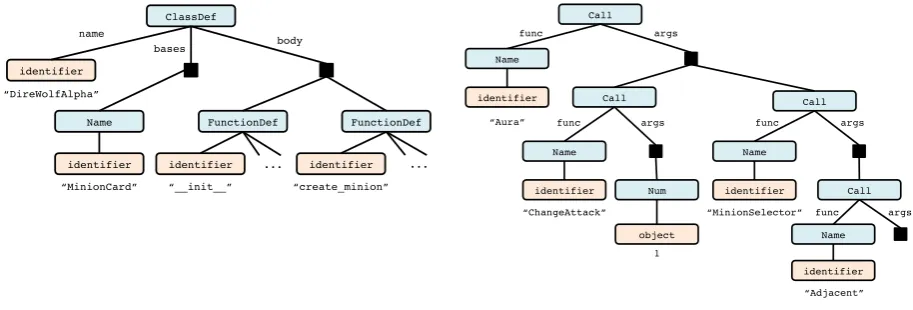
[image:3.595.70.527.62.217.2](b) Excerpt from the same AST, corresponding to the code snip-petAura(ChangeAttack(1),MinionSelector(Adjacent())).
Figure 3: Fragments from the abstract syntax tree corresponding to the example code in Figure1. Blue boxes represent composite nodes, which expand via a constructor with a prescribed set of named children. Orange boxes represent primitive nodes, with their corresponding values written underneath. Solid black squares correspond to constructor fields with sequential cardinality, such as the body of a class definition (Figure3a) or the arguments of a function call (Figure3b).
maintain recurrent state.
2 Data Representation 2.1 Abstract Syntax Trees
Our model makes use of the Abstract Syntax Description Language (ASDL) framework (Wang et al.,1997), which represents code fragments as trees with typed nodes.Primitive typescorrespond to atomic values, like integers or identifiers. Ac-cordingly, primitive nodes are annotated with a primitive type and a value of that type—for in-stance, in Figure3a, theidentifiernode stor-ing"create minion"represents a function of the same name.
Composite types correspond to language con-structs, like expressions or statements. Each type has a collection of constructors, each of which specifies the particular language construct a node of that type represents. Figure 4 shows con-structors for the statement (stmt) and expression (expr) types. The associated language constructs include function and class definitions, return state-ments, binary operations, and function calls.
Composite types enter syntax trees via compos-ite nodes, annotated with a composite type and a choice of constructor specifying how the node ex-pands. The root node in Figure3a, for example, is
1The full grammar can be found online on the documentation page for the Python ast module:
https://docs.python.org/3/library/ast. html#abstract-grammar
primitive types: identifier, object, ...
stmt
= FunctionDef(
identifier name, arg* args, stmt* body) | ClassDef(
identifier name, expr* bases, stmt* body) | Return(expr? value)
| ...
expr
= BinOp(expr left, operator op, expr right) | Call(expr func, expr* args)
| Str(string s)
| Name(identifier id, expr_context ctx) | ...
...
Figure 4: A simplified fragment of the Python ASDL grammar.1
a composite node of typestmt that represents a class definition and therefore uses theClassDef constructor. In Figure3b, on the other hand, the root uses the Call constructor because it repre-sents a function call.
associ-ated with zero or one children, while fields ofsequential cardinality are associated with zero or more children—these are designated us-ing? and*suffixes in the grammar, respectively. Fields ofsequentialcardinality are often used to represent statement blocks, as in thebodyfield of theClassDefandFunctionDef construc-tors.
The grammars needed for semantic parsing can easily be given ASDL specifications as well, us-ing primitive types to represent variables, predi-cates, and atoms and composite types for standard logical building blocks like lambdas and counting (among others). Figure2shows what the resulting
λ-calculus trees look like. The ASDL grammars
for bothλ-calculus and Prolog-style logical forms
are quite compact, as Figures9 and10 in the ap-pendix show.
2.2 Input Representation
We represent inputs as collections of named com-ponents, each of which consists of a sequence of tokens. In the case of semantic parsing, inputs have a single component containing the query sen-tence. In the case of HEARTHSTONE, the card’s
name and description are represented as sequences of characters and tokens, respectively, while cate-gorical attributes are represented as single-token sequences. For HEARTHSTONE, we restrict our
input and output vocabularies to values that occur more than once in the training set.
3 Model Architecture
Our model uses an encoder-decoder architecture with hierarchical attention. The key idea behind our approach is to structure the decoder as a col-lection of mutually recursive modules. The mod-ules correspond to elements of the AST gram-mar and are composed together in a manner that mirrors the structure of the tree being generated. A vertical LSTM state is passed from module to module to propagate information during the de-coding process.
The encoder uses bidirectional LSTMs to em-bed each component and a feedforward network to combine them. Component- and token-level at-tention is applied over the input at each step of the decoding process.
We train our model using negative log likeli-hood as the loss function. The likelilikeli-hood encom-passes terms for all generation decisions made by
the decoder.
3.1 Encoder
Each componentcof the input is encoded using a
component-specific bidirectional LSTM. This re-sults in forward and backward token encodings (−h→c,←h−c) that are later used by the attention
mech-anism. To obtain an encoding of the input as a whole for decoder initialization, we concatenate the final forward and backward encodings of each component into a single vector and apply a linear projection.
3.2 Decoder Modules
The decoder decomposes into several classes of modules, one per construct in the grammar, which we discuss in turn. Throughout, we let v
de-note the current vertical LSTM state, and use f
to represent a generic feedforward neural network. LSTM updates with hidden statehand inputxare
notated asLSTM(h,x).
Composite type modules Each composite type Thas a corresponding module whose role is to se-lect among the constructors C for that type. As Figure 5a exhibits, a composite type module re-ceives a vertical LSTM state v as input and
ap-plies a feedforward networkfTand a softmax out-put layer to choose a constructor:
p(C|T,v) =softmax (fT(v))
C. Control is then passed to the module associated with constructorC.
Constructor modules Each constructorChas a corresponding module whose role is to compute an intermediate vertical LSTM statevu,F for each of its fieldsFwheneverCis chosen at a composite nodeu.
For each field Fof the constructor, an embed-ding eF is concatenated with an attention-based context vector c and fed through a feedforward
neural network fC to obtain a context-dependent field embedding:
˜
eF=fC(eF, c).
An intermediate vertical state for the field F at composite nodeuis then computed as
vu,F = LSTMv(vu, ˜eF).
Assign
...
stmt ClassDef
Return If For
While If
(a) A composite type module choosing a constructor for the corresponding type.
If test
body orelse
expr
stmt*
stmt*
(b) A constructor module computing updated vertical LSTM states.
stmt*
stmt
(c) A constructor field module (sequential cardinal-ity) generating children to populate the field. At each step, the module decides whether to generate a child and continue (white circle) or stop (black circle).
damage ... identifier
__init__ create_minion add_buff change_attack
add_buff
[image:5.595.308.559.213.294.2](d) A primitive type module choosing a value from a closed list.
Figure 5: The module classes constituting our decoder. For brevity, we omit the cardinality modules for singularandoptionalcardinalities.
Constructor field modules Each field F of a constructor has a corresponding module whose role is to determine the number of children asso-ciated with that field and to propagate an updated vertical LSTM state to them. In the case of fields withsingularcardinality, the decision and up-date are both vacuous, as exactly one child is al-ways generated. Hence these modules forward the field vertical LSTM state vu,F unchanged to the childwcorresponding toF:
vw =vu,F. (1)
Fields withoptionalcardinality can have either zero or one children; this choice is made using a feedforward network applied to the vertical LSTM state:
p(zF= 1|vu,F) = sigmoid (fFgen(vu,F)). (2)
If a child is to be generated, then as in (1), the state is propagated forward without modification.
In the case of sequentialfields, a horizon-tal LSTM is employed for both child decisions and state updates. We refer to Figure 5cfor an illus-tration of the recurrent process. After being ini-tialized with a transformation of the vertical state,
sF,0 = WFvu,F, the horizontal LSTM iteratively
decides whether to generate another child by ap-plying a modified form of (2):
p(zF,i = 1|sF,i−1, vu,F) =
sigmoid (fFgen(sF,i−1, vu,F)).
IfzF,i = 0, generation stops and the process
ter-minates, as represented by the solid black circle in Figure5c. Otherwise, the process continues as represented by the white circle in Figure 5c. In that case, the horizontal statesu,i−1 is combined
with the vertical statevu,F and an attention-based context vector cF,i using a feedforward network
fFupdateto obtain a joint context-dependent
encod-ing of the fieldFand the positioni:
˜
eF,i=fFupdate(vu,F, su,i−1, cF,i).
The result is used to perform a vertical LSTM up-date for the corresponding childwi:
vwi = LSTM
v(v
u,F, ˜eF,i).
Finally, the horizontal LSTM state is updated us-ing the same field-position encodus-ing, and the pro-cess continues:
Primitive type modules Each primitive type T has a corresponding module whose role is to se-lect among the valuesywithin the domain of that type. Figure5d presents an example of the sim-plest form of this selection process, where the value yis obtained from a closed list via a soft-max layer applied to an incoming vertical LSTM state:
p(y|T,v) =softmax (fT(v))
y.
Some string-valued types are open class, how-ever. To deal with these, we allow generation both from a closed list of previously seen values, as in Figure5d, and synthesis of new values. Synthesis is delegated to a character-level LSTM language model (Bengio et al., 2003), and part of the role of the primitive module for open class types is to choose whether to synthesize a new value or not. During training, we allow the model to use the character LSTM only for unknown strings but in-clude the log probability of that binary decision in the loss in order to ensure the model learns when to generate from the character LSTM.
3.3 Decoding Process
The decoding process proceeds through mutual re-cursion between the constituting modules, where the syntactic structure of the output tree mirrors the call graph of the generation procedure. At each step, the active decoder module either makes a generation decision, propagates state down the tree, or both.
To construct a composite node of a given type, the decoder calls the appropriate composite type module to obtain a constructor and its associated module. That module is then invoked to obtain updated vertical LSTM states for each of the con-structor’s fields, and the corresponding constructor field modules are invoked to advance the process to those children.
This process continues downward, stopping at each primitive node, where a value is generated but no further recursion is carried out.
3.4 Attention
Following standard practice for sequence-to-sequence models, we compute a raw bilinear at-tention scoreqtrawfor each tokentin the input
us-ing the decoder’s current state x and the token’s
encodinget:
qtraw=e>t Wx.
The current state x can be either the vertical LSTM state in isolation or a concatentation of the vertical LSTM state and either a horizontal LSTM state or a character LSTM state (for string gener-ation). Each submodule that computes attention does so using a separate matrixW.
A separate attention score qcompc is computed
for each component of the input, independent of its content:
qccomp=w>cx.
The final token-level attention scores are the sums of the raw token-level scores and the corre-sponding component-level scores:
qt=qtraw+qccomp(t) ,
wherec(t)denotes the component in which token t occurs. The attention weight vector a is then
computed using a softmax:
a= softmax (q).
Given the weights, the attention-based context is given by:
c=X t
atet.
Certain decision points that require attention have been highlighted in the description above; however, in our final implementation we made attention available to the decoder at all decision points.
Supervised Attention In the datasets we con-sider, partial or total copying of input tokens into primitive nodes is quite common. Rather than pro-viding an explicit copying mechanism (Ling et al.,
2016), we instead generate alignments where pos-sible to define a set of tokens on which the atten-tion at a given primitive node should be concen-trated.2 If no matches are found, the
correspond-ing set of tokens is taken to be the whole input. The attention supervision enters the loss through a term that encourages the final attention weights to be concentrated on the specified sub-set. Formally, if the matched subset of component-token pairs isS, the loss term associated with the
supervision would be
logX t
exp (at)−log X
t∈S
exp (at), (3)
whereatis the attention weight associated with
to-kent, and the sum in the first term ranges over all
tokens in the input. The loss in (3) can be inter-preted as the negative log probability of attending to some token inS.
4 Experimental evaluation 4.1 Semantic parsing
Data We use three semantic parsing datasets: JOBS, GEO, and ATIS. All three consist of
nat-ural language queries paired with a logical repre-sentation of their denotations. JOBS consists of
640 such pairs, with Prolog-style logical represen-tations, while GEO and ATIS consist of 880 and
5,410 such pairs, respectively, withλ-calculus
log-ical forms. We use the same training-test split as Zettlemoyer and Collins(2005) for JOBS and
GEO, and the standard training-development-test
split for ATIS. We use the preprocessed versions
of these datasets made available byDong and La-pata(2016), where text in the input has been low-ercased and stemmed using NLTK (Bird et al.,
2009), and matching entities appearing in the same input-output pair have been replaced by numbered abstract identifiers of the same type.
Evaluation We compute accuracies using tree exact match for evaluation. Following the pub-licly released code ofDong and Lapata(2016), we canonicalize the order of the children within con-junction and discon-junction nodes to avoid spurious errors, but otherwise perform no transformations before comparison.
4.2 Code generation
Data We use the HEARTHSTONE dataset
intro-duced by Ling et al. (2016), which consists of 665 cards paired with their implementations in the open-source Hearthbreaker engine.3 Our
training-development-test split is identical to that ofLing et al. (2016), with split sizes of 533, 66, and 66, respectively.
Cards contain two kinds of components: tex-tual components that contain the card’s name and a description of its function, and categorical ones that contain numerical attributes (attack, health, cost, and durability) or enumerated attributes (rar-ity, type, race, and class). The name of the card is represented as a sequence of characters, while
3Available online at https://github.com/ danielyule/hearthbreaker.
its description consists of a sequence of tokens split on whitespace and punctuation. All categori-cal components are represented as single-token se-quences.
Evaluation For direct comparison to the results of Ling et al. (2016), we evaluate our predicted code based on exact match and token-level BLEU relative to the reference implementations from the library. We additionally compute node-based pre-cision, recall, and F1 scores for our predicted trees compared to the reference code ASTs. Formally, these scores are obtained by defining the intersec-tion of the predicted and gold trees as their largest common tree prefix.
4.3 Settings
For each experiment, all feedforward and LSTM hidden dimensions are set to the same value. We select the dimension from {30, 40, 50, 60, 70} for the smaller JOBS and GEO datasets, or from
{50, 75, 100, 125, 150} for the larger ATIS
and HEARTHSTONEdatasets. The dimensionality
used for the inputs to the encoder is set to 100 in all cases. We apply dropout to the non-recurrent connections of the vertical and horizontal LSTMs, selecting the noise ratio from{0.2, 0.3, 0.4, 0.5}. All parameters are randomly initialized using Glo-rot initialization (Glorot and Bengio,2010).
We perform 200 passes over the data for the JOBS and GEO experiments, or 400 passes for
the ATISand HEARTHSTONEexperiments. Early
stopping based on exact match is used for the se-mantic parsing experiments, where performance is evaluated on the training set for JOBS and GEO
or on the development set for ATIS. Parameters
for the HEARTHSTONE experiments are selected
based on development BLEU scores. In order to promote generalization, ties are broken in all cases with a preference toward higher dropout ratios and lower dimensionalities, in that order.
Our system is implemented in Python using the DyNet neural network library (Neubig et al.,
2017). We use the Adam optimizer (Kingma and Ba, 2014) with its default settings for optimiza-tion, with a batch size of 20 for the semantic pars-ing experiments, or a batch size of 10 for the HEARTHSTONEexperiments.
4.4 Results
ATIS GEO JOBS
System Accuracy System Accuracy System Accuracy
ZH15 84.2 ZH15 88.9 ZH15 85.0
ZC07 84.6 KCAZ13 89.0 PEK03 88.0
WKZ14 91.3 WKZ14 90.4 LJK13 90.7
DL16 84.6 DL16 87.1 DL16 90.0
ASN 85.3 ASN 85.7 ASN 91.4
[image:8.595.118.482.63.173.2]+ SUPATT 85.9 + SUPATT 87.1 + SUPATT 92.9
Table 1: Accuracies for the semantic parsing tasks. ASN denotes our abstract syntax network framework. SUPATTrefers to the supervised attention mentioned in Section3.4.
System Accuracy BLEU F1
NEAREST 3.0 65.0 65.7
LPN 6.1 67.1 –
ASN 18.2 77.6 72.4
[image:8.595.85.279.228.299.2]+ SUPATT 22.7 79.2 75.6
Table 2: Results for the HEARTHSTONEtask. SU -PATT refers to the system with supervised
atten-tion menatten-tioned in Secatten-tion 3.4. LPN refers to the system ofLing et al. (2016). Our nearest neigh-bor baseline NEAREST follows that ofLing et al.
(2016), though it performs somewhat better; its nonzero exact match number stems from spurious repetition in the data.
a new state-of-the-art accuracy of 91.4% on the JOBSdataset, and this number improves to 92.9%
when supervised attention is added. On the ATIS
and GEO datasets, we respectively exceed and
match the results of Dong and Lapata (2016). However, these fall short of the previous best re-sults of 91.3% and 90.4%, respectively, obtained byWang et al.(2014). This difference may be par-tially attributable to the use of typing information or rich lexicons in most previous semantic pars-ing approaches (Zettlemoyer and Collins, 2007;
Kwiatkowski et al.,2013;Wang et al.,2014;Zhao and Huang,2015).
On the HEARTHSTONE dataset, we improve
significantly over the initial results of Ling et al.
(2016) across all evaluation metrics, as shown in Table2. On the more stringent exact match metric, we improve from 6.1% to 18.2%, and on token-level BLEU, we improve from 67.1 to 77.6. When supervised attention is added, we obtain an ad-ditional increase of several points on each scale, achieving peak results of 22.7% accuracy and 79.2 BLEU.
class IronbarkProtector(MinionCard): def __init__(self):
super().__init__(
’Ironbark Protector’, 8, CHARACTER_CLASS.DRUID, CARD_RARITY.COMMON)
def create_minion(self, player): return Minion(
[image:8.595.307.551.241.359.2]8, 8, taunt=True)
Figure 6: Cards with minimal descriptions exhibit a uniform structure that our system almost always predicts correctly, as in this instance.
class ManaWyrm(MinionCard): def __init__(self):
super().__init__( ’Mana Wyrm’, 1, CHARACTER_CLASS.MAGE, CARD_RARITY.COMMON)
def create_minion(self, player): return Minion(
1, 3, effects=[ Effect(
SpellCast(), ActionTag(
Give(ChangeAttack(1)), SelfSelector())) ])
Figure 7: For many cards with moderately com-plex descriptions, the implementation follows a functional style that seems to suit our modeling strategy, usually leading to correct predictions.
4.5 Error Analysis and Discussion
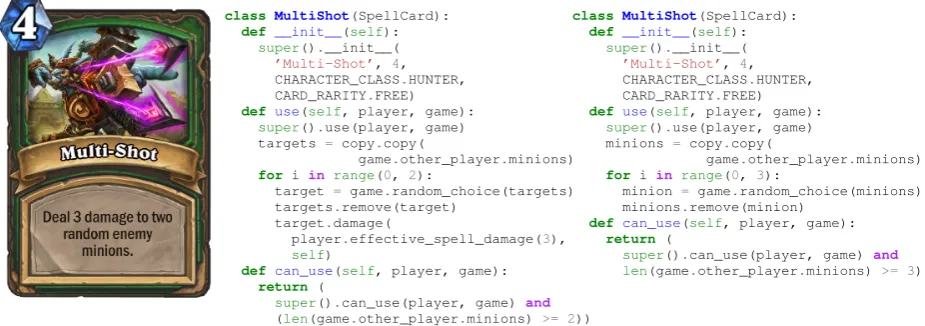
As the examples in Figures 6-8 show, classes in the HEARTHSTONE dataset share a great deal of
[image:8.595.309.543.436.558.2]class MultiShot(SpellCard): def __init__(self):
super().__init__( ’Multi-Shot’, 4, CHARACTER_CLASS.HUNTER, CARD_RARITY.FREE) def use(self, player, game):
super().use(player, game) targets = copy.copy(
game.other_player.minions) for i in range(0, 2):
target = game.random_choice(targets) targets.remove(target)
target.damage(
player.effective_spell_damage(3), self)
def can_use(self, player, game): return (
super().can_use(player, game) and
(len(game.other_player.minions) >= 2))
class MultiShot(SpellCard): def __init__(self):
super().__init__( ’Multi-Shot’, 4, CHARACTER_CLASS.HUNTER, CARD_RARITY.FREE) def use(self, player, game):
super().use(player, game) minions = copy.copy(
game.other_player.minions) for i in range(0, 3):
minion = game.random_choice(minions) minions.remove(minion)
def can_use(self, player, game): return (
super().can_use(player, game) and
[image:9.595.79.542.77.240.2]len(game.other_player.minions) >= 3)
Figure 8: Cards with nontrivial logic expressed in an imperative style are the most challenging for our system. In this example, our prediction comes close to the gold code, but misses an important statement in addition to making a few other minor errors.(Left)gold code;(right)predicted code.
exception of instances in which strings are incor-rectly transduced. Introducing a dedicated copy-ing mechanism like the one used by Ling et al.
(2016) or more specialized machinery for string transduction may alleviate this latter problem.
The next simplest category of card-code pairs consists of those in which the card’s logic is mostly implemented via nested function calls. Figure 7 illustrates a typical case, in which the card’s effect is triggered by a game event (a spell being cast) and both the trigger and the effect are described by arguments to anEffect construc-tor. Our system usually also performs well on in-stances like these, apart from idiosyncratic errors that can take the form of under- or overgeneration or simply substitution of incorrect predicates.
Cards whose code includes complex logic ex-pressed in an imperative style, as in Figure8, pose the greatest challenge for our system. Factors like variable naming, nontrivial control flow, and in-terleaving of code predictable from the descrip-tion with code required due to the convendescrip-tions of the library combine to make the code for these cards difficult to generate. In some instances (as in the figure), our system is nonetheless able to synthesize a close approximation. However, in the most complex cases, the predictions deviate sig-nificantly from the correct implementation.
In addition to the specific errors our system makes, some larger issues remain unresolved. Ex-isting evaluation metrics only approximate the actual metric of interest: functional equiva-lence. Modifications of BLEU, tree F1, and exact
match that canonicalize the code—for example, by anonymizing all variables—may prove more meaningful. Direct evaluation of functional equiv-alence is of course impossible in general (Sipser,
2006), and practically challenging even for the HEARTHSTONE dataset because it requires
inte-grating with the game engine.
Existing work also does not attempt to enforce semanticcoherence in the output. Long-distance semantic dependencies, between occurrences of a single variable for example, in particular are not modeled. Nor is well-typedness or executability. Overcoming these evaluation and modeling issues remains an important open problem.
5 Conclusion
ASNs provide a modular encoder-decoder archi-tecture that can readily accommodate a variety of tasks with structured output spaces. They are par-ticularly applicable in the presence of recursive decompositions, where they can provide a simple decoding process that closely parallels the inher-ent structure of the outputs. Our results demon-strate their promise for tree prediction tasks, and we believe their application to more general out-put structures is an interesting avenue for future work.
Acknowledgments
References
Alfred V. Aho, Monica S. Lam, Ravi Sethi, and Jef-frey D. Ullman. 2006. Compilers: Principles, Tech-niques, and Tools (2Nd Edition). Addison-Wesley Longman Publishing Co., Inc., Boston, MA, USA.
Miltiadis Allamanis, Daniel Tarlow, Andrew D. Gor-don, and Yi Wei. 2015. Bimodal modelling of source code and natural language. InProceedings of the 32nd International Conference on Machine Learning, ICML 2015, Lille, France, 6-11 July 2015. pages 2123–2132.
David Alvarez-Melis and Tommi S. Jaakkola. 2017. Tree-structured decoding with doubly-recurrent neural networks. InProceedings of the International Conference on Learning Representations (ICLR) 2017.
Jacob Andreas, Marcus Rohrbach, Trevor Darrell, and Dan Klein. 2016. Neural module networks. In Pro-ceedings of the IEEE Conference on Computer Vi-sion and Pattern Recognition (CVPR). Oral.
Dzmitry Bahdanau, Kyunghyun Cho, and Yoshua Bengio. 2014. Neural machine translation by jointly learning to align and translate. CoRR
abs/1409.0473.
Matej Balog, Alexander L. Gaunt, Marc Brockschmidt, Sebastian Nowozin, and Daniel Tarlow. 2016. Deepcoder: Learning to write programs. CoRR
abs/1611.01989.
Yoshua Bengio, R´ejean Ducharme, Pascal Vincent, and Christian Janvin. 2003. A neural probabilistic lan-guage model. J. Mach. Learn. Res. 3:1137–1155. http://dl.acm.org/citation.cfm?id=944919.944966.
Steven Bird, Ewan Klein, and Edward Loper. 2009. Natural Language Processing with Python. O’Reilly Media, Inc., 1st edition.
Danqi Chen and Christopher D. Manning. 2014. A fast and accurate dependency parser using neu-ral networks. In Proceedings of the 2014 Con-ference on Empirical Methods in Natural Lan-guage Processing, EMNLP 2014, October 25-29, 2014, Doha, Qatar, A meeting of SIGDAT, a Spe-cial Interest Group of the ACL. pages 740–750. http://aclweb.org/anthology/D/D14/D14-1082.pdf.
James Cross and Liang Huang. 2016. Span-based constituency parsing with a structure-label system and provably optimal dynamic oracles. In Proceed-ings of the 2016 Conference on Empirical Meth-ods in Natural Language Processing, EMNLP 2016, Austin, Texas, USA, November 1-4, 2016. pages 1– 11.
Li Dong and Mirella Lapata. 2016. Language to logical form with neural attention. CoRRabs/1601.01280.
Chris Dyer, Adhiguna Kuncoro, Miguel Ballesteros, and Noah A. Smith. 2016. Recurrent neural network
grammars. InNAACL HLT 2016, The 2016 Confer-ence of the North American Chapter of the Associ-ation for ComputAssoci-ational Linguistics: Human Lan-guage Technologies, San Diego California, USA, June 12-17, 2016. pages 199–209.
Xavier Glorot and Yoshua Bengio. 2010. Understand-ing the difficulty of trainUnderstand-ing deep feedforward neu-ral networks. InIn Proceedings of the International Conference on Artificial Intelligence and Statistics (AISTATS10). Society for Artificial Intelligence and Statistics.
Diederik P. Kingma and Jimmy Ba. 2014. Adam: A method for stochastic optimization. CoRR
abs/1412.6980. http://arxiv.org/abs/1412.6980.
Tom Kwiatkowski, Eunsol Choi, Yoav Artzi, and Luke S. Zettlemoyer. 2013. Scaling semantic parsers with on-the-fly ontology matching. In Pro-ceedings of the 2013 Conference on Empirical Meth-ods in Natural Language Processing, EMNLP 2013, 18-21 October 2013, Grand Hyatt Seattle, Seattle, Washington, USA, A meeting of SIGDAT, a Special Interest Group of the ACL. pages 1545–1556.
Percy Liang, Michael I. Jordan, and Dan Klein. 2010. Learning programs: A hierarchical bayesian ap-proach. In Proceedings of the 27th International Conference on Machine Learning (ICML-10), June 21-24, 2010, Haifa, Israel. pages 639–646.
Percy Liang, Michael I. Jordan, and Dan Klein. 2013. Learning dependency-based compositional semantics. Comput. Linguist. 39(2):389–446. https://doi.org/10.1162/COLI a 00127.
Wang Ling, Phil Blunsom, Edward Grefenstette, Karl Moritz Hermann, Tom´as Kocisk´y, Fumin Wang, and Andrew Senior. 2016. Latent predictor networks for code generation. InProceedings of the 54th Annual Meeting of the Association for Compu-tational Linguistics, ACL 2016, August 7-12, 2016, Berlin, Germany, Volume 1: Long Papers.
Chris J. Maddison and Daniel Tarlow. 2014. Struc-tured generative models of natural source code. In
Proceedings of the 31th International Conference on Machine Learning, ICML 2014, Beijing, China, 21-26 June 2014. pages 649–657.
Aditya Krishna Menon, Omer Tamuz, Sumit Gulwani, Butler W. Lampson, and Adam Kalai. 2013. A ma-chine learning framework for programming by ex-ample. In Proceedings of the 30th International Conference on Machine Learning, ICML 2013, At-lanta, GA, USA, 16-21 June 2013. pages 187–195.
Oda, Matthew Richardson, Naomi Saphra, Swabha Swayamdipta, and Pengcheng Yin. 2017. Dynet: The dynamic neural network toolkit. arXiv preprint arXiv:1701.03980.
Ana-Maria Popescu, Oren Etzioni, and Henry Kautz. 2003. Towards a theory of natural language inter-faces to databases. In Proceedings of the 8th in-ternational conference on Intelligent user interfaces. ACM, pages 149–157.
Richard Shin, Alexander A. Alemi, Geoffrey Irving, and Oriol Vinyals. 2017. Tree-structured varia-tional autoencoder. In Proceedings of the Inter-national Conference on Learning Representations (ICLR) 2017.
Michael Sipser. 2006. Introduction to the Theory of Computation. Course Technology, second edition.
Oriol Vinyals, Lukasz Kaiser, Terry Koo, Slav Petrov, Ilya Sutskever, and Geoffrey E. Hinton. 2015. Grammar as a foreign language. In Advances in Neural Information Processing Systems 28: Annual Conference on Neural Information Processing Sys-tems 2015, December 7-12, 2015, Montreal, Que-bec, Canada. pages 2773–2781.
Adrienne Wang, Tom Kwiatkowski, and Luke S Zettle-moyer. 2014. Morpho-syntactic lexical generaliza-tion for ccg semantic parsing. In EMNLP. pages 1284–1295.
Daniel C. Wang, Andrew W. Appel, Jeff L. Korn, and Christopher S. Serra. 1997. The zephyr ab-stract syntax description language. InProceedings of the Conference on Domain-Specific Languages on Conference on Domain-Specific Languages (DSL), 1997. USENIX Association, Berkeley, CA, USA, DSL’97, pages 17–17.
Luke S. Zettlemoyer and Michael Collins. 2005. Learning to map sentences to logical form: Struc-tured classification with probabilistic categorial grammars. InUAI ’05, Proceedings of the 21st Con-ference in Uncertainty in Artificial Intelligence, Ed-inburgh, Scotland, July 26-29, 2005. pages 658–666.
Luke S. Zettlemoyer and Michael Collins. 2007. On-line learning of relaxed ccg grammars for parsing to logical form. In In Proceedings of the 2007 Joint Conference on Empirical Methods in Natural guage Processing and Computational Natural Lan-guage Learning (EMNLP-CoNLL-2007. pages 678– 687.
Kai Zhao and Liang Huang. 2015. Type-driven in-cremental semantic parsing with polymorphism. In
NAACL HLT 2015, The 2015 Conference of the North American Chapter of the Association for Computational Linguistics: Human Language Tech-nologies, Denver, Colorado, USA, May 31 - June 5, 2015. pages 1416–1421.
A Appendix
expr
= Apply(pred predicate, arg* arguments) | Not(expr argument)
| Or(expr left, expr right) | And(expr* arguments)
arg
[image:11.595.318.569.248.419.2]= Literal(lit literal) | Variable(var variable)
Figure 9: The Prolog-style grammar we use for the JOBStask.
expr
= Variable(var variable) | Entity(ent entity) | Number(num number)
| Apply(pred predicate, expr* arguments) | Argmax(var variable, expr domain, expr body) | Argmin(var variable, expr domain, expr body) | Count(var variable, expr body)
| Exists(var variable, expr body)
| Lambda(var variable, var_type type, expr body) | Max(var variable, expr body)
| Min(var variable, expr body)
| Sum(var variable, expr domain, expr body) | The(var variable, expr body)
| Not(expr argument) | And(expr* arguments) | Or(expr* arguments)
| Compare(cmp_op op, expr left, expr right)
cmp_op = Equal | LessThan | GreaterThan
Figure 10: The λ-calculus grammar used by our