1969
Generating Long and Informative Reviews with Aspect-Aware
Coarse-to-Fine Decoding
Junyi Li1, Wayne Xin Zhao1,2∗, Ji-Rong Wen1,2,andYang Song3 1School of Information, Renmin University of China
2Beijing Key Laboratory of Big Data Management and Analysis Methods 3Boss Zhipin
{lijunyi,jrwen}@ruc.edu.cn
[email protected] [email protected]
Abstract
Generating long and informative review text is a challenging natural language generation task. Previous work focuses on word-level generation, neglecting the importance of top-ical and syntactic characteristics from natural languages. In this paper, we propose a novel review generation model by characterizing an elaborately designed aspect-aware coarse-to-fine generation process. First, we model the aspect transitions to capture the overall content flow. Then, to generate a sentence, an aware sketch will be predicted using an aspect-aware decoder. Finally, another decoder fills in the semantic slots by generating correspond-ing words. Our approach is able to jointly utilize aspect semantics, syntactic sketch, and context information. Extensive experiments results have demonstrated the effectiveness of the proposed model.
1 Introduction
In the past decades, online review services (e.g.,
AMAZONand YELP) have been an important kind of information platforms where users post their feedbacks or comments about products (Kim et al.,
2016). Usually, writing an informative and well-structured review will require considerable efforts by users. To assist the writing process, the task of review generation has been proposed to auto-matically generate review text for a user given a product and her/his rating on it (Tang et al.,2016;
Zhou et al.,2017).
In the literature, various methods have been developed for review generation (Tang et al.,
2016; Zhou et al., 2017; Ni et al., 2017; Wang and Zhang, 2017; Catherine and Cohen, 2018). Most of these methods adopt Recurrent Neu-ral Networks (RNN) based methods, especially
∗
Corresponding author
the improved variants of Long-Short Term Mem-ory (LSTM) (Hochreiter and Schmidhuber,1997) and Gated Recurrent Unit (GRU) (Cho et al.,
2014). They fulfill the review generation task by performing the decoding conditioned on useful context information. Usually, an informative re-view is likely to consist of multiple sentences, con-taining substantive comments from users. Hence, a major problem of existing RNN-based methods is that they have limited capacities in producing long and informative text. More recently, Genera-tive Adversarial Net (GAN) based methods (Zang and Wan,2017;Yu et al.,2017;Guo et al.,2018;
Xu et al., 2018a) have been proposed to enhance the generation of long, diverse and novel text. However, they still focus on word-level genera-tion, and neglect the importance of topical and syntactic characteristics from natural languages.
As found in the literature of linguistics (Pullum,
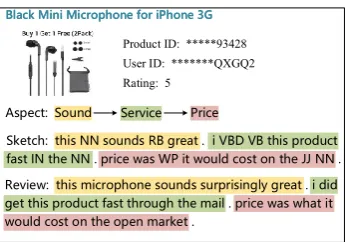
2010) and writing (Bateman and Zock,2003), the writing process itself has involved multiple stages focusing on different levels of goals. We argue that an ideal review generation approach should follow the writing procedure of a real user and capture rich characteristics from natural language. With this motivation, we design an elaborative coarse-to-fine generation process by considering the as-pect semantics and syntactic characteristics. Fig-ure 1presents an illustrative example for our re-view generation process. First, we conceive the content flow that is characterized as an aspect se-quence. An aspect describes some property or at-tribute about a product (Zhao et al., 2010), such
assound andservice in this example. To
Product ID: *****93428 User ID: *******QXGQ2 Rating: 5
Aspect:
Sketch: this NN sounds RB great . i VBD VB this product fast IN the NN . price was WP it would cost on the JJ NN . Review: this microphone sounds surprisingly great . i did get this product fast through the mail . price was what it would cost on the open market .
Sound Service Price
[image:2.595.96.269.62.183.2]Black Mini Microphone for iPhone 3G Black Mini Microphone for iPhone 3G
Figure 1. An illustrative example for our generation process. We select a sample review on AMAZON. The aspect labels and sketches are manually created for ex-plaining our idea, which will be learned by our model.
until all sentences are generated.
Based on such a generation process, in this pa-per, we propose a novel aspect-aware coarse-to-fine decoder for generating product reviews. We first utilize unsupervised topic models to extract aspects and tag review sentences with aspect la-bels. We develop an attention-based RNN de-coder to generate the aspect sequence conditioned on the context including users, items and ratings. By modeling the transitions of aspect semantics among sentences, we are able to capture the con-tent flow of the whole review. Then, we gen-erate a semantic template called sketch using an aspect-aware decoder, which represents the sen-tence skeleton. Finally, we generate the word con-tent according to an informed decoder that consid-ers aspect labels, sketch symbols and previously decoded words. Extensive experiments on three real-world review datasets have demonstrated the effectiveness of the proposed model.
To our knowledge, it is the first review gener-ation model that is able to jointly utilize aspect semantics, syntactic sketch, and context informa-tion. We decompose the entire generation process into three stages. In this way, the generation of long review text becomes more controllable, since we consider a simpler sequence generation task at each stage. Furthermore, we incorporate language characteristics (e.g., Part-of-Speech tags and n -grams) into the aspect-aware decoder to instruct the generation of well-structured text.
2 Related Work
In recent years, researchers have made great progress in natural language generation (NLG) (Zhang et al.,2018;Zhou et al., 2018;Fan et al.,
2018). As a special NLG task, automatic
re-view generation has been proposed to assist the writing of online reviews for users. RNN-based methods have been proposed to generate the re-view content conditioned on useful context infor-mation (Tang et al.,2016;Zhou et al.,2017). Es-pecially, the task of review generation is closely related to the studies in recommender systems that aim to predict the preference of a user over prod-ucts. Hence, several studies propose to couple the solutions of the two lines of research work, and utilize the user-product interactions for improv-ing the review generation (Ni et al., 2017; Wang and Zhang,2017;Catherine and Cohen,2018;Ni and McAuley,2018). AlthoughNi and McAuley
(2018) have explored aspect information to some extent, they characterize the generation process in a single stage and do not perform the coarse-to-fine decoding. Besides, the aspect transition pat-terns have been not modeled.
It has been found that RNN models tend to gen-erate short, repetitive, and dull texts (Lin et al.,
2018; Luo et al., 2018). For addressing this is-sue, Generative Adversarial Nets (GAN) based ap-proaches have been recently proposed to gener-ate long, diverse and novel text (Zang and Wan,
2017;Yu et al.,2017;Guo et al.,2018;Xu et al.,
2018a). These methods usually utilize reinforce-ment learning techniques to deal with the genera-tion of discrete symbols. However, they seldom consider the linguistic information from natural languages, which cannot fully address the difficul-ties of our task.
Our work is inspired by the work of using sketches as intermediate representations (Dong and Lapata,2018;Wiseman et al.,2018;Xu et al.,
2018b;Su et al.,2018). These works usually focus on sentence- or utterance-level generation tasks, in which global aspect semantics and transitions have not been considered. Our work is also related to review data mining, especially the studies on topic or aspect extraction from review data (Qiu et al.,
2017;Zhao et al.,2010).
3 Problem Formulation
A review is a natural language text written by a useruon a product (or item)iwith a rating score of r. Let V denote the vocabulary and y1:m =
{hyj,1,· · ·, yj,t,· · ·, yj,nji}
m
j=1 denote a review
We assume that the review generation process is decomposed into three different stages. First, a user generates an aspect sequence representing the major content flow for a review. To generate a sentence, we predict an aspect-aware sketch con-ditioned on an aspect label. Finally, based on the aspect label and the sketch, we generate the word content for a sentence. The process is repeated un-til all the sentences are generated.
Let A denote a set of A aspects in our col-lection. Following (Zhao et al., 2010), we as-sume each review sentence is associated with an aspect label, describing some property or at-tribute about a product or an item. We derive an aspect sequence for a review text, denoted by a1:m = ha1,· · ·, aj,· · ·, ami, where aj ∈ A is the aspect label (or ID) of thej-th sentence. For each sentence, we assume that it is written ac-cording to some semantic sketch, which is also denoted by a symbol sequence. Let s1:m =
{hsj,1,· · · , sj,t,· · · , sj,n0
ji}
m
j=1, where n0j is the length of the j-th sketch, and sj,t is the t-th to-ken of thej-th sketch denoting a word, a Part-of-Speech tag, a bi-gram, etc.
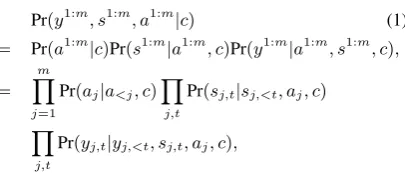
Based on the above notations, we are ready to define our task. Given useru, itemiand the rating scorer, we aim to automatically generate a review that is able to maximize the joint probability of the aspects, sketches and words
Pr(y1:m, s1:m, a1:m|c) (1)
= Pr(a1:m|c)Pr(s1:m|a1:m
, c)Pr(y1:m|a1:m
, s1:m, c),
=
m
Y
j=1
Pr(aj|a<j, c)
Y
j,t
Pr(sj,t|sj,<t, aj, c)
Y
j,t
Pr(yj,t|yj,<t, sj,t, aj, c),
where c = {u, i, r} denotes the set of available context information. Note that, in training, we have aspects and sketches available, and learn the model parameters by optimizing the joint proba-bility in Eq.1over all the seen reviews. While, for test, the aspects and sketches are unknown. We need to first infer an aspect sequence and then pre-dict the corresponding sketch for each sentence. Finally, we generate the review content based on the predicted aspect and sketch information.
4 The Proposed Approach
Unlike previous works generating the review in a single stage, we decompose the generation
pro-Item User Rating
... ...
<s> the NN are
the NN are pretty_well </s> !
! pretty_well
Sentence Decoder
Sketch Encoder Sketch Decoder
<s> vocals are
the vocals are pretty_well !
Aspect Decoder
Context Encoder
sound
the
sketch
!
</s>
semantic slot
aspect label
[image:3.595.314.518.66.200.2]pretty_well
Figure 2. The overview of the proposed review gener-ation model with the example of “the vocals are pretty well". The predicted aspect label issound, and the gen-erated sketch is “the NN are pretty_well".
cess into three stages, namely aspect sequence generation, aspect-aware sketch generation and sketch-based sentence generation. We present an overview illustration of the proposed model in Fig.2. Next we describe each part in detail.
4.1 Aspect Sequence Generation
To learn the model for generating aspect se-quences, we need to derive the aspect sequence for training, and then decode the aspect sequence based on the context encoder.
Aspect Extraction. Aspects provide an
informa-tive summary about the feature or attribute infor-mation about a product or an item. For example, aspects of a restaurant may include food, staff and price, etc. It is time-consuming and laborious to manually discover the aspects from texts. Here, we use an automatic unsupervised topic modeling approach to learning the aspects from the review content. Based on the Twitter-LDA model (Zhao et al., 2011), we treat a review as a document consisting of multiple sentences. Each document is associated with a distribution over the aspects. When generating a sentence, an aspect label (or ID) is first sampled according to the document’s distribution over the aspects. Then, the entire sen-tence is generated according to the word distri-bution conditioned on the aspect label. To pu-rify the aspect words, we further incorporate a background language model to absorb background words. When topic models have been learned, we can derive a set of Aaspect-specific word distri-butions, denoted by {θa
[image:3.595.86.289.471.561.2]Context Encoder. Our aspect generation module adopts an encoder-decoder architecture. We first develop the context encoder based on the informa-tion of useru, itemiand rating scorer. We first use a look-up layer to transform the three kinds of information into low-dimensional vectors. Let
vu ∈ RdE, vi ∈ RdE andvr ∈ RdE denote the embeddings foru,iandrrespectively. Then, we feed the concatenated vector into a Multi-Layer Perceptron (MLP) and produce a single vectorized representationvc∈RdC:
vc=MLP([vu;vi;vr]). (2)
The embeddingvc summarizes the necessary in-formation from the three kinds of context data. It is flexible to incorporate more kinds of useful in-formation using a similar approach.
Aspect Decoder. The decoder is built upon the
GRU-based RNN network. Let hAj ∈ RdHA
de-note adHA-dimensional hidden vector at the j-th
time step, which is computed via:
hAj =GRU(hAj−1,vaj−1), (3)
wherevaj−1 ∈ R
dA is the embedding of the
pre-vious aspect labelaj−1. The hidden vector of the
first time step is initialized by the encoding vector
hA0 =vcin Eq.2. Then, RNNs recurrently com-pute hidden vectors, and predict the next aspect label (or ID) aj. Additionally, we use an atten-tion mechanism (Luong et al., 2015) to enhance the effect of context information. We compute the attention score of context ck for the current time step of the decoder via:
wk(t)= exp(tanh(W1[h
A t;vck]))
P
ck0∈{u,i,r}exp(tanh(W1[hAt;vck0]))
, (4)
whereW1is the parameter matrix to learn, and the
attention vectorc˜tis obtained by:
˜ ct=
X
ck∈{u,i,r}
w(kt)vck (5)
Finally, we compute the probability of the j-th aspect labelp(at|a<j, c)via:
Pr(aj|a<j, c) = softmax(W4h˜Aj +b1), (6)
˜
hAj = tanh(W2c˜j+W3hAj), (7)
whereW2,W3,W4andb1are learnable parame-ter matrices or vector.
4.2 Aspect-Aware Sketch Generation
A sketch is a symbol sequence describing the skeleton of a sentence, where each symbol de-notes a semantic symbol such as a POS tag or a bi-gram. Similar to the aspect decoder, we also use the GRU-based RNNs to implement the sketch de-coder. As shown in Fig.1, the sketchesw.r.t. vary-ing aspects are likely to be different. Hence, we need to consider the effect of aspect information in the generation of a sketch. LethSj,t ∈RdHS
de-note adHS-dimensional hidden vector at time step
tfor thej-th sketch, which is computed via:
hSj,t=GRU(h S j,t−1,x
S
j,t), (8)
wherexSj,tis further defined as
xj,t=vsj,t−1vaj, (9)
where vsj,t−1 ∈ R
dS denotes the embedding for
the previous sketch symbolsj,t−1,vajdenotes the
embedding of the current aspect, and “" denotes the element-wise product. In this way, the aspect information can be utilized at each time step for generating an entire sketch. We set the initial hid-den vector for the j-th sketch as the last embed-ding of the previous sketch: hSj,0 = hSj−1,n0
j−1.
Specifically, we havehS1,0=vcfor initialization. Similar to Eq. 4 and5, we can further use an attention mechanism for incorporating context in-formation, and produce a context-enhanced sketch representation ˜hSj,t for time step t. Finally, we compute Pr(sj,t|sj,<t, aj, c)via:
Pr(sj,t|sj,<t, aj, c) =softmax(W5h˜Sj,t+W6vaj+b2),
(10)
where we incorporate the embedding vaj of the
aspectajfor enhancing the aspect semantics.
4.3 Sketch-based Review Generation
When the aspect sequence and the sketches are learned, we can generate the word content of a re-view. Here, we focus on the generation process of a single sentence.
Sketch Encoder. To encode the sketch
infor-mation, we employ the a bi-directional GRU en-coder (Schuster and Paliwal, 1997; Cho et al.,
2014) to encode the sketch sequencesj,1:n0
j into a
list of hidden vectors{←→hSj,t}n
0
j
t=1, where
←→
since the sketch is available at this stage, capturing the global information from the entire sketch.
Sentence Decoder. Consider the word generation
at time stept. Letvyj,t−1 ∈R
dY denotes the
em-bedding of the previous wordyj,t−1. As input, we
concatenate the current sketch representation and the embedding of the previous word
xYj,t=
←→
hSj,t⊕vyj,t−1, (11)
where “⊕" denotes the vector concatenation. Then, we compute the hidden vectorhYj,t∈RdHY for thej-th sentence via:
hYj,t=GRU(hj,tY−1,xYj,t). (12)
Similar to Eq.4and5, we further leverage the con-text to obtain an enhanced state representation de-noted byh˜Yj,tusing the attention mechanism. Then we transform it into an intermediate vector with the dimensionality of the vocabulary size:
z= tanh(W7[˜hYj,t;vsj,t] +b3), (13)
wherevsj,t is the embedding of the sketch symbol
sj,t. By incorporating aspect-specific word distri-butions, we can apply the softmax function to de-rive the generative probability of thet-th word
Pr(yj,t|yj,<t, sj,1:n0
j, aj, c) =softmax(zyj,t+θ
aj
yj,t), (14)
whereθayj,tj is the probability from the word
distri-bution for aspect aj. Here, we boost the impor-tance of the words which have large probabilities in the corresponding topic models. In this process, the generation of words is required to match the generation of sketch symbols slot by slot. Here, we align words and sketch symbols by using the same indices for each slot for ease of understand-ing. However, the length of the sketch is not nec-essarily equal to that of the generated sentence, since a sketch symbol can correspond to a multi-term phrase. When the sketch token is a multi-term or a phrase (e.g.,bi-grams), we directly copy the orig-inal terms or phases to the output slot(s).
4.4 Training and Inference
Integrating Eq.6,10and14into Eq.1, we derive the joint model for review generation. We take the log likelihood of Eq.1over all training reviews as the objective function. The joint objective func-tion is difficult to be directly optimized. Hence, we
Datasets #Users #Items #Reviews #Words
AMAZON 89,672 31,829 681,004 22,570
YELP 95,617 37,112 1,063,420 31,861 RATEBEER 12,266 51,365 2,487,369 42,757
Table 1. Statistics of our datasets after preprocessing.
incrementally train the three parts, and fine-tune the shared or dependent parameters in different modules with the joint objective. For training, we directly use the real aspects and sketches for learn-ing the model parameters. For inference, we apply our model in a pipeline way: we first infer the as-pect, then predict the sketches and finally gener-ate the words using inferred aspects and sketches. During inference, for sequence generation, we ap-ply the beam search method with beam size 4.
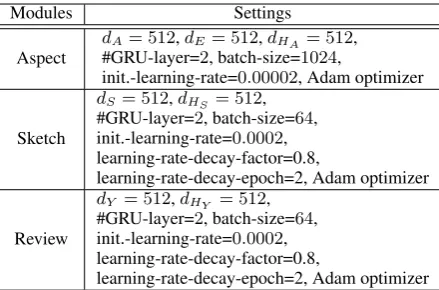
In the three sequence generation modules of our model, we incorporate two special symbols to in-dicate the start and end of a sequence, namely STARTand END. Once we generate the END sym-bol, the generation process will be stopped. Be-sides, we set the maximum generation lengths for aspect sequence and sketch sequence to be 5 and 50, respectively. In the training procedure, we adopt the Adam optimizer (Kingma and Ba,2014). In order to avoid overfitting, we adopt the dropout strategy with a rate of 0.2. More implementation details can be found in Section 5.1 (see Table2).
5 Experiments
In this section, we first set up the experiments, and then report the results and analysis.
5.1 Experimental Setup
Datasets. We evaluate our model on three
real-world review datasets, including AMA
-ZON Electronic dataset (He and McAuley,
2016), YELPRestaurant dataset1, and RATEBEER
dataset (McAuley et al., 2012). We convert all text into lowercase, and perform tokenization us-ing NLTK2. We keep the words occurring at least
ten times as vocabulary words. We discard re-views with more than 100 tokens, and remove users and products (or items) occurring fewer than five times. The reviews of each dataset are ran-domly split into training, validation and test sets (80%/10%/10%). The detailed statistics of the three datasets are summarized in Table1.
1
https://www.yelp.com/dataset
Modules Settings
Aspect
dA= 512,dE= 512,dHA= 512,
#GRU-layer=2, batch-size=1024,
init.-learning-rate=0.00002, Adam optimizer
Sketch
dS= 512,dHS = 512,
#GRU-layer=2, batch-size=64, init.-learning-rate=0.0002, learning-rate-decay-factor=0.8,
learning-rate-decay-epoch=2, Adam optimizer
Review
dY = 512,dHY = 512,
#GRU-layer=2, batch-size=64, init.-learning-rate=0.0002, learning-rate-decay-factor=0.8,
[image:6.595.73.293.61.206.2]learning-rate-decay-epoch=2, Adam optimizer
Table 2. Parameter settings of the three modules in our model.
Aspect and Sketch Extraction. After the
prepro-cessing, we use the Twitter-LDA model in (Zhao et al.,2011) for automatically learning the aspects and aspect keywords. The numbers of aspects are set to 10, 5, and 5 for the three datasets, respec-tively. The aspect numbers are selected using the perplexity score on validation set. By inspecting into the top aspect words, we find the learned as-pects are very coherent and meaningful. For con-venience, we ask a human labeler to annotate each learned aspect from topic models with an aspect
label. Note that aspect labels are only for ease of
presentation, and will not be used in our model. With topic models, we further tag each sentence with the aspect label which gives the maximum posterior probability conditioned on the words. To derive the sketches, we first extract the most pop-ular 200 bi-grams and tri-grams by frequency. We replace their occurrences withn-gram IDs. Fur-thermore, we keep the words ranked in top 50 po-sitions of an aspect, and replace the occurrences of the rest words with their Part-of-Speech tags. We also keep the top 50 frequent words in the entire text collection, such as background words “I" and “am". In this way, for each review, we obtain a sequence of aspect labels; for each sentence in the review, we obtain a sequence of sketch symbols. Aspect sequences and sketch sequences are only available during the training process.
Baseline Models. We compare our model against
a number of baseline models:
• gC2S (Tang et al., 2016): It adopts an encoder-decoder architecture to generate review texts conditioned on context information through a gating mechanism.
• Attr2Seq (Zhou et al., 2017): It adopts an attention-enhanced attribute-to-sequence
architec-ture to generate reviews with input attributes.
• TransNets (Catherine and Cohen, 2018): It applies a student-teacher like architecture for re-view generation by representing the rere-views of a user and an item into a text-related representation, which is regularized to be similar to the actual re-view’s latent representation at training time.
• ExpansionNet (Ni and McAuley, 2018): It uses an encoder-decoder framework to gener-ate personalized reviews by incorporating short phrases (e.g., review summaries, product titles) provided as input and introducing aspect-level in-formation (e.g.,aspect words).
•SeqGAN (Yu et al.,2017): It regards the gen-erative model as a stochastic parameterized policy and uses Monte Carlo search to approximate the state-action value. The discriminator is a binary classifier to evaluate the sequence and guide the learning of the generative model.
• LeakGAN (Guo et al., 2018): The generator is built upon a hierarchical reinforcement learning architecture, which consists of a high-level mod-ule and a low-level modmod-ule, and the discriminator is a CNN-based feature extractor. The advantage is that this model can generate high-quality long text by introducing the leaked mechanism.
Among these baselines, gC2S, Attr2Seq and TransNets are context-aware generation models in different implementation approaches, Expan-sionNet introduces external information such as aspect words, and SeqGAN and LeakGAN are GAN based text generation models. Original Seq-GAN and LeakSeq-GAN are designed for general se-quence generation without considering context in-formation (e.g., user, item, rating). The learned aspect keywords are provided as input for both ExpansionNet and our model. All the methods have several parameters to tune. We employ val-idation set to optimize the parameters in each method. To reproduce the results of our model, we report the parameter setting used throughout the experiments in Table 2. Our code is
avail-able at https://github.com/turboLJY/
Coarse-to-Fine-Review-Generation.
Evaluation Metrics. To evaluate the
perfor-mance of different methods on automatic review generation, we adopt six evaluation metrics, in-cluding Perplexity, BLEU-1/BLEU-4, ROUGE-1/ROUGE-2/ROUGE-L. Perplexity3 is the stan-dard measure for evaluating language models;
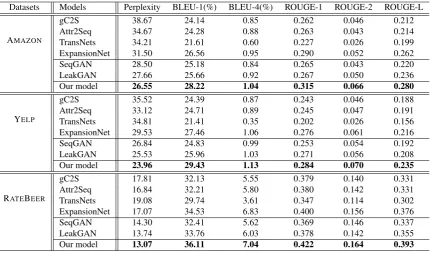
Datasets Models Perplexity BLEU-1(%) BLEU-4(%) ROUGE-1 ROUGE-2 ROUGE-L
AMAZON
gC2S 38.67 24.14 0.85 0.262 0.046 0.212
Attr2Seq 34.67 24.28 0.88 0.263 0.043 0.214
TransNets 34.21 21.61 0.60 0.227 0.026 0.199
ExpansionNet 31.50 26.56 0.95 0.290 0.052 0.262
SeqGAN 28.50 25.18 0.84 0.265 0.043 0.220
LeakGAN 27.66 25.66 0.92 0.267 0.050 0.236
Our model 26.55 28.22 1.04 0.315 0.066 0.280
YELP
gC2S 35.52 24.39 0.87 0.243 0.046 0.188
Attr2Seq 33.12 24.71 0.89 0.245 0.047 0.191
TransNets 34.81 21.41 0.35 0.202 0.026 0.156
ExpansionNet 29.53 27.46 1.06 0.276 0.061 0.216
SeqGAN 26.84 24.83 0.99 0.253 0.054 0.192
LeakGAN 25.53 25.96 1.03 0.271 0.056 0.208
Our model 23.96 29.43 1.13 0.284 0.070 0.235
RATEBEER
gC2S 17.81 32.13 5.55 0.379 0.140 0.331
Attr2Seq 16.84 32.21 5.80 0.380 0.142 0.331
TransNets 19.08 29.74 3.61 0.347 0.114 0.302
ExpansionNet 17.07 34.53 6.83 0.400 0.156 0.376
SeqGAN 14.30 32.41 5.62 0.369 0.146 0.337
LeakGAN 13.74 33.76 6.03 0.378 0.142 0.355
[image:7.595.85.517.61.314.2]Our model 13.07 36.11 7.04 0.422 0.164 0.393
Table 3. Performance comparisons of different methods for automatic review generation using three datasets.
BLEU (Papineni et al.,2002) measures the ratios of the co-occurrences ofn-grams between the gen-erated and real reviews; ROUGE (Lin,2004) mea-sures the review quality by counting the overlap-ping n-grams between the generated and real re-views.
5.2 Results and Analysis
In this subsection, we construct a series of experi-ments on the effectiveness of the proposed model for the review generation task.
Main Results. Table3 presents the performance
of different methods on automatic review gener-ation. We can make the following observations. First, among the three context-based baselines, gC2S and Attr2Seq perform better than TransNets. The two models have similar network architec-tures, which are simpler than TransNets. We find they are easier to obtain a stable performance on large datasets. Second, GAN-based methods work better than the above baselines, especially Leak-GAN. LeakGAN is specially designed for generat-ing long text, and we adapt it to our task by incor-porating context information. Third, Expansion-Net performs best among all the baseline mod-els. A major reason is that it incorporates exter-nal knowledge such as review summaries, prod-uct titles and aspect keywords. Finally, our model outperforms all the baselines with a large margin. These baseline methods perform the generation in
Models BLEU-1(%) ROUGE-1 Our model 28.22 0.315 w/o aspect 27.85 0.296 w/o sketch 25.95 0.273
Table 4. Ablation analysis on AMAZONdataset.
a single stage. As a comparison, we use a multi-stage process to gradually generate long and infor-mative reviews in a coarse-to-fine way. Our model is able to better utilize aspect semantics and syn-tactic sketch, which is the key of the performance improvement over baselines. Overall, the three datasets show the similar findings. In what fol-lows, we will report the results on AMAZONdata due to space limit. We select the best two baselines
ExpansionNet and LeakGAN as reference
meth-ods.
Ablation Analysis. The major novelty of our
the sketch generation module is able to utilize syn-tactic templates to improve the generation fluency, especially for long sentences. Current experiments evaluate the usefulness of the two modules based on the overall generation quality. Next, we ver-ify their functions using two specific experiments, namely aspect coverage and fluency evaluation.
Aspect Coverage Evaluation. A generated
re-view is informative if it can effectively capture the semantic information of the real review. Follow-ing (Ni and McAuley,2018), we examine the as-pect coverage of different models. Recall that we have used topic models to tag each sentence with an aspect label (or ID). We analyze the average number of aspects in real and generated reviews, and compute on average how many aspects in real reviews are covered in generated reviews. We con-sider a review as covering an aspect if any of the top 50 words of an aspect exists in the review4. In Table5, we first see an interesting observation that LeakGAN is able to generate more aspects but yield fewer real aspects. As a comparison, Expan-sionNet and our model perform better than Leak-GAN by covering more real aspects, since the two models use the aspect information to instruct the review generation. Our model is better than Ex-pansionNet by characterizing the aspect transition sequences. These results indicate the usefulness of the aspect generation module in capturing more semantic information related to a review.
Fluency Evaluation. We continue to evaluate the
usefulness of the sketch generation module in im-proving the fluency of the generated text. Follow-ing (Xu et al., 2018a), we construct the fluency evaluation to examine how likely the generated text is produced by human. We randomly choose 200 samples from test set. A sample contains the input contexts (i.e., user, item, rating), and the texts generated by different models. It is difficult to develop automatic evaluation methods for accu-rate fluency evaluation. Here, we invite two hu-man annotators (excluding the authors of this pa-per) who have good knowledge in the domain of electronic reviews to assign scores to the gener-ated reviews. They are required to assign a score to a generated (or real) review according to a 5-point Likert scale5on fluency. In the 5-point
Lik-4
For accuracy, we manually remove the irrelevant words (about 5%∼10%) from the top 50 words in each aspect.
5https://en.wikipedia.org/wiki/Likert_scale
Models # aspects (real)
# aspects (generated)
[image:8.595.309.522.62.116.2]# covered aspects ExpansionNet 2.41 2.02 0.885 LeakGAN 2.41 2.18 0.630 Our model 2.41 2.03 1.076
Table 5. Aspect coverage evaluation on AMAZON dataset.
Measures Gold ExpansionNet LeakGAN Our Fluency 4.01 3.29 3.26 3.54
Kappa 0.80 0.72 0.76 0.74
Table 6. Fluency evaluation on AMAZONdataset.
ert scale, 5-point means “very satisfying”, while 1-point means “very terrible”. We further average the two annotated scores over the 200 inputs. The results are shown in Table6. We can see that our model achieves the highest fluency score among the automatic methods. By using sketches, our model is able to leverage the learned syntactic pat-terns from available reviews. The Cohen’s kappa coefficients are above 0.7, indicating a high corre-lation and agreement between the two human an-notators.
5.3 Qualitative Analysis
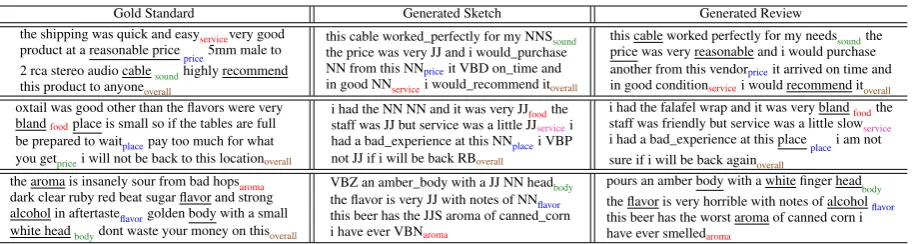
In this part, we perform the qualitative analysis on the quality of the generated reviews. We present three sample reviews generated by our model in Table 7. As we can see, our model has covered most of the major aspects (with many overlapping aspect keywords) of the real reviews. Although some generated sentences do not follow the ex-act syntex-actic structures of real reviews, they are very readable to users. Our model is able to gen-erate aspect-aware sketches, which are very help-ful to instruct the generation of the word content. With the aspect and sketch generation modules, our model is able to produce informative reviews consisting of multiple well-structured sentences. Another interesting observation is that the polar-ities of the generated text also correspond to their real rating scores, since the rating score has been modeled in the context encoder.
6 Conclusion
[image:8.595.306.529.153.187.2]Gold Standard Generated Sketch Generated Review the shipping was quick and easyservicevery good
product at a reasonable price
price5mm male to 2 rca stereo audio cablesoundhighly recommend this product to anyoneoverall
this cable worked_perfectly for my NNSsound the price was very JJ and i would_purchase NN from this NNpriceit VBD on_time and in good NNservicei would_recommend itoverall
this cable worked perfectly for my needssoundthe price was very reasonable and i would purchase another from this vendorpriceit arrived on time and in good conditionservicei would recommend itoverall
oxtail was good other than the flavors were very blandfoodplace is small so if the tables are full
be prepared to waitplacepay too much for what you getpricei will not be back to this locationoverall
i had the NN NN and it was very JJfoodthe staff was JJ but service was a little JJservicei
had a bad_experience at this NNplacei VBP not JJ if i will be back RBoverall
i had the falafel wrap and it was very blandfoodthe staff was friendly but service was a little slowservice i had a bad_experience at this place
placei am not sure if i will be back againoverall
the aroma is insanely sour from bad hopsaroma dark clear ruby red beat sugar flavor and strong alcohol in aftertasteflavorgolden body with a small white headbodydont waste your money on thisoverall
VBZ an amber_body with a JJ NN headbody the flavor is very JJ with notes of NNflavor this beer has the JJS aroma of canned_corn i have ever VBNaroma
[image:9.595.73.530.61.183.2]pours an amber body with a white finger head body the flavor is very horrible with notes of alcoholflavor this beer has the worst aroma of canned corn i have ever smelledaroma
Table 7. Samples of the generated reviews by our model. The three reviews with rating scores of 5 (positive), 3 (neutral), and 1 (negative) are from AMAZON, YELPand RATEBEERdatasets, respectively. For privacy, we omit the UIDs and PIDs. For ease of reading, colored aspect labels are manually created corresponding to the predicted aspect IDs by our model. We have underlined important overlapping terms between real and generated reviews.
the effectiveness of our model in terms of overall generation quality, aspect coverage, and fluency. As future work, we will consider integrating more kinds of syntactic features from linguistic analysis such as dependency parsing.
Acknowledgments
This work was partially supported by the National Natural Science Foundation of China under Grant No. 61872369 and 61832017, the Fundamental Research Funds for the Central Universities, the Research Funds of Renmin University of China under Grant No. 18XNLG22 and 19XNQ047.
References
John Bateman and Michael Zock. 2003. Natural lan-guage generation. InThe Oxford Handbook of Com-putational Linguistics 2nd edition.
Rose Catherine and William Cohen. 2018. Transnets for review generation.
Kyunghyun Cho, Bart van Merrienboer, Çaglar Gülçehre, Dzmitry Bahdanau, Fethi Bougares, Hol-ger Schwenk, and Yoshua Bengio. 2014. Learning phrase representations using RNN encoder-decoder for statistical machine translation. InProceedings of the 2014 Conference on Empirical Methods in Nat-ural Language Processing, EMNLP 2014, October 25-29, 2014, Doha, Qatar, A meeting of SIGDAT, a Special Interest Group of the ACL, pages 1724– 1734.
Li Dong and Mirella Lapata. 2018. Coarse-to-fine de-coding for neural semantic parsing. InProceedings of the 56th Annual Meeting of the Association for Computational Linguistics, ACL 2018, Melbourne, Australia, July 15-20, 2018, Volume 1: Long Papers, pages 731–742.
Angela Fan, Mike Lewis, and Yann Dauphin. 2018. Hi-erarchical neural story generation. InProceedings
of the 56th Annual Meeting of the Association for Computational Linguistics, ACL 2018, Melbourne, Australia, July 15-20, 2018, Volume 1: Long Papers, pages 889–898.
Jiaxian Guo, Sidi Lu, Han Cai, Weinan Zhang, Yong Yu, and Jun Wang. 2018. Long text generation via adversarial training with leaked information. In Pro-ceedings of the Thirty-Second AAAI Conference on Artificial Intelligence, (AAAI-18), the 30th innova-tive Applications of Artificial Intelligence (IAAI-18), and the 8th AAAI Symposium on Educational Ad-vances in Artificial Intelligence (EAAI-18), New Or-leans, Louisiana, USA, February 2-7, 2018, pages 5141–5148.
Ruining He and Julian McAuley. 2016. Ups and downs: Modeling the visual evolution of fashion trends with one-class collaborative filtering. In Pro-ceedings of the 25th International Conference on World Wide Web, WWW 2016, Montreal, Canada, April 11 - 15, 2016, pages 507–517.
Sepp Hochreiter and Jürgen Schmidhuber. 1997. Long short-term memory. Neural Computation, 9(8):1735–1780.
Bona Kim, Seongseop Kim, and Cindy Y Heo. 2016. Analysis of satisfiers and dissatisfiers in on-line hotel reviews on social media. International Journal of Contemporary Hospitality Management, 28(9):1915–1936.
Diederik P. Kingma and Jimmy Ba. 2014. Adam: A method for stochastic optimization. CoRR, abs/1412.6980.
Chin-Yew Lin. 2004. Rouge: A package for automatic evaluation of summaries. In Text Summarization Branches Out.
Junyang Lin, Xu Sun, Shuming Ma, and Qi Su. 2018. Global encoding for abstractive summarization. In
Liangchen Luo, Jingjing Xu, Junyang Lin, Qi Zeng, and Xu Sun. 2018. An auto-encoder matching model for learning utterance-level semantic depen-dency in dialogue generation. InProceedings of the 2018 Conference on Empirical Methods in Natural Language Processing, Brussels, Belgium, October 31 - November 4, 2018, pages 702–707.
Thang Luong, Hieu Pham, and Christopher D. Man-ning. 2015. Effective approaches to attention-based neural machine translation. In Proceedings of the 2015 Conference on Empirical Methods in Natural Language Processing, EMNLP 2015, Lisbon, Portu-gal, September 17-21, 2015, pages 1412–1421.
Julian J. McAuley, Jure Leskovec, and Dan Jurafsky. 2012. Learning attitudes and attributes from multi-aspect reviews. In12th IEEE International Confer-ence on Data Mining, ICDM 2012, Brussels, Bel-gium, December 10-13, 2012, pages 1020–1025.
Jianmo Ni, Zachary C. Lipton, Sharad Vikram, and Ju-lian McAuley. 2017. Estimating reactions and rec-ommending products with generative models of re-views. In Proceedings of the Eighth International Joint Conference on Natural Language Processing, IJCNLP 2017, Taipei, Taiwan, November 27 - De-cember 1, 2017 - Volume 1: Long Papers, pages 783–791.
Jianmo Ni and Julian McAuley. 2018. Personalized re-view generation by expanding phrases and attending on aspect-aware representations. InProceedings of the 56th Annual Meeting of the Association for Com-putational Linguistics, ACL 2018, Melbourne, Aus-tralia, July 15-20, 2018, Volume 2: Short Papers, pages 706–711.
Kishore Papineni, Salim Roukos, Todd Ward, and Wei-Jing Zhu. 2002. Bleu: a method for automatic eval-uation of machine translation. InProceedings of the 40th Annual Meeting of the Association for Compu-tational Linguistics, July 6-12, 2002, Philadelphia, PA, USA., pages 311–318.
Geoffrey K Pullum. 2010. The land of the free and the elements of style. English Today, 26(2):34–44.
Minghui Qiu, Yinfei Yang, Cen Chen, and For-rest Sheng Bao. 2017. Aspect extraction from prod-uct reviews using category hierarchy information. InProceedings of the 15th Conference of the Euro-pean Chapter of the Association for Computational Linguistics, EACL 2017, Valencia, Spain, April 3-7, 2017, Volume 2: Short Papers, pages 675–680.
Mike Schuster and Kuldip K. Paliwal. 1997. Bidirec-tional recurrent neural networks. IEEE Trans. Sig-nal Processing, 45(11):2673–2681.
Shang-Yu Su, Kai-Ling Lo, Yi Ting Yeh, and Yun-Nung Chen. 2018. Natural language generation by hierarchical decoding with linguistic patterns. In
Proceedings of the 2018 Conference of the North American Chapter of the Association for Computa-tional Linguistics: Human Language Technologies,
NAACL-HLT, New Orleans, Louisiana, USA, June 1-6, 2018, Volume 2 (Short Papers), pages 61–66.
Jian Tang, Yifan Yang, Samuel Carton, Ming Zhang, and Qiaozhu Mei. 2016. Context-aware natural lan-guage generation with recurrent neural networks.
CoRR, abs/1611.09900.
Zhongqing Wang and Yue Zhang. 2017. Opinion rec-ommendation using A neural model. In Proceed-ings of the 2017 Conference on Empirical Meth-ods in Natural Language Processing, EMNLP 2017, Copenhagen, Denmark, September 9-11, 2017, pages 1626–1637.
Sam Wiseman, Stuart M. Shieber, and Alexander M. Rush. 2018. Learning neural templates for text gen-eration. InProceedings of the 2018 Conference on Empirical Methods in Natural Language Process-ing, Brussels, Belgium, October 31 - November 4, 2018, pages 3174–3187.
Jingjing Xu, Xuancheng Ren, Junyang Lin, and Xu Sun. 2018a. Diversity-promoting GAN: A cross-entropy based generative adversarial network for di-versified text generation. InProceedings of the 2018 Conference on Empirical Methods in Natural Language Processing, Brussels, Belgium, October 31 -November 4, 2018, pages 3940–3949.
Jingjing Xu, Xuancheng Ren, Yi Zhang, Qi Zeng, Xi-aoyan Cai, and Xu Sun. 2018b. A skeleton-based model for promoting coherence among sentences in narrative story generation. In Proceedings of the 2018 Conference on Empirical Methods in Natural Language Processing, Brussels, Belgium, October 31 - November 4, 2018, pages 4306–4315.
Lantao Yu, Weinan Zhang, Jun Wang, and Yong Yu. 2017. Seqgan: Sequence generative adversarial nets with policy gradient. In Proceedings of the Thirty-First AAAI Conference on Artificial Intelli-gence, February 4-9, 2017, San Francisco, Califor-nia, USA., pages 2852–2858.
Hongyu Zang and Xiaojun Wan. 2017. Towards au-tomatic generation of product reviews from aspect-sentiment scores. InProceedings of the 10th Inter-national Conference on Natural Language Genera-tion, INLG 2017, Santiago de Compostela, Spain, September 4-7, 2017, pages 168–177.
Ruqing Zhang, Jiafeng Guo, Yixing Fan, Yanyan Lan, Jun Xu, and Xueqi Cheng. 2018. Learning to con-trol the specificity in neural response generation. In
Proceedings of the 56th Annual Meeting of the As-sociation for Computational Linguistics, ACL 2018, Melbourne, Australia, July 15-20, 2018, Volume 1: Long Papers, pages 1108–1117.
Dublin, Ireland, April 18-21, 2011. Proceedings, pages 338–349.
Wayne Xin Zhao, Jing Jiang, Hongfei Yan, and Xiaom-ing Li. 2010. Jointly modelXiaom-ing aspects and opin-ions with a maxent-lda hybrid. InProceedings of the 2010 Conference on Empirical Methods in Natural Language Processing, EMNLP 2010, pages 56–65.
Ming Zhou, Mirella Lapata, Furu Wei, Li Dong, Shao-han Huang, and Ke Xu. 2017. Learning to gen-erate product reviews from attributes. In Proceed-ings of the 15th Conference of the European Chap-ter of the Association for Computational Linguistics, EACL 2017, Valencia, Spain, April 3-7, 2017, Vol-ume 1: Long Papers, pages 623–632.