954
Joint Entity Extraction and Assertion Detection for Clinical Text
Parminder Bhatia Amazon, USA [email protected]
Busra Celikkaya Amazon, USA [email protected]
Mohammed Khalilia Amazon, USA [email protected]
Abstract
Negative medical findings are prevalent in clinical reports, yet discriminating them from positive findings remains a challenging task for information extraction. Most of the ex-isting systems treat this task as a pipeline of two separate tasks, i.e., named entity recog-nition (NER) and rule-based negation detec-tion. We consider this as a multi-task problem and present a novel end-to-end neural model to jointly extract entities and negations. We ex-tend a standard hierarchical encoder-decoder NER model and first adopt a shared encoder followed by separate decoders for the two tasks. This architecture performs considerably better than the previous rule-based and ma-chine learning-based systems. To overcome the problem of increased parameter size es-pecially for low-resource settings, we propose the Conditional Softmax Shared Decoder ar-chitecture which achieves state-of-art results for NER and negation detection on the 2010 i2b2/VA challenge dataset and a proprietary de-identified clinical dataset.
1 Introduction
In recent years, natural language processing (NLP) techniques have demonstrated increasing effec-tiveness in clinical text mining. Electronic health record (EHR) narratives, e.g., discharge sum-maries and progress notes contain a wealth of medically relevant information such as diagno-sis information and adverse drug events. Auto-matic extraction of such information and represen-tation of clinical knowledge in standardized for-mats (Singh and Bhatia,2019) could be employed for a variety of purposes such as clinical event surveillance, decision support (Jin et al., 2018), pharmacovigilance, and drug efficacy studies.
Although many NLP applications that success-fully extract findings from medical reports have
Discontinue Abraxane, patient denies taking Tyleno 325 mg and is not taking calcium carbonate. Patient also stopped taking colecalciferol 1,000 units PO.
Figure 1: Negated medications (highlighted in red) and negation cues (highlighted in purple) in clinical text. Our model does not explicitly label the cues.
been developed in recent years, identifying asser-tions such as positive (present), negative (absent), and hypothetical remains a challenging task, es-pecially to generalize (Wu et al., 2014). How-ever, identifying assertions is critical since nega-tive and uncertain findings are frequent in clinical notes (Figure1), and information extraction algo-rithms that do not distinguish between them will not paint a clear picture of the patient.
In this paper, we focus on identifying the negated findings in a multi-task setting (Bhatia et al., 2018). Most of the existing systems treat this task as a pipeline of two separate tasks, i.e., named entity recognition (NER) and negation de-tection. Previous efforts in this area include both rule-based and machine-learning approaches.
and thus are limited when attempting to capture complex syntactic constructions such as long noun phrases.
Kernel-based approaches are also very com-mon, especially in the 2010 i2b2/VA task of pre-dicting assertions. The state-of-the-art in that chal-lenge applies support vector machines (SVM) to assertion prediction as a separate step after con-cept extraction (de Bruijn et al., 2011). They train classifiers to predict assertions of each con-cept word, and a separate classifier to predict the assertion of the whole concept. Shivade et al. (2015) propose an Augmented Bag of Words Ker-nel (ABoW), which generates features based on NegEx rules along with bag-of-words features. Cheng et al. (2017) use CRF for classification of cues and scope detection. These machine learning based approaches often suffer in generalizability, the ability to perform well on unseen text.
Recently, neural network models by Fancellu et al. (2016) and Rumeng et al. (2017) have been proposed. Most relevant to our work is that of Rumeng et al. (2017) where gated recurrent units (GRU) are used to represent the clinical events and their context, along with an attention mechanism. Given a text annotated with events, it classifies the presence and period of the events. However, this approach is not end-to-end as it does not predict the events. Additionally, these models generally require large annotated corpus, which is necessary for good performance. Unfortunately, such clini-cal text data is not easily available.
Multi-task learning (MTL) is one of the most effective solutions for knowledge transfer across tasks. In the context of neural network archi-tectures, we perform MTL by sharing parameters across models, such as pretraining using word em-beddings (Bhatia et al., 2016; Bojanowski et al., 2016), a popular approach for most NLP tasks. In this paper, we propose an MTL approach to nega-tion detecnega-tion that overcomes some of the limita-tions in the existing models such as data accessi-bility. MTL leverages overlapping representation across sub-tasks and it is one of the most effec-tive solutions for knowledge transfer across tasks. In the context of neural network architectures, we perform MTL by sharing parameters across tasks. To the best of our knowledge, this is the first work to jointly model named entity and negation in an end-to-end system. Our main contributions are summarized below:
• An end-to-end hierarchical neural model con-sisting of a shared encoder and different de-coding schemes to jointly extract entities and negations. Using our proposed model, we ob-tain substantial improvement over prior mod-els for both entities and negations on the 2010 i2b2/VA challenge task as well as a propri-etary de-identified clinical note dataset for medical conditions.
• A Conditional softmax shared decodermodel to overcome low resource settings (datasets with limited amounts of training data), which achieves state of art results across different corpora.
• A thorough empirical analysis of parameter sharings for low resource setting highlighting the significance of the shared decoder.
2 Methodology
We first present a standard neural framework for named entity recognition. To facilitate multi-task learning, we expand on that architecture by build-ing a two decoder model. Then, to overcome the issues of the two decoder model we propose a sin-gle shared decoder model. Finally, we introduce theConditional softmax shared decoder.
2.1 Named Entity Recognition Architecture
NER is a sequence tagging problem which maxi-mizes a conditional probability of tagsygiven an input sequencex, parameterized byθ.
P(y|x;θ) =
T
Y
t=1
P(yt|xt, y<t;θ) (1)
Here T is the length of the sequence, and y<t represents tags for all previous time-steps. We focus on an established hierarchical architecture (Lample et al.,2016;Yang et al.,2016;Chiu and Nichols, 2016) consisting of encoders (at both word and character levels) and a tagger for output generation.
2.1.1 Encoders
Figure 2: Two decoder model, upper decoder for NER and the lower decoder for negation, where common encoder
word independently. For each word we
subse-quently have sequences
−→
h(1:t)l and
←−
h(1:t)l, wherel rep-resents the length of the word. We concatenate the last time-step of each of these sequences to obtain
a vector representation, h(ct) = [
−→
h(lt)|| ←−
h(lt)]. The final input to the word level encoder is a combi-nation of a pre-trained word embedding (Penning-ton et al.,2014) and the character representation,
mt = [h(ct)||embword(xt)]. For the word level en-coder we make use of another BiLSTM.
2.1.2 Tagger
The tagger consists of a uni-directional LSTM which takes as input the latent word representa-tion given by the word level encoder, as well as the label embedding of the previously generated tag. During training we feed ground truth labels by way of teacher forcing (Williams and Zipser, 1989), while at test time we use the generated se-quence directly. This system is trained using a standard cross-entropy objective.
2.2 Two Decoder Model
To facilitate the MTL setting, we begin with a two decoder model consisting of decoders which use the shared encoder representation to jointly predict entities and negation attribute (Figure2). This is a standard architecture used for MTL which consists of different LSTM’s for decoders followed by cor-responding softmaxes. This model mitigates the issues associated with rule-based models that rely solely on surface text, and thus are limited when attempting to capture complex syntactic construc-tions. With shared contextual encoder representa-tion consisting of character and word embedding based models, the proposed architecture provides an effective solution for knowledge transfer across tasks, thus consolidating the ability to perform well on unseen text. However, this proposed
ar-Figure 3: Shared decoder model
chitecture is not scalable, the number of decoders scales linearly with the number of attributes. An-other problem we realized with this architecture is the performance degradation when working in an extremely low resource setting, where more parameters prevent the model from generalizing well.
2.3 Shared Decoder Model
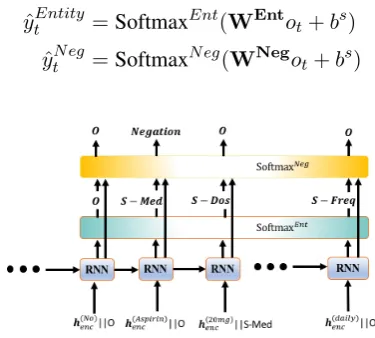
To overcome the limitations of the two decoder model we propose a shared decoder model (Figure 3). We share the encoder and decoder of the two tasks and the common output from the decoder is fed into two different softmax for entity and nega-tions.
ˆ
ytEntity =SoftmaxEnt(WEntot+bs)
ˆ
ytN eg =SoftmaxN eg(WNegot+bs)
Figure 4: Conditional softmax decoder model
[image:3.595.324.505.65.117.2] [image:3.595.320.508.366.535.2]2010 i2b2/VA Proprietary Med. Cond.
Model P R F1 P R F1
N
E
R
LSTM:CRF (R. Chalapathy and Piccardi,2016) 0.844 0.834 0.839 0.820 0.840 0.830 Independent NER (Lample et al.,2016) 0.857 0.841 0.848 0.880 0.848 0.863 Two Decoder (this paper) 0.849 0.855 0.851 0.876 0.861 0.868 Shared Decoder (this paper) 0.852 0.821 0.834 0.864 0.841 0.85
Conditional(this paper) 0.854 0.858 0.855 0.878 0.872 0.874
N
E
G
A
T
IO
N
Negex (Chapman et al.,2001) 0.896 0.799 0.845 0.403 0.932 0.563 ABoW Kernel (Shivade et al.,2015) 0.899 0.900 0.900 - - -Independent Negation (Lample et al.,2016) 0.810 0.850 0.820 0.840 0.820 0.83 Two Decoder (this paper) 0.894 0.908 0.899 0.931 0.865 0.897 Shared Decoder (this paper) 0.870 0.902 0.882 0.921 0.850 0.878
[image:4.595.95.502.62.222.2]Conditional(this paper) 0.919 0.891 0.905 0.928 0.874 0.899
Table 1: Test set performance during multi-task training. The table displays precision, recall and macro averaged F1. The baseline is the current state-of-the art optimized architecture.
i2b2 dataset. Providing the entity prediction dis-tribution helps the negation model to make better predictions. The negation model learns that if the prediction probability is not inclined towards PROB-LEM, then it should not predict negation irrespective of the word representation.
ˆ
yEntt ,SoftOut Ent
t =Softmax Ent
(WEntot+bs)
ˆ
yN egt =Softmax N eg
(WNeg[ot,
SoftOutEntt ] +b s
)
where, SoftOutEntt is the softmax output of the entity at time stept.
3 Experiments
3.1 Dataset
We evaluated our model on two datasets. First is the 2010 i2b2/VA challenge dataset for “test, treat-ment, problem” (TTP) entity extraction and asser-tion detecasser-tion (i2b2 dataset). Unfortunately, only part of this dataset was made public after the chal-lenge, therefore we cannot directly compare with NegEx and ABoW results. We followed the orig-inal data split from R. Chalapathy and Piccardi (2016) of 170 notes for training and 256 for test-ing. The second dataset is proprietary and consists of 4,200 de-identified, annotated clinical notes with medical conditions (proprietary dataset).
3.2 Model settings
Word, character and tag embeddings are 100, 25, and 50 dimensions, respectively. For word embed-dings we use GloVe (Peng et al., 2018) and fine tune during training, while character and tag em-beddings are randomly initialized. Character and
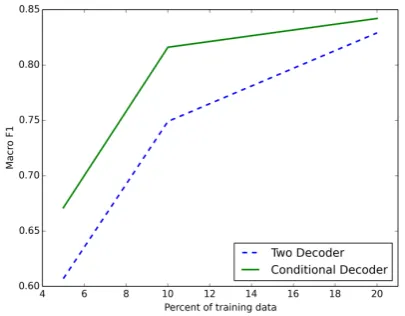
Figure 5: Conditional softmax decoder is more robust in ex-treme low resource setting than its two decoder counterpart.
word encoders have 50, and 100 hidden units, re-spectively, while the tagger LSTM has a hidden size of 50. Dropout is used after every RNN, as well as for word embedding input. We use Adam (Kingma and Ba, 2014) as an optimizer. Hyper-parameters are tuned using Bayesian Optimization (Snoek et al.,2012).
4 Results
[image:4.595.315.518.284.442.2]the conditional decoder model achieved new state-of-art for 2010 i2b2/VA challenge task. Shared decoder underperformed the other two models. That can be attributed to a single decoder which primarily focuses on making entity extraction pre-dictions which are more frequent than negations. The conditional decoder outperformed the base-line model on the negation prediction task and achieved an improvement of about8%in F1score
compared to the baseline model, which suggests that modeling named entity and negation tasks to-gether helps in achieving better results than each of the tasks done independently.
We compare our models for negation detec-tion against NegEx, and ABoW which has best results for the negation detection task on i2b2 dataset. Conditional decoder model outperforms both NegEx and ABoW (Table 1). Low perfor-mance of NegEx and ABoW is mainly attributed to the fact that they use ontology lookup to index findings and negation regular expression search within a fixed scope. A similar trend was observed in the medication condition dataset. The impor-tant thing to note is the low F1 score for NegEx.
This can primarily be attributed to abbreviations and misspellings in clinical notes which can not be handled well by rule-based systems.
To understand the advantage of conditional de-coder, we evaluated our model in extreme low data settings where we used a sample of our training data. We observed that the conditional decoder outperforms the two decoder model and achieved an improvement of6%in F1score in those settings
(Figure5). As we increase the data size, their per-formance gap narrows in demonstrating that the conditional decoder is robust in low resource set-tings.
5 Conclusion
In this paper we have shown that named entity and negation assertion can be modeled in a multi-task setting. Joint learning with shared parame-ters provides better contextual representation and helps in alleviating problems associated with using neural networks for negation detection, thereby achieving better results than the rule-based sys-tems. Our proposed conditional softmax decoder achieves best results across both tasks and is ro-bust to work well in extreme low data settings. For future work, we plan to investigate the model on other related tasks such as relation extraction,
nor-malization as well as the use of advanced condi-tional models.
References
Parminder Bhatia, Kristjan Arumae, and Busra Celikkaya. 2018. Dynamic transfer learning for named entity recognition. arXiv preprint arXiv:1812.05288.
Parminder Bhatia, Robert Guthrie, and Jacob Eisen-stein. 2016. Morphological priors for probabilis-tic neural word embeddings. InProceedings of the 2016 Conference on Empirical Methods in Natural Language Processing, pages 490–500.
Piotr Bojanowski, Edouard Grave, Armand Joulin, and Tomas Mikolov. 2016. Enriching word vec-tors with subword information. arXiv preprint arXiv:1607.04606.
Berry de Bruijn, Colin Cherry, Svetlana Kiritchenko, Joel Martin, and Xiaodan Zhu. 2011. Machine-learned solutions for three stages of clinical infor-mation extraction: the state of the art at i2b2 2010.
Journal of the American Medical Informatics Asso-ciation, 18(5):557–562.
Wendy W Chapman, Will Bridewell, Paul Hanbury, Gregory F Cooper, and Bruce G Buchanan. 2001. A simple algorithm for identifying negated findings and diseases in discharge summaries. Journal of biomedical informatics, 34(5):301–310.
Katherine Cheng, Timothy Baldwin, and Karin Ver-spoor. 2017. Automatic negation and speculation detection in veterinary clinical text. InProceedings of the Australasian Language Technology Associa-tion Workshop 2017, pages 70–78.
Jason Chiu and Eric Nichols. 2016. Named entity recognition with bidirectional lstm-cnns. Transac-tions of the Association of Computational Linguis-tics, 4(1):357–370.
Federico Fancellu, Adam Lopez, and Bonnie Webber. 2016. Neural networks for negation scope detection. In Proceedings of the 54th Annual Meeting of the Association for Computational Linguistics (Volume 1: Long Papers), volume 1, pages 495–504.
George Gkotsis, Sumithra Velupillai, Anika Oellrich, Harry Dean, Maria Liakata, and Rina Dutta. 2016. Don’t let notes be misunderstood: A negation de-tection method for assessing risk of suicide in men-tal health records. In Proceedings of the Third Workshop on Computational Lingusitics and Clin-ical Psychology, pages 95–105.
Henk Harkema, John N Dowling, Tyler Thornblade, and Wendy W Chapman. 2009. Context: an al-gorithm for determining negation, experiencer, and temporal status from clinical reports. Journal of biomedical informatics, 42(5):839–851.
Sepp Hochreiter and J¨urgen Schmidhuber. 1997. Long short-term memory. Neural computation, 9(8):1735–1780.
Mengqi Jin, Mohammad Taha Bahadori, Aaron Co-lak, Parminder Bhatia, Busra Celikkaya, Ram Bhakta, Selvan Senthivel, Mohammed Khalilia, Daniel Navarro, Borui Zhang, et al. 2018. Im-proving hospital mortality prediction with medical named entities and multimodal learning. arXiv preprint arXiv:1811.12276.
Diederik P Kingma and Jimmy Ba. 2014. Adam: A method for stochastic optimization. arXiv preprint arXiv:1412.6980.
Guillaume Lample, Miguel Ballesteros, Sandeep Sub-ramanian, Kazuya Kawakami, and Chris Dyer. 2016. Neural architectures for named entity recognition. InProceedings of NAACL-HLT, pages 260–270.
Yifan Peng, Xiaosong Wang, Le Lu, Mohammad-hadi Bagheri, Ronald Summers, and Zhiyong Lu. 2018. Negbio: a high-performance tool for nega-tion and uncertainty detecnega-tion in radiology reports.
AMIA Summits on Translational Science Proceed-ings, 2017:188.
Jeffrey Pennington, Richard Socher, and Christopher Manning. 2014. Glove: Global vectors for word representation. InProceedings of the 2014 confer-ence on empirical methods in natural language pro-cessing (EMNLP), pages 1532–1543.
E. Z. Borzeshi R. Chalapathy and M. Piccardi. 2016. Bidirectional lstm-crf for clinical concept extraction.
arXiv preprint arXiv:1611.08373.
Li Rumeng, N Jagannatha Abhyuday, and Yu Hong. 2017. A hybrid neural network model for joint pre-diction of presence and period assertions of medical events in clinical notes. In AMIA Annual Sympo-sium Proceedings, volume 2017, page 1149. Ameri-can Medical Informatics Association.
Chaitanya Shivade, Marie-Catherine de Marneffe, Eric Fosler-Lussier, and Albert M Lai. 2015. Extend-ing negex with kernel methods for negation detec-tion in clinical text. In Proceedings of the Second Workshop on Extra-Propositional Aspects of Mean-ing in Computational Semantics (ExProM 2015), pages 41–46.
Gaurav Singh and Parminder Bhatia. 2019. Relation extraction using explicit context conditioning. arXiv preprint arXiv:1902.09271.
Jasper Snoek, Hugo Larochelle, and Ryan P Adams. 2012. Practical bayesian optimization of machine learning algorithms. InAdvances in neural informa-tion processing systems, pages 2951–2959.
Ronald J Williams and David Zipser. 1989. A learn-ing algorithm for continually runnlearn-ing fully recurrent neural networks. Neural computation, 1(2):270– 280.
Stephen Wu, Timothy Miller, James Masanz, Matt Coarr, Scott Halgrim, David Carrell, and Cheryl Clark. 2014. Negation’s not solved: generalizabil-ity versus optimizabilgeneralizabil-ity in clinical natural language processing.PloS one, 9(11):e112774.