by Jana van Wyk
Thesis presented in partial fulfilment of the requirements for the degree of Master of Commerce (Computer Auditing) in the Faculty of Economic and Management
Sciences at Stellenbosch University
Supervisor: Professor Riaan Rudman
i
Declaration
By submitting this dissertation electronically, I declare that the entirety of the work contained therein is my own, original work, that I am the sole author thereof (save to the extent explicitly otherwise stated), the reproduction and publication thereof by Stellenbosch University will not infringe any third party rights and that I have not previously in its entirety or in part submitted it for obtaining any qualification.
Jana van Wyk
March 2017
Copyright © 2017 Stellenbosch University All rights reserved
ii
ACKNOWLEDGEMENTS My sincere gratitude to:
• my Heavenly Father, • my parents and friends, and • my supervisor
iii
ABSTRACT
Cognitive computing is recognised as the third era in the evolution of computing. This era is driven by the exponential growth in data, advances in enabling technologies and enterprise’s need to realise significant business value from data resources. The capabilities of cognitive computing creates significant and immediate opportunities for enterprises. The problem is that management are implementing cognitive computing systems without understanding the technology or the risks the enterprise are exposed. The aim of the research is therefore to identify and mitigate significant risks pertaining to the implementation of cognitive computing. The research aims to investigate cognitive computing, identify significant risks and recommend safeguards to mitigate these risks.
A literature review was performed to provide a theoretical foundation for the research and focussed on cognitive computing, corporate governance, IT governance, data protection and the use of control frameworks to achieve effective governance. COBIT 5 was selected as the most appropriate control framework to identify significant risk. In order to identify the risks the core components of a cognitive computing system were identified and classified into specific phases based on their function within the cognitive computing system The research found that a cognitive computing system consists of consist of twelve core components and four phases The core components include: unstructured, semi-structured and structured data; data access, metadata, feature extraction, natural language processing and deep learning; corpus and advances analytics; and hypothesis generation and scoring, and machine learning. Based on the understanding of the core components, COBIT 5 was used to identify significant risks. Significant risks were identified at a strategic and operational or technological level. Risks at a strategic level involved inadequate governance and management, as well as insufficient human skills and resource management. Significant risks at an operational or technological level comprised of cost, privacy, security, scalability, integration, interoperability, veracity, ownership and life cycle risks. The research proceeded to formulate appropriate internal control techniques to mitigate the significant risks identified. The internal control techniques include establishing a cognitive computing strategies and policies, implementing human skills and resource controls, data controls, infrastructure controls, supplier controls and life cycle controls. The final product of the findings is a risk matrix, which maps the relevant core components with the significant risk which they introduce and a risk-control matrix which maps the risk to the risk-control technique which mitigates the risk.
iv
UITTREKSEL
Kognitiewe verwerking (cognitive computing) word erken as die derde era in die evolusie van rekenaar verwerking (computing). Die era word gedryf deur die eksponensiële groei van data, die verbetering van bemagtigende tegnologieë en ondernemings se behoefte om beduidende besigheidswaarde uit data bronne te realiseer. Kognitiewe verwerking is in staat om beduidende en onmiddellike geleenthede vir ondernemings te skep. Die probleem is egter dat bestuur kognitiewe verwerking stelsels (cognitive computing systems) implementeer sonder dat hulle die tegnologie of die risiko’s waaraan die onderneming blootgestel word verstaan. Die doel van die navorsing is dus om wesenlike risiko’s in verband met die implementering van kognitiewe verwerking te identifiseer en aan te spreek. Die navorsing beoog om ‘n dieper begrip te ontwikkel van kognitiewe verwerking, om wesenlike risiko’s te identifiseer en om kontroles aan te beveel wat die risiko’s aanspreek.
ʼn Literatuur studie was uitgevoer om ʼn teoretiese basis vir die navorsing te bied en het gefokus op kognitiewe verwerking, korporatiewe beheer, IT beheer, data beskerming en die gebruik van kontrole raamwerke om effektiewe beheer te bewerkstellig. COBIT 5 was geselekteer as die beste kontrole raamwerk om wesenlike risiko’s te identifiseer. Om die risiko’s te identifiseer is die onderliggende komponente van ʼn kognitiewe verwerking stelsel geïdentifiseer en geklassifiseer gebaseer op hul funksies in die kognitiewe verwerking stelsel. Die navorsing het gevind dat ‘n kognitiewe verwerking stelsel uit twaalf onderliggende komponente en vier fases bestaan. Die onderliggende komponente sluit in: ongestruktureerde, semigestruktureerde en gestruktureerde data; data toegang, metadata, kenmerk ontrekking (feature extraction), natuurliketaalverwerking (natural language processing) en dieper leer (deep learning); korpus (corpus) en gevorderde ontleding (advances analytics); en hipotese generering en meting (hypothesis generation and scoring), en masjien leer (machine learning). COBIT 5 is gebruik om wesenlike risiko’s te identifiseer, gebaseer op kennis van die onderliggende komponente. Wesenlike risiko’s is op ‘n strategiese en operasionele of tegnologiese geïdentifiseer. Risiko’s op ‘n strategiese vlak sluit in onvoldoende beheer en bestuur, sowel as onvoldoende menslike hulpbron bestuur. Wesenlike risiko’s op ‘n operasionele of tegnologiese vlak bestaan uit koste, privaatheid, sekuriteit, skaalbaarheid (scalability), integrasie, interoperasionaliteit (interoperability), geldigheid (veracity), data eienaarskap en lewenssiklus risiko’s. Die navorsing het voortgegaan om interne beheermaatreëls te formuleer om die wesenlike risiko’s aan te spreek. Die interne
v
beheermaatreëls sluit in die vestiging van kognitiewe verwerking strategieë en beleide, die implementering van menslike hulpbron kontroles, data kontroles, infrastruktuur kontroles, verskaffer kontroles en lewenssiklus kontroles. Die finale produk van die bevindinge is ‘n risiko matriks, wat die relevante onderliggende komponente verbind met die wesenlike risiko’s wat hulle skep en ‘n risiko-kontrole matriks wat die risiko’s verbind met die beermaatreëls wat die risiko’s aan spreek.
vi
TABLE OF CONTENTS
CHAPTER 1: INTRODUCTION AND RESEARCH OBJECTIVE 1
1.1 Introduction and background 1
1.2 Problem statement and research objective 2
1.3 Scope limitations 2
1.4 Organisational structure of the research 3
CHAPTER 2: RESEARCH DESIGN AND METHODOLOGY 4
CHAPTER 3: LITERATURE REVIEW 7
3.1 Introduction 7
3.2 Historic review of prior research 7
3.3 Cognitive computing 8
3.3.1 Defining cognitive computing 9
3.3.2 Application of cognitive computing 10
3.4 Corporate governance and Information Technology governance 13
3.4.1 Corporate governance 13
3.4.2 Information Technology governance 14
3.4.3 Data protection and cognitive computing 15
3.4.4 IT gap and alignment 17
3.5 Control frameworks 17
3.5.1 Control objectives for information and related technologies (COBIT) 18 3.5.2 Information technology infrastructure library (ITIL) 20
3.5.3 Committee of sponsoring organizations (COSO) 22
3.5.4 Framework selected for the purpose of this research 23
3.6 Summary and conclusion 24
CHAPTER 4: CORE COMPONENTS OF A COGNITIVE COMPUTING SYSTEM 26
4.1 Data ingestion 28
vii 4.3 Resolve phase 30 4.4 Reason phase 32 4.5 Infrastructure 35 4.6 Enabling technologies 37 4.6.1 Hadoop 37 4.6.2 Could technologies 39 4.6.3 Big data 40
4.7 Summary and conclusion 41
CHAPTER 5: RISKS PERTAINING TO THE IMPLEMENTATION OF A COGNITIVE COMPUTING SYSTEM
42
5.1 Significant risks at a strategic level 42
5.1.1 Inadequate governance and management of cognitive computing systems 42
5.1.2 Inadequate human skills and resource management 44
5.2 Significant risks at an operational or technological level 45
5.2.1 Cost 45 5.2.2 Privacy 46 5.2.3 Security 49 5.2.4 Ownership 51 5.2.5 Scalability 51 5.2.6 Integration 53 5.2.7 Interoperability 54 5.2.8 Veracity (Quality) 55
5.2.9 Cognitive computing life cycle risks 56
5.3 Summary and conclusion 58
CHAPTER 6: SAFEGUARDS AND CONTROLS IN A COGNITIVE COMPUTING SYSTEM
60
6.1 Governance and management at a strategic level 60
6.1.1 Cognitive computing governance 60
viii
6.1.3 Human skills and resources controls 63
6.2 Controls at an operational or technological level 64
6.2.1 Data controls 64
6.2.2 Infrastructure controls 68
6.2.3 Service provider controls 70
6.2.4 Cognitive computing life cycle controls 72
6.3 Summary and conclusion 73
CHAPTER 7: CONCLUSION 85
ix
LIST OF FIGURES, TABLES AND APPENDICES Figures
Figure 1: The fundamental capabilities of cognitive computing 9
Figure 2: Core components of a cognitive computing system 27
Figure 3: Hypothesis generation and scoring process 34
Tables
Table 1: The benefits and limitations of COBIT, ITIL and COSO 24 Table 2: A risk matrix: linking the cognitive computing components to the significant risks it
gives rise to
58
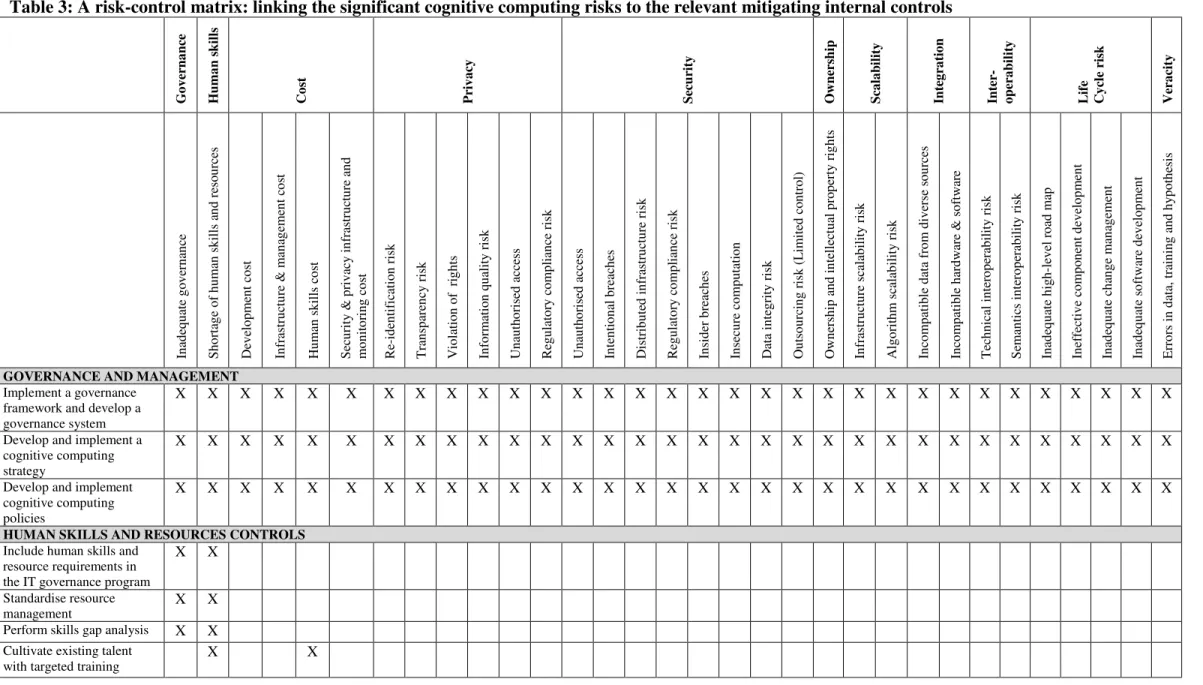
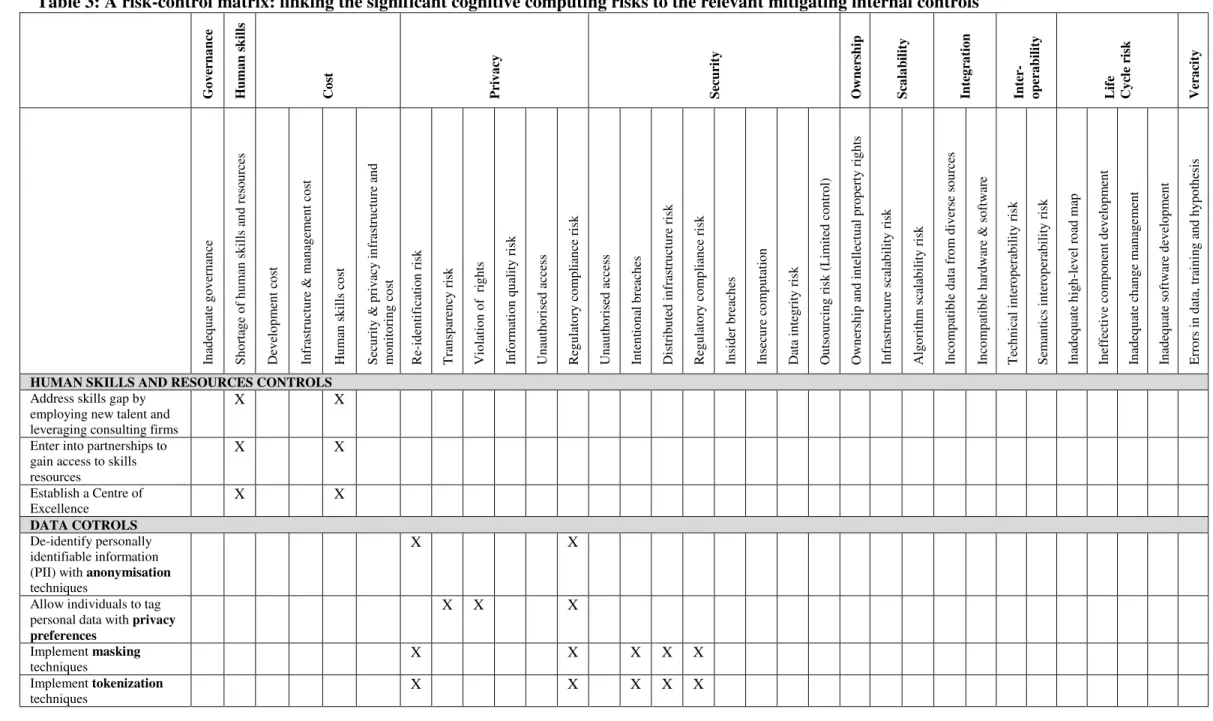
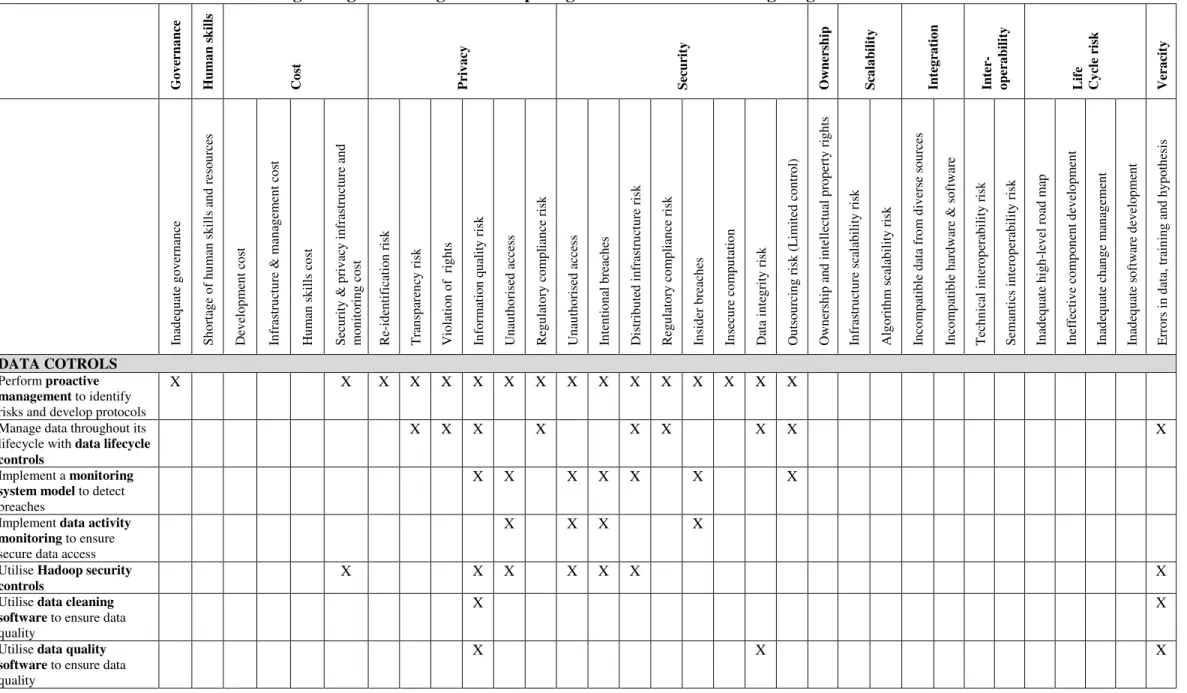
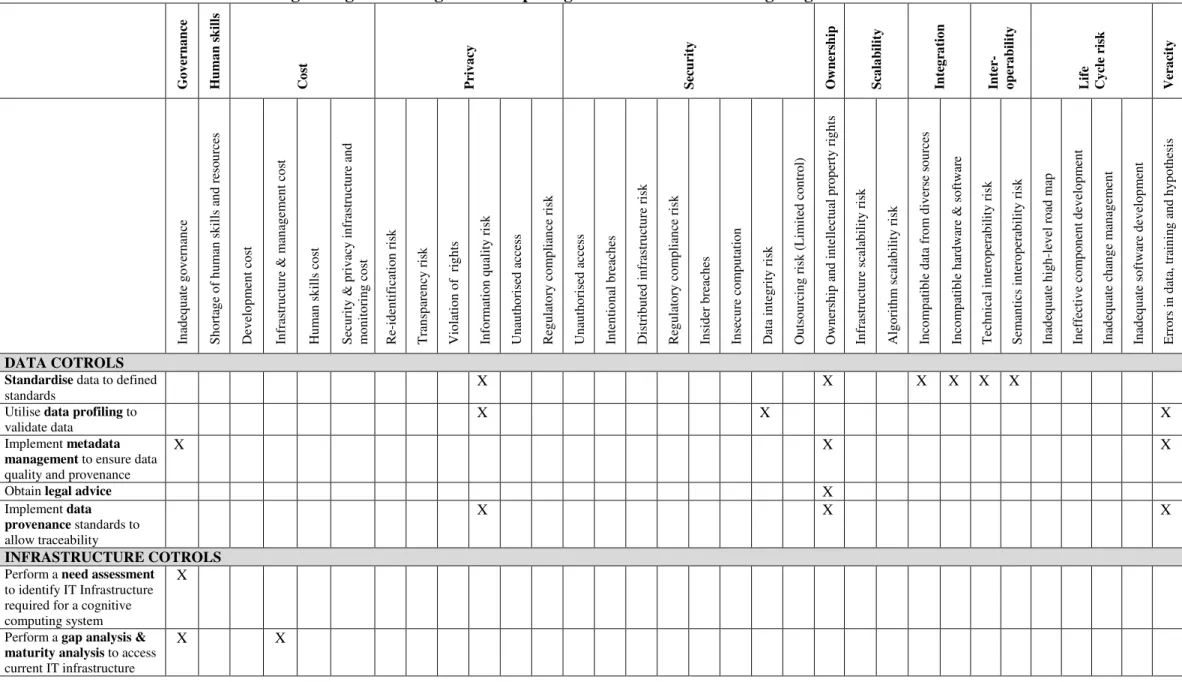
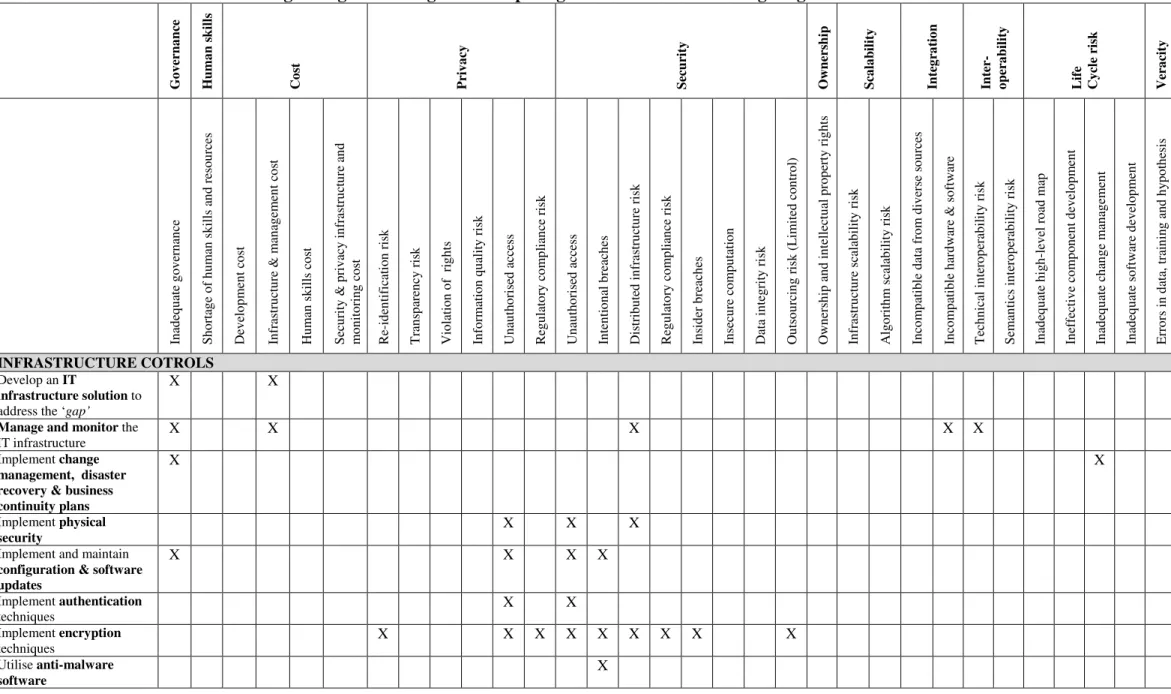
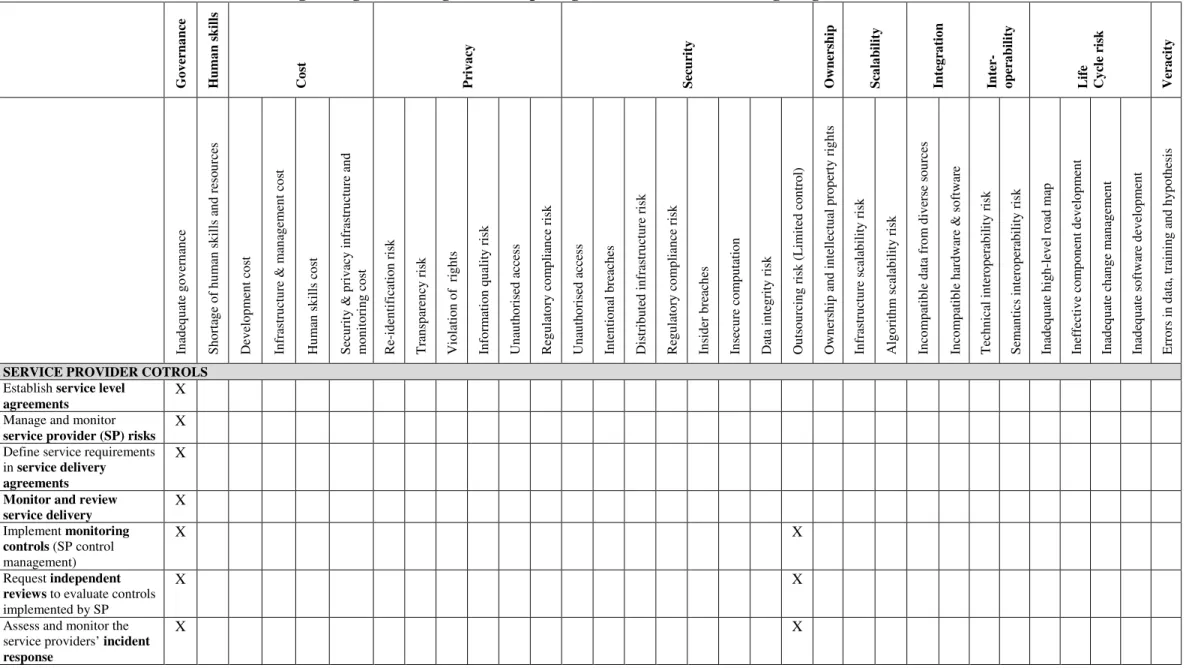
Table 3: A risk-control matrix: linking the significant cognitive computing risks to the relevant mitigating internal controls
74
Appendices
1
CHAPTER 1: INTRODUCTION AND RESEARCH OBJECTIVE
1.1 Introduction and background
Cognitive computing is recognised as the third era in the evolution of computing (Hurwitz, Kaufman & Bowles, 2015; Kelly III & Hamm, 2013). An era where computers learn from experience, instead of depending on programmed algorithms to respond to a set of predefined rules and questions, and are capable of formulating new ideas, hypotheses and knowledge based on an understanding of natural language (Willis Towers Watson, 2016). The advent of the cognitive computing era is driven by the exponential growth in data, specifically unstructured data which accounts for 80-90% of the digital universe, the advances in and increasing sophistication of enabling technologies, and the enterprise’s need to realise business and economic value from data resources (Willis Towers Watson, 2016; Bataller & Harris, 2015; Hurwitz, Kaufman & Bowles, 2015; Sarkar & Zaharchuk, 2015).
An increasing number of industries are utilising the innovative capabilities of cognitive computing, including health care, customer services, insurance, IT and telecommunications, and financial services. Deloitte estimates that, due to the increase in enterprises and industries using cognitive computing, more than 80 of the world’s largest enterprise software companies (by revenues) will have incorporated cognitive technologies into their products by the end of 2016. This is expected to rise to 95 out of 100 by 2020 (Willis Towers Watson, 2016).
The capabilities of cognitive computing creates significant and immediate opportunities for enterprises. Management requires knowledge about cognitive computing and the risks enterprises are exposed to pertaining to the implementation of a cognitive computing system.
1.2 Problem statement and research objective
Pioneering enterprises across industries are implementing cognitive computing systems to utilise cognitive computing capabilities. The problem is that management is implementing the cognitive computing system without understanding the technology or the risks enterprises are exposed to pertaining to the implementation of the cognitive computing system.
The objective of this research is to identify and mitigate significant risks pertaining to the implementation of cognitive computing and a cognitive computing system.
2
The research proposes to provide stakeholders with insight into (i) the core components of a cognitive computing system; (ii) the significant risks pertaining to the implementation of a cognitive computing system and (iii) to recommend safeguards to mitigate these risks to an acceptable level.
1.3 Scope limitations
The aim of the research is to mitigate and investigate significant risks pertaining to the implementation of a cognitive computing system and its core components. The purpose is not to identify and mitigate all the risks associated with cognitive computing in general or to identify all the risks associated with the interaction between cognitive computing and its surrounding environment.
Cognitive computing systems can be developed in-house or by cognitive computing developers. In-house development will introduce significant development risks and require appropriate internal control techniques to address these risks. The research will only highlight some of the significant development risks and appropriate control techniques that can be directly linked to cognitive computing systems and does not intend to identify and mitigate all risks relating to system or software development.
The focus of the research is on the four phases of the cognitive computing system and the core components included in each phase, as well as the infrastructure and enabling technologies which support the four phases. There as two components (virtualisation and application) which form part of the cognitive computing system but do not fall within the four phases based on their function. These components will be excluded from the research.
1.4 Organisational structure of research
The structure of the remainder of the research is illustrated in the chapter outline below: CHAPTER 2: Research design and methodology
Chapter 2 contains the research design and methodology used in the research. CHAPTER 3: Literature review
The literature review provides the theoretical foundation for the research and commences with an overview of prior research. The review establishes the definition, capabilities and
3
applications of cognitive computing. Thereafter the review focusses on corporate governance, IT governance and data protection, as well as the use of control frameworks to achieve effective governance. In order to select the most appropriate control framework to identify risks pertaining to the implementation of cognitive computing three control frameworks are reviewed. Chapter 3 forms the basis for the findings in Chapters 4, 5 and 6.
CHAPTER 4: Core components of a cognitive computing system
In Chapter 4 the core components of a cognitive computing system are identified and classified into specific phases based on their function within the cognitive computing system. Each component is defined and the purpose of each component describe within the context of the cognitive computing system.
CHAPTER 5: Risks pertaining to the implementation of a cognitive computing system In this chapter, the control framework selected in Chapter 3, is used to identify and investigate the significant risks pertaining to the implementation of a cognitive computing system, based on the knowledge obtained in Chapter 4. Chapter 5 concludes with a risk matrix which maps the relevant core components of each cognitive computing phase with the significant risk which they introduce.
CHAPTER 6: Safeguards and controls in a cognitive computing system
In Chapter 6, the appropriate internal control techniques to mitigate the significant risks identified in Chapter 5 are formulated. Chapter 6 concludes with a risk-control matrix which maps the significant risk to the relevant control techniques formulated to mitigate the specific risk to an acceptable level.
CHAPTER 7: Conclusion
Chapter 7 presents a summary of the findings of the research and identifies areas for future research.
4
CHAPTER 2: RESEARCH DESIGN AND METHODOLOGY
In this non-empirical study, literature from peer reviewed and non-peer reviewed sources were considered in order to provide a foundation for the research. According to Levy and Ellis (2006) an effective literature review should provide a theoretical foundation for the proposed study and establish that the proposed research will enhance current knowledge or contribute something new to the overall body of knowledge. An effective literature review is enabled by a process which consists of a structured approach to collect, comprehend, synthesise and evaluate quality literature (Levy & Ellis, 2006; Webster & Watson, 2002). Sylvester, Tate and Johnson (2010) suggest that a structured literature review should be performed in five stages. In the beginning stages relevant literature with a broad scope is accumulated and as the stages progress the selection is reduced to literature focussed on a specific area. Only four of the five stages were considered relevant to this study and were used:
1. The searching stage: The initial search criteria to identify and select relevant literature was deliberately diverse and with a broad scope. The terms used in the initial search included: “cognitive computing”, “cognitive technologies”, “cognitive analytics”, “cognitive computing and big data analytics”, “artificial intelligence”, “business value of cognitive computing”, “IT governance”, “corporate governance”, “control frameworks” and “risks related to cognitive computing, big data analytics and big data”. The sources used in the search include printed books and e-books, organisational articles and white papers, theses, scholarly articles published in local and international academic journals, electronic databases (such as IEEE, Elsevier, Emerald, Scopus) and web articles. Cognitive computing as a new generation technology has limited research available, therefore the literature reviewed was not evaluated or discarded based on the quality, academic focus or the reputation of the sources. Seeing as big data, big data analytics and cognitive computing were included in the search, it yielded 323 articles, books and white papers.
2. The mapping stage: The mapping stage focuses on narrowing the scope by identifying recurring themes, keywords and phrases. The themes, keywords and phrases identified during this stage included “data and information governance”, “COBIT”, “ITIL”, “COSO”, “cognitive computing systems”, “IBM’s Watson”, “machine learning”, “big data analytics”, “big data analytics and related risks” and “data privacy and security”. In order to refine the collection of literature the abstracts, introductions and conclusions were studied. This reduced the collection of literature to 131 articles, books and white papers.
5
3. The appraisal stage: During this stage the refined selection of articles, books and white papers were read, analysed and the contributions to the identified concepts were linked. Important concepts regarding cognitive computing and cognitive computing systems, the significant risks enterprises are exposed to due to the implementation of a cognitive computing system and the related mitigating control techniques, were identified, categorised and grouped.
4. The synthesis stage: During this stage the available literature from the previous stages are synthesised in order to enable a consistent approach in reaching conclusions and assists in creating a clear and structured final document.
The literature review, as described above, provided a theoretical foundation for a deeper understanding of cognitive computing, cognitive computing systems, corporate and IT governance, and control frameworks.
The objective of the research is to identify and mitigate significant risks pertaining to the implementation of cognitive computing. In order to achieve this objective the research was structured in the following manner:
a) Defining cognitive computing and the core components of a cognitive computing system: The aim was to define cognitive computing, as well as the fundamental capabilities which differentiate cognitive computing from other computing, based on the knowledge obtained from available literature. Thereafter the core components of a cognitive computing system were identified and classified into specific phases based on their function within the cognitive computing system.
b) Selecting the most appropriate control framework to achieve the objective of this research: The content, scope, benefits and limitation of a selection of control frameworks were compared, in order to select the most appropriate control framework to identify significant risks pertaining to the implementation of a cognitive computing system. The control frameworks reviewed included Control Objectives for Information and Related Technology (COBIT 5), IT Information Library (ITIL 4) and Committee of Sponsoring Organisation (COSO 2013). Based on the comparison COBIT 5 was selected as the most appropriate control framework.
c) Performing a study of COBIT 5 and use the detailed processes of COBIT 5 to identify significant risks associated with the implementation of a cognitive computing system: The detailed processes of COBIT 5 were studied and relevant processes pertaining to the
6
governance and management of cognitive computing were identified. These relevant processes were used to identify significant risks associated with the implementation of a cognitive computing system. The significant risks were mapped to the relevant core components of each cognitive computing phase which introduces the risk (Risk matrix). d) Formulating controls to mitigate the significant risk pertaining to the implementation
of a cognitive computing system: After identifying the significant risks appropriate controls were formulated to mitigate the risks to an acceptable level. The controls were mapped to the relevant risks that they will mitigate in a risk control matrix.
The methodology used in the research provided the foundation to obtain insight into cognitive computing and the core components of a cognitive computing system, identify and investigate the significant risks pertaining to the implementation of cognitive computing system and formulate safeguards to mitigate these risks.
7
CHAPTER 3: LITERATURE REVIEW
3.1 Introduction
The first section (3.2) of the literature review provides a review of prior cognitive computing studies. The second section (3.3) of the literature review briefly establishes the definition, capabilities and application of cognitive computing. The primary focus of the third (3.4) and fourth (3.5) sections of the literature review is corporate governance, IT governance, data protection and the use of control frameworks to achieve effective IT governance. Three control frameworks are reviewed and compared in order to select the most appropriate control framework to employ in the identification of significant risks pertaining to the implementation of a cognitive computing system (Chapter 5).
3.2 Historic review of prior research
The majority of research on cognitive computing has been conducted by independent organisations such as IBM Corporation (Drury, Harper, Marshall & Sarkar, 2015; Fox, Lala & Coelho, 2015; Sarkar & Zaharchuk, 2015; Ballard, Compert, Jesionowski, Milman, Plants, Rosen & Smith, 2014; Jewell, Barros, Diederichs, Duijvestijn, Hammersley, Hazra, Holban, Li, Osaigbovo, Plach, Portilla, Saptarshi, Seera, Stahl & Zolotow, 2014; Sudarsan, 2013; IBM Corporation, 2014a; IBM Corporation, 2014b; IBM Corporation, 2014c; High, 2012); Accenture (Bataller & Harris, 2015); SAS Institute (n.d.); and Deloitte (Danson, Pierce & Shilling, 2015; Schatsky, Muraskin & Gurumurthy, 2014; Ronanki & Steier, 2014a; Ronanki & Steier, 2014b). The focus of these articles and white papers are to define cognitive computing, describe the underlying technologies and the capabilities of the technologies, present a perspective on how the technology will impact business, and the opportunities that exist. IBM has focused much of their research on IBM Watson, one of the first cognitive computing platforms, while Accenture offers a perspective on cognitive computing challenges and presents a framework for understanding in what ways cognitive computing can deliver value.
Recent research concentrated on providing an overview of cognitive computing. These include the book by Hurwitz et al. (2015) on cognitive analytics and big data analysis. The book focuses on imparting both theoretical and practical guidance to technologists. On a theoretical level, the book defines cognitive computing, the elements within a cognitive system and the underlying technologies. On a practical level, case studies from the financial, healthcare, and
8
manufacturing industries address the design and testing of cognitive systems. In the book ‘Smart Machines’, Kelly III and Hamm (2013) introduce the world of cognitive systems to general audiences and investigate the future of computing. Kelly III and Hamm's (2013) comprehensive perspective describes the technology and explains how it will assist in the utilising and understanding of big data.
Academic research has also been conducted. Wang (2011 & 2009) explored the theoretical foundations of cognitive computing in terms of cognitive informatics, denotational mathematics, and neural informatics. A survey by Wang (2011) focused on a theoretical framework, architectural techniques, and conceptual models of cognitive computing.
The literature review established that prior research discussed the underlying technologies which forms part of the cognitive computing system, as well as the general challenges relating to cognitive computing. The prior research did not present an approach to identify specific risks pertaining to the different components of a cognitive computing system. This research proposes to address this gap by providing a structured approach to identify significant risks pertaining to the implementation of a cognitive computing system, with a specific focus on linking the underlying core components to the significant risks the component generates.
3.3 Cognitive computing
The evolution of information technology and computing consists of three eras. The first and second era encompassed instruction-driven computing, while the third era focuses on data-driven computing. The first era, known as the tabulating era, commenced in the 19th century and comprised of computers which automated the process of logging numbers and performing calculations. The second era, known as the programmable computing era, developed in the 1940s and is based on the Von Neumann architectural principles. These computers perform tasks, such as calculations and storing of information, based on a set of instructions embedded in software. Programmable computers are still used today, but do not support the enormous amounts of data generated daily by digital technologies (Kelly III & Hamm, 2013; Wladawsky-Berger, 2013).
Cognitive computing represents the third era in the evolution. An era which will be characterised by a collaboration between humans and machines (Kelly III & Hamm, 2013). Cognitive computing systems extract meaning from data, gain insight and solve problems in the same manner as the human brain does (Wladawsky-Berger, 2013).
9
3.3.1 Defining cognitive computing
In a 2014 cognitive computing survey Steve Adire, a contributor to the survey, defined cognitive computing as: “Natural language processing of structured, unstructured, streaming in Big Data or Smart Data layers with machine learning for reasoning and learning to generate contextual patterns and associations that enables humans to connect the dots faster and smarter for more informed decisions to drive better outcomes” (Zaino, 2014:2).
Adire’s definition highlights that cognitive computing consists of several components, which enables different capabilities when combined. Some of these components are fundamental to cognitive computing, while others may differ depending on the objective of the cognitive computing system, as well as the approach used to design the cognitive computing system.
Figure 1: The fundamental capabilities of cognitive computing
Figure 1 presents the fundamental capabilities of a cognitive computing system which differentiate cognitive computing from other computing (Hurwitz et al., 2015; Noor, 2015; Bellisimo, 2015; Sarkar & Zaharchuk, 2015; Zaino, 2014; Oberlin, 2012):
Explores & Discovers Generates & Scores Hypotheses Learns & Adapts Extract Features & Meaning Creates a domian model Engages & Communicates
COGNITIVE
COMPUTING
10
• Explores and discovers: Cognitive computing systems uses context driven dynamic
algorithms to discover patterns and insight in vast amounts of data that otherwise would have remained obscured knowledge.
• Generates and scores hypotheses: Cognitive computing systems generate, evaluate and
score contradictory hypotheses based on its corpus of knowledge. The cognitive computing system is bias free and probabilistic, therefore it presumes that there are multiple correct answers for a hypothesis and selects the most appropriate answer based on the applicable data.
• Learns and adapts: Cognitive computing systems learn from experience with data,
evidence, and hypotheses; and based on this experience, the system is able to improve its knowledge and its performance without direct programming.
• Extracts features and meaning: Cognitive computing systems extract meaning and make
sense of unstructured text data through Natural Language Processing and extract features from non-text data (images, videos, voice, and sensors) through deep learning tools.
• Creates domain models: Cognitive computing systems constructs a model of a domain,
which includes internal and external data, in the corpus and create assumptions to determine what learning algorithms are required to enable the system to learn.
• Engages and communicates: Cognitive computing systems are highly interactive,
facilitating advanced communication between human and computer. These systems offer expert assistance by gaining deep domain-specific insights and providing this information to people in a timely, natural and usable format.
3.3.2 Application of cognitive computing
According to Bataller and Harris (2015), cognitive computing capabilities can be divided into four types of activity models. Each model utilises the cognitive computing system in a different manner to create value for the enterprise. The following activity models can be implemented: 1. Efficiency model: The efficiency model provides consistent, low cost performance for
routine, predictable, rule-based activities. In this model the cognitive computing system senses, comprehends and acts, while humans monitor the accuracy of the results, and determine how the rules need to evolve as conditions change (Bataller & Harris, 2015). The following examples illustrate how cognitive computing systems are used within industries to facilitate efficiency:
11
• Communication industry: Call centres implement cognitive computing systems to
provide relevant and accurate automated responses to inquiries posed in natural language. This assists call center employees in quickly retrieving the correct responses, thereby improving call center productivity as well as customer satisfaction (Fox et al., 2015).
• Banking industry: Banks are employing cognitive computing systems to assist
customers in making better investment decisions based on their individual preferences. The cognitive computing system searches large quantities of data in order to answer specific questions, enable dialogue regarding investment options and deliver evidence-based recommendations (Drury et al., 2015).
2. Effectiveness model: An effectiveness model provides seamless integration and collaboration for routine, predictable, rule-based activities. However, the data is more complex in comparison with the efficiency model due to an increase in volume and unstructured data. In this model, the cognitive computing system acts as a personal assistant which assist humans in scheduling, communicating, monitoring and executing activities (Bataller & Harris, 2015). Cognitive computing systems can be used within consumer products to facilitate effectiveness. Virtual agents receive requests in a textual or verbal form, process them in the cognitive computing system using natural language processing or speech recognition, search the knowledge repositories (corpus), formulate hypotheses and consequently provide answers to the users in text or speech. For example, consumers are utilising agents such as Siri, Cortana and Google Now on their smartphones, while in a corporate situation, virtual agents will answer routine questions that come into a customer service center (Bataller & Harris, 2015). In the banking industry cognitive computing systems assit in account management, security management and identity management. 3. Expert model: An expert model provides specialised expertise for ad-hoc, unpredictable,
judgment-based activities. In this model, the cognitive computing system explores vast data stores, and subsequently makes inferences and recommendations based on the knowledge obtained during the exploration. The humans will make the ultimate decision based on recommendations (Bataller & Harris, 2015). The following examples illustrate how cognitive computing systems are used to provide expert advice:
• Healthcare industry: A medical diagnostic system is an example of an advisory
cognitive computing system that enhances human understanding and judgement. The system analyses patient data, medical literature and guidelines from world-class experts
12
in order to provide data-driven recommendation. The medical doctors interpret the results of the expert system’s analysis and present a diagnosis to the patient in person (Bataller & Harris, 2015).
• Banking industry: The cognitive computing system supports wealth management by
improving the advice and experience provided to customers. The system analyses research reports, product information and customer profiles in order to identify connections between customers’ needs and the investment knowledge in the corpus, and to weigh the available financial options. Based on the recommendations provided by the cognitive computing system, the bank’s relationship managers will be able to provide services in accordance with the client’s needs in a timely manner and create a personalised client experience (Drury et al., 2015).
4. Innovation model: The innovation model enhances ideas and creativity by identifying alternatives and optimising recommendations. However, the data is unstructured and more complex in comparison with the expert model due to an increase in volume. The cognitive computing system enhances creativity and ideas of biomedical researchers, fashion designers, chefs, musicians and entrepreneurs (Bataller & Harris, 2015). The following examples illustrate how cognitive computing systems are used within industries to augment innovation:
• Music industry: The cognitive computing system assists artists and producers by using
spectral sound-wave analysis to analyse songs and provide recommendations to increase the likelihood that the song will be a hit (Bataller & Harris, 2015).
• Healthcare industry: The cognitive computing system assists biomedical researchers
by extracting information from scientific literature and automatically identifying direct and indirect patterns, thereby accelerating research and discovering new insights. The time required for researchers to test hypotheses and formulate conclusions can be extensive and cognitive computing is a new and innovative method to advance and accelerate medical research (Sarkar & Zaharchuk, 2015).
The implementation of cognitive computing systems creates value in enterprises; however, it also exposes the enterprises to new and additional risks. In order to mitigate the exposure to these risks, enterprises should consider corporate governance, IT governance and control frameworks.
13
3.4 Corporate governance and Information Technology governance
The importance of corporate governance significantly increased over the past decade in response to corporate fraud, managerial misconduct and negligence that lead to the loss of shareholder wealth (Krechovská & Procházková, 2014; ISACA, 2012a). Information technology has become a core asset for most enterprises and in order to enhance corporate governance, it must be supported by the effective management of these IT assets (IT governance). The effective governance of cognitive computing (IT asset) requires investigation in order to strengthen and support corporate governance.
3.4.1 Corporate governance
Corporate governance is a structure of policies, practices and procedures by which enterprises are controlled, directed and organised (Grose, Kargidis & Vasilios, 2014; Krechovská & Procházková, 2014; Zalewska, 2014). Governance ensures that stakeholder needs are assessed to determine appropriate enterprise objectives that the decision making and procedures of the enterprise aligns with the objectives, and performance and compliance are monitored in accordance with the objectives (Grose et al., 2014; Gartner, 2013; ISACA, 2012a).
Effective corporate governance principles promote fairness, accountability, responsibility and transparency which is fundamental in managing an enterprise successfully (IODSA, 2009). The third King Code of Corporate Governance for South Africa (King III) was specifically written to assist South African enterprises in achieving good corporate governance principles. However, in order to maintain good corporate governance, the principles must be adjusted and grow with changes in business environment, new trends and new concepts (Krechovská & Procházková, 2014). The King report also had to adapt to these changes and as a result the King III specifically includes IT governance principles to address new developments in IT environments (IODSA, 2009).
On 15 March 2016, The Institute of Directors in Southern Africa (IODSA) and the King Committee made the draft version of King IV available for public comment. King IV addresses a number of new developments in corporate governance, including executive remuneration and the role of both social and ethics committees (IODSA, 2009).
Information systems have become an integral part of all businesses, revealing and creating new risks. Directors must take prudent and reasonable steps to generate business value and mitigate risks by incorporating international guidelines and frameworks (Juiz & Toomey, 2015; IODSA, 2009).
14
3.4.2 Information Technology governance
Information technology is a key resource for all enterprises and as a result IT governance forms an integral part of corporate governance. The core principle of IT governance is that it is a structured mechanism (framework) that enables the effective and efficient management of IT resources and assists a company in achieving its strategies and objectives (Gartner, 2013; Goosen & Rudman, 2013a; ISACA, 2012a; Marks, 2010; IODSA, 2009).
According to King, the responsibility of implementing good IT governance principles lies with the directors and senior management and recommends utilising international guidelines set by ITGI, ISACA and ISO authorities to assess and assist in IT governance (Gartner, 2013; Goosen & Rudman, 2013a; Marks, 2010; IODSA, 2009). Regardless of the guideline applied by those charged with this responsibility, King III contains seven principles that South African organisations should adhere to (IODSA, 2009; Liell-Cock, Graham & Hill, 2009):
1. The board should be responsible for information technology governance: The board of a company is responsible for IT governance and should ensure that appropriate IT policies are established and implemented.
2. IT should be aligned with the performance and sustainability objectives of the entity: The board should provide direction to facilitate the integration of the IT strategy and IT processes, with the company’s overall strategic and business processes.
3. The board should delegate the responsibility for the implementation of an IT governance framework to management: Directors should assign the responsibility for the implementation of the structures, processes and mechanisms for the IT governance framework to management.
4. The board should monitor and evaluate significant IT investments and expenditure: The board should ensure that IT resources and projects deliver the promised returns and benefits, with specific focus on adding value by optimising cost efficiency.
5. IT should form an integral part of the entity’s risk management process: Management should ensure that IT risks are included in the company’s risk management process. An adequate business resilience plan should be in place to recover from business disruptions and disasters, and the board must ensure that the company complies with IT laws and regulations.
6. The board should ensure that information assets are managed effectively: Processes should be implemented to enhance the performance and sustainability of the
15
company through the effective use of IT resources. The board has the responsibility to ensure that there are systems in place for the effective management of information, including information security, information privacy and the identification and processing of personal information in accordance with applicable laws and regulations (Refer to section 3.4.3 Data protection and cognitive computing).
7. A risk committee and audit committee should assist the board in carrying out its IT duties: The risk committee should ensure that all IT risks are identified and properly addressed, while the audit committee should assess IT in relation to the company’s financial reporting and going concern.
In order to effectively apply the IT governance principles listed above, an integrated framework should be implemented that provides structures and processes which align business and IT, and attend to all relevant risk areas pertaining to the implementation of the cognitive computing system (Goosen & Rudman, 2013a; Liell-Cock et al., 2009). An essential element of the IT governance principles is that the board and management should obtain an understanding of the laws and regulations applicable to the cognitive computing system. King III specifically addresses privacy of information, therefore it is important to obtain an understanding of data protection laws and regulation in South Africa in the context of a cognitive computing system.
3.4.3 Data protection and cognitive computing
Cognitive computing stimulates innovation and discovery. However, it is fundamental to eliminate the possibility of individuals, within or outside the organisation, misusing private data in unjustifiable and intrusive ways, which would incur both regulatory action, as well as financial losses and reputational damage (Wang, 2009). In accordance with Principle 7 of King III, the board should ensure that all personal information is identified and that there are systems in place to manage information security and information privacy (IODSA, 2009). As such, organisations must adhere to data protection legislation.
The Protection of Personal Information Act No. 4 of 2013 (POPI Act) was enacted on 26 November 2013 and the commencement date is expected to be in the second half of 2016, after the local government elections in August 2016 (de Bruyn, 2014). The POPI Act arises out of global developments with regard to data protection regulation and the purpose of this legislation is to enhance local privacy regulation and to prescribe data protection practices that aligns South Africa’s data privacy and protection legislation with global best practice (Jangara & Bezuidenhout, 2015; PWC, 2011).
16
The POPI Act presents eight conditions for the lawful processing of personal information (de Bruyn, 2014; POPI, 2013; PWC, 2011):
1. Accountability: The responsible party must ensure that the conditions for lawful processing with regard to the POPI Act are implemented and must also monitor adherence to the conditions.
2. Processing limitation: The responsible party must ensure that personal data is processed in a fair, lawful and reasonable manner, which does not infringe the right to privacy of the data subject. Processing limitations ensure that consent is provided by the ‘data subject’ and that objections from the data subject is adhere to, if justified in accordance with the provisions of the Act.
3. Purpose specification: Private data must be collected for a specific purpose, and the ‘data subject’ must be notified of the collection of their personal data as well as for what specific purpose it is collected.
4. Further processing limitation: Further processing of personal data must be consistent with the original purpose for which collection took place. Therefore prohibiting excessive processing.
5. Information quality: The private data collected must be accurate and relevant, to ensure the quality of information.
6. Openness: The data subject must be notified of the collection of their personal data and documentation must be maintained in terms of Section 14 to 51 of the Promotion of Access to Information Act.
7. Security safeguards: Policies and practices must be implemented to ensure the security, confidentiality and integrity of personal data, and that data subjects are notified of security breaches.
8. Data subject participation: The data subjects must have access to their personal information and have the right to request the correction or deletion of the personal information.
In order to identify and address confidentiality and privacy risks in a cognitive computing environment, these conditions must be taken into account. Although the POPI Act does not have a commencement date, de Bruyn (2014) determined that the core principles of the POPI Act and the UK’s Data Protection Act are significantly similar and therefore it can be concluded that it is reasonable to expect that the implementation of both these acts will produce similar outcomes.
17
3.4.4 IT gap and alignment
Within an organisation, the board is responsible for the implementation of an IT governance control framework, while IT specialists are responsible for the implementation of control techniques as indicated by the control framework. This is problematic, seeing as the board and top management have insufficient knowledge with regards to the control techniques and technology, and the IT specialist lacks understanding of the framework. This is known as the ‘IT gap’. The IT gap causes a misalignment between IT strategies / processes and business strategies / processes, which in turn creates risks and weaknesses in an IT system. In order to bridge the gap, the board must focus on integrating business and IT strategies by using a framework which facilitates alignment (Goosen & Rudman, 2013b; Rudman, 2010; Rudman, 2008).
3.5 Control frameworks
Effective governance of IT requires the implementation of a control framework which aligns business and IT, and addresses all IT related risks and relevant control areas (Juiz & Toomey, 2015; Goosen & Rudman, 2013a; Rudman, 2010).
There are numerous established standards, frameworks and best practices available to govern IT, which include Control Objectives for Information and Related Technology version 5 (COBIT 5), Information Technology Information Library (ITIL), ISO38500:2008 and ISO/IEC 27002. These frameworks can be applied individually or combined in order to establish a comprehensive IT framework which eliminates the weaknesses and combines the strengths of the various frameworks (Rubino & Vitolla, 2014). However, combining the frameworks may result in an ineffective control structure where work may be duplicated, controls could overlap and management may find it difficult to obtain a comprehensive understanding of the organisation’s risk exposure and control processes (Anisingaraju, 2013).
According to Zhang and Le Fever (2013), control frameworks can be separated into three main categories:
1. Business oriented controls:
(i) Committee of Sponsoring Organisation (COSO); (ii) Statement of Auditing Standards (SAS);
2. IT focused controls:
18
(ii) ISO/IEC 17799:2000, ISO/IEC 27000; 3. Business-IT alignment focused controls:
(i) Control Objectives for Information and Related Technology (COBIT).
One framework from each category was selected for review. COSO, ITIL and COBIT 5 were reviewed in order to choose the most suitable framework for the identification of cognitive computing risks.
3.5.1 Control Objectives for Information and Related Technology
Control Objectives for Information and Related Technology version 5 (COBIT 5) is a globally accepted, comprehensive framework that enables enterprises to create value through the effective governance and management of Information Technology (Rubino & Vitolla, 2014; Huang, Hung, Yen, Chang, & Jiang, 2011). The objective of this framework is to find a balance between the benefits and risks of IT, while considering the interests of all stakeholders (ISACA, 2012a).
COBIT was developed by ISACA (Information Systems Audit and Control Association) and was initially used as a framework for executing IT audits. The COBIT framework was developed further and in April 2012, the newest version, COBIT 5, was released. COBIT 5 consolidates and incorporates other frameworks such as Val IT and Risk IT and was updated to be in accordance with ITIL practices (Rubino & Vitolla, 2014). Val IT focuses on the attainment of business value through investment in IT and Risk IT addresses risk management (Sahibudin, Sharifi & Ayat, 2008). ISACA (2012) indicates that COBIT 5 is focused on five key principles:
• Principle 1: Meeting stakeholder needs by creating business value through the use of
information technology, specifically by transforming business objectives into information technology related objectives.
• Principle 2: Covering the enterprise end-to-end by incorporating governance and
management of enterprise information and related information technology into enterprise wide governance.
• Principle 3: Applying a single, integrated framework by aligning appropriate standards
and frameworks to function as an overarching framework for governance and management of information technology.
19
• Principle 4: Enabling a holistic approach through the use of categorised enablers (for
example, policies, processes etc.), in order to create efficient and effective governance and management of information technology.
• Principle 5: Separating governance from management since these two disciplines involve
different types of activities it necessitates different organisational structures and achieve different goals.
COBIT groups 34 IT processes into five domains (Kusumah, Sutikno & Rosmansyah, 2014; Rubino & Vitolla, 2014; Goosen & Rudman, 2013a; ISACA, 2012a; Sahibudin et al., 2008). The domains are defined as follows:
• Evaluate, direct and monitor (EDM): The five processes included in the EDM domain
provide guidance on the successful governance of IT-enabled business investments; through structures, principles, processes and practices; in order to achieve the company’s objectives.
• Align, plan and organize (APO): The APO domain comprises of thirteen processes which
provide guidance on the effective utilisation of internal and external IT resources in order to achieve business objectives and optimal IT results.
• Build, acquire and implement (BAI): The ten processes included in the BAI domain
provide guidance on the processes required to implement the IT strategy, specifically how to identify, develop / acquire, implement and integrate IT solutions.
• Deliver, service and support (DSS): The six processes of the DSS domain focus on the
delivery and support of services required by end users. The domain also covers the management of security; continuity; training; and data and operational facilities.
• Monitor, evaluate and assess (MEA): According to the three processes included in the
MEA domain, all IT processes must be continuously assessed to ensure quality and compliance with control requirements. The processes include performance management, monitoring of internal control, regulatory compliance and governance.
The benefits of applying COBIT 5 are the following (Bartens, de Haes, Lamoen, Schulte, & Voss, 2015; Crespo, 2015; Anisingaraju, 2013; Kneller, 2010; ISACA, 2012a):
• COBIT 5 offers an end-to-end business approach which integrates IT governance and
enterprise governance, taking into account the interests of both business and IT stakeholders in the process;
20
• COBIT 5 integrates (COBIT 4.1, Val IT 2.0, Risk IT, BMIS) and aligns (ITIL, TOGAF
and ISO standards) with other universally established standards, frameworks and practices, in order to create an overall, comprehensive governance and management framework;
• The framework achieves optimal value from IT investment by creating a balance between
realising benefits, optimising risk and effective and innovative utilisation of IT resource;
• COBIT 5 improves user satisfaction through IT engagement and services by creating an
increase in the contributions of users to the investment and use of IT;
• The framework supports compliance with relevant local and international laws, regulations,
and internal policies;
• The framework focuses on aligning business needs and IT objectives;
• The framework is generic and flexible, therefore it can be adapted to suit any enterprise’s
specific situation. However the enterprise (user) is responsible for selective implementation of COBIT 5 processes; and
• COBIT 5 and the 2013 COSO Internal Control – Integrated Framework are complimentary
and compatible.
COBIT 5 has the following inherent limitations (Bartens et al., 2015; Anisingaraju, 2013; Zhang & Le Fever, 2013; Kneller, 2010):
• There is a lack of implementation guidance, specifically for selective implementation and
customisation;
• COBIT requires detailed understanding and significant resources for its implementation
and this could exclude small- and medium-sized companies from applying the framework; and
• The complicated concepts and structure of COBIT 5 guidance may discourage new users
and prevent its adoption.
3.5.2 Information Technology Infrastructure Library
Information Technology Infrastructure Library (ITIL) is a comprehensible framework of best practices in IT service management and supports the governance, management and control of IT services (ITIL, 2012). ITIL was developed by the UK’s Office of Government Commerce (OCG) to provide value to users in the form of services (Peña, Vicente & Ocaña, 2013). It is currently managed by the Information Technology Service Management Forum (ITSMF) and is the most widely established approach to IT Service Management. ITIL is structured in five
21
lifecycle phases (ITIL, 2012). The phases are defined as follows (Kusumah, Sutikno & Rosmansyah, 2014; Peña et al., 2013; ITIL, 2012):
• Service strategy: This phase provides guidance on how to transform service management
into a strategic asset and using it to achieve strategic objectives. The processes included in this phase are Financial Management, Service Portfolio Management and Demand Management.
• Service design: This phase provide guidance for the design and development of
information technology services, including their architectures, processes and policies, to ensure quality service delivery, customer satisfaction and cost-effective service provision. The processes are Service Catalogue Management, Service Level Management, Capacity Management, Availability Management, Information Security Management, Supplier Management and IT Service Continuity Management
• Service Transition: This phase provides guidance for transitioning new and modified
services into operational use, ensuring that the service strategy requirements are followed through to the service design and effectively implemented in the operation phase. The processes are Change Management, Service Asset and Configuration Management, Release and Deployment Management, Knowledge Management, Service Validation and Testing, Evaluation.
• Service operation: This phase provides guidance to coordinate and perform processes
necessary to deliver and manage services effectiveness and efficiency at agreed levels to business users / service provider and customers. During this phase of the lifecycle, the services deliver value to the business by realising the strategic objective. The processes are Incidence Management, Event Management, Problem Management, Access Management and Request Fulfilment.
• Continual service improvement: This phase provides guidance on maintaining and
creating value for customers through the assessing and advancing the quality of services and overall maturity of each phase and its underlying processes.
The benefits of applying ITIL are the following (ITIL, 2012; Kneller, 2010; Fry, 2005):
• ITIL enables organisations to align IT services and business objectives in order to increase
benefits and create a return on investment;
• Costs are reduced as a result of increased business productivity and effective resource
22
• ITIL has a philosophy of continuous improvement, which is aided by well-defined,
consistent processes;
• ITIL provides a standard set of terminology which facilitates better communication
between all internal stakeholders; and
• ITIL consists of standard processes which create reliable, consistent and available IT
Services. These IT services enhances user satisfaction.
ITIL has the following inherent limitations (Küller, Grabowski, PetrSameš & Vogt, 2010; Fry, 2005):
• The complexity of ITIL discourages implementation, specifically for Small and
Medium-sized Enterprises;
• ITIL does not contain sufficient work instructions and practical guidance in order to
implement and maintain processes; and
• Processes which affect multiple departments may result in interdepartmental conflicts,
especially where the performance of each department is evaluated independently.
3.5.3 Committee of Sponsoring Organizations
Committee of Sponsoring Organizations (COSO) is the most widely applied internal control framework for designing, implementing, and managing internal controls, as well as evaluating the effectiveness of these controls (Rubino & Vitolla, 2014; D’Aquila, 2013). The Committee of Sponsoring Organizations issued the Internal Control–Integrated Framework in 1992 and revised it in 2013. The 2013 COSO framework version groups 17 principles over five integrated components of internal control (Rubino & Vitolla, 2014; D’Aquila, 2013; Rittenberg, 2013).
• Control environment: The control environment consists of five principles and establishes
a set of standards, processes, and structures that provide the foundation for applying internal control across the entire organisation.
• Risk assessment: Risk assessment provides a process to identify and assess the risk of an
organisation not achieving its objectives, not producing reliable financial reporting and not considering business and technological changes which could significantly impact the organisation’s internal control system. The component consists of four principles which also create a basis for deciding how to manage the identified risks.
23
• Control activities: These are actions developed and established by policies and procedures
to assist management in mitigating risks in order to achieve the organisation’s objectives. These activities are implemented at all levels of an organisation, at various stages within business processes, and throughout the information technology environment. This component consists of three principles.
• Information and communication: This component, which consist of three principles,
emphasises the importance of relevant, quality information and efficient communication processes. The principles cover both internal and external communicate of information.
• Monitoring activities: This component, which consist of two principles, requires
management to perform evaluations to ascertain whether all five components of internal control, including controls relating to the principles within each component, are in place and operating efficiently. In accordance with this component, any deficiencies identified must be communicated in a timely manner and corrective actions taken.
The benefits of applying COSO are the following (McNally, 2012; Küller et al., 2010):
• The COSO framework is flexible, which allows the framework to be applied to various
business and operation models;
• The framework offers agility to adapt the internal controls to changing business needs. • COSO produces an effective system of internal control through its cohesive approach to all
controls within an organisation;
• COSO 2013 provides coverage for financial, operational and compliance reports; and • COSO 2013 provides additional guidance for implementation, which enables more
effective internal controls at lower costs.
COSO has the following inherent limitations (Rubino & Vitolla, 2014):
• The COSO framework only provides high-level guidance for internal controls and does not
stipulate detailed control objectives which auditors require in the design of audit tests; and
• While COSO 2013 increased the focus on technology, it still does not provide detailed
guidance on the evaluation of specific controls relating to technology or addressing risks and complexities of IT.
3.5.4 Framework selected for the purposes of this research
The scope, content, benefits and limitations of the COSO, ITIL and COBIT frameworks were reviewed in order to select the most suitable framework for the identification of cognitive
24
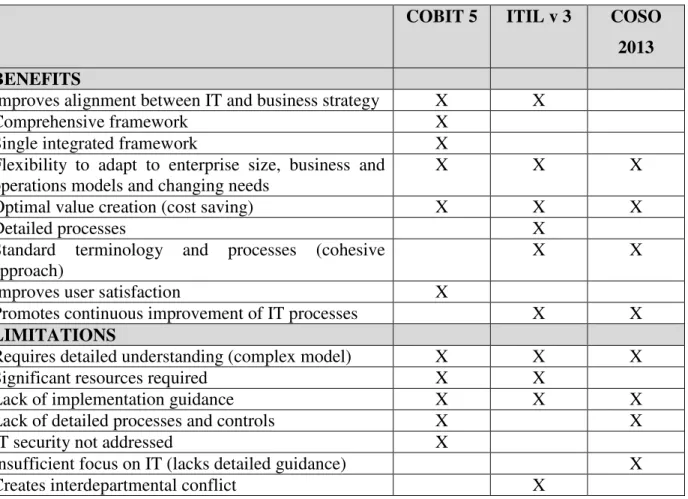
computing risks. Table 1 summarises the benefits and limitations of the COBIT, ITIL and COSO control frameworks.
Table 1: The benefits and limitations of COBIT, ITIL and COSO
COBIT 5 ITIL v 3 COSO 2013 BENEFITS
Improves alignment between IT and business strategy X X
Comprehensive framework X
Single integrated framework X
Flexibility to adapt to enterprise size, business and operations models and changing needs
X X X
Optimal value creation (cost saving) X X X
Detailed processes X
Standard terminology and processes (cohesive approach)
X X
Improves user satisfaction X
Promotes continuous improvement of IT processes X X
LIMITATIONS
Requires detailed understanding (complex model) X X X
Significant resources required X X
Lack of implementation guidance X X X
Lack of detailed processes and controls X X
IT security not addressed X
Insufficient focus on IT (lacks detailed guidance) X
Creates interdepartmental conflict X
(Bartens et al., 2015; Crespo, 2015; Sahd, 2015; Rubino et al., 2014; Anisingaraju, 2013; Zhang & Le Fever, 2013; ITIL, 2012; ISACA, 2012a; Kneller, 2010; Küller et al., 2010; McNally, 2012; Fry, 2005)
COBIT 5 was chosen as the most suitable framework, given that COBIT 5 is a comprehensive framework which seamlessly integrates IT governance into enterprise governance. The framework covers IT functions and processes, as well as other business functions and processes affected by IT. COSO was not selected due to insufficient focus on IT, and ITIL because it only focused on IT service management.
3.6 Summary and conclusion
The second section of the literature review established the definition, capabilities and application of cognitive computing. The knowledge obtained in this section will form the foundation for the identification, classification and definition of the core components of the
25
cognitive computing system in Chapter 4. The third and fourth sections of the literature review provided an understanding of corporate governance, IT governance, data protection and the implementation of control frameworks to achieve effective IT governance, identify significant risks pertaining to the implementation of a cognitive computing system, as well as mitigating control techniques. Three control frameworks were reviewed and COBIT was selected as the most suitable control framework. COBIT and its detailed processes form the foundation for the identification of significant risks pertaining to the implementation of the cognitive computing system in Chapter 5, as well as the formulation of mitigating control techniques to address the significant risks in Chapter 6.
26
CHAPTER 4: CORE COMPONENTS OF A COGNITIVE COMPUTING SYSTEM The COBIT 5 framework was selected as the most appropriate framework to identify significant risks pertaining to the deployment of a cognitive computing system. In order to utilise the framework effectively, the core components of cognitive computing system need to be identified, defined and classified. Based on studies performed by Bowles et al. (2015), Digital Reasoning (2015) and Kelly III & Hamm (2013), the core components of a cognitive computing system were identified. The core components were further classified into specific phases based on their functions within the cognitive computing system. The core components per phase are the following:
• Data ingestion: Unstructured data, semi-structured data and structured data.
• Read: Metadata, feature extraction, natural language processing (NLP) and deep
learning.
• Resolve: Corpus and advances analytics.
• Reason: Hypothesis generation and scoring, and machine learning.
The four phases in the cognitive computing system are supported by:
• Infrastructure: Storage, processing and management. • Enabling technologies: Hadoop, Cloud and Big Data.
Unstructured, semi-structured and structured data from various internal and external data sources are “ingested” into the cognitive computing system. The “Read” phase provides access to the ingested data and metadata (data regarding the origin, structure and meaning of data). In this phase Natural Language Processing (NLP) and Deep Learning are utilised to extract data elements and meaning from the ingested data and metadata in order to prepare the data and produce machine-readable data for the “Resolve” phase. In the “Resolve” phase, data from the “Read” phase is assembled, organised, and analysed in the corpus of the cognitive computing system to create a knowledge base. From the body of knowledge, hypotheses are generated and scored to uncover relationships in order to resolve problems. This is known as the “Reason” phase. The machine learning allows the cognitive computing system to continuously learn from the ingested data as well as hypotheses’ results in order to become a more effective system. These four phases are supported by an IT infrastructure and enabled by other technologies, which is also recognised as components of the cognitive computing system. Figure 2 illustrates how the core components and phases fit together in the cognitive computing system. The figure shows a further virtualisation and application phase, however these phases fall outside the