Procedia Computer Science 98 ( 2016 ) 290 – 297
1877-0509 © 2016 The Authors. Published by Elsevier B.V. This is an open access article under the CC BY-NC-ND license (http://creativecommons.org/licenses/by-nc-nd/4.0/).
Peer-review under responsibility of the Program Chairs doi: 10.1016/j.procs.2016.09.045
ScienceDirect
The 6th International Conference on Current and Future Trends of Information and
Communication Technologies in Healthcare (ICTH 2016)
Improving the Utilization of AAL Devices through Semantic Web
Technologies and Web of Things Concepts
Nicole Merkle
a,∗, Stefan Zander
aaFZI Forschungszentrum Informatik am KIT, Haid-und-Neu-Str. 10-14, Karlsruhe 76131, Germany
Abstract
The software-driven assistance of elderly and impaired people in their every day life requires the integration of heterogeneous devices and assistive services. The lack of interoperability hampers the integration and usage of these devices and services. Furthermore, one objective in the field of Ambient Intelligence and Human Machine Interaction is the adaption of assistive services to the user5. This is deeply rooted in the idea that the usage of ambient technologies still means a barrier for elderly and impaired
people and prevents them to trust and use these technologies. But as these technologies aim at supporting and not restricting elderly and impaired people, a methodology is needed to overcome the barrier of using ambient assistive technologies. In this paper, we present an approach to a) enable a simplified integration of heterogeneous devices and services by the Web of Things recommendation and b) a lightweight AAL ontology together with a rule-based engine calledSherlockin order to demonstrate the advantages in representing and linking user intentions to device capabilities using Semantic Web technologies. Moreover, we show how this semantic representation in the context-aware Sherlock engine is used to derive user intentions by recognising device events. The practical applicability of the presented approach is demonstrated in a real-world use case from the AICASys project1.
c
2016 The Authors. Published by Elsevier B.V.
Peer-review under responsibility of the Conference Program Chairs.
Keywords: Context awareness; Ambient Intelligence; ICT; Semantic Web; Knowledge Representation; Service-oriented Architectures
1. Introduction
It’s in the nature of things, that impairments and disabilities increase as people become older. In order to support these people in their daily life, we need technologies, individually tailored to the appropriate user and his/her impair-ments. This is required, as the lack of cognitive and motoric skills of impaired people hampers the utilisation of new and complex technologies. For this reason, it becomes still a barrier for elderly to handle these unfamiliar technolo-gies. So adaptivity, interoperability as well as personalization is required. In this paper, we outline how Semantic Web technologies and rule-based reasoning allow for building adaptive Ambient Assisted Living (AAL) systems and services that support elderly in controlling ubiquitous devices through the recognition of user intentions. In order
1See: http://www.mtidw.de/ueberblick-bekanntmachungen/ALS/aicasys
∗Corresponding author. Tel.:+49-721-9654-896 ; fax:+49-721-9654-897.
E-mail address:[email protected]
© 2016 The Authors. Published by Elsevier B.V. This is an open access article under the CC BY-NC-ND license (http://creativecommons.org/licenses/by-nc-nd/4.0/).
to provide adaptive helpful services, we presented and discussed in two workshops possible use case scenarios and interviewed people of the target group and their caregivers. The target group consisted of impaired people who are sitting in a wheelchair. The survey’s essential outcome was, that the most target users want easy configurable and suitable devices and services in order to compensate their impairments and overcome daily obstacles in controlling devices in the environment. The users want basically feel independent from the provided technologies despite their impairments. Furthermore, adaptivity and unobtrusiveness played for them an important role9. We derived by this
survey together with the target users, practicable services for assisting people in their every day life and we address this in our approach. To accomplish the determined objectives, some prerequisites have to be complied with, e.g., a semantic model of the users’ surroundings that facilitate the controlling of devices needs to be created. We show, how user intentions can be represented semantically in order to facilitate their recognition via rule-based reasoning. Fur-thermore, we present how appropriate actions can be derived via reasoning on the formal, model-theoretic semantics of the ontology language, used for the representation of user intentions and actions. Moreover, we demonstrate how actions can be semantically linked to intentions in order to react to the users’ intentions in an adequate way.Adequate means in this context that the objective to control a device can be detected and the designed actions are executed in order to achieve the objective of the user. For this reason, we provide means that help system designers to model and process relevant situational aspects. Such situations comprise, for instance, user activities, sensed environmental data, and further input which has to be specified and represented in a consistent and machine processable format.
Furthermore, adaptive AAL environments require an engine, which can semantically process sensed environmental data in order to detect the user’s context (events in the surroundings) and reason on subsequent actions. For this reason, we developed a set of formal AAL domain semantics and implemented a context-aware, rule-based engine calledSherlock. Sherlock uses a semantic representation of the environment and its services as relevant specified objects to deduce possible and predefined user intentions. A userintentionis defined in this paper as an objective of the user to cause a state change in his/her surroundings by triggering actions in order to control integrated devices. By elaborating on the devised formal, model-theoretic semantics and the Sherlock engine, this paper provides the following contributions:
1. It shows how an Internet of Things (IoT) approach can be combined with semantic technologies in order to facilitate a) the integration of IoT devices into AAL environments and b) how such devices can be linked with context-aware AAL services.
2. A concrete AAL use case demonstrates how such semantic information can be used in a light controlling scenario (that serves as use case of the presented approach) where the Sherlock reasoning engine is able to deduce appropriate actions from such descriptions.
The remainder of this work is structured as follows. Section 2 presents state of the art approaches and compares our approach with these approaches. The engine comprises different components and uses a semantical representation of the AAL application domain. In Section 3, we illustrate these components, their requirements and the concrete application of the Sherlock engine and its functions. Moreover, we present a semantic representation which is the foundation of reasoning the user intention and its subsequent actions. In Section 4, we evaluate the Sherlock engine and its underlying semantic representation. Section 5 ends with a conclusion about the presented approach and gives an outlook to future work regarding the improvement of the Sherlock engine.
2. Related Work
In the field of AmI, there are several attempts (e.g.11,7,4,12) to model and integrate devices and service as well as to recognise user activities and situations. We provide here an excerpt of some related work, we considered for our work. For instance, the work of1 presents an approach for modelling and detecting anomalous and dangerous situations in order to safe patients with cognitive diseases. The approach in1uses the siutation-awareness paradigm for defining correctness properties. Hence, Coronato et. al. model the properties and entities of the environment by means of axioms. The problem in this approach is, that the description of axioms can become very complex according to the situations and activities which have to be expressed. Moreover, the used formal language is not very intuitive as the modelling by a formal, model-theoretic semantic. In contrast, our approach provides a formal, model-theoretic
Fig. 1: T-Box representation of the devised ontology and its relations
semantic which can be easily implemented by means of Semantic MediaWiki (SMW). So the user does not require expertise in formal description languages for modelling and integrating devices and services.
The work of Klein et. al. is similar to our approach and provides a lightweight ontology for integrating device and services and describing the user context by state instances. Our apporach differs according the integration of devices and services, as we use the WoT recommendation for this task. The WoT approach enables the re-use and extensibility of the environment as well as the on-the-fly integration of IoT devices and services. Moreover, we provide a service description which is considering user intentions and linking these intentions to appropriate actions in order to deduce the users goals and needs.
Wojciechowski et. al. present in3a layered context model for AAL in order to support inhabitants with no context
modelling expertise to get and give feedback on context by a simplified context description. The objective in their work is to provide a natural interaction between the system and the inhabitant. However, interoperability and re-use aspects are not considered in their approach. Furthermore, it becomes not clear in their paper, how they implement their approach (e.g. which formal language they are using and how in the interaction, the user configuration need is deduced). To close some gaps of previous works, our approach provides an easy way to program adaptive engines in order to achieve user adequate services and to integrate devices. In this way, we enable elderly people to live—despite complex technologies — a self-determined life.
3. Approach
The approach of this paper provides a lightweight semantic representation2expressed in RDF(S) and SWRL rules
for enabling the Sherlock engine to deduce user intentions by sensed enivronmental observations8. Figure 1 depicts
an excerpt of the baseline model, which extends and references existing ontologies (e.g. DUL, SSN, FOAF). We choose RDF(S) and SWRL as formal languages because they are a common standard and widely used in knowledge representation. Moreover, a lot of APIs are available for processing RDF(S) and SWRL. An additional reason is, that we use SMW to describe semantically relevant elements of the environment. According to our observations and experiences in the AAL domain, we have detected the following elements of relevance8:
1. Service—e.g. LightService, EmergencyService 2. Intention—eg SwitchLigthOn, DimmLightIntention
3. Action—e.g. SwitchLightOn/Off; CallRelative, CallEmergency
4. Event—e.g. ETGHasInFocusLamp; PersonEntersRoom+Information describing the triggering of an Event 5. Devices—e.g. Eye Tracking Glass (ETG), Door/Window contact, Motion sensor, Actuators for Switching
Lights, Smoke detector, etc.
In the subsections below, we explain briefly how the Web of Things (WoT) is used in order to create and integrate new elements6. Furthermore, we discuss the structure of the mentioned elements of relevance and how the Sherlock engine uses these elements in oder to deduce the user intention.
3.1. The Service Description
The Sherlock engine requests in a first step service descriptions from the SPARQL endpoint. These service de-scriptions are parsed by the OWL-API parsers in order to get the linked elements of a service description. A service description is linked by object properties to certain intentions and capabilities. The reason for linking capabilities to service descriptions is to express that every service aims at changing environmental states by requiring certain capabilities which are provided generally by devices. Hence, the Sherlock engine needs to map searched service capabilities to device capabilities to get information about the environmental device states and to execute actions in order to achieve state changes in the surroundings. Moreover, the linked intentions provide linked rules which are evaluated by the Sherlock engine to decide in which situations a service and its capabilities are required.
3.2. The Intention Description
An intention is linked to at least one or several rules and appropriate actions. The user intention contains addi-tionally a Context Query element, which allows the Sherlock engine to request relevant context information from the triple store. In this request the Sherlock engine requests the room of a lamp device and additional room-integrated sensors with their provided capabilities. The Sherlock engine compares the service capabilities with the received device capabilities in order to choose the relevant device ids of the response. Then, the Sherlock engine requests by the device ids the current device states from the WoT server via a Websocket connection and pre-defined JSON-LD messages (see section 3), to include their states into the reasoning process. This is necessary to deduce the conditions under which an observation occurs.
3.3. The Rule description
A Rule element references SWRL rule strings. The system designer creates the SWRL rules according to the conditions in which the Sherlock engine has to serve for an appropriate use case. This is required as an initial step, because these rules provide an initial configuration and logic of the provided services. During its runtime, the Sherlock engine collects data and learns from these data in order to adjust its behaviour to the user. The goal is to improve the assistance of the Sherlock engine by gaining experience. A rule can be considered as a base hypothesis which adjusts its weights according to the given observations. The general SWRL rule structure is defined as follows:
Device(?device)hasState(?device, ?state)Capability(?capability)hasCapability(?device, ?capability)
→hasIntention(?user, intention) 3.4. The Action Description
The action description consists of reifying statements to provide a meta description about an action. Action state-ments are related to appropriate device commands which control devices by the WoT framework. A label property provides a short description about what the action intends to do. This is necessary for the Sherlock engine in order to inform the user via different user interfaces about its next action. The user gets in this way the possibility to confirm or decline the deduced action of Sherlock.
An action can link subsequent actions, which have to be invoked after the current one was executed. This allows the Sherlock engine to act in an ordered manner. In this way an ordered sequence of actions can be invoked to allow complex control procedure.
3.5. The Event Description
An event is related to arbitrary devices which trigger the event. Equivalent to action descriptions, an event provides also reifying statements for describing the event. Moreover, the event provides a timestamp which shows the occurence time of the event. The Sherlock engine registers itself to the WoT server for every device event which are linked in every single device (see section 3.7). An event causes that the Sherlock engine requests further context information and infers the user intention. So every event received from the WoT server, leads to a reasoning process in the Sherlock engine.
3.6. The Device description
A device is the producer of events and actions. It is related to one or several events and invokes one or several actions. By linking events and actions to devices, we express that every event is related to subsequent actions. Fur-thermore, a device description has properties which describe the device characteristics. A property is constituted by a name, a value and the type of the value. Properties are used by the Sherlock engine in order to know, which statements can be invoked on the device and which kind of values are allowed as literal or object in a property. By the properties the Sherlock engine can infer similar device characteristics. Every device has at least one capability. This makes sense, because as introduced before, the capability or functionality of a device is requested by the Sherlock engine in order to allow a mapping of searched and provided functionalities. To map actions and capabilities, every capability is linked to one or several actions. For monitoring purposes, it is mostly necessary to know the location of a device. Hence, a device description is linked to a location. Furthermore, a location can integrate additional devices which are also relevant for the Sherlock engine. So by linking devices to locations, we achieve the local relation of devices to each other.
3.7. The Reasonging Process
We have seen in the last subsections, the composition of our proposed ontology. Now, we present how the Sherlock engine reasons by means of this ontology the appropriate intention and its subsequent actions.
The Sherlock engine steadily requests and receives via a Websocket connection sensed data by a WoT server, which is transforming device specific data into a general semantic representation by means of a JSON-LD protocol. Every device can be integrated by providing a device description which contains the mentioned elements (actions, events, properties, deviceID, etc.)10. In a first step, the Sherlock engine requests all device IDs of the environment. The
WoT sends as response the appropriate device IDs, which the Sherlock engine stores locally in a datastructure. In a second step the Sherlock engine subscribes at the WoT server for events of the appropriate devices, because the WoT server provides a publisher/subscriber communication mechanism. If a device event occurs, the Sherlock engine gets informed by the WoT server with the appropriate event message and requests in a subsequent step from the triplestore the available service descriptions. Hence, the Sherlock engine extracts the appropriate context SPARQL query which is linked in the intention instance. The extracted query is sent to the SPARQL enpoint. Sherlock uses the response of the endpoint to request by the gotten device IDs the current device states. Afterwards, the A-Box representation is modified by adding new axioms to it. In a subsequent step, Sherlock gets by parsing the service description and its linked intention the appropriate SWRL rules. The SWRL-API in the Sherlock engine reasons by the retrieved SWRL rules and the OWL API the linked service intention. If there is no result, it is assumed that the intention is not met and Sherlock does nothing. Otherwise, if an intention is deduced, the Sherlock engine sends anUserConfirmationAction to the WoT server. The WoT server sends this action to all devices which are supporting in their capabilities this action. For instance, the UserConfirmationAction provides to the user the result of Sherlocks conclusion and asks the user to confirm the result by speech or by pressing a button at the appropriate device display. If the intention is confirmed at the display, the dispay is sending a confirmation event to the WoT server. The Sherlock engine is subscribed for this display device and its linked events, so the Sherlock engine gets informed by the WoT server. In a subsequent step, the Sherlock engine stores the reasoning result—which consists of the device states, the reasoned intention as well as the user cofirmation—in a local database to learn and improve its reasoning ability. Furthermore, Sherlock sends the subsequent actions—linked in the intention—to the WoT server. The WoT server transforms the actions to device commands and forwards these comands by REST requests to the appropriate devices in order to cause state changes.
4. Use Case
The general applicability of the presented approach is demonstrated by means of a concrete scenario from the AICASys3project. In the scenario, the Sherlock engine enables the user to control lamp devices by his/her gaze
{"@context" : "https://koralle27.fzi.de/aicasys/RemoteMessage.jsonld", "@type" : "https://koralle27.fzi.de/aicasys/RemoteMessage", "method" : "getDevice", "paramType" : "Device", "sender" : "Sherlock", "timestamp" : "2016-04-28T17:18:45:000"}
Fig. 2: Requesting all devices from the WoT server.
"sender": "Sherlock", "method": "subscribeForDevices", "timestamp": "2016-04-28T17:29:50.790", "deviceId": [ "Lamp1", "AmbientLightSensor1", "ETG-2BGG"]
Fig. 3: Subscribing for device states at the WoT server.
patterns and by context information. We demonstrate the feasibility and reliability of our approach. The topology of our evaluation looks as follows. We use an ETG which is worn by the user. The ETG has an application running, which is sending statements about recognized objects in the environment. The ETG just sends these statements, if the user has looked for an appropriate time to a labeled object with a QR marker. Lamp1 is placed into a radio controlled plug socket. At Lamp1, we have attached a QR marker. This QR marker encodes the ID of the lamp device, which is also referenced in the SWM at its description page. To recognize the ambient brightness, we use the AmbientLightSensor1, which is also described by a SWM page. The AmbientLightSensor1 provides the brightness of the environment as floating point values with the unit LUX. We start first the WoT server and then the Sherlock engine, which are both running on two different computer platforms. The Sherlock engine requests all devices by the message in Figure 2.
The WoT server sends a response back. The response message contains the IDs of Lamp1, AmbientLightSensor1 and the ETG-2BGG. The Sherlock engine uses these three device IDs to subscribe for their events at the WoT server. This is exemplarily depicted in Figure 3.
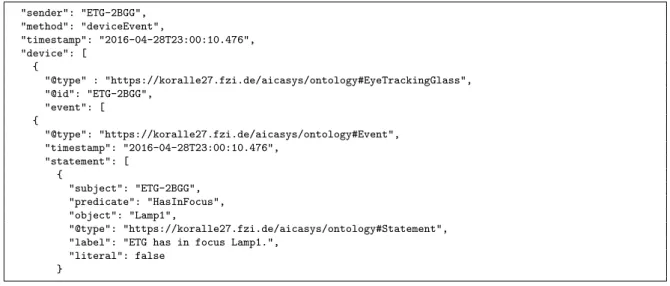
When the user looks through the ETG to the QR marker of Lamp1, the WoT server sends the device event message represented in Figure 4.
The Sherlock engine requests afterwards by a CONSTRUCT query the A-Box statements from the SMW related SPARQL endpoint. In the next step Sherlock extracts the LightService description by accessing the A-Box represen-tation via the OWL-API. Sherlock sends the in the LightService referenced context query (see Figure 5) to the triple store.
The response to this query contains as result the Lamp1 and the AmbientLightSensor1 which are related to each other by their location (?room). The Sherlock engine requests afterwards the states of the both devices by their IDs from the WoT server as depicted in Figure 6.
The response contains the current state of Lamp1 and AmbientLightSensor1. The message states, Lamp1 is offand the AmbientLightSensor1 has a sensed value of 500 LUX. The Sherlock engine modifies with this state information the current A-Box representation and extracts from the LightService description the referenced SWRL rule, which looks as depicted below.
Action(SwitchLightOn)AmbientLightSensor(?ambie)AssistedPerson(?u)EyeTrackingGlass(?e) In-tention(SwitchLightOnIntention)Lamp(?l)HasFunctionality(?l, SwitchLightOn)
HasAction(SwitchLightOnIntention, SwitchLightOn)HasInFocus(?e, ?l)HasState(?ambie, ?ambientState)
HasState(?l, OFF)
swrlb:greaterThan(?ambientState , 450)
"sender": "ETG-2BGG", "method": "deviceEvent", "timestamp": "2016-04-28T23:00:10.476", "device": [ { "@type" : "https://koralle27.fzi.de/aicasys/ontology#EyeTrackingGlass", "@id": "ETG-2BGG", "event": [ { "@type": "https://koralle27.fzi.de/aicasys/ontology#Event", "timestamp": "2016-04-28T23:00:10.476", "statement": [ { "subject": "ETG-2BGG", "predicate": "HasInFocus", "object": "Lamp1", "@type": "https://koralle27.fzi.de/aicasys/ontology#Statement", "label": "ETG has in focus Lamp1.",
"literal": false }
Fig. 4: ETG device event. Lamp1 was recognized by the ETG.
select?inventory ?sensor where {
?inventory wiki:Attribut-3AIsInRoom ?room. ?inventory rdf:type wiki:Kategorie-3ALamp. ?room wiki:Attribut-3AHasInventory ?inventory. ?room wiki:Attribut-3AHasSensor ?sensor.
?sensor rdf:type wiki:Kategorie-3AAmbientLightSensor}
Fig. 5: SPARQL Select query for getting context information.
"sender": "Sherlock", "method": "getDeviceStates", "timestamp": "2016-04-28T17:29:50.790", "deviceId": [ "Lamp1", "AmbientLightSensor1"]
Fig. 6: Requesting device states from the WoT server.
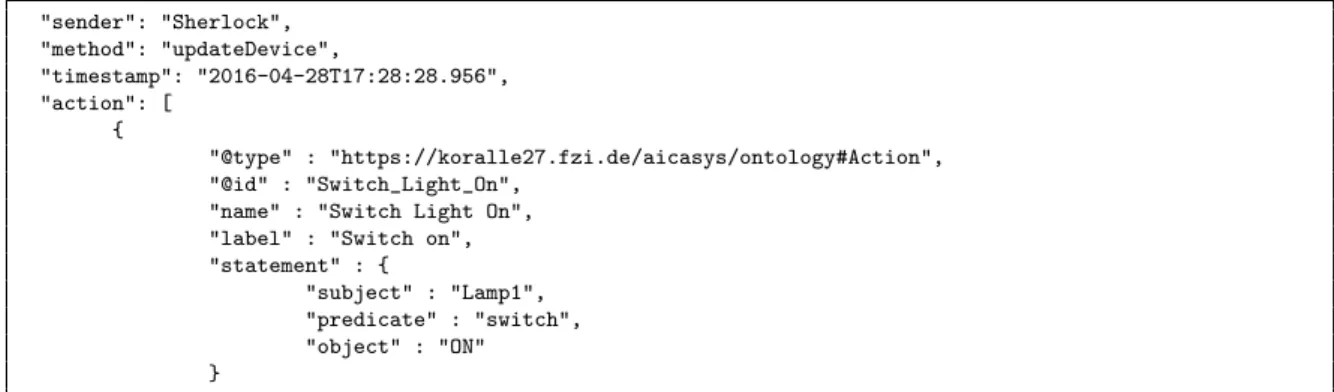
The Sherlock engine infers by this rule that the user has the intention to switch the Lamp1 on, because the state of Lamp1 is offand the value of the AmbientLightSensor1 is greater than 450 LUX. So the premise to turn Lamp1 on, is achieved. The Sherlock engine sends the linked action message to turn the Lamp1 on, as depicted in Figure 7. The WoT server transforms the action to the device specific REST request and Lamp1 is switched on.
The process from recognising Lamp1 to turning it on, took 3000 milliseconds. Regarding this result, the lamp device was controlled user intention driven in a reasonable timespan with the correct reasoned user intention, as the intention was specified before the evaluation run through. As result we can conclude, that the presented approach is feasible regarding the presented scenario. In a next step, it is necessary to extend the evaluation to other scenarios, in order to cover the determined user requirements and to prove the extendibility and reusability of the given approach.
5. Conclusion and Future Work
This paper has presented an easy to use methodology to integrate heterogeneous devices by means of the WoT recommendation. Moreover, we showed how elements of the ambient intelligent environment can be linked together in
"sender": "Sherlock", "method": "updateDevice", "timestamp": "2016-04-28T17:28:28.956", "action": [ { "@type" : "https://koralle27.fzi.de/aicasys/ontology#Action", "@id" : "Switch_Light_On",
"name" : "Switch Light On", "label" : "Switch on", "statement" : {
"subject" : "Lamp1", "predicate" : "switch", "object" : "ON" }
Fig. 7: Sending an action to turn Lamp1 on.
order to allow the Sherlock engine to deduce service linked intentions. The description of devices and services as well as the WoT approach allows the Sherlock engine to be independent from certain device characterstics. The provided capability descriptions are sufficient in order to apply a suitable device according to the occured device events and service intentions. An objective of future work is to extend the functionality of the Sherlock engine in order to enable the engine to deduce also in uncertain situations user intentions. One objective in ambient intelligent environments is to be unobtrusive. An idea to avoid frequent user interventions, is to use unsupervised learning methods, e.g. K-Means for clustering sensor states and executed actions. But this diverts the problem, because the user has to act for a while in order to train the Sherlock engine. The target users are impaired people. These impairments and their evolution require also to be considered by the Sherlock engine, because the appropriate impairments need to be compensated by subsequent actions. Hence, an improvement of the Sherlock engine would be to consider and adjust user profiles by monitoring the user’ health status in order to address user characteristics in the reasoning process.
References
1. Coronato A. et. al.A Safe Kitchen for Cognitive Impaired People. Costa Rica; 2013.
2. Klein M. et. al.Ontology-Centered Design of an Ambient Middleware for Assisted Living: The Case of SOPRANO. Germany, 2007. 3. Wojciechowski M. et. al.A User Interface Level Context Model for Ambient Assisted Living. Berlin-Heidelberg; 2008.
4. Bacciu D. et. al.Smart Environments and Context-Awareness for Lifestyle Management in a Healthy Active Ageing Framework. 2015, Portugal. 5. Grguric A.ICT towards elderly independent living. Croatia, 2012.
6. Guinard D.A Web of Things Application Architecture – Integrating the Real World into the Web. Switzerland, 2011. 7. Hristova A. et. al.Context-aware services for ambient assisted living: A case-study. Spain, 2008.
8. Merkle N., Zander S. (n.d)Representing and Reasoning over User Intentions and Actions in Adaptive Ambient Assisted Living. Germany, (i), 1124.
9. Merkle N. et. al. (n.d)Anforderungen an die AICASys-Plattform aus einer Analyse der Ethischen Juristischen und Sozialen Implikationen der Anwendungsflle. 2016, Germany.
10. Raggett D.The Web of Things: Challenges and Opportunities. May 2015.
11. Stavropoulos T. et.al.The DemaWare Service-Oriented Platform for AAL of Patients with Dementia, 2014, Czech Republic. 12. Stelios A. et. al.Dem@Home: Ambient Intelligence for Clinical Support of People Living with Dementia, May 2016, Greece.